Platner Should Drop Out of Maine’s US Senate Race after Sexual Assault Allegation, Sanders Says

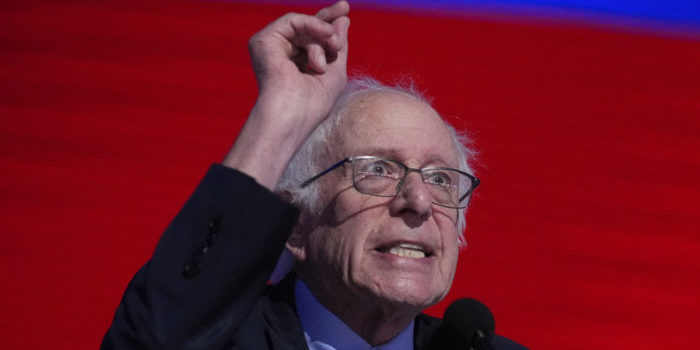
(Headline USA) Sen. Bernie Sanders on Tuesday became the latest and most notable lawmaker to pull support for Maine Democratic U.S. Senate nominee Graham Platner following an allegation of sexual assault, adding to a chorus of calls for him to step aside as party leaders scramble to determine the next steps.

Sanders, a Vermont independent who caucuses with Democrats, has long backed Platner in the high-stakes race against Republican Sen. Susan Collins, but he said in a statement that he spoke with the candidate and “in light of these very serious allegations, I have recommended that he step aside.”

Platner, who denies the allegation, has not heeded the calls to resign. Instead, he posted a video on Monday saying he was considering the next steps for his campaign while canceling town hall events.

Platner posted the video after reports that a woman who previously dated the first-time candidate said he drunkenly forced her to have sex after she told him to stop.

The allegation is the latest in a string of controversies Platner has faced and so far weathered since the oyster farmer and Marine veteran entered the race. But the seriousness of the assault claim has put the Maine contest — and Democrats’ ability to win control of the Senate — at risk, with even some of his strongest supporters questioning whether Platner should continue his campaign.

If Platner steps down, a possible succession battle would inflame a Democratic divide as the party seeks unity ahead of the November midterms.

Platner became a populist hero among the party’s left flank, pulling far ahead of an establishment-backed candidate, Gov. Janet Mills, in the primary. Now, if he quits the contest, progressive groups are demanding that the state’s Democratic Party choose a similarly shake-up-the-system candidate to replace him.

“To the Democratic establishment: This is not your opening,” said Joseph Geevarghese, who leads an organization founded by Sanders, Our Revolution.

Joanie Monteith, a passionate supporter from the southern Maine town of York who organized a trivia night about Platner in March, said through tears Tuesday that she was devastated by the news. She was waiting for another public statement from Platner before making a decision about whether she could keep supporting him.

“I’m numb, and I’m waiting for what Graham has to say,” she said. “I’m trying not to be a part of this public trial. And I’m heartbroken. And I’m heartbroken for him and his wife.”

She added that she believes the allegations are serious.

“I’m not going to blame a victim. Because if this is true I feel very bad for the woman,” she said.

Jenny Racicot, who lives in Maine, told Politico that Platner entered her home in 2021 while drunk and assaulted her. Racicot said she had been in an on-and-off relationship with Platner, but she cut off contact with him after that night and told him the incident wasn’t consensual. She said in a CNN interview on Monday evening that she opted not to fight back for fear of Platner, a former Marine, becoming more violent.

Another Maine voter, Lee Holman, said she wants Platner to stay in the race.

“I feel like the people of Maine have spoken,” the Democrat said. “If they wanted Janet Mills, they could have voted for her.”

She said the allegation against Platner may be legitimate, but she questions the timing. Democrats, she added, can be too quick to “throw the baby out with the bathwater” by calling on politicians facing allegations to resign.

“Every time we think we have a chance to snatch our democracy back, something gets in the way,” she said.

The pressure for Platner to withdraw from the Senate race has only increased given the short deadlines Maine law allows for replacing general election candidates.

There is no mechanism for Democrats to remove Platner from the ballot, meaning Platner must first opt to drop out of the general election before a replacement can be selected. The deadline to withdraw is 5 p.m. on July 13.

Just who should replace Platner if he drops out appeared to be further splintering Democrats. Some argued the next Democrat should echo Platner’s progressive messaging, pointing to his success at rallying voters across the state. Others cautioned that having ties to Platner will only doom an already uphill campaign against Collins.

Joe Baldacci, a Democratic state senator, said he’s concerned about what the latest allegations will do to the voter excitement over the past year.

“I think the major concern, even with a nominee, a new replacement, is that person is going to start very much behind the eight ball,” Baldacci added.

Mills, who sought the Democratic nomination but dropped out before the June 9 primary, could be considered as a nominee. Mills was supported by Democratic Senate leader Chuck Schumer but abandoned her campaign saying she couldn’t raise the money needed to compete.

Another possible replacement is Troy Jackson, Maine’s former state Senate President, who unsuccessfully ran to be the Democratic gubernatorial nominee earlier this year with the backing of Platner and Sanders.

While Jackson hasn’t publicly said he’d run for the Maine Senate seat, he did file paperwork Tuesday to launch a Senate exploratory committee with the Federal Election Committee. Separately, U.S. Rep. Ro Khanna threw out his name as someone who stands up for “progressive values” after the California Democrat withdrew his support for Platner.

Nirav Shah, the former director of Maine’s Center for Disease Control and Prevention, said Tuesday he was “evaluating” whether to join the race should Platner depart. Shah came in second in this year’s Maine Democratic gubernatorial primary, where he was considered more moderate compared with Jackson.

Jordan Wood, a former U.S. Senate candidate who then switched to unsuccessfully run for Maine’s 2nd District, posted Tuesday that he was “continuing conversations” with voters about joining the race.

Other names include Shenna Bellows, the current Maine Secretary of State; Dan Kleban, founder of Maine Beer Co.; Maine U.S. Rep. Jared Golden, who is not running for reelection; as well as Hannah Pingree, currently Maine’s Democratic gubernatorial nominee.

Adapted from reporting by the Associated Press.
Investigator Says Video Shows Defendant Going Onto Roof to Kill Charlie Kirk

(Headline USA) The man charged with killing Charlie Kirk strolled Utah Valley University in shorts and a T-shirt, bought a meal at Chick-fil-A and made contact with Kirk’s staff, before returning in different clothes to shoot the conservative activist from a rooftop, an investigator testified Tuesday.

Utah State Bureau of Investigation Agent David Hull described Tyler Robinson’s alleged movements before and after Kirk was killed as prosecutors played previously unseen campus surveillance videos in state court. The defendant first arrived on campus about four hours before Kirk was killed, Hull said.

Prosecutors say they intend to seek the death penalty in the case. They are trying to convince Judge Tony Graf that they have enough evidence to bring Robinson to trial on an aggravated murder charge.

Robinson has not yet entered a plea. His attorneys have not commented on his guilt or innocence. They have, however, sought to get the death penalty taken off the table, so far unsuccessfully.

In a video shown Tuesday, Robinson goes over a railing onto a rooftop, crouches down and runs to a site overlooking where Kirk was speaking, Hull testified. After the shooting, Robinson runs back across the roof, drops to the ground and flees on foot, Hull said.

Investigators later found the suspected murder weapon — a bolt-action rifle with one spent round — wrapped in a towel in some nearby woods. Later that night, a police offer again spotted Robinson in the campus area, Hull testified.

This week’s preliminary hearing marks the most significant presentation of evidence to date in the case. Authorities allege Robinson, 23, shot Kirk on Sept. 10 while the 31-year-old activist and ally of President Donald Trump was speaking to a crowd of thousands.

Defense attorney Kathryn Nester questioned Hull’s handling of the crime scene on the day of the shooting. She also asked about a bullet that was found on campus at a different location than the alleged shooting site.

Hull said that bullet was traced back to a law enforcement officer who had “cleared” his weapon, ejecting an unused bullet. He also said a handgun in a backpack was found at the scene.

Prosecutors contend the shooting endangered others at Kirk’s campus event — an aggravating circumstance that could make the crime punishable by death under Utah law. Robinson also faces possible sentence enhancements based on the prosecution’s claim that he targeted Kirk because of his political views.

Prosecutors allege Robinson confessed in a note left for his roommate, who was also his romantic partner, that read: “I had the opportunity to take out Charlie Kirk and I’m going to take it.” Robinson also sent a text saying he targeted Kirk because he “had enough of his hatred,” prosecutors have said.

Robinson’s defense team pushed back Tuesday on the idea that he was hostile to Kirk’s politics. Defense attorney Richard Novak sought to block prosecutors from introducing a statement describing the traditional Christian values of Turning Point USA, a group co-founded by Kirk that galvanized the conservative youth vote to help Trump win a second term.

“This doesn’t say anything about Mr. Robinson’s state of mind,” Novak said about the statement from Turning Point USA board member David Englehardt. “I don’t think that this court should be deciding— based on the record before it — where, if at all, politics and religion intersect.”

Judge Graf ruled that the statement was relevant and said it would be “provisionally admitted” with a final decision at a later date.

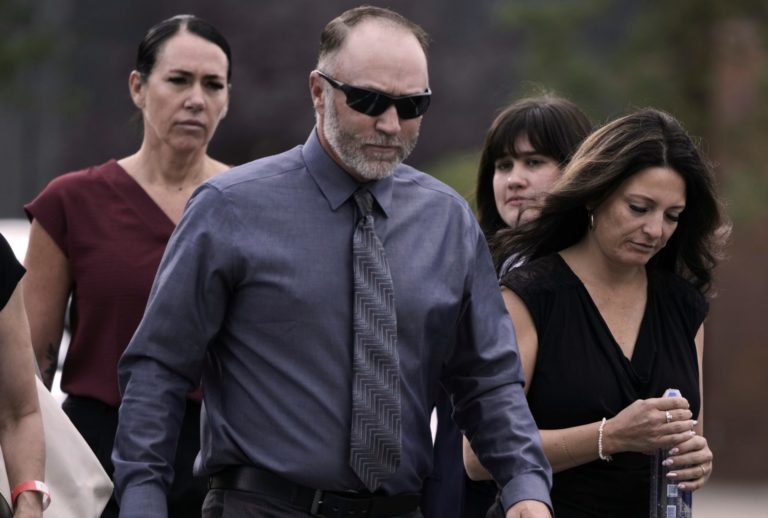
This week marks the first time Kirk’s parents, Kathryn and Robert, and widow, Erika, have been in the courtroom since the case began. The president’s son, Donald Trump Jr., and Robinson’s parents, Matt and Amber Robinson, also have been present.

The proceeding resembles a minitrial, but prosecutors need only demonstrate that there are reasonable grounds to believe Robinson killed Kirk and should stand trial. The standard is lower than for a trial, where prosecutors must prove guilt “beyond a reasonable doubt.”

Legal experts say that means prosecutors should have little trouble advancing their case.

Prosecutors also this week plan to present video from Sept. 11 when Robinson turned himself in to the Washington County Sheriff’s Office, recorded testimony from Robinson’s roommate, DNA linking Robinson to the suspected murder weapon and witness statements.

Utah County residents Denae Branch and Jean Rivera lined up outside the courthouse in Provo around midnight Tuesday and snagged one of the few seats available to the public for this week’s hearing.

The women said they were in the crowd when Kirk was shot and now think about it every day.

“It feels like a lot of the world just kept spinning and we’re still dealing with the trauma of it,” Branch said. “Our hearts and minds are still trying to process it and, yeah, it kind of helps being here.”

Rivera on Tuesday wore a shirt that read “FREEDOM” — just as Kirk did on the day he was shot. She said she hoped to hear testimony about Robinson’s alleged confession note.

Adapted from reporting by the Associated Press

US Launches New Strikes Against Iranian Targets

(Headline USA) The U.S. military launched a series of strikes against Iranian targets early Wednesday after three merchant ships were struck in the waters off Oman.

In a statement posted to social media, U.S. Central Command said American forces launched the strikes “to impose heavy costs for targeting and attacking commercial shipping crewed by innocent civilians in an international waterway.”

Iran’s demonstrated aggression was unwarranted, dangerous, and a clear violation of the ceasefire,” the statement said.

Three tankers were struck by projectiles Tuesday in the Strait of Hormuz, the British military said, and the United States revoked a license that had authorized the sale of Iranian oil as part of an interim deal to end the fighting between the U.S. and Iran.

The new assaults in the fuel-shipping waterway were the most in a single day since late April, according to the U.N. International Maritime Organization. The fresh attacks threatened to choke off the flow of traffic in the strait just as countries hoped to restore normal shipping practices and ease the global economic strain of the war.

Hours later, the U.S. revoked the 60-day license issued last month by the Treasury Department that waived sanctions on Iranian oil.

A U.S. official said the license was revoked because Iran’s actions in the strait were unacceptable and needed to be met with consequences. The official spoke with The Associated Press on the condition of anonymity to share insight into the reasoning behind the move.

The Iranian mission to the United Nations did not immediately respond to a request for comment.

One tanker was traveling off the coast of Oman when it was hit and caught fire, the United Kingdom Maritime Trade Operations center said. Iranian state television said the liquefied natural gas tanker came under attack after ignoring warnings but did not directly claim the assault.

The other two ships sustained some damage, but no one was injured, and both continued on their way, the U.K. maritime agency said.

Tehran, which has repeatedly declared that only its approved route through the strait is safe, is suspected of attacking other ships that have used another route close to the Omani shore.

Location details provided by the U.K. agency showed that all three attacks occurred off the coast of Oman or the neighboring United Arab Emirates, making it likely that the ships were using the route near Oman.

The U.S. is eager to press ahead with negotiations with Iran aimed at fully reopening the strait, rolling back Tehran’s disputed nuclear program and reaching a permanent end to the war launched Feb. 28. An interim deal has been strained.

Previous attacks in the strait have sparked retaliatory strikes by the U.S. Iran then attacked Gulf Arab states.

In peacetime, a fifth of all traded oil and natural gas passed through the channel.

The license issued by the U.S. authorized the production, delivery and sale of Iranian oil through Aug. 21. U.S. Vice President JD Vance said at the time that lengthy talks with senior Iranian officials in Switzerland created a “good foundation for a successful final deal” to end the war.

U.S. sanctions on the purchase of Iranian oil had been in place since the 1979 Iranian Revolution. After the U.S. and Israel launched the war, and after the closure of the strait, the U.S. had authorized the temporary sale of Iranian oil at least twice as an incentive toward a deal.

Meanwhile, talks between Iran and the U.S. appeared to be on hold until after the burial of Iran’s Supreme Leader Ayatollah Ali Khamenei, who was killed at the beginning of the war.

One tanker was carrying liquid natural gas south through the strait near Limah, Oman, when a projectile hit the left-side engine room and sparked a fire, the U.K. Maritime Trade Operations center said.

Majed Al-Ansari, a spokesperson for the Qatari Foreign Ministry, said the Qatari tanker Al Rekayyat was targeted in an “unacceptable attack” on international navigation and global energy security. He called it a “serious and explicit violation” of international law.

In a post on X, he said Qatar holds Iran “fully legally responsible.”

Later Tuesday, the U.K. maritime agency reported that an oil tanker was hit on its left side as it exited the strait near the Omani-Emirati border. A third tanker was struck by a drone off Oman, the agency said.

The Joint Maritime Information Center, a multinational body overseen by the U.S. Navy, told shippers Monday that the route around Oman “has been expanded and remains available for all traffic.”

Ships going to the north on the Iranian route must register with Tehran. Those going south work with Oman and the U.S.

Iran and the United States agreed as part of an interim deal to allow ships to pass without paying charges for 60 days. But Tehran insisted it must control the vessels’ routes and later charge fees for passage, which would upend decades of practice in the waterway.

The U.S. and many Gulf Arab states say they will not agree to Iran charging for passage through the strait.

The data firm Kpler reported that at least 108 ships crossed through the strait last weekend using various routes.

Authorities flew Khamenei’s body to the Shiite seminary city of Qom, where mourners honored him Tuesday.

Iranian state television aired live images of hundreds of thousands of people walking toward Jamkaran Mosque, just south of Qom, for the funeral service. Shiites believe the mosque once hosted Muhammad al-Mahdi, the 12th and last Shiite imam, who disappeared in the 9th century and is supposed to one day reappear to bring justice to the world.

Khamenei’s son, Iran’s new Supreme Leader Ayatollah Mojtaba Khamenei, has yet to make an appearance at the ceremonies, which began Saturday in Tehran. He is believed to be in hiding after reportedly being wounded in the airstrike that killed his father.

Khamenei’s body arrived late Tuesday in Najaf, Iraq, where it was received by senior officials from both countries. Processions are planned for Wednesday in Najaf and Karbala, the two holy cities of Iraqi Shiism. Iraq has a sizable Shiite population and is home to major Shiite religious sites and centers of learning.

Khamenei, who was 86, will then be returned to Iran to be buried Thursday at the Imam Reza shrine in Mashhad, his birthplace.

Adapted from reporting by the Associated Press

Trump Threatens To Destroy Iran’s Bridges and Energy Infrastructure If No Deal Reached

(Dave DeCamp, Antiwar.com) President Donald Trump on Monday renewed his threats against Iran, saying that if a deal isn’t reached, the US will “finish the job” and target Iran’s bridges and energy infrastructure.

“We can knock down their bridges in one hour, we can knock out their energy supply…. They don’t have any ​money now. ​We haven’t ⁠given them any money,” he added.

The president’s threats are in themselves a violation of the USIran Memorandum of Understanding, which states that the two sides agreed to “refrain from the threat or use of force against each other.”

Trump’s comments came as a massive number of Iranians filled the streets of Tehran to attend a procession that was part of the funeral for Iranian Supreme Leader Ali Khamenei, who was killed along with several family members by a US-Israeli attack on February 28, the first day of the bombing campaign.

Trump recently said that he gave Iran “the week off” for the funeral, which came after the US and Iran held indirect talks in Qatar on the implementation of the MoU, as the two sides remain far apart on several core issues, including the Israeli war in Lebanon, the situation in the Strait of Hormuz, and Iran’s frozen funds.

This article originally appeared at Antiwar.com.  

Trump Says He Will Lift Sanctions on Turkey and ‘Certainly Consider’ F-35 Sale

(Dave DeCamp, Antiwar.com) President Donald Trump said on Tuesday that the US will lift sanctions imposed on Turkey in 2020 and that he would “certainly consider” selling F-35 fighter jets to the country, as he met with Turkish President Recep Tayyip Erdogan at the opening of the NATO summit in Ankara.

“We’re going to be taking the sanctions off,” Trump told reporters alongside Erdogan. The US sanctioned Turkey during the first Trump administration under the 2017 Countering America’s Adversaries Through Sanctions Act over its purchase of Russian S-400 missile defense systems.

When asked about the F-35 sale, Trump said, “It’s a decision we’re going to make,” and went on to praise Turkey. “We have a better relationship with Turkey, and Turkey has been, in many ways, much more loyal than other countries that we think would be loyal, so, yeah, it’s something certainly we would consider,” he said.

While Trump has been critical of other NATO countries for not backing his war with Iran, he expressed appreciation to Turkey for not entering the conflict on the side of Iran, citing its hostile relationship with Israel. “They could’ve gotten into the fight. They’re a very powerful military nation. They didn’t do that, maybe they didn’t do that because of me, but they could’ve gotten into the fight on the other side,” he said.

The president’s praise for Turkey came after Israeli Prime Minister Benjamin Netanyahu said that he doesn’t want President Trump to sell F-35s to Ankara, as Israeli officials have identified Turkey as the next potential target in a future war.

“I don’t think they should be given F-35s or the engines for their fighter jets because that’ll upset the power balance in the Middle East, which is ultimately guaranteed by Israeli air superiority and also, I think, by America’s posture in the Middle East,” Netanyahu said in an appearance on “Fox & Friends.”

This article originally appeared at Antiwar.com.  

Despite Correction Gold Remains One of the Top-Performing Assets in the Last 12 Months

(Mike Maharrey, Money Metals News Service) Despite the steep correction and increased volatility, gold remains one of the best-performing assets over the last 12 months.

It feels like gold has tanked this year, but the yellow metal was only down about 7 percent through the first six months of 2026. The sharp price rally to kick off the year exacerbated the scope of the ensuing correction. Gold is down about 28 percent from its record highs.

Gold started the year with a bang, hitting 12 all-time highs and pushing above $5,000 an ounce in January. After a brief spike at the beginning of the U.S.-Iran conflict, gold has been generally range-bound between $4,000 and $4,500 an ounce.

Gold’s volatility spiked to over 50 percent early in the year. It has since moderated to around 30 percent; however, this is still far above the 20-year average of 17 percent.

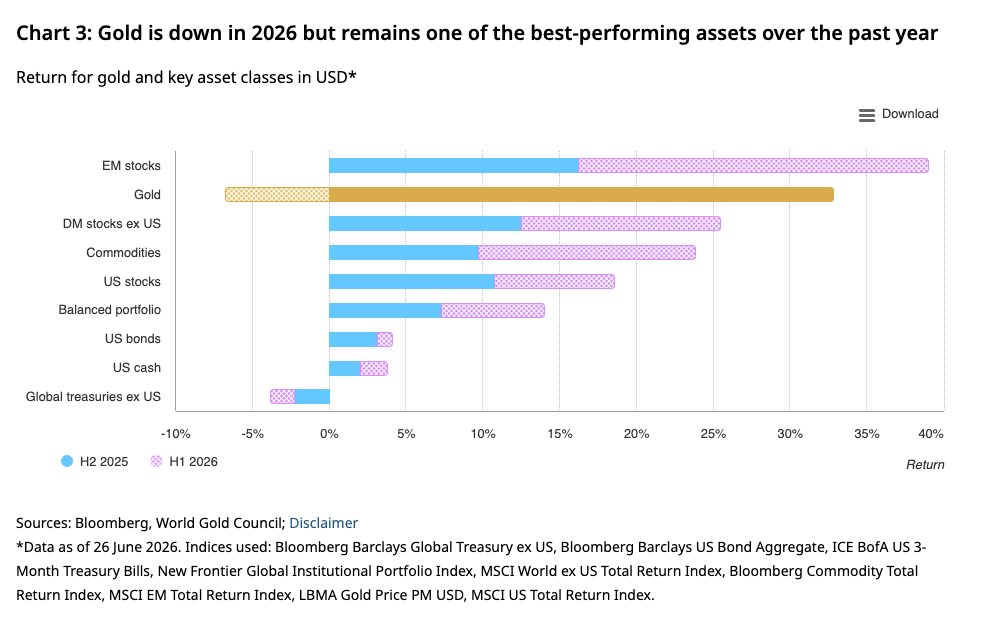
Even with the correction, gold has still outperformed most assets over the last 12 months with a gain of around 33 percent. Only emerging market stocks have done better than gold in the last year.

The selloff has led some pundits to declare the gold bull market is over, but it’s important to remember that corrections are normal and healthy during a bull market, and the dynamics that drove gold to record highs remain firmly in place.

However, in the short-run, gold continues to face headwinds due to expectations that the Federal Reserve will maintain a tighter monetary policy to combat price inflation. However, mainstream prognosticators seem to be ignoring the massive Debt Black Hole and the difficulty it creates. A debt-riddled bubble economy does not function in a higher interest rate environment.

World Gold Council analysts say they think the current gold price is in line with the current economic backdrop of “moderate growth, cooling but still elevated inflation, and expectations of further – but limited – central bank tightening.

“Under these conditions, gold will likely stay relatively rangebound (±5%).”

However, they say the “stage is set for a possible breakout.”

“On the upside, clear catalysts – a worsening economy or renewed geopolitical shock, a shift towards lower interest-rate expectations, or a wave of dip buying – could reignite gold’s momentum and lift it back towards US$4,500/oz or above. If the signals are strong, gold could push even higher. Conversely, an environment of resilient growth, rising yields, and calmer markets could see gold slip further – though a fall of more than 10 percent from current levels may be tempered by bargain-hunting demand. Meanwhile, enduring central bank demand and policy shifts in key markets like India are additional wildcards that could subtly influence gold’s path in the second half.”

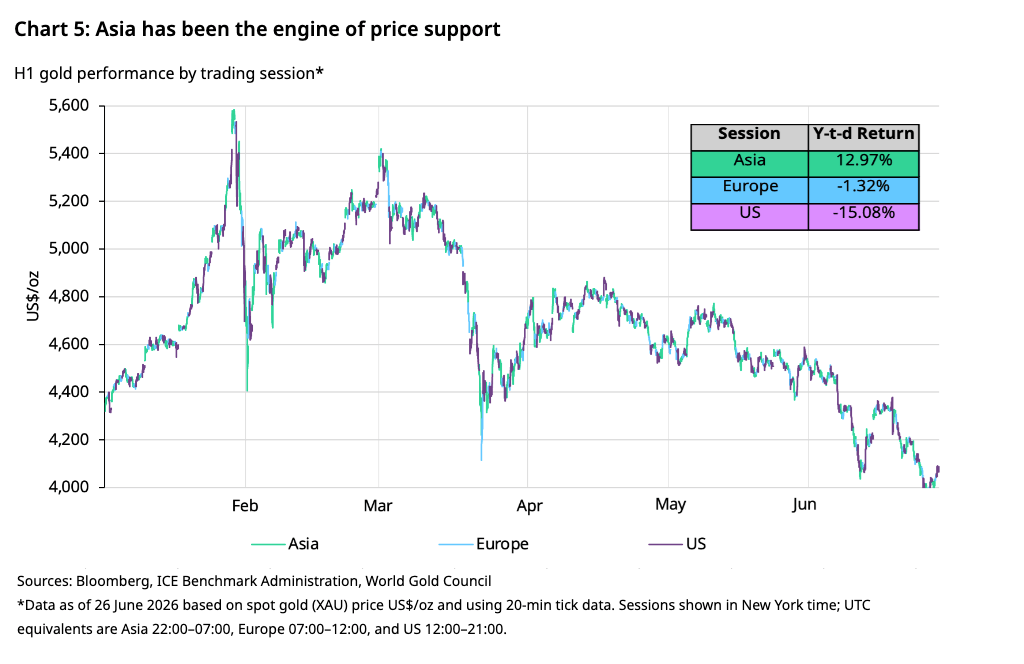
World Gold Council analysts picked up on an interesting trend through the first half of 2026. North American investors have driven the sell-off, with Asian investors taking advantage of price drops to add to their gold holdings. World Gold Council analysts call Asia “the engine of price support.”

“Interestingly, intraday analysis suggests that the bulk of gold’s movements have been linked to activity during Asian and U.S. trading hours. Many of the pullbacks occurred during US hours and, conversely, gold’s rebounds generally occurred during Asian hours.”

During Asian trading hours, gold was up 12.9 percent through the first six months of the year. During North American trading hours, the yellow metal was down 15 percent.


Mike Maharrey is a journalist and market analyst for Money Metals with over a decade of experience in precious metals. He holds a BS in accounting from the University of Kentucky and a BA in journalism from the University of South Florida.

De-Dollarization Alert: Central Banks Plan to Keep Swapping Dollars for Gold

(Mike Maharrey, Money Metals News Service) Central bankers expect de-dollarization to continue over the next several years, with gold and other currencies taking on a growing role in the global monetary system, according to a survey by the Official Monetary and Financial Institutions Forum (OMFIF).

This comes on the heels of a World Gold Council survey reflecting the same sentiment.

According to the OMFIF survey, more central banks plan to cut dollar allocations than increase them over the next year. The World Gold Council survey mirrored these findings, with 74 percent of the respondents saying they expect their share of dollar reserves to be lower in five years.

Meanwhile, 79 percent of the central banks surveyed by the OMFIF indicated that the world is moving toward a “multi-polar” monetary system, with other currencies taking on a larger role as the dollar’s importance wanes.

Nearly all the central bankers surveyed by the OMFIF indicated that holding yuan provides diversification, and two-thirds said the euro has become more attractive in international trade.

However, the dollar isn’t being replaced by the yuan or euro. It is being knocked off its monetary throne by gold.

According to the survey, gold “has moved to the center of reserve management strategy.

The survey found 82 percent of respondents now hold physical gold. That was up from 71 percent a year ago. Thirty percent plan to increase their gold allocations over the next one to two years.

Last year was the fourth-largest expansion of central bank gold reserves on record, at 863 tonnes. That was down 21 percent year-on-year, but still well above the 2010-2021 annual average of 473 tonnes.

The all-time high was set in 2022 (1,136 tonnes). It was the highest level of net purchases on record, dating back to 1950, including since the suspension of dollar convertibility into gold in 1971.

Last month, the European Central Bank confirmed that gold had overtaken U.S. Treasuries as the world’s top reserve asset.

According to the OMFIF report, this shift toward gold has been “driven by protection against geopolitical risk and growing doubts about the stability of the international monetary system.

OMFIF head of research Andrea Correa said she thinks this trend will continue into the foreseeable future.

“Gold is not moving anywhere. Reserve managers of the central banks are still very bullish on gold. Despite the fact that the gold value itself keeps rising, they are still demanding it.”

Correa said gold is the one asset that everybody perceives as “safe” in the midst of increasing geopolitical shocks and growing uncertainty. Protection against geopolitical risk was cited by 51 percent of reserve managers as a reason to own gold, up 11 percentage points from 2024.

That is not going to change in the short term,” Correa said.

She also said there seems to be a long-term commitment to the yellow metal.

“When you ask central banks about the long term—10 years—gold is still the second asset they name. They no longer say they want to increase government bonds. Instead, they shift toward corporate bonds, then gold, and then public equities.”

It’s not surprising that central bankers are spurning government bonds, given the unprecedented level of government debt. Governments can’t seem to stop borrowing and spending. At some point, a wise man stops loaning his drunk uncle money.

The survey notes that the dollar isn’t in any danger of falling off its perch as the world’s reserve currency. However, even a modest de-dollarization spells trouble for the U.S. economy.

Since the global financial system runs on dollars, the world needs a lot of them, and the United States depends on this global demand to underpin its bloated government. The only reason the U.S. can borrow, spend, and run massive budget deficits to the extent that it does is the dollar’s role as the world’s reserve currency. It creates a built-in global demand for dollars and dollar-denominated assets. This absorbs the Federal Reserve’s money creation and helps maintain dollar strength despite the Federal Reserve’s inflationary policies.

But what happens if that demand drops?

A de-dollarization of the world economy would cause a dollar glut. The value of the U.S. currency would further depreciate. At the extreme, global de-dollarization could spark a currency crisis. You and I would feel the impact through more price inflation, eating away at the purchasing power of the dollar. In the worst-case scenario, it could lead to hyperinflation.


Mike Maharrey is a journalist and market analyst for Money Metals with over a decade of experience in precious metals. He holds a BS in accounting from the University of Kentucky and a BA in journalism from the University of South Florida.

Haitian Parolee Charged in Trooper’s Fiery Highway Death

(José Niño, Headline USA) Fox News correspondent Bill Melugin set off an uproar this weekend by publishing Department of Homeland Security details on the man accused of killing a Pennsylvania state trooper. In his breaking report, Melugin wrote that the driver “is a Haitian illegal alien who flew into the US via the Biden administration’s CHNV mass parole program in 2024 & received his CDL from the state of Massachusetts.”

The trooper, 44 year old Michael Pahira Jr., died July 1, 2026, while inspecting a commercial truck along Interstate 81 in Schuylkill County. According to NBC10 Philadelphia, state police say a tractor trailer left the roadway, struck his patrol vehicle and the rig he was checking, then pinned him as both trucks caught fire. Construction workers pulled him free, yet he died hours later, becoming the 106th member of the force to fall in the line of duty. Per abc27, Gov. Josh Shapiro (D) called him “the very best of us.”

Melugin named the accused driver as 33-year old Michael Bon of Brockton, Massachusetts. Bon’s truck, the report said, “veered off the road and crashed into the truck Pahira was inspecting, creating a domino effect that killed him and caught both trucks on fire.” Prosecutors charged Bon with “homicide by vehicle, involuntary manslaughter, and other charges,” a judge set bail at $700,000, and he awaits a preliminary hearing on July 16.

DHS laid out the immigration record Melugin highlighted. Bon flew into Fort Lauderdale as a parolee on July 2, 2024, applied for Temporary Protected Status that October, and lost that bid, per a report by WFMZ-TV 69 News. Melugin stressed that “the Trump administration terminated his legal status in 2025, but he remained in the US illegally.” Per NPR, the Supreme Court cleared Trump to end the CHNV program in 2025 after it had admitted roughly 532,000 migrants from four countries, including Haiti.

The tweet also spotlighted the license. According to Fox News, Massachusetts issued Bon a non-domiciled CDL in March 2025 and renewed it in February 2026, months after DHS revoked his parole. The state’s motor vehicle agency deflected blame, saying federal standards ruled him eligible to drive. ICE has lodged a detainer on Bon with Pennsylvania authorities.

José Niño is the deputy editor of Headline USA. Follow him at x.com/JoseAlNino 

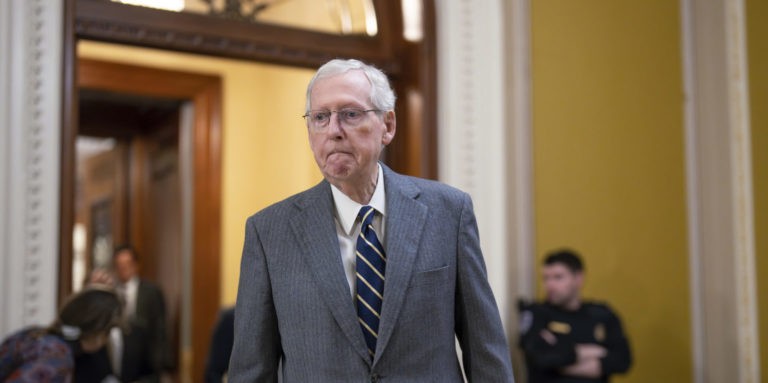
Mitch McConnell Rumored ‘Brain Dead,’ His Office Stays Silent

(Luis CornelioHeadline USA) Rumors surrounding Sen. Mitch McConnell’s health have intensified, with journalists Laura Loomer and Desirée Townsend saying the longtime Kentucky senator may be “brain dead” after reportedly suffering a heart attack on June 14.

Loomer wrote Monday via X that a “high-level source close to the White House” told her McConnell, 84, is “officially brain dead.”

“‘He’s not coming back,’” the alleged source added, according to Loomer. In a separate post, Loomer said her “White House source” told her McConnell was “in organ failure.”

Townsend said she had heard “the same thing” from her own sources.

“At this point, I am at the hospital for when they eventually decide to move cut him off of life support and move his body,” Townsend wrote.

The independent journalist also reported that McConnell’s taxpayer-funded security detail remained at the hospital as of 3:39 p.m. ET on Monday.

Headline USA could not independently verify Loomer and Townsend’s reporting.

McConnell’s office declined to tell the reporters whether McConnell was conscious or on life support. Instead, the staff directed the outlet to the July 2 statement, which also said: “Senator McConnell appreciates the outpouring of support he’s receiving while he continues his recovery in the hospital.”

The last official statement from McConnell’s office came on Thursday, when his staffers claimed the Republican lawmaker was “working closely with his staff on Kentucky and Senate matters while the Senate is out of session.”

The octogenarian Republican was found unconscious inside his Washington, D.C., home after suffering a heart attack, according to emergency dispatch audio revealed by Townsend.

McConnell’s office confirmed the hospitalization but declined to disclose the reason.

Senate Majority Leader John Thune told reporters that he spoke with McConnell after he was rushed to the hospital.

McConnell is “clearly dialed into what’s going on,” Thune reportedly said at the Capitol.

Meanwhile, McConnell’s wife, former Transportation Secretary Elaine Chao, reportedly traveled to China three days after his hospitalization. His oldest daughter, Porter McConnell, also deleted her X account amid mounting speculation about his condition, according to news reports.

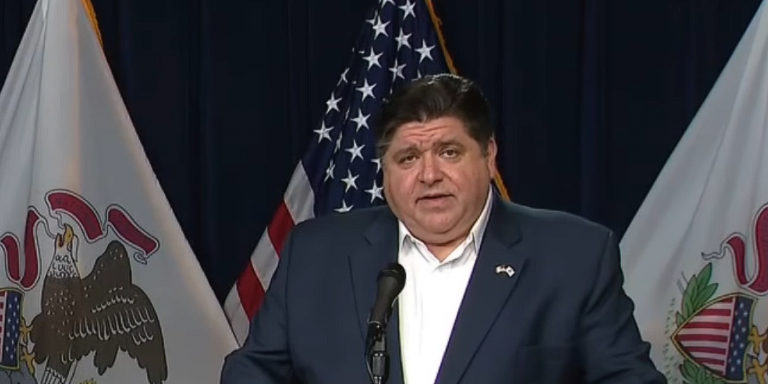
Biden Defender JB Pritzker Now Claims Trump Has ‘Dementia’

(Luis CornelioHeadline USA) Illinois Gov. JB Pritzker, one of President Joe Biden’s most vocal defenders when the former president faced questions about his mental acuity, is now claiming President Donald Trump has dementia.

Pritzker made the remarks during a June 29 interview with CNN host Caitlin Collins while discussing Trump’s criticism of democratic socialism.

Trump had argued that socialism represents a similar threat to the country than historical crises.

“The man is continually suffering from dementia. I don’t think he really understands what he’s saying,” Pritzker stated, providing no evidence for his claim.

Pritzker’s comments mark a stark contrast from how he defended Biden during the 2024 presidential campaign, when questions about the former president’s mental fitness intensified.

Pritzker served as one of Biden’s fiercest campaign surrogates and even sat on his national advisory board.

For instance, when Special Counsel Robert Hur raised concerns about Biden’s memory, Pritzker quickly went on the defensive, going as far as accusing Hur of being politically motivated.

“I’ve been with the President of the United States many times. He is on the ball. The man knows more than most of us have forgotten,” Pritzker claimed in February 2024.

In 2023, ahead of the presidential election, Pritzker downplayed questions about Biden’s fitness for office, praising him as “a gem of a human” while describing Trump as “cruel, cowardly and small.”

Pritzker doubled down on his backing of Biden even after the former president’s disastrous performance in the 2024 presidential debate.

“Listen: Joe Biden is our nominee. I am for Joe Biden,” the Illinois governor claimed. “I’ve been campaigning for Joe Biden. I think you’ve seen I’ve got dates scheduled to go to Indiana, to Ohio for Joe Biden.”

Pritzker’s attacks are in line with a broader Democratic strategy of weaponizing Trump’s age after years of dismissing concerns about Biden, despite mounting video evidence.