In his lengthy post, he tried to claim deporting illegal immigrants could prevent scientific breakthroughs.
“Who’s really being removed by ICE tonight? The child who would’ve discovered the cure for cancer in 2046?” he wrote. “The 9th grade nerd who would’ve stopped that Astroid that’s gonna hit us in 2032? Do we care?”
Moore doubled down on his belief that one of the illegals being deported may have been able to cure cancer if they stated in the United States.
“When I go to bed tonight, as I lay my head down to fall asleep,” he continued, “I will try not to think about the potential millions suffering from cancer some 30 years from now who might’ve lived had this little girl not been seen as a threat to our national security.”
The Fahrenheit 9/11 director also made reference to Apple cofounder Steve Jobs. He attempted to use Jobs’s biological father as more “evidence,” and went as far as implying Jobs could have been an “anchor baby?” even though he was adopted.
In response to Moore’s rant, the White House released a statement ripping into his claims.
“In a strong contender for dumbest statement of the year, disgraced ‘filmmaker’ Michael Moore lamented illegal immigrant criminals being apprehended because they might’ve ‘discovered the cure for cancer’ or ‘stopped that asteroid,'” it read. “The only thing more foolish than that statement are the politicians who oppose the deportations.”
The article proceed to list just a few of the horrific crimes that have been committed by illegal immigrants.
White House Deputy Press Secretary Kush Desai sarcastically told Moore that he should visit the science labs that criminals will erect once they are deported.
“Michael Moore is free to visit the quantum computing and particle physics labs that MS-13, TDA, and the cartels are now going to have to set up back home in El Salvador, Venezuela and Mexico,” Desai said.
(Joakim Book, Money Metals News Service) In a monetary economy, the money layer “exists on top of” real economic decisions, actions, and processes.
When the money layer faithfully mirrors the underlying real economy, it maximally serves its purpose; a stable, neutral, non-distortionary money allows us to plan our economic affairs, make economic calculations, engage in financial contracts, and save for the future.
When the monetary layer fails to achieve its role, it makes all those actions harder to navigate, causing a real drag on our economic behavior—with the unfortunate outcome that we’re all poorer for it.
We find it harder to make commerce, engage in mutually beneficial contracts with employers or clients, or save for old age. We must constantly reassess and renegotiate our contracts and wages, even switching jobs every few years to make real headway.
But the most immediate consequence, known to anyone who has ever had a little bit left over from their earnings, is that you cannot save in the “money” used today.
Whether the physical notes in your wallet or the digital bank account representations thereof, over time, they yield a saver fewer goods and services. The outcome for us in the 21st century, and for most of the 20th century, is that we must constantly chase returns on the funds we have already earned.
We become, so to speak, part-time managers of our own finances, having to maximize interest on bank accounts, invest spare funds in the stock market, set savings aside in tax-favored retirement accounts (again consisting mostly of paper stocks), or lend funds to the government against fickle and unreliable promises that we will get back what we put in—tomorrow or in 40 years.
This is the outcome of a very different world than that for most people and nations up until comparatively recently.
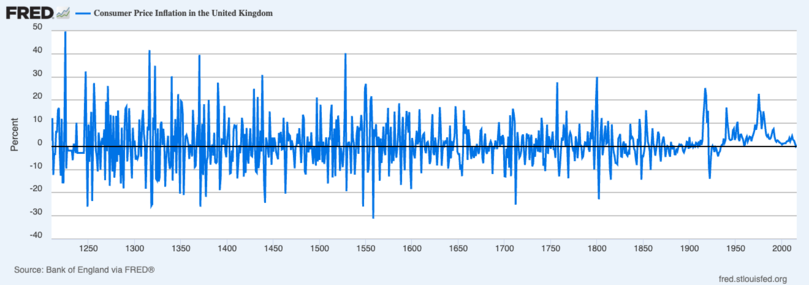
For all of the Bank of England’s 800-year plentiful price history for England/Britain/the U.K., we see aggregate prices bounce up and down greatly—as one would expect from underdeveloped and largely agricultural economies subject to random harvest surpluses and misfalls.
What is astonishing to a modern eye is that from 1210 to around 1934, there is no trendline. There are years where prices explode upward, most likely due to some real economic event (poor harvests or wartime constraints), followed by years of price declines (improved harvests and/or end of wars).
This is precisely what we would expect from a commodity-based monetary system with credible commitment: A gold standard—a monetary order where gold is the base money or the monetary unit is tied directly to a quantity of gold—constrains monetary affairs such that prices over time are mean-reverting.
The exploration and inflow of gold accelerate when prices are low; they slow down when prices are high. Over time, the real value of a unit of money remains flat. Trendless.
Beginning in 1934, British prices never again fell. There’s a concrete regime shift, where prices after this point had an upward trend—forever.
That makes it harder to forecast the value in the future of today’s income, a given sum of money, or a contract, since even small forecasting errors around a stated target (such as the 2% inflation target favored by most central banks) add up over time and push the saver far off course.
The American experience is less clean, but the principle still holds. Prices here gradually fell until the 1860s, when they shot up during the Civil War, came down afterward, and continued their slow, secular, downward trajectory.
They hit a low point in the 1890s, and increased somewhat up until World War I—a price level experience it shared with the rest of the Atlantic world, having much to do with the shared monetary base (gold) and the gold mine discoveries in Western Australia (1885), South Africa (1886), and eventually the Yukon Territory (1896).
After the Great Depression and the first complete detachment of money from gold, America followed Britain and other industrialized nations into the fiat century, where the price level has a consistent but greatly variable and unpredictable trend—and erratic and varying inflation rates punctuated by once-a-decade bursts of money printing.
This is not a natural economic world, and, it is not inevitable either. Our savings behavior and the assets we use to move economic value forward across time are directly related to the monetary regime under which we live.
When the money itself doesn’t work to safeguard future value, people use (“monetize”) everything else that’s liquid enough—paintings, rare wine, houses, stocks. Our houses become ATMs, our mortgages a way to short the currency; these behaviors have distortionary effects, most obviously by using condos and apartments in our largest cities for storing economic value rather than providing shelter for their owners, or a financial sector much larger than it would have been under a harder money.
The perverse conclusion, contrary to all prudent savings advice up and down the centuries, is for individuals to hold the maximum amount of debt they can carry and to never, ever, hold money (i.e., fiat currency)—the very object whose socioeconomic function is to move economic value across time and place.
The backdrop of a broken monetary regime is the underappreciated variable in many current political and social disputes.
Until we pay attention to how today’s monetary regime is different from all that came before it, most current topics of a fiscal or macroeconomic nature won’t make sense.
To paraphrase James Carville, Bill Clinton’s strategist during the 1992 election, only a little: It’s the money, stupid.
Joakim Book is a professional editor and writer with a passion for monetary economics and financial history, and a 2025 Sound Money Fellow, conducting advanced comparative analyses of economic history and financial behavior under a gold standard in 19th-century Britain and America versus current times.
(Mike Maharrey, Money Metals News Service) A lot of gold has moved from London to New York in recent weeks.
Mainstream analysts blame the dynamic on the threat of tariffs pushing the futures price of gold (and silver) higher in New York. There could also be a more fundamental issue at play: the fact that there is a lot more paper gold than physical metal.
No matter what’s driving the movement, there has certainly been a significant disruption in the gold market evidenced by this movement of metal across the pond.
Just how much gold has shifted to New York?
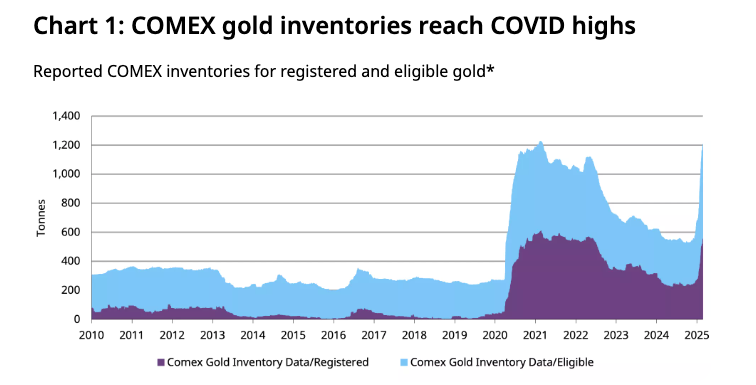
According to the most recent data, COMEX registered gold has increased by nearly 300 tonnes (9 million ounces). Eligible inventories have swelled by more than 500 tonnes (17 million ounces).
The last time we saw COMEX inventories spike this quickly was during the early stages of the pandemic.
Registered gold meets the exchange’s delivery standards including purity and weight and has been officially recorded with an exchange-approved depository or warehouse. This gold is ready to be delivered against a futures contract.
Eligible gold also meets the exchange’s delivery standards but has not been registered with an exchange-approved warehouse. With no receipt, this gold is not yet available for delivery under a futures contract, but it could be registered and made deliverable if necessary.
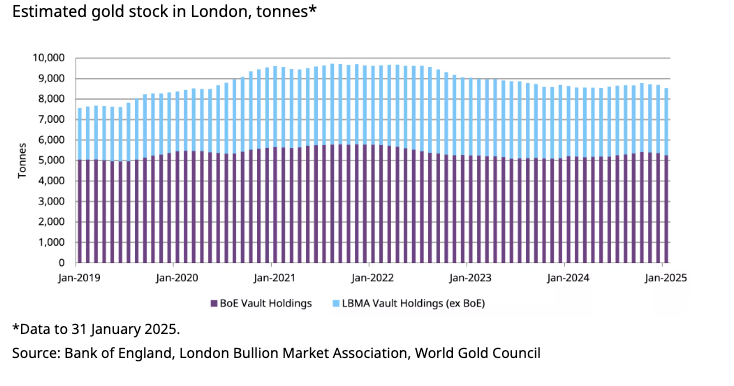
Meanwhile, the levels of gold vaulted in London have dropped, but still remain above their 2022 level.
The World Gold Council explains the situation this way, based on the assumption that the tariff threat is the primary driver:
“Short-term speculators and some investors often hold large net-long gold futures positions on the COMEX futures market, while banks and other financial institutions short these futures contracts as counterparties. But these financial institutions are generally not short gold; instead, they run long over-the-counter (OTC) positions to hedge their futures shorts. And because physical gold is more often found in the London OTC market – as a large trading hub and often a cheaper location in which to vault gold – financial institutions typically prefer to hold these hedges in London, knowing that they can quickly – in normal market times – ship gold to the US when there is a need. In recent months, many traders have chosen to pre-empt the threat of tariffs by moving gold to the US, thus avoiding the possibility that they may have to pay higher charges.”
In a nutshell, the premium on the COMEX has created an arbitrage opportunity that big institutions capable of quickly moving metal between trading hubs can take advantage of.
There could be more going on than meets the eye. Gold Newsletter publisher Brien Lundin believes cracks are spreading in the global gold market infrastructure, with tremendous implications for the price of the metal.
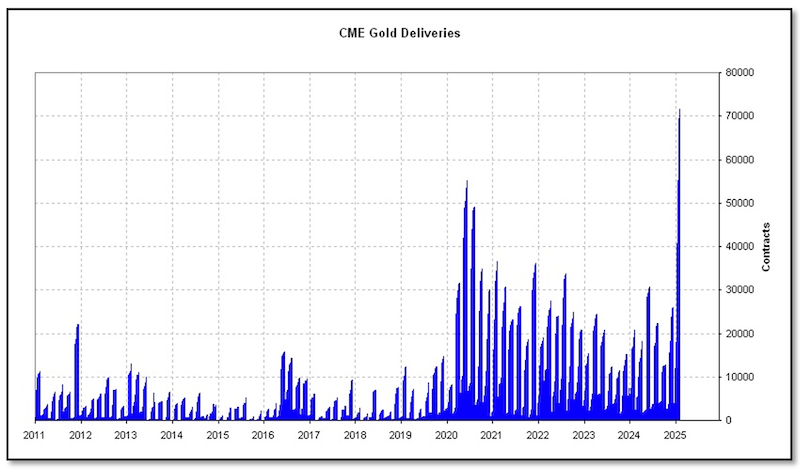
He points out that we’re also seeing a significant surge in gold being pulled from COMEX vaults as investors take physical delivery instead of rolling future contracts over.
“Now, the flow of gold from the London Bullion Market Association vaults into Comex could be explained away by the threat of tariffs… but that doesn’t explain the coincident surge of deliveries — physical demand — from COMEX.”
This movement of gold is definitely something to keep an eye on moving forward.
Mike Maharrey is a journalist and market analyst for MoneyMetals.com with over a decade of experience in precious metals. He holds a BS in accounting from the University of Kentucky and a BA in journalism from the University of South Florida.
(Ken Silva, Headline USA) The Jasper County Sheriff’s Office has released footage of police fatally shooting a Jan. 6, 2021, Capitol Hill protestors during a traffic stop, just days after he was pardoned by President Donald Trump.
J6er Matthew Huttle, 42, was shot on Jan. 26 after “an altercation took place between the suspect and officer,” according to state police. At the time, no other details were released and authorities did not say what prompted the traffic stop.
Headline USA filed an open records request for the police body cam footage immediately after the incident. On Thursday, Jasper County Sheriff’s Office provided that footage.
According to the footage, police stopped Huttle because he was going 70 miles per hour in a 55 MPH zone.
🚨Graphic warning: J6er Matthew Huttle was attempting to flee the scene when an officer shot him on Jan. 26, according to body cam footage we just obtained from the Jasper County Sheriff’s Office "I'm shooting myself," Huttle said, apparently reaching for his gun. The officer… pic.twitter.com/CyGzS4N65i
When he was stopped, Huttle informed police he didn’t have a driver’s license. He also notified police he was a J6er.
“I stormed the Capitol,” he said, adding, “I am driving without a license right now.”
“Why are you doing that?” the officer asked him, to which he responded: “I just moved back from Idaho because of my federal case. I’m just in the middle of everything right now.”
The officer returned to his car. Minutes later, he got out and had Huttle step out of his vehicle. The officer told Huttle he’d have to arrest him, and that’s when Huttle fled.
“I can’t go to jail for this, sir,” Huttle said before bolting to his vehicle.
“I’m shooting myself,” Huttle said.
“No, no, no, no!” the officer responded, right before firing shots.
🚨BREAKING: We have obtained police dash cam of the Jan. 26 fatal police shooting of recently pardoned Jan. 6 protestor Matthew Huttle.
Huttle had been pardoned for a misdemeanor offense for entering the Capitol on Jan. 6. and was sentenced to six months in custody in 2023. He had traveled with his uncle to Washington to attend the Jan. 6, 2021, pro-Trump rally. Huttle was inside the Capitol for 16 minutes and recorded it on video.
“He is not a true believer in any political cause,” defense attorney Andrew Hemmer said in a court filing. “He instead went to the rally because he thought it would be a historic moment and he had nothing better to do after getting out of jail” for a driving offense.
Also on Thursday, the the Jasper County Sheriff’s Office released a report from the Clinton County Prosecutor’s Office, which deemed the shooting of Huttle a justified kill.
“Probable cause existed to arrest Huttle for a felony. Despite lawful commands, Huttle attempted to reach for a firearm, posing an imminent threat to the Deputy’s safety,” the report stated. “Given these facts, the Deputy’s actions were legally justified under Indiana law. This investigation is now closed, and no charges will be filed.”
Addendum: Read the Clinton County Prosecutor’s Office report on the incident, in which the shooting of J6er Matthew Huttle was deemed a justified kill.
Most people believe the Fed bowed out of the inflation fight and began easing monetary policy in September when it delivered its super-sized rate cut. In fact, the Fed began easing months earlier when it tapered balance sheet reduction, or quantitative tightening (QT), in June 2024.
Now it appears that even with hawkish talk about keeping monetary policy tighter for longer and slowing the pace of interest rate cuts, the central bank may be set to ease monetary policy even further despite inflation by further slowing or even ending balance sheet reduction.
The Fed Balance Sheet and Monetary Policy
The balance sheet serves as a direct pipeline to the money supply. When the Fed buys assets – primarily U.S. Treasuries and mortgage-backed securities – it does so with money created out of thin air. Those assets go on the balance sheet and the new money gets injected into the financial system and ultimately the broader economy.
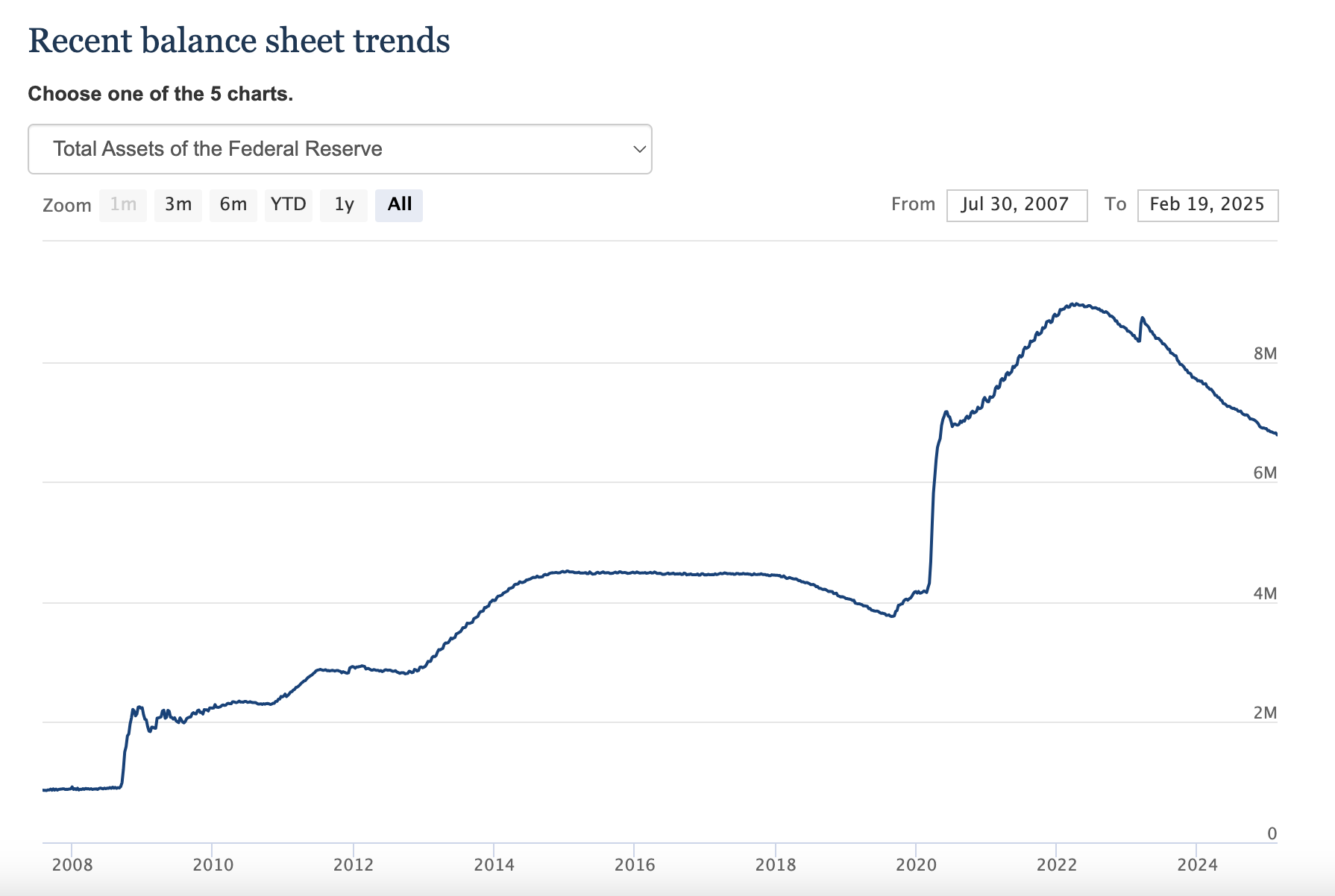
Before the 2008 financial crisis and Great Recession, the balance sheet was just over $900 billion. By the end of the pandemic era, it stood at just under $9 trillion.
In other words, the Fed pumped over $8 trillion into the economy in 14 years through QE.
When Ben Bernanke launched the first round of QE at the onset of the Great Recession, he assured Congress that the Fed was not monetizing debt. He said the difference between debt monetization and the Fed’s policy was that the central bank was not providing a permanent source of financing. He said the Treasuries would only remain on the Fed’s balance sheet temporarily. He assured Congress that once the crisis was over, the Federal Reserve would sell the bonds it bought during the emergency.
That never happened.
And then the Fed doubled down, expanding the balance sheet by nearly $5 trillion during the pandemic.
As former Federal Reserve Governor Kevin Warsh explained in an op-ed published by the Wall Street Journal last year, there is a direct connection between this monetary expansion and price inflation.
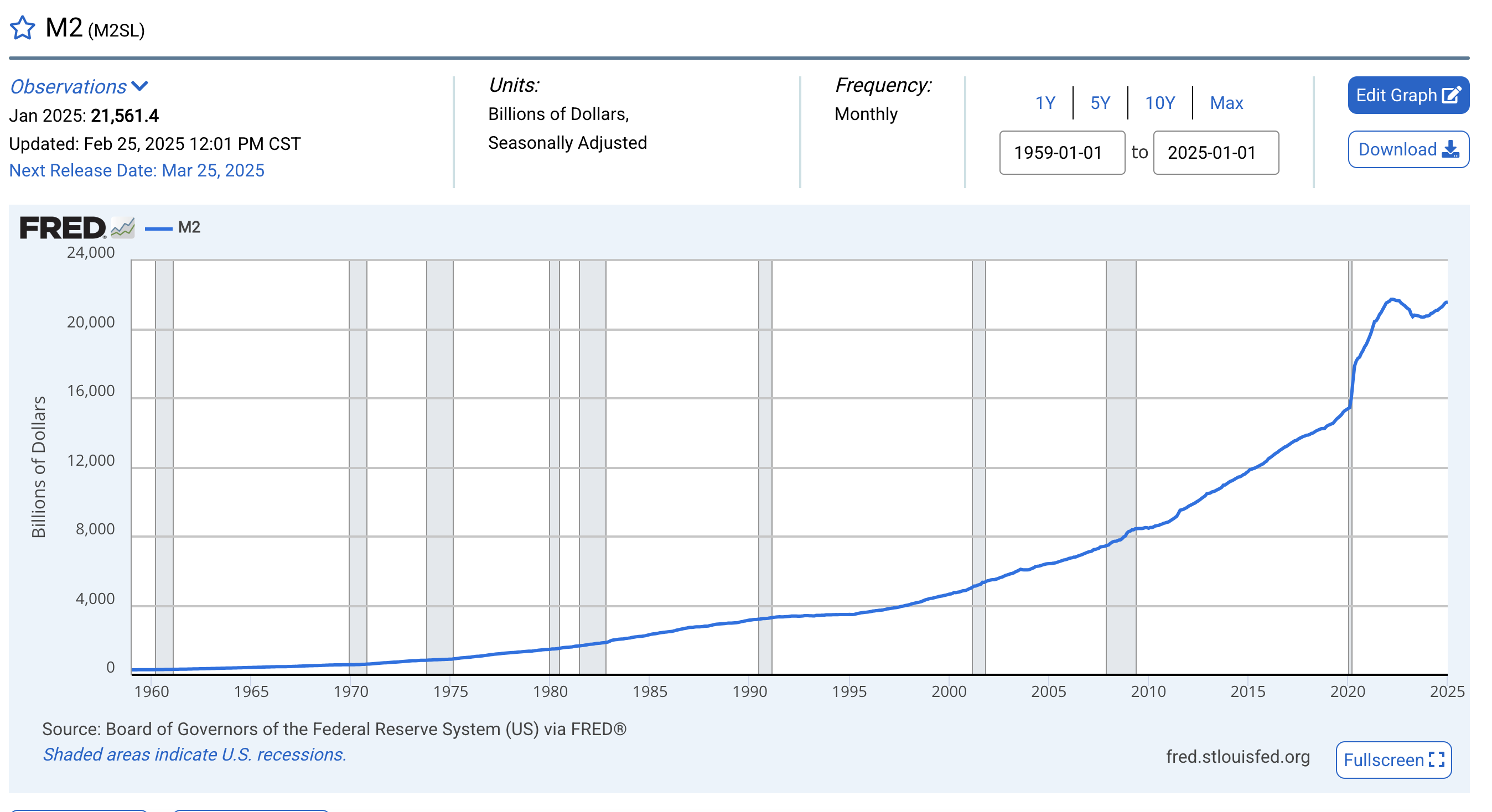
“The monetary base is up 60 percent since the pandemic. Another measure of money, M2, is up 36 percent in the past four years. The inflation surge in the same period– cumulatively about 22 percent– shouldn’t have been a surprise.”
The Fed announced a balance sheet reduction plan in March 2022 when it could no longer convince everybody that price inflation was “transitory.” The plan wasn’t exactly ambitious given the amount of inflation it created during the pandemic. If the Fed followed the blueprint (and it didn’t), it would take 7.8 years for the Fed to shrink its balance sheet back to pre-pandemic levels. This doesn’t even account for the trillions added in the wake of the 2008 financial crisis.
The money supply began shrinking in April 2022 due to a combination of quantitative tightening and interest rate hikes. (The first hike of the cycle was in March 2022.)
The M2 money supply bottomed in October 2023 at $20.69 trillion. Since then, it has crept upward. As of January, it was at $21.56 trillion. That’s the highest level since January 2022.
In other words, despite all the talk about fighting price inflation, the central bank has been creating monetary inflation (the cause of price inflation) for over a year.
Why Is the Fed Considering Further Slowing Balance Sheet Reduction Now?
As already alluded to, price inflation is far from dead. The annual CPI has increased for four straight months. So, why is the Fed considering slowing balance sheet reduction now?
According to a Reuters report, many banks had pushed back the expected end date of quantitative tightening due to stubborn price inflation, “but there’s now no solid consensus as to how the U.S. central bank will proceed with shrinking the holdings over the coming months.”
As the Reuters report put it, expectations about the future path of the balance sheet drawdown process have been “scrambled.”
Why?
Because the minutes of the January Federal Reserve meeting “showed central bankers concerned about how the effort to shed bonds might collide with dynamics around the federal debt ceiling.” Based on the minutes, “various” policymakers said they were open to pausing or slowing the reduction of Fed-owned Treasury and mortgage bonds to navigate uncertain money market conditions as Congress sorts out government finances and a statutory cap on the federal debt that came back into force last month.”
The federal government ran up against the debt ceiling at the beginning of the year. In effect, this means the government can’t borrow any money until Congress raises the ceiling. (You can read more about the debt ceiling, its history, and its ramifications HERE.)
To keep funding federal deficits, the U.S. Treasury is employing “extraordinary measures,” that include pausing some funding, along with redeeming existing investments and suspending future investments in the Civil Service Retirement Disability Fund, the Postal Service Retiree Health Benefits Fund, and federal employee retirement system savings plans. These moves would likely push the hard debt ceiling deadline to the summer of 2025.
However, the current situation is driving “unsettled” money market conditions. According to Reuters, this “increases the risk the Fed could go too far with liquidity withdrawals, something central bank officials do not want, and which opens the door to a shift in the QT process.”
One analyst told Reuters the most likely scenario is a slowdown in balance sheet reduction. Freezing QT outright would require the central bank to purchase Treasuries to keep the balance sheet stable as some bonds mature and roll off. This would in effect be a return to quantitative easing.
“The communications hurdles stemming from any shift in the pace of QT are daunting enough without having to explain the introduction of a temporary new asset purchase program as well,” the analyst said.
Barclays analysts believe the Fed will simply end QT in September.
The Bigger Picture
I have said for months that the Fed will eventually have to return to QE to facilitate the federal government’s borrowing and spending.
When the central bank buys U.S. Treasuries on the open market in QE operations, it “monetizes” the debt.
In effect, QE turns Uncle Sam’s debt (Treasury notes and bonds) into cash. In the process, it creates artificial demand for those bonds, driving the price higher and yields lower. This lowers the U.S. government’s borrowing costs and enables the U.S. government to borrow more than it otherwise could under normal market conditions.
Now, it faces a similar problem with its balance sheet. It needs to slow down or end QT to help the federal government with its borrowing problem, and it simultaneously needs to keep trimming the balance sheet to pull the inflation that it created since 2008 out of the system.
Again, it can’t do both.
Federal Reserve Chairman Jerome Powell claims that the central bank doesn’t consider the government’s fiscal problems when making monetary policy decisions, but it clearly does. Even if it wants to maintain the illusion of central bank “independence” from government policy, it can’t because the two are intertwined.
With the possibility of slowing the balance sheet out in the open, this clears the path for the Fed to do just that, despite the fact that inflation isn’t dead.
The bottom line is the inflation monster isn’t dead, and he’s about to get another shot in the arm.
Mike Maharrey is a journalist and market analyst for MoneyMetals.com with over a decade of experience in precious metals. He holds a BS in accounting from the University of Kentucky and a BA in journalism from the University of South Florida.
(Money Metals News Service) In the latest episode of the Money Metals Midweek Memo, host Mike Maharrey analyzes the economic forces shaping the gold market, the Federal Reserve’s precarious balancing act with interest rates, and the long-term implications of inflation on precious metals.
From Newton’s third law of motion to a potential breakout in gold prices, this episode unpacks crucial financial trends that investors need to watch.
The Economics of Action and Reaction
Maharrey opens the episode by drawing a parallel between Newton’s third law—where every action has an equal and opposite reaction—and the principles of economics. In monetary policy, every decision triggers consequences, often playing out over extended periods.
For example, artificially low interest rates have encouraged borrowing and inflated debt levels.
Now, with interest rates rising, the economy faces the inevitable reaction: financial strain.
Gold Market Recap: A Bull Run with Volatility
This past week saw a dramatic movement in gold prices. After reaching a new all-time high of $2,953 per ounce, the price dropped nearly 2 percent, testing the $2,900 support level before stabilizing around $2,925. Such volatility, according to Maharrey, is normal in a bull market and should not be mistaken for a collapse in gold’s upward trajectory.
Gold exchange-traded funds in North America saw a significant inflow of 48.8 tons last week—the highest since April 2020.
Historically, Western investors have been slow to jump on the gold bandwagon, with demand primarily coming from central banks and investors in Asia.
If this trend continues, some analysts predict it could push gold beyond $3,000 per ounce, with a potential breakout once that psychological resistance level is cleared.
Trade War Fears and the Gold Market
One driver of recent gold price fluctuations is the increasing talk of tariffs, particularly from President Donald Trump. A looming trade war could impact the Federal Reserve’s policy decisions, as tariffs are often associated with rising prices. While some view tariffs as inflationary, Maharrey clarifies that true inflation stems from an expansion in the money supply, not just price increases on specific goods.
Despite short-term fluctuations, trade wars tend to drive safe-haven demand for gold. If economic turmoil arises, gold could benefit from investor flight to security.
The Federal Reserve’s Catch-22 on Interest Rates
The core theme of the episode is the Federal Reserve’s difficult position. The central bank must balance:
Keeping interest rates high to combat inflation.
Cutting interest rates to ease economic strain caused by mounting debt.
Currently, the federal funds rate sits at 4.5 percent, with a 3 percent Consumer Price Index (CPI) inflation rate, making the real interest rate just 1.5 percent. If inflation continues rising, real interest rates will decline unless the Fed hikes rates further—an unlikely scenario given economic vulnerabilities.
The Housing Market as a Canary in the Coal Mine
The impact of higher interest rates is becoming evident in the housing market, a sector particularly sensitive to borrowing costs. Mortgage rates, which peaked at 7.8 percent in 2023, had temporarily dropped but are now hovering around 7 percent again. This has led to:
A 4.9 percent month-over-month decline in existing home sales (January 2024).
The worst year for existing home sales since 1995.
A growing inventory glut, with 3.5 months of unsold homes—the highest since 2019.
Maharrey warns that the housing market’s struggles are a preview of broader economic consequences as businesses and consumers grapple with higher borrowing costs.
A Debt-Driven Economy on the Brink
Beyond real estate, rising debt levels across all sectors indicate financial distress. U.S. credit card debt has soared to a record $1.38 trillion, with many consumers relying on credit cards just to cover basic living expenses.
Unlike the pandemic era, when government stimulus allowed households to pay down balances, today’s consumers are accumulating debt at a rapid pace, with an $18 billion increase in December alone—a 20.2 percent year-over-year jump.
Meanwhile, the average credit card interest rate remains above 20 percent, offering little relief despite the Fed’s rate cuts.
This debt burden extends to corporations as well. Corporate bankruptcies hit a 14-year high in 2024, surpassing even the economic fallout of the pandemic lockdowns.
Many companies, particularly those accustomed to the artificially low interest rates of the past decade, are struggling to refinance their obligations. Delinquent corporate bank loans have spiked from $21 billion in Q4 2023 to nearly $29 billion today, as firms face sharply higher borrowing costs.
This widespread debt stress underscores the fragility of an economy propped up by easy credit and points to a looming financial squeeze that could trigger a broader economic downturn.
The Fed’s Inevitable Return to Easy Money
With mounting economic pressures, Maharrey argues that the Federal Reserve will eventually resort to rate cuts and quantitative easing, even at the risk of reigniting inflation. Historically, when faced with economic turmoil, the Fed prioritizes market stability over price control.
For long-term investors, this makes gold and silver essential hedges against the coming wave of inflation and currency devaluation.
Final Thoughts: Now Is the Time to Act
With gold in a strong uptrend and silver still undervalued relative to gold, Maharrey urges investors to take advantage of market dips rather than waiting for higher prices.
The potential for gold to surpass $3,000 per ounce could mark the beginning of a rapid price acceleration, making now a strategic buying opportunity.
For those interested in diversifying into precious metals, Money Metals offers expert guidance via 800-800-1865 or through their online platform atMoneyMetals.com.
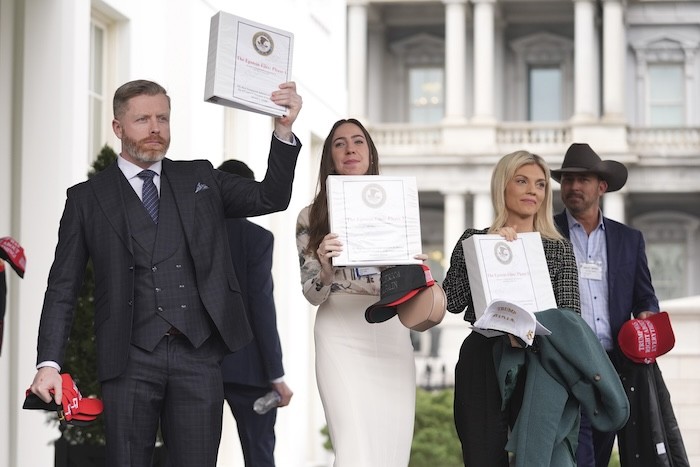
(Ken Silva, Headline USA) Pro-Israel conservative political commentators were spotted at the White House Thursday holding binders that read “The Epstein Files” hours after Attorney General Pam Bondi promised the release of documents about wealthy financier Jeffrey Epstein, who sexually abused underage girls.
It was not immediately clear what was in the binders, which have not been released publicly by the Justice Department.
Pam Bondi: "We're releasing the first of the Epstein files tomorrow."
Americans: "Cool! Then we'll get to read them?"
Bondi: "Well actually you'll get to see fun little photo shoots of conservative personalities & influencers holding a binder!" pic.twitter.com/cspoCg4s9b
The binders read “declassified,” but it was not immediately clear whether the information contained in the binders ever had been classified. Among those holding the binders was political commentator Rogan O’Handley, also known as DC Draino.
Bondi said Wednesday on Fox News that the documents would include flight logs and “a lot of names,” though it was unclear whether there would be details not already publicly known.
Rep. Anna Paulina Luna, R-Fla., who’s been calling for the publication of all Epstein records, was not happy with what she criticized as a PR stunt.
“[Neither] I nor the task force were given or reviewed the Epstein documents being released today… A NY Post story just revealed that the documents will simply be Epstein’s phonebook,” she said on Twitter/X. “THIS IS NOT WHAT WE OR THE AMERICAN PEOPLE ASKED FOR. GET US THE INFORMATION WE ASKED FOR instead of leaking old info to press.”
I nor the task force were given or reviewed the Epstein documents being released today… A NY Post story just revealed that the documents will simply be Epstein's phonebook.
THIS IS NOT WHAT WE OR THE AMERICAN PEOPLE ASKED FOR and a complete disappointment.
Bondi has signaled that more records are to come. In a Thursday letter to FBI Director Kash Patel, she revealed that the bureau’s New York office has been suppressing hundreds of documents.
“I learned from a source that the FBI Field Office in New York was in possession of thousands of pages of documents related to the investigation and indictment of Epstein,” she said.
“By 8 a.m. tomorrow, February 28, the FBI will deliver the full and complete Epstein files to my office, including all records, documents, audio and video recordings, and materials related to Jeffrey Epstein and his clients, regardless of how such information was obtained.”
Prior to Kash Patel's confirmation, the FBI withheld full disclosure of the files. The remaining documents are slated for delivery tomorrow. It seems likely that this refers to a portion of the files—those contained in the binders—which… pic.twitter.com/CPCT6yUaPl
Epstein’s crimes and connections to famous people have long been a subject of public fascination and media scrutiny. Over the years, thousands of pages of records have been released through lawsuits, his criminal dockets, public disclosures and Freedom of Information Act requests.
In January 2024, a court unsealed a trove of documents that had been collected as evidence in a lawsuit filed Epstein victim Virginia Giuffre. Much of the material, including transcripts of victim interviews and old police reports, had already been publicly known.
Epstein sexually abused children hundreds of times over more than a decade, exploiting vulnerable girls as young as 14. He allegedly killed himself in 2019 while awaiting trial in his Manhattan jail cell.
The case has drawn widespread attention because of Epstein and his former girlfriend Ghislaine Maxwell’s links to royals, presidents and billionaires. Maxwell herself is the daughter of the late British media tycoon Robert Maxwell, who once owned the New York Daily News.
Maxwell, 62, was found guilty in December 2021 of luring young girls to Epstein so he could molest them, between 1994 and 2004. She was sentenced to 20 years in prison.
Numerous researchers have determined that Epstein and the Maxwells were intelligence assets, providing information to agencies such as the FBI, CIA, and Israel’s intelligence agency, the Mossad. An ongoing lawsuit from an unknown Epstein victim, “Jane Doe 200,” is seeking to compel Epstein’s estate to release records that would confirm these connections.
The DOJ is purportedly releasing Epstein files today. Compare what they release to the discovery that one proven Epstein victim is still trying to obtain (look at the filing date of this!) https://t.co/7T7MbNodYTpic.twitter.com/GGShTryIaA
Jane Doe 200 seeks such information because she says Epstein’s intelligence connections is the reason she didn’t report his crimes against her sooner.
“It was directly communicated to Jane Doe 200 that Ghislaine Maxwell’s father, Robert Maxwell, was in Mossad, and Jane Doe 200 was led to believe that Epstein was as well,” she said in a court filing earlier this month.
“Plaintiff specifically alleges that the only reason for her failure to report the rape was that she reasonably believed that she could not report Epstein to the police without risking fatal retaliation because she would be reporting rape by a Mossad agent with some of the most unique connections in the world.”
Given the pro-Israel stance held by the White House and its conservative influencers, many researchers are skeptical that the DOJ’s Epstein document dumps will reveal the truth about who he was working for, and why. Along with “DC Draino,” other influencers to receive a binder included Chaya Raichik, the pro-Israel influencer who runs Libs of TikTok, as well as the pro-Israel Jack Posobiec.
Epstein was most likely a Mossad asset, running a honey trap to ensnare powerful figures so Israel could blackmail them.
The most disturbing part? The first version of the Epstein files has now been handed to influencers who openly support the very agency Epstein was working… pic.twitter.com/KgShSexNVp
“Epstein was most likely a Mossad asset, running a honey trap to ensnare powerful figures so Israel could blackmail them,” said Dr. Simon Goddeck. “The most disturbing part? The first version of the Epstein files has now been handed to influencers who openly support the very agency Epstein was working for. Selective disclosure. Narrative control. Damage management. What a disgrace.”
Ken Silva is the editor of Headline USA. Follow him atx.com/jd_cashless.
(Headline USA) U.S. Agency for International Development workers, some in tears, carted away belongings from a final visit to their now-closed headquarters Thursday as the Trump administration’s rapid-fire dismantling of the congressionally authorized agency moved into its final stages.
Notices are going out to terminate over 90% of USAID’s contracts for humanitarian and development work around the world, and the Supreme Court has temporarily blocked a judge’s order requiring the administration to release billions of dollars in foreign aid.
The administration notified most USAID staffers in recent days that they were on leave or terminated, then gave thousands of those who worked in the Washington headquarters 15-minute time slots to clear out their desks.
With a backdrop of cheers from a few supporters outside, some staffers wept as they carried out grocery bags and suitcases with what was left from their life’s work.
USAID has been one of the biggest targets of a broad campaign by President Donald Trump and cost-costing chief Elon Musk’s Department of Government Efficiency to slash the size of the federal government. The actions at USAID have left only a small fraction of its employees on the job. The Trump administration has slashed $60 billion in assistance overseas.
Trump and Musk have called USAID programs out of line with the Republican president’s agenda and asserted that its work is wasteful.
Several groups are suing the Trump administration over the staff cuts and more than monthlong freeze on foreign assistance. While the administration’s efforts to slash the size of the federal government are embroiled in various lawsuits, court challenges to temporarily halt the shutdown of USAID have been unsuccessful.
Late Wednesday, the Supreme Court temporarily blocked a judge’s order that had given the Trump administration a deadline of this week to release billions of dollars in foreign aid. Chief Justice John Roberts said that order will remain on hold until the high court has a chance to weigh in more fully.
The court’s late-night intervention is a temporary step as the justices consider the case, but their eventual determination could be pivotal in the increasingly fraught legal battles playing out nationwide.
It halted a decision from a federal judge who said this week that the administration had given no sign of complying with his nearly two-week-old order to pause the funding freeze. Trump paused foreign aid in an executive order on his first day in office.
(Casey Harper, The Center Square)The White House sent a memo to several federal agencies telling them to prepare to reorganize and fire high quantities of workers.
The memo is the latest in Trump’s ongoing war against what he calls bloated federal “woke” policies, overregulation, and wasteful spending. About 75,000 federal workers took a buyout to leave their position, and a few thousand have been fired so far.
“The federal government is costly, inefficient, and deeply in debt. At the same time, it is not producing results for the American public,” reads the memo from Russell Vought, director of the Office of Management and Budget, and Charles Ezell, acting director of the Office of Personnel Management.
OMB runs federal agencies for the White House. OPM acts like a human resources department for the federal government.
“Instead, tax dollars are being siphoned off to fund unproductive and unnecessary programs that benefit radical interest groups while hurting hardworking American citizens,” the memo continued.
Trump signed executive orders after taking office directing federal agencies to identify and eliminate wasteful spending. Agencies have until March 13 to prepare “agency reorganization plans.”
The memo says agencies should attempt to cut expenses, reduce its need for office space, and carry out a “significant reduction in the number of full-time equivalent (FTE) positions by eliminating positions that are not required.”
“Pursuant to the President’s direction, agencies should focus on the maximum elimination of functions that are not statutorily mandated while driving the highest-quality, most efficient delivery of their statutorily-required functions,” the memo said.
American Federation of Government Employees National President Everett Kelley, who leads the largest union of federal workers, blasted Trump after the news broke.
“Laying off potentially hundreds of thousands of federal workers will mean fewer services at higher costs for the American taxpayer,” Kelley said.
Kelley argued Americans will receive lower quality federal services with “no discernible savings for taxpayers.”
“This administration has targeted every single federal worker and does not seem to care how much turmoil they cause for either the employees or the American public,” she added. “The chaos is the point.”
(Kenneth Schrupp, The Center Square) U.S. Attorney General Pam Bondi issued a letter to the California Interscholastic Federation, which oversees high school sports for both private and public schools in California, warning that the state could lose federal funding and face lawsuits for allowing biological males to compete against girls — which she says violates Title IX and thus federal law.
“The Department of Justice does not want to have to sue states or state entities, or to seek termination of their federal funds. We only want states and state entities to comply with the law,” wrote Bondi. “And federal law requires giving girls an equal opportunity to participate in sports and athletic events by ensuring that girls need to compete only with other girls, not with boys.”
On Feb. 5, President Donald Trumpsigned his “Keeping Men Out of Women’s Sports” executive order banning biological men from competing in female sports, citing his earlier order on transgenderism titled, “Defending Women from Gender Ideology Extremism and Restoring Biological Truth to the Federal Government.”
“President Trump recently directed the Department of Justice and the Department of Education to prioritize enforcement actions against athletic associations that deny girls an equal opportunity to participate in sports and athletic events by requiring them to compete against boys,” wrote Bondi. “Yet in response, state athletic associations – including California’s – have issued defiant statements saying that they would continue requiring girls to compete against boys in sports and athletic events.”
Trump also has ordered that doctors no longer provide Americans under 19 with gender-changing surgical or hormonal interventions.
Notably, California Attorney General Rob Bonta issued a warning to hospitals that under state law, they cannot withhold “hormone therapies” and “gender-affirming surgeries” from minors and are in violation of state law if they otherwise offer similar interventions to “cisgender” individuals seeking changes to better align with their birth genders, such as individuals with births or hormonal issues.
Bondi’s letter says that under the U.S. Constitution’s supremacy clause, federal law trumps state law and that CIF must abide by Title IX rules as a result.
“It therefore does not matter if California state law allows, or even requires, state athletic associations or other similar entities to require girls to compete against boys in sports and athletic events,” wrote Bondi. “Where federal and state law conflict, states and state entities are required to follow federal law.”