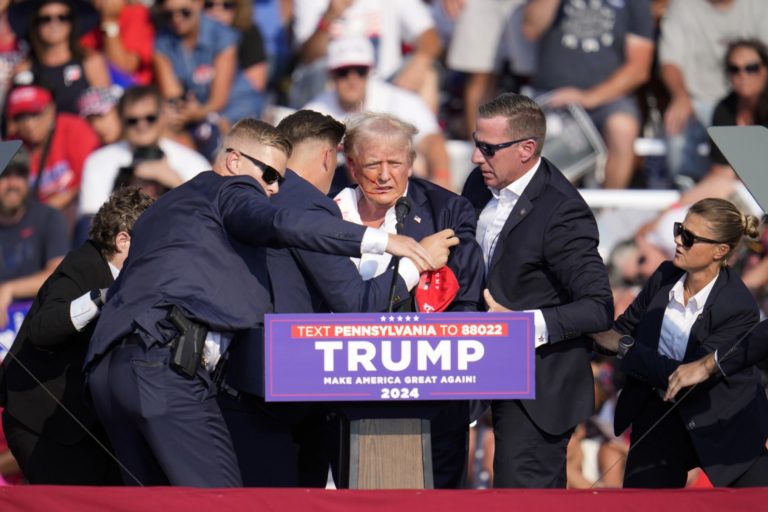
(Ken Silva, Headline USA) Donald Trump told reporters on Thursday that he expects to receive a report about the two men who allegedly tried assassinating him last year: Thomas Crooks and Ryan Routh.
Trump’s remarks were in response to Fox News reporter Peter Doocy, who asked him why the public still doesn’t know much about Crooks, who allegedly shot Trump in the ear last July.
“They are giving me a report next week sometime, and I do believe I’ll be releasing it, I want to release the report. A lot of people have asked that question,” Trump said.
“You had one who had three apps, two of which were foreign, supposedly, and who has the biggest white-shoe law firm in Pennsylvania [working for them], even though they don’t live in, necessarily, a white-shoe area. What’s that all about?” the President said—referring to the fact that Crooks used encrypted chat apps based in Germany, New Zealand and Belgium, and that his parents have hired the Pittsburgh-based law firm Quinn Logue.
🇺🇸 President Trump announces he wants to release the information on his would-be assassin within days.
"They are giving me a report next week sometime. I want to release the report."pic.twitter.com/gWqDzQ0nRu
Trump also referenced Routh and his numerous electronic devices. He said Routh was arrested with six or seven cellphones, some of them with “strange markings on them.”
Trump then said the report will be released—probably.
“I want to find out, and I would be willing to release it. Maybe there’s a reason we shouldn’t, so I don’t want to get too far out in front of my skis. But I would be very willing to release it. I’d like to see it. Not only you—I want to see that one myself,” he said.
Trump’s remarks come nearly a month after he told the New York Post that he’s ordered the Secret Service to provide all its info on Crooks and Routh.
“I’m entitled to know,” Trump told The Post. “I want to find out about the two assassins … Why did the one guy have six cell phones and why did the other guy have [foreign] apps? No more holding back because of Biden … I’m entitled to know. And they held it back long enough.”
The Post added that Trump has been briefed on the matter by National Security Adviser Mike Waltz, who sat on the House Task Force that investigated the assassination attempts last year. Waltz has been pushing the dubious claim that Iran might be behind one or more assassination plots against Trump.
Crooks allegedly grazed Trump’s ear with a bullet at his campaign rally last July, while Routh was caught hiding in the bushes within several feet of Trump on his golf course last September. Crooks was killed by law enforcement, and Routh is awaiting trial for attempted assassination.
The information Trump seeks may not be held by the Secret Service, which is now headed by the former leader of his security detail, Sean Curran. The FBI headed the investigations into both Crooks and Routh—withholding information about both from the House Task Force formed last year to investigated the assassination attempts.
According to the Task Force’s report, the FBI declined to provide any documents about the second, Sept. 15 assassination attempt that occurred at Trump’s Florida golf course—despite the fact that the Task Force’s legal authority was expanded to investigate that case, too.
Nor did the FBI provide the Task Force with much information about Crooks himself. The Task Force’s report said the FBI provided the Task Force with access to only 81, out of over 1,000, witness interview reports—known as 302s—comprising roughly 180 pages.
Ken Silva is the editor of Headline USA. Follow him at x.com/jd_cashless.
(Ken Silva, Headline USA) In September 2023, former U.S. Attorney Patrick Scruggs, who prosecuted numerous peaceful Jan. 6 protestors, was arrested for allegedly stabbing someone who crashed into his car that morning.
It turns out, the man Scruggs stabbed was a confidential informant, according to recent updates in his case.
The information about Scruggs’s victim was reported by the Tampa Bay Times about two months ago. The newspaper reported that Scruggs’s lawyers filed a court motion to find out more material about the victim, Blake Sharp, including about his background as a snitch.
“Scruggs’ defense attorneys noted two prior encounters Sharp had with law enforcement where he likewise claimed to have high blood sugar, but officers believed he was under the influence of drugs,” the Times reported in January.
“Not long before the stabbing, Sharp said he’d called Carlos Cruz, an investigator with the Pinellas-Pasco State Attorney’s Office. Sharp admitted he’d worked with Cruz as a confidential informant, according to his testimony,” the Times reported.
“I aided them in busting a lot of fentanyl dealers,” Sharp testified, according to the Times.
The motion filed by Scruggs’s lawyers further says that “it appears that Mr. Sharp attempted to leverage his status as a confidential informant and role as a witness to receive favorable treatment for his own criminal cases.”
Scruggs reportedly still faces trial in May. He was going to stand trial in February, but his case was again delayed, according to Jan. 6 protestor Adam Johnson, now known as the “Lectern Guy” for the famous photo of him carrying then-House Speaker Nancy Pelosi’s lectern through the Capitol rotunda. Scruggs prosecuted Johnson.
According to reports, Scruggs is accused of stabbing a driver who hit his car following another collision in Florida around 9:30 a.m. on a Tuesday morning.
“Troopers said Scruggs got out of his car and approached the man’s vehicle. He broke a window, then stabbed the driver repeatedly using a pocketknife,” Tampa’s local NBC affiliate reported at the time.
“The couple tried to intervene, but Scruggs tried to stab them. They were able to flee,” the news station added. “An officer who was passing by the scene stopped to help and was able to detain Scruggs and call for backup.”
Scruggs was reportedly arrested on charges of aggravated battery, aggravated assault and armed burglary. He was booked into the Pinellas County Jail, where was released 10 hours later on a $65,000 bond.
Scruggs reportedly worked as an U.S. Attorney in their Criminal Division from September 2012 to April 2023. The Justice Department did not say why he left.
Ken Silva is the editor of Headline USA. Follow him at x.com/jd_cashless.
(José Niño, Headline USA) Israel is apparently spying on the Trump administration and leaking sensitive diplomatic moves to the media.
Throughout the past few weeks, the Trump administration has been conducting direct talks with Hamas concerning the release of U.S. hostages held in Gaza and the possibility of reaching a more comprehensive deal to end the war, per a report by Axios.
As the Trump administration held talks with Israel about the possibility of communicating with Hamas, Israel discovered other aspects of the talks via other channels, suggesting that the Israelis were conducting espionage operations to obtain such information.
In an X/Twitter post, independent journalist Max Blumenthal commented on this development, “So Israel is spying on the Trump admin and leaking its sensitive diplomatic moves to the press.”
U.S. presidential envoy for hostage affairs Adam Boehler is conducting the talks. Such talks are unprecedented due to how the U.S. had never previously engaged with Hamas, which the U.S. government designated as a terrorist organization in 1997.
These talks were held in Doha, the capital of Qatar, over the last few weeks and have sought to take steps toward releasing all the remaining hostages and establish a long-term truce. However, no deal has been reached yet.
White House envoy Steve Witkoff had plans of traveling to Doha this week to meet Qatari Prime Minister Mohammed bin Abdulrahman bin Jassim bin Jaber Al Thani to discuss the ceasefire negotiations but canceled the trip on Tuesday night after he saw there was no meaningful progress made by Hamas’ side, according to a U.S. official’s account of the negotiations.
Hamas is reportedly holding 59 hostages in Gaza. According to the Israel Defense Forces, 35 of those hostages are reportedly dead. Sources from the Israeli intelligence community report that 22 hostages are still alive, while the status of two other hostages is unknown.
In a statement he posted on his Truth Social platform shortly after holding a meeting at the White House with eight former hostages, Trump revealed that he was “sending Israel everything it needs to finish the job.”
“Release all of the Hostages now, not later, and immediately return all of the dead bodies of the people you murdered, or it is OVER for you,” Trump demanded. “Only sick and twisted people keep bodies, and you are sick and twisted!”
Thus far, the fighting has not resumed but Israel stopped the delivery of all humanitarian aid to Gaza. Israel’s punitive military action has displaced 1.9 million Palestinians — 90 percent of Gaza’s population — with the threat of a famine looming on the horizon.
José Niño is the deputy editor of Headline USA. Follow him at x.com/JoseAlNino
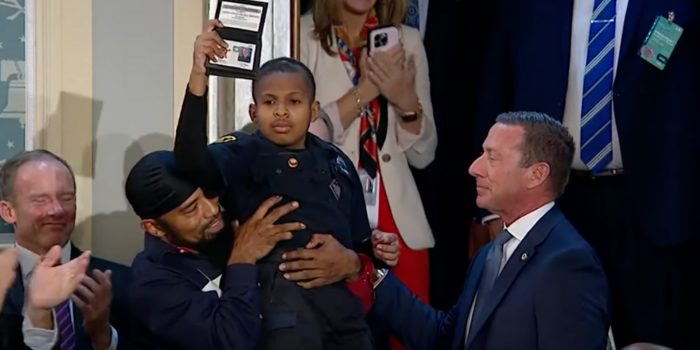
(Maire Clayton, Headline USA) The father of the 13-year-old cancer survivor who was honored by President Donald Trump responded after Rachel Maddow made nasty comments about the event.
“She needs to shut her mouth if she has nothing nice to say,” Theodis Daniel told the New York Post.
“This lady didn’t even serve time in the military,” he added. “I was on the USS Kitty Hawk. She does not need to put her bad energy on us.”
The MSNBC host tried to claim giving DJ Daniel the honor was “disgusting” and attempted to act as though Trump was making the moment political.
“For the record, and this is disgusting, the president made a spectacle out of praising a young man who thus far survived pediatric cancer, as if the president had something to do with that,” Maddow said.
Theodis Daniel also stated he was appalled when Democrat Rep. Al Green disrupted Trump’s address.
“When [Rep.] Al Green stood up and made that ruckus, I was disgusted,” he told the outlet. “What kind of message is he sending?”
DJ Daniel’s aunt also spoke with the Post, but did not comment on Maddow’s statements.
“I thought it was awesome for my nephew. He deserves it,” Jane Daniel said regarding receiving accolades from the president. “I think that such an honor will help him to reach his goals. If you can accomplish this, you can accomplish anything.”
Theodis and his son visited the Oval Office on Wednesday and met with Trump.
“There’s one more thing I got for you – a big hug,” DJ said to the president.
The moment quickly circulated on social media.
DJ Daniel, newest member of the United States Secret Service, meets President Trump in the Oval Office! 🇺🇸 pic.twitter.com/MshogUuMK9
(Headline USA) Lindsey Boylan helped drive Andrew Cuomo from office in 2021 when the former aide came forward as the first woman to accuse the governor of sexual harassment.
At the time she had allies in high places: Every New York Democrat in Congress, the state’s legislative leaders and then-President Joe Biden all condemned Cuomo’s behavior and said he should resign.
But now that Cuomo is back as a serious contender in the race to be mayor of New York City, many of those top Democrats have little to say about his candidacy.
To Boylan, that feels like a betrayal — one that can’t simply be explained away as an easing of #MeToo outrage.
“If anything has changed, momentarily, it’s that across our country, across issues, people who should be speaking up, aren’t,” Boylan, who served in the Cuomo administration for three years, said in an interview with The Associated Press.
“I don’t think anything has specifically changed with women being angry about how our rights are being taken away,” she said. “But the fact that most of our leaders are more interested in staying comfortable and staying in their jobs than actually protecting us and defending us. That’s gotten much worse.”
Cuomo resigned in 2021 after a report released by the state attorney general concluded that he had sexually harassed 11 women, including Boylan.
Now, Cuomo is a frontrunner in the mayoral race, even as state and party leaders, while not warm to his candidacy, haven’t condemned it either.
New York Gov. Kathy Hochul, who as Cuomo’s lieutenant governor had called his alleged behavior with women “repulsive and unlawful,” said Tuesday she stood by those comments. But, she added, she had to “deal in the reality today.”
“I have to go forward in light of where we are today and deal with whatever the voters decide to deal with,” she said, adding that she would work with Cuomo if he was elected.
U.S. Sen. Kirsten Gillibrand said on the NY1 television station that Cuomo made mistakes, but was also a talented executive who did good things as governor. It was up to New York City voters whether he deserved a second chance, she said, declining to give her own opinion on his candidacy.
U.S. Rep. Hakeem Jeffries, the House minority leader, said last week that he would not endorse a candidate until after the city’s June primary. The office of U.S. Sen. Chuck Schumer, the Senate minority leader, declined to comment.
That Cuomo is a credible candidate is likely due to a mix of factors, experts said. These include the former governor’s aggressive effort to discredit his accusers and his deep record of accomplishments as governor, as well as a field of mayoral candidates with little name recognition and an ongoing sense of disorder at City Hall.
Mayor Eric Adams, the incumbent, was indicted in September on federal corruption charges and is now dealing with a tempest of criticism after President Donald Trump’s newly installed Justice Department leaders asked a court to drop the case so Adams could assist with the federal government’s immigration crackdown.
In a statement, a Cuomo spokesperson, Rich Azzopardi, said multiple prosecutors have dug into the allegations the former governor sexually harassed women and none have sought to pursue the cases. He accused Boylan of making false accusations during a failed run for a local political office in 2020, and accused her of bullying behavior.
“Three years, five district attorney reviews that resulted in zero cases and civil cases that were either dropped or are dying on the vine,” Azzopardi said, calling that “a clarifying dose of due process.”
New York City “is in crisis and everybody knows that Andrew Cuomo has the experience, the record and the skill to help save it,” he added.
Grant Reeher, a political science professor at Syracuse University, said the current mayor’s legal and political troubles help place Cuomo at the front of the pack of candidates.
“New York is in such a state of chaos and the government needs someone to come in and take charge and run the show. He is well-matched for that moment,” he said.
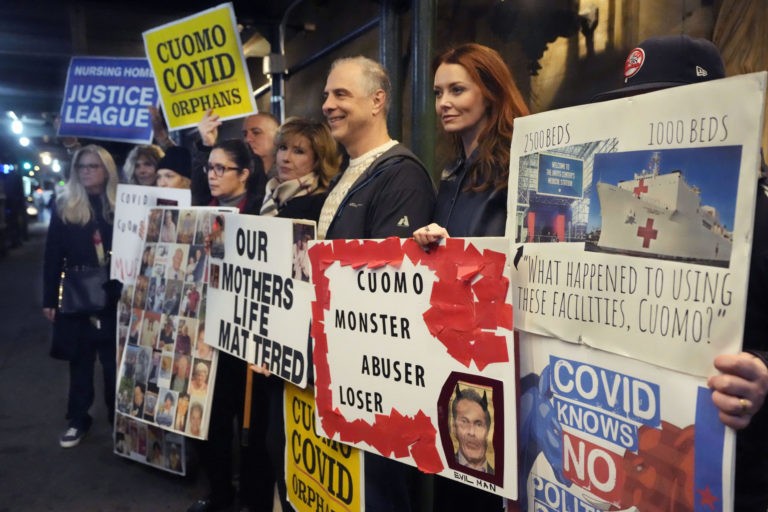
Not to Boylan, though, who joined a demonstration outside a Cuomo campaign fundraising event on Tuesday.
“His path to victory is to destroy the women he abused,” she told the AP. “I’ll do everything within my power and my sense of ethics to make sure it doesn’t happen.”
Boylan, who said she was subjected to an unwanted kiss and inappropriate comments from Cuomo, was disappointed but not surprised that other Democrats in New York had not spoken out more forcefully.
“The most powerful people in New York politics are afraid of him,” she said.
Other female ex-aides described fielding kisses — sometimes on the lips — and sexually charged questions and remarks from him about their personal lives and appearance.
A staffer at a state-related agency said he groped her rear while they posed for a photo. A state Health Department doctor was affronted by his comments, such as “you make that gown look good,” while she gave him a COVID-19 test at a news conference. Another woman described Cuomo planting an unwanted kiss on her face when she met him at a wedding.
One aide, Brittany Commisso, filed a criminal complaint accusing Cuomo of groping her breast while they were alone in an office at the governor’s mansion, but a local district attorney declined to prosecute, citing lack of sufficient evidence.
Cuomo apologized for having “offended” the women with remarks he said were intended to be collegial, and allowed that he sometimes had been “too familiar” with people. But he denied touching anyone inappropriately and said the investigation of his conduct was flawed and politically motivated.
Attorney General Letitia James, the Democrat who commissioned the sexual harassment investigation, herself briefly ran for governor in 2021 after Cuomo resigned, but dropped out after two months.
Cuomo’s lawyers and representatives have since fought to vindicate him amid multiple lawsuits from his accusers. Cuomo even has indicated he plans to file a defamation suit against one of the women, former aide Charlotte Bennett.
Despite the accusations, Cuomo has lined up some endorsements from women in politics. City Council Member Kamillah Hanks, a Staten Island Democrat, said in her statement endorsing Cuomo that the “unprecedented times” called for a “strong, unapologetic” leader.
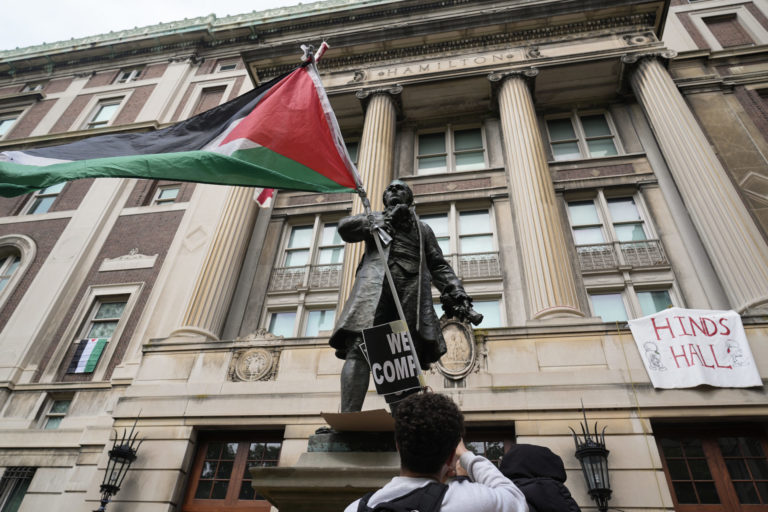
According to a report by The Associated Press, Columbia University senior Maryam Alwan, while visiting her family in Jordan during her winter break, received an email from the university accusing her of engaging in acts of harassment.
The university cited her writing of an op-ed in The Columbia Daily Spectator, the university’s student newspaper, pushing for divestment from Israel.
This investigation is part of a surge in recent cases being reviewed by the Office of Institutional Equity. This is a disciplinary committee being used to launch probes against Columbia students who have manifested views critical of Israel.
Over the last few weeks, the committee has sent notices to dozens of students who have engaged in activities ranging from sharing posts on social media in support of Palestinians to participating in “unauthorized” protests.
For example, one student activist is being investigated for putting up stickers outside of the campus that resembled “Wanted” posters, featuring the likenesses of university trustees. In another case, the president of a campus literary club, is being investigated for helping host an art exhibition off campus that focused on the pro-Palestinian movement’s occupation of a campus building last spring.
In the case of Alwan, university investigators claimed that the unsigned op-ed in the Columbia Spectator, which also called on the university to limit academic ties to Israel, may have forced students to endure “unwelcome conduct” based on their national origin or religion.
“It just felt so dystopian to have something go through rigorous edits, only to be labeled discriminatory because it’s about Palestine,” commented Alwan, a Palestinian-American comparative studies major. “It made me not want to write or say anything on the subject anymore.”
The committee told her that possible penalties for violating school policy ranged from receiving a simple warning to being expelled from the university.
The Office of Institutional Equity is generating concerns among students, faculty, and free speech advocates, who believe the school is kowtowing to President Donald Trump’s threats to cut funding to universities and deport pro-Palestinian “agitators” on campus.
“Based on how these cases have proceeded, the university now appears to be responding to governmental pressure to suppress and chill protected speech,” observed Amy Greer, an attorney who is providing legal counsel to students accused of discrimination. “It’s operating as a business by protecting its assets ahead of its students, faculty and staff.”
On Monday, federal agencies announced they would entertain the idea of slashing $51 million in contracts to the university on top of cutting billions in additional grants because of the university’s alleged “inaction in the face of relentless harassment of Jewish students.”
“We are resolute that calling for, promoting, or glorifying violence or terror has no place at our university,” Columbia proclaimed in a statement after the announcement.
The Office of Institutional Equity was established in the summer. Per the university’s updated harassment policy, criticism of another country’s policies could be deemed as harassment if “directed at or infused with discriminatory comments about persons from, or associated with, that country.”
Columbia’s investigations come at a time when the Trump administration issued an executive order titled “Additional Measures to Combat Anti-Semitism” on Jan. 29, 2025.
The order aims to tackle the reported increase in antisemitic incidents, particularly on college campuses, since the Oct. 7, 2023 attack by Hamas against Israel. This order instructs the Justice Department to use the appropriate civil rights enforcement authorities to fight antisemitism.
(Brien Lundin, Money Metals News Service) Well, that was quick. I recently wrote about the detailed technical setup for gold that was predicting a correction in the gold price. I shared a couple of areas of concern.
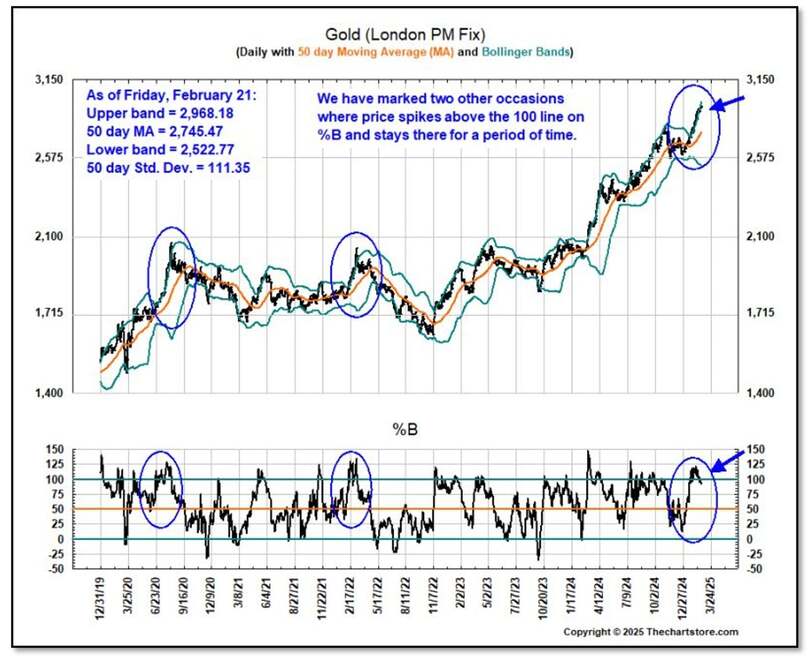
First, gold’s relative strength index (RSI) had risen to overbought levels. We’ve seen this before during this year-old bull run, and in each instance it presaged a correction. The good news is that these corrections had been fairly mild, and the gold price quickly resumed its uptrend.
Second, I featured a chart, courtesy of Ron Griess at TheChartStore dot com, showing how gold had soared above its upper Bollinger band and stayed there. As you can see in the chart below, Ron marked two previous instances where this had occurred, and each of those preceded lengthy corrections lasting the better part of a year.
A correction of that degree was worrisome, but those previous instances came in vastly different market environments. As I shared last week, I didn’t expect that kind of a decline this time.
That’s because powerful fundamentals — from the Fed’s debt trap to the newly sparked global trade war and more — argue for much higher gold and silver prices over the long term.
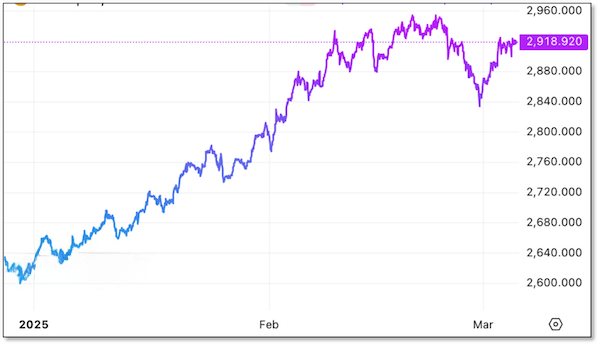
Given that gold had soared $200 over only about a month to begin the year, it seemed only natural that some of that froth would get blown off.
And thus, gold quickly gave back about half of what it had gained, as you can see in the chart below.
But, as you can also see, that correction didn’t last long at all. We’ve gained back about $80 from the lows over the past few days, as President Trump’s tariff talk has shaken the markets.
And gold opened down about $20 this morning as the bears took another swing at gold, but the relentless buying pressure drove the price right back up. It’s trading slightly in the green once again as I write.
Now I’ll be the first to admit that neither I nor anyone else have any idea what the metals are going to do in the near term. As I always say, however, we can be very confident that we want to own them over the long term, given the fundamental trends in place.
And now I will argue, strongly, that we should own the gold and silver equities.
To get Brien Lundin’s ongoing commentary on the markets at no charge, click here to subscribe to his free Golden Opportunities newsletter.
Brien Lundin is the publisher and editor of Gold Newsletter, the publication that has been the cornerstone of precious metals advisories since 1971. Mr. Lundin covers not only resource stocks but also the entire world of investing. He also hosts the annual New Orleans Investment Conference. To get Brien Lundin’s ongoing commentary on the markets at no charge, click here to subscribe to his free Golden Opportunities newsletter.
(Jesse Colombo, Money Metals News Service) Gold has been soaring all year, while silver has spent the past nine months languishing, leaving long-suffering investors wondering: Will silver always play second fiddle to gold, or is it finally ready to shine?
Like many, I’ve been frustrated by silver’s lackluster performance, but in this report, I’ll highlight a growing number of reasons to believe its rough patch may soon be over. Silver may finally step out of gold’s shadow and embark on a sustained bull market of its own.
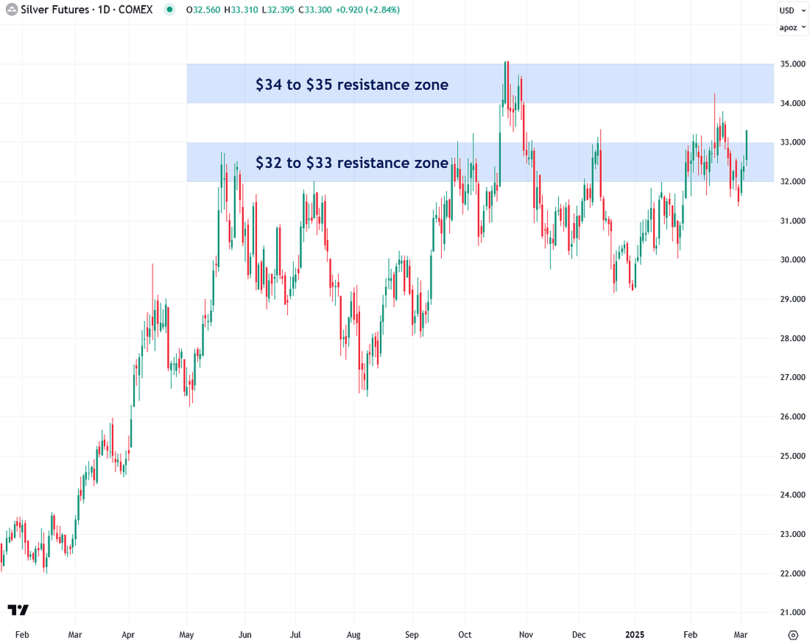
This breakout would be encouraging signal, but the next crucial confirmation will be a strong, high-volume close above the $34 to $35 resistance zone—the same level that halted the late-October rally in its tracks.
Once silver clears both barriers, the path should be wide open for the powerful bull market I’ve anticipated since April 2024.
However, for this breakout to remain valid, silver must close and hold above both resistance zones; otherwise, all bets are off.
Although silver has traded in a choppy, erratic manner for much of the past year, it is in a confirmed uptrend, despite grinding higher in a frustrating “two steps forward, one step back” manner.
This is evident in the 200-day simple moving average, a helpful tool for identifying an asset’s primary trend by filtering out short-term price fluctuations.
More importantly, the 200-day moving average suggests that the odds favor further gains, as a trend in motion tends to stay in motion—much like Newton’s first law of motion, also known as the law of inertia.
The even better news is that once silver fully breaks out, as discussed earlier, I expect it to rise in a much more orderly fashion rather than continuing its erratic price swings.
One of the key reasons I believe silver is on the verge of a powerful new phase in its bull market is gold’s impressive rally over the past year.
Historically, gold is a major driver of silver’s price, though silver often lags before catching up. With economic uncertainty rising and the risk of a recession increasing, I believe gold still has plenty of upside potential.
Based on historical patterns, gold could climb to roughly $3,380 in this leg of the rally alone, which would provide a strong catalyst for silver.
As I’ll explain shortly, the higher gold climbs, the more undervalued silver will become relative to gold, making it increasingly difficult for silver to remain at these relatively low levels while gold continues to soar.
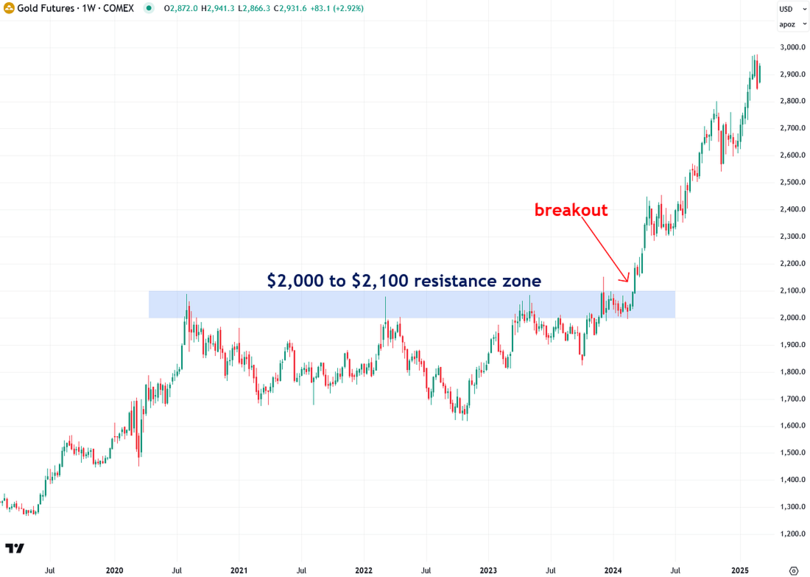
Also, take a look at the chart below and notice how gold struggled from 2020 to early 2024 to break above the $2,000–$2,100 resistance zone, which acted as a price ceiling for much of that period.
Despite multiple attempts, gold was repeatedly pushed back down. However, in March 2024, it finally broke out, igniting the powerful bull market we see today.
I see striking parallels with silver’s $32–$33 resistance zone over the past year and believe that once silver manages to close above this level, it will soar just as gold did.
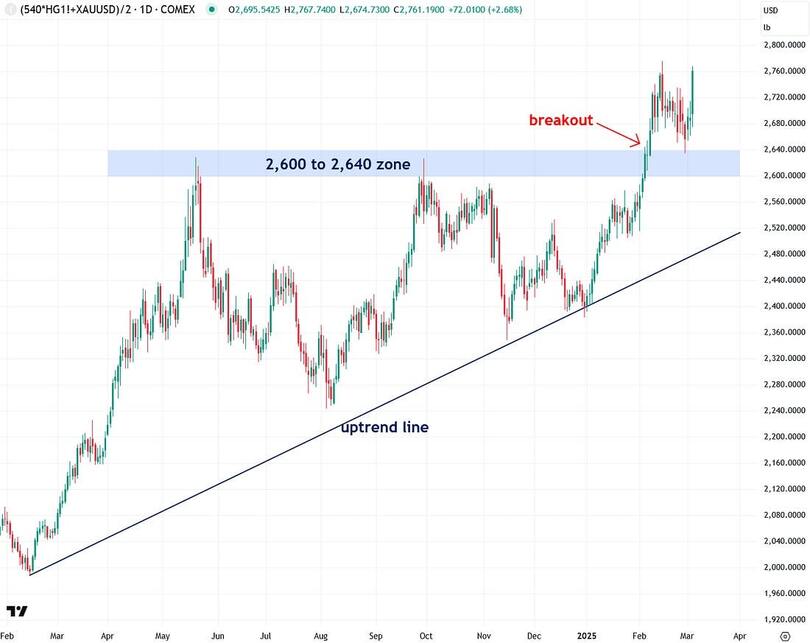
In addition to gold, copper is another key metal that strongly influences silver’s price. This understanding led me to develop the Synthetic Silver Price Index (SSPI)—an indicator designed to validate silver’s price movements and filter out potential fakeouts.
The SSPI is calculated as the average price of gold and copper, with copper adjusted by a factor of 540 to ensure gold doesn’t disproportionately impact the index. Remarkably, despite silver not being an input, the SSPI closely mirrors silver’s price movements.
Thanks to recent impressive rallies in both copper and gold, that long-anticipated breakout has finally occurred, signaling that a significant move in silver is likely imminent.
However, for this breakout to remain valid, the SSPI must stay above the 2,600 to 2,640 zone, which has now turned into a key support level. If it holds, it will further strengthen the case for a powerful silver rally ahead.
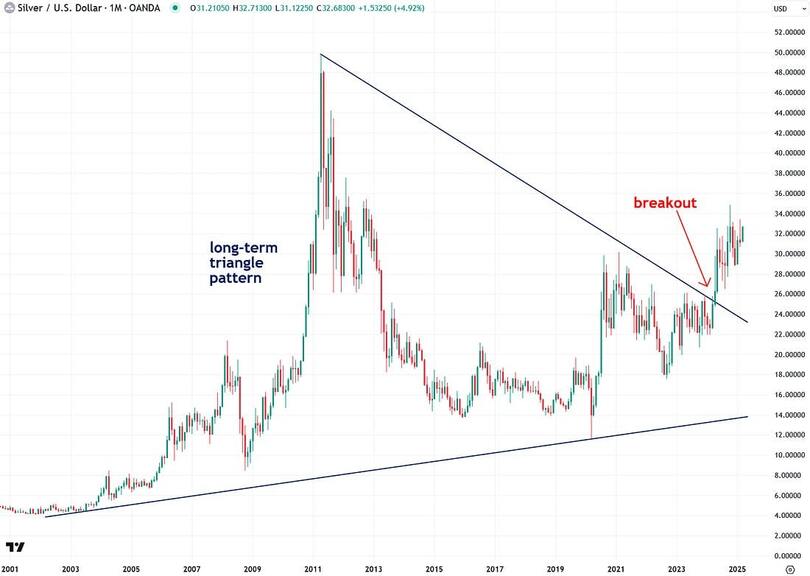
Another strong indication that silver is on the verge of a powerful bull market is its breakout in April 2024 from a two-decade-long triangle pattern.
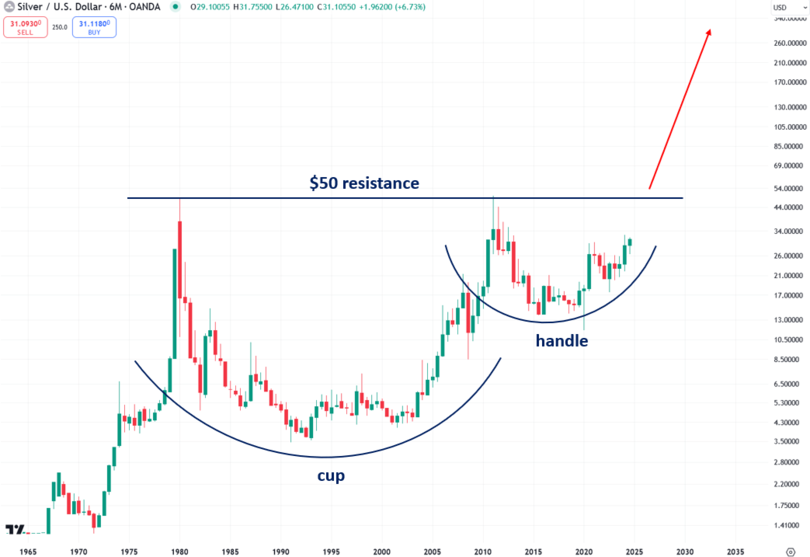
Even more exciting is the fact that silver’s logarithmic chart, dating back to the 1960s, reveals a cup-and-handle pattern, indicating the potential for silver to reach several hundred dollars per ounce during this bull market.
In order to confirm this particular scenario, silver needs to close decisively above the $50 resistance level.
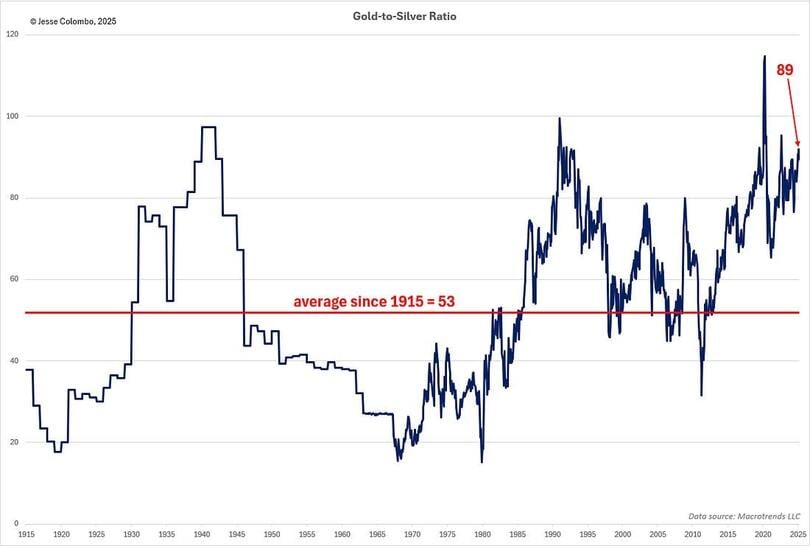
The long-term gold-to-silver ratio chart clearly shows that silver is significantly undervalued relative to gold, suggesting that silver has substantial upside potential. As silver rises to close this gap, the ratio would decline.
The current gold-to-silver ratio stands at 89, but if it were to revert to its historical average of 53 since 1915—without any increase in gold’s price—silver would be valued at a solid $55 per ounce (as compared to the current price of $32.65).
Adjusting silver’s price for inflation further highlights how undervalued it is by historical standards. During the Hunt brothers-induced spike in 1980, silver reached an inflation-adjusted price of $196.
In the 2011 bull market, driven by quantitative easing, it hit $71. Currently trading at just $32.69, silver has significant room to rise if it’s to catch up with these previous inflation-adjusted peaks.
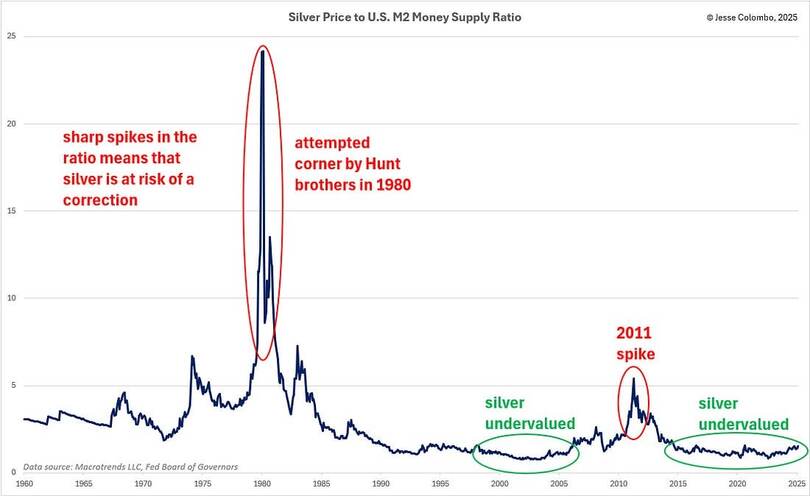
Another way to assess whether silver is undervalued or overvalued is by comparing it to various money supply measures. The chart below shows the ratio of silver’s price to the U.S.
M2 money supply, providing insight into whether silver is keeping pace with, outpacing, or lagging behind money supply growth. If silver’s price significantly outpaces money supply growth, the likelihood of a strong correction increases.
Conversely, if silver lags behind money supply growth, it suggests a potential period of strength ahead. Since the mid-2010s, silver has slightly lagged behind M2 growth, which, combined with other factors discussed in this piece, position it for a strong rally.
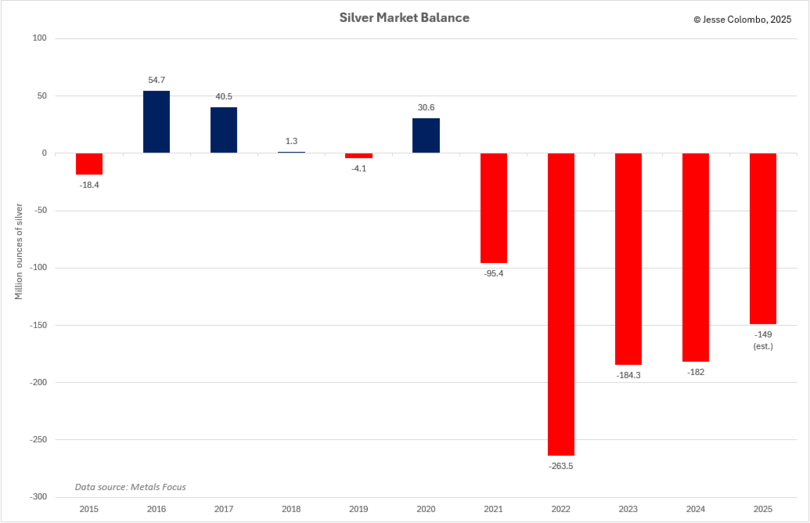
One key reason I believe silver will soon break free comes down to basic Economics 101: supply and demand. Over the past five years, silver demand has consistently exceeded supply, resulting in a persistent deficit—as shown in the chart below.
In 2024 alone, the shortfall reached 182 million ounces, with an estimated additional 149 million ounces this year—and deficits are expected to continue for the foreseeable future.
As a result, above-ground silver stocks are dwindling rapidly. While bullion banks can create unlimited amounts of paper silver to suppress prices, they can’t manufacture the real physical silver that is crucial for a wide range of industries, alongside growing investment demand.
The persistent silver deficit stems from both dwindling supply and surging demand—a combination that, in an unmanipulated market, would naturally drive prices higher. That’s why I see silver as a beach ball being held underwater—pressure is building, and it won’t stay suppressed for much longer.
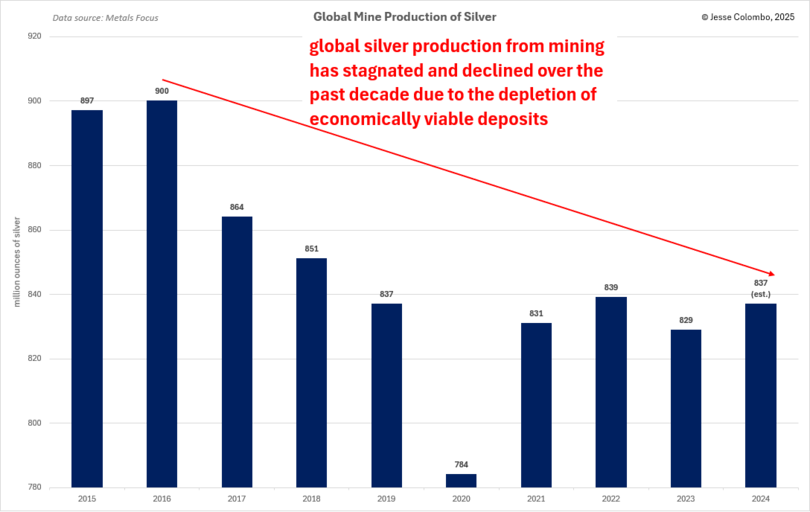
On the supply side, global silver mine production has peaked and declined over the past decade as economically viable deposits become depleted—something the bullion banks have absolutely no control over. And as time goes on, this supply crunch is only likely to worsen.
At the same time, demand for physical silver has skyrocketed across multiple sectors, with the biggest driver being the surge in solar panel manufacturing.
As the world shifts away from fossil fuels toward renewable energy, this trend is only in its early stages. Silver demand for photovoltaic (solar panel) applications alone has nearly tripled over the past four years, increasing by an astonishing 143.1 million ounces.
Another key factor likely to drive precious metals prices higher is the growing risk of a U.S. recession and the Federal Reserve’s expected response to it:
A recession would be bullish for both silver and gold, as the U.S. Federal Reserve and government would respond with aggressive measures to support the economy.
This would include slashing interest rates back to zero—and even into negative territory—while abruptly ending the current quantitative tightening (QT) policy and reviving quantitative easing (QE).
In doing so, they will digitally create hundreds of billions—eventually trillions—of new dollars in a desperate attempt to stabilize financial markets and the broader economy.
In summary, while most investors continue to overlook silver, it is well positioned to thrive and catch up to gold’s soaring price.
As we’ve seen, silver remains incredibly undervalued by multiple measures—including the gold-to-silver ratio, its inflation-adjusted price, its price relative to the M2 money supply, and the persistent supply-demand imbalance, with physical silver demand outpacing supply for over half a decade.
For these reasons and more, I don’t expect silver to stay this cheap for much longer. The final missing piece is a decisive technical breakout—one that propels silver into escape velocity. And as we speak, it may already be in the early stages of doing just that.
Jesse Colombo is a financial analyst and investor writing on macro-economics and precious metals markets. Recognized by The Times of London, he has built a reputation for warning about economic bubbles and future financial crises. An advocate for free markets and sound money, Colombo was also named one of LinkedIn’s Top Voices in Economy & Finance. His Substack can be accessed here.
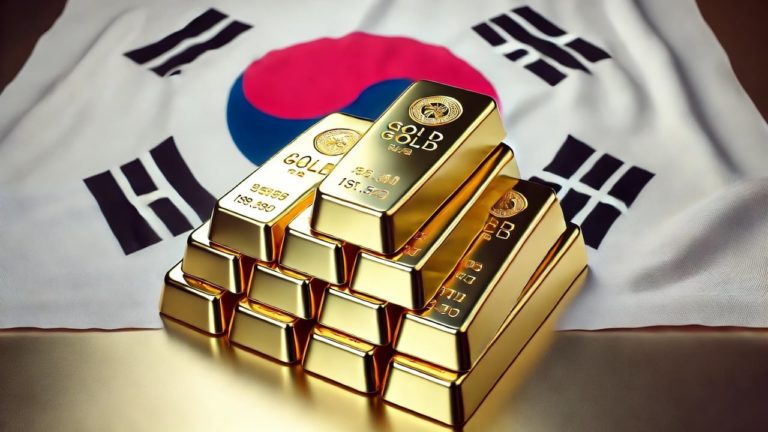
KOMSCO mints gold coins and bars, along with other “security items” including banknotes, IDs, and passports. Among its many products, the government “enterprise” supplies bullion bars to Korean commercial banks, retail outlets, and online malls.
Due to the shortage of raw gold available at nearby refineries, the mint was forced to suspend the sale of gold bars last month — and the suspension is ongoing.
The problem appears to be a combination of strong retail demand for physical gold in South Korea and disruption in the gold market due to gold moving West, coupled with poor planning by KOMSCO.
Earlier this year, the prices of gold and silver futures traded on the COMEX surged above the spot price of gold in London and other markets. Mainstream analysts blame the dynamic on the threat of tariffs pushing the futures price of gold (and silver) higher in New York, but as Chris Powell reported, there could be a more fundamental issue at play: the fact that there is a lot more paper gold than physical metal.
Regardless of the reason, the movement of gold has driven record outflows of gold from London vaults, and it pressured availability in Asia as well. According to a Reuters article last month, “Global bullion banks are flying gold into the United States from trading hubs catering to Asian consumers, including Dubai and Hong Kong, to capitalize on the unusually high premium that U.S. gold futures are enjoying over spot prices.”
At the same time, there has been a surge of retail demand for gold products in South Korea.
Last year, Korea’s largest convenience store chain, CU, has teamed up with Korea Minting and Security Printing Corporation (KOMSCO) to offer customers fingernail-sized gold bars. The bars come in a range of sizes between 0.1 grams and 1.87 grams. The largest bars sell for 225,000 won, the equivalent of about $165. The gold is packaged in cards that feature various graphics and messages.
Similar products are sold in vending machines.
According to a CNBC report, machines in Seoul have sold out of the small bars. A State Street Global Advisors analyst told CNBC this reflects the surging demand for gold.
“The sudden spike in gold demand in South Korea has led to Korean banks to temporarily suspend gold bar sales at the request of KOMSCO as there are not enough gold bars in the country to fulfill local demand.”
Analysts say several factors, including domestic political turmoil, along with geopolitical and economic uncertainty sparked by the threat of a trade war are driving safe haven demand.
South Korean President Yoon Suk Yeol is embroiled in an impeachment trial after declaring martial law last December.
According to the World Gold Council, South Korean gold bar and coin investment jumped by 29 percent in Q4 2024. Meanwhile, the South Korean won dropped by 11 percent against the U.S. dollar.
Natixis analyst Bernard Dahdah told CNBC the surge in gold demand makes sense given the current climate.
“If you’re concerned about your currency devaluing, you switch to gold. If you’re not confident about your stock market, you would switch to gold.”
Bad Decisions by Government Planners
It also appears that KOMSCO made some poor decisions, exacerbating its current shortage.
As noted, there was a surge of gold moving to New York over the past three months. Traders made deliveries to the COMEX in kilogram bars, the preferred form of commercial gold in Asia and the Middle East. World Gold Council analyst John Reade speculated that as they sought to take advantage of the arbitrage opportunities in New York, traders scrounged around the globe to obtain bars.
“Korean refineries and wholesalers probably got a phone call and said: ‘We will buy your entire stock off you at a good premium, stick it on a plane and send it to New York.’”
Money Metals Exchange CEO Stefan Gleason said that the refineries probably jumped on the offer to make a quick buck, and mints like KOMSCO were left flat-footed.
“The refineries did what made sense for them at the time, and their minting customers were unprepared and got stuck. Now it will take both time and higher wholesale market premiums to draw more gold back to Asia.”
“The premium that could be captured by delivering large gold bars to the COMEX rose to over $50 an ounce at one point. If you’re in the business of minting and selling little wafer bars, you’re going to get a much higher premium on those items — so you better make sure you have plenty of gold feedstock, even if you have to pay up for it. Poor planning by mints invariably sours relationships with their retail and dealer customers.”
The problems apparent at the Korea-owned mint are similar to problems seen at other government mints from time to time. Gleason pointed to the sad saga of recent American Silver Eagle shortages and sky-high premiums caused by gross mismanagement at the U.S. Mint, as explained in his 2022 article, “The Most Over-Rated Silver Coin in the World.”
“Government mint bureaucrats are either incapable or unwilling (or both) to find any creative ways of increasing production. Always operating hand-to-mouth on blanks, they’ve pointedly refused to build up surpluses of the blanks during periods of slower demand. God forbid the U.S. Mint has extra silver sitting on the shelf!”
Gleason noted that privately owned mints have historically been more reliable suppliers and provide more reasonable and stable pricing, which is one reason why Money Metals encourages customers to focus on rounds and bars, rather than government-minted coins.
Mike Maharrey is a journalist and market analyst for MoneyMetals.com with over a decade of experience in precious metals. He holds a BS in accounting from the University of Kentucky and a BA in journalism from the University of South Florida.
De-dollarization is of particular concern. The weaponization of the dollar and its use as a foreign policy hammer have made many countries wary of holding the greenback.
These factors appear to be taking a toll on the dollar.
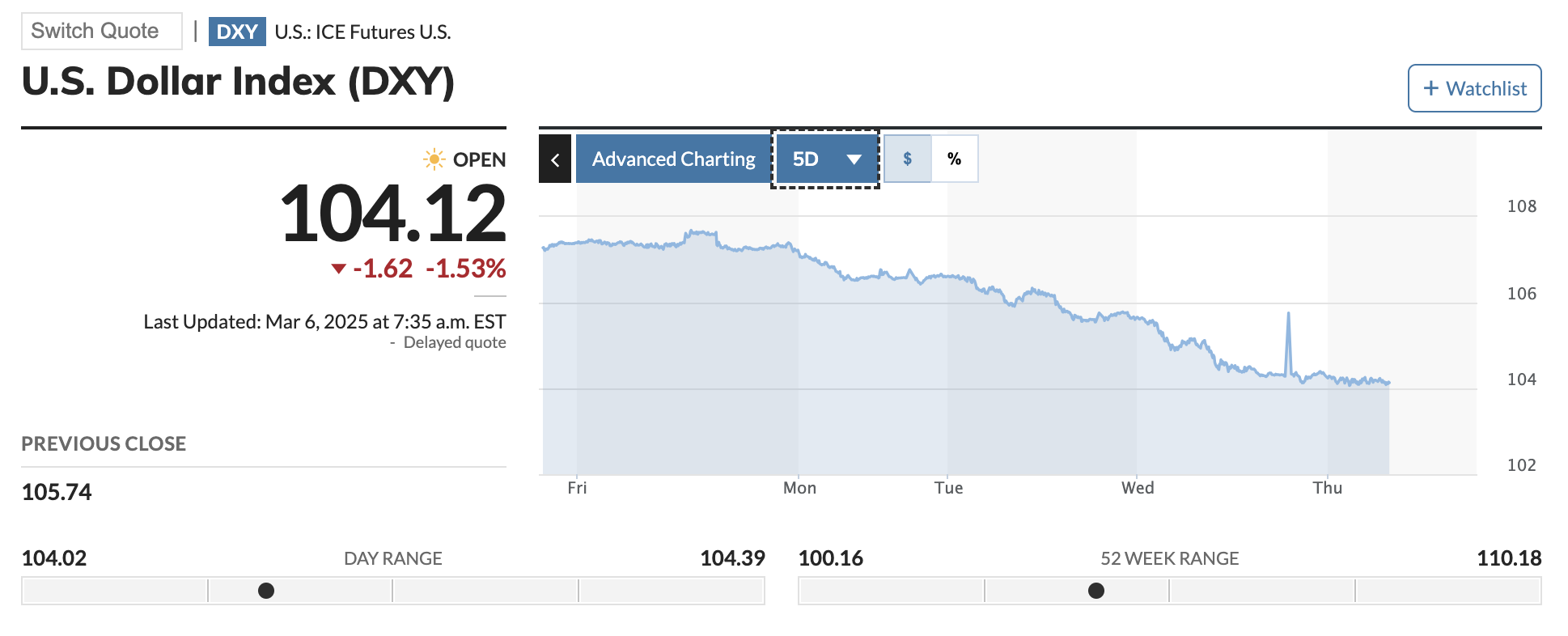
The fact that the dollar weakened against other currencies when tariffs went into effect earlier this week underscores the impact. The dollar index dropped by as much as 0.7 percent during the day and it has continued to dip.
The drop in the dollar is counterintuitive. Conventional wisdom says the dollar should have gained given the economic and market uncertainty inherent in a trade war, a bullish environment for haven assets. Gold’s rally the same day reflects the safe haven trade.
“What stands out in today’s market reaction is that the dollar is not strengthening materially,” Deutsche Bank head of FX strategy George Saravelos wrote. “We would not have expected these market moves at the start of the year.”
Saravelos notes a decline in the historical correlation between the dollar and other risk assets. He also pointed out the growing U.S. current account deficit. This occurs when a country imports more goods, services, and capital than it exports. Saravelos said this typically marks the limits of dollar “overevaluation.”
The U.S. current account deficit hit a record high of $310.9 billion in the third quarter of 2024. That was a 13.1 percent increase from the previous quarter. The Q4 data has not been released.
Saravelos said that landscape for the dollar is changing rapidly as the world adjusts to “a new geopolitical order.”
He was specifically referring to the impacts of the trade war, along with the abrupt pullback of American security support in Europe. This has sent the EU scrambling to ramp up defense spending.
According to Bloomberg, Deutsche Bank has reversed its longstanding negative outlook on the euro in light of this defense spending ramp up.
Saravelos emphasized that “the speed and scale of global shifts is so rapid,” and that the possibility of the dollar losing safe haven status “needs to be acknowledged as a possibility.”
“It is hard to over-estimate the scale of change taking place in global economic and geopolitical relations in a matter of days.”
Saravelos said, “Two pillars of America’s role in the world are being fundamentally challenged,” referring to its role as a security backstop for Europe and its respect for “rules-based free trade.”
“Bringing it all together, we are starting to become more open-minded to the prospects of a broader weaker trend unfolding [for the dollar].”
Mike Maharrey is a journalist and market analyst for MoneyMetals.com with over a decade of experience in precious metals. He holds a BS in accounting from the University of Kentucky and a BA in journalism from the University of South Florida.