Trump Speaks With Netanyahu, Says They’re ‘On the Same Side of Every Issue’

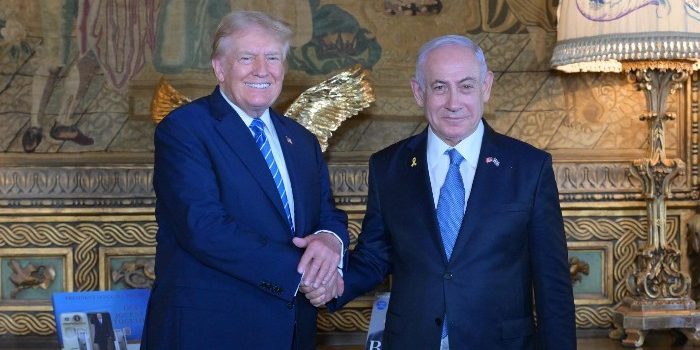
(Dave DeCamp, Antiwar.com) President Trump said on Tuesday that he spoke with Israeli Prime Minister Benjamin Netanyahu and that he and the Israeli leader were on the “same side of every issue.”

Trump said in a post on Truth Social that they discussed “numerous subjects including Trade, Iran, etc.” The call comes after a report said Trump declined to back an Israeli plan to attack Iran, which would have required significant US support, and chose to pursue diplomacy instead.

Another report said Israel was considering a “limited attack” on Iran without US support, but a final decision hadn’t been made. Trump has been threatening to bomb Iran if a deal isn’t reached on its nuclear program, even though his intelligence agencies recently reaffirmed that there’s no evidence that Tehran is building a nuclear bomb.

According to Axios, Trump and Netanyahu also discussed Gaza and the potential for a ceasefire and hostage deal, although there’s no sign Israel is interested in a diplomatic solution as it’s refusing Hamas’s offer for all Israeli captives to be released in exchange for a permanent ceasefire and Israeli withdrawal from Gaza.

The Trump administration has strongly backed Israel’s decision to break the ceasefire agreement signed in January, which would have resulted in the release of all Israeli hostages if implemented. Israel fully resumed its genocidal war on March 18 and has imposed a total blockade on humanitarian aid and all other goods entering Gaza since March 2.

Trump has signed off on at least $12 billion in arms deals since returning to office in January. Over the weekend, Israeli media reported that the US delivered nine plane loads of bunker-busting bombs to Israel to prepare for a potential attack on Iran, but the bombs could also be dropped on Gaza.

This article originally appeared at Antiwar.com.

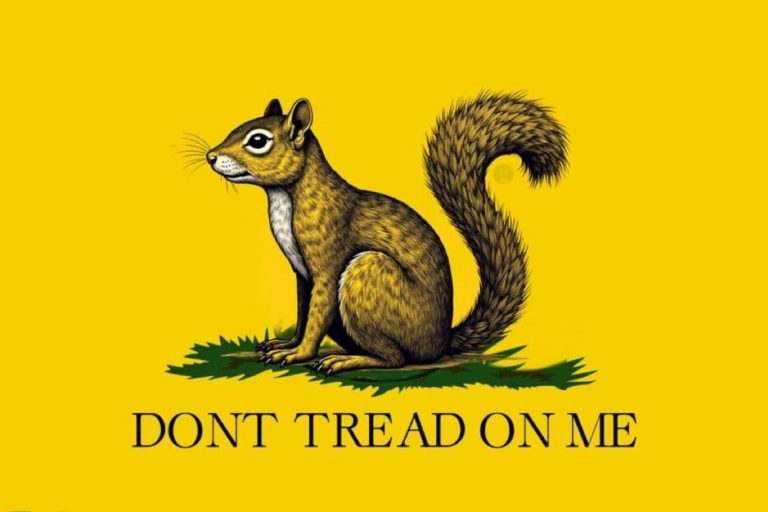
Inside the Investigation, Seizure and Death of Peanut the Social Media Star Squirrel

(Headline USA) New York environmental workers who came with a warrant looking for Peanut the squirrel found the social media star on a bathtub. His housemate, Fred the raccoon, was in a suitcase in a bedroom closet.

Soon after the Oct. 30 seizure, both animals were euthanized and Peanut became a martyr – held up as a symbol of government overreach by political candidates, including Republican vice presidential candidate JD Vance, who invoked Peanut’s name during a rally just days before the presidential election. State and Local officials received angry messages about this perceived overreach. 

How did events in a sleepy corner of upstate New York snowball so dramatically?

Records recently released under freedom of information requests show complaints about the P’nuts Freedom Farm Animal Sanctuary were initially treated with little urgency by the state Department of Environmental Conservation — but that changed in the weeks leading up to the fateful seizure amid new complaints and the reported arrival of raccoons to the sanctuary.

Government officials laid the groundwork for euthanizing the animals so they could be tested for rabies in the days before the seizure. Yet a state employee also lined up a wildlife rehabilitator to take Peanut, if needed.

A final phone call to discuss Peanut’s fate was made after the squirrel bit the gloved thumb of a wildlife biologist, according to records.

Who was Peanut?

Peanut, also known as P’nut, was the star of the sanctuary run by Mark Longo and Daniela Bittner in Southport near the Pennsylvania line. Online videos show the squirrel skittering on Longo’s shoulders, holding and eating waffles and wearing a tiny cowboy hat.

Longo said he found Peanut years ago in New York City after the animal’s mother was hit by a car. It’s against New York state law to possess a wild animal without a license, though Longo and Bittner took steps last year to become wildlife rehabilitators.

Fred the raccoon was dropped off at the sanctuary last summer.

The road to seizure

The DEC knew about the sanctuary since at least January 2024.

“A report came in of a recent news story about this facility,” reads an incident report. “There are images of a non-releasable squirrel being referred to as a ‘pet’ and being dressed up and showcased for publicity reasons.”

One self-described wildlife rehabilitator and former neighbor emailed authorities multiple times with complaints about how the animals were being treated.

In May, a conservation officer spoke to Longo and was told that Peanut and another baby squirrel were sent to Connecticut. Longo said in a recent interview that was true, but that Peanut later came back.

When a fresh complaint came in that month, one officer wrote, “no judge will give us a search warrant for a squirrel.”

“Unfortunately this isn’t a big crime, it is just a violation,” a conservation officer wrote in response to a complaint that summer. “Mark won’t let me into his house without a search warrant. There is just nothing more I can do at this point. I am sorry.”

Views shifted by October amid more complaints and the arrival of Fred the raccoon. One correspondent alleged Longo was “keeping a raccoon in a small cage in his house. I follow him on TikTok.”

DEC workers viewed videos on Facebook, TikTok and Instagram and reached out to the Chemung County health department.

State environmental officials asked a county health official if they recommend testing animals for rabies “as a precaution for human safety.” That would require the animals to be killed so brain tissue could be examined.

The county, in turn, checked with a state health department expert, who advised the animals would need to be tested if there was any potential of rabies exposure. A week before the search, the county emailed the DEC:

“We fully expect that all ‘wild’ animals in the home will need to be euthanized and sent for rabies testing due to the nature of the human contact.”

A judge signed a search warrant authorizing the seizure of the animals.

Peanut bites the hand that seizes it

A team of about a dozen searchers converged on Longo’s property around 10:30 a.m. on the morning of Oct. 30.

Longo said the squirrel was taken to Connecticut, according to the incident report.

Bittner revealed to searchers the raccoon was in an upstairs closet. Fred was in an open suitcase on the floor, which was zipped closed and moved to give workers room to transfer the raccoon into a carrier.

Peanut’s seizure was more dramatic. The squirrel bit the state wildlife biologist through a thick leather glove with a nitrile exam glove underneath. The worker had a bleeding wound, according to a DEC email.

Longo pleaded with searchers not to take Peanut and said the squirrel was a large source of income for the farm, according to incident reports.

“He stated he knew we would be euthanizing it,” the report reads.

Did Peanut need to die?

Anger over Peanut’s fate revolves around the belief by critics that he was needlessly killed.

Longo believes euthanization was always on the government’s agenda, citing the pre-search email indicating that testing on the animals was expected. Longo and Bittner said they did not witness anyone getting medical attention during the seizure.

A DEC report indicates the agency took steps before the raid to place the squirrel with a wildlife rehabilitator, if needed “for temporary holding/rehabbing.” The agency also coordinated with local animal control in case animals needed to be euthanized.

The documents suggest Peanut’s fate was ultimately sealed at the end of the search, when a call was made to a county health department official about the “high profile” case. A state DEC worker recalled in a report that the person on the phone said “both animals should be tested as a precaution as she didn’t want to chance it.”

That’s because both animals were in direct contact with people in the home and the squirrel bit someone. County officials have said they had to follow rabies protocols from the state.

“Sad but it has to be done,” a county health official wrote in an email that afternoon. “The poor animals didn’t do anything wrong.”

The rabies tests were performed quickly, though officials didn’t publicly disclose the negative results until almost two weeks later.

By then, Peanut’s death had made headlines around the world.

The DEC conducted an internal investigation after the seizure, eventually promising to add a new deputy commissioner for public protection and to develop a body-camera policy for its officers.

“We have carefully reviewed all the public feedback and we understand the distress caused to communities throughout the state,” acting Commissioner Amanda Lefton said in a prepared release last month. “We know that we can do better moving forward.”

Adapted from reporting by the Associated Press.

Staffer Who Filmed Gay Porn on Capitol Hill Went to Psych Ward, Now Has an Only Fans

(Ken Silva, Headline USA) The man who was filmed having gay sex in a Senate hearing room last year reportedly checked himself into a psych ward after the scandal, and now is running an OnlyFans account—the site where subscribers pay people to perform sexual acts live on camera.

The New York Post reported the news about the former staffer, Aidan Maese-Czeropski’s, life on Monday.

“Mentally, I spent a little bit in the psych ward after the fact because it was just … it’s overwhelming to realize and to know that tens of millions of people literally despise you,” Maese-Czeropski told the Gay Sydney News, also revealing that he has since moved to Australia and started an OnlyFans, according to the Post.

“Everyone in DC knew me, and it was kind of gross and horrifying because I’m not someone who likes to be in the public spotlight at all.”

The Post added that Maese-Czeropski now claims to be happier and healthier than ever—and wealthier, thanks to his OnlyFans subscribers.

The bizarre incident was first reported in December 2023 by the Daily Caller, which obtained footage of the gay sex.

“The alleged staffer can also be seen in a photo, naked on all fours, looking back at the camera on the table where Senators often sit to ask questions during a hearing. It appears to be unprotected sex,” the publication said.

Videos of the scene are included in the Daily Caller’s article. Headline USA has not reviewed them. Daring readers can do so by clicking this link. However, videos spread like wildfire on Twitter and elsewhere.

According to conservative personality Lauren Loomer, the staffer worked for Sen. Ben Cardin, D-Md.

Capitol Police decided last year not to pursue charges over the matter.

Ken Silva is the editor of Headline USA. Follow him at x.com/jd_cashless.

Trump’s Inauguration Sets Fundraising Record with $239 Million

(José Niño, Headline USA) The latest inauguration for Donald Trump has smashed fundraising records, with major companies and high-profile donors contributing to an unprecedented $239 million celebration.

The staggering total, disclosed in a Federal Election Commission filing on Sunday, more than doubles the previous record of $107 million set by Trump’s own inaugural committee in 2017.

Roughly 140 individuals and companies contributed at least $1 million each, including household names like JPMorgan Chase, Delta Air Lines, and Target, underscoring both Trump’s enduring clout and the eagerness of major players to secure influence in the new administration.

Formally known as the Trump-Vance Inaugural Committee, the group is required by federal law to disclose all contributions over $200 within 90 days of the January 20 ceremony. However, it is not obligated to report how the money is spent.

While many of the donations were previously announced, including $1 million contributions from Meta and Amazon, the FEC filing revealed new names as well. Several close associates of Elon Musk, including venture capitalists John Hering, Ken Howery, and Keith Rabois, each gave $1 million. Musk himself, a senior adviser to President Trump, and his companies did not donate.

The largest contributions came from Pilgrim’s, a major poultry producer, which donated $5 million; crypto firm Ripple Inc., which contributed just under that amount; and GOP donor Warren Stephens, who gave $4 million on December 2 — the same day he was tapped by Trump as the next U.S. ambassador to the United Kingdom.

Despite the scale of events, which included several days of galas and dinners, no prior inauguration has come close to this quarter-billion-dollar price tag. The sheer size of the haul has renewed questions about how any surplus funds will be used. 

Although the committee has not disclosed its expenditures, allies of the president have said that leftover funds will support Trump-affiliated initiatives — most notably, a nonprofit dedicated to building his presidential library.

Historically, inaugural donations have been used by corporate donors to build goodwill with incoming administrations. Still, Trump’s totals far exceed those of his predecessors. 

George W. Bush raised $30 million in 2001 (about $55 million today), while President Joe Biden hauled in $62 million for his 2021 inauguration — scaled down due to the pandemic — which equals nearly $76 million in today’s dollars.

Trump’s 2017 fundraising set a historic precedent, doubling the highest previous total. Combined, Trump’s two inaugurations have raised $346 million — more in nominal terms than every presidential inaugural committee since Richard Nixon’s $4 million effort in 1973.

This year’s donation haul was so massive that some donors who contributed seven-figure sums were denied access to marquee events simply because venues were at capacity. The total raised stood at approximately $245 million, with around $6 million refunded. This included a $50,000 check from the Miss Universe Organization, a company once owned by Trump.

The record-breaking haul not only highlights Trump’s enduring influence but also signals the lengths donors will go to secure a seat at the table.

José Niño is the deputy editor of Headline USA. Follow him at x.com/JoseAlNino 

Elon Musk’s Former Employees are Now Advising the FBI

(Ken Silva, Headline USA) The Intercept reported Tuesday that a former employee of billionaire Elon Musk’s electric car company, Tesla, is now a senior advisor with the FBI.

“Tarak Makecha, who previously worked at Elon Musk’s electric car company, now has roles at both the FBI and the Justice Department’s Justice Management Division,” the Intercept reported, citing DOJ documents.

“At the FBI, the records show Makecha is a ‘senior advisor’ to the agency’s executive assistant director for human resources. At the Justice Management Division, he is listed as an ‘advisor’ to the office of the chief information officer, which oversees IT and cybersecurity for the department.”

An anonymous source told The Intercept that Makecha’s work is focused on the DOJ’s grant programs. Before that, he was reportedly working with Musk’s Department of Government Efficiency to slash costs at other federal agencies, including the Federal Communications Commission, the State Department, and the Office of Personnel Management.

According to Makecha’s LinkedIn, he worked in a variety of roles at Tesla from 2017 to 2019, before eventually moving over to a drone detection startup called SkySafe, where he was the CFO until January. He also served in the Army from 2008 to 2013, being deployed in Afghanistan as a Ranger Platoon Leader for the 2ndBatallion, 75th Ranger Regiment, according to his LinkedIn.

Makecha is at least the second Musk employee to now hold a position with the nation’s largest federal law enforcement agency. SpaceX’s former security director, Justin Monroe, is also working as an adviser within the office of the director of the FBI, according to ProPublica. Monore was previously an information warfare officer for the Navy.

Additionally, Christopher Stanley—who reportedly still lists himself as an active employee for both SpaceX and Twitter/X—works as a “senior advisor” to the DOJ’s deputy attorney general’s office, according  to Reuters.

Ken Silva is the editor of Headline USA. Follow him at x.com/jd_cashless.

Trump Wants Interest Rate Cuts; Be Careful What You Wish For!

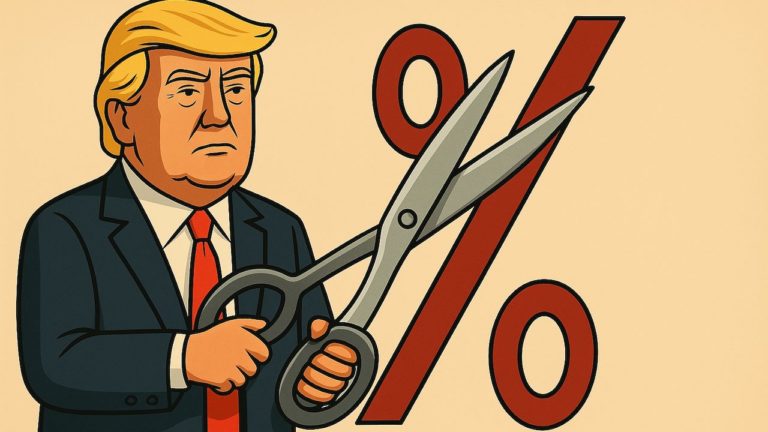
(Mike Maharrey, Money Metals News Service) President Donald Trump is pushing hard for interest rate cuts. He should be careful what he wishes for, because he is begging for more inflation.

Literally.

Trump started badgering Federal Reserve Chairman Jerome Powell about rate cuts even before his inauguration, saying last January that “interest rates are far too high.”

In fact, this running battle with Powell over rates dates back to Trump’s first term. As the Fed finally tried to normalize rates in 2017 after holding them at zero for nearly a decade in the aftermath of the 2008 financial crisis, Trump frequently criticized Powell and urged him to lower rates.

Trump got his wish after the economy became shaky and the stock market crashed in the fall of 2018. The Fed reversed course and began cutting rates. Even then, Trump wasn’t happy. He wanted deeper cuts. When the Fed only delivered a 25-basis point rate decrease in September 2019, Trump went after Powell on Twitter (now X) even though the interest rate was only at 2 percent.

“Jay Powell and the Federal Reserve Fail Again. No ‘guts,’ no sense, no vision! A terrible communicator!”

With the stock market in freefall and many analysts now worried about a looming recession due to fallout from the trade war, Trump has doubled down on his demands for lower interest rates and has ramped up his rhetoric against Powell. In a Monday post on Truth Social, Trump said many people are calling for “preemptive cuts” and claimed there is “virtually no inflation.”

“With these costs trending so nicely downward, just what I predicted they would do, there can almost be no inflation, but there can be a SLOWING of the economy unless Mr. Too Late, a major loser, lowers interest rates, NOW.”

Why Does Trump Want Rate Cuts?

As already noted, Trump’s push for low interest rates is nothing new. He recognizes the stimulative effect of easy money.

After all, he is a real estate developer. He knows that when rates are low and borrowing is easy, people can get loans and build things.

He also knows that a trade war could push the economy into recession. He’s likely calculated that he can negotiate better trade deals before that happens, but he wants the safety net of “preemptive” cuts.

This kind of “stimulus” mentality comes straight out of the Keynesian economic playbook. If there is economic weakness, the prescription is easy money and fiscal stimulus. Trump seems to hope that by starting that process now, he can avoid an economic downturn should winning the trade war take longer than expected.

Rate cuts could also slow rising Treasury yields. The recent breakdown in the bond market is problematic for a government that needs to borrow a lot of money. The U.S. is already paying more than $1 trillion per year just to service its debt. Very few people will say it out loud, but the federal government needs lower rates to facilitate its borrowing and spending habits.

In one sense, Trump is right.

This debt-riddled bubble economy can’t keep limping along in this higher interest rate environment. This is precisely why the Fed delivered a third rate cut last December while simultaneously jawboning about caution and trying to dampen expectations of more rate cuts in 2025.

It’s not just about the trade war, either. The president inherited an economic bubble pumped up by decades of Federal Reserve monetary malfeasance. And as a recent Reuters article succinctly put it, “The bubble economy is inherently fragile.”

It is certainly reasonable to argue that an economy addicted to easy money could use lower interest rates.

But there is another consideration.

The Inflation Side of the Coin

As I mentioned, the Federal Reserve is the prime culprit behind this big, fat, ugly bubble economy.

The Fed creates bubbles by injecting money directly into the economy through quantitative easing (QE). But it also increases the money supply indirectly by keeping interest rates artificially low and incentivizing debt.

Because we have a fractional reserve banking system and lenders don’t have to back their loans with 100 percent reserves, every new loan creates new money out of thin air. In effect, if a bank has $10, it can loan somebody $100.

Whether it’s accomplished through QE, low rates, or both, this money creation is, by definition, inflation, and this inflation of the money supply blows up bubbles.

What about Trump’s assertion that there is “virtually no inflation?”

He can plausibly make this argument because the last CPI report was much cooler than expected. Prices fell month-on-month, and the annual CPI was 2.4 percent, as close to the 2 percent target as we’ve seen in a long time.

But keep in mind that even when we see a “Goldilocks” CPI of 2 percent, prices are still going up by that amount every single year.

Furthermore, the CPI only measures price inflation. Rising prices are just one symptom of monetary inflation – the increase of money and credit.

When most people hear “inflation,” they think of rising consumer prices. This is exactly what Trump meant by the term. But inflation typically shows up in financial markets first. Monetary inflation blows up asset bubbles in stocks, real estate, art, and other sectors. That’s exactly what happened during the Fed’s easy money spree during the Great Recession. But the full effects didn’t hit consumer prices until the Fed doubled down on its monetary binge during the pandemic.

Consider the amount of inflation the Fed has created since the 2008 financial crisis. It pumped over $9 trillion into the economy through QE alone. On top of that, it suppressed interest rates for well over a decade.

That’s a tidal wave of inflation, and it blew up some mighty big bubbles. It also created a lot of malinvestments in the economy.

The Fed managed to cool down CPI with its rate increases and balance sheet reduction, but I’ve been saying for months that it never did enough to slay the inflation dragon.

Even so, the Fed has effectively ended the inflation fight. Keep in mind, the central bank has already cut rates three times, and it has drastically slowed balance sheet reduction.

And the fact is, monetary inflation has been on the upswing for well over a year.

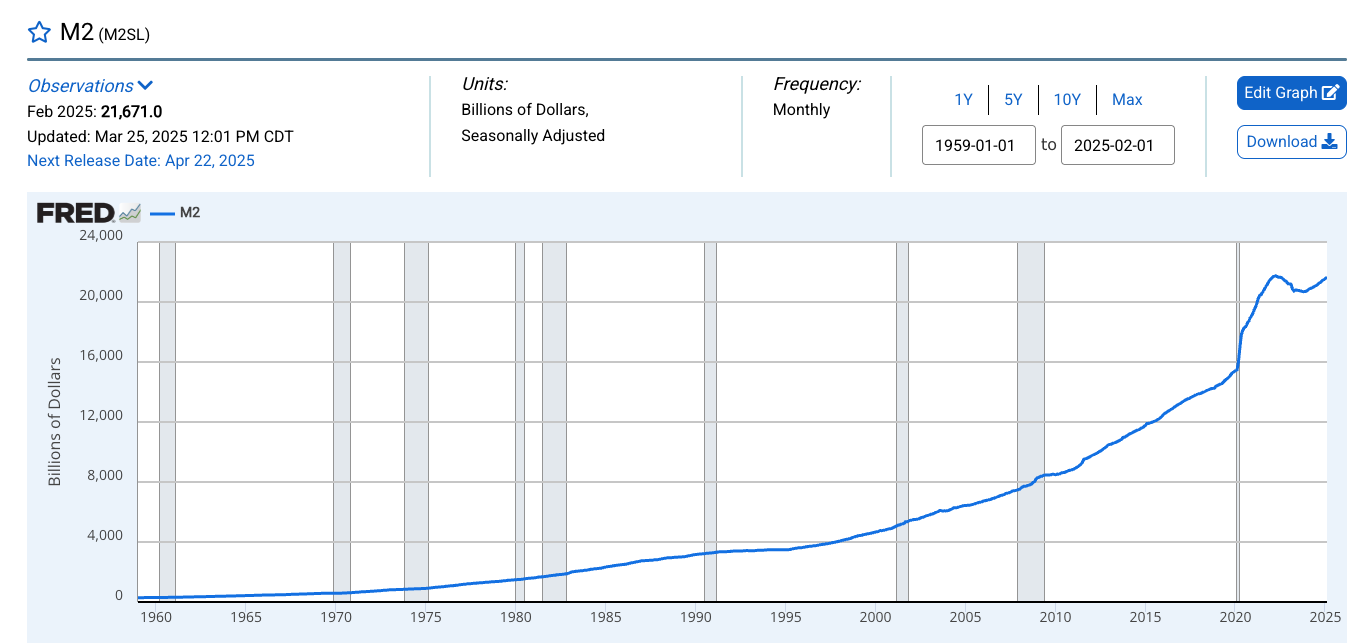
We see this in the M2 money supply. It bottomed a little over a year ago at $20.60 trillion. Since then, it has crept upward. As of February, it was at $21.67 trillion. That’s the highest level since June 2022 and approaching the all-time high of $21.72 trillion hit in the spring of that year.
We also see the ramp-up in inflation in the Chicago Fed National Financial Conditions Index. By this measure, monetary policy has been historically loose for months.

As of the week ending April 11, the NFCI stood at -0.42. A negative number reflects historically loose financial conditions.

Now, Trump wants even more looseness!

And the truth is, the markets want more looseness, too.

Even if they won’t say it out loud, everybody knows this economy is doomed without easy money.

But the fact remains that inflation is still a problem.

This is why I’ve been saying for months that the Fed is in a Catch-22. It needs to keep rates higher for longer (and I would argue it needs to raise rates) to deal with the underlying inflation problem (cooler CPI notwithstanding), and it simultaneously needs to cut rates to keep the bubble economy afloat.

Good luck with that.

Powell & Company has apparently decided the best course of action for now is inaction. They are taking a “wait and see” position, much to Trump’s chagrin.

However, at some point, the economy will force their hand.

It wouldn’t surprise me if the Fed delivered a 25-basis point cut in May or June. After all, it has the green light from the CPI report, and the stock market is a mess.

But at some point, it will become undeniable that the bottom has fallen out and the bubbles have popped. That’s when we’ll see deep rate cuts (likely back to zero) and more rounds of quantitative easing.

In other words, Trump will get his wish sooner or later.

But he needs to be careful what he wishes for because opening the inflation flood gates will inevitably lead to rising prices.

And with the dollar already weakening, we could be setting the stage for stagflation with rising prices and weak economic growth.


Mike Maharrey is a journalist and market analyst for Money Metals with over a decade of experience in precious metals. He holds a BS in accounting from the University of Kentucky and a BA in journalism from the University of South Florida.


Dow/Gold Ratio Breakdown: What’s the Downside Target for Stocks?

(Money Metals News Service) The U.S. dollar has been breaking down as capital continues to flow out of America, creating a strong tailwind for gold.

Meanwhile, the yellow metal rallied to $3,500 in last night’s overnight session but has since pulled back to trade near yesterday’s close of $3,437.

Gold Price Chart: April 21, 2025

Frenetic Chinese buying is a major driver fueling this month’s gold rally, but so is the rotation of capital out of stocks and bonds into the best-performing asset class of the year, by far.

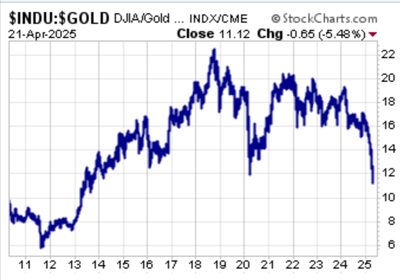
The Dow:Gold ratio is breaking down badly – i.e., stocks are doing even worse in terms of gold.

If this key ratio returns to its 2011 low, that points to a 50% further decline in stocks as compared to gold bullion.

Meanwhile, silver is trading sideways around $32.90 this morning. The “poor man’s gold” continues its underperformance to gold but has nevertheless been handily beating general U.S. stock indices.

Both buying and selling of gold coins, bars, and rounds have increased in recent days.

Premiums at Money Metals remain at multi-year lows – meaning that purchasers are able to acquire gold ounces at just a smidgeon over the global spot price.

Ryan Routh’s Attorneys Want to Suppress Evidence of Human Smuggling Activities

(Ken Silva, Headline USA) Attorneys for alleged would-be Trump assassin Ryan Routh have asked Judge Aileen Cannon to bar the Justice Department from introducing evidence that their client was in touch with a human trafficker in Mexico about smuggling Afghans into the U.S. last year—arguing that such evidence is irrelevant to whether Routh tried killing Trump last September.

Information about Routh’s human smuggling efforts was included in an April 8 motion from the DOJ, which seeks to introduce about Routh’s purported plans to kill Trump. According to that DOJ motion, Routh used aliases, he was in touch with a human smuggler in Mexico about an escape plan, and he attempted to buy both a rocket launcher and a .50 caliber sniper rifle in late August.

The DOJ’s motion stated that Routh was in touch with the Mexican smuggler, identified in court records only as “Ramiro,” since at least February 2024, when they discussed smuggling an Afghan family into the U.S.

“While this February chat involved smuggling others, it is necessary context for how that same chat evolved on September 13th and 14th, the two days before Routh set up his sniper hide at Trump International, when he contacted Ramiro for the first time since February 29,” the DOJ’s April 8 motion stated.

“On those two days, Routh told Ramiro that he would be in Mexico City in the days immediately after September 15, with Ramiro responding that he would see Routh then and that he was located four hours outside of Mexico City and with Routh replying that he would call Ramiro once he knew for sure whether he’d meet him—something Routh planned through extensive web searches about travel to Mexico.”

Responding to that information, Routh’s defense attorneys said Monday that they’re OK with the DOJ presenting evidence of their client’s communications with Ramiro from last September—but not from earlier that year.

“The February chats involved bringing a family into the United States from Mexico. In the second chat, approximately six months later, Mr. Routh simply informed Ramiro that he would be traveling to Mexico later that month,” Routh’s attorneys argued.

“These communications are better characterized as sporadic or episodic rather than evolving. The February chats are too attenuated from the charged offenses or Mr. Routh’s alleged flight to Mexico to be admissible.”

Routh’s attorneys also have no objection to evidence of Routh trying to buy a rocket launcher, sniper rifle, or that he used aliases. The defense has, however, objected to the DOJ’s move to introduce Routh’s past criminal convictions as evidence.

“Mr. Routh has no prior convictions for committing acts of extreme violence,” they argued.

Tainted Witness?

Also on Monday, the DOJ responded to Routh’s motion to exclude testimony from a witness who purportedly saw Routh flee the crime scene last September.

According to Routh’s attorneys, the FBI manipulated the witness, who is identified in court records as “T.C.M.,” into identifying their client as the man who fled Donald Trump’s Florida golf course after a Secret Service agent spotted him hiding in the nearby bushes. The defense has noted that the witness told police that the man fleeing was in his 20s (Routh was 58 at the time of his arrest) and that the Nissan X-Terra that fled the scene had a sunroof (it didn’t).

On Monday, the DOJ said the witness was highly reliable, those two mistakes notwithstanding.

“It is true the witness believed that a slim man with dyed blond hair, who was sprinting across the street in baggy clothes, was younger than Routh’s actual age. It is also possible he mistook the open window of Routh’s Xterra for a ‘sunroof.’ But that’s it,” the DOJ said.

“Defendant cites no authority for the proposition that an eyewitness’s description must be exact. On the contrary, courts examine whether the identification was reliable based on the totality of the circumstances; not whether the witness got every detail right.”

Legal issues aside, the court filings repeatedly identify the witness as a man, which runs counter to Trump’s previous statements about the witness being female.

The parties have until this Monday to reply to their respective counterparties’ motions. Routh’s next court hearing is scheduled for May 14. His trial is set for September.

Ken Silva is the editor of Headline USA. Follow him at x.com/jd_cashless.

Iran Says Israel Trying To ‘Undermine’ Tehran’s Talks With US

(Dave DeCamp, Antiwar.com) Iran’s Foreign Ministry said on Monday that Israel was seeking to “undermine” Tehran’s nuclear talks with Washington, comments that came after a report said Israel was considering a “limited” attack on Iran.

Iranian Foreign Ministry spokesman Esmaeil Baghaei said a “kind of coalition is forming… to undermine and disrupt the diplomatic process” and that the “Zionist regime is at the center of this effort.”

Baghaei added that hawks in the US are also involved in the effort to sabotage the talks. “Alongside it are a series of warmongering currents in the United States and figures from different factions,” he said.

Last week, The New York Times reported that President Trump decided not to back an Israeli plan to attack Iran, which would have involved significant US support, in favor of pursuing diplomacy.

On Friday, a report from Reuters said that Israel was still considering some sort of “limited” attack on Iran, even though it didn’t have the support of the Trump administration. The report said that Israeli officials hadn’t made a decision, and it was unclear if they would go through with the attack.

President Trump has repeatedly threatened to bomb Iran if talks on a nuclear deal fail, even though his intelligence agencies recently reaffirmed that there’s no evidence that Tehran is building a nuclear bomb or that Iranian Supreme Leader Ali Khamenei has reversed his 2003 fatwah that banned the production of weapons of mass destruction.

The negotiations between the US and Iran appear to be making progress as more talks will be held at the expert level this Wednesday to work out the details of a potential deal before another round of high-level negotiations is held this Saturday.

This article originally appeared at Antiwar.com.

Russia Welcomes US Statements Ruling Out Ukraine Joining NATO

(Dave DeCamp, Antiwar.com) The Kremlin said on Monday that Moscow welcomed statements from US officials that ruled out Ukrainian entry into NATO.

“We have heard statements made at various levels in Washington that Ukraine’s NATO membership is ruled out. This is something that brings us satisfaction and aligns with our stance,” said Kremlin spokesman Dmitry Peskov, according to TASS.

Several high-level Trump administration officials, including President Trump himself, have said that any peace deal to end the war in Ukraine would not involve Ukrainian membership in NATO.

Russia sought a guarantee from the US that Ukraine wouldn’t join NATO before it launched its invasion in February 2022, but the Biden administration refused to engage with Moscow on the issue. During short-lived peace talks in March and April of 2022, which were discouraged by the US, Russia’s main demand was for Ukrainian neutrality.

Bloomberg has reported that the US has presented a potential peace proposal for the war in Ukraine that would involve ruling out Ukrainian entry into NATO and easing sanctions on Russia. The report said the possible deal would effectively freeze the war, with Russia keeping the territory it currently controls, but other details are unclear.

Secretary of State Marco Rubio on Friday said that the US would decide in the coming days if a peace deal was possible in Ukraine. “We’re not going to continue with this endeavor for weeks and months on end. So we need to determine very quickly now, and I’m talking about a matter of days, whether or not this is doable in the next few weeks,” he said.

President Trump also said the US would “take a pass” on negotiating an end to the war if a deal isn’t reached soon. “Now, if for some reason one of the two parties makes it very difficult, we’re just going to say: ‘You’re foolish. You’re fools. You’re horrible people’ – and we’re going to just take a pass,” he said. “But hopefully we won’t have to do that.”

In the meantime, the fighting in Ukraine continues. Russian President Vladimir Putin declared a 30-hour Easter truce, although both sides accused the other of violations, and Russia announced it resumed attacks on Monday.

This article originally appeared at Antiwar.com.