(Luis Cornelio, Headline USA) Barron Trump, President Donald Trump’s youngest and tallest son, is living a relatively normal life at New York University and even has a girlfriend, despite legacy media’s obsession with every aspect of his life.
Barron has friends and a “really nice girlfriend” with whom he often hangs out, NewsNation reported on Thursday, quoting a friend of the younger Trump.
“He does have friends he just (unlike his father Donald Trump) screws the limelight,” the friend said anonymously.
He added that Barron is “much more like his mother, Melania” in that he “keeps his head down and gets on with it.”
“He is not trying to be BMOC (big man on campus),” the friend continued.
Still, that hasn’t stopped the legacy media and leftist activists from attacking him since he turned 18.
For example, a spokesperson for First Lady Melania Trump had to squash the viral conspiracy that President Trump was defunding Harvard because it rejected Barron’s college application.
“Barron did not apply to Harvard, and any assertion that he, or that anyone on his behalf, applied is completely false,” the spokesperson toldPeople Magazine.
Vanity Fair went even further, publishing a 16,000-character deep dive into Barron’s life. The leftist magazine faced backlash for quoting Kaya Walker, the former president of the NYU chapter of the College Republicans, who smeared Barron as an “oddity.” Walker was forced to resign following her bizarre comments.
Barron isn’t new to leftist attacks. As soon as he turned 18, leftist influencer Mike Sington called him “fair game.”
Sington, a self-described retired “senior executive at NBCUniversal,” quickly backtracked amid the mounting backlash.
“Someone pointed out to me ‘fair game’ could mean fair game to be harmed. I don’t wish physical harm on anyone, so I took it down. I listen to the comments and criticism I receive,” he said.
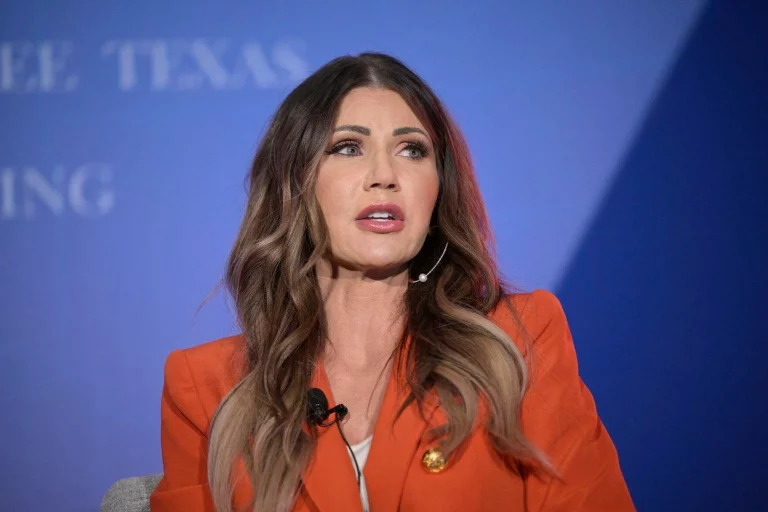
(Headline USA) A claim by Homeland Security Secretary Kristi Noem that an immigrant threatened the life of President Donald Trump has begun to unravel.
Noem announced an arrest of a 54-year-old man who was living in the U.S. illegally, saying he had written a letter threatening to kill Trump and would then return to Mexico. The story received a flood of media attention and was highlighted by the White House and Trump’s allies.
But investigators actually believe the man may have been framed so that he would get arrested and be deported from the U.S. before he got a chance to testify in a trial as a victim of assault, a person familiar with the matter told The Associated Press. The person could not publicly discuss details of the investigation and spoke to the AP on condition of anonymity.
The DHS touted the arrest this week of an illegal immigration who allegedly threatened to kill Trump, but it turns out that was likely a hoax. The illegal immigrant is set to testify in a trial against someone who assaulted him, and it's believed that the letter was sent to get… pic.twitter.com/TJpJxwkhJE
Law enforcement officials believe the man, Ramon Morales Reyes, never wrote a letter that Noem and her department shared with a message written in light blue ink expressing anger over Trump’s deportations and threatening to shoot him in the head with a rifle at a rally. Noem also shared the letter on X along with a photo of Morales Reyes, and the White House also shared it on its social media accounts. The letter was mailed to an Immigration and Customs Enforcement office along with the FBI and other agencies, the person said.
As part of the investigation, officials had contacted Morales Reyes and asked for a handwriting sample and concluded his handwriting and the threatening letter didn’t match and that the threat was not credible, the person said. It’s not clear why Homeland Security officials still decided to send a release making that claim.
In an emailed statement asking for information about the letter and the new information about Morales Reyes, the Department of Homeland Security said “the investigation into the threat is ongoing. Over the course of the investigation, this individual was determined to be in the country illegally and that he had a criminal record. He will remain in custody.”
His attorneys said he was not facing current charges and they did not have any information about convictions in his record.
Immigration and Customs Enforcement’s records show Morales Reyes is being held at a county jail in Juneau, Wisconsin, northwest of Milwaukee. The Milwaukee-based immigrant rights group Voces de la Frontera, which is advocating for his release, said he was arrested May 21. Attorney Cain Oulahan, who was hired to fight against his deportation, said he has a hearing in a Chicago immigration court next week and is hoping he is released on bond.
Morales Reyes had been a victim in a case of another man who is awaiting trial on assault charges in Wisconsin, the person familiar with the matter said. The trial is scheduled for July.
Morales Reyes works as a dishwasher in Milwaukee, where he lives with his wife and three children. He had recently applied for a U visa, which is carved out for people in the country illegally who become victims of serious crimes, said attorney Kime Abduli, who filed that application.
The Milwaukee Police Department said it is investigating an identity theft and victim intimidation incident related to this matter and the county district attorney’s office said the investigation was ongoing. Milwaukee police said no one has been criminally charged at this time.
Abduli, Morales Reyes’ attorney, says he could not have written the letter, saying he did not receive formal education and can’t write in Spanish and doesn’t know how to speak English. She said it was not clear whether he was arrested because of the letters.
“There is really no way that it could be even remotely true,” Abduli said. “We’re asking for a clarification and a correction from DHS to clear Ramon’s name of anything having to do with this.”
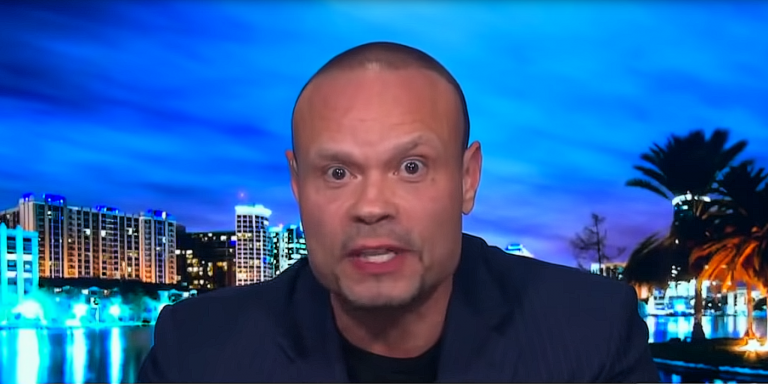
(Ken Silva, Headline USA) FBI Deputy Director Dan Bongino has claimed that the bureau has video proving that deceased multimillionaire sex trafficker Jeffrey Epstein killed himself. However, the DOJ Inspector General has already released a report stating that no such video footage exists.
Bongino made his implausible claim in an interview with Fox & Friends that aired Thursday.
“There’s video clear as day. He’s the only person in there and the only person coming out. You can see it,” he said. A Fox & Friends host asked him if there’s video of Epstein actually hanging himself. While that doesn’t exist, the available footage shows Epstein was alone in his cell on the night he died, according to Bongino.
“There is video and when you look at the video — and we will release it, we’re working on cleaning it up to make sure you have an enhanced – and we will give the original so you don’t think there are any shenanigans – you will see no one in there but him. There’s just nobody there,” Bongino said.
“I say to people of the time — if you have a tip, let us know — but there is no DNA, there’s no audio, there’s no fingerprints, there’s no suspects, there’s no accomplices, there’s no tips. There is nothing. If you have it, I’m happy to see it.”
Bongino’s claims run counter to a DOJ-OIG report released in 2023, which showed that only two cameras in Epstein’s housing unit were recording—and that those cameras had numerous blind spots. For instance, the camera in Epstein’s cell block, which had at least three other inmates, wasn’t recording. Nor was the camera covering one of the elevator bays that led to Epstein’s floor.
Again, Bongino's claim is impossible. Epstein had three other inmates on his cell block, and the camera there wasn't recording. Even if no one came to kill Epstein from the outside, we can't rule out these other inmates.
According to the DOJ-OIG report, prison officials actually knew about the malfunctioning cameras the day before Epstein died.
Inspector General Michael Horowitz said his staff interviewed an MCC technician, who started to repair the cameras on Aug. 8, 2019, but did not finish his work. The technician told the inspector general he had “no idea” why he did not stay at the facility to resolve the problem that day.
Epstein’s death was ruled a suicide by hanging after he was found dead in his jail cell on August 10, 2019. But his lawyers contested that claim. Skeptics point to malfunctioning surveillance cameras, sleeping guards, and broken bones in Epstein’s neck as indications that his death was something other than suicide.
Because of Epstein’s extensive fraternization with high-profile politicians and celebrities such as Bill Clinton, former Israeli PM Ehud Barak, Prince Andrew and Bill Gates and many more, some claim that Epstein’s death was actually a hit job to silence him. Proponents of that theory include Epstein’s former partner, Ghislaine Maxwell, who’s serving a 20-year prison sentence for sex trafficking.
“I believe that he was murdered. I was shocked, and I wondered, ‘How did this happen?’ Because I was sure he was going to appeal, and I was sure he was covered by the non-prosecution agreement,” Maxwell told British reporter Jeremy Kyle of TalkTV in 2023.
The non-prosecution agreement referenced by Maxwell was a sweetheart deal Epstein signed with the Department of Justice in 2008, in which he pleaded guilty to a state charge of procuring for prostitution a girl below the age of 18. Epstein was housed in a private wing of the Palm Beach County Stockade, and was reportedly allowed to leave the jail on “work release” for up to 12 hours a day.
After the Miami Herald published an expose on Epstein and his non-prosecution agreement in late 2018, Epstein was arrested again on July 6, 2019, on federal charges for the sex trafficking of minors in Florida and New York.
Ken Silva is the editor of Headline USA. Follow him at x.com/jd_cashless.
(Ken Silva, Headline USA) Michigan Gov. Gretchen Whitmer says President Donald Trump would be going back on his word to her if he pardoned two men whom multiple courts have found were baited by the FBI into a phony plot to kidnap her in 2020.
Whitmer, a Democrat, told Michigan Public Radio on Thursday that Trump asked her about a month ago how she would feel if he pardoned the two men.
“I said, ‘I think it would be the wrong decision,’” Whitmer recounted. “I would oppose it and he said, ‘OK, I’ll drop it.’”
Whitmer, a possible 2028 presidential candidate, recounted the conversation one day after Trump said he was considering a pardon for the men, saying, “I will take a look at it. It’s been brought to my attention.”
Gov. Whitmer conspired with the FBI to frame a group of men for a fake kidnapping plot. Whitmer picked the date and time of the FBI-planned recon of her vacation cottage the guys were duped into going on under false pretense. This is entrapment and it's illegal. Half of these men… https://t.co/ChgFYt50hk
The Republican president said he followed the men’s trial and “it looked to me like somewhat of a railroad job.” He said the men “were drinking and I think they said stupid things.”
The U.S. Justice Department’s new pardon attorney also said this month he would take a “hard look” at pardoning Barry Croft Jr. and Adam Fox.
Croft, 49, and Fox, 42, were portrayed as leaders of the kidnapping scheme. After an initial mistrial in early 2022, they were convicted of conspiracy in federal court later that year. Croft, a trucker from Delaware, was also found guilty of a weapons charge.
Croft and Fox were convicted despite evidence that that at least 12 undercover FBI informants and agents pushed them to formulate a plan against Whitmer—much of which they were never able to present to a jury. The Sixth Circuit Appeals Court even admitted earlier that the FBI fomented the Whitmer plot, but justices upheld the convictions anyway.
“The Defendants are correct that the government encouraged them to settle on a plan,” the Sixth Circuit ruled on April 1, referring to the informants and undercover agents who repeatedly encouraged militias to engage in criminality throughout 2020. “But as the government points out in its supplemental briefing, the jury heard the substance of most of these statements and yet still convicted both Fox and Croft.”
This is batshit crazy: "The defendants are correct that the government encouraged them to settle on a plan … but a jury of sub-literates convicted them so we're affirming convictions anyway" OK I'm paraphrasing the last part a little, but still. This is the American justice… https://t.co/vBeReElDDkpic.twitter.com/0GopBBdDth
Croft is serving nearly 20 years in prison, while Fox, a Grand Rapids man, is serving a 16-year term. They are being held at a prison in Colorado — the most secure in the federal system.
Meanwhile, state defendants Paul Bellar, Joe Morrison and Pete Musico are also serving seven-year, 10-year and 12-year prison sentences, respectively, due to state charges stemming from the Whitmer case.
Like with the federal case, the state defendants were convicted despite a judge acknowledging that the FBI fomented the plot to kidnap Whitmer. In the state case, Michigan Judge Thomas Wilson acknowledged in January that the III%er militias involved in the Whitmer kidnap plot were created by the FBI.
“The ‘3%’groups were established across the country and were created by the FBI,” Judge Wilson said. “The FBI used assets from other 3% groups in forming the Michigan 3% group.”
But even though the defendants weren’t allowed to present that evidence at their trial, they were able to do so during a pretrial entrapment hearing in 2022, the judge said. Their arguments were unsuccessful at the time, and Judge Wilson declined to change his mind in his recent decision, which was made on Jan. 24.
Whitmer was never physically harmed. Newly appointed DOJ pardon attorney Ed Martin Jr. called it a “fed-napping” plot last week on “The Breanna Morello Show.”, not a kidnapping plot, apparently referring to the numerous undercover FBI agents and informants who had infiltrated the group and built the case.
The White House did not immediately respond to an email seeking comment on Whitmer’s remarks.
Whitmer and Trump clashed publicly during his first term, with Trump referring to her as “that woman from Michigan.” She has blamed Trump for the political anger that motivated the plot to kidnap her right before the 2020 presidential election. That year, she also appeared on a television interview with “8645” written in the background—an apparent dog whistle to assassinate Trump. Former FBI Director James Comey is currently under investigation for posting a similar message.
Whitmer has faced scrutiny from some Democrats for taking a more collaborative approach to the Trump administration in his second term.
Michigan Attorney General Dana Nessel, a Democrat who has criticized Whitmer for working with and appearing with Trump, said releasing the convicted men is “no laughing matter.”
The reward you get for cozying up to Trump is him threatening to pardon the terrorists who plotted to kidnap and murder you.
These criminals are a threat to public safety and law enforcement. Releasing them is no laughing matter. https://t.co/cJt7L5zc7u
(Brett Rowland, The Center Square) President Donald Trump accused China on Friday of breaking a short-term trade deal with the U.S.
Earlier this month, the two countries reached a 90-day deal to reduce high tariffs on trade between the world’s two largest economies. The global superpowers agreed to slash tariffs that had been so high that nearly all trade between the two nations stopped. The U.S. reduced its tariffs on China from 145% to 30% while the two nations continued to talk. China cut its levies on U.S. imports from 125% to 10%.
“China, perhaps not surprisingly to some, HAS TOTALLY VIOLATED ITS AGREEMENT WITH US. So much for being Mr. NICE GUY!” Trump wrote on Truth Social.
U.S. markets retreated on the news in what has been a challenging month for investors.
Trump also lashed out at the three judges on the U.S. Court of International Trade who unanimously ruled on Wednesday that Congress did not give tariff authority to the president under the International Emergency Economic Powers Act of 1977. That court voided most of Trump’s tariffs, but the administration appealed the decision to a higher court, which paused the Court of International Trade ruling for now.
“Where do these initial three Judges come from? How is it possible for them to have potentially done such damage to the United States of America?” Trump wrote on Truth Social. “Is it purely a hatred of ‘TRUMP?’ What other reason could it be?”
The Court of International Trade said the International Emergency Economic Powers Act of 1977 didn’t give Trump “unbounded” authority to set tariffs. The ruling was a setback for Trump’s foreign and domestic policy agenda, which is underpinned by tariffs.
“Worldwide and Retaliatory Tariffs do not comply with the limitations Congress imposed upon the President’s power to respond to balance-of-payments deficits,” the Court of International Trade judges wrote. “The President’s assertion of tariff-making authority in the instant case, unbounded as it is by any limitation in duration or scope, exceeds any tariff authority delegated to the President under IEEPA.”
On Thursday, the Trump administration filed an emergency motion asking for a stay.
“The injunction threatens to unwind months of foreign policy decision-making and sensitive diplomatic negotiations, at the expense of the Nation’s economic well-being and national security,” DOJ attorneys wrote.
The appeals court granted the stay Thursday afternoon.
“The ruling by the U.S. Court of International Trade is so wrong, and so political!” Trump wrote. “Hopefully, the Supreme Court will reverse this horrible, Country threatening decision, QUICKLY and DECISIVELY. Backroom ‘hustlers’ must not be allowed to destroy our Nation!”
Trump made it clear he didn’t want to work with Congress on tariffs.
“The horrific decision stated that I would have to get the approval of Congress for these Tariffs. In other words, hundreds of politicians would sit around D.C. for weeks, and even months, trying to come to a conclusion as to what to charge other Countries that are treating us unfairly,” Trump wrote. “If allowed to stand, this would completely destroy Presidential Power – The Presidency would never be the same!”
(Sarah Roderick-Fitch, The Center Square) Deportation of nearly 500,000 people illegally in the country was cleared by the U.S. Supreme Court on Friday morning, handing a victory to the Trump administration.
The decision puts a hold on a lower court’s decision to allow people from Cuba, Haiti, Nicaragua and Venezuela to remain in the U.S. for two years through a Biden era decision. The case will continue to play out in lower courts.
Judge Indira Talwani of the U.S. District Court for the District of Massachusetts blocked an executive order from President Donald Trump instructing Homeland Security Secretary Kristi Noem to “terminate all categorical parole programs,” which included the CHNV (Cuba, Haiti, Nicaragua and Venezuela parole program).
“DHS awards the parole status through a competitive and detailed application process that involves a rigorous, individualized assessment of the applicant’s circumstances,” the justices said.
In the decision filed in the Boston court detailed in the Supreme Court’s ruling, Talwani said Noem “acted arbitrarily and capriciously, contrary to law, and in excess of her legal authority by prematurely terminating their parole.”
The court did not sign the order; however, Justices Sonia Sotomayor and Ketanji Brown Jackson dissented from the ruling.
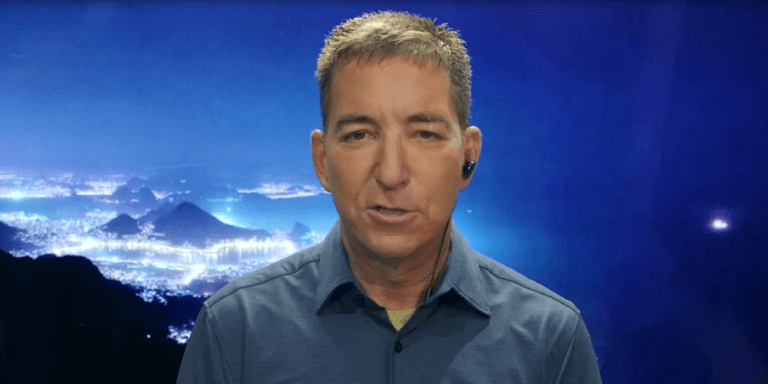
(Ken Silva, Headline USA) Pulitzer Prize-winning journalist Glenn Greenwald said Friday that he’s being maliciously targeted after videos circulated online the night before, showing him engaging in sexually explicit acts with another man.
Videos of Greenwald, who is openly gay, circulated Thursday night on Twitter/X, showing him in sexual acts with a Brazilian man. Out of respect for Greenwald’s privacy, Headline USA is not sharing the video or describing its contents. Screenshots circulated online showing that Greenwald apparently retweeted the video before deleting it.
Greenwald, who broke numerous prize-winning stories based on the leaks of ex-NSA contractor Edward Snowden, confirmed the videos’ authenticity Friday morning. He said he’s close to finding out who leaked the videos, and that he believes he was targeted for political reasons.
“Last night, videos were released online depicting behavior in my private life. Some were distorted and others were not. They were published without my knowledge or consent and its publication was therefore criminal,” he said, adding that he wasn’t embarrassed by the videos.
“They all display fully consensual behavior, harming nobody … the only wrongdoing here is the criminal and malicious publication of the videos in an attempt to malign perceived political enemies and advance a political agenda.”
Greenwald was once popular among liberals, but became a pariah when he became a critic of the FBI’s politically motivated Russia collusion investigation into the 2016 Trump campaign. He continued to criticize Democrats under the Biden administration over the Ukraine war, internet censorship and other issues.
More recently, Greenwald has become a vocal critic of Israel’s mass slaughter of Palestinians.
That Piers Morgan of all people — who justified Israel's destruction of Gaza for months — is treating an Israeli official this way shows the massive sea change in global opinion.
And: nobody is petrified now when Israel screams "blood libel!" It lost its sting from overuse: https://t.co/Yqg4CG56mB
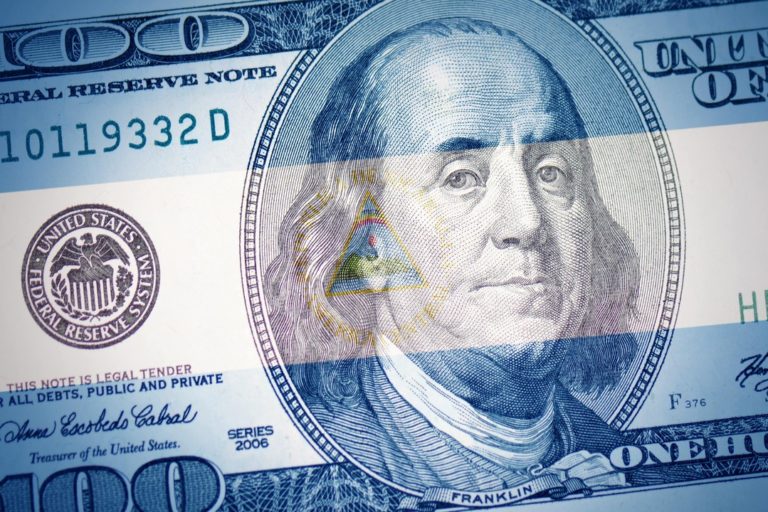
(Jesse Colombo, Money Metals News Service) The U.S. Dollar Index is at a critical inflection point, and how it behaves from here will have a major impact on the direction of gold, silver, and commodities.
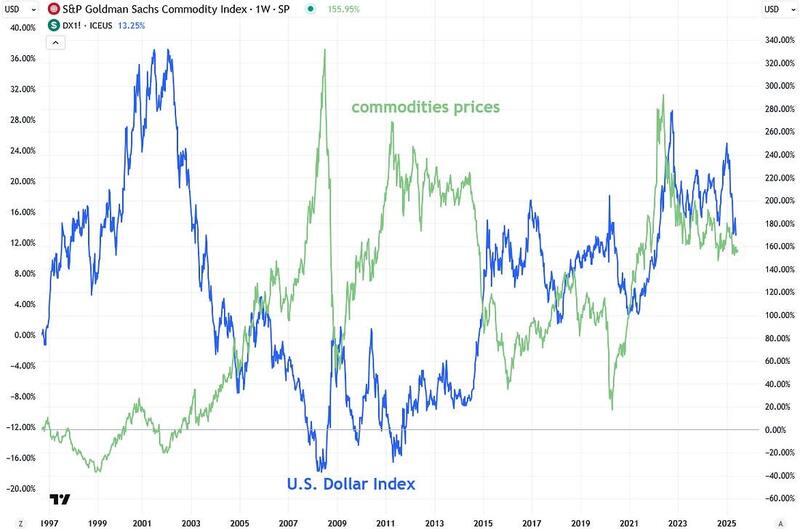
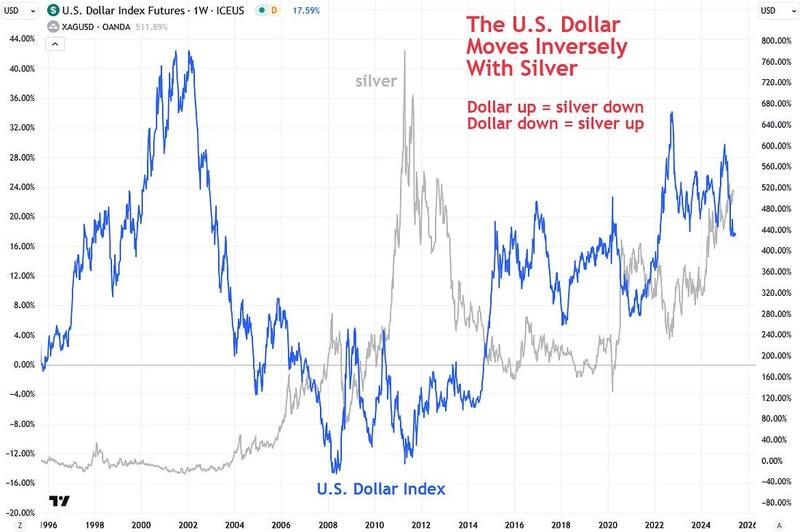
As a quick reminder, the U.S. dollar typically trades inversely with commodities—when the dollar rises, commodity prices often fall, and vice versa. This is where intermarket analysis comes into play—a method of examining related markets to gain insights and anticipate moves across asset classes.
As a reminder, I track the dollar via the U.S. Dollar Index—a measure of the dollar’s exchange rate against a basket of major world currencies (not its purchasing power).
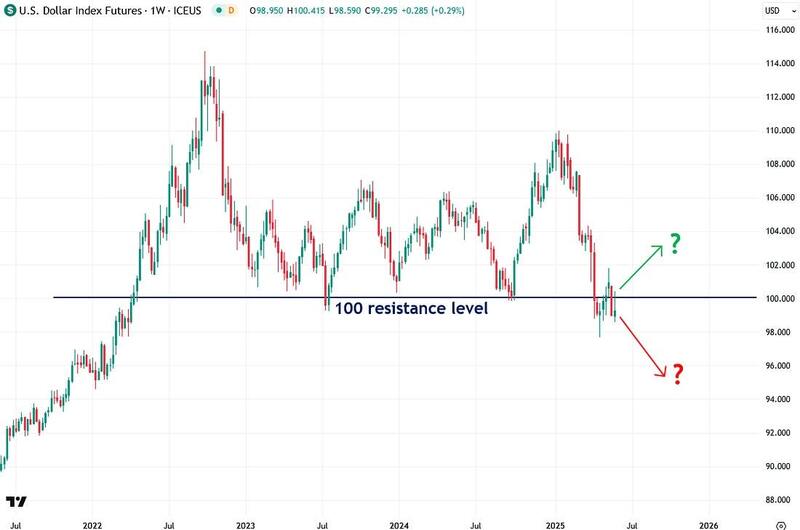
I’ve been highlighting how the U.S. Dollar Index has been teetering on the critical 100 level—a key technical support that dates back to 2023. Since then, several major dollar rallies have originated from this level, often exerting downward pressure on commodity prices—including gold and silver.
However, it’s noteworthy that the index has now broken below this key threshold, signaling an important shift in trend. If the dollar remains below 100, it would strongly indicate that further weakness lies ahead—an important bullish development for gold, silver, and the broader commodities complex.
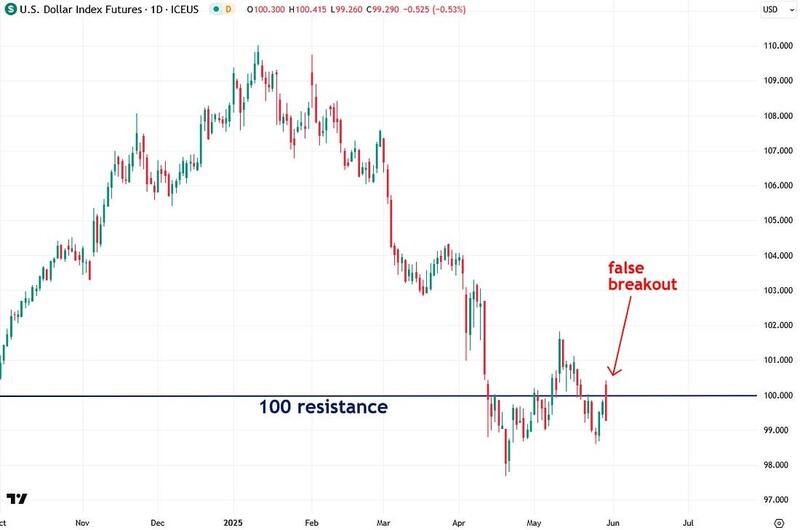
Zooming in on the daily Dollar Index chart, it’s important to note that the index hasn’t cleanly broken down yet. Instead, it has been chopping back and forth around the key 100 level, creating a series of false moves and overall choppy, indecisive price action. However, I believe that once the dollar commits to a direction, the resulting move will be significant.
As of yesterday, the dollar is trading sharply lower—giving a lift to gold and silver—after a hit to market confidence stemming from a U.S. Court of International Trade ruling on Wednesday night. The court found that President Trump exceeded his authority in imposing “reciprocal” tariffs and ordered those measures to be vacated.
Adding to the pressure, Moody’s recent downgrade of U.S. debt has further eroded confidence in the dollar, contributing to its ongoing weakness.
As a result of yesterday’s decline, the U.S. Dollar Index has once again slipped below the 100 level, signaling that another attempt to reclaim that key threshold has failed—a clear sign of weakness. If the index can finally remain below 100, there’s a strong chance it will continue to slide toward multi-year lows—a scenario that would be a major tailwind for precious metals investors. This is a critical development worth watching closely.
Although I’ve emphasized the longstanding inverse relationship between the U.S. dollar and commodities, it’s especially helpful to see that correlation visually:
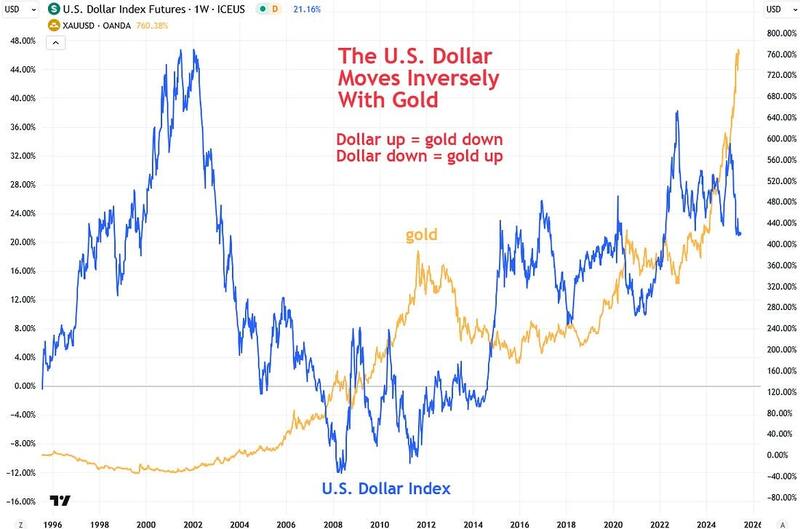
You can also clearly see the inverse relationship between the U.S. dollar and gold:
Gold has been taking a healthy pause, trading in a consolidation range between $3,200 and $3,500 over the past month.
If the U.S. Dollar Index finally holds below the critical 100 level, it should provide the fuel gold needs to break out of that range and resume its upward trajectory—likely targeting the $4,000 level next. That’s a major technical and psychological milestone, and such round numbers often act like price magnets.
This is an exciting setup worth keeping a close eye on.
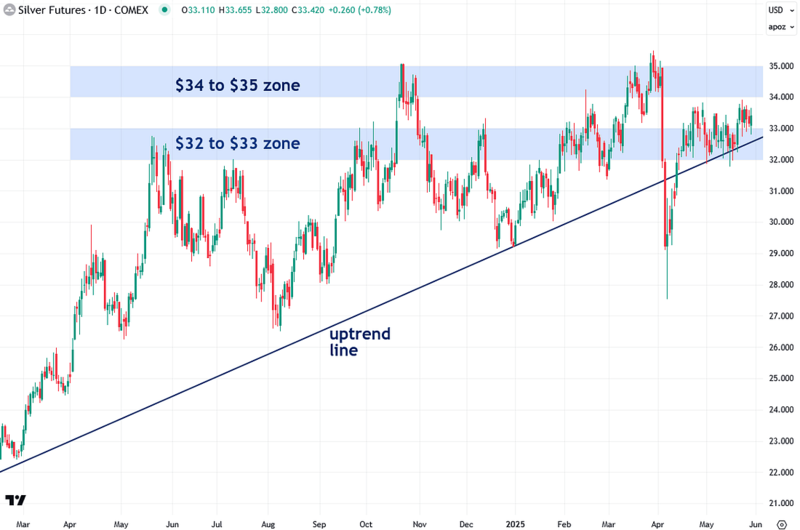
Similarly, silver has spent the past year trading beneath two major resistance zones—$32–$33 and $34–$35—even as gold has surged ahead, much to the frustration of silver bulls. However, there are numerous compelling reasons to remain bullish on silver.
If the U.S. Dollar Index continues to weaken, it may be the catalyst silver needs to finally break through those resistance levels. Once that breakout occurs, I believe silver will accelerate quickly toward $40, $50, $60, and ultimately much higher.
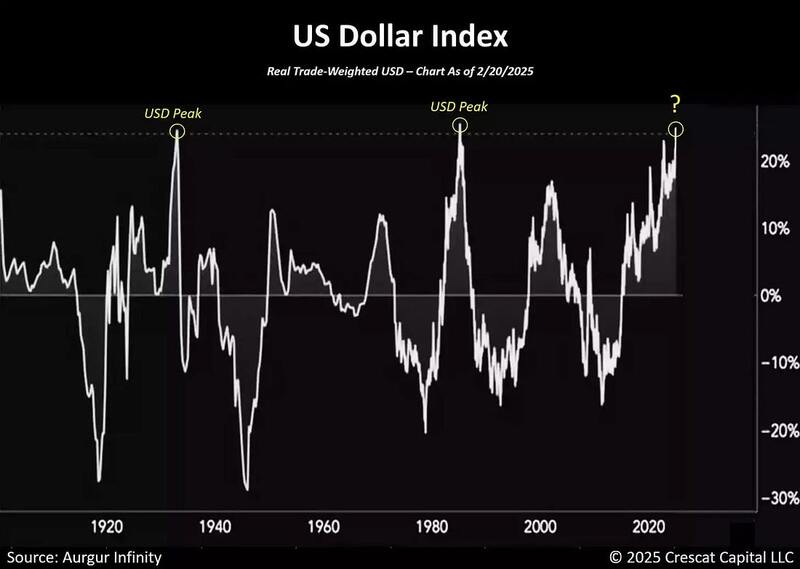
It’s important to recognize the high probability of a coming U.S. dollar bear market, largely due to how historically overvalued the dollar has become relative to other major currencies.
In fact, based on over 120 years of data, such extreme overvaluation has only occurred twice before—in 1933 and 1985—both of which were followed by substantial dollar declines.
The dollar’s unusual strength in recent years has been a major factor keeping commodity prices much lower than they would ordinarily be. However, an impending correction in the dollar’s value should trigger a powerful bullish surge across the commodities sector, including assets like copper, gold, silver, and mining stocks.
One of the key reasons the U.S. dollar remains so strong relative to other currencies is the massive—and unsustainable—bubble in U.S. equities, particularly in tech stocks like Nvidia and Microsoft. This has attracted a surge of foreign capital into U.S. markets, driving demand for dollars and pushing the currency much higher.
Interestingly, we saw a similar dynamic during the late 1990s dot-com bubble. When that bubble eventually burst, the dollar weakened significantly, helping to ignite the early 2000s commodities supercycle. I believe we’re on the verge of a similar pattern playing out once today’s stock market bubble finally unravels in a major way.
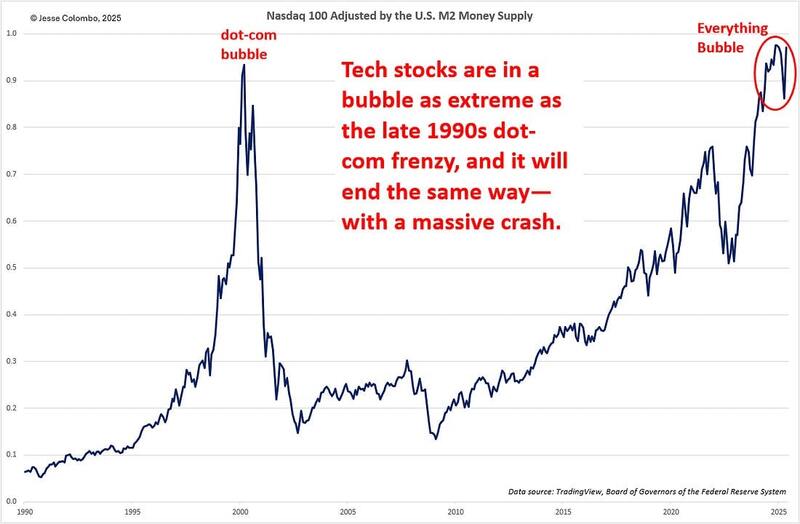
Numerous valuation metrics confirm that U.S. stocks—especially tech—are deep in bubble territory.
One striking example is the Nasdaq 100 relative to the U.S. M2 money supply, which shows that tech stocks have become severely overextended. The chart reveals clear parallels to the dot-com bubble, and unfortunately, I believe the outcome will be the same.
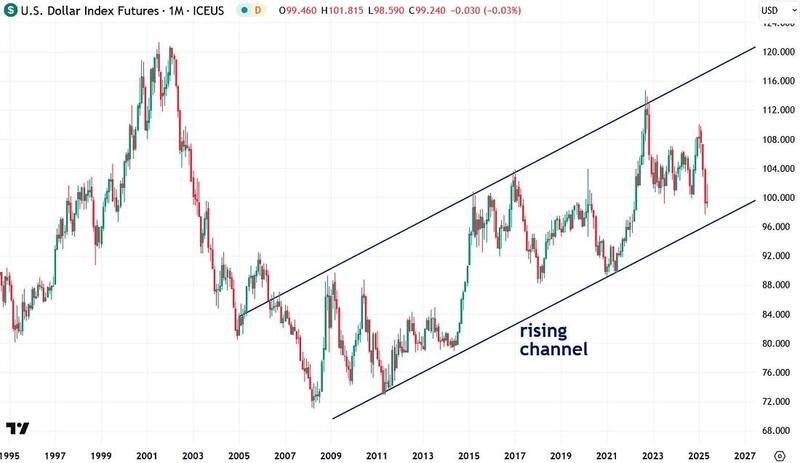
A look at the long-term U.S. Dollar Index chart reveals that it has been trading within a rising channel since around 2008. I believe an eventual breakdown from this channel would be a key signal that the dollar is entering a new bear market—much like the one that occurred in the early 2000s.
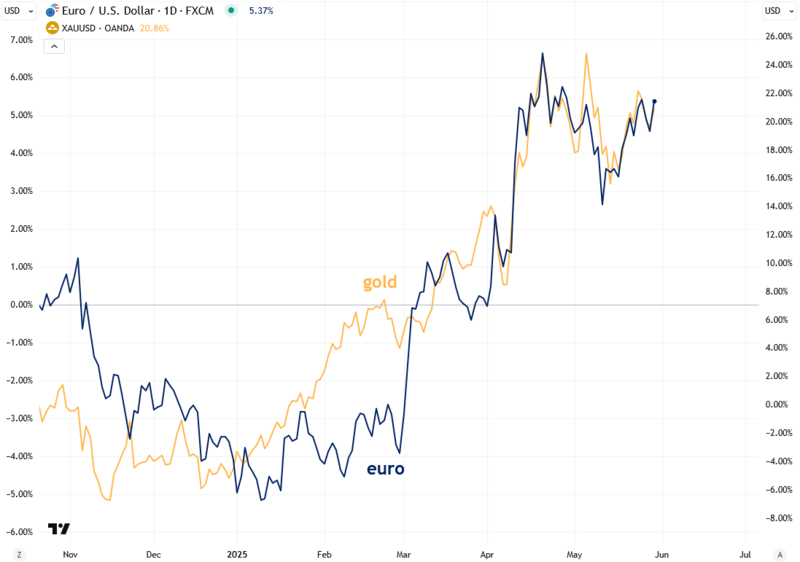
As the chart below illustrates, the euro and gold have been moving in close lockstep in recent months. If this nascent euro breakout gains traction, it should serve as a powerful catalyst for gold—potentially propelling it to $4,000 and beyond.
I believe this gold bull market is still in its early stages, with the potential to reach at least $15,000 an ounce over the next 5 to 10 years.
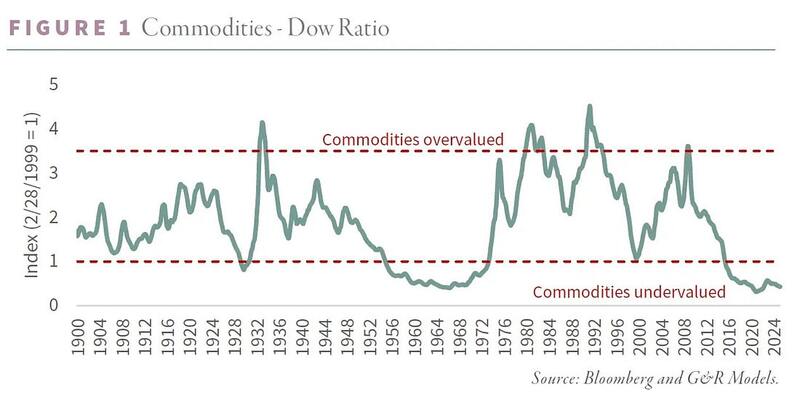
I previously mentioned the early-2000s commodities supercycle and why I believe another one is on the horizon—driven in large part by the U.S. dollar’s extreme overvaluation, which I expect will lead to a prolonged bear market. There’s further confirmation of this thesis in the commodities-to-Dow ratio, which shows that commodities remain extremely undervalued relative to stocks.
Historically, such imbalances don’t last; they tend to normalize over time—likely through a powerful commodities boom and a significant correction in equity markets. This aligns with my broader view that we’re in the early stages of a major capital rotation out of overvalued stocks and into still-undervalued gold and silver.
I hope you found this analysis helpful. It also serves as a great example of intermarket analysis—a method I strongly believe in and rely on heavily, both in this newsletter and in my own investing. Intermarket analysis involves examining one asset, such as the U.S. dollar, to gain insights into how correlated assets—whether positively or negatively correlated, like commodities or the euro—are likely to behave. This approach often reveals key market signals and turning points that might be missed when analyzing assets in isolation.
Intermarket analysis is a lesser-known but incredibly powerful technique. If you’d like to dive deeper into it, I highly recommend Intermarket Analysis by John Murphy—it’s one of my all-time favorite market books and an essential read for anyone serious about understanding cross-market relationships. Trust me, you won’t be disappointed.
Another book worth exploring is Intermarket Analysis and Investing by Michael E.S. Gayed, which I’ve heard great things about and recently picked up myself.
To sum up, the U.S. Dollar Index is at a critical inflection point as it hovers around the key 100 technical level. How it behaves from here will have a major impact on the direction of gold, silver, and other commodities.
My longer-term bias remains firmly to the downside, given how historically overvalued the dollar is—indicating that the path of least resistance is lower. If that scenario plays out, I expect a powerful commodities boom, with gold surging to $4,000 and silver climbing to $50+. I’ll be monitoring this closely and will keep you updated as it unfolds.
If you found this report valuable, click here to subscribe to The Bubble Bubble Report for more content like it.
Jesse Colombo is a financial analyst and investor writing on macro-economics and precious metals markets. Recognized by The Times of London, he has built a reputation for warning about economic bubbles and future financial crises. An advocate for free markets and sound money, Colombo was also named one of LinkedIn’s Top Voices in Economy & Finance. His Substack can be accessed here.
(Mike Maharrey, Money Metals News Service) The U.S. government has an interest problem. Just how bad is it?
Really bad.
Most people intuitively understand that massive budget deficits aren’t sustainable. They recognize you can’t live indefinitely on a credit card.
Granted, it is fair to say government finance isn’t the same as personal finance, nevertheless, Joe Sixpack’s intuition is on target. Uncle Sam can’t keep borrowing and spending at the current pace forever. Eventually, the debt bubble will pop, and that moment looms closer with each passing day.
We’re starting to see warning signs.
After Moody’s downgraded the U.S. credit rating, bonds sold off, causing interest rates to spike. The 10-year Treasury yield surged to nearly 4.6 percent, and the 30-year approached a level not seen in nearly 18 years. This reflects waning demand for U.S. Treasuries.
And it makes sense. Would you loan your drunk uncle with a spending problem more money?
The slide in demand for Treasuries exacerbates a growing problem for the federal government. In simple terms, it means the government’s borrowing cost is rising. The more interest Uncle Sam has to pay, the more money has to borrow, creating an upward spiraling feedback loop.
How Much Is the Government Spending on Interest
Interest expense is already getting out of hand.
Interest on the national debt cost $101.7 billion in April alone. That brought the total interest expense for the fiscal year to $684.1 billion, up 9.5 percent over the same period in 2024.
So far, in fiscal 2025, the federal government has spent more on interest on the debt than it has on national defense or Medicare. The only higher spending category is Social Security.
Uncle Sam paid $1.13 trillion in interest expenses in fiscal 2024. It was the first time interest expense had ever eclipsed $1 trillion. Projections are for interest expense to break that record in fiscal 2025.
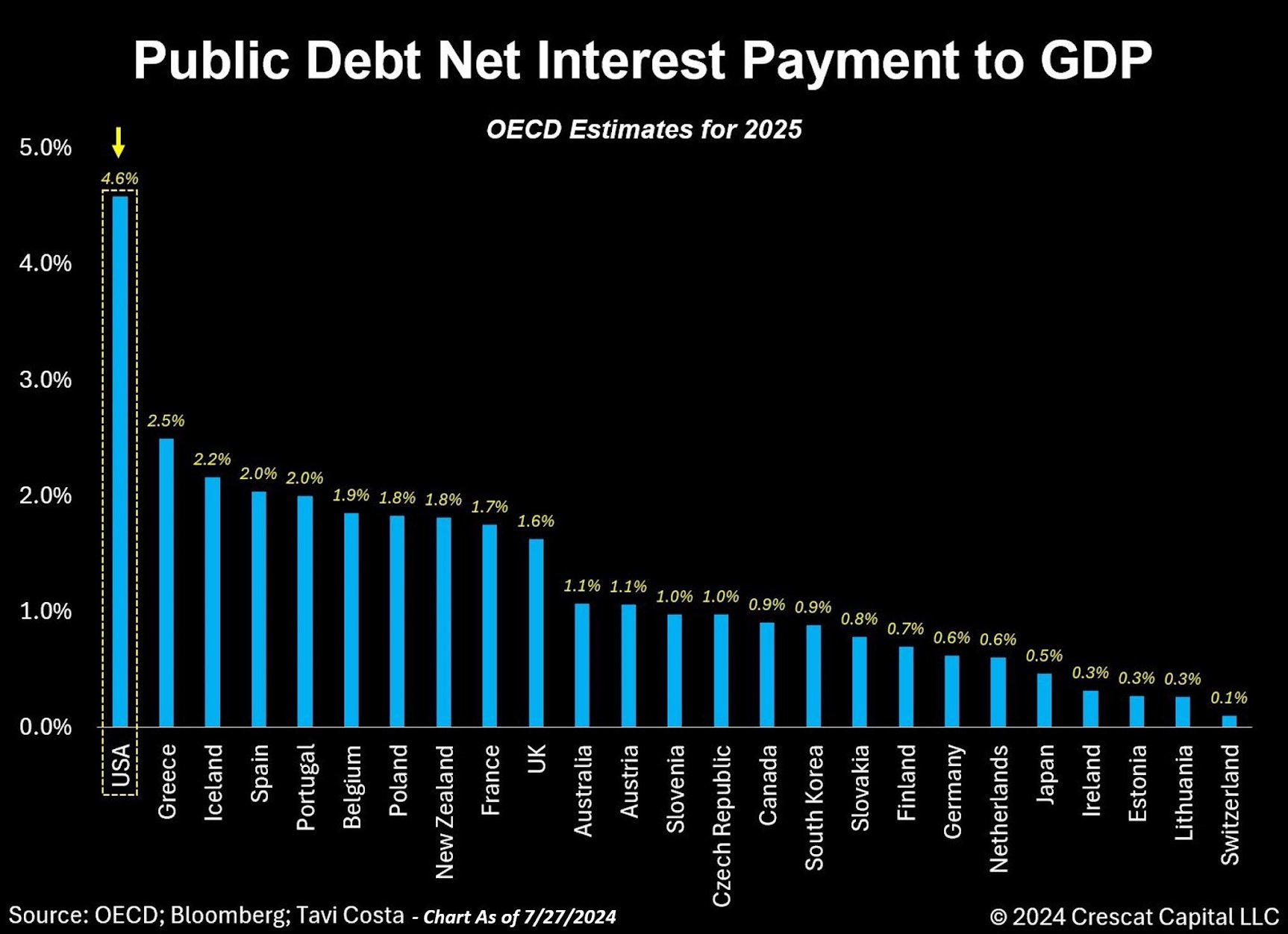
The United States has the highest debt interest payment to GDP ratio of any developed economy. It’s currently around 4.6 percent. That’s ahead of Greece at a mere 2.5 percent.
How’s that for “America First?”
The Interest Problem Is Only Going to Get Worse
Interest expense is rapidly increasing because debt that was financed when the Fed had rates pushed to zero is maturing. The federal government can’t just pay those bonds off. It must borrow more money to pay back prior borrowers. This maturing debt is being refinanced at much higher rates.
And there is a lot of debt to be refinanced coming down the pike.
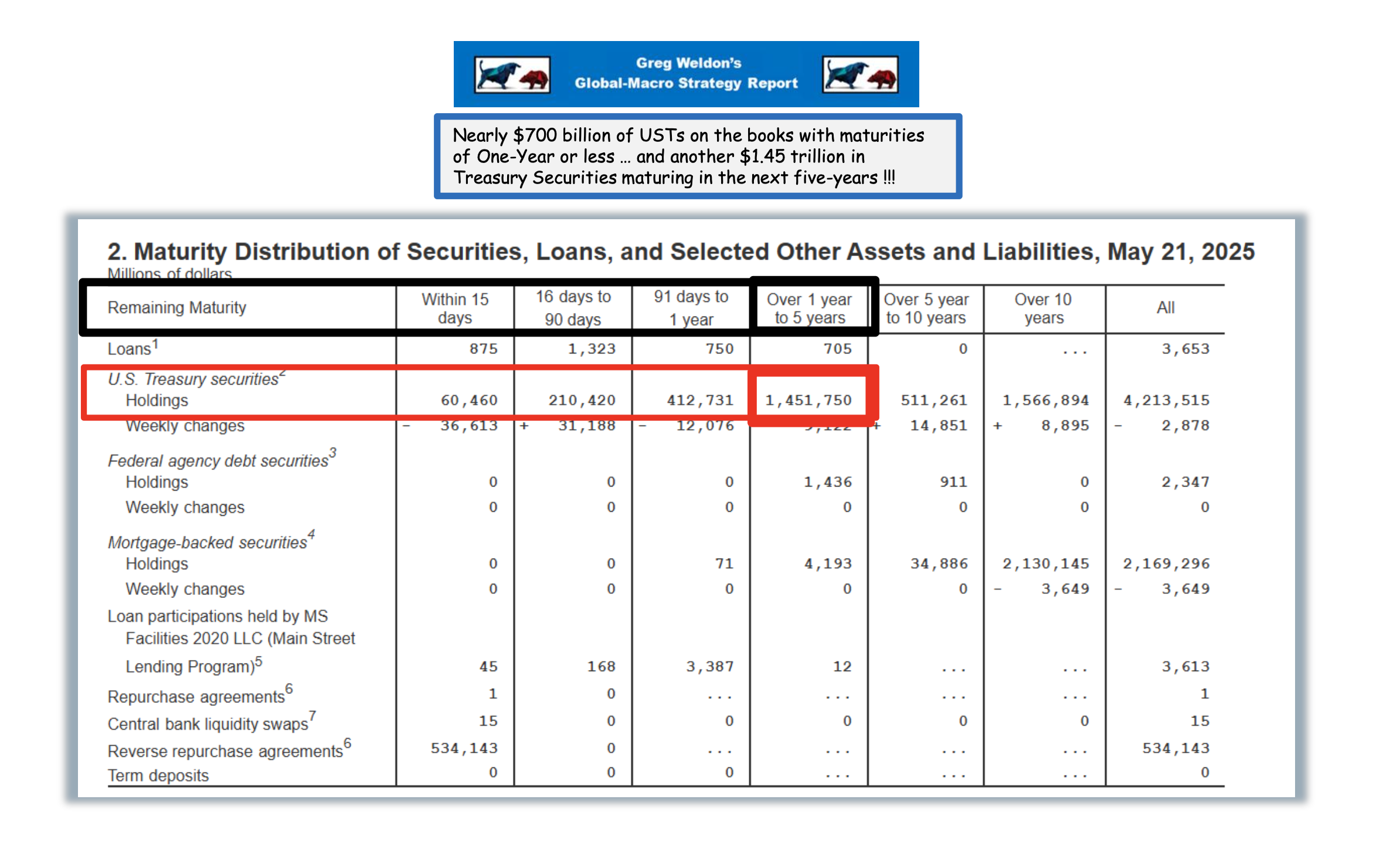
There are nearly $700 billion in Treasuries on the Fed’s balance sheet alone with maturities of one year or less, and another $1.45 trillion maturing in the next five years.
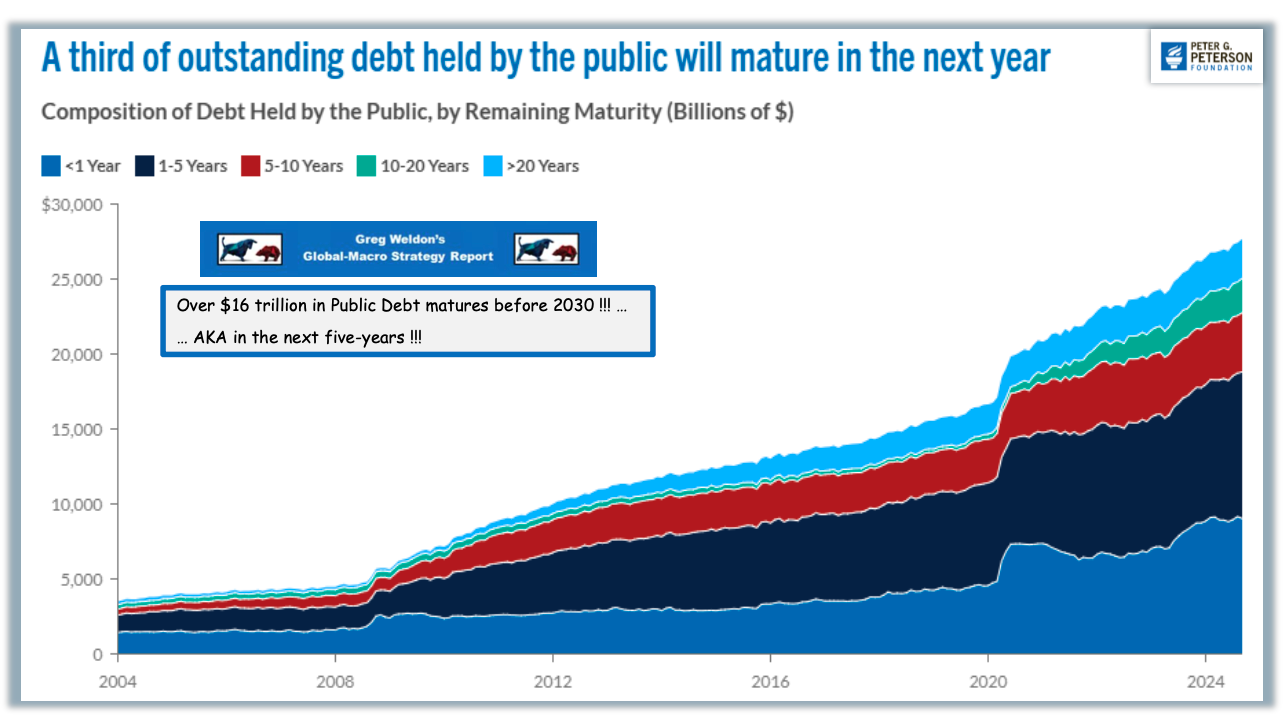
In all, about a third of the public debt, totaling $9.3 trillion, will mature by the end of Q1 2026. More than $3.1 trillion set to roll over in that period was issued more than two years ago, meaning it will be refinanced at much higher rates.
Analyst Greg Weldon calls this a debt tsunami.
The projected 10-year net interest cost is $13.8 trillion. That is more than the entire national debt before 2010.
Where Is the Off-Ramp Here?
Where is the off-ramp?
There isn’t one.
This highway is going off a cliff, and we passed the last exit a long time ago.
Some people think the Federal Reserve can intervene with rate cuts and mitigate Uncle Sam’s interest problem. But the fact is, the Fed has little control over the long end of the yield curve. This was apparent when Treasury yields spiked even after the Fed cut rates last year.
That leaves one option – monetize the debt.
What does that mean?
In a word — inflation.
I’m talking about quantitative easing (QE). The Fed can ease the pressure on the bond market by buying Treasuries and holding them on its balance sheet. This “demand” pushes prices up and yields down.
In effect, QE turns Uncle Sam’s debt (Treasury notes and bonds) into cash. This enables the U.S. government to borrow more money at lower rates than it otherwise could under normal market conditions.
This is exactly how the government was able to borrow so much money during the pandemic. Between the time it launched QE in March 2020 and May 2021, the Fed purchased a staggering $2.44 trillion in U.S. government bonds. In effect, the central bank monetized more than half of the U.S. debt accrued.
No other entity bought more U.S. bonds than the Fed – not foreign investors, not U.S. banks, and not even U.S. corporations and individuals.
In effect, the Fed put its big fat thumb on the bond market.
The problem is that the Fed runs QE with money created out of thin air.
With a few keystrokes, the central bankers at the Fed transfer money that never existed until that moment to a bank or financial institution in return for securities.
The central bank then holds these assets on its balance sheet, having injected the newly created money into the banking system. The effect is to increase the money supply, incentivize borrowing, and drive interest rates lower. Banks can take this newly minted cash and make loans. This increases overall liquidity in the financial system and theoretically stimulates lending, boosting the broader economy.
Keep in mind, inflation properly defined is an increase in the money supply. So, when the Fed creates money out of thin air, it is driving inflation.
Ironically, QE also incentivizes debt, which is exactly how we got into this situation to begin with.
The overall long-term impact of QE is overwhelmingly negative. It distorts interest rates, incentivizes massive levels of debt, creates misallocations of economic resources, and blows up bubbles throughout the economy. Eventually, the bubbles burst, and the debt becomes unsustainable, leading to a bust.
So, yes — the national debt matters. And the proverbial chickens will come home to roost. It’s just a matter of time. They are playing a game of kick the can down the road. The question is: how long is the road?
Mike Maharrey is a journalist and market analyst for Money Metals with over a decade of experience in precious metals. He holds a BS in accounting from the University of Kentucky and a BA in journalism from the University of South Florida.
(Ken Silva, Headline USA) Billionaire Elon Musk announced this week that he’s stepping away from politics to focus on his private businesses—claiming that had been his plan all along.
But according to numerous reports from both conservative and liberal media, President Donald Trump had grown tired of Musk’s antics. And according to a bombshell article Friday in the New York Times, Musk’s departure may be related to his drug abuse.
“Mr. Musk’s drug consumption went well beyond occasional use. He told people he was taking so much ketamine, a powerful anesthetic, that it was affecting his bladder, a known effect of chronic use. He took Ecstasy and psychedelic mushrooms,” the Times reported, citing people familiar with the matter.
“And he traveled with a daily medication box that held about 20 pills, including ones with the markings of the stimulant Adderall.”
What happened to Elon is one of the great mysteries of the last few years.
NYT: Musk "told people he was taking so much ketamine, a powerful anesthetic, that it was affecting his bladder…he traveled with a daily medication box that held about 20 pills."
The Times noted that Musk said last year he only takes “a small amount” of ketamine for depression issues. But the newspaper said the drug habit runs far deeper than that.
“Mr. Musk had been using ketamine often, sometimes daily, and mixing it with other drugs, according to people familiar with his consumption. The line between medical use and recreation was blurry, troubling some people close to him,” the Times reported.
“He also took Ecstasy and psychedelic mushrooms at private gatherings across the United States and in at least one other country.”
Musk and his attorney didn’t respond to the Times’ requests for comment on the matter, while the White House declined to comment on whether it asked Musk to take drug tests.
The Times report comes on the heels of the Wall Street Journal reporting last month that Tesla started a formal process to find its next CEO to replace Musk.
Additionally, the Times reported in December that Musk is under three federal investigations related to alleged violation of security clearance regulations. Part of those investigations are focused on him failing to disclose to the Defense Department when he used ketamine. Nine countries have raised concerns about Musk, according to the Times.
Ken Silva is the editor of Headline USA. Follow him at x.com/jd_cashless.