Israel Is Arming an ‘ISIS-Affiliated’ Gang in Southern Gaza

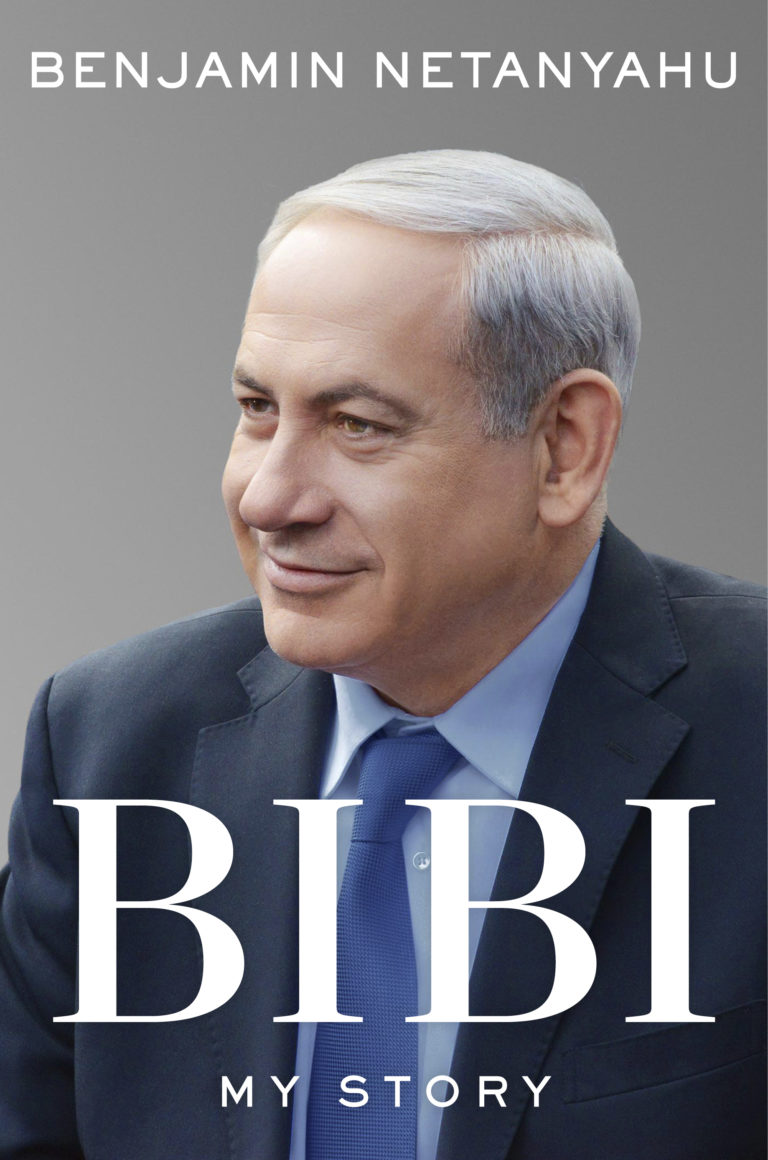
(Dave DeCamp, Antiwar.comIsraeli opposition leader and former Defense Minister Avigdor Liberman said on Thursday that Prime Minister Benjamin Netanyahu was arming a gang in southern Gaza that’s affiliated with ISIS, a charge that has been confirmed by Israeli officials.

“The Israeli government is giving weapons to a group of criminals and felons, identified with the Islamic State, at the direction of the prime minister,” Liberman said. “To my knowledge, this did not go through approval by the cabinet.”

Liberman compared the arming of the criminal gang to Netanyahu’s previous strategy of propping up Hamas as a counter to the Palestinian Authority. “No one can guarantee that these weapons will not be directed at Israel. We have no way of monitoring or tracking them,” he said.

An initial statement released by Netanyahu’s office didn’t deny the allegation. “Israel is acting to defeat Hamas in various and diverse ways, upon the recommendation of all heads of the security establishment,” the office said.

Later, Netanyahu confirmed that Israel has been arming “clans” in southern Gaza. “On the advice of security officials, we activated clans in Gaza that oppose Hamas. This is only good and saves the lives of IDF soldiers. The publication of this only benefits Hamas – but Lieberman doesn’t care,” he said, according to The Jerusalem Post.

Israeli military sources told The Times of Israel that Israel has been arming a group described as a “criminal gang of jihadists” led by Yasser Abu Shabab, a member of one of the largest clans in southern Gaza. Israel has been providing Abu Shabab’s gang with Kalashnikov rifles, including some that were seized from Hamas.

According to the Times, Hamas sources speaking to Lebanon’s Al-Akhbarnewspaper said that members of Abu Shabab’s gang belong to an extremist Salafi faction that has had run-ins with Hamas.

Abu Shabab’s gang has been operating in Israeli-controlled areas of southern Gaza and has been involved in looting aid shipments. Last year, an internal UN memo identified Abu Shabab’s gang as “the main and most influential stakeholder behind systematic and massive looting” of aid trucks. Haaretzalso reported last year that the Israeli military was allowing armed gangs to loot aid convoys and extort protection fees from drivers.

In an interview with The Washington Post, Abu Shabab admitted that he and his group “take from trucks” but claimed they didn’t touch “food, tents, or supplies for children.” According to a report from The New Arab, Abu Shabab is affiliated with Shadi al-Soufi, another gang leader who was detained by Hamas in 2020 over an alleged murder. The report said al-Soufi fled Gaza with the help of ISIS and returned following the start of Israel’s genocidal war.

Abu Shabab, who was imprisoned by Hamas for drug trafficking before an Israeli airstrike allowed him to escape, recently released a video where he said his new armed group “cleared” eastern Rafah of Hamas fighters and said Palestinians could return to the area, which is under the control of the IDF.

Yair Golan, another Israeli opposition leader and retired IDF general, slammed Netanyahu for arming the gang in a post on X. “Netanyahu, who transferred billions to Hamas in cash suitcases, based on a misguided notion that Hamas is an ‘asset’ and that it would end in flip-flops, is now promoting a new dangerous notion: arming a Gazan militia with ties to ISIS,” he said.

“Netanyahu is dangerous to Israel’s security. Instead of securing a deal, creating arrangements with the moderate Sunni axis, and bringing back the hostages and security to Israel’s citizens, he is creating a new ticking bomb in Gaza,” Golan added.

This article originally appeared at Antiwar.com.


Audit: Fraudsters Stole $79B COVID-19 Aid Using False Social Security Numbers

(The Center Square) A federal committee tasked with tracking pandemic assistance fraud found that the Small Business Administration and the Department of Labor together disbursed nearly $80 billion to potential fraudsters.

In total, the federal government spent over $4.6 trillion on all COVID-19 relief programs. The SBA received an extra $957 billion to fund its Economic Injury Disaster Loan program and its Paycheck Protection Program, while the DOL received $695 billion for its COVID-19 Unemployment Insurance programs.

Previous audits have estimated that the total amount of improper or fraudulent payments in these programs reached $400 billion. The new Pandemic Response Accountability Committee (PRAC) report shows that $79 billion of this fraud stemmed from the use of an estimated 1.4 million stolen or invalid Social Security numbers.

PRAC Chair Michael Horowitz said federal agencies might have deterred the fraud if they had conducted more rigorous identity checks and not removed normal program guardrails in their haste to disperse the aid.

“Our oversight work during the past five years has detailed federal agencies’ inability to use data to effectively prevent pandemic-related fraud,” Horowitz said in a Wednesday statement. “By contrast, the PRAC’s sophisticated data analytics capabilities…can strengthen program integrity and prevent billions of dollars in fraud, ensuring taxpayer funds are paid to legitimate applicants.”

To conduct the analysis, investigators randomly sampled 662,000 identity records from the 67.5 million applicants across the three programs. In almost 24,000 cases, the Social Security number, date of birth, and name of the applicant(s) did not match the Social Security Administration’s records. In some instances, the social security number submitted by the applicant did not exist.

The SSA also found that 11,514 of the applications came from individuals who are currently deceased. However, PRAC did not include those individuals in its fraud estimate data because it does not know whether those applicants were alive during the pandemic.

The full scope of pandemic aid fraud is still unknown. Some Republican lawmakers have pushed forward legislation that would extend the statute of limitations for criminally prosecuting COVID-19 aid fraudsters, as The Center Square reported.

Judge Walks Back Mind-Boggling Decision to Release Mass Shooter

(Headline USAA North Carolina judge ordered Thursday that a defendant accused in last weekend’s shootings at a house party that left one person dead and 11 others injured stay in jail while awaiting trial.

The decision came the day after another judge had set a $200,000 bond for Garon Nathaniel Killian, 20, of Lenoir, who is charged with one count of attempted first-degree murder related to the shootings. Prosecutors on Wednesday had asked that no bond be allowed.

Killian had not posted the amount to be released. On Thursday, when Killian had a court date for charges involving a different altercation in April, District Court Judge Scott Conrad revoked the $200,000 bond related to last weekend’s violent fracas, according to the Catawba County Clerk of Court’s office.

Investigators of the shootings that happened early Sunday believe at least 80 shots were fired in a crime scene that spanned several properties along a road in the usually quiet residential neighborhood. FBI agents spent this week at the scene examining bullet trajectories.

The Catawba County Sheriff’s Office has said that beyond Killian three people have been arrested and charged with crimes related to the party or shootings, and that authorities were seeking on Thursday two other men also wanted on attempted first-degree murder.

Giving Killian on Wednesday the chance to post bond had angered local law enforcement leaders. Hickory city police announced previously that Killian and another young man had been charged with many counts — including attempted first-degree murder and assault with a deadly weapon with intent to kill — for an April 6 altercation in a parking lot that led to shots being fired into a crowd. No one was injured.

Catawba Sheriff Don Brown said on Wednesday at a media briefing that while Killian was freed by posting bond several days later he “should have never went back on the street,” and called the situation “frustrating” and “infuriating.”

Shawn Patrick Hood, 58, of Lenoir, was killed in last weekend’s gunfire. He was the oldest of the victims, who ranged in age from as young as 16, the sheriff’s office said.

Two of the other three people arrested were charged with three counts of helping someone underage 21 by allowing the possession of alcoholic beverages. The charges are related to the planning and promotion of the house party, the sheriff’s office said.

There were many juvenile or underage attendees, the state Division of Alcohol Law Enforcement said Wednesday. The other person arrested was charged as an accessory to attempted first-degree murder after the fact, the sheriff’s office said.

Adapted from reporting by the Associated Press


BREAKING: Elon Musk Says Trump is in the ‘Epstein Files,’ Accuses Him of Suppressing Them

(Ken Silva, Headline USA) The world’s richest man has essentially accused the world’s most powerful man of being compromised by a sexual blackmail operation.

What started as a public debate between President Donald Trump and billionaire Elon Musk over the so-called “big beautiful” spending bill escalated Thursday, with Musk saying that Trump was in the “Epstein files”—blaming the President for their suppression. The Epstein files are the thousands of investigatory records the government has on Jeffrey Epstein, the late accused sex trafficker who’s thought to have run an international blackmail operation.

“Time to drop the really big bomb: @realDonaldTrump is in the Epstein files. That is the real reason they have not been made public. Have a nice day, DJT!” he said on Twitter/X, which he owns.

“Mark this post for the future. The truth will come out,” Musk added.

Musk’s bombshell came minutes after Trump threatened to cut his subsidies, which Headline USA covered in this article. Musk didn’t explain why he spent some $250 million on helping Trump get elected last year, or why he allowed Trump to be around his son.

However, to Musk’s point, Trump has expressed hesitation about releasing all the Epstein files.

“I think that less so, because you don’t want to affect people’s lives if there’s phony stuff in there. Because there’s a lot of phony stuff in that whole world,” Trump once told Fox & Friends.

The FBI did not immediately respond to a request for comment on Musk’s allegations. FBI Deputy Director Dan Bongino recently promised that the bureau is going to soon release video evidence related to Epstein’s purported suicide.

Trump and Epstein were once considered friends, but they had a falling out in 2004 over a bidding war for a mansion near Mar-a-Lago. Trump also kicked Epstein out of Mar-a-Lago in 2007 for harassing the daughter of a member there.

Additionally, disgraced author Michael Wolff reported last November that Epstein was “afraid” of Trump up until his final days, when he died in prison.

According to Wolff, Epstein believed that Trump caused him to be initially investigated by law enforcement in 2005 after the two had a fight over the property near Mar-a-Lago—an allegation that, if true, could arguably be seen as a heroic move by Trump, regardless of his motives.

Ken Silva is the editor of Headline USA. Follow him at x.com/jd_cashless.

Trump Makes Fun of Elon’s Black Eye, Threatens to Cut His Subsidies

Update: After this story’s publication, Musk said he’d begin decommissioning SpaceX projects in response to Trump’s threats.

(Headline USATalk about adding insult to injury.

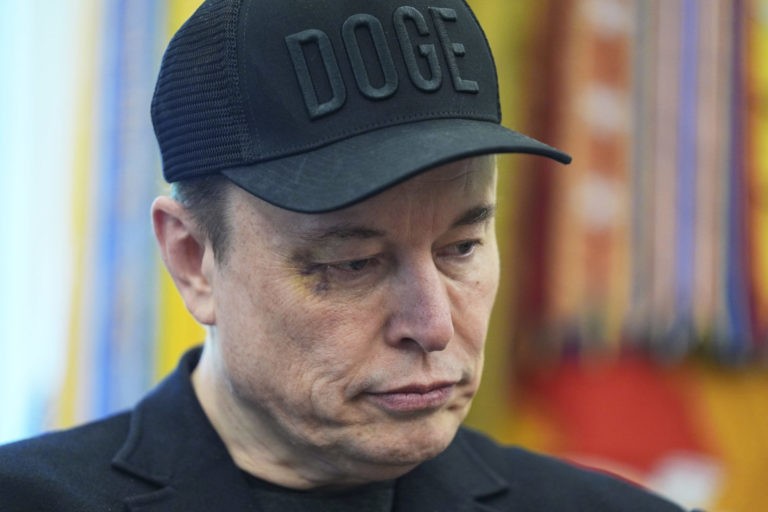
President Donald Trump made fun of Elon Musk’s black eye Thursday while responding to the billionaire’s criticism of his “big beautiful bill.” Trump also threatened to cut Musk’s government contracts.

“You saw a man who was very happy when he stood behind the Oval desk. Even with a black eye. I said, do you want a little makeup? He said, ‘No, I don’t think so,’ which is interesting … Elon and I had a great relationship. I don’t know if we will anymore,” Trump told reporters.

“He’s worn the hat, ‘Trump was right about everything,’ and I am right about the great big beautiful bill.”

“Whatever,” Musk wrote on his social media platform while responding to Trump in real time.

Musk later offered up an especially stinging insult to a president sensitive about his standing among voters: “Without me, Trump would have lost the election,” Musk retorted. “Such ingratitude,” Musk said in a follow-up post.

Hours after Trump lamented his breakup with Musk and said he was “disappointed” in his former backer and adviser and Musk responded on social media, Trump escalated the feud by threatening to use the U.S. government to hurt Musk’s bottom line.

“The easiest way to save money in our Budget, Billions and Billions of Dollars, is to terminate Elon’s Governmental Subsidies and Contracts,” Trump wrote on his social media network. “I was always surprised that Biden didn’t do it!”

Musk announced his support for Trump shortly after the then-candidate was nearly assassinated on stage at a Butler, Pennsylvania, rally last July. News of Musk’s political action committee in support of Trump’s election came days later.

Musk soon became a close adviser and frequent companion, memorably leaping in the air behind Trump on stage at a rally in October. Once Trump was elected, the tech billionaire stood behind him as he took the oath of office, flew with him on Air Force One for weekend stays at Trump’s Mar-a-Lago club in Palm Beach, Florida, slept in the White House’s Lincoln Bedroom at the president’s invitation and joined his Cabinet meetings wearing a MAGA hat (sometimes more than one).

“I’ll be honest, I think he missed the place,” Trump said Thursday. “He got out there, and all of a sudden he wasn’t in this beautiful Oval Office.”

Musk bid farewell to Trump last week in a subdued news conference in the Oval Office, where he sported a black eye that he said came from his young son but that seemed to be a metaphor for his messy time in government service.

Adapted from reporting by the Associated Press

Rich Dad Kiyosaki Says Trade “Fake Money” for Silver

(Mike Maharrey, Money Metals News Service) Silver has cracked a key resistance level, and Rich Dad Poor Dad author Robert Kiyosaki called the white metal “the biggest bargain today.

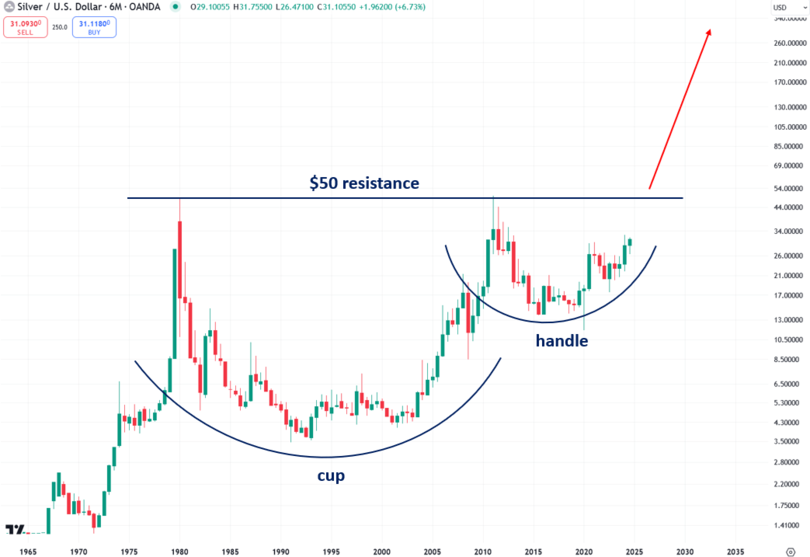
Silver was up 5.3 percent on Monday, the biggest gain in eight months. And on Wednesday, the white metal surged above $36 an ounce in early trading. The last time we saw $36 silver was in 2011, when it was on its way to a record high near $50 an ounce.

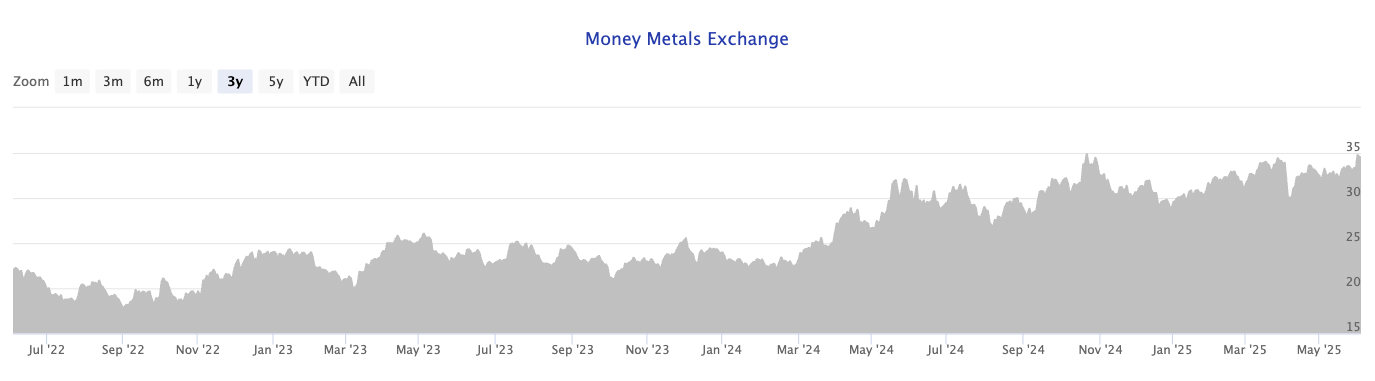
Over the last year, $35 has stood as a significant resistance level for silver. The Money Metals price chart below plots silver’s nearly 100% move higher over the past three years.

Having finally blown well past that barrier, there doesn’t appear to be much resistance on the way to new record highs.

We’ve also finally seen a narrowing of the gold-silver ratio to 94:1. It has been hovering around 100:1 for the last several months and rose to over 103:1 in April. This could signal the beginning of a rally that will bring silver closer to its historical relationship with gold. In modern times, the gold-silver ratio has averaged around 60:1.

In a post on X, Kiyosaki pointed out that silver is still significantly below its all-time high, even as gold has set multiple records over the last year. That means silver is on sale.

“Tomorrow I am going to my local gold and silver dealer and trading fake money for real silver…. no ETFs… the biggest bargain today.”

He also noted that at around $35 an ounce, “almost everyone anywhere in the world… has a chance to grow richer… while millions grow poorer.

The technicals signal that silver is set up for a bull run.

If we look at a 50-year price chart for silver, we see a very distinctive pattern known as a “secular cup and handle.”

Money Metals CEO Stefan Gleason has long brought attention to this massive, long-term bullish pattern.

You can see the “cup” with the twin highs of around $50 per ounce in 1980 and 2011. Following the 2011 peak, we see a sharp decline in the price, followed by a consolidation “handle.”

A handle pattern on the chart of a stock or commodity often precedes a breakout.

This cup-and-handle pattern has played out over an extremely long timeframe. Historically, longer patterns portend bigger breakouts with a broader base signaling a bigger upside case.

Gold followed a similar long-term pattern, resolving with a breakout to new all-time highs beginning in 2023.

The supply and demand dynamics are also positive for silver.

Money Metals has recently reported that industrial demand for silver set a fourth consecutive record in 2024, driving a market deficit for the fourth consecutive year. Demand outstripped new supply by 148.9 million ounces. That drove the four-year market shortfall to 678 million ounces, the equivalent of 10 months of mining supply in 2024.

Given the dynamics, Kiyosaki asks a poignant question:

“What are you going to do tomorrow… grow richer or grow poorer? Please choose to get richer.”


Mike Maharrey is a journalist and market analyst for Money Metals with over a decade of experience in precious metals. He holds a BS in accounting from the University of Kentucky and a BA in journalism from the University of South Florida.

Gold: A Place to Hide

(Mike Maharrey, Money Metals News Service) Incentives matter. Policymakers ignore this axiom at their own risk.

The U.S. government’s weaponization of the dollar has made many countries wary of holding greenbacks, and we’ve seen an accelerating de-dollarization over the last few years.

Now the U.S. government has weaponized trade.

Many countries have responded by positioning themselves to minimize exposure to the dollar – and thus shield themselves from U.S. interference. To accomplish this, they have turned to gold.

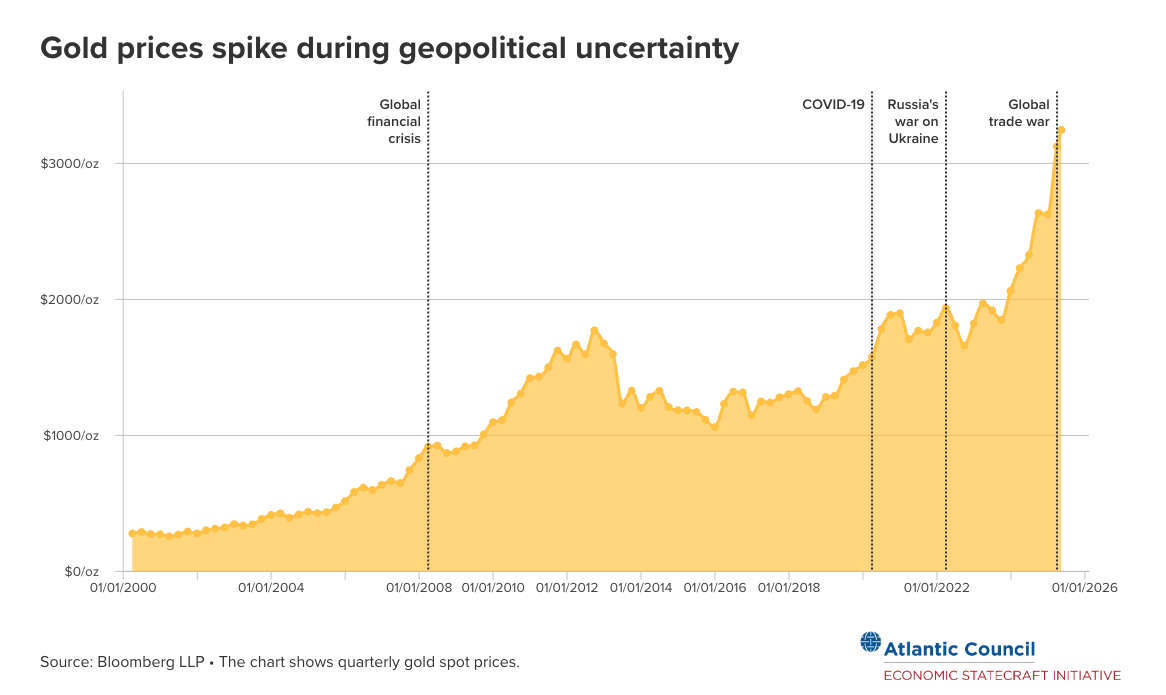
Gold has historically served as a safe place to hide during times of chaos and trouble. Now, countries are realizing that they can use the yellow metal as a haven from U.S. economic coercion.

In an article published by the Atlantic Council, Kimberly Donovan and Maia Nikoladze point out that “central banks that are worried about getting sanctioned, want to protect themselves from a potential global financial crisis, or both have been stacking up gold at record levels.

The data backs up this claim.

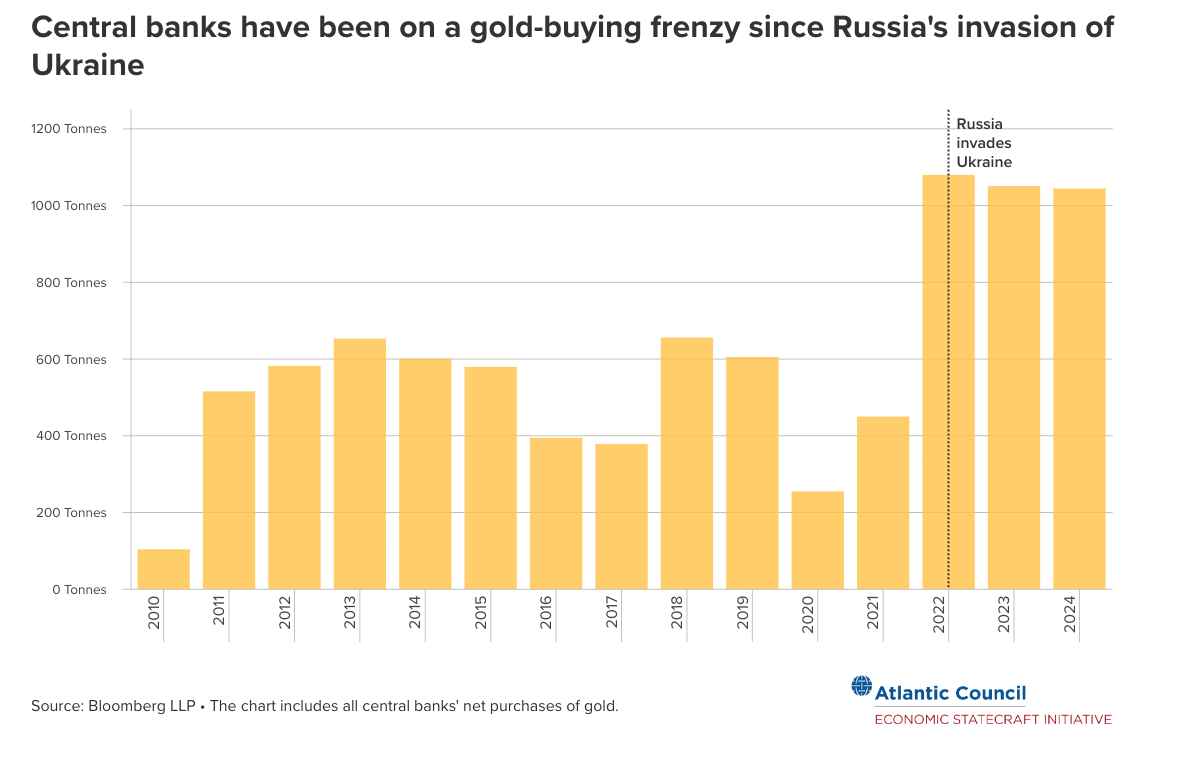
On net, central banks officially increased their gold holdings by 1,044.6 tonnes in 2024. It was the 15th consecutive year of expanding gold reserves.

Last year was the third-largest expansion of central bank gold reserves on record, coming in just 6.2 tonnes lower than in 2023 and 91 tonnes lower than the all-time high set in 2022. (1,136 tonnes). 2022 was the highest level of net purchases on record, dating back to 1950, including since the suspension of dollar convertibility into gold in 1971.

Meanwhile, the dollar’s share of global reserve currencies slid further last year. As of the end of 2024, dollars made up 57.8 percent of global reserves. That is the lowest level since 1994, representing a 7.3 percent decline over the last decade. In 2002, dollars accounted for about 72 percent of total reserves.

Donovan and Nikoladze also note that many countries are experimenting with gold-backed digital assets and trading systems to bypass the dollar-denominated global financial system.

“In many cases, these initiatives are for purely economic benefits. However, gold is also being used by U.S. adversaries to evade sanctions or finance activities that counter U.S. national security interests.”

Russia provides a case study in the protective power of gold.

The Bank of Russia was one of the biggest central bank gold buyers in the years before it invaded Ukraine. At the same time, the central bank divested itself of most of its U.S. Treasury holdings.

When the war began, Russia held about half of its reserves in dollar, euro, and pound sterling assets. The other half was in yuan and gold, which remain accessible.

The Russians also made a shrewd move before the invasion of Ukraine, transferring their National Welfare Fund holdings into yuan (60 percent) and gold (40 percent). A RAND Corporation study notes, “This was an indication that Russia was preparing for increased Western economic pressure. During the war, Russia has been using these funds to support the budget.

The strategy paid off.

In the last year alone, the value of Russian gold reserves has increased by $96 billion due to the rapidly rising gold price, offsetting about one-third of the country’s frozen assets.

In tonnage terms, Russia’s gold reserves have remained relatively unchanged since the invasion of Ukraine, however, Donovan and Nikoladze said the Russian central bank has likely been buying gold from domestic producers without reporting it.

Russia mines a significant amount of gold. In 2023, the country tied with Australia as the world’s number two gold producer.

Despite their best efforts, the West has found it difficult to stop Russia from using its gold due to its fungible nature (easy to exchange) and the global demand for the precious metal.

Gold is money, and it is recognized as such everywhere. Even if they don’t want dollars or some other fiat currencies, everybody wants gold.

The Russians have used their gold holdings to maintain trade in the face of economic sanctions. Donovan and Nikoladze noted that the UAE and Turkey have engaged in “cash for gold” trade with Russian banks.

“The Russia-based Lanta Bank and Vitabank received twenty-one shipments of currencies such as U.S. dollars, euros, UAE dirhams, and Chinese renminbi worth $82 million from the UAE and Turkey in exchange for Russian gold.”

Donovan and Nikoladze offered some advice to U.S. policymakers.

“The United States has the power to indirectly reduce gold prices and encourage the adoption of dollar-backed assets by returning to being the provider of stability in the global economy. That can be achieved by dialing down the use of tariffs and other economic measures that could cause governments and private actors to turn to gold.”

However, it seems unlikely that the U.S. government will be able to resist the temptation to use its economic clout as a foreign policy tool.

That’s not to say U.S. policy isn’t justified or that it won’t be effective in the long run. But it does underscore the fact that it is foolish to ignore the incentives and potential blowback inherent in any policy decision.


Mike Maharrey is a journalist and market analyst for Money Metals with over a decade of experience in precious metals. He holds a BS in accounting from the University of Kentucky and a BA in journalism from the University of South Florida.

Death of David Horowitz Leaves a Controversial Political Legacy

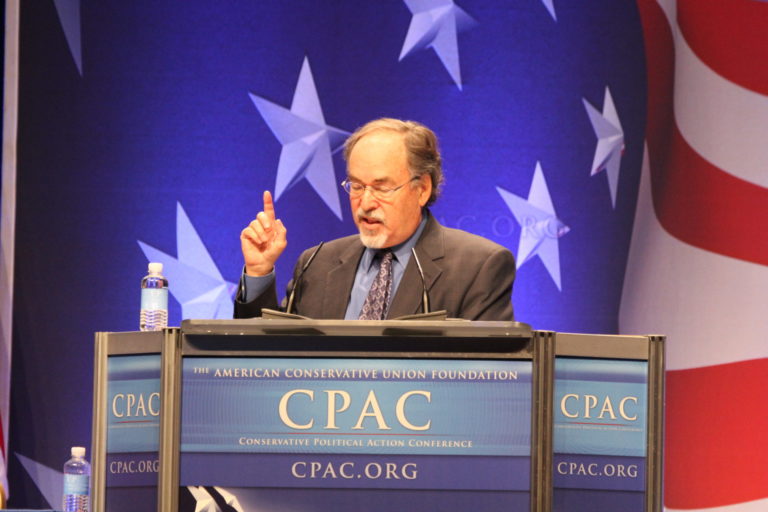
(José Niño, Headline USA)The recent passing of David Horowitz closes a chapter on decades of ideological warfare in America. His pro-Israel brand of conservatism is shared by many in the Trump administration. 

David Horowitz, the influential conservative writer and activist died at his Colorado home toward the end of April at age 86. The cause was cancer, as confirmed by his wife and the David Horowitz Freedom Center (DHFC), the think tank he founded in 1988.

Born in New York City in 1939 to Jewish parents who were members of the Communist Party, Horowitz was a leading figure in the “New Left” of the 1960s before dramatically renouncing his progressive beliefs in the 1970s. He would spend the rest of his life crusading against what he called the “radical left and its Islamist allies,” advancing a hardline pro-Israel agenda and shaping the careers of a new generation of conservative influencers.

Through the DHFC, Horowitz built a vast network of donors, media figures, and activists. As Robert Inlakesh reported for MintPress News, this network was instrumental in shifting the American Right from championing free speech to embracing censorship by “pushing inflammatory anti-Islam and pro-Israel narratives intended to provoke backlash.”

Horowitz’s influence extended well beyond his own writing. He mentored prominent figures like Ben Shapiro, who began as a DHFC fellow, and played a key role in connecting rising activists with wealthy benefactors. Turning Point USA founder Charlie Kirk credited Horowitz with introducing him to most of his earliest major donors. 

In an X post he published at the end of April, Kirk eulogized Horowitz for his commitment to promoting conservative values. Kirk described Horowitz as a “fearless truth-teller” who “was a titan in the battle of ideas and a warrior for Western civilization.”

The Turning Point founder revealed that Horowitz was a key connector for the student activist organization and its early donor base: 

Over 90% of our earliest major donors were introduced at a David Horowitz event—thanks to his warm endorsements and generous introductions. His support opened doors that would have otherwise remained closed.

José Niño is the deputy editor of Headline USA. Follow him at x.com/JoseAlNino 

Democrat Called in Favor to Have Husband Removed from TSA Watchlist

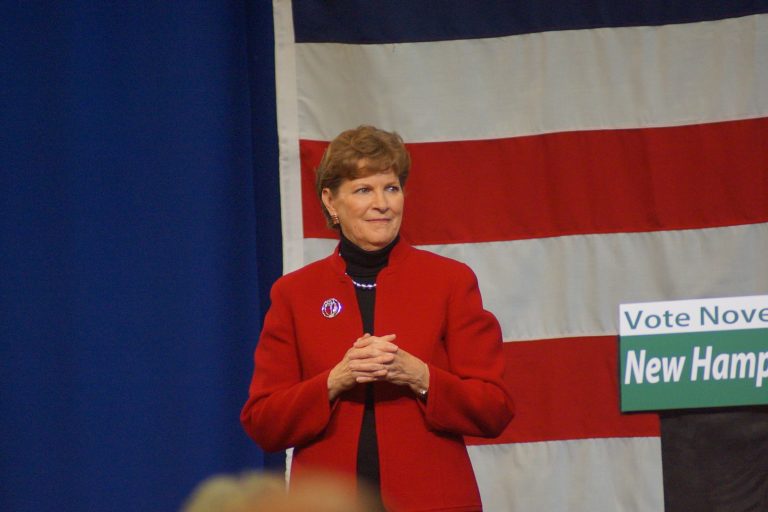
(José Niño, Headline USA)  When Sen. Jeanne Shaheen’s, D-NH, husband, William Shaheen, was flagged by a government travel watchlist in 2023, a single phone call to the Transportation Security Administration (TSA) swiftly removed him from additional scrutiny, CBS News reported on Tuesday.

According to sources familiar with the situation, William Shaheen, a Lebanese-American attorney and active member of the Arab-American community, was placed on the TSA’s “Quiet Skies” surveillance program after his travel profile was flagged in October 2023, shortly after the Hamas attack on Israel. 

CBS’s report comes as the Trump administration is set to discontinue the Quiet Skies program, which was used against Trump’s National Intelligence Director Tulsi Gabbard when she was a citizen under the Biden administration. Unlike Sen. Shaheen, Gabbard wasn’t removed from the watchlist until Biden was ousted.

The watchlist was also used against an untold number of Jan. 6, 2021, Capitol Hill protestors after that event.

The Quiet Skies program, which began in 2010, uses analysts and undercover air marshals to monitor travelers based on suspicious patterns, behaviors, and data, even if they are not suspected of committing a crime.

After Sen. Shaheen contacted then-TSA Administrator David Pekoske, her husband was removed from the list of people subjected to additional scrutiny. Instead, William Shaheen was placed on the “secure flight exclusion list,” which exempted him from any future advanced screening, including random TSA checks, according to two sources cited by CBS News.

The episode unfolded during a period of heightened security. In July 2023, William Shaheen was pulled aside for extra screening at Boston airport before two flights, which officials initially attributed to random selection. 

Months later, his travel companion was flagged as a “known or suspected terrorist” by the FBI, prompting further surveillance.

A spokesperson for Senator Shaheen told CBS News she reached out to TSA after her husband endured “several extensive, invasive and degrading searches at airport checkpoints” and was looking to understand what provoked this security concern. 

The spokesperson added that the senator was unaware William Shaheen was being monitored under Quiet Skies or that he received preferential treatment afterward.

The decision to shield a senator’s spouse from enhanced screening is highly unusual in a system designed to operate without political interference. As CBS News notes, most Americans must fight for years to be removed from such lists, sometimes by being mired in protracted legal battles.

Sen. Shaheen, the leading Democrat on the Foreign Relations Committee, recently announced she will not seek re-election in 2026

José Niño is the deputy editor of Headline USA. Follow him at x.com/JoseAlNino

Navy Ship No Longer to be Named after Dead Gay Politician

(Luis CornelioHeadline USADefense Secretary Pete Hegseth ordered the military to rename the USNS Harvey Milk—a ship named after the controversial late politician, veteran and gay rights activist.  

An internal memo from the Pentagon showed the Office of the Secretary of the Navy has created a plan to change the ship’s name, though the replacement has yet to be announced. 

Harvey Milk, the first openly gay person elected to public office in California, was assassinated in 1978 by a disgruntled former colleague at the San Francisco City Hall. 

Some critics label Milk a “pedophile” because, at age 33, he allegedly became romantically involved with a 17-year-old. By contrast, National Review, a purportedly conservative magazine, hailed Milk as an American patriot, citing his prior service in the U.S. Navy. 

According to Military.com, Hegseth issued the renaming order directly to Navy Secretary John P. Fleming. An anonymous source told the outlet the move was intentionally timed to coincide with Pride Month. 

The memo indicated Milk’s stripping was done to align with President Donald Trump’s and Hegseth’s push to re-establish a “warrior culture” in the military, rather than pursue forced inclusivity through DEI policies. 

The renaming is scheduled for public announcement on June 13. 

The memo also revealed that other ships have been targeted for renaming, including USNS Thurgood Marshall, USNS Ruth Bader Ginsburg, USNS Harriet Tubman, USNS Dolores Huerta, USNS Lucy Stone, USNS Cesar Chavez and USNS Medgar Evers. 

On Jan. 31, 2025—days after his confirmation—Hegseth issued a directive titled “Identity Months Dead at DoD.” 

“Our unity and purpose are instrumental to meeting the Department’s warfighting mission. Efforts to divide the force – to put one group ahead of another – erode camaraderie and threaten mission execution,” Hegseth wrote. 

That directive banned celebrations for: 

  • National African American/Black History Month 
  • Women’s History Month 
  • Asian American and Pacific Islander Heritage Month 
  • National Hispanic Heritage Month 
  • National Disability Employment Awareness Month 
  • National American Indian Heritage Month