(Headline USA) Investigators believe that a convicted murderer and former police chief known as the “Devil in the Ozarks” has likely fled Arkansas after escaping from prison last month, a federal court filing released this week shows.
A criminal complaint filed in federal court in Little Rock against Grant Hardin, who escaped prison last month, was released this week. Authorities have said Hardin escaped the Calico Rock prison in Arkansas by donning an outfit designed to look like a law enforcement uniform.
In the complaint, Deputy U.S. Marshal Robert J. Hammons cites two previously publicized unconfirmed sightings of Hardin — one in central Arkansas and another in southern Missouri.
“Based on this information, investigators believe Hardin has fled the state of Arkansas to avoid recapture,” the filing said. “He has extensive knowledge of the Ozark Mountain region, where he is believed to be possibly hiding in caves or rugged terrain that he is familiar with.”
The complaint, first reported by The Arkansas Democrat-Gazette, does not detail any other sightings of Hardin or evidence of him fleeing the state. Arkansas authorities have previously said they’re focusing on north-central Arkansas and tips of sightings elsewhere so far have not panned out.
Hardin, a former police chief in the small town of Gateway near the Arkansas-Missouri border, was serving lengthy sentences for murder and rape. He was the subject of the TV documentary “Devil in the Ozarks.”
Hardin was housed in a maximum-security wing of the primarily medium security prison, formally known as the North Central Unit. Officials are investigating whether a job Hardin held in the kitchen helped in his escape, including whether it gave him access to materials he could have used to fashion his makeshift uniform.
The Arkansas Department of Corrections this week released a new photo rendering of Hardin, depicting what he may look like now.
Trump made the comments to reporters in the Oval Office while hosting German Chancellor Friedrich Merz and compared the war in Ukraine to a fight between children.
“Sometimes you see two young children fighting like crazy,” he said. “They hate each other, and they’re fighting in a park, and you try and pull them apart. They don’t want to be pulled. Sometimes you’re better off letting them fight for a while and then pulling them apart.”
Trump said he made the analogy in his phone call with Russian President Vladimir Putin this week. “I said, ‘President, maybe you’re going to have to keep fighting and suffering a lot,’ because both sides are suffering before you pull them apart, before they’re able to be pulled apart,” he said.
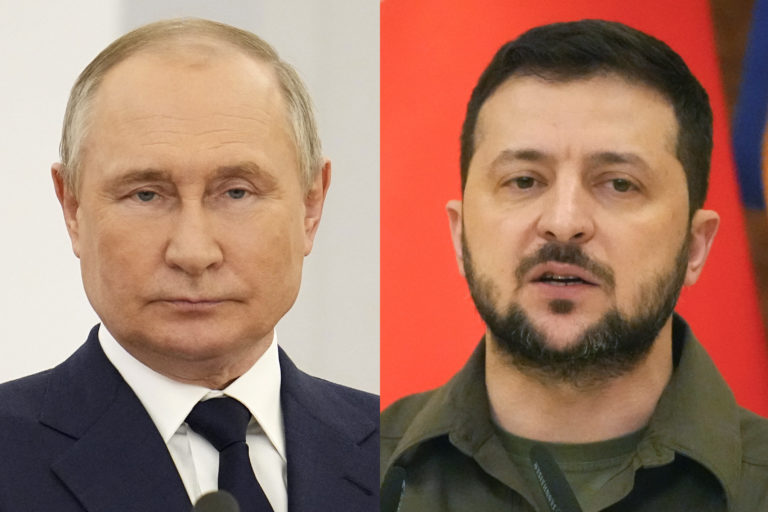
After the call with Putin on Wednesday, Trump said that the Russian leader told him Moscow would have to respond to the Ukrainian drone attack on Russian airfields, and said there would likely not be “immediate peace.”
In his remarks on Thursday, Trump suggested he could sanction both Russia and Ukraine if a peace deal isn’t reached. “When I see the moment where it’s not going to stop … we’ll be very, very tough,” he said. “And it could be on both countries, to be honest. It takes two to tango.”
Ukrainian President Volodymyr Zelensky has been demanding new US sanctions on Russia and made the call again on Thursday. “We do count on strong steps. That’s what’s in short supply right now. And this is what can make even the sleazebags in Moscow realize they can’t pull the war off,” Zelensky wrote on X.
We see how many people around the world are with us no matter what. These days, our team is having meetings in Washington. Thank you to everyone who attended the briefings from the Ukrainian delegation. There were meetings — in Congress, with U.S. Administration officials,… pic.twitter.com/9z09qp5Qzn
— Volodymyr Zelenskyy / Володимир Зеленський (@ZelenskyyUa) June 5, 2025
“This is why we need new and sufficient sanctions, first and foremost from the United States. This is why we need clear political pressure for diplomacy to be effective,” the Ukrainian leader added.
In the meantime, the US continues to provide military aid and intelligence support to Ukraine to fuel the proxy war. Ukraine has been stepping up attacks on Russian territory, which always risks a major escalation.
(José Niño, Headline USA) The Trump administration is rethinking how it deals with Chinese-linked tech firms after a short-lived self-driving truck company was found to have stolen a vast trove of U.S. intellectual property.
Founded in 2015 by Chinese entrepreneurs and backed by Chinese capital, TuSimple was once hailed as a leader in autonomous trucking, boasting a record-setting 80-mile driverless journey in Arizona and partnerships with major firms like UPS and Navistar.
But beneath its rapid rise, TuSimple’s dual presence in the U.S. and China created vulnerabilities. According to a Wall Street Journal report, February 2022, the company signed a national security agreement with the U.S. government after concerns emerged about its Chinese ties and potential for technology transfer.
The agreement, enforced by the Committee on Foreign Investment in the United States (CFIUS), required TuSimple to separate its U.S. operations and technology from China-based employees and partners, build firewalls, and prohibit the sharing of intellectual property.
Yet, just a week after signing, TuSimple transferred a trove of sensitive data, which included test results and technical blueprints—to Beijing-owned Foton, a major Chinese truck manufacturer. “They want a lot of details,” said TuSimple employee Xiaoling Han in a February 2022 chat. “It is pretty time consuming.” Internal correspondence shows the data sharing continued up to the six-month compliance deadline.
WSJ reporter Heather Somerville noted thatTuSimple provided Chinese companies with what essentially constituted a complete autonomous driving system. This included the source code that serves as the brain of an autonomous truck, in addition to various elements of the design, hardware, and integration of all these systems.
A CFIUS investigation later found that while the data sharing did not technically violate the agreement, TuSimple was fined $6 million for other infractions. The company did not admit fault, and co-founder Xiaodi Hou insisted that no information prohibited by the company’s national security agreement “was ever shared with anyone.”
The fallout was swift. TuSimple shut down U.S. operations, while being delisted from Nasdaq. These events prompted it to move investor funds to China.
The episode compelled the Trump administration to rethink its reliance on mitigation agreements for high-risk, foreign-connected firms. According to new directives, the White House will “cease the use of overly bureaucratic, complex, and open-ended ‘mitigation’ agreements” and instead block more China-backed deals outright.
Earlier this year, Commerce Department has also issued new rules prohibiting the sale of internet-connected vehicles and components to entities connected to China, with further restrictions on commercial vehicles expected to be imposed soon.
José Niño is the deputy editor of Headline USA. Follow him at x.com/JoseAlNino
(Jesse Colombo, Money Metals News Service) Silver futures have broken out, delivering a strong bullish signal—but I’m still looking for additional confirmation to strengthen the case.
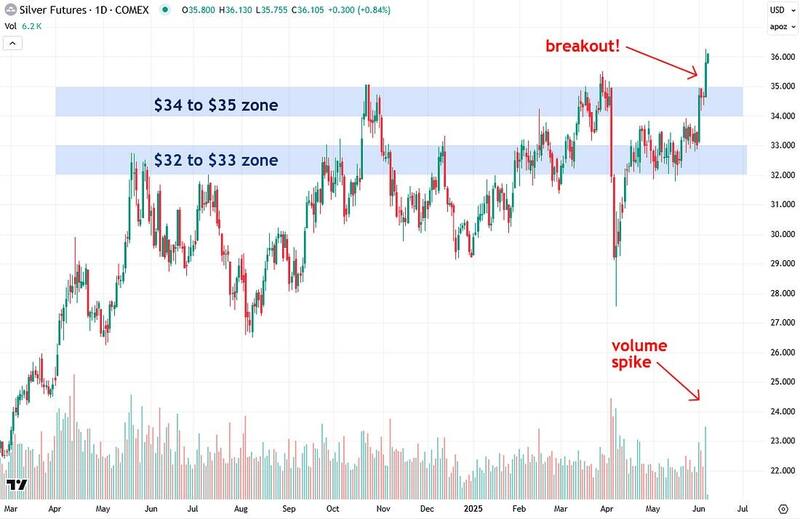
I’ve been consistently bullish on silver and have been pointing out the key signals to watch for a breakout from its prolonged consolidation of the past year. I’ve repeatedly said the main trigger would be a decisive, high-volume move above two critical resistance zones: $32 to $33 and then $34 to $35.
While many grew weary of waiting and doubted it would happen, it finally did yesterday—which is incredibly exciting. That’s why I’m publishing this quick technical update to show you where silver stands now and what I’m looking for next to confirm that the bull market is fully underway.
The primary form of silver I monitor is COMEX silver futures, as they tend to respect $1 increments as key support and resistance levels and, unlike the spot price, also display trading volume—an essential indicator of conviction and institutional money flows.
Remarkably, silver finally broke through the critical $35 threshold yesterday on strong volume, delivering a clear and decisive bullish signal. This signal remains valid as long as silver holds above that level. I believe this breakout sets the stage for a rapid move to $40, $50, $60, and beyond, as outlined in my detailed report linked in the first paragraph of this update.
One of the immediate catalysts behind yesterday’s breakout is China’s rare earth metals export curbs. However, the reality is that this breakout was inevitable—and it is primarily technical in nature. Silver has been like a coiled spring, simply waiting for a spark to unleash its momentum, and that’s exactly what we’re seeing now.
In addition, precious metals have been gaining support from a combination of recent developments: Moody’s downgrade of U.S. debt, continued weakness in the U.S. dollar, escalating tariff tensions between the U.S. and China, the Trump administration’s controversial new budget, and rising political dysfunction—fueled further by Elon Musk’s public falling-out with President Trump.
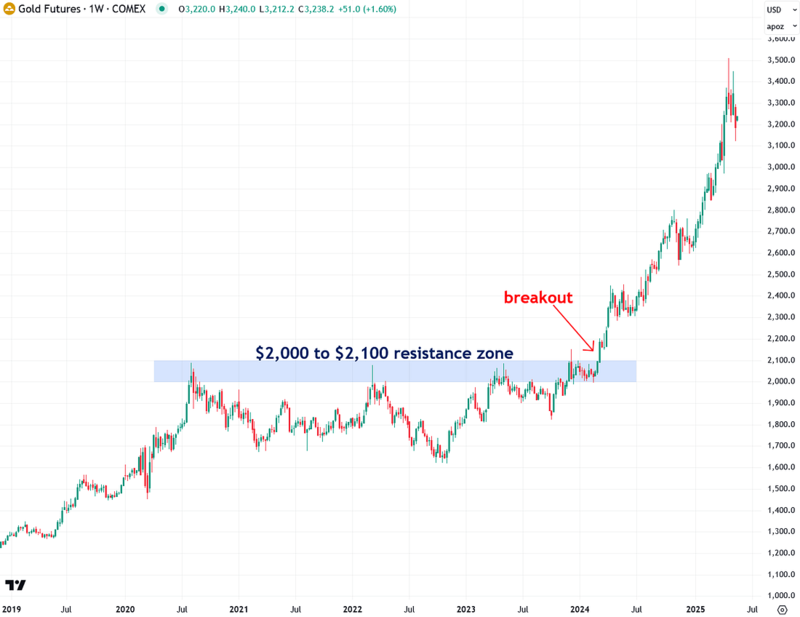
As I’ve noted before, silver’s frustrating consolidation over the past year has reminded me of gold’s prolonged range from 2020 to 2024—a period I said would eventually give way to a major bull market once gold broke above its $2,000 to $2,100 resistance zone, which it ultimately did.
I believe silver is now following a similar path, and yesterday’s breakout has a very strong chance of marking the beginning of a powerful new bull market.
I’ve also developed a proprietary tool called the Synthetic Silver Price Index (SSPI), designed to help validate silver’s price action and filter out potential false breakouts.
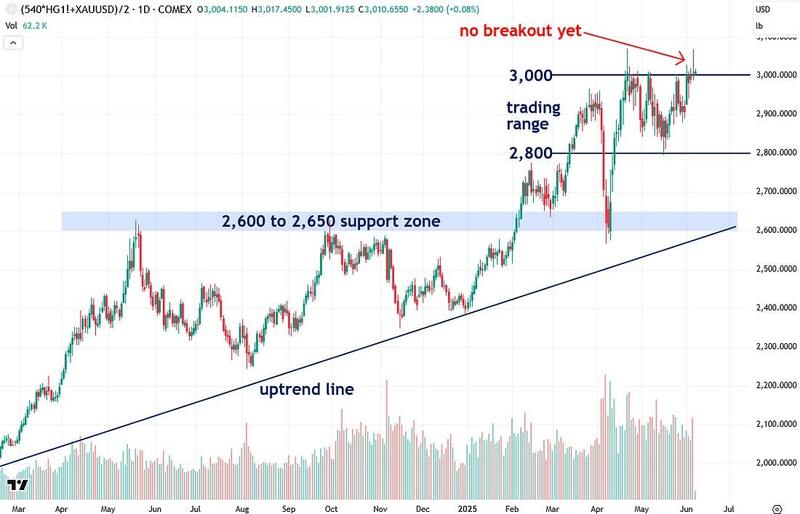
The SSPI is calculated as the average of gold and copper prices, with copper scaled by a factor of 540 to prevent gold from dominating the index. Interestingly, even though silver isn’t part of the calculation, the SSPI closely tracks its movements.
I’ve been highlighting how the SSPI has been trading within a consolidation range between 2,800 and 3,000. A breakout above the 3,000 level would serve as a strong bullish confirmation for silver.
Yesterday, the SSPI initially rallied—driven by a sharp upward move in copper—but as copper gave back much of its gains, the SSPI failed to close above the key 3,000 level. Despite that, momentum remains strong, and I believe there’s a high probability the SSPI will make another breakout attempt soon. This, along with a decisive breakout in euro-priced silver, is one of the final confirmations I’m watching for.
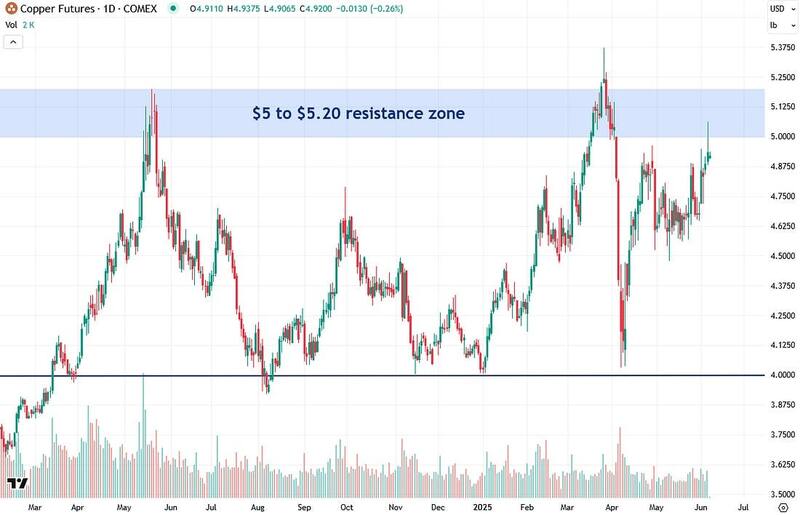
The copper futures chart below shows how prices tested—but failed to break above—the key $5.00 to $5.20 resistance zone, which held back both the SSPI and silver from achieving even further gains yesterday. For more on my outlook for copper and why I’m bullish on it alongside silver, read my recent report.
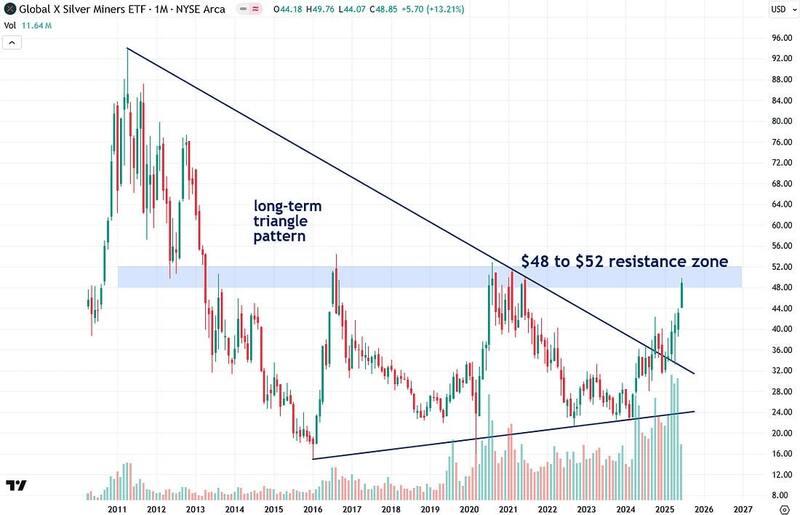
In addition to silver itself, I’m also highly bullish on silver mining stocks and ETFs, which I expect to deliver even larger gains in the coming bull market due to their leverage to the price of silver. Large silver miners, as tracked by the SIL ETF, have been performing strongly after breaking out of a long-term triangle pattern that dates all the way back to 2011.
SIL is now approaching a critical resistance zone between $48 and $52—a level that has repeatedly capped rallies since 2016. I believe a decisive breakout above this zone, especially in tandem with a confirmed silver bull market, will trigger an explosive move higher in silver mining stocks. I’m watching closely and very excited about the potential upside.
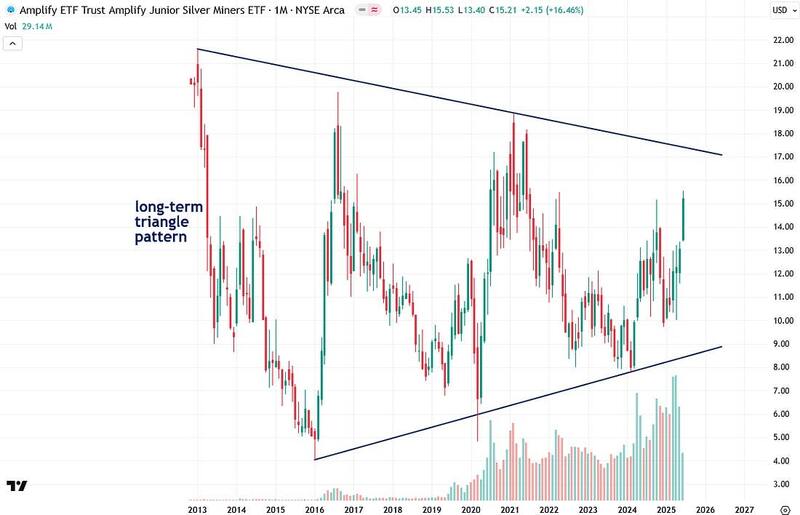
Silver junior mining stocks, as tracked by the SILJ ETF, are even more volatile than their larger-cap counterparts—and offer even greater profit potential during bull markets.
Currently, SILJ remains within a long-term triangle pattern that dates back to 2013. I believe that once it breaks out of this formation, both SILJ and the broader junior silver mining space are poised to surge dramatically—offering significant upside for those positioned ahead of the move.
While not an absolute necessity, one final confirmation of the silver bull market would be a decisive breakdown in the U.S. dollar, which historically trades inversely to commodities—including precious metals.
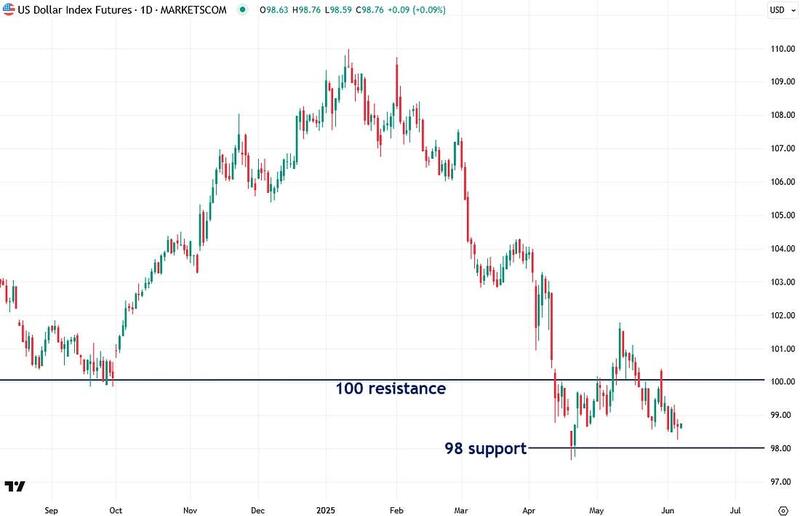
As I’ve explained recently, the key level to watch on the U.S. Dollar Index (DXY) is 100. The index is now trading below that threshold, giving it a clear bearish bias. The next critical level is 98; if that support breaks, I believe the index will quickly move toward the next major support at 90. Such a move would act as rocket fuel for the bull market in gold, silver, and mining stocks.
To summarize, yesterday’s nascent breakout in silver is both encouraging and exciting. However, I’m looking for additional confirmation before calling it a full-scale breakout. Specifically, I want to see silver break out in euros, the Synthetic Silver Price Index (SSPI) move decisively higher, and the U.S. Dollar Index break down further.
Once those pieces fall into place, I truly believe the major silver bull market I’ve been calling for—and that many of us have been waiting on—will finally be underway. As always, I’ll continue to keep you updated.
If you found this report valuable, click here to subscribe to The Bubble Bubble Report for more content like it.
Jesse Colombo is a financial analyst and investor writing on macro-economics and precious metals markets. Recognized by The Times of London, he has built a reputation for warning about economic bubbles and future financial crises. An advocate for free markets and sound money, Colombo was also named one of LinkedIn’s Top Voices in Economy & Finance. His Substack can be accessed here.
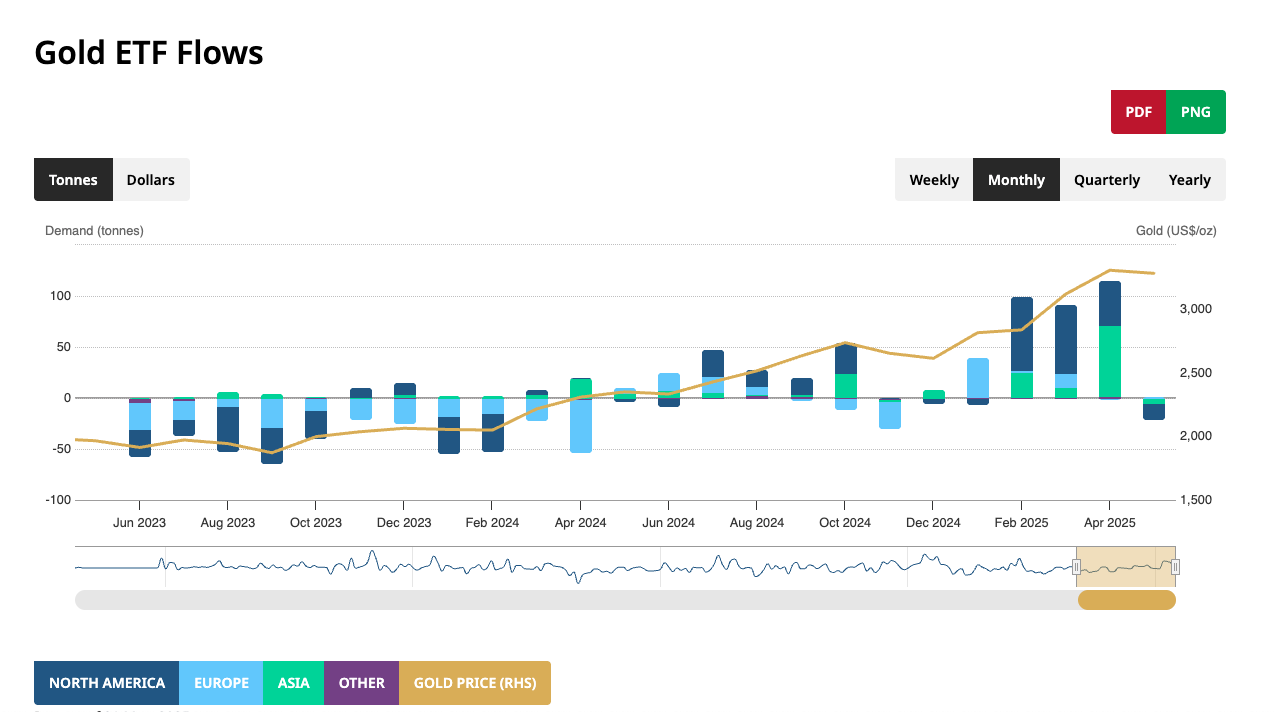
(Mike Maharrey, Money Metals News Service) For the first time in five months, gold-backed ETFs globally reported modest outflows in May as investors took profits.
After charting the largest inflows of gold since August 2022 in April, gold-backed ETFs globally reported modest outflows of 19 tonnes totaling $1.8 billion last month.
A combination of gold outflows and a moderating gold price pushed total assets under management (AUM) by ETFs to fall 1 percent to $347 billion.
After setting a record of $3,500 an ounce in April, gold prices consolidated last month, and many investors took the opportunity to book profits. An easing in trade war tensions also increased risk appetite, driving a pivot out of haven assets.
Despite the outflows in May, flows of metal into gold-backed funds remain positive for the year at 322 tonnes.
U.S funds drove global gold outflows, decreasing their holdings by 15.6 tonnes. According to the World Gold Council, “The better-than-expected temporary easing of tariffs between the U.S. and China improved investor risk appetite, which led to a strong rebound in equities, but lower safe-haven demand for gold.”
WGC analysts said that the recent trend of gold outflows from U.S. funds could be short-lived as stagflation worries grow.
“The newly proposed ‘One Big Beautiful Bill Act (OBBBA)’ and Moody’s recent U.S. sovereign credit downgrade have reignited investor concerns about U.S. debt sustainability. And while this lifts U.S. Treasury yields via rising term premiums, it could also benefit demand for gold as investors search for alternative safe havens.”
European ETFs reported gold inflows of 1.6 tonnes. Gold accumulation by French funds offset outflows from funds based in Germany and the UK.
The World Gold Council cites three factors driving increased gold demand in Europe…
Sluggish economic growth and weakening consumer sentiment.
The Trump administration’s escalation of tariff threats attracted gold ETF inflows across Europe in late May.
Intensifying fiscal concerns and political instability.
In April, Asian funds upped their AUM by $7.3 billion, the highest monthly increase on record. Last month, they gave some of that back with gold outflows totaling $489 million.
As in other regions, cooling trade tensions diminished safe haven demand and investors took profits.
In tonnage terms, Asian funds reported outflows of -4.8 tonnes.
China led outflows, but Japanese funds reported modest inflows as their bond market went into meltdown mode.
Funds in other regions, including Australia and Africa, reported modest outflows of -0.4 tonnes.
ETFs are relatively liquid. You can buy or sell an ETF with a couple of mouse clicks. You don’t have to worry about transporting or storing metal. In a nutshell, it allows investors to play the gold market without buying full ounces of metal at the spot price.
Since you are just buying a number in a computer, you can easily trade your ETF shares for another stock or cash whenever you want, even multiple times on the same day. Many speculative investors take advantage of this liquidity.
But while a gold ETF is a convenient way to play the price of gold on the market, you don’t actually possess any gold. You have paper. And you don’t know for sure that the fund has all the gold either, especially when the fund sees inflows. In such a scenario, there have been difficulties or delays in obtaining physical metal.
Gold market trading volumes averaged $363 billion per day last month, 18 percent lower month-on-month, but significantly higher than the 2024 average of $233 billion per day.
Total COMEX gold futures net longs reached 551 tonnes at the end of May, representing a mild 3 percent decline month-on-month. However, money manager net longs saw a mild 1 percent monthly rebound to 365 tonnes, driven mainly by a larger decline in total shorts compared to longs.
Mike Maharrey is a journalist and market analyst for Money Metals with over a decade of experience in precious metals. He holds a BS in accounting from the University of Kentucky and a BA in journalism from the University of South Florida.
(Mike Maharrey, Money Metals News Service) Central banks have been aggressively adding gold to their reserves over the last three years, and several African banks are poised to join the party.
On net, central banks officially increased their gold holdings by 1,044.6 tonnes in 2024. It was the 15th consecutive year of expanding gold reserves.
Last year was the third-largest expansion of central bank gold reserves on record, coming in just 6.2 tonnes lower than in 2023 and 91 tonnes lower than the all-time high set in 2022. (1,136 tonnes). 2022 was the highest level of net purchases on record, dating back to 1950, including since the suspension of dollar convertibility into gold in 1971.
Many of these countries are seeking to diversify their holdings and minimize their dependence on dollar assets due to the U.S. weaponization of the dollar.
Meanwhile, the dollar’s share of global reserve currencies slid further last year. As of the end of 2024, dollars made up 57.8 percent of global reserves. That is the lowest level since 1994, representing a 7.3 percent decline over the last decade. In 2002, dollars accounted for about 72 percent of total reserves.
Some of the biggest gold buyers over the last year include Poland, India, Turkey, China, and the Czech Republic.
According to the World Gold Council, at least four African banks have announced plans to join these countries in expanding their gold reserves.
The Bank of Namibia announced plans to begin accumulating gold in May, with the goal of increasing it to 3 percent of total reserves. A bank statement said, “This aligns with global central banking trends, given gold’s strategic value in hedging against inflation and enhancing resilience during economic shocks.”
Namibia currently holds no gold reserves.
Last month, the National Bank of Rwanda announced plans to expand its gold reserves.
“Similar to our peers, the central bank of Rwanda is conducting a study to see whether gold can be embraced as an additional asset that we can invest in given its ability to counter shocks on financial markets and as a hedging option in terms of external shocks,” NBR Governor Soraya Hakuziyaremye said earlier this year.
Last month, she announced that the central bank board had approved gold as an investment asset and the bank would begin buying the yellow metal at the start of the fiscal year in July.
“We will probably communicate the end of the next financial year, how much gold we have been able to acquire, and whether its potential for high returns is what we have expected,” Hakuziyaremye said.
Bank of Uganda Governor Michael Atingi-Ego recently told Bloomberg TV that the bank plans to begin diversifying reserves into gold with purchases from artisanal miners. Uganda wants gold to help “address the risks in the international financial markets.”
The Central Bank of Madagascar also recently released a statement saying it plans to acquire 4 tonnes of gold.
At least one other African central bank is considering gold. In April, Bank of Kenya Governor Kamau Thugge told Bloomberg TV they are “actively considering” adding gold to their reserves for diversification purposes, although he didn’t provide any timeline.
These countries join other African nations already on the gold bandwagon.
Last June, Tanzania announced a plan to spend $400 million on six tons of gold. Tanzania Finance Minister Dr. Mwigulu Nchemba also issued a directive to curb the widespread use of the U.S. dollar in the country.
Nigeria has launched a domestic gold-buying plan to bolster its reserves. In addition to buying locally sourced gold, the Nigerian central bank has announced plans to bring its existing gold reserves back into the country “to mitigate risks associated with the weakening U.S. economy.”
“Economic indicators such as rising inflation, escalating debt levels, and geopolitical tensions have raised apprehensions among Nigerian policymakers about the stability of the U.S. financial system.”
Mike Maharrey is a journalist and market analyst for Money Metals with over a decade of experience in precious metals. He holds a BS in accounting from the University of Kentucky and a BA in journalism from the University of South Florida.
(Luis Cornelio, Headline USA) The Biden-led FBI distributed its infamous memo targeting traditional Catholics to over 1,000 employees nationwide before it was exposed by a whistleblower in 2023, newly released documents showed.
The memo’s broad distribution contradicts the Biden administration’s defense that it was created solely by the Richmond Field Office and did not represent official government policy.
Unearthed internal documents released Tuesday by Senate Judiciary Committee Chairman Chuck Grassley, R-Iowa, dismantle that narrative.
According to Grassley, the FBI produced 13 additional documents and five attachments using derogatory terminology against traditional Catholics.
What’s worse, the field office relied heavily on the Southern Poverty Law Center—a leftist group notorious for its campaigns against conservatives, Republicans and religious groups.
One FBI agent even admitted that their “overreliance” on the SPLC for the “hate designation” of Catholics was “problematic.”
The FBI Richmond Field Office also manufactured a second memo dubiously linking traditional Catholicism to extremism. That document was never published after the fierce backlash aimed at the first memo.
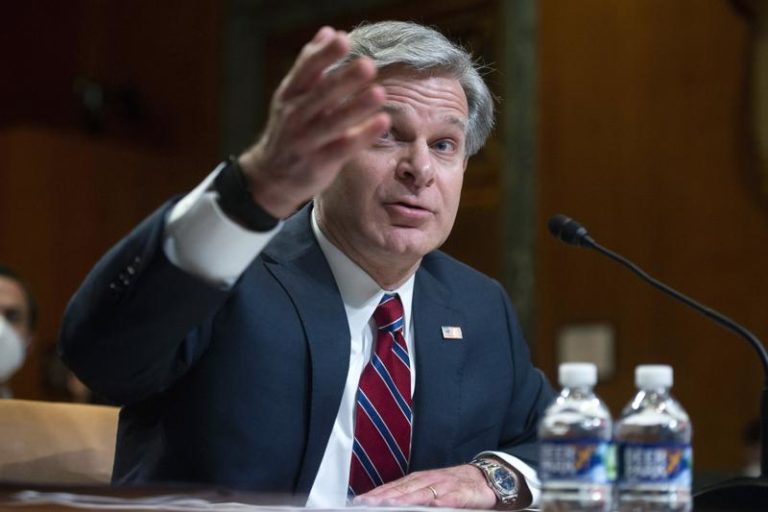
The existence of this second memo directly contradicts then-FBI Director Chris Wray’s testimony to Congress that the Richmond office had produced “a single product.”
Grassley has asked current FBI Director Kash Patel to release more documents related to both memos, specifically their origins.
“I’m determined to get to the bottom of the Richmond memo, and of the FBI’s contempt for oversight in the last administration,” Grassley wrote Monday to Patel. “I look forward to continuing to work with you to restore the FBI to excellence and prove once again that justice can and must be fairly and evenly administered, blind to whether we are Democrats or Republicans, believers or nonbelievers.”
The FBI’s targeting of traditional Catholics follows a years-long campaign by the SPLC against what it describes as “radical traditional Catholics.”
The SPLC’s claims, however, are based on vague associations and ideological assumptions. The group claims that some “white power activists” have “embraced the aesthetics and practices” of traditional Catholicism to supposedly reverse the Civil Rights movement and the Novus Ordo Missae reforms enacted after the Second Vatican Council.
The New Order replaced the Traditional Latin Mass—introduced by Pope Pius V in 1570—with the modern Mass instituted by Pope Paul VI in 1969.
The left’s attempt to link traditional Catholicism to so-called extremism conveniently ignores the faith’s historic and spiritual roots. What’s more, there is no evidence that traditional Catholicism leads to violent extremism.
(Luis Cornelio, Headline USA) As Elon Musk ramps up his social media attacks on President Donald Trump, podcast host Steve Bannon has fired back with a blunt proposal: deport Musk to South Africa.
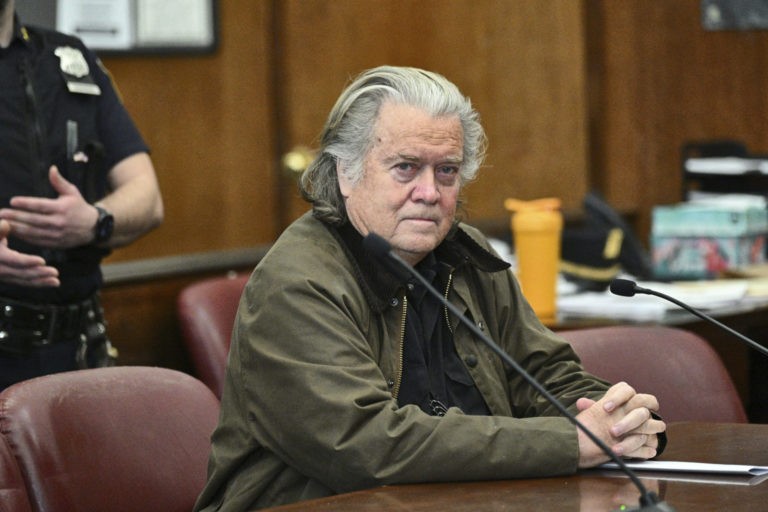
“They should initiate a formal investigation of his immigration status because I am of the strong belief that he is an illegal alien, and he should be deported from the country immediately,” Bannon said Thursday in an interview with the leftist New York Times.
Bannon doubled down on his War Room podcast, saying, “Elon Musk is illegal, and he’s got to go,” and “You’re going to ship these other people home. Let’s start with the South Africans, OK?”
Steve Bannon calls for Elon Musk's deportation and for Trump to sign an executive order seizing SpaceX pic.twitter.com/wk34gkW7vJ
Bannon’s comments appear to reference a Washington Post report claiming that Musk began his career as an illegal alien.
According to The Post, Musk entered the U.S. under a student visa in 1995 but never enrolled in courses. Instead, Musk began working, a potential violation of his visa.
At the time, Musk was building Zip2, a company he sold for $300 billion in 1999. This windfall became Musk’s “steppingstone” to Tesla and the other ventures that made him the world’s richest man, the newspaper found.
Bannon’s remarks came in response to Musk’s relentless social media tirades against Trump. At the heart of Musk’s attacks is Trump’s support for the Big Beautiful Bill, which Musk claims would increase the federal deficit.
However, media reports suggest Musk was “butthurt” after being excluded from the bill’s drafting process.
Adding insult to injury, the legislation also halts taxpayer-funded credits for individuals who purchase electric vehicles, including Teslas. Tesla had lobbied the Trump administration to preserve those subsidies, which could have helped the company amid plummeting sales.
Musk was also reportedly upset that Trump did not offer to extend his temporary appointment as a special government employee.
In a series of viral posts, Musk spiraled into accusations against Trump, claiming the president “is in the Epstein files.”
Trump, in response, quipped that Musk was bitter over being sidelined and suggested that Musk’s lucrative government contracts should be canceled to save the deficit.
“The easiest way to save money in our Budget, Billions and Billions of Dollars, is to terminate Elon’s Governmental Subsidies and Contracts. I was always surprised that Biden didn’t do it!” Trump wrote on Truth Social.
(José Niño, Headline USA) Accenture, the world’s largest consulting firm, has quietly become a driving force behind the rise of global surveillance and algorithmic policing—growing from the 59th largest U.S. government contractor to the 8th largest in about two decades.
A new investigation published last month by Reactionary International, dubbed the “Accenture Files,” details how the world’s largest consultancy rose from the ashes of the Enron scandal to become a cornerstone of state surveillance infrastructure.
Originally Andersen Consulting, Accenture rebranded in 2001 after separating from Arthur Andersen, distancing itself from scandal while retaining global reach. The post-9/11 security boom offered Accenture a golden opportunity.
In 2004, the company quickly secured a pivotal contract with the U.S. Department of Homeland Security to build the US-VISIT program—a biometric tracking system that has the ability to surveil millions of travelers and immigrants.
However, Accenture manipulated the bidding process to secure the U.S. Department of Homeland Security’s US-VISIT contract by moving into government offices and setting up operations before the award was officially announced.
In doing so, it effectively positioned itself as the de facto contractor during the evaluation phase. This move created logistical advantages, making it difficult for competitors like Lockheed Martin and CSC to displace them.
Moreover, in August 2003, three months prior to the government starting to request bids, Accenture officials recommended US-VISIT director James L. Williams to “limit the number of bidders, and streamline the procurement approach,” according to a report by the Washington Post.
This aggressive maneuvering set a precedent for how Accenture would win future government work, establishing a pattern of leveraging insider relationships, exploiting opaque procurement processes, and recruiting former officials
New research reveals how Accenture, a global IT company has systematically embedded itself within the architecture of state surveillance. The documents expose the company’s involvement in algorithm-driven policing and the construction of biometric databases containing the… pic.twitter.com/dwKUKJ9fXq
Accenture’s influence extends through strategic partnerships. One of the most significant is with Palantir, the controversial data-mining company founded by Peter Thiel. Together, they have secured major contracts, such as a $600 million deal with the UK’s National Health Service to create a centralized data platform.
Accenture is now one of the top U.S. government contractors, with clients including the Department of Defense and Immigration and Customs Enforcement (ICE). It has developed “smart border” technologies and modernized IT systems for border agencies, further entrenching its role in the military-industrial complex. The company has also invested heavily in Israeli cybersecurity firms, advancing its offensive cyber capabilities and expanding its global reach.
Despite positioning itself as a cybersecurity leader, Accenture has suffered several high-profile data breaches. In 2017, it left sensitive data on unsecured cloud servers, exposing secrets from both its own operations and those of its clients.
More recently, a 2024 data leak allegedly compromised tens of thousands of employee records, further putting into question its security practices.
José Niño is the deputy editor of Headline USA. Follow him at x.com/JoseAlNino
(Dave DeCamp, Antiwar.com) Israeli opposition leader and former Defense Minister Avigdor Liberman said on Thursday that Prime Minister Benjamin Netanyahu was arming a gang in southern Gaza that’s affiliated with ISIS, a charge that has been confirmed by Israeli officials.
“The Israeli government is giving weapons to a group of criminals and felons, identified with the Islamic State, at the direction of the prime minister,” Liberman said. “To my knowledge, this did not go through approval by the cabinet.”
Liberman compared the arming of the criminal gang to Netanyahu’s previous strategy of propping up Hamas as a counter to the Palestinian Authority. “No one can guarantee that these weapons will not be directed at Israel. We have no way of monitoring or tracking them,” he said.
An initial statement released by Netanyahu’s office didn’t deny the allegation. “Israel is acting to defeat Hamas in various and diverse ways, upon the recommendation of all heads of the security establishment,” the office said.
Later, Netanyahu confirmed that Israel has been arming “clans” in southern Gaza. “On the advice of security officials, we activated clans in Gaza that oppose Hamas. This is only good and saves the lives of IDF soldiers. The publication of this only benefits Hamas – but Lieberman doesn’t care,” he said, according to The Jerusalem Post.
Israeli military sources told The Times of Israelthat Israel has been arming a group described as a “criminal gang of jihadists” led by Yasser Abu Shabab, a member of one of the largest clans in southern Gaza. Israel has been providing Abu Shabab’s gang with Kalashnikov rifles, including some that were seized from Hamas.
According to the Times, Hamas sources speaking to Lebanon’s Al-Akhbarnewspaper said that members of Abu Shabab’s gang belong to an extremist Salafi faction that has had run-ins with Hamas.
Abu Shabab’s gang has been operating in Israeli-controlled areas of southern Gaza and has been involved in looting aid shipments. Last year, an internal UN memo identified Abu Shabab’s gang as “the main and most influential stakeholder behind systematic and massive looting” of aid trucks. Haaretzalso reported last year that the Israeli military was allowing armed gangs to loot aid convoys and extort protection fees from drivers.
In an interview with The Washington Post, Abu Shabab admitted that he and his group “take from trucks” but claimed they didn’t touch “food, tents, or supplies for children.” According to a report from The New Arab, Abu Shabab is affiliated with Shadi al-Soufi, another gang leader who was detained by Hamas in 2020 over an alleged murder. The report said al-Soufi fled Gaza with the help of ISIS and returned following the start of Israel’s genocidal war.
Abu Shabab, who was imprisoned by Hamas for drug trafficking before an Israeli airstrike allowed him to escape, recently released a video where he said his new armed group “cleared” eastern Rafah of Hamas fighters and said Palestinians could return to the area, which is under the control of the IDF.
Yair Golan, another Israeli opposition leader and retired IDF general, slammed Netanyahu for arming the gang in a post on X. “Netanyahu, who transferred billions to Hamas in cash suitcases, based on a misguided notion that Hamas is an ‘asset’ and that it would end in flip-flops, is now promoting a new dangerous notion: arming a Gazan militia with ties to ISIS,” he said.
נתניהו שהעביר מיליארדים לחמאס במזוודות מזומן, מתוך קונספציה שגויה שחמאס הוא “נכס” ושזה ייגמר בכפכפים, מקדם עכשיו קונספציה מסוכנת חדשה: חימוש מליציה עזתית עם זיקה לדאעש.
נתניהו מסוכן לביטחון ישראל. במקום להביא עסקה, לייצר הסדרים עם הציר הסוני המתון ולהחזיר את החטופים ואת הביטחון…
— Yair Golan – יאיר גולן (@YairGolan1) June 5, 2025
“Netanyahu is dangerous to Israel’s security. Instead of securing a deal, creating arrangements with the moderate Sunni axis, and bringing back the hostages and security to Israel’s citizens, he is creating a new ticking bomb in Gaza,” Golan added.