Biden State Dept Imposed Bizarre Bathroom Rules to Appease Muslims

(Luis Cornelio, Headline USA) The State Department under the Biden administration installed foot-washing stations for Muslim employees. Now the Trump administration is under pressure to halt such stations.

Journalist Laura Loomer was the first to expose the stations, reportedly aimed at allowing Muslim staffers to perform ritual ablutions before prayer.

The installation was made possible through the employee group American Muslims and Friends at State (AMFAS).

In a March 2024 blog, AMFAS admitted it worked “closely” with the State Department’s Bureau of Administration to “establish bathrooms with ablution capability,” along with a designated Quiet Reflection Room.

The creation of these stations was made possible thanks to the employee organization American Muslims and Friends at State (AMFAS).

In a March 2024 blog, the organization bragged about working “closely” with the State Department’s Bureau of Administration to “establish bathrooms with ablution capability,” along with a designated Quiet Reflection Room.

In an X post, Loomer controversially referred to the group as “jihadist” and questioned whether Secretary of State Marco Rubio will remove the installations.

“The Islamification at the US State Department is not only evident in the way jihadists still work within the Department where they are actively abusing the US visa system to let dangerous Islamic immigrants into our country, but did you know the @StateDept has caved to Muslims so much they have established foot washing stations for Muslim employees at State to wash themselves before their Islamic prayers???” Loomer wrote.

“It’s time for @SecRubio to eliminate AMFAS as an Employee organization at State Department and it’s time for the State Department to get rid of the Islamic prayer rooms and Muslim foot washing stations inside the State Department bathrooms,” Loomer added.

She concluded with a strong call to action: “America is not a Muslim country and we need to RESIST all efforts by Muslims to Islamify the United States.”

It remains unclear whether the State Department implemented similar policies for employees of other faiths.
Suspended FBI Whistleblowers Steve Friend and Garret O’Boyle Set to Return

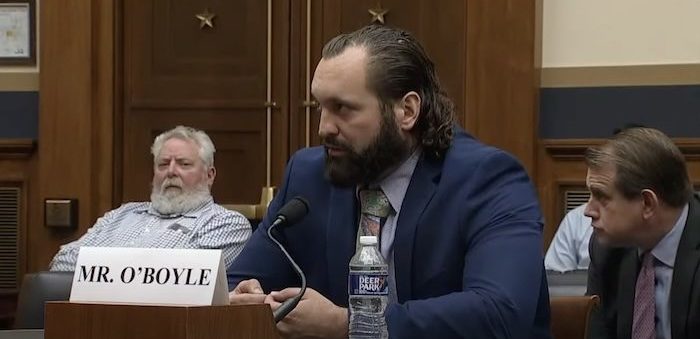
(Luis Cornelio, Headline USA) New details have emerged about the FBI settlements with agents-turned-whistleblowers persecuted by the Biden administration, including Steve Friend and Garret O’Boyle, whose high-profile cases drew widespread attention.

Friend, who faced retaliation after objecting to harsh Jan. 6 raids, and Garret O’Boyle, falsely accused of leaking information to Project Veritas, are set to return to their FBI jobs with back pay, interest, and benefits reinstated, government watchdog Empower Oversight announced Tuesday.

The settlements resolve 10 longstanding disputes with the bureau. FBI Director Kashyap Patel announced the settlements earlier this week, noting they were made with the assistance of Senate Judiciary Committee Chairman Chuck Grassley.

“For each of these cases where whistleblowers finally received at least some measure of justice for the retaliation they faced just for telling the truth about wrongdoing, there are many more who still need a remedy,” Empower Oversight Founder Jason Foster and President Tristan Leavitt wrote in a letter to Grassley.

The Biden administration suspended Friend after he objected to the use of a SWAT team to arrest a Jan. 6 protestor. Notably, the protestor had expressed his willingness to collaborate with the FBI regarding their investigation.

“After Friend made these protected disclosures, his superiors threatened his career, overruled his objections, denied his request to volunteer for other duties on the day of the arrest, and ordered him to stay home on the day of the arrest,” Empower Oversight wrote.

O’Boyle was suspended after preparing for a transfer from Kansas to Virginia. He had sold his Kansas home, begun purchasing another in Virginia and placed his belongings in FBI storage. His wife was pregnant with their fourth child at the time. They were also relocating to Virginia.

“Immediately upon his arrival at CIRG, SA O’Boyle was interviewed by NY agents investigating Project Veritas,” Empower Oversight added. “After the interview, he was notified his security clearance was suspended, and soon after, he was indefinitely suspended without pay.”

Each settlement differs in terms but generally includes no forced resignations, four voluntary retirements and all involve lump-sum payments for damages.

Four settlements restore full back pay and benefits under the Back Pay Act. This law requires putting federal employees in the same financial position they would have been had they not been subjected to an “unjustified or unwarranted personnel action,” as noted by Empower Oversight.


Headline Geopolitics: Dave DeCamp on U.S. Interventionism

(José Niño, Headline USA) In this Headline Geopolitics episode, José Niño interviews Dave DeCamp, News Editor at Antiwar.com and host of Antiwar News with Dave DeCamp.

DeCamp discusses Iran’s stronger-than-expected performance against Israel, Marjorie Taylor Greene’s surprising anti-Israel turn, and the flashpoints looming in Yemen, Iran, and Russia.

Listen now for one of the clearest antiwar perspectives in American journalism today.

Follow Dave DeCamp’s work below:

Twitter: https://x.com/DecampDave
Website: https://www.antiwar.com/blog/author/dave_decamp/

José Niño is the deputy editor of Headline USA. Follow him at x.com/JoseAlNino

Silicon Valley Launches $100 Million PAC to Fight AI Regulations

(Christina Urso) Silicon Valley is dumping over $100 million into a network of political action committees (PACs) and various organizations to advocate against regulation of artificial intelligence.

The Wall Street Journal reported Monday that venture-capital firm Andreessen Horowitz and OpenAI President Greg Brockman are “among those helping launch and fund Leading the Future, a new super-PAC network focused on AI.” Other backers of the network include Palantir Technologies co-founder Joe Lonsdale and Ron Conway from Perplexity.

The new Pro-AI PAC network, “Leading the Future,” will use campaign donations and digital ads to promote candidates who advocate for favorable AI regulation, and to oppose candidates whose policies the network thinks will stifle the industry. The PACs are led by former staffers for Sen. Chuck Schumer, former New York Gov. Andrew Cuomo, and former Sen. Mitt Romney.

The network has taken inspiration from the pro-crypto super PAC network Fairshake, which helped President Trump secure his victory in 2024.

Leading the Future will focus on four key states (California, New York, Illinois, and Ohio) during the 2026 midterm elections. This comes after the Trump Administration announced a plan in July to make the US an AI “powerhouse” and to unleash the “fourth industrial revolution” and win the global AI race.

During the Trump Presidential campaign, Silicon Valley titans went from being vehemently anti-Trump to some of his biggest funders and defenders. The same oligarchs were front and center at his inauguration, a sign of the influence the industry would exert during his second administration.

Vice President JD Vance worked in venture capital for years at Mithril Capital, where he grew close to Peter Thiel. Elon Musk became a fixture on the campaign trail and then established DOGE.

David Sacks, another member of the so-called “PayPal Mafia,” a founder and partner at VC firm Craft Ventures, now serves as Trump’s artificial intelligence and crypto czar. Entrepreneur and venture capitalist Sriram Krishnan, who led product teams at Microsoft, Facebook, and Twitter before becoming a general partner at Andreessen Horowitz, is now a senior White House policy advisor on AI.

Last but not least, Jacob Helberg, a senior advisor to Palantir Technologies CEO Alex Karp, is now the Under Secretary of State for Economic Growth, Energy, and the Environment.

On July 4, 2025, President Trump signed “The One Big Beautiful Bill” into law. This bill initially included a 10-year federal ban on state and local AI regulation, which was rejected. However, the bill did provide federal funding, grants, and tax incentives for companies investing in US-based AI infrastructure, which includes data centers, semiconductor manufacturing, and AI research.

Both Andreessen Horowitz and OpenAI were behind the push for the 10-year moratorium on states’ rights to regulate AI. Since this moratorium didn’t pass in the Big Beautiful Bill, some members of Congress are now trying to sneak this same provision into the National Defense Authorization Act. Buried in the NDAA is a provision that would ban states and local governments from regulating AI for 10 years.

Many of these venture capital firms work together and operate as a cartel, including Andreeseen Horowitz (a16z), Founders Fund, Oracle, Pronomos Capital, In-Q-Tel (CIA), Y Combinator, Sequoia, General Catalyst, Sanabil Investments, Vintage Investment Partners, Shield Capital, 8VC, Craft Ventures, Lux Capital, and Eric Schmidt’s White Stork, Schmidt Foundation, Innovation Endeavors, and America’s Frontier Fund.

These tech giants always invoke the specter of losing the “AI arms race” to China in their push for not regulating AI. The American public overwhelmingly supports regulating this disruptive, invasive, and potentially dangerous technology.

Christina Urso is an independent filmmaker and a correspondent for Headline USA. Follow her at https://x.com/NotRadix.

Syria’s Al-Qaeda-Leader-Turned President To Visit New York To Address the UN General Assembly

(Dave DeCamp, Antiwar.com) Ahmed al-Sharaa, the former al-Qaeda leader who is now Syria’s de facto president, is expected to travel to New York City in September to address the UN General Assembly, Reuters reported on Monday.

According to The Cradle, Sharaa will become the first Syrian president to address the General Assembly since 1967. He will participate in the General Assembly week, which is scheduled to begin on September 22.

The Jerusalem Post reported that the US is hoping to have a security deal between Israel and Sharaa’s government to announce by the time of the General Assembly.

Sharaa, formerly known as Abu Mohammed al-Jolani, has been embraced by the Trump administration, which recently lifted sanctions on Syria and revoked the Foreign Terrorist Organization designation for Sharaa’s group of jihadists that took power in Damascus, known as Hayat Tahrir al-Sham (HTS), despite repeated massacres of minorities by HTS-affiliated forces.

In May, President Trump met with al-Sharaa in Saudi Arabia and praised the former al-Qaeda leader, calling him a “young, attractive guy” with a “strong past.”

Sharaa got his start with al-Qaeda in Iraq, where he fought an insurgency against US troops before being imprisoned from 2006 to 2011. In 2012, he travelled to Syria, where he formed al-Qaeda’s affiliate in the country, the al-Nusra Front.

In 2016, Sharaa claimed the al-Nusra Front was cutting ties with al-Qaeda. At the time, he thanked the “commanders of al-Qaeda for having understood the need to break ties.” In 2017, Julani merged his group with several other Islamist factions to form HTS, which took power in Damascus in December 2024 after ousting former President Bashar al-Assad.

This article originally appeared at Antiwar.com. 

Trump Administration Shatters the Record for Annual US Airstrikes in Somalia

(Dave DeCamp, Antiwar.com) The Trump administration has shattered the record for total US airstrikes in Somalia in a single calendar year, as the US has been bombing the country at a record pace with virtually no American media coverage.

US Africa Command told Antiwar.com in an email on Tuesday that its forces launched a total of nine airstrikes in a recent two-week campaign against the ISIS affiliate in Somalia’s northeastern Puntland region, bringing the total number of US airstrikes in Somalia this year to 68.

The previous record for US airstrikes in Somalia in a single year was set at 63 in 2019 during President Trump’s first term. The current Trump administration is set to significantly outpace the 2019 bombing campaign as it continues to provide air support for local Puntland forces fighting the ISIS affiliate in the northeast and for US-backed government forces fighting al-Shabaab in southern Somalia.

At the beginning of his term, Trump eased restrictions on airstrikes and special operations raids in areas outside of countries officially considered combat zones by the US, which applies to every country except Iraq and Syria. The result was a massive increase in US airstrikes, including in Yemen, where the Trump administration conducted a brutal bombing campaign from March 15 to May 6 that killed more than 250 civilians.

According to figures from the Armed Conflict Location and Event Data (ACLED), Trump launched nearly as many airstrikes during his first five months in office as President Biden did during his entire four-year term. Trump also became the first US president to bomb Iran with his strikes against Iranian nuclear facilities during the 12-day US-Israeli war on the Islamic Republic.

The Trump administration has also conducted airstrikes against ISIS and al-Qaeda fighters in Iraq and Syria while also supporting the new Syrian government, which is led by a former al-Qaeda commander.

This article originally appeared at Antiwar.com.


Trump Proposes Returning Death Penalty to D.C.

(Sarah Roderick-Fitch, The Center Square) Capital punishment could be returning to Washington, D.C., as President Donald Trump announced during a cabinet meeting on Tuesday.

“Anybody murders in the capital? Capital punishment. Capital—capital punishment. If somebody kills somebody in the capital, Washington, D.C., we’re going to be seeking the death penalty. That’s a very strong preventative,” Trump told reporters and members of his cabinet.

The president’s announcement comes on the heels of local reports that the district broke a nearly two-week streak without a homicide in the nation’s capital after the president announced “Liberation Day,” declaring a crime emergency.

During the president’s “Liberation Day” announcement at the White House on Aug. 11, the White House released a fact sheet showing the district’s 2024 murder rate per 100,000 in comparison to other nations’ capitals. America led the pack, nearly double second-place Bogota, Columbia; followed by Mexico City, Mexico; and Islamabad, Pakistan.

Washington, D.C. City Council repealed the death penalty in 1981, and the district residents voted against capital punishment in 1992 in a referendum ordered by Congress, according to the Death Penalty Information Center.

The president invoked the D.C. Home Rule Act, deploying the National Guard and increasing federal law enforcement officers to patrol the streets, citing “out of control” violence.

Since Aug. 11, the D.C. Police Union has calculated major decreases in crimes, including 83% drops in carjackings, 46% decreases in robberies, 22% drops in violent crime, 21% decreases in car theft, and 6% drops in property crime. The group adds that there has been an 8% reduction in crime overall.

Despite vocal critics of the move and protests calling for D.C. statehood and to “Free D.C.,” a Harvard CAPS/Harris poll released Monday shows that 54% of voters support Trump’s actions in D.C., considering them “justified and necessary,” including 28% of Democrats and 47% of independents.

The poll also shows that 56% of voters believe the “typical” large cities are unsafe, specifically New York City (63%) and Los Angeles (62%).

The last execution carried out in Washington, D.C. was in 1957, when Robert Carter was convicted of killing an off-duty police officer. One of the most famous executions in history was carried out in Washington, D.C. in 1865 when the military hanged Mary Surratt for conspiring in the assassination of President Abraham Lincoln.


BREAKING: White Mother Criminally Charged for Using Racial Slur after Black Child Took Her Property

(Ken Silva, Headline USA) In late April 2025, a Minnesota mother, Shiloh Hendrix, was recorded at a public park in Rochester, Minnesota, after she berated a 5-year-old black child for allegedly taking items from her 18-month-old son’s diaper bag—calling the kid the “N-word.” The recording went viral soon thereafter.

Now, Hendrix is facing criminal charges over the matter. The prosecutor on the case is Michael Spindler-Krage.

The city of Rochester announced the charges Tuesday. Hendrix faces 90 days in jail and a $1,000 fine for three counts of disorderly conduct.

According to the criminal complaint filed by Rochester police officer Dylan Beck, the incident started at a local park, where a 5-year-old autistic child took apple sauce from Hendrix’s bag. Hendrix chased after the boy. So did the boy’s father, Somali national Sharmake Beyle Omar, according to the police complaint.

“[Hendrix] became very angry while chasing [the child]. [Hendrix] shouted at him and repeatedly used a racial epithet (the N-word; [the child] is of Somali background) … Based on her anger and words, [Omar] feared that defendant may strike [the child],” the complaint says. “[Hendrix angrily grabbed the food item from [the child].”

That’s when Omar began filming Hendrix in a video that would go viral.

“Don’t dig into people’s shit, you dumb fuck,” Hendrix told the Somali man. “He took my son’s stuff.”

In a press release, Rochester Mayor Kim Norton said the incident has affected her community.

“This was a situation that deeply affected many people, especially our communities of color, and caused real turmoil in our community,” Rochester Mayor Kim Norton said in a press release.

“We acknowledge the lasting impact this incident has had, not only on those directly involved and across our community, but also in the broader conversations happening at the state and national level. These moments remind us of the complexity and far-reaching impacts of situations like this,” she added.

Following the video’s viral dissemination, Hendrix established a GiveSendGo fundraiser titled “Help Me Protect My Family.” Originally setting a goal of $1,000,000, she has raised over $600,000 as of the time of this writing.

In her fundraiser description, Hendrix claims she has been “put into a very dire situation” following the incident. She alleges her personal information has been compromised: “My SSN has been leaked. My address, and phone number have been given out freely. My family members are being attacked. My eldest child may not be going back to school. Even where I exercise has been exposed.”

Ken Silva is the editor of Headline USA. Follow him at x.com/jd_cashless.

Indian Gold Imports Surged in July

(Mike Maharrey, Money Metals News Service) Indian gold imports rebounded significantly in July as retailers built inventories for the festival and wedding season.

Meanwhile, gold investment demand remained robust.

India ranks as the second-largest gold market in the world behind China.

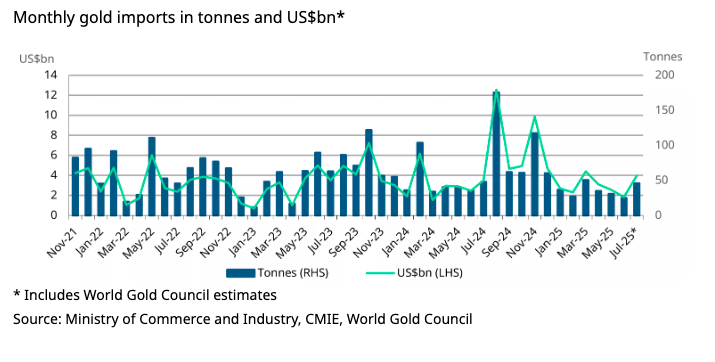
After declining for three straight months, gold imports surged in July, totaling nearly $4 billion, according to Indian customs data. The World Gold Council estimates that translates to between 42 and 48 tonnes.

July gold imports were up 14 percent year-on-year and doubled June totals, exceeding the monthly average through the first half of the year.

Jewelry makers are building inventory in anticipation of the fall wedding and festival season, when Indians traditionally buy gold.

The Indian jewelry market has faced headwinds due to higher prices, with many consumers opting for smaller pieces or sitting out altogether. But World Gold Council analyst Kavita Chacko said there are signs of revival and anecdotal reports indicate “a positive outlook.”

Chacko said that during the recent India International Jewelry Show, “many manufacturers reported stronger-than-expected buying interest and a noticeable pickup in orders from both large chain stores and independent retailers.

Meanwhile, retailers who had been cautious about inventories are reportedly actively restocking in anticipation of improved festival sales.

Even as gold jewelry demand withered under price pressure, gold bar and coin sales have remained robust. Chacko said physical investment demand “remains healthy.”

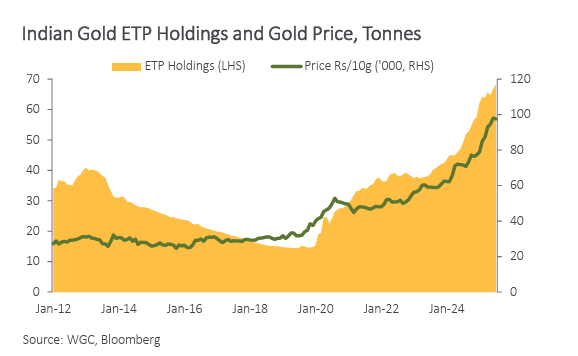
Investor bullishness is also reflected in continued inflows of gold into Indian ETFs. Indian funds added ₹12.6 billion ($146 million) of gold in July, approximately 1.2 tonnes. It was the third straight month of gold inflows.

Analysts say the momentum continued through the first two weeks of August.

As of the end of July, Indian gold ETFs reported assets under management (AUM) of ₹676 billion ($7.85 billion), a 96 percent year-on-year increase.

There were 215,000 new Indian ETF accounts set up in July. So far this year, ETF accounts have grown by 42 percent.

A gold ETF is backed by a trust company that holds metal owned and stored by the trust. In most cases, investing in an ETF does not entitle you to any amount of physical gold. You own a share of the ETF, not gold itself. ETFs are a convenient way for investors to play the gold market, but owning ETF shares is not the same as holding physical gold.

Indians have a longstanding love affair with gold.

The yellow metal is deeply interwoven into the country’s marriage ceremonies, along with its religious and cultural rituals. Festival seasons typically boost gold demand.

Indians have long valued the yellow metal as a store of wealth, especially in poorer rural regions. Around two-thirds of India’s gold demand comes from beyond the urban centers, where large numbers of people operate outside the tax system. Many Indians use gold jewelry not only as an adornment but as a way to preserve wealth.

In the West, gold is generally viewed as a luxury item. Not in India. Even poor Indians buy gold.

According to a 2018 ICE360 survey, one in every two households in India had purchased gold within the last five years. Overall, 87 percent of Indian households own some gold. Even households at the lowest income levels in India hold some of the yellow metal. According to the survey, more than 75 percent of families in the bottom 10 percent of income managed to buy some gold.

The yellow metal was a lifeline for Indians buffeted by the economic storm caused by the government’s response to COVID-19. After the Indian government locked down the country, banks tightened credit to mitigate the default risk. Unable to secure traditional loans, Indians used gold to secure financing. As Indians endured a second wave of lockdowns, many Indians resorted to selling gold outright to make ends meet.


Mike Maharrey is a journalist and market analyst for Money Metals with over a decade of experience in precious metals. He holds a BS in accounting from the University of Kentucky and a BA in journalism from the University of South Florida.

Economic Stress: Credit Card Delinquencies Are on the Rise Even Among Those With Prime Credit

(Mike Maharrey, Money Metals News Service) Over the last several months, consumer credit data has suggested that Americans may have reached their credit limits. Now, there is further evidence of debt stress, as more consumers with high credit scores are falling behind on their credit card payments.

This is dreadful news for an economy that depends on consumers borrowing and spending money, and signals that it may not be as robust as some analysts claim.

The pace of new consumer borrowing has slowed to a crawl, and revolving debt, primarily made up of credit card balances, contracted in both May and June. (July data will come out early in September.)

Even with the contraction, Americans are still buried under $1.3 trillion in revolving debt.

The double whammy of rising debt and interest rates exacerbates the debt problem. The average annual percentage rate (APR) currently stands at 20.13 percent, with some companies still charging rates as high as 28 percent. The average is only slightly down from the record high of 20.79 percent set last August.

We’re seeing growing evidence that Americans are struggling under the burden of those debt payments.

LegalShield’s Consumer Stress Index (CSLI) increased by 4.4 percent in the second quarter and is at the highest level since November 2020, when the economy was shut down during the pandemic.

A LegalShield spokesperson said, “As consumers take on more credit to keep up with inflation and everyday expenses, many are hitting a breaking point. The increase in legal inquiries tied to foreclosures and personal finance issues suggests that debt-fueled spending is no longer sustainable for a growing number of Americans.” 

LegalShield’s Foreclosure Index surged 13.3 percent in Q2 and now stands nearly 29 percent higher than a year ago.

Meanwhile, according to Federal Reserve data, late-stage delinquencies on credit card debt ticked year-over-year in Q1. Meanwhile, 4.3 percent of total outstanding household debt is in some stage of delinquency. Serious delinquencies, defined as debts that are 90 or more days past due, rose to 2.8 percent of total debt, a 52 percent increase year-on-year.

Subprime credit card borrowers are struggling the most. According to credit scoring company VantageScore, the number of subprime borrower accounts over 90 days delinquent is up 109 percent year-on-year.

Consumers with the highest credit scores are also starting to fall behind.

According to VantageScore, there was a 47 percent year-on-year increase in late payments by people in the prime segment.

“Even though in absolute terms the increase is modest, it shows that even consumers considered the most credit-healthy are also beginning to see some stress with regard to repayments.”

Reuters noted that there has also been a “uptick” in auto loan and mortgage late-stage delinquencies. A VantageScore economist said, “Defaults on secured loans, such as mortgages, typically happen only when the pressure on finances is too much for the consumer to manage.”

The End of the Road?

Does the increasing consumer stress indicate that this bubble economy could be on its last legs?

It might.

As inflation surged in the wake of the monetary malfeasance of the pandemic era, Americans blew through their savings. Then they turned to credit cards. It wasn’t that people were buying more. They were just paying more, trying to keep up with surging price inflation. Once they blew through their savings, consumers were forced to finance life using Visa and Mastercard. Consumer debt surged from $4.15 trillion in 2020 to over $5 trillion today.

Now the bill is coming due, and Americans are tapped out.

Consumers may get a break from the Federal Reserve interest rate cuts. Fed chair Jerome Powell indicated that the central bank is close to further easing monetary policy. However, that’s no guarantee of relief. When the Fed cut in late 2023, credit card rates barely budged.

Furthermore, easing monetary policy means more monetary inflation, which may well drive consumer prices even higher.

The bottom line is that Americans have blown through the savings they accumulated during the pandemic and have run their credit cards close to the limit. An economy run on Visa and Mastercard simply isn’t sustainable. When Americans finally hit their credit limit, it will have major implications for economic growth.


Mike Maharrey is a journalist and market analyst for Money Metals with over a decade of experience in precious metals. He holds a BS in accounting from the University of Kentucky and a BA in journalism from the University of South Florida.