“[T]he President has made this a top priority, I think as evidenced by the fact that both Steve Witkoff and Jared Kushner were here for much of the week … and the Vice President just left,” Rubio told reporters after meeting with Netanyahu.
“I’m here now today because this is a priority. It’s a very important achievement, but there’s more work to be done and bigger achievements that lie ahead. And so we’re here to work on that, and we feel very positive and confident that we’re going to get there despite substantial obstacles,” he added.
The New York Timesreported on Wednesday that, according to several Trump officials, there is concern within the administration that Netanyahu may quit the ceasefire deal and that the strategy is for senior US officials to prevent him from restarting the full-scale bombing campaign in Gaza.
Israel has been violating the deal by not allowing a sufficient number of aid trucks to enter Gaza, and it has continued attacks on Palestinians, killing at least 89 since the ceasefire went into effect, including one over the past day, according to Gaza’s Health Ministry. The US appears to be tolerating the current situation but wants to prevent Israel from launching major airstrikes on Gaza, like the attacks that were seen this past Sunday.
The Israeli newspaper Haaretzreported on Thursday that the US expects to be notified in advance before the IDF “conducts any exceptional military strikes in the Gaza Strip, including airstrikes.”
The report said: “Israeli defense sources say that the Americans are not yet presenting this as a demand for a green light from them before any military action. But, in practice, they are making it very clear that they will not tolerate any more Israeli surprises that would jeopardize the cease-fire.”
(Jesse Colombo, Money Metals News Service) Despite their well-earned reputations as stable assets and safe havens, gold and silver have become highly volatile in recent weeks, with sharp moves in both directions.
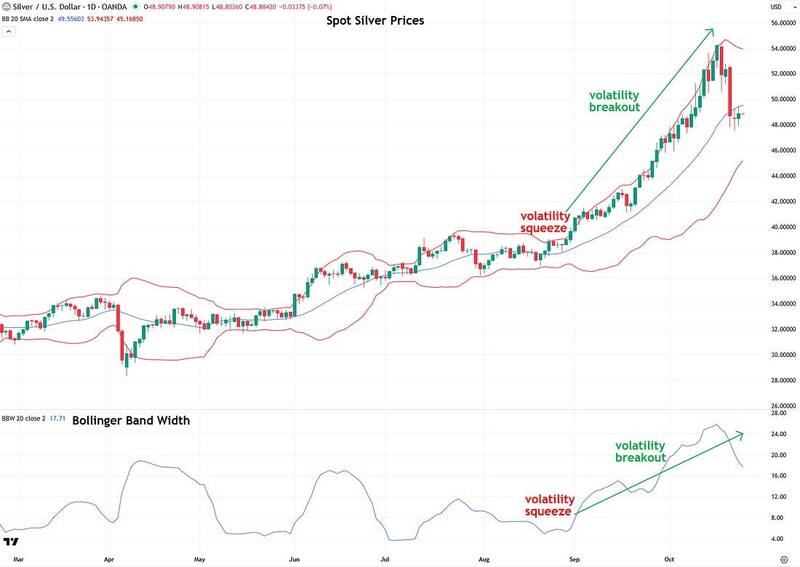
This marks a significant change in behavior and has sparked widespread discussion across the financial world, particularly after last week’s steep declines. Gold dropped from $4,400 to $4,000, a loss of about 9%, while silver fell from $54 to $48, or roughly 11%, all within just a couple of days.
This volatility was entirely foreseeable, however. I explicitly called for it back in August, at a time when the precious metals space was eerily calm and before gold’s $1,000-per-ounce surge in the fall. Today’s piece follows up on that earlier analysis, contextualizes the recent swings in precious metals, and explains why the current wave of volatility should settle down soon.
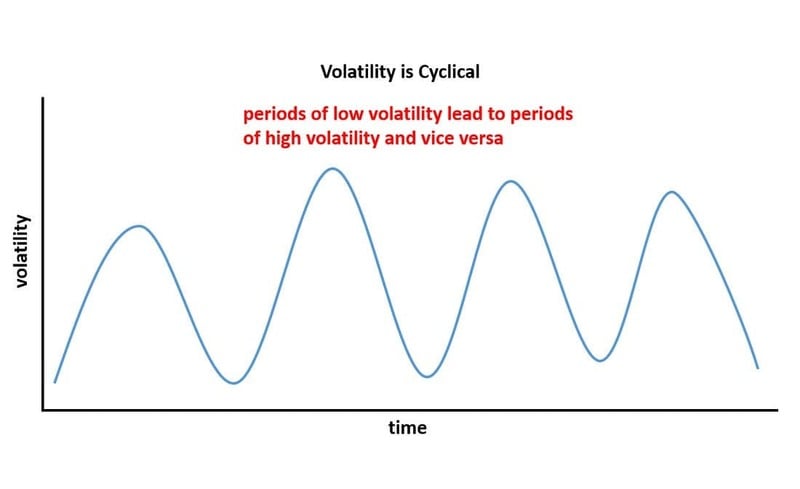
Volatility in financial assets and markets is highly cyclical. While asset prices like precious metals and stocks may not follow clear cycles, the volatility of those prices does, consistently moving through repeating phases of low and high volatility.
Periods of quiet, low volatility tend to build pressure that leads to sharp spikes in volatility, which then eventually subside, starting the cycle again. See the diagram below for a visual of this repeating pattern.
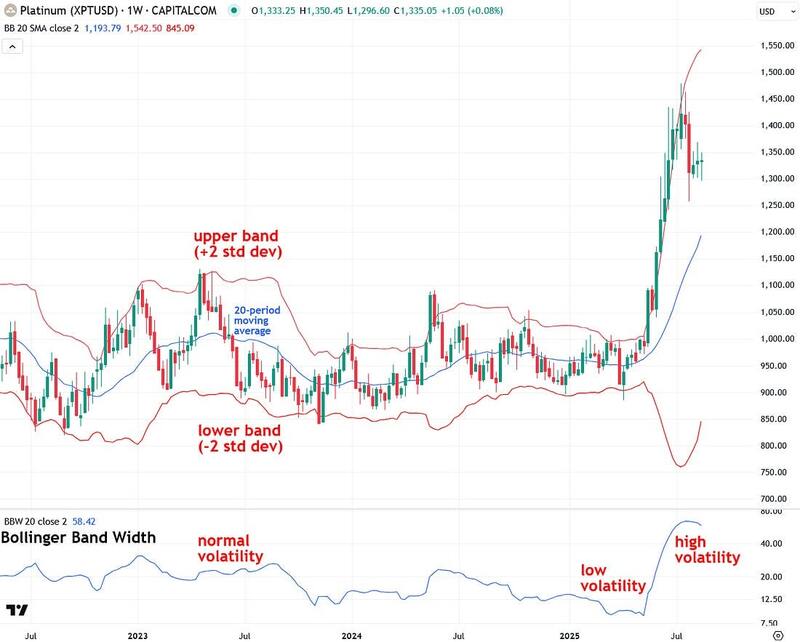
Next, let’s discuss how volatility can be measured and monitored in the real world. While there are a number of ways to do this, one of the most efficient and widely followed is to use an indicator called Bollinger Bands, which, when applied to a chart of an asset such as platinum in the example below, envelops the price.
The way the Bollinger Bands indicator works is that it takes a 20-period moving average of the asset’s price (the blue line in the chart below), and then upper and lower bands (the red lines in the chart below) are plotted two standard deviations above and below the moving average.
There are several ways to use Bollinger Bands, such as treating the upper band as a resistance level and the lower band as a support level. However, that’s not the focus today.
Instead, I’m going to focus on the width of the Bollinger Bands as a way to measure the volatility of the asset they’re applied to. Simply put, when the bands are close together, the asset has low volatility; when the bands are wide apart, the asset is experiencing high volatility—based on the past twenty trading periods, whether measured in days, weeks, or another timeframe.
While it’s easy to eyeball the Bollinger Bands to gauge their width and the asset’s volatility, there is another helpful related indicator called Bollinger Band Width that makes this even easier.
You can see it plotted on platinum’s weekly chart below. The chart shows clear periods of normal volatility, low volatility, and high volatility. When an asset moves sideways for a while, volatility is low, and when it trends strongly either up, as platinum has in recent months, or down, volatility is high.
Now that we’ve briefly covered the theory behind how volatility works in financial markets and how to monitor it, I want to discuss the powerful concept of a volatility squeeze. As mentioned at the start of this report, volatility is highly cyclical: periods of low volatility are followed by periods of high volatility, and vice versa.
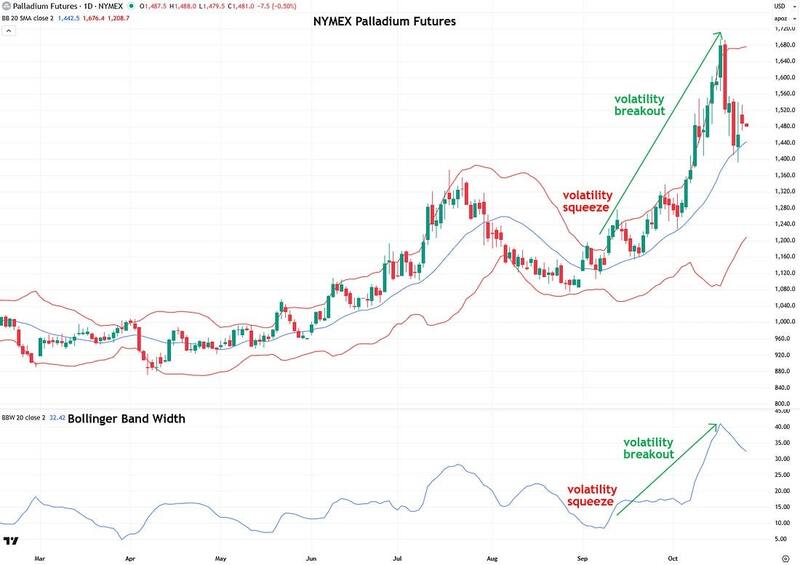
More specifically, periods of extremely low volatility, known as a volatility squeeze, often precede explosive volatility, known as a volatility breakout. This makes volatility squeezes highly valuable to watch for, as they frequently occur just before large, tradeable moves in either direction.
In fact, a high percentage of major bullish and bearish moves in markets are preceded by these squeezes. Volatility squeezes can be thought of as a spring compressed under pressure that snaps back violently once released.
It’s also important to understand investor and trader psychology during volatility squeezes. During these periods, the asset drifts sideways within a range, news flow is minimal, and boredom and discouragement set in as traders lose interest and shift their attention to more active markets. It’s often at that very point, when most eyes are elsewhere, that a major catalyst appears and propels the asset out of its volatility squeeze into a strong new trend.
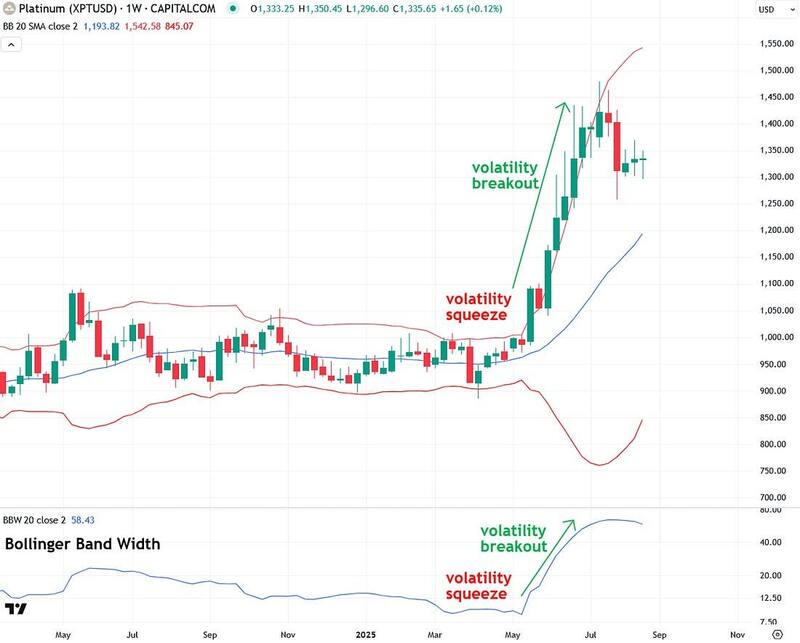
Returning to the platinum example below, from March to May, the metal entered a clear volatility squeeze, visible in the narrowing Bollinger Bands and confirmed by the Bollinger Band Width indicator beneath the chart. During this period, traders grew bored and shifted their attention to more active markets.
Then, on May 20th, platinum broke out explosively, surging nearly 50% over the following two months and sending volatility sharply higher. This is a textbook example of a volatility squeeze, and they occur regularly, yet most traders are unfamiliar with the concept and are often caught off guard by these powerful moves.
Now that the background is out of the way, let’s get into the recent and current action in precious metals. Hopefully, you read the two articles I published back in August, where I highlighted that both gold and silver were in rare volatility squeezes that I expected to lead to explosive moves.
This is the follow-up to what happened next. As predicted, those volatility squeezes during the summer gave way to powerful volatility breakouts in the fall. That breakout was reflected in the sharp price surges in both gold and silver.
To my knowledge, no other analyst was calling for this scenario.
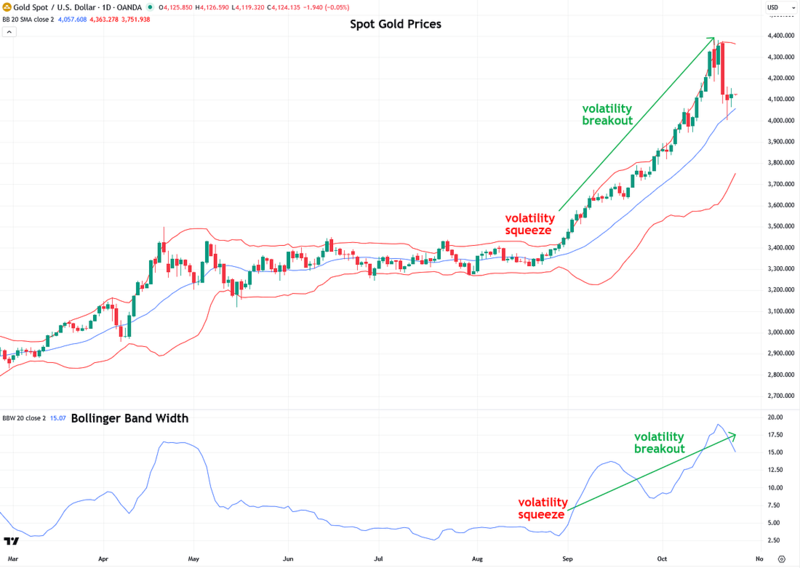
Let’s start by looking at what happened with gold. In August, it formed a clear volatility squeeze, followed by a breakout as prices surged by roughly $1,000 per ounce. This breakout is clearly visible in the widening of the Bollinger Bands around the price, as well as in the rise of the Bollinger Band Width indicator below the chart.
The heightened volatility over the past two weeks occurred in both directions, up and down, which explains why the recent pullback over the past few trading sessions was so sharp.
The volatility squeeze and breakout are also clearly visible in the chart of silver:
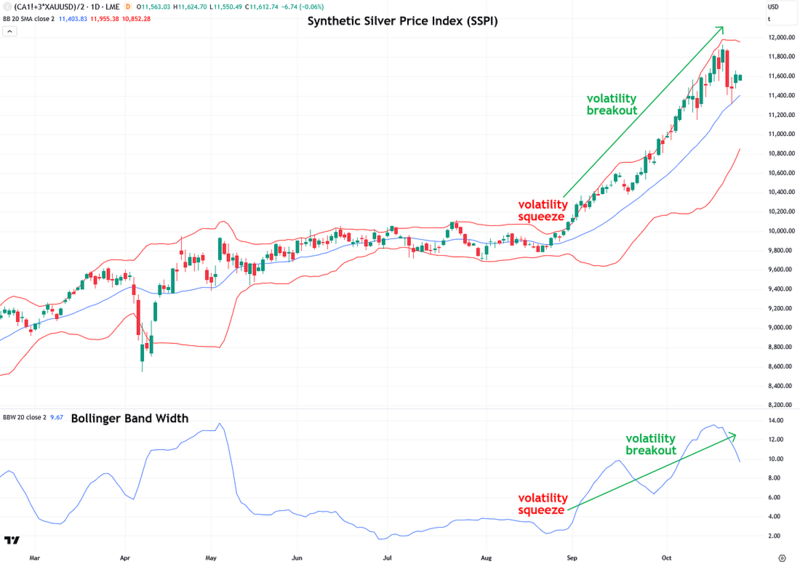
Interestingly, a volatility squeeze and breakout also occurred in my proprietary Synthetic Silver Price Index (SSPI), which I use to confirm that moves in silver are genuine and not false signals:
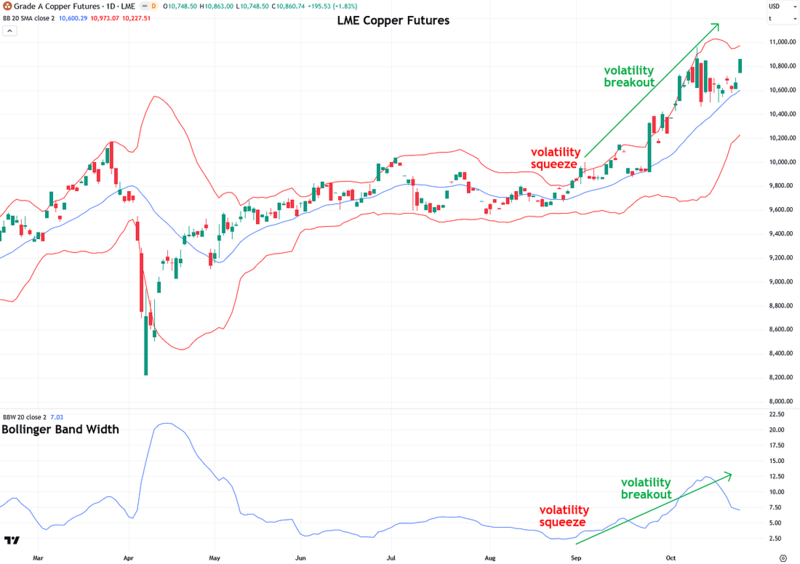
The same pattern occurred in copper, which has a major influence on the price of silver. This is why copper is included as a component of the Synthetic Silver Price Index.
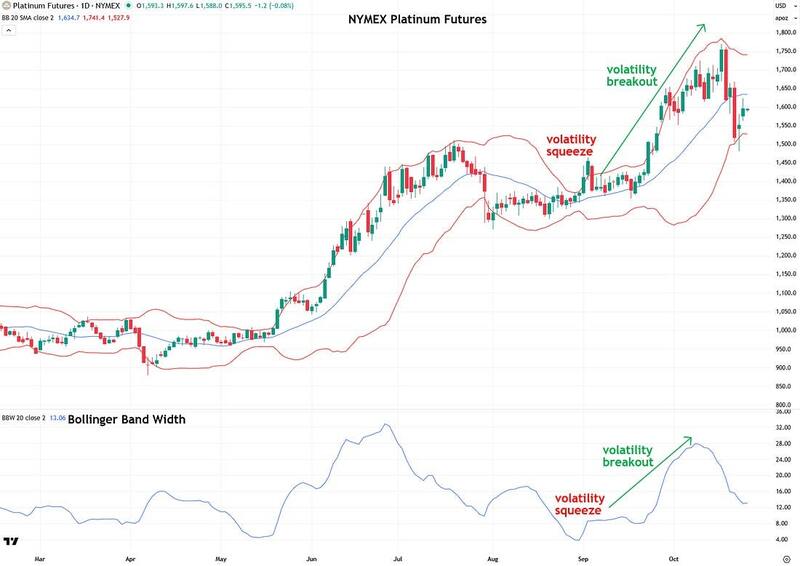
It wasn’t just traditional precious metals like gold and silver that exhibited volatility squeezes and breakouts. Platinum showed the same pattern as well:
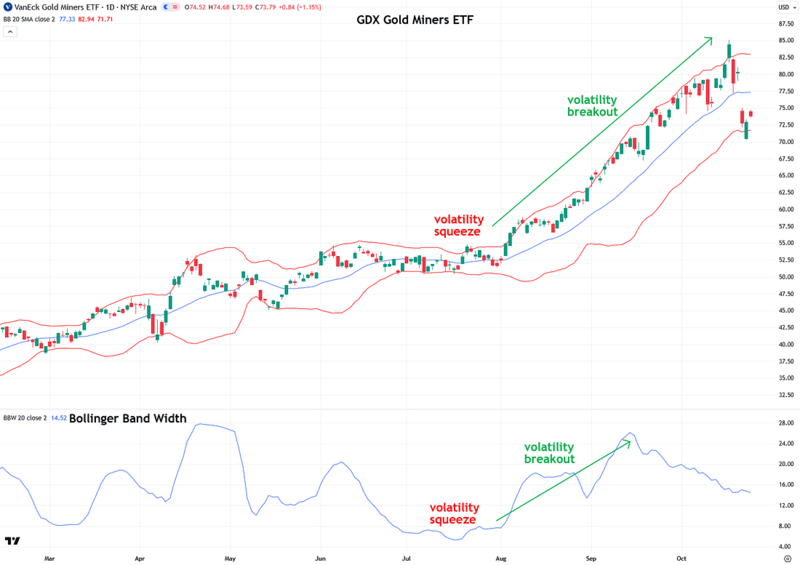
And lest you think it was only the metals themselves that experienced volatility squeezes and breakouts, that was not the case. The same pattern is clearly visible in gold mining stocks and ETFs, such as the popular GDX shown below.
The GDXJ junior gold miners ETF, although not pictured here, exhibited the exact same pattern. This surge in volatility explains why mining stocks have seen such sharp moves recently, both upward and downward.
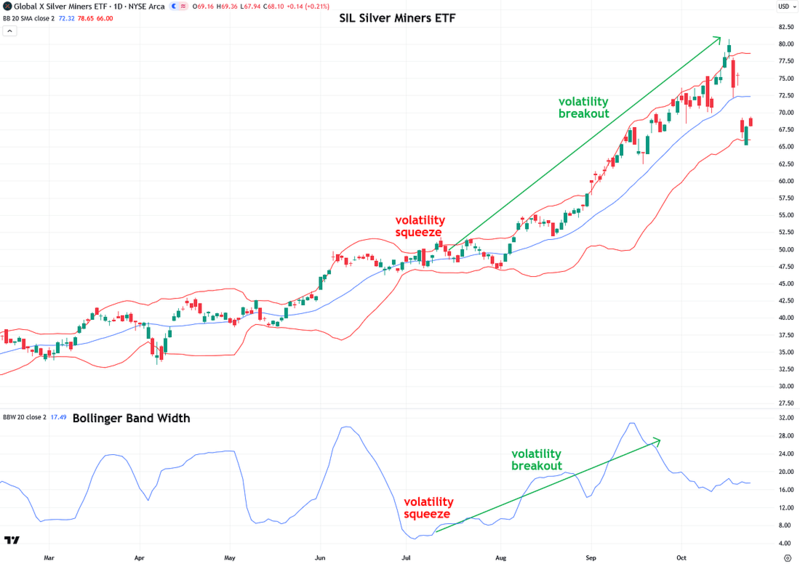
Silver miners showed the same pattern, as seen in the SIL Silver Miners ETF. The SILJ Junior Silver Miners ETF, although not shown here, followed the exact same pattern.
At this point, I hope the case is clear for why volatility is currently so elevated across the entire precious metals space, including both the metals themselves and the miners.
As discussed at the beginning of this piece, due to the cyclical nature of volatility, the extremely low volatility seen over the summer gave way to extremely high volatility this fall.
So where is volatility heading next? Hopefully, you’ve gotten the gist by now. Volatility is likely to subside significantly from here, and it has already started to decline.
This is evident in the narrowing Bollinger Bands and the falling Bollinger Band Widths on all of the charts above for the metals and mining stock ETFs. The easing of volatility will be a welcome relief for many precious metals investors, myself included, who are ready for some peace and calm after the recent gut-wrenching moves. I believe that is exactly what we are about to see.
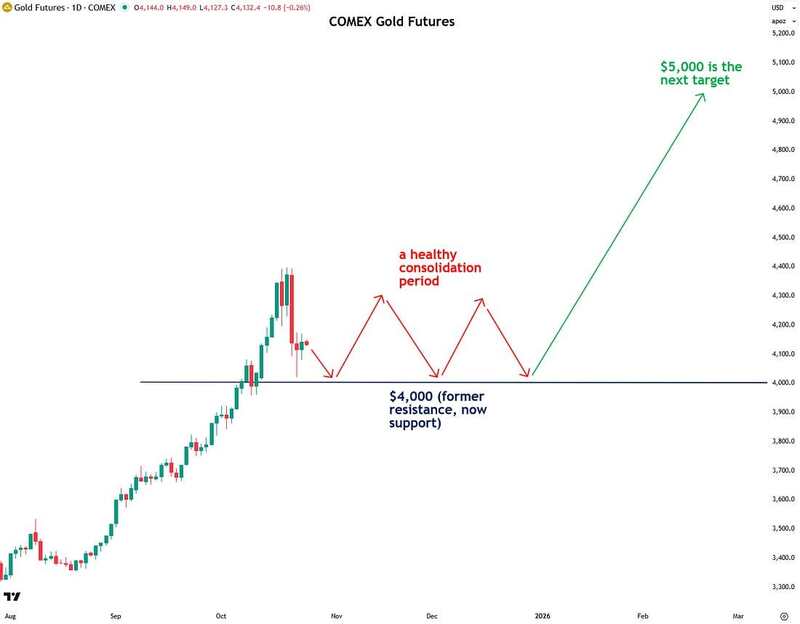
Now I want to discuss how I expect this declining volatility to manifest in the precious metals space, using gold as the example since it is the leader of the group.
I anticipate that precious metals will consolidate sideways as they work off their overbought conditions. This type of price action is typical during periods of declining volatility. I view these consolidations, which have already begun, as a healthy development—similar to a runner catching their breath after a powerful sprint.
My theory, though not a hard prediction, is that gold’s consolidation will occur above the new $4,000 floor. I expect it to fluctuate around this level for some time, possibly re-testing $4,000 several times as it works off its overbought condition. This consolidation should help gold conserve and build energy for its next move higher, which I expect will take it to $5,000 in 2026.
That outlook is shared by major institutions including Goldman Sachs, Bank of America, HSBC, and Société Générale. In addition, JPMorgan CEO Jamie Dimon, who is not exactly known for being a gold advocate, recently said that gold “could easily go to $5,000 or $10,000 in environments like this.”
It will be interesting to see if precious metals form another volatility squeeze in the coming weeks or months, which would set the stage for gold’s surge to $5,000. This is something to keep an eye on.
Anyway, to summarize: while much of the financial world has been shocked by the recent volatility in precious metals and mining stocks, anyone who has been following my work and is familiar with the cyclical nature of volatility, along with the related concepts of volatility squeezes and breakouts, was not only unsurprised by the sharp recent moves but was expecting them.
The good news is that volatility is now likely to subside through the end of the year, bringing precious metals back in line with their historically more stable character. This period of consolidation will likely set the stage for the next leg higher.
Remember, gold, silver, and the miners are only 1.6 years into what I see as a powerful secular bull market. These typically last a decade or more, and I fully expect this one to do the same. As always, I will keep you apprised of what I am seeing.
If you found this report valuable, click here to subscribe to The Bubble Bubble Report for more content like it.
Jesse Colombo is a financial analyst and investor writing on macro-economics and precious metals markets. Recognized by The Times of London, he has built a reputation for warning about economic bubbles and future financial crises. An advocate for free markets and sound money, Colombo was also named one of LinkedIn’s Top Voices in Economy & Finance. His Substack can be accessed here.
(Mike Maharrey, Money Metals News Service) You might imagine that a museum would be a pretty safe place to keep stuff like gold, silver, and jewels.
Not in France.
Just hours after the theft of French crown jewels from the Louvre, workers discovered that a different band of thieves had made off with 2,000 gold and silver coins from another museum.
The coins were lifted from a museum located in Landres (NE France), dedicated to the French philosopher Denis Diderot.
The stolen coins date between 1790 and 1840. They were discovered in 2011 during renovation work on the building that houses the museum. The pilfered coins are worth around €90,000 ($140,000).
According to police, the thieves chose the coins with “great expertise.”
It’s unclear how the burglars got the coins. When the museum opened, workers noticed a smashed case and the missing coins.
This raises a question. How will our intrepid thieves sell these coins? Wouldn’t it be kind of obvious if they showed up at the local pawn shop with valuable French coins?
I guess they could always go the black-market route. Or they could just melt them down. After all, the gold and silver are worth plenty on their own. They’d likely make a pretty penny even if they forgo the historic value of the coins.
That’s what thieves who broke into the Natural History Museum in Paris and made off with six gold nuggets worth €1.5 million did. They melted them down to sell them.
It was a good plan. But they still got caught. A Chinese national was busted in Barcelona while trying to sell the pilfered gold.
By the way, don’t try melting down stolen fiat currency. Dollars are mostly paper these days. Paper doesn’t melt, although you might be able to cook a marshmallow if you have a pile of them. And a U.S. coin like a quarter isn’t worth much more than a quarter when you melt it down. Unless, of course, you have a quarter minted before 1965. They were 90 percent silver and have a melt value of around $8.85 at the current silver price of around $49.
They call this “junk silver,” but in reality, the modern quarters are junk.
Safe to say, people won’t likely be stealing U.S. fiat currency from a museum 100 years from now.
Anyway, it’s been a bad month for French museums. The thieves who stole the French crown jewels from the Louvre pulled off the heist in broad daylight while the museum was open, with patrons wandering around inside. They used a mechanical ladder to access a window and an angle grinder to get inside. The BBC has a pretty good overview of how it all went down.
Art detective (Yes, that’s a thing) Arthur Brand told the BBC there could be copycat burglaries across Europe, given the success of this heist. If someone can target the Louvre and escape with the French crown jewels, local thieves may think “let’s try our nearest museum”, he said.
So, what is the moral of this story?
Well, don’t count on security at a French museum.
But do you know where you can count on tight security?
At the Money Metals Exchange bullion vault in Eagle, Idaho. The place is bigger than Fort Knox. I got to visit there last month. I’m not going to give away any security secrets, but just trust me when I say, you don’t want to try to break in if you value your freedom and your life.
Photo courtesy of Musees de Langres
Mike Maharrey is a journalist and market analyst for Money Metals with over a decade of experience in precious metals. He holds a BS in accounting from the University of Kentucky and a BA in journalism from the University of South Florida.
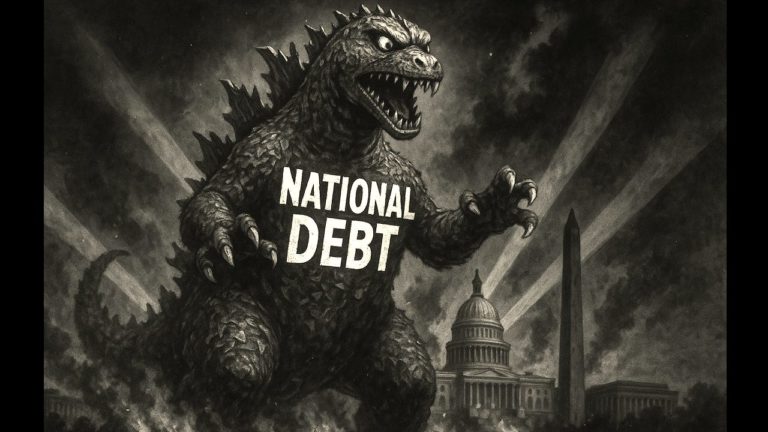
That’s how long it took for the federal government to add another trillion dollars to the national debt.
In August, the debt eclipsed $37 trillion for the first time. On Oct. 21, it blew passed $38 trillion.
As of that date, the U.S. government owed $38,019,813,354,700.26.
This happened despite record tariff revenue and the media relations program known as DOGE.
And the debt is snowballing at an accelerating pace.
In 2020, the Congressional Budget Office (CBO) projected that the debt wouldn’t hit $37 trillion until 2030.
Oops.
Putting the growth in context, the national debt hit $34 trillion in January 2024 and $35 trillion in November 2024.
It took 188 days for the debt to grow from $35 trillion to $36 trillion. It took another 265 days to reach $37 trillion. But don’t be fooled. The borrowing didn’t slow down between $36 and $37 trillion. It was just that the federal government ran up against the debt ceiling on January 1. As a result, it couldn’t borrow any money until the enactment of the “Big Beautiful Bill,” which raised the debt ceiling by $5 trillion as of July 1.
At that time, the national debt stood at $36.2 trillion. It took less than two months for the federal government to borrow more than $800 billion, pushing the debt over $37 trillion.
And here, barely two months later, at $38 trillion.
It won’t be long before we’re talking about a $39 trillion national debt.
I’ve heard people discussing eliminating the income tax and filling the hole with tariff revenue. This is absurd. Tariff receipts grew by 142 percent in fiscal 2025. That wasn’t even enough to fill the deficit hole. Despite a 6.4 percent increase in federal revenue in fiscal ’25 and an 11 percent increase in the previous year, the U.S. government still ran the fourth-largest budget deficit in history.
The problem is on the spending side of the ledger. The U.S. government spent over $7 trillion in fiscal 2025, a 4.1 percent increase over the prior year.
Call me cynical, but I would bet dollars to donuts that the spending isn’t going to decrease in fiscal 2026.
The National Debt in Perspective
It’s hard to fathom $38 trillion. What does that even mean?
Here’s some perspective.
Every U.S. citizen would have to write a $110,641 check to pay off the debt.
Of course, a lot of people don’t pay taxes. That means the taxpayer burden is much higher. Every U.S. taxpayer would have to write a check for $327,507 to wipe out the debt. And that’s on top of the taxes we already pay!
Looking at it another way, $38 trillion is more than the annual GDP of China, Germany, India, Japan, and the UK combined.
It’s hard to wrap your head around how big 1 trillion is, much less 38 trillion. Here are a few factoids to help you visualize just how big that number is:
There are 1 million seconds in 11.5 days. A trillion seconds is about 32,000 years.
If you could say one number every second, it would take about 11.5 million days to count to 1 trillion.
If you had spent $1 million every day since the birth of Christ, you still wouldn’t have spent $1 trillion.
If you line up dollar bills end-to-end, you could go to the moon and back around 203 times with $1 trillion. You could wrap them around the Earth about 3,893 times.
If you stacked up 1 trillion-dollar bills, the dollar tower would rise to 67,866 miles.
If a cup of coffee costs $3, you could buy 333 billion cups of coffee with $1 trillion.
If you had 1 trillion dollars, you could give every person on Earth approximately $125.
One trillion grains of rice would weigh about 20,000 metric tons.
Keep in mind that all these examples illustrate the size of $1 trillion. The national debt is 38 times that number.
Does the National Debt Really Matter?
A lot of people are under the illusion that the debt doesn’t matter. Whenever I talk about it, people’s eyes glaze over, and they just shrug.
James Madison disagreed. He called public debt “a public curse, and in a Rep. Govt. a greater than in any other.
Thomas Jefferson also disagreed. He called public debt “the greatest of dangers to be feared.”
So did George Washington.
“No pecuniary consideration is more urgent than the regular redemption and discharge of the public debt. On none can delay be more injurious or an economy of time more valuable.”
So, what’s the big deal?
In the first place, a large national debt puts a drag on economic growth.
According to the national debt clock, the current debt level represents 120.6 percent of the GDP. Studies have shown that a debt-to-GDP ratio of over 90 percent retards economic growth by about 30 percent.
And then there’s the growing interest expense. Interest on the national debt cost $1.2 trillion in fiscal 2024. That was up 7.3 percent over 2024.
In the last fiscal year, the federal government spent more on interest on the debt than it did on national defense ($917 billion) or Medicare ($997 billion). The only higher spending category is Social Security ($1.58 trillion).
Even more concerning is the fact that at some point, the world will decide it’s no longer interested in financing the U.S. government’s borrowing and spending.
“Confidence in U.S. creditworthiness may be undermined by a rapidly deteriorating fiscal situation, an increasing concern with federal debt set to grow substantially in the coming years.”
If you’re wondering why the Federal Reserve is talking about easing monetary policy despite persistently high inflation, look no further than the debt. The government needs the central bank to keep its thumb on the bond market. That requires it to hold more Treasuries on its balance sheet, thereby creating demand for bonds. This allows the federal government to borrow at a lower interest rate than it otherwise would. This is exactly why Fed Chair Jerome Powell recently said balance sheet reduction will end soon.
Given the budget deficit and the pace of debt accumulation, it may not be long before the Fed returns to quantitative easing (QE).
People seem unconcerned about the growing debt because people have warned about it for decades, and the promised crisis hasn’t occurred – yet.
But the bottom line is that just because the debt hasn’t caused a crisis doesn’t mean it won’t. After all, things happen slowly and then all at once.
Mike Maharrey is a journalist and market analyst for Money Metals with over a decade of experience in precious metals. He holds a BS in accounting from the University of Kentucky and a BA in journalism from the University of South Florida.
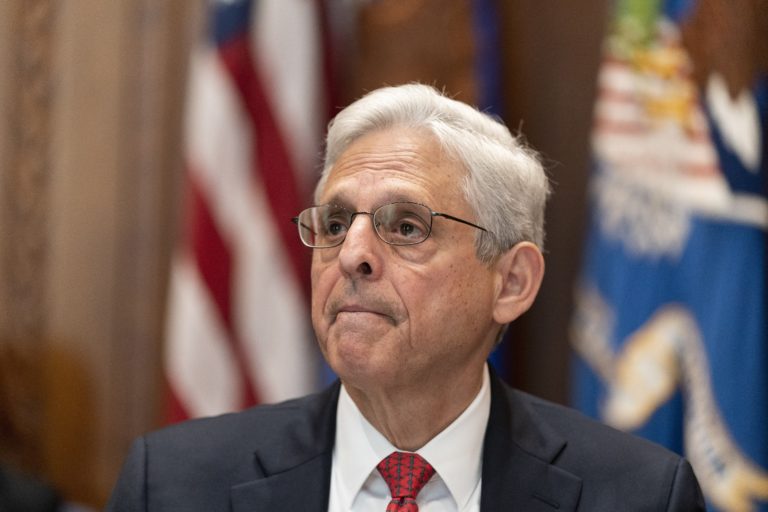
(Luis Cornelio, Headline USA) A newly declassified memorandum confirms that the FBI’s anti-Trump Arctic Frost probe was requested by FBI Director Chris Wray and personally approved in 2022 by Attorney General Merrick Garland, the two top officials in the Biden DOJ.
The memorandum—written by Wray and addressed to Garland on April 4, 2022—explicitly requested authorization to launch the probe.
“Your approval is requested as soon as possible,” Wray wrote in the memo for the “Approval to Open a Certain Sensitive Investigative Matter Investigation.”
In its summary, Wray said the probe would center around President Donald Trump’s challenge to the certification of the 2020 election and the alleged submission of alternate electors to the federal government.
“Open source reporting and public statements made by individuals closely associated with Donald J. Trump, Inc. (Trump Campaign) present an articulate factual basis indicating the existence of a federal crime, and thus the FBI seeks to open a full investigation,” Wray proclaimed.
Wray noted Garland’s personal approval was needed due to the sensitive nature of the probe.
The file also shows Deputy Attorney General Lisa Monaco left a hand-written note to Garland reading, “Merrick – I recommend you approve. LM 4/5/22.”
Signatures on the memo confirm Garland approved the probe that same day.
The controversial memo was released by the Trump administration after Senate Judiciary Committee Chairman Chuck Grassley, R-Iowa, requested its declassification.
In an X post, Grassley decried that the memorandum ultimately unleashed “unchecked” government power at the highest levels.
Just received this doc frm DOJ Proof that Biden Atty General Merrick Garland+ Deputy Atty General Lisa Monaco+ FBI Dir Chris Wray all PERSONALLY APPROVED opening Arctic Frost
This investigation unleashed unchecked govt power at the highest levels My oversight will continue pic.twitter.com/atuRnC8ara
Declassified documents confirm that the FBI probe expanded to include extensive surveillance of multiple conservative organizations, including Turning Point USA, the Conservative Partnership Institute and several pro-Trump super PACs.
The probe also targeted the phone records of at least eight lawmakers, seven Republicans and one congressman.
This probe also paved the way for Garland’s appointment of Special Counsel Jack Smith, who went on to criminally indict Trump twice, the first time in U.S. history a former president faced such charges.
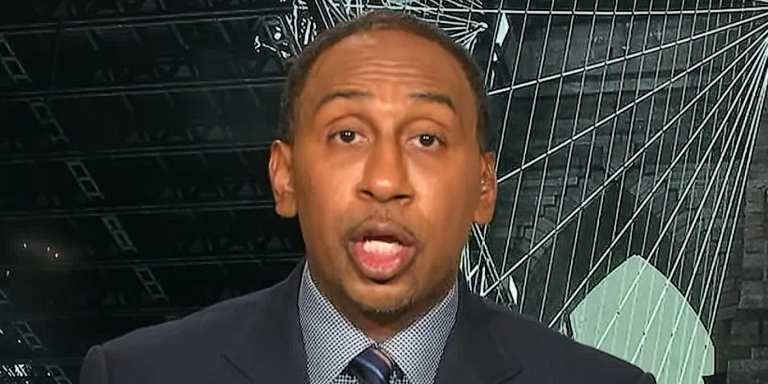
(Luis Cornelio, Headline USA) Stephen A. Smith, the flamboyant ESPN host-turned-political commentator, claimed that the recent bombshell indictment against NBA figures is part of President Donald Trump’s broader effort to target the sports industry—even though the investigation started under the Biden administration.
Smith provided no proof to support his theory, which he first proclaimed on Thursday’s episode of ESPN’s First Take. His comments came after dozens of individuals, including an NBA player and coach, were arrested in connection with an illegal gambling scheme.
“You know what world we’re living in in terms of politics. How many times with one incident after another? Trump is coming,” Smith bemoaned. “He’s coming. I’m going to say it on national television again. … Remember, Trump has a long, long history connected to the world of sports because he had those casinos.”
He added, “Don’t be surprised if the WNBA is next on his list. Because when you got all of these protesters that have been going out there and people who have been protesting against him and what have you, this man is coming. He’s coming. And I’ve been saying it for a long time. To me, this is the latest nugget of evidence that we’re talking about right here.”
His comments followed the DOJ’s announcement of a seven-count indictment against 31 individuals charged with “criminal schemes to rig illegal poker games at various locations.” Among those charged are Miami Heat guard Terry Rozier and Hall of Fame player and Portland Trail Blazers coach Chauncey Billups.
Despite his conspiracy-tinged rant, Smith later admitted he didn’t know the details of the NBA case.
“It’s not to question the legitimacy of the case,” he continued. “We don’t know. But anybody that’s been around him, anybody that has talked to him, anybody that has seen his reactions from the sports leagues and the positions that people have taken, they are not surprised at what’s going on today.”
The only apparent evidence Smith cited was that FBI Director Kash Patel appeared at the press briefing announcing the investigation and arrests, though FBI directors are routinely present at high-profile DOJ announcements.
“It’s not coincidental. It’s not an accident. It’s a statement,” he claimed. “And it’s a warning that more is coming, and that’s what they’re saying here. … In (Trump’s) eyes, folks tried to throw him in jail. In his eyes, he’s innocent, and they tried to put me behind bars. ‘I’m getting everybody.’ He’s not playing.”
The DOJ case is being handled by its Organized Crime and Gangs Section. If convicted, each defendant faces up to 40 years in prison.
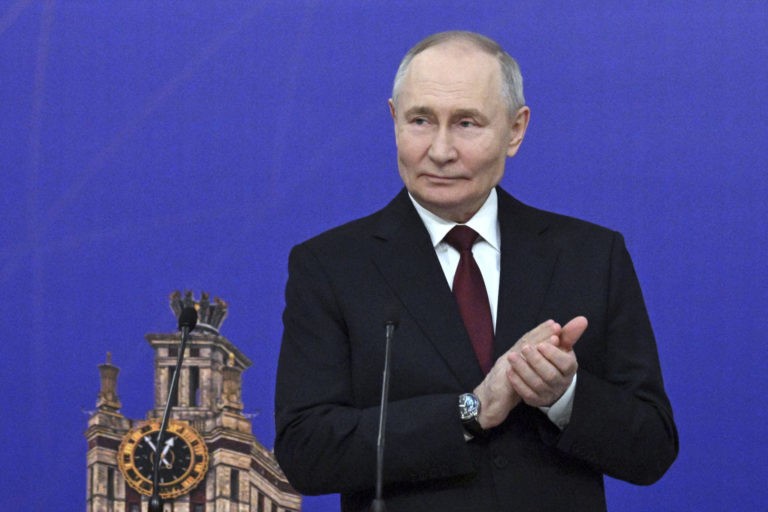
(Dave DeCamp, Antiwar.com) Russian President Vladimir Putin on Thursday brushed off the new sanctions imposed by the US targeting two Russian oil companies and issued a new warning against the potential US supply of Tomahawk missiles to Ukraine.
“Regarding the new sanctions, first of all, there is nothing new about it. Yes, they are serious for us and may have certain consequences, but they will not significantly impact our economic health,” Putin said, according to the Russian news agency TASS.
The Trump administration called on Russia to end its war in Ukraine when it issued the sanctions and threatened more would be coming if the conflict continued. But the measures are unlikely to have much impact, since Russia has been under heavy Western sanctions for years and is prepared to face more.
Putin also said that the sanctions harm US-Russia relations. “Speaking about the political part, then, certainly, this is an unfriendly act against Russia. It is an obvious thing and it does not strengthen Russia-US relations that have just started recovering. Certainly, the US administration harms Russia-US relations by such actions,” he said.
Discussing the possibility of the US providing Ukraine with Tomahawk missiles, Putin said any Ukrainian Tomahawk strikes would be met with an “overwhelming” response. “If Russian territory is hit… with such a weapon, the response will be very serious if not outright overwhelming,” he said.
President Trump appears to have cooled on the idea of supplying Ukraine with Tomahawks, which are nuclear-capable and have a range of over 1,000 miles. “The problem with the Tomahawk is — a lot of people don’t know — It’ll take a minimum of six months, usually a year, to learn how to use,” he told reporters on Wednesday. “The only way a Tomahawk is going to be shot is if we shot it.”
According to media reports, the US has been supporting long-range Ukrainian drone and missile attacks on Russian territory. Trump denied a Wall Street Journal report that said he was backing the missile strikes, but Ukraine’s military claimed it used British-provided Storm Shadow missiles in an attack on a Russian chemical plant, which requires US targeting data.
(Dave DeCamp, Antiwar.com) The US flew two US Air Force B-1B bombers over the Caribbean on Thursday in the latest US provocation in the region aimed at Venezuela, as the Trump administration is moving toward war with the country and seeking the ousting of Venezuelan President Nicolas Maduro.
A US official told The Wall Street Journal that the bombers took off from Dyess Air Force Base in Texas on Thursday and flew near Venezuela. When asked about the report, President Trump said it was “false,” but the bombers were spotted on flight trackers, and other US officials confirmed the flight took place.
Last week, the US flew three B-52 bombers near Venezuela, in what the US Air Force called a “bomber attack demonstration mission.” US special operations helicopters have also flown within 90 miles of Venezuela as part of a major US military buildup in the region, which has involved the deployment of eight Navy warships.
The provocations come amid reports that the US is preparing to bomb Venezuela, and as President Trump is threatening to launch strikes against alleged drug shipments “on land.” While drug trafficking is the pretext for the military campaign, US officials have been clear that the real goal is regime change in Venezuela.
The US has also bombed at least seven alleged drug boats in the Caribbean and two in the Eastern Pacific Ocean near Colombia. The US War Department has provided no evidence to back up its claims about what the vessels were carrying or to back up its assertion that the people it has been killing are “narco-terrorists,” a term the administration has been using to justify extrajudicial executions at sea.
“The Utah County Sheriff’s Office has asked 4th District Court Judge Tony Graf to prohibit any further photography or video coverage of any future proceedings, [alleged assassin Tyler] Robinson’s attorneys revealed in their latest filing, adding that they agree with that request,” the Tribune reported Thursday.
“The defense attorneys argue that limiting courtroom imagery would ensure that Robinson’s physical appearance is ‘no longer the subject of interest’ in media coverage.”
The agreement between the defense and prosecution comes as they argue whether Robinson should be allowed to wear street clothes at his court hearings.
Robinson’s attorneys have been seeking to have Robinson appear in court in regular street clothes instead of jail attire—both to maintain his presumption of innocence and to avoid prejudicing a future jury. The prosecution opposes that request for reasons that are unclear, as they were able to file their arguments in secret because their filing purportedly contains “secure information that might endanger personal and public safety if disclosed.”
A secret hearing is set to be held Friday over the matter.
4th District Court Judge Tony Graf has also issued a gag order on Robinson’s lawyers, preventing them and any witnesses they want to use from speaking to the public—even though the FBI and other government parties have already widely publicized their side of the story.
Robinson has Salt Lake lawyer Kathryn Nester representing him, as well as two California-based attorneys. Along with Friday’s secret hearing, he has a waiver hearing set for Oct. 30, and he’s yet to enter a plea. After turning himself in to the police on Sept. 11—about 33 hours after Kirk was killed—he’s since stopped cooperating with law enforcement. Utah County prosecutors have said they will seek the death penalty against him.
Ken Silva is the editor of Headline USA. Follow him at x.com/jd_cashless.
(Ken Silva, Headline USA) Decarlos Brown Jr., who allegedly stabbed Ukrainian refugee Iryna Zarutska to death on a Charlotte train on Aug. 22, was federally indicted on Wednesday, and could face the death penalty over the matter.
Brown had already been facing state murder charges. The federal indictment charges him with the offence of “Violence Against a Railroad Carrier and Mass Transportation System Resulting in Death”—a crime that carries the death sentence.
Brown has yet to make an appearance in federal court. At the state level, a judge ordered him to be sent to a psychiatric hospital to determine if he’s fit to stand trial. He’s still listed as an inmate of Mecklenburg County jail, and it’s not clear how the federal case will impact his status there.
Here's the federal indictment for Charlotte train stabber Decarlos Brown Jr., who faces the death penalty. Brown now has 4 lawyers in a case that looks to have major implications for how capital punishment is applied to the criminally insane. pic.twitter.com/X0qfKaDhWp
Brown now has five different attorneys—one for the state charges and four, including a private practice lawyer, in federal court—in a case that looks to impact how capital punishment is applied to the criminally insane.
Brown was taken to Atrium Health – Carolinas Medical Center to treat lacerations on his hand after he stabbed 23-year-old Zarutska to death on Aug. 22. He remained at the hospital until Aug. 28, when he was arrested and charged with first-degree murder. That same day, Brown, who is reportedly schizophrenic, requested that Charlotte police obtain his medical records—signing a release form for their disclosure.
Headline USA, which was the first publication to obtain and publish the full video of the gruesome incident, will continue to cover both cases as they develop.
Ken Silva is the editor of Headline USA. Follow him at x.com/jd_cashless.