DOJ Probes Tina Peters Attack in Colorado Prison

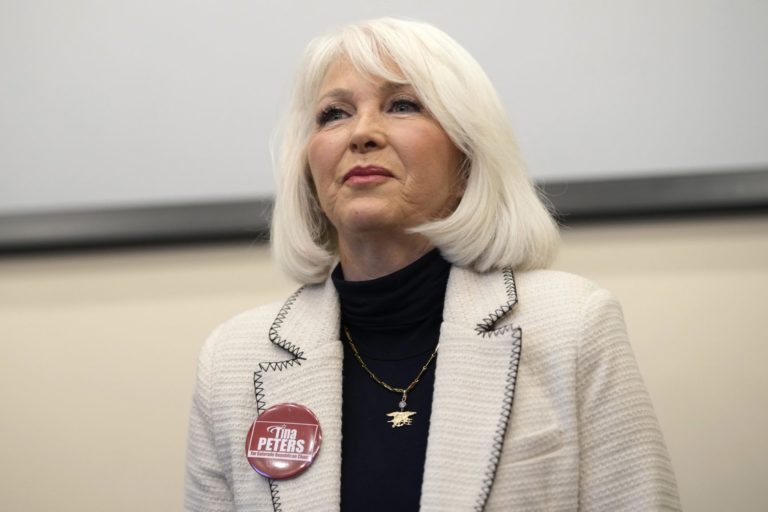
(Luis CornelioHeadline USA) The DOJ announced Tuesday the launch of an investigation into the safety conditions within Colorado prisons, following a reported attack against Tina Peters, the former Mesa County clerk imprisoned over 2020 election-related charges. 

Peters, the only Republican serving a prison sentence for objecting to the 2020 election, faced credible threats to her life while in custody, according to a Friday letter sent by her attorney, Peter Ticktin, to President Donald Trump. 

“About 6 months ago, Mrs. Peters was threatened with harm. Her life was threatened by a group of inmates, to stab her and to kill her,” Ticktin wrote in the letter reviewed by Headline USA.  

Peters, a 70-year-old grandmother, is serving a nine-year sentence on state charges of attempting to influence a public servant, conspiracy to commit criminal impersonation, first-degree official misconduct and other related charges. 

Ticktin said that the threats were reported to the DOJ and FBI and ultimately forced Colorado prison officials to transfer Peters to a different unit. 

The letter, part of a pardon request, prompted the DOJ Civil Rights Division to open a formal probe into facilities operated by the Colorado Department of Corrections and the Colorado Department of Youth Services. 

Assistant Attorney General Harmeet K. Dhillon announced the investigation in letters sent to Colorado officials, including Jared Polis, the left-wing governor who has refused to pardon Peters despite growing national criticism over her imprisonment. 

“The Constitution protects every American, whether they are a young person confined in a juvenile facility or an elderly person confined to a prison,” Dhillon said in a statement, without referencing Peters directly. 

“We are committed to upholding our federal civil rights laws so that no one is subject to unconstitutional mistreatment when held in state custody,” she added. 

The DOJ probe comes just days after President Donald Trump publicly slammed Polis as a “sleazebag” for refusing to pardon Peters. 

“This lightweight Governor, who has allowed his State to go to hell (Tren de Aragua, anyone?), should be ashamed of himself. FREE TINA!” Trump wrote on Dec. 3. 

Read Tricktin’s letter to Trump below:

Sup. Cover Letter for Application for Pardon for Tina Peters by Luis Cornelio

Gov. Shapiro Stands by Remarks That Kamala Was Trying to ‘Cover Her Ass’

(Luis CornelioHeadline USA) Pennsylvania Gov. Josh Shapiro refused to walk back his rebuke of former Vice President Kamala Harris after she claimed she passed him over as a running mate because he appeared overly ambitious. 

Shapiro previously told The Atlantic that Harris was trying to “sell books and cover her ass” following revelations in her memoir, 107 Days. 

He was pressed about those comments during a Sunday interview on MS Now (formerly MSNBC), where co-host Symone D. Sanders asked whether he wanted to “parse” the remarks. 

“No, there’s no parsing,” Shapiro replied. “Look, I stand by what I said. I think the way in which the author described my emotion, frankly, was not accurate, but the words are mine and I stand by them.” 

Shapiro added that The Atlantic author mischaracterized both what Harris had written about him and his reaction to those claims in a Dec. 3 article titled “The Operator.” 

“I think what was relayed to me by that author that the vice president had written about me just simply wasn’t true. I think the vice president and I had very and continue to have very candid conversations. And I think the way in which it was articulated to me what was said was certainly not accurate.” 

Asked why he felt “it was important to correct the record here?” Shapiro replied: “No, I’m not correcting in any record. I’m standing by what I said.” 

The remarks come just months after Harris explained in her memoir 107 Days that she passed over Shapiro for the vice-presidential slot due to concerns he was unwilling to settle for a subordinate role. 

“At one point, he mused that he would want to be in the room for every decision,” Harris wrote. “I told him bluntly that was an unrealistic expectation. A vice president is not a copresident. I had a nagging concern that he would be unable to settle for a role as number two and that it would wear on our partnership.” 

Charlotte High School Student Criminally Investigated for Charlie Kirk Memorial

(Ken Silva, Headline USA) A high school student in Charlotte, North Carolina was criminally investigated over a memorial she painted to honor conservative activist Charlie Kirk after he was assassinated on Sept. 10, according to a lawsuit over the matter.

The student, Gabby Stout—she’s only identified by initials in court records but Fox News reported her full name—said in her lawsuit that she obtained permission from Ardrey Kell High School to paint a message on its “spirit rock” in support of Kirk’s and his Christian message. She, her parents, and two fellow students painted the rock with the words “Freedom 1776” and “Live Like Kirk—John 11:25” on Sept. 13.

Within hours, Stout learned that school officials ordered the memorial to be painted over, according to the lawsuit, which was filed Monday in North Carolina federal court with the help of the organization Alliance Defending Freedom.

“The next day, [school] officials publicly accused [Stout] of a crime and a student conduct violation (vandalism), contacted law enforcement, and began cooperating with the criminal investigation,” Stout’s lawsuit says.

“The day after that, the Monday (and first school day) after [Stout] painted the spirit rock, [school] officials called her out of class, forced her to write out a statement summarizing her rock-painting efforts, and forced her to edit that statement to include details they believed to be important. And they did this without first advising [Stout] of her constitutional rights in any criminal proceeding, including the right to remain silent and the right to have legal counsel.”

By the end of the week, the school quietly closed its investigation. But the damage had already been done. Along with the distress caused by the prospect of criminal charges, Stout said she felt humiliated and ostracized by other students over the matter.

“Right after these accusations, her best friends, with whom she had been close for years, wanted nothing to do with her and stopped socializing with her. In most of her classes, she sat alone, with fellow students alienating her. As recently as just before Thanksgiving, students have labeled her as the girl that painted the rock,” her lawsuit says.

The lawsuit further notes that other students have been allowed to paint politically charged messages on the school’s spirit rock. In 2020, for example, students painted pro-Black Lives Matter messages on the rock, including the “black power” fist symbol along with the names of George Floyd and other perceived victims of police brutality.

The lawsuit seeks a declaration from the judge that the school violated Stout’s First, Fourth, Fifth and/or 14th Amendment rights, as well as compensatory damages and attorney fees over the matter.

The school has yet to respond. School officials falsely told local media earlier that no criminal investigation had been launched, according to the lawsuit.

Ken Silva is the editor of Headline USA. Follow him at x.com/jd_cashless.

Report: Israel Is Spying on US Troops at Gaza Monitoring Base in Southern Israel

(Dave DeCamp, Antiwar.comCongress has released its 2026 National Defense Authorization Act (NDAA) and is preparing to pass the sweeping spending bill, which will give President Trump a total military budget of over $1 trillion.

Earlier this year, a supplemental for an additional $156 billion was included in the so-called “Big Beautiful Bill,” most of which will go toward the 2026 military budget and be added to the $901 billion NDAA unveiled by Congress, bringing total military spending well over $1 trillion.

The supplemental was factored into the White House’s 2026 military budget request, and Congress actually added $8 billion more than President Trump requested in the NDAA.

Over the weekend, Secretary of War Pete Hegseth signaled that the budget could get even bigger. “We received a historic boost in funding last year, and believe that is only just the beginning,” he said at the Reagan National Defense Forum, according to Defense One.

“We need a revived defense industrial base. We need those capabilities. We need them yesterday. And so, resource-wise, I think this room will be encouraged by what we’ll see soon — but I don’t want to get too ahead,” Hegseth added.

POLITICO reported on Monday that House Speaker Mike Johnson is planning to hold a vote on the NDAA on Wednesday afternoon. Once passed by the House, it will head to the Senate, then to President Trump’s desk.

At least one House Republican will vote against the NDAA, Rep. Marjorie Taylor Greene (GA), who objected to the foreign aid included in the bill. “Funding foreign aid and foreign wars is America Last and is beyond excuse anymore,” she wrote on X. “I would love to fund our military, but refuse to support foreign aid and foreign militaries and foreign wars. I am here and will be voting NO.”

Notable amendments in the NDAA include a measure to block troop drawdowns from South Korea and Europe, as Russia hawks in both parties are unhappy with President Trump’s recent decision to pull some troops out of Romania, and a provision to protect Israel from global arms restrictions it may face due to its destruction campaign in Gaza.

The mammoth bill also includes an amendment to lift the Caesar Act sanctions on Syria, which were imposed in 2020 and designed to prevent the reconstruction of the country until former President Bashar al-Assad was ousted, which happened one year ago today. The Trump administration and Congress have embraced the new Syrian government and its leader, Ahmed al-Sharaa, despite his history as a senior al-Qaeda commander.

This article originally appeared at Antiwar.com.


Cincinnati Settles with Protesters for George Floyd-Protest Arrests

(The Center Square) Cincinnati taxpayers are on the hook for an $8.1 million settlement of a lawsuit stemming from the 2020 George Floyd-murder protests in the city.

City Manager Sheryl Long called the settlement of the class action suit a good financial decision. The Cincinnati City Council Public Safety and Governance Committee unanimously approved the settlement at a meeting Tuesday.

That vote pushes the settlement plan to the full council, which is expected to approve it.

“I am glad to have reached a settlement and am especially proud of our CPD officers and their willingness to continuously improve policies and procedures,” City Manager Sheryl Long said in a statement. “While the incidents that led to this case predate the current administration, we as city leaders must do everything we can to address the issues passed on to us so that they can be prevented in the future.”

Hamilton County will pay $65,000 of the settlement, with the city responsible for the rest for those arrested in 2020 during protests over Floyd’s murder by a Minneapolis police officer.

“This settlement results in positive changes to police policy and training,” plaintiff attorney Jacqueline Green said in a statement. “Our community will benefit from CPD’s commitment to these reforms, and we commend the city and county for taking this opportunity to acknowledge, protect, and work for the interests of the people.”

The settlement also allows for the city not to admit fault, but the city changed police procedures following the protests. There are new rules in police for how police respond to protests and how law enforcement and the courts handle mass arrests.

Charges were later dropped against the 479 people arrested, and protesters claim they were denied food and water, and officers used excessive force.

Cincinnati Fraternal Order of Police President Ken Kober told WLWT he thought the settlement made good financial sense but was critical of how the city handled things during the protests.

“It put the police in a terrible position,” Kober told WLWT. “They went out. They protected the city. They protected people from getting hurt. They allowed them to protest until the point where they just started to break the law, and then they made arrests. And, ultimately, this comes down to the law department fumbled this whole thing. And that’s why we are where we are today.”

Judge Orders Grand Jury Materials of Maxwell Case Unsealed

(The Center Square) A federal judge has approved the release of grand jury materials from the case of Ghislaine Maxwell, convicted child sex offender and close associate of Jeffrey Epstein.

U.S. District Judge Paul Engelmayer’s Tuesday decision grants the Department of Justice’s request that grand jury transcripts, exhibits and investigative materials related to Maxwell’s case be unsealed.

Engelmayer had previously denied the DOJ’s request to unseal materials because the cited “extensive public interest,” he reasoned, did not override legal protective orders.

With the recent enactment of the Epstein Files Transparency Act, however, the situation changed. Engelmayer said the act, which requires the U.S. attorney general to release all documents related to Epstein and Maxwell within 30 days, “implicitly reflects Congress’s intent to overcome grand jury secrecy.”

DOJ has promised to “withhold or redact segregable portions that contain personally identifiable and other victim-related information.”

The Tuesday ruling also requires that before any materials covered by the order are publicly released, “the United States Attorney for this District personally certify that such material has been rigorously reviewed for – and found to be in – compliance with Section 2(c)(1)(A) of the Act, which protects victims against revelations of their identities and invasions of their privacy.”

Cinnabon Employee Caught Using ‘N Word’ Exposed as a Biden Backer

(Ben Sellers, Headline USA) A viral video featuring a racist Cinnabon employee may have been a false-flag operation, according to one well known investigative journalist.

A video from the Dec. 5 incident in Ashwaubenon, Wisc., appeared to show a “racist Karen” spouting racial epithets after initially mocking the hijab of a Somali customer.

According to a caption that accompanied the initial post, the incident began after the Cinnabon employee—later identified as 43-year-old Crystal Terese Wilsey—refused to put enough caramel on a pecan cinnamon roll.

After the customer, identified as Farhia Ahmed, asked for more caramel, Wilsey allegedly responded, “You could see me squeezing it through that witchcraft bandana you’re wearing on the top of your head.”

The filming began at some point after the altercation had already escalated.

“I am racist, and I’ll say that to the whole entire world,” Wilsey said.

The Somali couple continued to goad Wilsey in the video, leading her to flip them off, while telling them to “Suck it” and “Get the f**k out of my face.”

She went on to reiterate her message, saying “I am racist, and you are a n***er.”

After the clip was posted by a cousin of the customers, Sabrina Osman, it  received more than 11,000 views and Wilsey lost her job.

“We’ve seen the disturbing video … and we do not condone this behavior,” Cinnabon said in a statement posted to social medial. “The former employee was immediately terminated by the franchise owner.”

Some social-media respondents initially appeared to rush to her defense. Community notes on X argued that Wilsey was sexually harassed.

Jack Posobiec, the well-known Real America’s Voice host and frequent cohost of the “Charlie Kirk Show,” compared Wilsey to other victims of leftist cancel culture, such as Nick Sandmann, Kyle Rittenhouse and Derek Chauvin.

Pro-MAGA influencer Paul Szypula was among those who encouraged followers to visit a GiveSendGo campaign for Wilsey, which had raised nearly $125,000 as of Monday night.

A separate fundraiser for Ahmed had raised approximately $5,700 via GoFundMe.

Meanwhile, far-left influencers like Harry Sisson attacked Wilsey, with referring to her as a “MAGA woman.”

However, respected investigative journalist Megan Basham of the Daily Wire appeared to be more skeptical of Wilsey’s apparent victimhood, hinting at the possibility that the entire event may have been staged.

“For what it’s worth [Wilsey] … appears to be a Democrat,” Basham noted.

“I was curious about the background on the incident and found her Facebook page. This was among her photos,” Basham added, pointing to screenshots of the woman’s Facebook feed that included a Biden/Harris yard sign along with a pro-abortion one.

Although the context was unclear, the original post from April 21, 2024, appeared to portray them in a favorable light as part of a springtime walk.

A review of voting records offered no confirmation, identifying Wilsey as unregistered with no voting history.

Records from the Federal Election Commission likewise offered no indication of past political donations.

According to some reports, Wilsey may have an arrest record stemming from a 2022 incident in Ohio, including charges related to domestic abuse, endangering children and drug possession.

Headline USA could not independently verify that the records corresponded with the same Crystal Wilsey, who has an extensive history of addresses all located in Wisconsin since at least 2006.

Ben Sellers is a freelance writer and former editor of Headline USA. Follow him at x.com/realbensellers.

Consumer Credit Growth Remains Tepid Signaling Consumer Stress

(Mike Maharrey, Money Metals News Service) Consumer borrowing remained tepid in October, possibly indicating that Americans are feeling increasing financial stress.

The U.S. economy depends on consumers buying stuff. Persistent price inflation forced Americans to blow through their savings and then turn to credit cards to make ends meet. However, consumer borrowing has slowed significantly this year, indicating Americans may be maxing out the plastic.

This is bad news for an economy built on borrowing and spending money. It also reveals why so many people are pushing for further interest rate cuts despite price inflation still well above the Fed’s stated target.

October Consumer Debt Data

Consumer debt grew at a slower-than-expected pace of 2.2 percent in October. The forecast was for consumer credit to increase by $11.8 billion. The actual figure was $9.18 billion, according to the latest data from the Federal Reserve.

Investing.com said the “unexpected dip” in borrowing could signal declining consumer confidence.

“A decrease in consumer credit could signal that consumers are less willing or able to take on credit for purchases, which could in turn impact the broader economy.”

Total outstanding consumer debt currently stands at $5.08 trillion.

The Federal Reserve consumer debt figures include credit card debt, student loans, and auto loans, but do not factor in mortgage debt. When you include mortgages, U.S. households are buried under a record $18.59 trillion in debt.

Over the last several months, the growth of revolving credit has slowed significantly. In October, non-revolving debt growth, primarily reflecting outstanding auto loans, student loans, and loans for other big-ticket durable goods, collapsed.

Non-revolving credit grew by just $3.7 billion, a 1.2 percent increase. This was well below the 2 percent average growth we have seen over the last year. And before the pandemic, revolving credit growth averaged 5 percent.

It appears consumers are opting not to finance big-ticket items, as more and more of their income is necessary just to pay daily expenses.

Borrowers are also struggling to keep up with their non-revolving loans – particularly their student debt. Seriously delinquent student loans surged to 10.2 percent in the second quarter as the government began requiring payments after years of forbearance in the wake of the pandemic.

Transitions of student loans into serious delinquency rose to 14.3 percent in the third quarter. That was up from 12.9 percent in the second, 8 percent in the first, and 0.8 percent in the fourth quarter of last year. It has been the fastest transition rate into serious delinquency since the data have been collected, going back to 2000.

Meanwhile, revolving debt, primarily reflecting credit card balances, grew by a modest $5.4 billion in October, a 4.9 percent annual increase. This was a larger increase than recent months, but still below the average debt growth we saw last year.

In fact, the growth of revolving debt has been slowing all year. It contracted in May and June, after a one-off surge in April, before suddenly surging once again in July. But in August, revolving debt contracted by 5.5 percent.

KPMG recently reported that the slowing growth of revolving credit likely reflects a drop in borrowing and spending by the bottom 80 percent of U.S. households “that are increasingly stressed.”

“The top 20 percent now account for nearly two-thirds of all consumption. The top 3.3 percent have increased spending the most. Spending has stagnated, adjusting for inflation, among the bottom 80 percent.”

The double whammy of rising debt and interest rates exacerbates the debt problem. The average annual percentage rate (APR) currently stands at 19.83 percent, with some companies still charging rates as high as 28 percent. The average is only slightly down from the record high of 20.79 percent set in August 2024, despite Fed rate cuts.

High debt levels have created elevated levels of consumer stress.

LegalShield’s Consumer Stress Index (CSLI) increased by 3 points in the third quarter and was at the highest level since March 2020, when the economy was shut down during the pandemic.

The source of this stress: debt.

According to LegalShield, “The index has now increased for seven consecutive months, up 8.2 percent in 2025, signaling continued financial strain among American households. Legal inquiries related to bankruptcy rose sharply, while foreclosure and consumer finance issues remain elevated.”

Meanwhile, the New York Fed reported that overall delinquency rates remained “elevated” in the third quarter, with 4.5 percent of all debt in some stage of delinquency. Credit card and student loan delinquencies have increased at the fastest rate.

Overall debt flow into serious delinquency was 3.03 percent in the third quarter, up from 1.68 percent year-on-year.

Credit card delinquencies are rising, even among consumers with strong credit scores. According to VantageScore, there was a 47 percent year-on-year increase in late payments by people in the prime segment.

The bottom line is that Americans have blown through the savings they accumulated during the pandemic and have run their credit cards close to the limit. An economy run on Visa and Mastercard simply isn’t sustainable. When Americans finally hit their credit limit, it will have major implications for economic growth.


Mike Maharrey is a journalist and market analyst for Money Metals with over a decade of experience in precious metals. He holds a BS in accounting from the University of Kentucky and a BA in journalism from the University of South Florida.


Silver as a Giffen Good: Setup Could Mean Even More Explosive Upside

(Mike Maharrey, Money Metals News Service) Is silver a Giffen good?

It appears to be behaving like one.

A Giffen good, named after Scottish statistician and economist Sir Robert Giffen and his theory, is an “inferior good” whose demand rises as its price increases (holding income and other prices stable), defying the typical laws of supply and demand.

If silver behaves as a Giffen good… it means its upmove could be even more explosive.

Let me explain…

First, you might balk at the notion that silver is inferior to gold, but I am using an economic definition, not a subjective description.

A good is considered economically “inferior” when demand for it generally falls as incomes rise. Think of meat and potatoes. Potatoes are “inferior” because, as income rises, a household will typically consume more meat and fewer potatoes.

Conversely, when a household faces economic stress, it will typically try to substitute cheaper goods for more expensive ones. Potato consumption increases, and the amount of meat consumed falls (the substitution effect).

In a Giffen setup, the income effect (the way changes in purchasing power alter demand) is stronger than the substitution effect (as the product gets relatively expensive, people buy less of that product).

The potato behaved as a Giffen good during the Irish famine. As prices rose, the Irish people effectively became poorer. This made it impossible for them to purchase more expensive meat. To cope, they had to buy even more potatoes, even as the price was rising, because it was still the least expensive way to get calories. Therefore, demand for potatoes skyrocketed even as the price climbed.

Silver As a Giffen Good

As the price of silver has gone up, investment demand has increased sharply.

Is there a Giffen mechanism at play?

I can make the case.

While they might prefer to buy gold, silver is the go-to precious metal for many poor and middle-income investors because it is much less expensive than gold.

You can think of gold as the “meat” precious metal and silver as the “potato.”

If an investor has a fixed monthly amount available to invest. He would prefer gold as the “superior” investment. However, silver is less expensive and more “practical.” As a result, the bulk of his investment is in silver even though he’d prefer gold.

That’s not to say he spurns gold altogether. He may occasionally buy a small gold coin when the price dips, much like a poor Irish family occasionally eats meat even though potatoes dominate the diet. He might also trade silver for gold when he’s stacked enough silver to make the transaction viable. In other words, gold is the “upgrade.”

When silver becomes more expensive compared to gold, the dynamics change.

As the prices of both metals rise, our investors’ overall purchasing power falls. His fixed investment budget buys fewer total ounces. In response, the investor will cut back first on the “luxury” item, buying even less gold. However, to get enough metal exposure, our investor will have to shift even more of his investment budget to silver despite the rising prices.

If the income effect is strong enough, the result will be growing silver demand in ounces even though the relative price keeps increasing compared to gold.

A Real-World Example

This dynamic already seems to be playing out in India at this very moment.

Typically, Indian investors prefer gold. But as the price of gold scaled record highs in October, many poor Indians found themselves priced out of the market. To continue to protect their wealth, they turned to silver.

This sharp increase in silver demand was one of the dynamics that drove the recent silver squeeze in London and pushed the silver price over $50 an ounce for the first time ever.

The higher silver prices have been going, the more they seem to chase it.

When you combine the Giffen effect with the silver supply and demand dynamics, you have truly explosive upside price potential.

As we’ve reported, silver supply is already strained.

According to Metals Focus, silver is on track for its fifth straight structural market deficit.

Metals Focus projects demand will outstrip supply by 95 million ounces this year. That would bring the cumulative 5-year market deficit to 820 million ounces, an entire year of average mine output.

Since 2010, the silver market has accumulated a supply deficit of over 580 million ounces.

Even with higher prices, it is unlikely that mine supply will quickly grow to erase the supply shortfall.

Silver mine output peaked in 2016 at 900 million ounces. Up until last year, silver production had dropped by an average of 1.4 percent each year. In 2023, mines produced 814 million ounces of silver.

It appears that for the next few years at least, we will have to depend on drawdowns of above-ground stocks to meet the silver supply deficit.

Rising prices will likely create headwinds for industrial demand; however, substituting silver in electronics applications isn’t easy given the metal’s superior characteristics. Metals Focus projects just a modest 2 percent drop in industrial offtake this year. This will be offset by skyrocketing investment demand.

When you combine inelastic supply and inelastic demand with surges in both industrial and investment interest, PLUS the Giffen effect, you end up with an extremely bullish setup.


Mike Maharrey is a journalist and market analyst for Money Metals with over a decade of experience in precious metals. He holds a BS in accounting from the University of Kentucky and a BA in journalism from the University of South Florida.

Report: Israel Is Spying on US Troops at Gaza Monitoring Base in Southern Israel

(Dave DeCamp, Antiwar.comIsraeli operatives are conducting widespread surveillance of US troops and allies at the new US base in southern Israel meant to monitor Gaza, The Guardian reported on Monday.

The report said that the scale of spying was so widespread that the US commander of the base, Lt. Gen. Patrick Frank, summoned an Israeli counterpart for a meeting to tell him that “recording has to stop here.” Personnel from other countries at the base have also raised concerns about Israel recording conversations.

US Army Soldiers assigned to US Army Central discuss humanitarian aid routes inside the Civil-Military Coordination Center (CMCC) in Israel on November 24, 2025 (US Army photo)

The Guardian cited sources who had been briefed on disputes about open and covert recording of meetings and discussions at the base. In response to the report, the IDF said that it “documents and summarizes meetings in which it is present through protocols, as any professional organisation of this nature does in a transparent and agreed upon manner,” but added that the “claim that the IDF is gathering intelligence on its partners in meetings which the IDF is an active participant is absurd.”

The US established the base, officially known as the Civil-Military Coordination Center (CMCC), to monitor the Gaza ceasefire deal, which Israel continues to violate by launching regular attacks against Palestinians inside the Strip. Initially, the US sent 200 troops to the base, though The Guardian reported that dozens had recently left.

Israel has also violated the ceasefire deal by continuing to restrict humanitarian aid. Last month, it was reported that the CMCC replaced Israel as the “overseer” of aid entering Gaza, but a US official speaking to The Guardian disputed the idea that the US was now in charge of the deliveries.

“We didn’t take over [aid],” the official said. “It is an integration. It is hand in glove. They [The Israelis] remain the hand, and the CMMC have become the glove over that hand.” The report said that US logistics experts arrived at the CMCC to help boost aid deliveries, but they soon learned that the biggest impediment to the shipments was Israel’s restrictions, and that within weeks, several dozen had left.

This article originally appeared at Antiwar.com.