(Andrew Rice, The Center Square) President Donald Trump on Monday announced the United States would be building two new battleships to be part of the Navy’s “Golden Fleet.”
Trump, alongside Secretary of State Marco Rubio, War Secretary Peter Hegseth and Secretary of the Navy John Phelan, announced the “Golden Fleet” of Navy ships. Trump said the U.S. would start building two ships, with the ultimate goal of having between 20 and 25 “Golden Fleet” ships total.
“These ships will be the first of a whole new class of battleships in the years to come,” Trump said. “America’s battleships have always been unmistakable symbols of American power.”
"Trump-class" battleship, the USS Defiant—the biggest and most deadly warship since WWII. Packed with hypersonics, lasers, and nukes, America's Golden Fleet will dominate the seas like never before. You won't believe how massive this beast is! pic.twitter.com/K3euCLMLHF
The Navy has steadily been increasing its shipbuilding capacity, with the goal to increase its overall fleet. When analyzing the Navy’s 2025 spending plan, the Congressional Budget Office estimatedthat total ship building costs would average $40 billion over the next 30 years.
Under the Navy’s 2025 purchasing plan, the number of battle force ships in the Navy would increase from 295 today to 390 in 2054. Overall, the Navy would purchase more current generation ships and smaller ships.
John Phelan, secretary of the Navy, said the new class of battleships will contain capacity to carry the nuclear-armed sea launch cruise missile. He highlighted that the Navy will have increased capabilities due to
“This is just one piece of the president’s golden fleet that we’re going to build,” Phelan said.
Trump said the new battleships will use hypersonic weapons and high powered lasers to the ship’s capabilities.
The Navy announced Friday it would commission a new class of frigates to be built in the United States. Frigates are meant to escort larger sea vessels, general patrols and anti-submarine warfare.
Hegseth highlighted the ship building as an example of the administration’s efforts to deter narcotrafficking behavior. He highlighted recent strikes of alleged narcotics smugglers in the Caribbean ocean.
“With every strike, we’re saving American lives,” Hegseth said. “No other president is willing to do real deterrence.”
Trump criticized an overall slow down of shipbuilding in the Navy. The latest battleship the Navy was first commissioned in 1944 and then recommissioned during the Gulf War in 1986.
“We’re going to restore America as a major ship building power. We’re going to ensure the USA has the most powerful fleet anywhere in the world and long into the future with battleships helping lead the way,” Trump said.
(José Niño, Headline USA) A Seattle grandmother has been permanently blinded in one eye following a vicious unprovoked assault by a man authorities describe as a habitual violent offender.
According to a report by the Daily Mail, Jeanette Marken, 75, suffered devastating facial injuries when struck with a nail-studded wooden plank in a random daytime attack, allegedly carried out by Fale Vaigalepa Pea, 42. A protruding screw from the makeshift weapon destroyed Marken’s right eye, and medical professionals have confirmed the damage is irreversible despite multiple surgical interventions, family members toldKOMO.
“To take a wood club with nails and hit her at full force in the face? I don’t understand it,” Marken’s son Andrius Dyrikis told the outlet.
Surveillance video captured the shocking assault as Marken approached a street corner intersection. The footage shows Pea approaching from behind before delivering the devastating blow that knocked the elderly woman to the pavement.
A witness quickly photographed the attacker before rushing to assist the injured woman. That bystander subsequently directed a King County Sheriff’s deputy to the suspect, leading to Pea’s apprehension near the crime scene.
🇺🇸 THIS IS WHAT “JUSTICE REFORM” LOOKS LIKE: VIOLENT FELON BLINDS 75-YEAR-OLD WOMAN
75-year-old Jeanette Marken was standing outside the King County Courthouse – right in front of the justice system – when a known violent offender walked up and drove a screw through her eye.… pic.twitter.com/jdPmjkFqS5
Body camera recordings from the arrest reveal a troubling detail: responding Seattle police officers immediately recognized the suspect. “He’s notorious for random assaults,” one officer stated upon encountering Pea.
When a paramedic inquired about the suspect’s identity, asking “Who is this guy?” the officer’s response painted a disturbing picture.
“He’s a regular. He usually punches,” the officer responds. “I guess today he decided to escalate from his usual.”
KOMO’s investigation uncovered a lengthy criminal record stretching back to 2011, when Pea stabbed two individuals at a gathering. One victim sustained eight stab wounds, yet Pea received merely 18 months of community supervision despite a jury conviction for the brutal assault.
His criminal activity continued accumulating: one offense in 2020, four in 2023, and another in 2024. This year alone, King County jail records document eight separate bookings involving charges ranging from assault and indecent exposure to narcotics violations and property damage. Additional offenses included unlawful weapons possession and malicious mischief.
Remarkably, Seattle Municipal Court and King County Superior Court documents indicate none of this year’s arrests resulted in formal charges—until the alleged attack on Marken.
Pea now faces first-degree assault charges and remains detained pending a competency evaluation scheduled for later this month.
Prosecutors referenced Pea’s extensive criminal background in charging documents, stating that his “egregious actions in this case, as well as his prior assaultive criminal history, demonstrate that he is a substantial danger to the community and is likely to commit a violent offense.”
Dyrikis expressed profound frustration with the criminal justice system’s apparent failure to prevent the attack.
“He’s a usual? A usual what? Attacking people? Civilians? What the hell is wrong with your system?” he questioned. “I want someone to at least say to my mom, ‘Hey, we’re working on this, we’re fixing it… I want them to say, ‘we notice, hey, we’re working on it.'”
The family remains devastated by the senseless violence that has permanently altered Marken’s life, questioning how someone with such an extensive history of violent behavior remained free to strike again.
José Niño is the deputy editor of Headline USA. Follow him at x.com/JoseAlNino
(Dave DeCamp, Antiwar.com) US Africa Command announced on Monday that its forces launched airstrikes in Somalia’s Puntland region on December 19 as the Trump administration continues bombing the country at a record pace, an air war that receives virtually no media coverage in the United States.
AFRICOM said the strikes targeted the small ISIS affiliate about 28 miles to the southeast of the Gulf of Aden port city of Bosaso in a remote mountain region where the US has been backing local Puntland forces in their fight against militants based in caves.
The command offered no other details about the strikes as it stopped sharing casualty estimates and assessments on civilian harm earlier this year. “Specific details about units and assets will not be released to ensure continued operations security,” AFRICOM said.
AFRICOM said its forces launched “airstrikes” but didn’t specify how many. Counting the action as two airstrikes brings the total number of US airstrikes in the country this year to at least 119, an unprecedented number. Antiwar.com has asked AFRICOM to clarify how many total strikes its force has launched in Somalia in 2025, but it didn’t receive a reply at the time of the publication of this article.
The Trump administration is approaching near double the number of airstrikes of the previous annual record of US bombings in Somalia, which President Trump set back in 2019 at 63. According to New America, an organization that tracks the air war, the 119 airstrikes launched this year are more than were conducted in Somalia during the administrations of Joe Biden, Barack Obama, and George W. Bush combined.
Somali media reports suggest that there were more US airstrikes against al-Shabaab in southern Somalia on Monday, but AFRICOM typically takes a few days to confirm its bombings. Al-Shabaab captured a strategic town in southern Somalia as the group continues to make gains despite the unprecedented number of US airstrikes.
In recent months, there have been civilian casualties in operations conducted by the US and US-backed forces in southern Somalia. Last week, local media reported that more than 30 civilians were killed by an attack on a village near Mogadishu that was carried out by a US-trained Somali government force.
On November 15, US airstrikes and US-backed Somali ground forces targeted the village of Jamame, which is near Kismayo. The attack killed at least 11 civilians, including seven children, according to a report from Drop Site News.
A US airstrike in Somalia’s northern Sanag region, west of Puntland, that was launched on September 13, also killed a civilian clan leader who was known for his peace efforts, according to family members, local officials, and a committee that investigated the airstrike.
AFRICOM claimed he was an al-Shabaab weapons dealer, but has provided no evidence to back up the assertion.
(Brett Rowland, The Center Square) Homeland Security Secretary Kristi Noem raised her incentives on Monday for illegal migrants who volunteer to return home before the end of the year as part of a program to lower deportation costs for taxpayers.
Noem had a new offer of $3,000 stipend and free flight home if they sign up to self-deport through the CBP Home app by the end of the year. That’s up from a previous offer of $1,000.
She said 1.9 million illegal aliens have voluntarily self-deported, including tens of thousands who used the CBP Home program since January.
“During the Christmas Season, the U.S. taxpayer is so generously TRIPLING the incentive to leave voluntarily for those in this country illegally – offering a $3,000 exit bonus, but just until the end of the year,” Noem said. “Illegal aliens should take advantage of this gift and self-deport because if they don’t, we will find them, we will arrest them, and they will never return.”
Self-deportation is less expensive than average cost to arrest, detain, and remove an illegal alien. That average stands at $17,121 per person. Even with the cost of the stipend, DHS projected that the use of CBP Home will decrease the costs of a deportation by around 70%, according to a DHS report.
DHS officials didn’t immediately respond to questions from The Center Square on the costs of the enhanced stipends or the total costs of the program.
Noem first announced the stipend and taxpayer-funded self-deportation plan in April after the administration reached agreements with countries to accept the returning citizens.
In May, DHS launched Project Homecoming, using chartered flights to return people and families, including young children, to their home countries. DHS began offering $1,000 stipends and U.S. taxpayer-funded flights to eligible nonviolent foreign nationals.
(Thérèse Boudreaux, The Center Square) Frustrated with a lack of cooperation from the U.S. Department of Justice, the lawmakers responsible for forcing the release of government files on Jeffrey Epstein are threatening legal repercussions.
Led by Reps. Thomas Massie, R-Ky., and Ro Khanna, D-Calif., Congress last month overwhelmingly passed the Epstein Files Transparency Act. The law mandates that the DOJ declassify all information pertaining to Epstein, a well-connected financier and convicted sex trafficker who died in prison in 2019.
The Justice Department failed to meet the 30-day deadline, however, releasing only part of the cache. As a result, Massie and Khanna have vowed to hold Pam Bondi in contempt of Congress, which could lead to fines, impeachment, or even imprisonment.
Bondi said the delay is due to the number of redactions still needed to protect victims’ privacy, and that the rest of the files will be released on a rolling basis over the coming weeks.
Another batch of files is set to drop Monday afternoon. But lawmakers say the department’s track record of completely blacking out hundreds of pages and redacting information unrelated to victims’ protection proves the release is “bogus.”
“The survivors deserve justice. The DOJ release does not comply with the Epstein Files Transparency Act and does not provide what the survivors are guaranteed under the new law,” Massie posted on X on Monday.
“The results are in: nobody is buying this bogus Epstein release. The DOJ needs to quit protecting the rich, powerful, and politically connected,” he said in a follow-up post.
Most of the thousands of files already released are either heavily censored or reveal no new information. In a Monday letter to Congress, 18 of Epstein’s victims called for accountability and condemned the DOJ for seemingly trying to “keep survivors and the public in the dark as much as possible and as long as possible.”
“[W]hat we received was riddled with abnormal and extreme redactions with no explanation,” the women wrote. “Moreover, the partial release was done in a manner that made it difficult or impossible for survivors to find materials that would be most relevant to our search for accountability.”
Khanna has demanded that the next batch of files include FBI witness interviews which names other men, the Epstein emails seized from his computer, the 60 count draft indictment, and the 82 page prosecution memo.
“The DOJ must stop protecting rich & powerful men who were not charged or those who sabotaged the prosecution,” Khanna said on social media.
Bondi has defended the department’s approach, posting on X that the DOJ “will ensure that Justice is served.”
“The Department of Justice previously stated we will bring charges against anyone involved in the trafficking and exploitation of Jeffrey Epstein’s victims. We reaffirm this commitment, and ask any victim to please come forward with any information pertaining to any individuals who engaged in illicit activity at their expense,” Bondi said. “We have met with many victims and victims groups, and will continue to do so if more reach out.”
(Luis Cornelio, Headline USA) The Democratic National Committee hid its 2024 post-election autopsy report to protect former Vice President Kamala Harris ahead of a potential 2028 presidential run, left-wing critics said Thursday.
The report, typically released after presidential elections, is meant to identify mistakes and foster accountability for party leadership.
DNC officials previously pledged to release the report, but they quietly reversed course, according to reporting by news outlet Axios.
David Hogg, a left-wing social media influencer and former DNC vice-chair, accused party leaders of burying the report to protect consultants and other officials.
“Duh why do you think they killed it?” Hogg wrote on X. “If we know Mike Donilon was paid $4 MILLION imagine how much actual consultants were paid who we haven’t heard about. As a party we’re more worried about keeping the same consultants and incumbents in power and rich than actually winning.”
Hogg was referring to criticism of Mike Donilon, a senior adviser to President Joe Biden, who critics say was incentivized by a lucrative campaign bonus to push Biden toward reelection rather than stepping aside.
“We are allergic to competition and accountability and it’s massively eroding trust in the party,” Hogg said.
Former Democratic presidential candidate Marianne Williamson echoed those concerns, saying the issue extended past consultants.
“It was more than ‘consultants,’ I assure you,” she wrote.
Other Democrats raised similar alarms in remarks quoted by Axios, the first outlet to report on the autopsy’s suppression.
“Kamala Harris certainly benefits from not having an open discussion” about the 2024 campaign, said Jeff Weaver, who managed Sen. Bernie Sanders’ 2016 presidential bid.
Mike Casca, chief of staff to Rep. Alexandria Ocasio-Cortez, questioned whether those who authored the report would pledge not to work on 2028 campaigns.
“Seems like a problem to me,” Casca said.
DNC Chair Ken Martin dismissed the criticism, calling the autopsy a “distraction” from future races.
“Here’s our North Star: Does this help us win? If the answer is no, it’s a distraction from the core mission,” he said.
(Money Metals News Service) Gold, silver, platinum, and palladium are building upon last week’s gains and rallying again this morning — in a big way.
Traders are paying particularly close attention to gold — with the yellow metal now poking above its all-time high reached back in October. Gold has traded sideways for two months while silver and the platinum group metals took the lead.
A new breakout in gold would make major headlines and lead to a new surge in retail interest in all precious metals as well as mining stocks. Interestingly, the stocks have barely outperformed the metals themselves this year.
At Money Metals, we’re seeing rising levels of first-time purchaser inflows — and only modest selling from long-time holders despite the significant capital gains they now enjoy.
In reality, though, very few Americans own a single ounce of gold or silver bullion — having been failed by their financial advisors who were taught to belittle gold and those who own it. Other parts of the world, particularly Asia, are having all the fun.
A quick reminder — Money Metals’ free silver bonus is still valid through Wednesday. Purchase $750 or more in silver, and we’ll throw in a quarter-ounce buffalo silver round with our thanks.
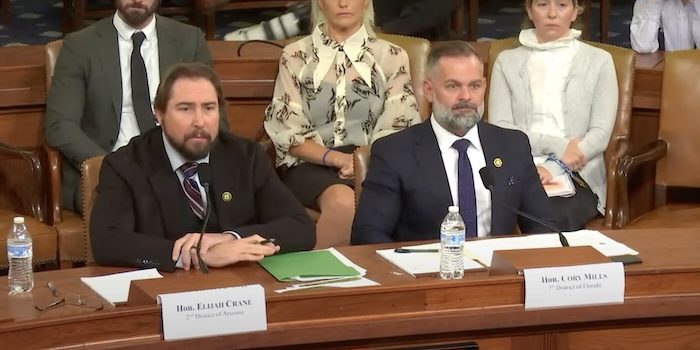
(José Niño, Headline USA) While publicly denouncing military aid to Ukraine as corrupt, Rep. Cory Mills, R-Fla., was privately selling millions of dollars in grenades to a Ukrainian government firm now under investigation, according to anexplosive investigation by journalist Roger Sollenberger.
Mills has emerged as a leading voice against federal assistance to Ukraine. “This is but one example of U.S. tax dollars that has been corruptly stolen by the Ukrainian government,” Millsdeclared in a February 2024 social media statement, referencing Pentagon audit findings and lamenting “millions in suitcases, shoe boxes, kickback from companies to procurement heads.”
During this same period, however, Mills’s weapons manufacturer PACEM was conducting private grenade sales to SpetsTechnoExport (STE)—a Ukrainian state-run defense procurement firm currently facinggovernment investigation overcorruption allegations dating back more than 10 years. The organization has gained notoriety for involvement in money launderingschemes.
Mills established PACEM in 2014 and maintains ownership according to his financial records. Defense industry specialists explained to Sollenberger that eliminating federal military assistance to Ukraine wouldn’t damage Mills’s commercial interests. Such a policy shift would compel Kiev to depend more substantially on private weapons suppliers like PACEM, creating potential financial advantages for Mills.
NEW: Rep. Cory Mills owns a defense company that appears to have been illegally exporting weapons to Ukraine—while Mills sits on the committee with oversight of those sales. This has gone unreported and for a long time unknown in Congress. My latest here:https://t.co/myyFQ5ztrdpic.twitter.com/wnuXREdqj4
The congressman represents an unprecedented case in that he is apparently the first sitting member of Congress actively engaged in the arms trade. Mills holds positions on both the House Armed Services and Foreign Affairs committees while PACEM executes direct commercial weapons transactions—an opaque segment of the defense industry that critics characterize as lackingadequate transparency andeffective oversightmechanisms.
Sollenberger noted that House Ethics Committee investigators are examining PACEM’s federal contracting activities following an Office of Congressional Conductdetermination that such arrangements likely violated legal standards. Legal professionals andfederal regulations suggest PACEM’s international commercial sales face identical legal obstacles: corporations under complete ownership by active congressional representatives cannot lawfully participate in such business activities.
The situation grows more complex when examining Mills’s professional network. PACEM’s long-serving chief legal officer is Joseph E. Schmitz, a former Pentagoninspector general who left under controversy and later served as Blackwater’sCOO. Schmitz’s background includes an attemptedweapons sale to Syrian rebel groups and participation in Erik Prince’s unsuccessful proposal to establish a $10 billionprivate military force for Ukraine.
Prince’s proposal also involved Andrii Artemenko, a contentious pro-Russia Ukrainian entrepreneur currently residing in Florida. Multiple sources confirmed to Sollenberger that Artemenko functioned as PACEM’s Ukrainian operations director, with banking documents from 2020 referencing agreements valued at $5 million.
Legal filings reveal PACEM secured authorization for exporting 800,000 grenades to Ukraine last November—carrying a price tag of $66.4 million, precisely matching the company’s outstanding obligations to a foreign creditor. Mills provided personal financial guarantees for this debt without filing mandatory congressional disclosures, potentially violating federal requirements.
“I was elected to represent America and not Zelenskyy and his corrupt band of officials,” Mills wrote in that February statement. Yet shortly before, he participated in acongressional hearing advocating for reducedfederal oversight of private international arms transactions.
PACEM currently faces foreclosure proceedings over nearly $66.4 million in unpaid debts. The company has ceased operations and discontinued employee compensation. During this period, Mills has engaged in substantial personal expenditures while allegedly omitting disclosure of multiple PACEM-related entities to Congress, including subsidiary corporations and international operations in Canada, Dubai, and Pakistan.
Brad Moss, a specialist in national security law who examined PACEM’s export documentation and applicable statutes, noted the unprecedented nature of a serving congressional representative conducting private international arms sales. Given Mills’s concurrent positions, “it certainly appears that Mills would be ineligible,” Moss concluded.
Mills’s office reportedly did not respond to requests for comment from Sollenberger.
Mills has traveled to Syria multiple times this year, including a September individual visit featuring meetings with Syria’s Minister ofFinance and Information Technology. Nodisclosure documents have been submitted identifying the funding source for this trip.
Neither Mills, PACEM, nor his congressional office provided responses to inquiries. In previous statements, PACEM has rejected allegations of impropriety, asserting that Mills established adequate separation through a “blind” trust arrangement—though Sollenberger’s priorinvestigation questioned whether this trust meets blindness standards.
At some point after June 4, Mills modified his automated PACEM business email response to include: “I will not be engaged in Pacem business as long as I am serving in Congress.”
José Niño is the deputy editor of Headline USA. Follow him at x.com/JoseAlNino
(Mike Maharrey, Money Metals News Service) Gold prices continued to rise in India, creating headwinds for jewelry demand while boosting investment.
India ranks as the world’s second-largest gold market behind China.
Gold has increased 73 percent year-to-date in rupee terms. That compares with a 67 percent increase in dollar terms. A weakening dollar, persistent geopolitical tensions, and strong ETF inflows have supported gold prices in India.
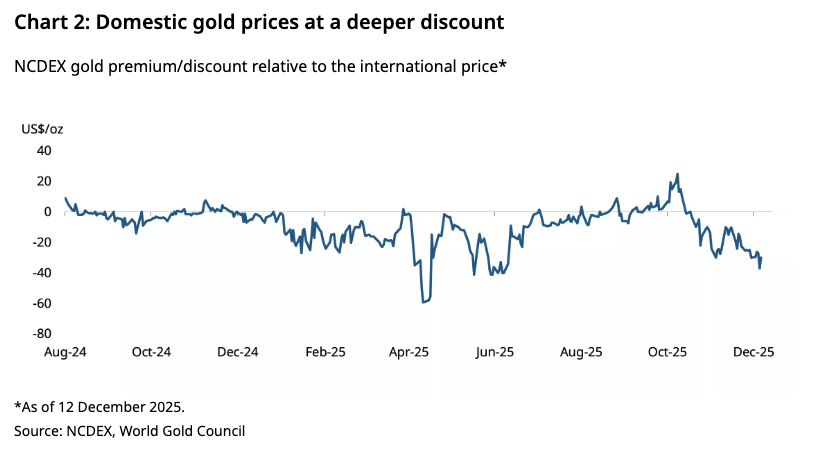
We’ve been seeing gold selling at a discount in the Indian market, and this trend accelerated in November, with the discount increasing from around $11 per ounce to nearly $30 per ounce as of December 12. According to the World Gold Council, this reflects a slowdown in jewelry demand.
Higher prices have dampened overall gold demand, but not by as much as one might think. With the price increasing by 50 percent through the first nine months of 2025, demand only fell by about 16 percent.
Jewelry sales have fallen precipitously in volume as prices have skyrocketed. However, the value of jewelry sales has increased.
Mid and small-ticket purchases underpin Indian jewelry demand, and we have seen growing pressure on this segment, according to the World Gold Council.
“Although demand in the luxury segment remains strong, it is insufficient to offset the broader volume weakness. Price volatility is further constraining discretionary and everyday jewelry purchases.”
Metals Focus analysts expect soft jewelry demand to persist into 2026, forecasting another 9 percent decline in volume. However, they say they “expect the decline to be less severe than in 2025, as consumers gradually adjust to higher prices and economic conditions improve.”
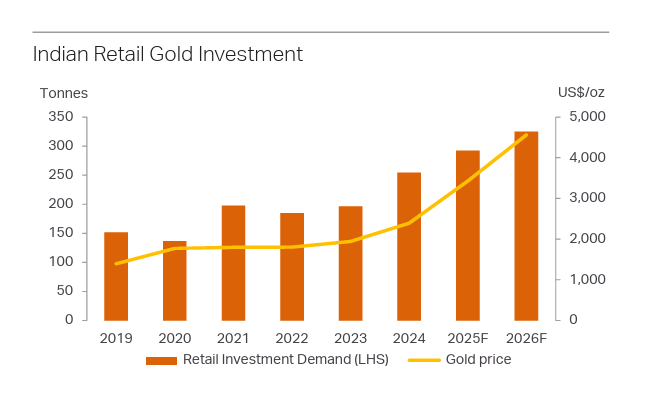
While high prices have pressured jewelry demand, investment demand continued to surge in November. According to the World Gold Council, gold bar and coin demand have been particularly robust.
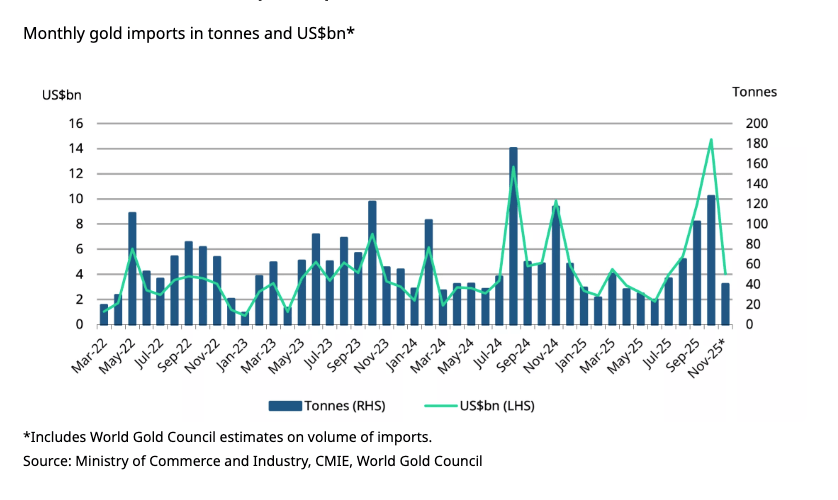
“The preference towards investment-focused buying is reflected in the volume of gold imports, which rose sharply to 340 tonnes between July and October, compared with 204 tonnes between January and June, underscoring the resilience of investment-led demand.”
According to Metals Focus, Indian retail investment rose by 13 percent year-on-year to 198 tonnes through the first three quarters of 2025.
Full-year bar and coin demand is expected to reach its highest level since 2013.
ETF inflows also reflect growing investment demand.
Net gold inflows into Indian-based funds rose by ₹37.4 billion ($421 million). That was about half of the previous month but still comfortably above the average through the first 10 months of 2025.
Indian ETF gold holdings rose by nearly 3 tonnes during the month, pushing cumulative ETF holdings to 86.4 tonnes.
Through the first 10 months of 2025, Indian gold ETFs reported increased gold holdings amounting to 28.6 tonnes, the highest total on record. That’s nearly double the 2024 total.
Investor participation in Indian gold ETFs has also expanded significantly, with 3.4 million new accounts (folios) added between January and November. That represents a 152 percent year-on-year increase.
A gold ETF is backed by a trust company that holds metal owned and stored by the trust. In most cases, investing in an ETF does not entitle you to any amount of physical gold. You own a share of the ETF, not gold itself. ETFs are a convenient way for investors to play the gold market, but owning ETF shares is not the same as holding physical gold.
Metals Focus forecasts physical investment gold demand will grow by another 11 percent next year, approaching 2013 levels during the later stages of the Great Recession.
Traditionally, Indian investors have preferred physical metal, but there is growing interest in ETFs due to the convenience.
After three months of growth, gold imports fell substantially in November, dropping by 73 percent month-on-month and 59 percent year-on-year. According to the World Gold Council, “This sharp decrease can be attributed to the moderation in post-festive demand.”
So far this year, India has imported an estimated 580 tonnes of gold, a 20 percent decline from the same period in 2024. However, in volume terms, gold imports are up by about 2 percent due to the rapidly appreciating price.
Indians have a longstanding love affair with gold.
The yellow metal is deeply interwoven into the country’s marriage ceremonies, along with its religious and cultural rituals. Festival seasons typically boost gold demand.
Indians have long valued the yellow metal as a store of wealth, especially in poorer rural regions. Around two-thirds of India’s gold demand comes from beyond the urban centers, where large numbers of people operate outside the tax system. Many Indians use gold jewelry not only as an adornment but as a way to preserve wealth.
In the West, gold is generally viewed as a luxury item.
Not in India. Even poor Indians buy gold.
According to a 2018 ICE360 survey, one in every two households in India had purchased gold within the last five years. Overall, 87 percent of Indian households own some gold. Even households at the lowest income levels in India hold some of the yellow metal. According to the survey, more than 75 percent of families in the bottom 10 percent of income managed to buy some gold.
The yellow metal was a lifeline for Indians buffeted by the economic storm caused by the government’s response to COVID-19. After the Indian government locked down the country, banks tightened credit to mitigate the default risk. Unable to secure traditional loans, Indians used gold to secure financing. As Indians endured a second wave of lockdowns, many Indians resorted to selling gold outright to make ends meet.
Mike Maharrey is a journalist and market analyst for Money Metals with over a decade of experience in precious metals. He holds a BS in accounting from the University of Kentucky and a BA in journalism from the University of South Florida.
The question should be: why is anybody putting any stock in this CPI report at all? The Bureau of Labor Statistics (BLS) basically made the data up.
We knew that the data was suspect, given that the BLS didn’t collect data for October due to the government shutdown. Reading through the BLS notes, we get some idea of how the agency parsed the data. It doesn’t exactly increase confidence in the report’s veracity.
In the CPI report summary, the BLS offers a quick overview of how it handled the mass of missing October data.
“BLS did not collect survey data for October 2025 due to a lapse in appropriations. BLS was unable to retroactively collect these data. For a few indexes, BLS uses nonsurvey data sources instead of survey data to make the index calculations. BLS was able to retroactively acquire most of the nonsurvey data for October. CPI data collection resumed on November 14, 2025.”
“Collection began on Friday, November 14. By authorizing additional collection hours, BLS attempted to collect data for the entire month of November.”
Note the key word – “attempted.”
The BLS goes on to further explain this “attempt.”
“How were November indexes calculated? November 2025 indexes were calculated by comparing November 2025 prices with October 2025 prices.”
Umm… wait a minute. There wasn’t any October data. What is a government number-cruncher to do?
“BLS could not collect October 2025 reference period survey data, so survey data were carried forward to October 2025 from September 2025 in accordance with normal procedures.”
In other words, they just pretended October prices were the same as September prices and went on their merry little way.
Or to put it more bluntly, they just made up the October data. If we’re being generous, we can call it an educated guess. But a guess, nonetheless.
And he also pointed out that the BLS carried over some hinky September data into the November CPI report.
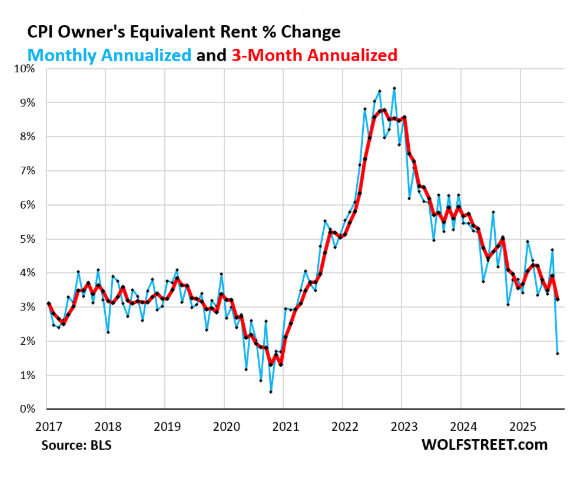
In September, there was an unexpected and unexplained drop in Owner’s Equivalent Rent (OER). This is a key metric the BLS uses to calculate the cost of home ownership. It is a stand-in for expenses such as homeowner’s insurance, HOA fees, property taxes, and maintenance. OER is based on the following question in the Consumer Expenditure Survey posed to people who own their primary residence: “If someone were to rent your home today, how much do you think it would rent for monthly, unfurnished and without utilities?”
So, OER is always, at best, just an educated guess based on a survey.
This guess accounts for 26 percent of overall CPI, for 33 percent of core CPI, and for 44 percent of core services CPI.
In September, Owner’s Equivalent Rent charted a massive outlier, rising by only 0.13 percent. That compared to a .38 percent increase in August and a 12-month range between 0.27 and 0.41 percent.
Simply put, this sudden outlier plunge doesn’t make any sense. It doesn’t take a PhD in economics to recognize that the rapidly rising cost of homeownership didn’t suddenly stop rising in September.
WolfStreet explains how this was carried over into October and November.
“[OER] has been at an annualized rate of 1.6 percent for the past three months, compared to an average 4.1 percent in the six months before the doctored September. That’s a sudden 2.4 percentage-point plunge out of nowhere for the third month in a row.”
Therefore, as WolfStreet notes, the November CPI would have been much hotter had it not been for this outlier being carried forward into the new data.
“The September data, which was used as base for the made-up October data, was marred by the total outlier plunge of OER… And that outlier plunge in September was carried forward to October and November.”
This really isn’t shocking. The government has a solid track record of providing bad data. Remember all of those revisions to the employment data? The problem is that this data is implicated in all kinds of decisions. The Federal Reserve uses it to guide monetary policy. CPI data is used to calculate real GDP and real consumer spending. It is used to determine cost-of-living adjustments to Social Security and other government programs.
You should always take government data with a grain of salt, but this CPI report needs an entire shaker. When government people point to this data to claim they won the inflation fight and to justify further rate cuts, remember, they are leaning on the punchline of a bad joke to make their case.
Mike Maharrey is a journalist and market analyst for Money Metals with over a decade of experience in precious metals. He holds a BS in accounting from the University of Kentucky and a BA in journalism from the University of South Florida.