Jan. 6 Pipe Bomber Suspect’s Lawyer Says Trump’s Pardon Applies to Him

(Ken Silva, Headline USA) The defense attorney for the man accused of planting pipe bombs outside the RNC and DNC headquarters on the eve of the Jan. 6, 2021, Capitol Hill protest says that President Donald Trump’s sweeping pardon for Jan. 6 offenses should apply to his client.

Brian Cole Jr.’s lawyer, Mario Williams, told local news station Fox 5 DC that he plans on making legal arguments about the pardon issue soon.

“I think you have to employ some kind of common sense as applied to the allegations. So, if the allegations are that he went out there and he set down these components and that they were found on Jan. 6, the judge says that it’s a part of Jan. 6 apart and says that you were allowed to get a pardon for everything related to the events that occurred on or at the Capitol building on Jan. 6,” Williams said.

The pardons Williams was referring to were made by Trump on the day of his inauguration.

Trump granted a “complete and unconditional pardon to all other individuals convicted of offenses related to events that occurred at or near the United States Capitol on January 6, 2021.” He also directed the Justice Department to “pursue dismissal with prejudice to the government of all pending indictments against individuals for their conduct related to the events at or near the United States Capitol on January 6, 2021.”

DOJ prosecutors have said that Cole confessed to placing pipe bombs outside the Republican National Committee and the Democratic National Committee headquarters on Jan. 5, 2021.

Williams said he’s watched a recording of Cole’s alleged confession, and that the DOJ has misrepresented in court filings what was really said during that two-hour-plus interview.

“Some of the representations that the government made, in our opinion, are false,” he told Fox 5.

The news station has not aired the full interview, and it’s unclear what Williams specifically says the DOJ is lying about.

If convicted of both charges against him, Cole faces up to 10 years of imprisonment on one charge and up to 20 years of imprisonment on a second charge that also carries a five-year mandatory minimum prison sentence.

Williams has also said in court that the defense team has an expert witness who will testify that the so-called bombs “cannot explode and are not viable.”

Pipe Bomb Case History

As Headline USA revealed in March 2024, the FBI had a suspect identified by Jan. 10, 2021 in the pipe bomb case, but didn’t make an arrest at the time.

FBI records released in September revealed that agents didn’t interview the woman who discovered a pipe bomb near the RNC around 12:40 p.m. on Jan. 6 until days later. That woman, former counterterrorism analyst and then-Commerce Department worker Karlin Younger, said she found the bomb while doing laundry.

Meanwhile, former Vice President Kamala Harris continues to be tight-lipped on the subject, despite the fact that her motorcade drove past the DNC pipe bomb on Jan. 6. Harris left the Capitol at 11:21 a.m. arrived to the DNC at 11:25 a.m., but the nearby pipe bomb wasn’t discovered until 1:07 p.m. by a plainclothes Capitol Police officer.

The bizarre circumstances have driven many to suspect that it may have been a false-flag attempt overseen by the feds themselves to divert law enforcement from the Capitol right as the Jan. 6 protest was turning violent.

Rep. Morgan Griffith, R-Va., has said that it may be impossible to successfully prosecute the pipe bomber.

“Here’s what a good criminal defense attorney’s going to say: If you identified the individual who’s believed to place the bomb, then hours go by, and you had a search by the Secret Service at the DNC and the dog didn’t find the explosive—so clearly, the device [the defense attorney’s] client might have left there wasn’t the device that was determined to be the pipe bomb, because it wasn’t picked up by the bomb-sniffing dog,” Griffith argued in March 2024.

Ken Silva is the editor of Headline USA. Follow him at x.com/jd_cashless.

Trump Weighing ‘Strong Options’ Against Iran

(Sarah Roderick-Fitch, The Center Square) The U.S. could be inching closer to striking Iran for a second time, with President Donald Trump voicing his support for protesters of the Islamic Republic’s regime.

Trump told reporters late Sunday evening on board Air Force One that he and the military are looking very seriously at responding to reports that the Iranian regime is killing protesters.

Earlier in the month, the president issued a stern warning to the regime if it retaliated against protesters.

“If Iran shoots and violently kills peaceful protesters, which is their custom, the United State of America will come to their rescue. We are locked and loaded and ready to go,” the president posted to his Truth Social Account.

Trump told reporters Sunday evening that he is receiving “hourly updates,” and that he is “looking at some very strong options.”

The president said Iranian officials have reached out to the White House to negotiate. He added that a meeting is being set up, but indicated it may be too little, too late.

“Iran wants to negotiate, yes. We may meet with them … But we may have to act, because of what’s happening, before the meeting,” Trump told reporters.

Retaliation against protesters in Iran adds more fuel to the fire as the president is eyeing the Islamic Republic’s nuclear program.

During the last week of December, Trump hosted Israeli Prime Minister Benjamin Netanyahu, when the two leaders reportedly discussed the potential of future strikes on Iran if the Islamic Republic attempts to rebuild its nuclear capabilities, after U.S. strikes in June that targeted the country’s nuclear sites.

“I hear Iran is looking to rebuild its facilities again, and if they do we will have to knock them down again,” the president told reporters during a news conference in late December. “We’re going to have no choice but very quickly to eradicate that build up. So I hope Iran is not trying to build up, as I’ve been reading.”

The civil uprising in Iran follows a pattern of Iranian citizens protesting the brutal regime’s grip on its citizens. The most recent unrest occurred in 2019, with one of the most significant events taking place in 2009, known as the Green Movement, which resulted in millions of Iranian citizens demonstrating against the government.

Tennessee Bill Would Put Prayer, Bible Reading Back in Schools

(Kim Jarrett, The Center Square) Tennessee lawmakers will consider a bill that would allow voluntary prayer and Bible studies in state schools and public charter schools.

House Bill 1491, by Rep. Gino Bulso, R-Brentwood, said the prayer time could be silent or groups could have a designated prayer time. Parents would be required to give schools written permission for their children to participate.

The 1962 U.S. Supreme Court decision Engel v. Vitale banned prayer in public schools. The case was based on the Establishment Clause of the First Amendment of the U.S. Constitution. Bulso said the court did not correctly understand the history of that clause.

“The Establishment Clause of the United States Constitution restricts only laws enacted by Congress, and the 14th Amendment of the United States Constitution offers no support for requiring states to comply with the restrictions that the Establishment Clause imposes on Congress,” according to the bill, which is named the Protecting Religious Liberty and Expression in Public Schools Act. “This Legislature enjoys the power to extend protection to religious liberty and freedom of expression and to provide redress against deprivations of these liberties.”

The prayers could not be broadcast over a school intercom system or take away from instructional time, the bill said. Prayers are also not limited to Christian prayers, but parents must give schools permission.

The 1962 case involved a 22-word prayer that students could opt into or out of, Bulso said in an interview with TCS.

The Supreme Court has been actively addressing the issue of religious liberty recently, he said. In 2022, the court sided with a high school football coach in the state of Washington suspended for having an on-field private prayer with his team.

“I think this is exactly the right time to have this issue brought back into public square both because you know our Supreme Court has I think more properly aligned in most recent decisions and because I think we just need to have prayer back in our schools,” Bulso said.

The study of the Bible would be in a historical context, not as religious dogma, Bulso told TCS in an interview. Parents could choose not to allow their children to participate in the Bible curriculum.

Another Supreme Court case is the basis of Bulso’s House Bill 1473, which would protect private citizens opposed to same-sex marriage from doing things that violate their religious beliefs.

The court legalized same sex marriage in a 2015 ruling. A Colorado baker was sued for refusing to bake a cake for a same-sex couple because of his religious beliefs. The Supreme Court ruled in favor of the baker in 2018.

House Bill 1473 would protect individuals and private entities who are not going to be “compelled to do something to violate their sincerely held religious beliefs,” Bulso said.

Tennesseans passed a constitutional amendment in 2006 that defined marriage between a man and a woman. The 2015 decision that legalized same-sex marriage was a federal overreach, Bulso said.

“Those five judges had no ability legislative to do anything but they used an interpretation of the 14th Amendment to accomplish what they couldn’t accomplish legislatively,” he said.

Bulso does not have a Senate sponsor for his bills as of Monday, the day before the General Assembly convenes. He said he hasn’t had time to talk to his colleagues in the upper chamber.

“But believe me, all of these bills that we are talking about are going to enjoy enormous bipartisan support in both the House and Senate and we will be able to get a really good Senate sponsor for each one of them,” Bulso said.

Trump ‘Inclined’ To Keep Exxon Out of Venezuela

(Dave DeCamp, Antiwar.com) President Donald Trump has said that he is “inclined” to keep ExxonMobil out of his plans to plunder Venezuela’s vast oil resources after the CEO of the oil company suggested the country was “uninvestible.”

Exxon CEO Darren Woods made the comments on Friday, when President Trump hosted a group of oil executives to discuss his plans for Venezuela. Before the meeting, Trump claimed that oil companies were ready to invest more than $100 billion rebuilding Venezuela’s oil infrastructure, but he received no commitments.

“We have a very long history in Venezuela. In fact, we first got into Venezuela back in the 1940s. We’ve had our assets seized twice,” Woods said at the meeting, referring to the nationalization of Venezuela’s oil industry in 1976 and the further nationalization of oil projects by Hugo Chavez in the early 2000s.

“So you can imagine, to reenter a third time would require some pretty significant changes from what we’ve historically seen here and what is the current state. If we look at the legal and commercial constructs and frameworks in place today in Venezuela, it’s uninvestable, and so significant changes have to be made,” Woods added.

The Exxon CEO did add that he was “confident” those changes could be put in place by the Trump administration working with the Venezuelan government, but the president was still unhappy with his remarks.

“I didn’t like Exxon’s response,” Trump told reporters aboard Air Force One on Sunday night. “I’ll probably be inclined to keep Exxon out. I didn’t like their response. They’re playing too cute.”

The one US oil company that said it’s ready to act is Chevron, the only US oil firm that continues to operate in Venezuela through joint ventures with the state oil company, PDVSA.

“We have a path forward here very shortly to be able to increase our liftings from those joint ventures 100% essentially effective immediately,” Chevron Vice Chairman Mark Nelson told Trump at the White House. “We are also able to increase our production within our own disciplined investment schemes by about 50% just in the next 18 to 24 months.”

Trump has insisted that the Venezuelan government will cooperate with his plan following the US attack on Caracas that killed 80 to 100 people and resulted in the abduction of President Nicolas Maduro, though it remains unclear if Venezuela’s acting president, Delcy Rodriguez, will agree to all of his demands.

This article originally appeared at Antiwar.com.  

Mississippi Synagogue Torched Over ‘Jewish Ties,’ FBI Says

(Headline USA) The FBI says that a suspect in the arson fire at a Mississippi synagogue admitted to targeting the institution because of its “Jewish ties.”

Stephen Spencer Pittman was charged Monday with maliciously damaging or destroying a building by means of fire or an explosive. In an affidavit filed in U.S. District Court in Mississippi on Monday, the FBI said the suspect confessed to lighting a fire inside the building “due to the building’s Jewish ties.”

The weekend fire ripped through the Beth Israel Congregation in Jackson shortly after 3 a.m. on Saturday. No congregants or firefighters were injured in the blaze. Security camera footage released Monday by the synagogue showed a masked and hooded person using a gas can to pour a liquid on the floor and a couch in the building’s lobby.

In an interview with law officers, Pittman referred to the synagogue as the “synagogue of Satan,” according to an affidavit filed in U.S. District Court in Mississippi.

During that interview with representatives of the Jackson Fire Department and Hinds County Sheriff’s Office, Pittman “admitted to starting a fire inside the Beth Israel Congregation/ISJL building,” the affidavit states.

During his interview with investigators, Pittman said he stopped at a gas station on his way to the synagogue to purchase the gas used in the fire. He also took the license plate off of his vehicle at the gas station. He then used an ax to break out a window of the building, poured gas inside and used a torch lighter to start the fire, the affidavit states.

The FBI later recovered a burned cell phone believed to be Pittman’s, and recovered a hand torch a member of the congregation found and turned over to authorities.

With just a few hundred people in the community, it was never particularly easy being Jewish in Mississippi’s capital city, but members of Beth Israel took a special pride in keeping their traditions alive in the heart of the Deep South.

But the fire badly damaged the historic synagogue’s library and administrative offices.

One Torah was behind glass and was not damaged in the fire, according to the congregation. Five Torahs — the sacred scrolls with the text of the first five books of the Hebrew Bible — located inside the sanctuary were being assessed for smoke damage. Two Torahs inside the library, where the most severe damage was done, were destroyed, according to a synagogue representative.

The suspect’s father contacted the FBI and said that his son confessed to setting the building on fire, the affidavit states. Data on the suspect’s cell phone corroborated that information, the agent wrote.

Yellow police tape on Monday blocked off the entrances to the synagogue building, which was surrounded by broken glass and soot. Bouquets of flowers were laid on the ground at the building’s entrance — including one with a note that said, “I’m so very sorry.”

Security camera footage released Monday by the synagogue showed a masked and hooded person using a gas can to pour a liquid on the floor and a couch in the building’s lobby.

The congregation’s president, Zach Shemper, vowed to rebuild the synagogue and said several churches had offered their spaces for worship during the rebuilding process.

“As Jackson’s only synagogue, Beth Israel is a beloved institution, and it is the fellowship of our neighbors and extended community that will see us through,” Shemper said.

With the exception of the cemetery, every aspect of Jewish life in Jackson was under Beth Israel’s roof. The midcentury modern building not only housed the congregation but also the Jewish Federation, a nonprofit provider of social services and philanthropy that is the hub of Jewish institutional life in most U.S. cities. The building also was home to the Institute of Southern Jewish Life, which provides resources to Jewish communities in 13 southern states.

Beth Israel as a congregation was founded in 1860 and acquired its first property where it built Mississippi’s first synagogue after the Civil War. In 1967, the synagogue moved to its current location where it was bombed by local Ku Klux Klan members not long after relocating. 

Adapted from reporting by the Associated Press

Mark Kelly Sues the Pentagon Over Attempts to Punish Him for His Warnings About Illegal Orders

(Headline USA) Democratic Sen. Mark Kelly sued the Pentagon on Monday over attempts to punish him for his warnings about illegal orders.

Kelly, a former Navy pilot, is seeking to block his censure from Defense Secretary Pete Hegseth last week. Hegseth announced last Monday that he censured Kelly over the former Navy pilot’s participation in a video that called on troops to resist unlawful orders.

Hegseth said the censure — by itself simply a formal letter with little practical consequence — was “a necessary process step” to proceedings that could result in a demotion from Kelly’s retired rank of captain and subsequent reduction in retirement pay.

Kelly asked the court to declare the censure letter, the proceedings about his rank and any other punishments against him “unlawful and unconstitutional.

“The First Amendment forbids the government and its officials from punishing disfavored expression or retaliating against protected speech,” his lawsuit says. “That prohibition applies with particular force to legislators speaking on matters of public policy.”

The censure stemmed from Kelly’s participation in a video in November with five other Democratic lawmakers — all veterans of the armed services and intelligence community — in which they called on troops to uphold the Constitution and defy “illegal orders.”

Adapted from reporting by the Associated Press


Unusual COMEX Trend Could Signal Accelerating Silver Squeeze

(Mike Maharrey, Money Metals News Service) An interesting development in the COMEX silver exchange seems to reflect an accelerating silver squeeze.

The stage was set for a silver squeeze last April when significant amounts of metal moved from London to New York, driven by tariff worries. The displacement of metal, coupled with surging Indian demand, set off the first squeeze in October. That drove the silver price over $50 for the first time.

Metal flowed back to London, but that didn’t solve the underlying problem. While shuffling silver between London, New York, and India took the immediate pressure off the market, it didn’t magically create new silver, and it didn’t take long for silver squeeze 2.0 to develop last month. That pushed the price over $80.

This squeeze isn’t manifesting just because metal is in the “wrong place.” The underlying issue is that there are true shortages beginning to manifest.

Silver demand has outstripped supply for four straight years, and the Silver Institute projects that 2025 will be the fifth. The structural market deficit came in at 148.9 million ounces in 2024. That drove the four-year market shortfall to 678 million ounces, the equivalent of 10 months of mining supply in 2024.

This inventory tightness globally seems to have created an unusual setup in COMEX futures, as investors appear to be moving March contracts backward to January and February.

Analysts came to this conclusion by examining the open interest data released by the COMEX.

Open interest represents the total number of outstanding contracts. In other words, these are contracts that have been created but not yet closed out or settled by delivery or cash settlement at expiration.

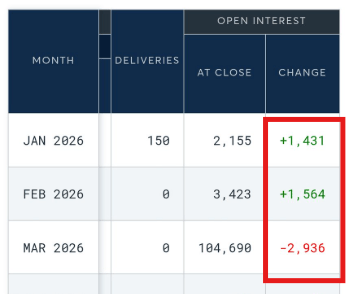
Examining the January 7 data, we find that open interest in the January 2026 contract rose by 1,431. Open Interest in the February 2026 contract also rose by 1,564 contracts. That brings the total open interest contracts for those months to 2,995.

Meanwhile, the March 2026 open interest fell at a nearly identical number – 2,936.

The best explanation for this surge in open interest for earlier contracts and the sudden drop in March open interest is that investors are rolling contracts backward. In other words, they are exchanging positions from a longer contract into earlier contracts that are closer to the expiration date.

Why would they do this?

Simply because they want to take delivery of the metal now, even though January is not typically an active delivery month. They don’t want to wait until March.

Keep in mind, there could be other reasons for these moves; however, this seems to be the most logical interpretation of the numbers.

Jon Lindau explained the situation in a report on SilverTrade.com.

“Typically, rolls are forward (to the next front month) in normal markets, as traders wish to maintain a position in silver (exposure to the silver price), without taking physical delivery of the metal.

“Backward rolling (moving the position from the front month March to nearer months, as seen here) indicates the exact opposite: backwardation along with immediate scarcity of physical silver metal as traders wish to take delivery instead of merely remaining exposed to the futures price of silver.”

Lindau said two scenarios could be driving backwardation.

“Longs positioning aggressively to stand for immediate delivery, which will further drain COMEX registered stocks and further exacerbate the silver shortage.

“Conversely, if shorts are involved in the roll, they might be attempting to avoid delivery demands in March by shifting earlier, but this would still be extremely dangerous for shorts amid tight supply and increasingly more contracts standing for delivery in January.”

Again, there could be other reasons for the recent shift in open interest. However, Occam’s Razor teaches us that the simplest explanation is generally the best. It’s at least the best place to start.

It appears we are reaching a point where those with long positions don’t want to wait too far into the future to take possession of physical metal they may want or need.

As Lindau put it, if this is what’s happening, the COMEX could end up in big trouble.


Mike Maharrey is a journalist and market analyst for Money Metals with over a decade of experience in precious metals. He holds a BS in accounting from the University of Kentucky and a BA in journalism from the University of South Florida.


Precious Metals in 2026: Will the Bulls Keep Running?

(Mike Maharrey, Money Metals News Service) 2025 was quite the year for precious metals. What does 2026 have in store for gold, silver, platinum, and palladium?

Last year, gold rose by over 64 percent, setting 53 new record highs along the way. Silver gained just under 148 percent. Platinum’s price increased by 125.9 percent. Palladium was up just over 80 percent.

There were multiple factors driving metals higher, including persistent inflation, uncertainty surrounding U.S. trade and foreign policy, concerns about the long-term outlook of U.S. debt, the ongoing weaponization of the dollar, shaky economic data, and a global trend toward de-dollarization.

Metals Focus projects that many of these dynamics will persist into 2026.

“Looking ahead, we anticipate further price upside across the precious metals complex, as persistent economic and geopolitical uncertainties continue to support portfolio diversification. For the white metals, U.S. tariff uncertainty and favorable underlying fundamentals are likely to provide an additional boost to prices.”

The following is a brief overview of the likely trajectory of precious metals in 2026, based on analysis by Metals Focus. This London-based independent precious metals consultancy specializes in gold, silver, platinum, palladium, and rhodium markets…

Gold

After ending 2025 with a significant correction from over $4,500 to as low as $4,330, gold rebounded to kick off 2025, moving back close to the all-time high of $4,550 hit on December 26, 2025.

Despite increased volatility, Metals Focus remains bullish on gold this year with highs rising “well above” $5,000.

“In essence, the underlying drivers, which drove the gold rally during 2025, will remain in place this year.”

Metals Focus specifically cites regime uncertainty in the U.S. as a factor that will continue to support gold.

“Since the start of the Trump 2.0 administration, the abrupt and often unpredictable nature of U.S. policy moves has remained a key driver of sentiment towards gold.”

The organization also expects worries about economic health to support the yellow metal, along with continued monetary easing.

This is probably one of the biggest factors driving gold higher. Despite elevated inflation, the Federal Reserve has cut rates multiple times and pivoted back to quantitative easing. This is, by definition, inflation.

President Trump will choose a new Federal Reserve chair this year, and that individual will likely be more favorable toward loose monetary policy than Jerome Powell.

According to Metals Focus, “Even if the Fed’s cuts are less aggressive than markets currently anticipate, the fact that these are still coming will continue to provide support.

“Layered over this are worries about persistent fiscal deficits, the rapid accumulation of U.S. debt, and questions surrounding the Fed’s independence. These factors raise doubts about long-term debt sustainability and, by extension, the dollar’s role as the world’s reserve currency.”

Metals Focus also expects central bank gold demand to continue supporting the gold market.

Central banks globally have increased their gold reserves by over 1,000 tonnes for three straight years, and the World Gold Council projects that 2025 will be the fourth.

2024 ranked as the third-largest expansion of central bank gold reserves on record, coming in just 6.2 tonnes lower than in 2023 and 91 tonnes lower than the all-time high set in 2022 (1,136 tonnes). 2022 was the highest level of net purchases on record, dating back to 1950, including since the suspension of dollar convertibility into gold in 1971.

To put that into context, central bank gold reserves increased by an average of just 473 tonnes annually between 2010 and 2021.

Gold recently overtook U.S. Treasuries as the top global reserve asset. Metals Focus projects, “U.S. action in Venezuela and President Trump’s aggressive stance towards Greenland, for example, are likely to underpin ongoing de-dollarization.”

The higher price will potentially create some headwinds in the gold market.

“We do not see much support from other gold fundamentals, given record prices. Even with firmer retail investment, shrinking jewelry consumption, rising recycling, and increased mine production will lead to a growing market surplus. In keeping with 2025, this surplus will be readily absorbed by strong institutional investment, which will therefore help to drive much of the price upside forecast for this year.”

Silver

The same macro dynamics driving gold higher should also support silver in 2026. While much more silver demand comes from industrial offtake compared to gold, it remains at the core a monetary metal and tends to generally track with gold over time.

Because of its significant industrial demand, the silver price tends to be much more volatile than gold. Metals Focus anticipates some price pressure early in the year due to profit-taking and liquidations linked to index rebalancing.

While Metals Focus analysts think there could even be a deep correction, they anticipate it will be relatively short-lived.

“We expect a recovery to soon emerge, with silver poised to achieve new all-time highs.”

Along with the geopolitical and macroeconomic factors already highlighted for the gold market, the silver market has one overwhelming dynamic driving it forward. There simply isn’t enough metal.

Silver demand has outstripped supply for four straight years, and the Silver Institute projects that 2025 will be the fifth. The structural market deficit came in at 148.9 million ounces in 2024. That drove the four-year market shortfall to 678 million ounces, the equivalent of 10 months of mining supply in 2024.

We’ve seen an ongoing silver squeeze develop in recent months. It started when metal moved from London to New York, driven by tariff worries. The displacement of metal, coupled with surging Indian demand, set off the first squeeze in October. That drove the silver price over $50 for the first time.

Metal flowed back to London, but that didn’t solve the underlying problem. While shuffling silver between London, New York, and India took the immediate pressure off the market, it didn’t magically create new silver, and it didn’t take long for silver squeeze 2.0 to develop. That briefly pushed the price over $80.

Metals Focus expects the metal shortage to persist as demand remains robust.

“Physical liquidity in the London market is likely to remain tight in the coming weeks, driven by strong investment demand, tariff uncertainty keeping substantial silver stocks in the US, refining capacity bottlenecks, and a structural deficit. Given silver’s smaller market size, these factors may well amplify price movements, with a three-digit peak looking likely this year.”

Metals Focus does expect some demand pressure at the higher price.

“Following silver’s exceptional price gains, efforts to reduce silver usage in the industrial space are expected to accelerate. That said, the impact of these demand losses is likely to be mitigated by continued strong investment demand.”

Platinum and Palladium

The platinum group metals have virtually no monetary demand. However, inflation also provides price support for these metals.

Platinum broke out of an extended period of range-bound price performance last year.

South African flooding disrupted platinum mining, exacerbating tight physical supply. On the demand side, surging gold prices incentivized Chinese jewelry manufacturers to rotate to platinum. This added to growing industrial demand.

In one of the most significant shifts in the platinum market, the Guangzhou Futures Exchange (GFEX) launched platinum futures in late November. Metals focus expects the move to open up the market to a wider range of investors.

Like silver, the platinum market is functioning at significant market deficits. Supply fell short of demand in 2023 and 2024, and the World Platinum Investment Council (WPIC) projects a market deficit of around 848,000 ounces in 2025, with another supply shortfall expected this year.

Metals Focus forecasts several factors will push and pull the platinum market this year.

“Automotive demand is expected to ease modestly; jewelry demand too will slip, while industrial consumption expands, led by glass, chemical and hydrogen-related applications. Retail investment, especially in China is forecast to show healthy growth. Following the strong price gains of 2025, some consolidation is likely. However, the re-basing of the market following the opening of the GFEX is expected to support further upside in 2026, with prices forecast to rise sharply, as liquidity and participation deepen.”

Metals Focus also expects the palladium price to continue an upward trajectory, at least through the early months of 2026, with the metal possibly retesting $2,000 per ounce before moderating later in the year.

One of the factors driving the palladium market was U.S. Section 232 trade measures (import restrictions the U.S. government can impose when the Department of Commerce finds that certain imports threaten to impair U.S. national security) and Russian anti-dumping policies.

Metals Focus analysts think these concerns will ease as the year progresses.

“As we expect Section 232 and anti-dumping concerns will move toward resolution, nervousness is expected to fade, leading to a 10–20 percent price correction by year-end.”

However, analysts also project demand will be stronger than previously expected.

“The decline in automotive demand will moderate, helped by signs of reverse substitution back toward palladium as its price advantage to platinum grows.”


Mike Maharrey is a journalist and market analyst for Money Metals with over a decade of experience in precious metals. He holds a BS in accounting from the University of Kentucky and a BA in journalism from the University of South Florida.

Thousands of Nurses Go on Strike at Several Major New York City Hospitals

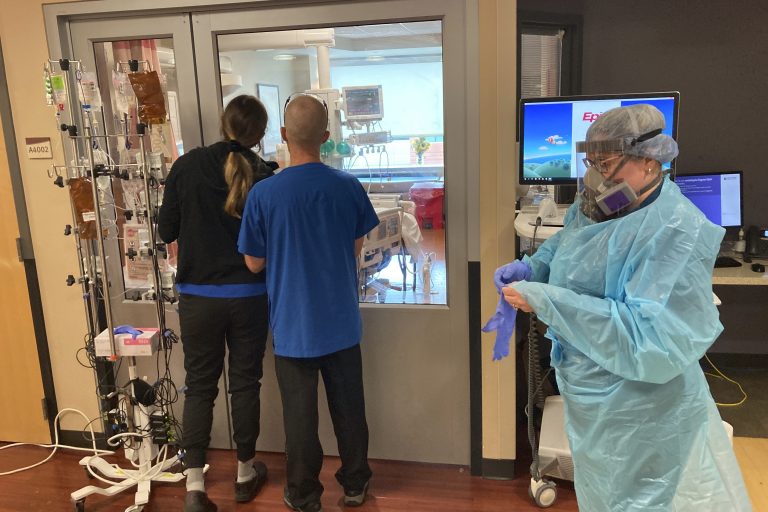
(Headline USA) Thousands of nurses in three hospital systems in New York City went on strike Monday after negotiations through the weekend failed to yield breakthroughs in their contract disputes.

“Nurses on strike! … Fair contract now!” they shouted on a picket line outside NewYork-Presbyterian Hospital’s campus in Upper Manhattan. Others picketed at hospitals in the Mount Sinai and Montefiore systems, where a 2023 nursing strike fed off pandemic-era frustrations and led to a deal to boost staffing and pay.

“And now, it’s how they’re treating us: They don’t want to give us a fair contract, and they don’t want to give us safe staffing, and now they’re trying to roll back on our benefits,” emergency department nurse Tristan Castillo said as she picketed Monday outside Mount Sinai West.

About 15,000 nurses are involved in the strike, according to their union, the New York State Nurses Association. The hospitals remained open, hiring droves of temporary nurses to try to fill the labor gap.

The strike involves private, nonprofit hospitals, not city-run ones. But the strike, which the union casts as lifesaving essential workers fighting hospital executives who make millions of dollars a year, could be a significant early test of Mayor Zohran Mamdani’s new administration.

The democratic socialist campaigned on a pro-worker platform and struck a similar note while visiting nurses on the NewYork-Presbyterian picket line Monday.

“These executives are not having difficulty making ends meet,” said Mamdani, who extolled nurses’ work and said they were seeking “dignity, respect and the fair pay and treatment that they deserve. They should settle for nothing less.”

Some other Democratic city and state politicians also visited striking nurses, while Gov. Kathy Hochul sent state health officials to the hospitals to keep watch over patient care. She called in a statement for the sides to negotiate a deal that “recognizes the essential work nurses do.”

The strike, which comes during a severe flu season, could potentially force the hospitals to transfer patients, cancel procedures or divert ambulances. It could also put a strain on city hospitals not involved in the contract dispute, as patients avoid the medical centers hit by the strike.

The nurses’ demands vary by hospital, but the major issues include staffing levels and workplace safety. The union says hospitals have given nurses unmanageable workloads.

Nurses also want better security measures in the workplace, citing incidents such as an episode last week when a man with a sharp object barricaded himself in a Brooklyn hospital room and was then killed by police.

The union also wants limitations on hospitals’ use of artificial intelligence.

The hospitals say that they’ve been working to improve staffing levels but say that the union’s demands overall are too costly.

After the nurses gave notice Jan. 2 of the looming strike, the hospitals hired temporary nurses, vowed to “do whatever is necessary to minimize disruptions” and said they were prepared to deliver care no matter how long the strike lasts. Mount Sinai said in a statement Monday it had lined up 1,400 temporary nurses.

Mount Sinai said the union was making “extreme economic demands.” Montefiore spokesperson Joe Solmonese said the union was pressing “$3.6 billion in reckless demands,” including exorbitant raises. The union hasn’t publicly disclosed its salary proposal.

New York-Presbyterian accused the union of staging a strike to “create disruption.”

“We’re ready to keep negotiating a fair and reasonable contract that reflects our respect for our nurses and the critical role they play, and also recognizes the challenging realities of today’s healthcare environment,” the hospital said.

Each medical center is negotiating with the union independently. Several other private hospitals in and near New York City reached deals in recent days to avert a possible strike.

The three-day strike in 2023 resulted in a deal raising pay 19% over three years at Mount Sinai and Montefiore. The pact also included staffing improvements, though the union and hospitals now disagree about how much progress has been made, or whether the hospitals are retreating from staffing guarantees.

The sides also dispute whether the hospitals are trying to reduce health benefits. Mount Sinai, for instance, says its proposals would cut costs without changing coverage.

Adapted from reporting by the Associated Press

Stocks of Credit Card Companies Slump as Wall Street Overall Drifts in Mixed Trading

(Headline USA) Stocks of credit card companies are dropping Monday after President Donald Trump threatened moves that could eat into their profits. The rest of Wall Street, meanwhile, is showing only modest signs of concern after tensions ramped to a much higher degree between the White House and the Federal Reserve.

The S&P 500 erased a small loss from the morning and was inching up by 0.1% from its all-time high set on Friday, as U.S. stocks drifted through mixed trading. The Dow Jones Industrial Average was up 11 points, or less than 0.1%, as of 1:35 p.m. Eastern time, and the Nasdaq composite was up 0.4%.

Some nervousness was still evident in the market, amid concern that the Fed may be on the path to less independence in setting interest rates to keep inflation under control. Prices for gold and other investments that tend to do well when investors are nervous rose, while the value of the U.S. dollar also dipped against other currencies.

On Wall Street, the sharpest drops hit credit card companies, as Synchrony Financial fell 8.5%, Capital One Financial sank 6.3% and American Express fell 4.2%. They weakened after Trump said he wanted to put a 10% cap on credit card interest rates for a year. Such a move could eat into profits for credit card companies.

But it was a separate move by Trump that grabbed the most attention across financial markets. Over the weekend, the Federal Reserve’s chair said the U.S. Department of Justice subpoenaed the Fed and threatened a criminal indictment over his testimony about renovations at its headquarters.

In al video statement released on Sunday, Fed Chair Jerome Powell said his testimony and the renovations are “pretexts” for the threat of criminal charges, which is really “a consequence of the Federal Reserve setting interest rates based on our best assessment of what will serve the public, rather than following the preferences of the President.”

The Fed has been locked in a feud with Trump, who has loudly called for lower interest rates to make borrowing cheaper for U.S. households and companies and give the economy a kickstart. The Fed did lower its main interest rate three times last year and indicated more cuts may arrive this year, but it’s moved deliberately enough that Trump has nicknamed Powell “Too Late.”

In a brief interview with NBC News Sunday, Trump insisted he didn’t know about the investigation into Powell. When asked if the investigation is intended to pressure Powell on rates, Trump said, “No. I wouldn’t even think of doing it that way.”

The Fed has traditionally operated separately from the rest of Washington, making its decisions without having to bend to political whims. Such independence, the thinking goes, gives it the freedom to keep interest rates high when necessary to drive down high inflation, even if it slows the economy and frustrates politicians looking to please voters.

In the bond market, the yield on the 10-year Treasury briefly rose to 4.21%, up from 4.18% late Friday, amid concerns that a less independent Fed could lead to higher inflation over the longer term. But it later eased back to 4.17%.

The worries also hit the value of the U.S. dollar, which slipped 0.3% against the euro and 0.4% against the Swiss franc.

Financial markets could be shaking off concerns about the Fed’s independence for a couple reasons. Traders could see “a limitation to the White House’s success in getting its way,” according to Thierry Wizman, a strategist at Macquarie Group, because Congress could deny confirmation of any nominees for the Fed from the White House.

“It is now the independence and credibility of the Department of Justice that are in question,” Senator Thom Tillis, a Republican from North Carolina, said on social media. “I will oppose the confirmation of any nominee for the Fed—including the upcoming Fed Chair vacancy—until this legal matter is fully resolved.”

Trump has already criticized the Fed sharply, and he’s trying at the moment to fire Fed Gov. Lisa Cook, but the Fed’s rate-setting committee still seems to be acting independently.

Plus, this latest move could encourage Powell to stay on at the Fed as a governor until his term expires in 2028, even though his term as chair will end in May, said Brian Jacobsen, chief economist at Annex Wealth Management.

“With the political pressure on the Fed, he may choose to stay on as a governor out of spite,” he said. “It would deprive President Trump of the ability to stack the board with another appointee.”

On Wall Street, Abercrombie & Fitch dropped 16.3% after the retailer gave a forecasted range for profit in the final quarter of 2025 whose midpoint fell short of analysts’ expectations. Its forecast for growth in revenue also fell shy of Wall Street’s.

On the winning side of the market was Walmart, which climbed 3.2% after learning that its stock will join the widely followed Nasdaq 100 index. 

Google also said Sunday that it’s expanding the shopping features in its AI chatbot by teaming up with Walmart and several other big retailers.

The price of gold rose 2.5% to $4,613.70 per ounce and was heading toward another record.

In stock markets abroad, indexes were mixed across Europe and rose Asia. Stocks jumped 1.4% in Hong Kong and 1.1% in Shanghai for two of the world’s bigger gains following reports that Chinese leaders were preparing more help for the economy.

Adapted from reporting by the Associated Press