(Mike Maharrey, Money Metals News Service) Gold demand has reached such a fevered pitch in Vietnam that the government is taking aggressive measures to crack down on smuggling.
I often talk about the fact that gold is money. In Vietnam, consumers are using it that way. According to a report by Nikkei Asia, “The metal is so popular that locals have quoted the prices of motorbikes and homes in gold instead of dong.”
Now, Hanoi is trying to “cool the gold fever” that has pushed significant demand into the black market.
Vietnam ranks as Asia’s third-largest gold market behind China and India.
Gold prices are higher in Vietnam because, up until December, the government maintained exclusive control over the market.
In 2012, the government ended the exclusive production rights of state-owned enterprises and centralized gold bar production under the State Bank of Vietnam (SBV). A combination of the government monopoly and strong demand has pushed gold to a premium in the country.
The government surrendered its monopoly in December, replacing it with a licensing regimethat allows qualified banks and private enterprises to produce and trade gold bars and participate in import/export. The reforms should ease supply shortages and bring prices closer to global averages; however, it will take time for the price to respond.
Unsurprisingly, people are trying to avoid higher prices and shortages by smuggling.
Under the new regulations, anybody caught smuggling gold across the border faces a 100-million-dong fine (around $3,850). Buying gold from unlicensed sellers carries a 20-million-dong penalty.
The Vietnamese government learned a lesson on monopolies the hard way.
Last year, a former Saigon Jewelry Company director received 25 years in prison for embezzlement and abuse of power. According to the VietNamNet news site, the government monopoly “provides the perfect conditions for power to morph into unchecked privilege.” In an opinion article responding to the verdict, the news organization wrote, “Where there is no competition, oversight becomes ineffective, and profiteering opportunities flourish.”
The Vietnamese people have a cultural affinity for gold, much like the Chinese and Indian people. A World Gold Council survey found that 80 percent of Vietnamese people consider gold “a good safeguard against periods of political/economic uncertainty,” and a hedge against inflation.
Mike Maharrey is a journalist and market analyst for Money Metals with over a decade of experience in precious metals. He holds a BS in accounting from the University of Kentucky and a BA in journalism from the University of South Florida.
(Mike Maharrey, Money Metals News Service) I see a lot of people out there in the world of social media claiming that Trump is solving the debt problem. One woman insisted that “Trump is paying down the debt!”
However, despite all the talk about DOGE and spending cuts, despite all the chatter about tariff revenue plugging the budget hole, the national debt keeps getting bigger and bigger.
Last October, U.S. government debt eclipsed $38 trillion. Just four months later, it’s approaching $39 trillion.
Just since the first of the year, the national debt has ballooned by $300 billion. It rose by $145.7 billion in January alone. That’s roughly $50 billion per day!
Putting the speed of debt growth into perspective, the national debt hit $34 trillion in January 2024 and $35 trillion in November 2024. It took 188 days for the debt to grow from $35 trillion to $36 trillion. It took another 265 days to reach $37 trillion.
Don’t be fooled. The borrowing didn’t slow down between $36 and $37 trillion. It was just that the federal government ran up against the debt ceiling on January 1. As a result, it couldn’t borrow any money until the enactment of the “Big Beautiful Bill,” which raised the debt ceiling by $5 trillion as of July 1.
At that time, the national debt stood at $36.2 trillion. It took less than two months for the federal government to borrow more than $800 billion, pushing the debt over $37 trillion. And here we are today.
Despite record levels of federal revenue thanks to the surge in tariff receipts, spending is driving the debt higher at a staggering rate.
It’s true that tariff revenue has shrunk the monthly budget deficits. But it hasn’t erased them entirely. Through the first four months of fiscal 2026, the Trump administration ran a $697 billion deficit. That compares to a $841.6 billion deficit through the same period in fiscal ’25, a 20 percent reduction.
You can argue the Trump administration is making progress, but the fact that the government continues to spend significantly more than it’s taking in means we’re a long way from any kind of celebration.
The fact of the matter is, the federal government has a spending problem. Through the first four months of fiscal 2026, the federal government has blown through $2.48 trillion, a 2 percent increase. If it weren’t for the influx of tariff revenue, we’d be seeing even bigger deficits.
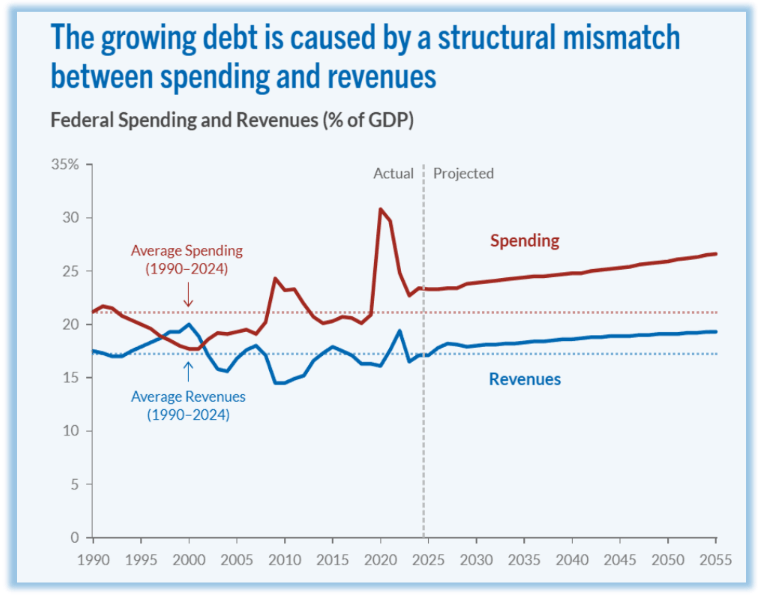
As analyst Greg Weldon put it, there is a structural mismatch between spending and revenues.
CBO Ups Deficit Projection
The CBO doesn’t have any confidence that the current gaggle of politicians in Washington, D.C. is going to address the debt problem. It recently upped its deficit projections by $1.4 trillion over the next 10 years.
The CBO forecasts a $1.9 trillion deficit in fiscal 2026. That would be up slightly from $1.8 trillion in fiscal ’25.
From there, it only gets worse.
By 2036, the CBO projects deficits running $3.1 trillion annually.
Relative to the size of the economy, the deficit will represent around 5.8 percent of GDP. In 10 years, the deficits will grow to an estimated 6.7 percent of GDP. Over the past 50 years, the deficit has averaged 3.8 percent of GDP.
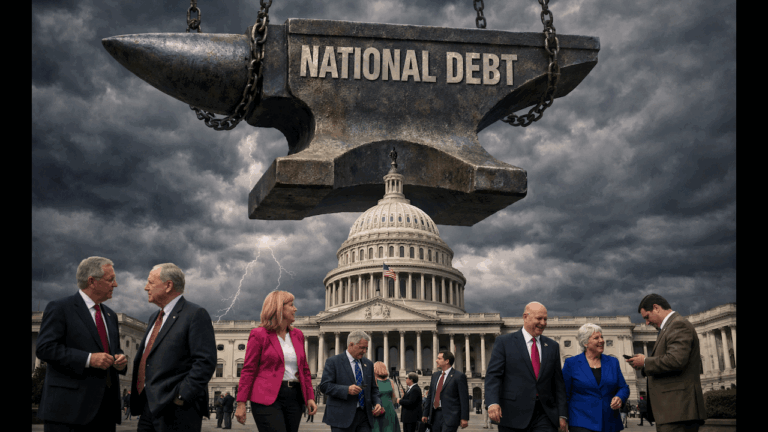
The bottom line is that the Debt Black Hole is getting bigger and more powerful by the day.
Weldon created a chart to help us visualize what is happening. He argues that the pandemic pushed the U.S. past the point of no return.
Why Does It Matter?
In the first place, a large national debt puts a drag on economic growth.
According to the national debt clock, the current debt level represents 124.2 percent of the GDP. Studies have shown that a debt-to-GDP ratio of over 90 percent retards economic growth by about 30 percent.
And then there’s the growing interest expense. Interest on the national debt cost $1.2 trillion in fiscal 2025. That was up 7.3 percent over 2024.
In the last fiscal year, the federal government spent more on interest on the debt than it did on national defense ($917 billion) or Medicare ($997 billion). The only higher spending category is Social Security ($1.58 trillion).
Even more concerning is the fact that at some point, the world will decide it’s no longer interested in financing the U.S. government’s borrowing and spending.
“Confidence in U.S. creditworthiness may be undermined by a rapidly deteriorating fiscal situation, an increasing concern with federal debt set to grow substantially in the coming years.”
If you’re wondering why the Federal Reserve is talking about easing monetary policy despite persistently high inflation, look no further than the debt. The government needs the central bank to keep its thumb on the bond market. That requires it to hold more Treasuries on its balance sheet, thereby creating demand for bonds. This allows the federal government to borrow at a lower interest rate than it otherwise would. This is exactly why the Fed recently relaunched quantitative easing (QE).
People seem unconcerned about the growing debt because people have warned about it for decades, and the promised crisis hasn’t occurred – yet.
But the bottom line is that just because the debt hasn’t caused a crisis doesn’t mean it won’t. After all, things happen slowly and then all at once.
Mike Maharrey is a journalist and market analyst for Money Metals with over a decade of experience in precious metals. He holds a BS in accounting from the University of Kentucky and a BA in journalism from the University of South Florida.
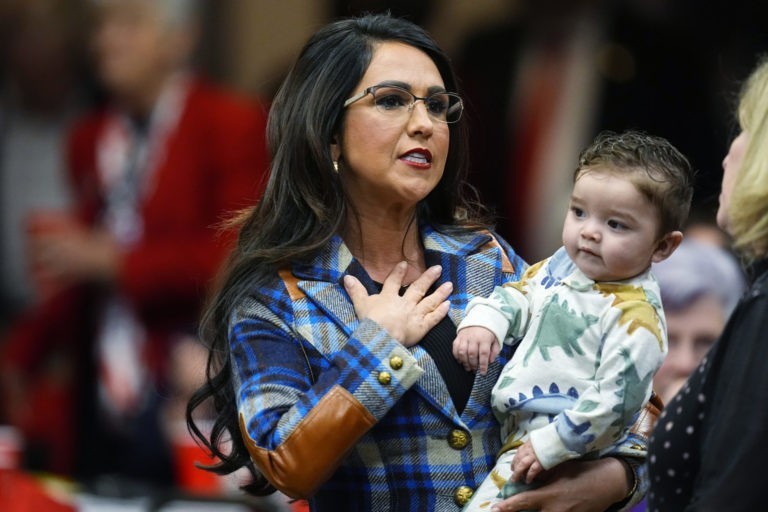
(José Niño,Headline USA) Tyler Boebert, the 20-year-old son of Rep. Lauren Boebert (R-Colo.), received a second child abuse charge after his two-year-old son wandered from the congresswoman’s Windsor home on Sunday, according to a report by The Daily Beast.
The incident follows a similar occurrence last July involving the same child, as Headline USA previously reported.
Authorities cited Tyler Boebert on a “misdemeanor charge of child abuse without injury,” news outlet9NEWS reported Tuesday, citing information from the Windsor Police Department.
The Colorado lawmaker, 39, told 9NEWS there is “no excuse” for what transpired when asked about the incident involving her grandson, adding that she feels “very frustrated this happened.”
“A kind woman quickly and safely secured him, and authorities were called as a precaution,” Boebert stated.
The congresswoman’s Windsor residence sits near a lake, according to the news outlet. Authorities have not released additional details about the incident. The Daily Beast contacted Boebert’s office and the Windsor Police Department for comment.
Tyler Boebert is scheduled to face trial in April, per 9NEWS.
Last summer, the 20-year-old also received a citation for “criminal negligence where no death or injury occurred” after what the congresswoman characterized as “a miscommunication on monitoring my young grandson that recently led to him getting out of our house.”
The representative said at that time it constituted a “one-time incident that we have addressed as a family.” Tyler Boebert received the July 11, 2024 citation for “criminal negligence where no death or injury occurred.”
Tyler has encountered previous legal difficulties. In February 2024, he faced multiple felony charges related to a series of car break-ins and credit card thefts.
“I love my son Tyler, who has been through some very difficult, public challenges for a young man and the subject of attention that he didn’t ask for,” the congresswoman said in a statement to The Denver Post at the time.
“It breaks my heart to see my child struggling and, in this situation, especially when he has been provided multiple opportunities to get his life on track.”
Boebert, who won her first House of Representatives election six years ago, has three other sons with her ex-husband Jayson Boebert including Brody, Kaydon and Roman. The congresswoman announced in May 2023 that they had separated due to “irreconcilable differences.”
José Niño is the deputy editor of Headline USA. Follow him at x.com/JoseAlNino
(Money Metals News Service) In a recent episode of the Money Metals Midweek Memo, host Mike Maharrey opened with a blunt reminder from Thomas Paine that cuts straight to the heart of today’s monetary debate.
“Money is money and paper is paper. All the inventions of man cannot make them otherwise.” -Thomas Paine
Paine’s warning was simple but devastating. Gold and silver come from nature. Paper comes from political design. One is limited by geology. The other is limited only by policy.
Paine argued that real money must derive its value from outside human control. He wrote, “The value of gold and silver is ascertained by the quantity which nature has made in the earth. We cannot make that quantity more or less than it is. And therefore, the value being dependent upon the quantity depends not on man.”
That constraint is the point. Governments cannot manufacture more gold and silver at will. Paper, by contrast, carries none of those limitations.
As Paine put it, “Paper, considered as a material whereof to make money, has none of the requisite qualities in it. It is too plentiful and too easy to come by.”
Maharrey argues that modern markets have repeated the same mistake Paine condemned. Even in gold and silver, investors have created a paper-dominated system. Now, that structure is being tested.
The 356-to-1 Paper Silver Problem
The silver market has long been driven by futures contracts that promise delivery of metal at a future date. The scale of paper claims compared to real metal is staggering.
According to analyst Faysal Amin, cited by FX Street, the paper-to-physical silver ratio sits near 356-to-1 (i.e., 356:1). That means for every ounce of real silver, there are 356 paper ounces claiming exposure.
The system resembles fractional reserve banking. As long as most participants do not demand delivery, the structure holds. If too many holders want physical metal at once, the imbalance becomes visible and destabilizing.
Silver briefly skyrocketed to $120 per ounce in January, then corrected sharply into the $75-$80 range, recently trading around $77. Despite the correction, the core issue remains. There is not enough physical silver to satisfy demand.
The lesson echoes Paine’s critique. Paper claims can multiply indefinitely. The underlying metal cannot.
COMEX Inventories Under Pressure
The stress is becoming measurable.
As of February 11, total registered silver at the COMEX fell below 100 million ounces, landing at 98,138,050 ounces. Registered silver is the metal officially available for delivery against futures contracts.
That threshold is both psychologically and structurally significant.
An additional 4.7 million ounces were withdrawn from the eligible category, which consists of silver stored in vaults but not designated for delivery. This suggests more metal is being repositioned to meet physical claims.
Macro analyst David Morgan, publisher of The Morgan Report, told Kitco News that the drawdown signals strain. In his words, the physical market is taking control over whatever the paper price is.
When delivery demand begins draining vault inventories, the gap between paper representation and physical reality becomes harder to ignore.
Shanghai’s silver benchmark is currently trading at roughly a $10 per-ounce premium to Western spot prices. That premium reflects a shortage. In theory, arbitrage should pull silver from the West to China. The spread has not fully closed.
Morgan noted that logistics and capital controls are creating friction. London inventories have been tight for months, especially after tariff concerns last spring prompted metal transfers to the United States. Then an explosion in Indian demand last fall intensified pressure.
The result was what Maharrey calls the first modern silver squeeze, pushing prices above $50 per ounce for the first time.
In 2025, silver surged 140 percent, including a 70 percent gain in January alone. That was not retail speculation. That was industrial demand.
Industrial users require 1,000-ounce bars, the standard commercial unit tied to futures contracts. When those bars become scarce, the paper market loses some of its dominance.
Industrial Buyers Versus Paper Traders
Shanghai’s market is more industrially oriented than New York or London. When industrial users begin taking delivery of 1,000-ounce bars, the dynamic shifts.
Morgan emphasized that once industrial needs were not met, the physical market began dictating price. This dynamic has appeared sporadically in history. This time, he suggested, it was the real deal.
Even Money Metals shipped pallets of 1,000-ounce silver bars to India, illustrating just how tight the market became. A single pallet of those bars, even before the surge, was worth well over $1 million.
Despite physical strength, futures markets remain powerful. The CME Group recently raised margin requirements, forcing traders to put up more capital. That move flushed out leveraged speculation and contributed to the correction back toward the $75-$80 range.
The struggle now is clear. Paper leverage is colliding with physical scarcity.
Paine’s words apply as much to silver futures as to fiat currency. “Money is money and paper is paper.”
A contract is not the same thing as the metal itself.
A Structural Silver Deficit
Underlying the volatility is a simple structural imbalance.
According to preliminary data from the Silver Institute, silver demand exceeded supply by approximately 95 million ounces last year. That marked the fifth consecutive annual deficit.
Over five years, cumulative deficits have surpassed 800 million ounces, roughly the equivalent of an entire year of global mine output.
The imbalance between physical supply and paper exposure is not theoretical. It is cumulative and growing.
CPI, Inflation, and the Monetary Reality
Maharrey then shifted to inflation, tying the silver story back to Paine’s broader critique of paper money.
The latest CPI report showed headline annual inflation falling to 2.4 percent, nearing the Federal Reserve’s 2 percent target. Mainstream commentary celebrated the result.
Maharrey disagreed.
Even at 2 percent, purchasing power erodes by more than 10 percent every five years. That is not price stability. That is managed debasement.
He argues that CPI is merely a symptom. True inflation is an increase in the money and credit supply.
After peaking in April 2022, the money supply declined during rate hikes and quantitative tightening, bottoming in October 2023. It has since resumed accelerating and now exceeds pandemic peaks.
The Federal Reserve quietly relaunched quantitative easing in December, expanding its balance sheet again and purchasing United States Treasuries with newly created money.
This is precisely the danger Paine described. Paper is too plentiful and too easy to come by.
The Fed faces a catch-22. It needs to cut interest rates and provide liquidity to support a debt-riddled economy. At the same time, higher rates are needed to restrain price inflation. It cannot do both. According to Maharrey, it is choosing inflation.
A 10-Year-Old Gold Investor in China
To close the episode, Maharrey shared a story that illustrates inflation’s real-world impact.
A 10-year-old girl in China began buying gold at age seven using Lunar New Year lucky money. Each year, she received about 4,000 yuan, roughly $580 at current exchange rates.
She purchased gold at approximately 460 yuan per gram. By February, the price had risen to 1,100 yuan per gram, delivering a 139 percent return.
She has accumulated about 30 grams of gold and has not sold, even during January’s correction. She plans to buy more.
Whether or not she understands monetary policy, she understands preservation of value. She intuitively understands what Paine articulated centuries ago. Money is money. Paper is paper.
The Bottom Line
The silver market is locked in a battle between leveraged paper claims and finite physical supply. COMEX inventories have dipped below 100 million ounces. Shanghai trades at a $10 premium. Five consecutive annual deficits have removed more than 800 million ounces from available supply.
That is what a market under structural strain looks like.
A true breaking point would not necessarily arrive with a headline. It would show up as widening premiums, delivery delays, persistent price gaps between East and West, or a failure of paper contracts to settle smoothly into physical metal. It would show up when the futures market can no longer suppress the reality of tight supply.
We are not there yet. But the ingredients are visible.
Paper can be created endlessly.
Metal cannot.
As Paine warned long ago, “Money is money and paper is paper.” When paper promises multiply faster than real metal can be mined, the breaking point becomes a matter of time, not theory.
The Post reported Thursday that Mountbatten-Windsor was arrested on suspicion of misconduct in public office for allegedly forwarding trade documents to convicted sex offender Jeffrey Epstein.
“Six unmarked police cars and around eight plain clothed officers had arrived at Wood Farm on the Sandringham estate in eastern England earlier on Thursday,” the Post reported.
“An unmarked cop car left the property around 30 minutes later. Another police car and a vehicle thought to contain Andrew’s security team also left Sandringham,” the newspaper added. “Trade envoys must keep details about their trips confidential – even when they are no longer in post under the Official Secrets Act.”
He reportedly remains in custody.
Last year, it was reported that Andrew once hosted 40 prostitutes at a hotel in over four days during a taxpayer-funded government trip to Thailand in 2001.
The arrest also comes on the heels of the Oversight Committee releasing records that further implicate Windsor in Epstein’s alleged sex-trafficking scheme. Epstein’s heavily redacted ledger shows that he cut a $200 check in February 2000 for a “massage for Andrew.” Another $200 check was cut in May of that year for the same reason. The rest of the ledger is redacted.
Andrew has been accused of having a sexual relationship with an Epstein-trafficked teen, Virginia Giuffre, who later sued him and reached a settlement.
Andrew reportedly paid Giuffre nearly $14 million in the settlement, which allowed him to admit no wrongdoing. She died in April 2025.
Ken Silva is the editor of Headline USA. Follow him at x.com/jd_cashless.
(Luis Cornelio, Headline USA) Self-described comedian Stephen Colbert and Democrat James Talarico claimed the Trump administration blocked their interview on The Late Show. But CBS News clarified that the network, not the president, chose not to air the episode due to FCC equal-time rules.
Colbert had interviewed Talarico earlier this week, as Talarico runs for the Democratic nomination for U.S. Senate in Texas against Rep. Jasmine Crockett. CBS said that broadcasting the episode on its networks could trigger the FCC rule, which requires equal airtime be offered to other candidates, including Crockett herself.
Despite this, both Colbert and Talarico publicly accused the Trump administration’s Federal Communications Commission of censorship.
“This is the interview Donald Trump didn’t want you to see,” Talarico claimed on X. “His FCC refused to air my interview with Stephen Colbert,” Talarico claimed on X. “Trump is worried we’re about to flip Texas.”
Colbert echoed the claim on Monday, saying that Talarico was supposed to be on the show, but that “we were told in no uncertain terms by our network’s lawyers, who called us directly, that we could not have him on the broadcast.”
Colbert added, “Then, then I was told in some uncertain terms that not only could I not have him on, I could not mention me not having him on. And because my network clearly doesn’t want us to talk about this, let’s talk about this.”
In remarks, CBS clarified that despite Colbert’s claims, the network itself was responsible for the show’s interview not airing on TV. A CBS spokesperson specifically stated:
“THE LATE SHOW was not prohibited by CBS from broadcasting the interview with Rep. James Talarico. The show was provided legal guidance that the broadcast could trigger the FCC equal-time rule for two other candidates, including Rep. Jasmine Crockett, and presented options for how the equal time for other candidates could be fulfilled. THE LATE SHOW decided to present the interview through its YouTube channel with on-air promotion on the broadcast rather than potentially providing the equal-time options.”
Crockett herself said that the Trump administration was not behind CBS’s decision not to air Colbert’s interview of Talarico:
CBS’s move came after President Donald Trump reportedly secured millions in advertising from the network following his lawsuit over a 60 Minutes segment that aired an edited interview of then-Vice President Kamala Harris in 2024.
(Luis Cornelio, Headline USA) Nine federal defendants accused in the July 4 ambush of a North Texas ICE detention facility secured a trial delay after a federal judge declared a mistrial stemming from a defense attorney’s courtroom actions.
U.S. District Judge Mark Pittman abruptly stopped the trial on Wednesday after defense attorney MarQuetta Clayton wore a shirt displaying images of civil rights leaders Martin Luther King Jr. and Shirley Chisholm while interviewing potential jurors, according to KHOU 11.
Pittman said he was “left with no other choice” but to declare a mistrial because political messaging is strictly prohibited in the courtroom, even “if it is something as admirable as civil rights or the D-Day landing.”
In addition to the shirt, Pittman took issue with Clayton’s alleged failure to clear the use of a visual aid depicting activism and protests during jury selection. At one point, he stopped the proceedings, asked jurors to step out of the courtroom and began lecturing Clayton.
The mistrial resets the entire case, delaying potential convictions and forcing the court to restart jury selection. The delay will likely cost taxpayers thousands of dollars.A new jury is set to be selected on Feb. 23.
The DOJ announced the charges on Nov. 14 against the nine defendants, who were alleged Antifa members: Cameron Arnold (also known as Autumn Hill), Zachary Evetts, Benjamin Hanil Song, Savanna Batten, Bradford Morris (also known as Meagan Morris), Maricela Rueda, Elizabeth Soto, Ines Soto and Daniel Rolando Sanchez Estrada.
According to the grand jury indictment, the defendants participated in a coordinated July 4 ambush targeting an ICE detention facility in North Texas. The attack resulted in a police officer being shot.
According to court documents, the Antifa members were shooting fireworks at the facility. When police responded, one member of the group yelled “get to the rifles” and then opened fire, striking an Alvarado Police Department officer in the neck area. He fell to the ground but was able to return a few shots. Prosecutors say more rounds were then fired at the wounded officer and an unarmed DHS correction officer.
Court documents say Gibson, Baumann and Sikes were among those who were present the night of the attack and were arrested shortly after, while Sharp and Thomas were among those who helped the accused shooter avoid arrest until July 15.
Sources told Ravid that the potential US attack on Iran would likely be a massive multi-week operation, much bigger than the US operation to abduct Venezuelan President Nicolas Maduro. They said it would also be much broader in scope than the 12-day US-Israeli war on Iran that was launched in June 2025. Reuters also recently reported that the US was preparing for a sustained, multi-week attack on Iran.
Israeli officials said that the Israeli government, which is pushing for the US to pursue regime change in Iran, is preparing for the possibility of the attack starting in the coming days, while other sources put the timeline a little later, saying the war would likely start in a few weeks.
“The boss is getting fed up,” a Trump adviser told Ravid. “Some people around him warn him against going to war with Iran, but I think there is 90% chance we see kinetic action in the next few weeks.”
The Axios report noted that there has been little public debate about the potential war amid the major US military buildup and said that Americans will likely be surprised by the scale of the coming attack.
All signs indicate that if the US bombs Iran, Tehran will not hold back in its response and could target multiple US bases and warships in the region, leaving open the possibility that the war could result in hundreds or thousands of US casualties. The conflict could also have a major impact on the global economy, as Iran could close the Strait of Hormuz, through which 31% of seaborne crude oil shipments passed in 2025.
The US and Iran held talks on Tuesday, and while the Iranian side said there was a “clear path” toward a deal, US Vice President JD Vance said that Iran was not acknowledging President Trump’s “red lines.”
Vance claimed the main US demand was that Iran must not pursue a nuclear weapon, but for many months, the administration had insisted the June 2025 US strikes on Iran “obliterated” Iran’s nuclear facilities, and there’s no sign Tehran can enrich uranium at the moment. Iran has also made clear it’s willing to enter a deal that would involve a commitment to low enrichment levels, and Iranian officials maintain they don’t seek a nuclear bomb.
The real goal of any US attack on Iran will likely be regime change or taking out Iran’s ability to fire missiles at Israel. President Trump said back in December, when he met with Israeli Prime Minister Benjamin Netanyahu at his Mar-a-lago resort in Florida, that he would support another Israeli attack on Iran if the Islamic Republic “continued” its missile program.
(Kim Jarrett, The Center Square) Republican Steven McNeel won the District 18 Georgia Senate post, staving off a Democrat who took the majority of the votes in the initial contest.
Former Fort Valley City Councilman LeMario Nicholas Brown received 40.58% of the vote in Tuesday’s runoff, more than the nearly 37% he received in Jan. 21, but not enough to overcome the 59.42% McNeel received, according to unofficial results from the Georgia Secretary of State’s office.
Republican votes were split in the January contest among five candidates.
McNeel will be replacing former Sen. John F. Kennedy, who stepped down to concentrate on his run for lieutenant governor.
Senate District 18 includes portions of Bibb and Houston counties and all of Crawford, Monroe, Peach and Upson counties.
Tuesday’s runoff is one in a series of off-season elections prompted by resignations on the state and federal levels.
Eighteen candidates are vying for the U.S. District House 14 seat formerly held by Marjorie Taylor Greene of Rome. The election is March 10 with a runoff scheduled for April 7.
Also on March 10, voters will cast ballots for three General Assembly seats.
Voters in Northwest Georgia will decide who will replace former Republican state Sen. Colton Moore, who is running for Congress. Lanny Thomas, Denise Burns and Blake Elsberry are running as Republicans. John Bentley Zibluk is the sole Democrat on the ballot.
Four Democrats are running to replace Karen Bennett in House District 94. Bennett, a Democrat, resigned after pleading guilty to a charge of making a false statement related to pandemic unemployment fraud. Kelly Kautz, Audrey Lux, Venola Mason and Ikenna Ugwumadu will be on the ballot. The district covers portions of DeKalb and Gwinnett counties.
Four Democrats and two Republicans are hoping to win the House District 130 post formerly held by Augusta Democrat Lynn Heffner, who stepped down to focus on rebuilding her home damaged by Hurricane Helene. Sha’Quanta Calles, Karen Gordon, Sheila Clark Nelson and LaFawn Pinkey-Mealing are running as Democrats and David Carson and Thomas McAdams are the Republican candidates.
(Headline USA) Mark Zuckerberg and opposing lawyers dueled in a Los Angeles courtroom on Wednesday, where the Meta CEO answered questions about young people’s use of Instagram, his congressional testimony and internal advice he’s received about being “authentic” and not “robotic.”
Zuckerberg’s testimony is part of an unprecedented social media trial that questions whether Meta’s platforms deliberately addict and harm children.
Attorneys representing the plaintiff, a now 20-year-old woman identified by the initials KGM, claim her early use of social media addicted her to the technology and exacerbated depression and suicidal thoughts. Meta Platforms and Google’s YouTube are the two remaining defendants in the case, which TikTok and Snap have settled.
Beginning his questioning, the plaintiff’s attorney Mark Lanier laid out three options of what people can do regarding vulnerable people: help them, ignore them, or “prey upon them and use them for our own ends.” Zuckerberg said he agrees the last option is not what a reasonable company should do, saying, “I think a reasonable company should try to help the people that use its services.”
When he was asked about his compensation, Zuckerberg said he has pledged to give “almost all” of his money to charity, focusing on scientific research. Lanier asked him how much money he has pledged to victims impacted by social media, to which Zuckerberg replied, “I disagree with the characterization of your question.”
Lanier also asked Zuckerberg about what he characterized as extensive media training, including for testimonies like the one he was giving in court. Lanier pointed to an internal document about feedback on Zuckerberg’s tone of voice on his own social media, imploring him to come off as “authentic, direct, human, insightful and real,” and instructing him to “not try hard, fake, robotic, corporate or cheesy” in his communication.
Zuckerberg pushed back against the idea that he’s been coached on how to respond to questions or present himself, saying those offering the advice were “just giving feedback.”
Regarding his media appearances and public speaking, Zuckerberg said, “I think I’m actually well known to be sort of bad at this.”
The Meta CEO has long been mocked online for appearing robotic and, when he was younger, nervous when speaking publicly. In 2010, during an interview with renowned tech journalists Kara Swisher and Walt Mossberg, he was sweating so profusely that Swisher asked him if he wanted to “take off the hoodie” that was his uniform at the time.
Lanier spent a considerable stretch of his limited time with Zuckerberg asking about the company’s age verification policies.
“I don’t see why this is so complicated,” Zuckerberg said after a lengthy back-and-forth, reiterating that the company’s policy restricts users under the age of 13 and that they work to detect users who have lied about their ages to bypass restrictions.
Zuckerberg mostly stuck to his talking points, referencing his goal of building a platform that is valuable to users and, on multiple occasions, saying he disagreed with Lanier’s “characterization” of his questions or of Zuckerberg’s own comments.
Zuckerberg has testified in other trials and answered questions from Congress about youth safety on Meta’s platforms, and he apologized to families at that hearing whose lives had been upended by tragedies they believed were because of social media. This trial, though, marks the first time Zuckerberg will answer similar questions in front of a jury. and, again, bereaved parents are expected to be in the limited courtroom seats available to the public.
The case, along with two others, has been selected as a bellwether trial, meaning its outcome could impact how thousands of similar lawsuits against social media companies are likely to play out.
A Meta spokesperson said the company strongly disagrees with the allegations in the lawsuit and said they are “confident the evidence will show our longstanding commitment to supporting young people.”
One of Meta’s attorneys, Paul Schmidt, said in his opening statement that the company is not disputing that KGM experienced mental health struggles, but rather disputing that Instagram played a substantial factor in those struggles. He pointed to medical records that showed a turbulent home life, and both he and an attorney representing YouTube argue she turned to their platforms as a coping mechanism or a means of escaping her mental health struggles.
Zuckerberg’s testimony comes a week after that of Adam Mosseri, the head of Meta’s Instagram, who said in the courtroom that he disagrees with the idea that people can be clinically addicted to social media platforms. Mosseri maintained that Instagram works hard to protect young people using the service, and said it’s “not good for the company, over the long run, to make decisions that profit for us but are poor for people’s well-being.”
Much of Mosseri’s questioning from the plaintiff’s lawyer, Mark Lanier, centered on cosmetic filters on Instagram that changed people’s appearance — a topic that Lanier is sure to revisit with Zuckerberg. He is also expected to face questions about Instagram’s algorithm, the infinite nature of Meta’s feeds and other features the plaintiffs argue are designed to get users hooked.
Meta is also facing a separate trial in New Mexico that began last week.