‘Old Crow’ McConnell Endorses Trump for President

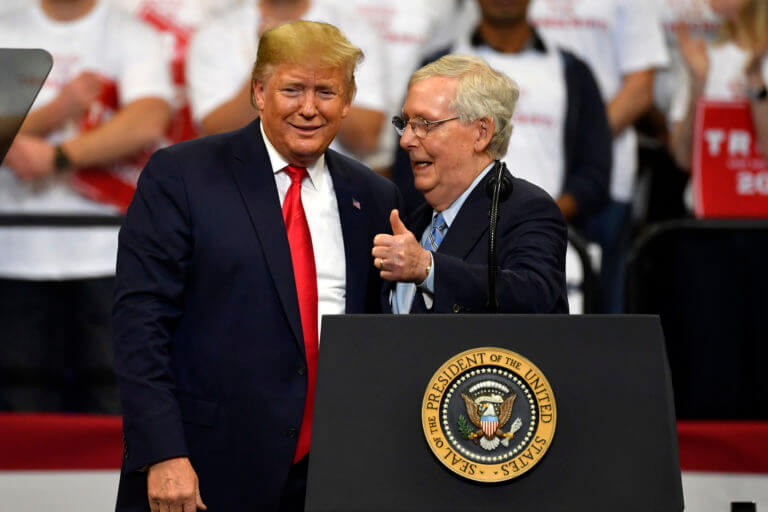
(Headline USA) Senate Republican leader Mitch McConnell, R-Ky., endorsed Donald Trump for president on Wednesday—a remarkable turnaround from the onetime critic who blamed the then-president for “disgraceful” acts in the Jan. 6, 2021, uprising but now supports his bid to return to the White House.

McConnell, who was the last top GOP leader in Congress to fall in line with Trump, declared his support in a short statement after Super Tuesday wins pushed the GOP front-runner closer to the party nomination.

McConnell, 82, one of the most unpopular figures on Capitol Hill given his deep divisiveness among both Democrats and pro-Trump Republicans, recently indicated that he would step down from his leadership role in the next congressional term, making his support for Trump somewhat superfluous.

Nonetheless, it marks another symbolic triumph for the MAGA leader over a powerful D.C. Establishment that has fought tooth-and-nail to destroy him—and another welcome step toward party unity given McConnell’s control over a wealth of GOP resources.

The nod from McConnell lends an imprimatur of institutional legitimacy to the indicted former president’s bid to return to the White House.

McConnell said he and Trump “worked together to accomplish great things for the American people.”

He noted in particular policies that “supercharged our economy and a generational change of our federal judiciary—most importantly, the Supreme Court.”

The two men have not spoken since 2020 when McConnell declared Democrat Joe Biden the winner of that year’s presidential election. But more recently, their teams had reopened talks about an endorsement.

“It is abundantly clear that former President Trump has earned the requisite support of Republican voters to be our nominee for President of the United States,” McConnell said in the statement.

McConnell said, “It should come as no surprise that as nominee, he will have my support.”

Trump now counts the GOP leaders in Congress, including Speaker Mike Johnson, R-La., and Senate Republicans vying to replace McConnell as leader, as backing his bid for the White House.

Another Republican in leadership, Sen. Joni Ernst of Iowa, announced her support for Trump on Wednesday after the last major GOP challenger Nikki Haley suspended her campaign.

While McConnell said early in the election cycle he would support the eventual Republican presidential nominee, his endorsement of Trump is a striking reunion for the two men, who have put political interests ahead of any personal displeasure with one another.

Trump routinely bashed McConnell as an “Old Crow” in public, and Trump hurled insults at the senator’s wife, Elaine Chao.

Chao, who served as Trump’s Transportation secretary, stepped down in the aftermath of the Jan. 6 protest—which McConnell labeled an “insurrection.”

While McConnell refused to convict Trump in the Senate trial on House impeachment charges of inciting the insurrection at the Capitol, which could have left him ineligible to serve again as president, he warned that Trump was not immune from civil or criminal prosecution once he left the White House.

“He didn’t get away with anything yet — yet,” McConnell said in the Senate at the time.

“We have a criminal justice system in this country. We have civil litigation, and former presidents are not immune from being accountable by either one,” he said.

With McConnell’s endorsement of Trump, it gives the green light to other remaining skeptical Republicans—and the deep-pocketed donors who fuel campaigns—to fall in line.

Voters have roundly dismissed not only the two failed impeachment attempts against Trump, but also the four criminal cases and multiple other lawfare attacks that are designed to weaponized the justice system as an obstruction to the political process.

Despite having charged Trump with 91 felony counts, several of the cases pushed by far-left prosecutors seem ready to implode, giving even more momentum to the righteous indignation that has fueled Trump’s improbable winning streak.

Despite his concerns about Trump’s behavior in the White House, McConnell appears ready to set aside those issues in favor of the outcomes he said the former president was able to accomplish during his term.

McConnell said he looks forward to “switching from playing defense against the terrible policies the Biden administration has pursued” to going on offense on policies that he believes will make a difference.

Adapted from reporting by the Associated Press

Shock Poll: Majority of N.Y. Jews Intend to Vote for Trump

(Jacob Bruns, Headline USA) Jews in New York—a traditionally left-leaning demographic in a left-leaning state—may largely intend to vote for former President Donald Trump over the incumbent, Joe Biden, the Jewish News Syndicate reported.

New York Jews, according to a recent Sienna College poll, favor Trump to Biden by a 53% to 44% margin.

“Jewish voters moving towards the GOP is a clear trend, long in the making,” tweeted Sam Markstein, national political director at the Republican Jewish Coalition.

Markstein noted that while Republican gubernatorial candidate Lee Zeldin, who is Jewish, failed to notch a win over incumbent New York Gov. Kathy Hochul in 2022, he came the closest of any Republican since Gov. George Pataki left office in 2006.

Helping to drive Zeldin’s turnout was his 46% support within the Jewish community.

Oddly enough, the same trend does not hold when it comes to congressional voting. The poll suggested that Jews in the state still intended to back Democrats over Republicans for congressional seats by a 54% to 39% margin.

The discrepancy suggested that Biden has failed in key areas that Jews in the state care most about, with his indifference toward Israel potentially being one area of contention.

The war between the Jewish state and Hamas terrorists in Gaza has been a political quagmire for American leftists who had counted on both Jews and Muslims to vote Democrat as part of their identity-politics election strategy.

However, both groups see Biden’s attempt to straddle the middle by supporting both Israel and Hamas as a tepid and noncommittal response.

In Muslim-heavy areas of Michigan and Minnesota, voters notably have cast their recent primary ballots as “uncommitted” in protest.

Jews have more reason to embrace Trump’s presidency, given his past track record for supporting Israel in his first term. That included moving the U.S. embassy to its official capital of Jerusalem and brokering a series of peace agreements, the Abraham Accords, with several Arab neighbors.

Still, some critics cast doubts on the Sienna poll’s conclusions, noting that the survey of 806 registered New York voters included only 65 Jewish participants.

When segmenting out that portion, the small sample size made the findings too unreliable to be deems statistically significant, argued Mark Mellman, president of Democratic Majority for Israel.

“[T]he margin of error for Jews in the Sienna poll is plus or minus 13 points on each number,” Mellman said, noting that major swings were possible.

Ultimately, he concluded, “this poll tells us very little about how New York Jews will vote.”

Nonetheless, seeing Jewish support max out at 57% would still be a marked decline for Biden, who secured 77% of the U.S. Jewish vote in 2020.

Whether the shift is enough to put New York into play remains to be seen. However, Trump hinted that he thought it was in an interview with Fox News host Maria Bartiromo following his victory in the New Hampshire primary.

“I think we’re gonna give New York a heavy shot,” said Trump, who signaled the possibility of holding a rally at Madison Square Gardens.

“They’re very unhappy in New York, what’s happening, and they’re unhappy with the crime,” he continued. “You take a look at the crime in New York; it’s at record levels.”

The Biden administration’s open-border policies and the soft-on-crime stances of George Soros-backed prosecutor Alvin Bragg have wreaked havoc in particular on New York City.

Things came to a head in New York City last fall when Mayor Eric Adams and the city’s infrastructure were overwhelmed by the mass influx of migrants.

Headline USA’s Ben Sellers contributed to this report. 

Oregon Re-Criminalizes Drugs after Failed Experiment Yields 1,500% Spike in ODs

(Headline USA) Oregon lawmakers voted overwhelmingly this week to reverse their decriminalization of drugs as fatal overdose numbers continued to increase in the state.

Along with other outlandish experiments in social justice, such as defunding police, the Democrat-controlled state passed the law decriminalizing possession of all drugs during the 2020 election, in an effort ostensibly, to keep drug users out of prison and send them to rehab.

But lawmakers have now acknowledged that if users had no desire to stop the drug use and if there were no punishment for it, then they would continue to use them at unprecedented rates.

“What we have tried to do is give law enforcement tools they need to intervene in the moment and hand [addicted people] off to the behavioral health mental world,” Democratic state Rep. Jason Kropfl told the Wall Street Journal. “The overarching goal is how do you sometimes give a little bit of a push to treatment.” 

As a result of the policy, Oregon has seen a 1,500% rise in overdose deaths—the largest increase in the country.

The bill revising the decriminalization law would now make small possession of drugs such as fentanyl, heroin, and cocaine illegal. It passed both state houses on Friday and was awaiting signature from Democratic Gov. Tina Kotek. 

Kotek has not confirmed whether she plans to sign the bill since it passed, but has signaled an openness to it.

“If it’s a bill that I think will have the outcomes we need, I’m committed to making sure we can move forward,” Kotek told reporters in January.

“The issue of addiction and the need for pathways to recovery should not be a political football,” she added, despite the fact that responsibility for the fiasco rests squarely on the shoulders of the Democrats in power. “We should understand any changes that we’re making.”

Some on the Left, however, have derided the bill as a step backward, claiming it will disproportionately affect minorities.

“The disproportionate impact on my community is ultimately too concerning for me to support the bill,” said state Rep. Andrea Valderrama, who is Peruvian-American and was one of the only lawmakers to vote against the bill.

Hillary Clinton Says Voters Need to Accept That Biden Is Old, Vote For Him Anyway

(Headline USA) Hillary Clinton said this week that voters need to “accept the reality” that President Joe Biden is old and move on, Fox News reported.

Clinton made the comment during an interview for the “Mornings with Zerlina” radio show prior to the Super Tuesday primaries, where Biden swept all but one of the contested races, losing American Samoa to political neophyte Jason Palmer. 

The failed 2016 candidate admitted Biden’s age, 81, was a point of concern among many Americans, but she insisted they should focus on protecting democracy instead.

“Somebody the other day said to me … ‘Well, but, you know, Joe Biden’s old,'” Clinton claimed.

“I said, ‘You know what, Joe Biden is old. Let’s go ahead and accept the reality. Joe Biden is old,'” she continued. “So we have a contest between one candidate who’s old, but who’s done an effective job and doesn’t threaten our democracy. And we have another candidate who is old, barely makes sense when he talks, is dangerous, and threatens our democracy.” 

Other Biden surrogates have conveyed similar talking points, attempting to downplay concerns over Biden’s serious decline in both physical and cognitive abilities by projecting a false equivalence with 77-year-old Donald Trump.

Of the “two old” candidates, Clinton clamed Biden was still the better choice because “no matter where you stand on the political spectrum, you want to maintain freedom, and the rule of law, and protection for people’s fundamental rights—or at least I used to think so.”

Clinton also dismissed questions about whether Biden’s old age had implications for his mental acuity, instead claiming Trump was the one with memory issues.

“If you are worried about that, listen to Donald Trump, who is like ranting, making no sense, can’t even remember who he is running against,” she claimed.

“He constantly talks about Barack Obama being his opponent. Last I checked, that wasn’t what was happening,” she said. “So, if you’re worried about a person not necessarily knowing what’s going on, I’d worry a lot more about Donald Trump.”

Trump has suggested in many of his hourslong rallies that former President Barack Obama was actually operating a shadow government while his corrupt former vice president ruled in absentia.

When asked whether the concerns about Biden’s age were, in part, tied to concerns about Vice President Kamala Harris and whether she’d be able to step in and do the job, Clinton cried sexism.

“It’s a challenge for a number of Americans to think of a woman as being president, and then, if the woman is also a woman of color and the daughter of immigrants, you know, that might make it even more of a challenge,” she said.

As Trump Rises, Embattled Powell May Use Rate Cuts to Boost Biden

(Headline USA) With former President Donald Trump having already announced last month that he would not keep Jerome Powell as Federal Reserve chairman, Tuesday’s GOP primary blowout may have given Powell all the evidence he needed that it wasn’t the right time to cut interest rates and jumpstart the economy—just yet.

That will likely be better suited as a late-summer/October surprise, but much still depends on how President Joe Biden holds up in the meantime, and ensuring that the swamp-friendly central bank manipulating the country’s economic conditions doesn’t waste what could be a major ace-in-the-hole on an already doomed Democratic candidacy if Biden is to be replaced after the August convention.

Reminding all of the political impact that his decision is bound to have, Powell reinforced his belief Wednesday that the Federal Reserve would cut its key interest rate this year but said it first wants to see more evidence that inflation is falling sustainably back to the Fed’s 2% target.

That depends largely on whether the Fed continues to flood new “money” into the system— and whether the Biden government continues to spend it with reckless abandon on top priorities such as Ukraine, illegal immigrants, student-loan amnesty and prosecutions of their political enemies, adding a trillion more dollars in federal debt every three months.

Powell’s comments to a House committee largely echoed those he made at a news conference Jan. 31. Since then, government reports have shown that inflation picked up from December to January, and that the process of further slowing inflation would likely be uneven from month to month.

Powell noted that according to the Fed’s preferred gauge, inflation “has eased notably over the past year” even though it remains above the central bank’s target. Nonetheless, that decline follows near-unprecedented spikes in the first years of the Biden presidency, unseen since the end of the Jimmy Carter administration.

Many Americans are continuing to reel from the astronomical cost-of-living increases, with growing concerns that a buildup of debt could eventually cause a bubble to burst and reveal the true impacts of a recessionary economy. Much of the purported economic growth, meanwhile, has benefited noncitizens, according to recent data released by the Center for Immigration Studies.

On the first of his two days of semi-annual testimony to Congress, Powell nebulously suggested that the Fed faced two risks: cutting rates too soon—which could “result in a reversal of progress” in reducing inflation—or cutting them “too late or too little,” which could weaken the economy and hiring.

The effort to balance those two risks marked a shift from early last year, when the Fed was still rapidly raising its benchmark rate to combat high inflation.

The financial markets are consumed with divining the timing of the Fed’s first cut to its benchmark rate, which stands at a 23-year high of about 5.4%. A rate reduction would likely lead, over time, to lower rates for mortgages, auto loans, credit cards and many business loans.

Most analysts and investors expect a first rate cut in June, though May remains possible. Fed officials, after their meeting in December, projected that they would cut rates three times this year.

In his remarks Wednesday, Powell offered no hints on the potential timing of rate cuts. Wall Street traders put the likelihood of a rate cut in June at 69%, according to futures prices, up slightly from about 64% a week ago.

Overall inflation has steadily cooled, having measured at just 2.4% in January compared with a year earlier, according to the Fed’s preferred gauge. It is down from a peak of 7.1% in 2022, although other gauges put it closer to double digits.

Yet recent economic data have complicated the picture and clouded the outlook for rate cuts.

Under questioning at the hearing about what more evidence the Fed needed to feel confident that inflation is coming under control, Powell said the policymakers want to see further data similar to what was reported in the second half of last year. Over the past six months, prices have risen at a 2.5% annual rate, not far above the Fed’s target.

“We don’t want to have a situation where where it turns out that the six months of good inflation data we had last year didn’t turn out to be an accurate signal of where underlying inflation is,” he said.

The Fed chair added that with the economy healthy and unemployment low, “we think we can and should be careful” in deciding when to cut the central bank’s benchmark rate.

On a separate topic, Powell replied to a question at the hearing by saying the Fed will alter a central bank proposal that would toughen bank regulation by requiring the 32 largest banks to hold additional capital—assets similar to cash—against potential lending losses.

The biggest banks have criticized the proposal, released last summer, arguing that it would force the banks to reduce lending and slow the economy as a result.

“I do expect there will be broad and material changes to the proposal,” Powell said. “I’m confident that the final product will be one that does have broad support both at the Fed and in the broader world,” he added, acknowledging that some Fed officials opposed the proposal when it was first released.

Just before the hearing, Republicans on the committee denounced the proposed rule and urged the Fed to withdraw it. Powell said the central bank would consider withdrawing it and re-issuing an amended version.

Powell also underscored that the Fed’s policymakers believed they were done raising rates, which are likely high enough to restrain the economy and inflation.

“There’s no reason to think the U.S. economy is in some kind of short-term risk of falling into recession,” Powell said.

He stressed that the Fed’s rapid rate hikes in 2022 and 2023 haven’t led to higher unemployment. However, figures showed that the growth was focused on only three sectors: healthcare, hospitality and government.

The healthcare industry—which includes hospital and ambulance workers—was continuing to recover from major attrition during the pandemic.

Hospitality—or restaurant work—likely was benefiting many illegal immigrants and those seeking second jobs to supplement their income.

The growth in government employment was doing little to actually improve the economy since it was taxpayers who were subsidizing it.

The Fed chair’s testimony to the House Financial Services Committee coincided with intensified efforts by the Biden administration to gaslight the public about the current state of the economy and the president’s handling of it.

Deflecting from the role of wasteful government spending, Biden recently attacked “shrinkflation,” whereby a company shrinks the contents of a product rather than raise its price.

The president has also sought to blame “junk fees,” which, in effect, raise the prices that consumers pay for certain services. However, many of these are tied in with the cost of excess government regulation, such as the Transportation Department’s threat to impose draconian fines on airlines that damage wheelchairs. Such costs undoubtedly will be passed on to consumers, already facing sticker-shock over the surges in air-travel expenses.

Adapted from reporting by the Associated Press

Bitcoin Briefly Hits All-Time High, Less than 2 Yrs after FTX Scandal

(Headline USA) Bitcoin has hit an all-time high less than two years after the collapse of the crypto exchange FTX severely damaged faith in digital currencies and sent prices plunging.

The world’s largest cryptocurrency jumped 4% this week and briefly surpassed $68,800 Tuesday, according to CoinMarketCap. That’s just above bitcoin’s previous record set in November 2021.

The volatile asset soon fell some, standing at just under $62,000 as of 3 p.m. ET, but the price is still up more than 175% from one year ago.

Gains in recent months have likely been fueled by the anticipation of another Trump presidency, which would favor greater economic freedom where the Biden administration has demanded more government oversight and regulation, including the threat of its own central bank digital currency to undermine and supplant the crypto market.

On the other hand, the eventual U.S. approval of bitcoin exchange traded funds promised to provide access to a much broader class of investors.

The price for bitcoin has surged about 60% since the approval of bitcoin ETFs in January, an easy way to invest in assets or a group of assets—like gold, junk bonds or bitcoins—without having to directly buy the assets themselves.

Also driving prices is what is known as bitcoin “halving” which is anticipated in April. Halvings trim the rate at which new coins are mined and created, thus lowering the supply.

EARLY SUCCESS OF BITCOIN SPOT ETFS

In January, the U.S. Securities and Exchange Commission approved the first spot bitcoin ETFs from asset managers including Blackrock, Invesco and Fidelity. These newly approved ETFs hold actual bitcoin—unlike previous bitcoin-related ETFs that were invested in contracts related to future price bets, but not on the cryptocurrency itself.

While regulators have pointed to persisting risks and maintained reluctance around January’s decision, the greenlight marked a major win the crypto industry.

Institutional demand for bitcoin showed “no signs of slowing down,” H.C. Wainwright’s Mike Colonnese and Dylan Scales wrote Tuesday—adding that bitcoin’s popularity “is likely to accelerate in the coming months as more wealth management platforms make spot [bitcoin] ETFs accessible to their clients.”

Using data from crypto platform BitMEX, Colonnese and Scales estimated that the 10 bitcoin ETFs averaged $302 million in net daily inflows for the month of February. Last week alone, these spot ETFs booked record inflows of $1.7 billion—bringing total net inflows to $7.5 billion since their Jan. 11 launch.

HALVING ON THE HORIZON

Increased demand is also aligning with bitcoin’s next halving event, which is expected at the end of April.

Bitcoin halving, which occurs every four years, is when the reward for bitcoin mining is cut in half. This reduces how fast new coins are created—making supply scarcer.

While analysts say that constrained supply in a time of high demand can push bitcoin’s price higher over time, others point to significant volatility that has resulted before and after halving events — and the possibility of sizable declines.

“Past history may not be a reliable guide to predict how the upcoming halving of bitcoin will influence its value,” Rajeev Bamra, senior vice president of digital finance at Moody’s Investors Service, noted. “Various external factors, market sentiment shifts, and regulatory developments can influence the trajectory of Bitcoin’s price.”

A HISTORY OF VOLATILITY

Bitcoin has a history of drastic swings in value—which can come suddenly and happen over the weekend or overnight in trading that continues at all hours, every day.

Bitcoin rocketed from just over $5,000 at the start of the pandemic to its November 2021 peak of nearly $69,000, in a period marked by a surge in demand for technology products.

Prices crashed during an aggressive series of Federal Reserve rate hikes intended to cool inflation, slow money flows and make risky investments potentially riskier.

Then came the 2022 collapse of FTX, which significantly undermined confidence in crypto.

At the start of last year, a single bitcoin could be had for less than $17,000. Investors, however, began returning in large numbers as inflation started to cool.

And 2023’s collapse of prominent tech-focused banks actually led more investors to turn to crypto as they bailed out of positions in Silicon Valley start-ups and other risky bets.

Despite the recent excitement around bitcoin, experts still maintain that crypto is a risky bet with wildly unpredictable fluctuations in value. In short, investors can lose money as quickly as they make it.

“It’s essential to exercise caution and acknowledge that the road ahead for the digital finance ecosystem, particularly the crypto markets, is expected to navigate through a period marked by volatility,” Bamra noted — pointing the importance of “cautious optimism.”

Adapted from reporting by the Associated Press

Dems’ Plan B?: Biden Defeated in Huge Primary Upset by Dark-Horse Jason Palmer

(Headline USA) Despite having no serious competition, President Joe Biden faced a brutal and humiliating primary loss on Tuesday in the U.S. territory of American Samoa.

He fell short there to a previously unknown candidate named Jason Palmer. Out of 91 ballots cast in the territory’s caucus, Palmer won 51 and Biden won 40, according to the local party.

“I found out that I had won because my phone started blowing up with friends and campaign staffers texting me,” Palmer said in an interview late Tuesday.

Palmer, 52, said he never visited the territory before the caucus.

“I have been campaigning remotely, doing Zoom town halls, talking to people, listening to them about their concerns and what matters to them,” he said.

Only six delegates were at stake in the U.S. territory, a tiny collection of islands in the South Pacific with fewer than 50,000 residents. Palmer and Biden each earned three delegates from the race.

Nonetheless, the win immediately elevates Palmer into status as the Democrats’ best hope of winning the 2024 election with few having faith that the 81-year-old Biden has the cognitive capacity for another term in office.

Vice President Kamala Harris’s abysmal approval ratings likewise suggest that she is not a viable alternative.

On Tuesday, former first lady Michelle Obama, whom many assumed Democrats would use to pull a last-minute bait-and-switch during or after the August convention, publicly stated through her office that she would not be running.

The strategy behind Palmer’s stunning political upset was deceptively simple: Just show up.

The day before the caucus, Palmer tweeted that “Washington D.C. is long overdue for a president who will be an advocate for American Samoa.”

His account includes pictures of young people holding homemade campaign signs.

Palmer is a Baltimore resident who has worked for various businesses and nonprofits, often on issues involving technology and education.

That reportedly includes the Bill and Melinda Gates Foundation, perhaps raising questions for some as to whether his candidacy could be a globalist psy-op.

He said voters want “someone who is more of the 21st century than Joe Biden” to serve as president.

According to campaign finance records, Palmer has loaned his campaign more than $500,000 of his own money.

“You can’t take the money with you when you die,” he said. “But you can change the world while you’re here.”

Residents of U.S. territories vote in primaries but do not have representation in the Electoral College.

American Samoa has been the site of quixotic victories before. During the 2020 Democratic primaries, billionaire Michael Bloomberg’s only win came in the territory.

Adapted from reporting by the Associated Press
MAHARREY: Is the U.S. Playing With Fire Using the Dollar as a Foreign Policy Weapon?

(Mike Maharrey, Money Metals News Service) The United States has weaponized the dollar, leveraging it to achieve foreign policy objectives. But is the U.S. playing with fire? Is it setting itself up for significant blowback?

In this episode of the Money Metals’ Midweek Memo, host Mike Maharrey explains how the U.S. has turned the dollar into a weapon and the risk it takes by using its privilege as the issuer of the reserve currency to bend other countries to its will.

Mike Maharrey opens the episode by asking the listener to imagine a gun with the barrel pointing back at the shooter. He argues that this illustrates the inherent danger the U.S. faces by using the dollar as a foreign policy weapon.

Mike then pivots to describe the recent bull run in gold and silver.  What is driving precious metals higher? Mike says there are many factors, but for one thing, gold is climbing a wall of hope – hope that interest rate cuts are coming sooner rather than later. He explains that two data releases last week seemed to indicate that price inflation was cooling, renewing hope that the Federal Reserve can proceed with loosening monetary policy.

“The gold and silver rallies on Friday followed a pattern we’ve seen over the last couple of years. Any indication that price inflation is cooling, or the economy is weakening, has been bullish for gold and silver. The hope is a victory over inflation will allow the Fed to cut interest rates. Since gold is a non-yielding asset, most people consider a higher interest rate environment negative for gold.

“Now, I hate to throw cold water on the party, but the mainstream seems to be totally ignoring the reality of price inflation. Despite the PCE, price inflation is far from beaten. The CPI trend has been hotter; and more significantly, the Fed hasn’t done enough to put inflation in its grave.”

While the mainstream is focused on the inflation issue, Mike argues that there could be another factor driving gold and silver higher.

Fear.

With the U.S. threatening to seize Russian assets and give them to Ukraine, other countries may be worried about holding dollars. He quotes a post on X by economist Jim Rickards who supports this theory.

“Nice rally in gold. New all-time highs. There are always multiple factors but I have no doubt a main driver is Biden’s push to steal $300 billion in Treasury notes from Russia. Once Treasuries are unsafe, Euro and Yen notes don’t look any better. Countries are going for gold.”

Mike describes some of the past actions taken by the U.S. and its allies against the Russians, and he points out that using economic warfare is nothing new. He also explains why the U.S. has so much power due to the dollar’s status as the global reserve currency. He then focuses on the most recent threat articulated by Treasury Secretary Janet Yellen – the seizure of Russian assets – calling it “one heck of a precedent.”

Mike quotes Sen. Jim Risch (R-Idaho), who called the Repo Act (the legislation that would authorize the asset seizure) “a big hammer.”

“This is intended to be a big hammer. It’s intended to be a very new way of attacking a country that does not behave itself.”

Mike concedes that using dollars as a foreign policy billy club could certainly incentivize other countries to “behave.”

“But you’d have to be nuts not to realize there might be some backlash.”

And as Mike points out, there already is.

“If you were holding something that could be used against you, what would you do?

“You’d get rid of it to minimize the risk. After all, something you don’t have can’t be used against you.

 “In other words, if you are concerned that the U.S. could pull the ‘dollar rug’ out from under you, why not pull out from the dollar system first?

“This is already happening.

“And if enough countries diversify away from the dollar, it could ultimately undermine the greenback’s role as the world reserve currency.”

Mike argues that the best alternative to the dollar is gold. Many countries apparently agree, judging by the fact that central bank gold buying has been at record levels for the last two years.

But why should we care?

Mike argues that de-dollarization would be a disaster for the United States.

“The dollar’s status as the reserve currency indirectly supports the U.S. government’s ability to borrow and spend. Demand for dollars props up the greenback’s value and somewhat shields Americans from the impact of its inflationary monetary policy.

“A de-dollarization of the world economy would cause the value of the U.S. currency to crash and likely spark a currency crisis. This would further erode the purchasing power of the dollar and drive prices even higher. It could even lead to hyperinflation.”

Mike wraps up the show by explaining that individuals should also consider the threat to the dollar. 

“We can debate the efficacy of economic sanctions, but it’s always wise to be careful when you start pointing fingers, or guns, you should be aware of what’s pointing back.

“Now, all of this has some application to you, dear listener. Should you maybe consider minimizing your own exposure to dollars? Or at least diversifying your wealth?”


Mike Maharrey is a journalist and market analyst for MoneyMetals.com with over a decade of experience in precious metals. He holds a BS in accounting from the University of Kentucky and a BA in journalism from the University of South Florida.

Fed Admits It Was Wrong – Kind Of

(Thomas L. Hogan, Money Metals News Service) During the pandemic recovery, inflation reached the highest rates in 40 years, largely driven by the Federal Reserve’s excessive monetary policy. The Fed got “behind the curve” by not raising its interest rate target fast enough, even once it became apparent its own policy was to blame.

While some officials are reluctant to accept it, Fed Chair Jerome Powell now acknowledges the Fed’s mistakes. When asked in a recent interview whether the Fed was too slow to recognize inflation in 2021, Chair Powell admitted, “In hindsight, it would’ve been better to have tightened policy earlier.”

In truth, the Fed was not simply too slow to recognize inflation. Rather, it worsened inflation by continuing its monetary expansion even after the negative effects were known.

Transitory Inflation?

From the early pandemic recovery through mid-2021, inflation appeared to be largely caused by supply-chain disruptions, which led to shortages of production inputs like lumber and automotive computer chips. These problems restricted supply and drove up the prices of homes and cars, respectively.

According to Powell, such dislocations led the Fed to misidentify inflation as primarily a supply-side phenomenon. “We saw what we thought was that this inflation, seemed to be mostly limited to the goods sector and to the supply chain story,” he said.

If that alone were the issue, inflation would have been only a “transitory” problem that dissipated as the economy recovered and supply problems alleviated. As Powell describes, “We thought that inflation would go away fairly quickly without an intervention by us.”

A Rise in the Fall

By the fall of 2021, prices were rising across the economy, not just in supply-constrained sectors. Such broad-based increases seemed to have been caused by excessive monetary policy rather than by supply-side disruptions.

Powell acknowledges this in his recent remarks, noting that “in the fourth quarter of ‘21, it became clear that inflation was not transitory in the sense that I mentioned.”

While the admission is heartening, the Federal Open Market Committee (FOMC) should have realized even before the fourth quarter that rising inflation was increasingly demand-driven.

Powell then adds, “And we pivoted and started tightening.” But did they?

It is true that Powell changed his language, saying at the FOMC’s November press conference that Fed officials “accept responsibility and accountability for inflation in the medium term,” and that, “the level of inflation we have right now is not at all consistent with price stability.”

Despite these admissions, however, the Fed was still actively expanding the money supply at that time and did not actually start tightening for another four months.

Although the Fed slowed the rate of its open market purchases in December of 2021, it continued its expansionary quantitative easing (QE) program until mid-March of 2022. The FOMC raised its interest rate target range slightly in March but did not make substantial increases until May, six months after acknowledging its responsibility for high inflation.

In fact, the Fed engaged in a passive monetary expansion through May of 2022 since real interest rates were actually falling. What matters for economic activity is the real interest rate, that is the short-term interest rate minus the rate of inflation. Since inflation was increasing by more than the Fed’s target rate from late 2021 through mid-2022, real interest rates were falling.

So rather than starting to tighten policy in the fourth quarter of ‘21, as Powell described, the Fed was implicitly loosening policy through May of ‘22.

Lessons Not Learned

Powell credits the Fed’s actions for bringing inflation back down towards the Fed’s two percent target. “It’s essential that we did that,” he said in his recent interview. “It was critical that we did that. And that’s part of the story why inflation’s going down now.”

While it is true that the Fed’s actions helped bring inflation down, it is hard to give Fed officials too much credit: they solved a problem they created. Had the Fed started tightening in late 2021, as Powell claims, it could have prevented inflation from surging. Instead, officials pushed it to the highest rates in 40 years.

While it is notable that Powell admits the Fed was too slow in identifying monetary policy as a cause of inflation, we should recognize that the Fed failed to act for several months after this problem was known. We can hope that acknowledging this mistake will improve Fed policy by helping prevent such errors in the future.


Thomas L. Hogan, Ph.D., is senior research faculty at American Institute for Economic Research. He was formerly the chief economist for the U.S. Senate Committee on Banking, Housing and Urban Affairs. His work regularly appears on MoneyMetals.com.

Hunter Biden’s Psychiatrist Talks about DEA Raiding Him, Confiscating ‘Laptop from Hell’

(Ken Silva, Headline USA) Dr. Keith Ablow, who once was Hunter Biden’s psychiatrist, broke his silence on the matter Tuesday in an interview with conservative broadcaster Tucker Carlson.

Among other topics, Ablow recounted a now-mostly forgotten incident where the Drug Enforcement Administration raided his office in February 2020. During that raid, the DEA confiscated Hunter’s laptop, he said.

“I can’t say why these things were taken or why I was raided, but laptop was one of the things taken,” Ablow, who has also contributed to Fox News, told Carlson. “He leaves laptop places. Even though I told him to pick it up, he didn’t. and so there it was, and it was taken.”

When it was revealed in 2020 that Ablow had treated Hunter, some of Biden’s defenders accused the psychiatrist of orchestrating the laptop scandal.

Hunter’s “sugar brother,” Kevin Morris, alleged that Trump ally Roger Stone and his lawyer, Tyler Nixon, masterminded a plot with Ablow and Mac Isaac to create “clones” of the laptop left in Newburyport to damage Joe before the 2020 election. The DEA raid disproves that theory, Ablow said.

Ablow also took flak from conservatives, who accused him of colluding with Hunter and withholding the laptop. Ablow told Carlson that he didn’t make Hunter’s laptop public because he owed the President’s son a duty of confidentiality. He said he knew many of Hunter’s dark secrets, but he vowed to take them with him to his grave.

Along with the laptop, Ablow said the DEA confiscated his firearms. Apparently, a “disgruntled assistant” ratted on him and told the DEA he stored the guns improperly.

The DEA still has those firearms, even though Ablow has not been charged or convicted of a crime. Ablow said he’s still under federal investigation, though he doesn’t know for what.

Ablow added that the DEA thought it was about to charge him for illicit drugs.

During the February 2020 raid, agents found a vial with blue powder in his desk. Ablow told the agents “it’s a long story” how the blue powder got there—to which the agent replied, “it always is.”

“I said, ‘You see that carved bear on my desk. That bear was given to me by a Native American chief that I treated. He said if I feed it ground-up turquois stone, that I will get courage from the bear. And that there is what you have in your hand,’” Ablow said.

“Take it and test it, but the agent said, ‘Even you can’t come up with a story that fast. It’s too weird to be fake.’ But when a Native American chief gives you a bear and tells you to feed it turquois stone ground up, that’s what you do. You don’t want to mess with that kind of juju.”

Ken Silva is a staff writer at Headline USA. Follow him at twitter.com/jd_cashless.