(Ken Silva, Headline USA) The CIA allegedly retaliated against a covert agent over his whistleblowing on COVID-related matters, according to a lawsuit filed in federal court last month.
However, it’s unlikely that the public will ever know the CIA whistleblower’s name, as he’s moved to keep his identity secret.
According to the lawsuit, the unnamed CIA agent filed several complaints with the Agency in 2021 about concerns with its handling of “various mandates, policies, and internal investigations related to the COVID-19 pandemic.” The CIA agent also met with the House Permanent Select Committee on Intelligence in November 2021. The court records don’t give more details about his whistleblower disclosures.
According to the CIA agent, he was subjected to retaliatory action for his filing of the complaints and meeting with the HPSCI.
“Part of that retaliation included a two-year moratorium on serving in foreign posts. When his wife was transferred overseas Plaintiff had to take leave without pay,” the CIA agent said in a Friday court filing.
The CIA agent’s lawsuit is pursuant to the Freedom of Information Act, seeking records of the Agency’s investigation into his whistleblower complaints.
In a Friday filing, the agent filed a motion to keep his identity secret. Even though he no longer works for the CIA in a covert capacity, his wife still does, he said.
“His wife remains covert and overseas with their minor aged child. Given the nature of his wife’s position, revealing his true name in this pleading very likely could have a negative impact on his wife and minor-aged child,” he said.
The CIA agent’s Friday filing further disclosed that his whistleblower complaint is being considered by the Office of the Director of National Intelligence on appeal.
The CIA has yet to respond to the whistleblower’s FOIA lawsuit or his motion to remain anonymous.
The CIA whistleblower is one of numerous U.S. agents, soldiers and employees to have experienced retaliation for challenging COVID-19 mandates.
In December, for example, an FBI photographer sued the bureau for removing her from being considered for a position at an overseas embassy because she didn’t take the COVID-19 vaccine—even though there was no explicit requirement for her to be jabbed.
“Ms. Davis expressed to the FBI that her religious beliefs prohibited her from accepting the COVID-19 vaccine,” her lawsuit said. “The FBI failed to accommodate Ms. Davis, instead removing her from the position that she had rightfully earned.”
The photographer’s lawsuit is ongoing. She filed an amended complaint Thursday.
(Headline USA) Two brothers from Nigeria pleaded guilty Wednesday to sexually extorting teenage boys and young men in Michigan and across the country, including one who took his own life, a federal prosecutor said.
Samuel Ogoshi, 22, and Samson Ogoshi, 20, of Lagos, Nigeria, each pleaded guilty to conspiring to sexually exploit teenage boys, U.S. Attorney Mark Totten said in a statement.
The offense has a mandatory minimum sentence of 15 years in prison, Totten said, and a maximum penalty of 30 years. A date for sentencing hasn’t been set.
Sexual extortion, or sextortion, involves persuading a person to send explicit photos online and then threatening to make the images public unless the victim pays money or engages in sexual favors.
The Ogoshis were accused of running an international sextortion ring in which they posed as a woman—and which resulted in the suicide of 17-year-old Jordan DeMay of Marquette, in Michigan’s Upper Peninsula, on March 25, 2022. The two men were accused of inducing DeMay to send a naked picture of himself and then extorting him.
DeMay sent the compromising photo on the first night he began communicating with the “catfish” account he believed to be a woman named @dani.robertts, the .
Shortly thereafter, Samuel Ogoshi threatened to make the photo go “viral” if DeMay did not send him $1,000. After sending $300, the extortionists continued to demand more money, the Canadian Broadcasting Corporation reported.
According to court records Demay then sent a message saying “I’m kms rn [I’m kill myself right now] … Bc of you [Because of you].”
The blackmailers then responded, “Good. .. Do that fast. Or I’ll make you do it. I swear to God.”
The Ogoshis, who had previously been extradited from Nigeria to stand trial, were remanded to the custody of federal marshals after pleading guilty.
“These convictions will send a message to criminals in Nigeria and every corner of the globe … we can find you and we can bring you to justice,” Totten said in a statement.
“I hope these guilty pleas also bring a small measure of relief to the family of Jordan DeMay, who died as a result of this crime,” he said.
“I always had this confident feeling that they would find who did this to Jordan,” DeMay’s mother, Jennifer Buta, told WDIV-TV.
(Headline USA) As rhetoric becomes increasingly tense, fueling concerns of a possible war between the U.S. and China, military planners are gearing up for a new kind of warfare in which squadrons of air and sea drones equipped with artificial intelligence work together like a swarm of bees to overwhelm an enemy.
The planners envision a scenario in which hundreds, even thousands of the machines engage in coordinated battle. A single controller might oversee dozens of drones. Some would scout, others attack. Some would be able to pivot to new objectives in the middle of a mission based on prior programming rather than a direct order.
The world’s only AI superpowers are engaged in an arms race for swarming drones that is reminiscent of the Cold War—except drone technology will be far more difficult to contain than nuclear weapons. Because software drives the drones’ swarming abilities, it could be relatively easy and cheap for rogue nations and militants to acquire their own fleets of killer robots.
The Pentagon is pushing urgent development of inexpensive, expendable drones as a deterrent against China acting on its territorial claim on Taiwan. Washington says it has no choice but to keep pace with Beijing.
Chinese officials—who have been experimenting with a wide range of unconventional warfare and tactics that would impact not just military forces but American citizens, as well—say AI-enabled weapons are inevitable so they, too, must have them.
The unchecked spread of swarm technology “could lead to more instability and conflict around the world,” said Margarita Konaev, an analyst with Georgetown University’s Center for Security and Emerging Technology.
As the undisputed leaders in the field, Washington and Beijing are best equipped to set an example by putting limits on military uses of drone swarms. But their intense competition, China’s military aggression in the South China Sea and persistent tensions over Taiwan make the prospect of cooperation look dim.
The idea is not new. The United Nations has tried for more than a decade to advance drone non-proliferation efforts that could include limits such as forbidding the targeting of civilians or banning the use of swarms for ethnic cleansing.
MILITARY CONTRACTS OFFER CLUES
Drones have been a priority for both powers for years, and each side has kept its advances secret, so it’s unclear which country might have an edge.
A 2023 Georgetown study of AI-related military spending found that more than a third of known contracts issued by both U.S. and Chinese military services over eight months in 2020 were for intelligent uncrewed systems.
The Pentagon sought bids in January for small, unmanned maritime “interceptors.” The specifications reflect the military’s ambition: The drones must be able to transit hundreds of miles of “contested waterspace,” work in groups in waters without GPS, carry 1,000-pound payloads, attack hostile craft at 40 mph and execute “complex autonomous behaviors” to adapt to a target’s evasive tactics.
It’s not clear how many drones a single person would control. A spokesman for the defense secretary declined to say, but a recently published Pentagon-backed study offers a clue: A single operator supervised a swarm of more than 100 cheap air and land drones in late 2021 in an urban warfare exercise at an Army training site at Fort Campbell, Tennessee.
The CEO of a company developing software to allow multiple drones to collaborate said in an interview that the technology is bounding ahead.
“We’re enabling a single operator to direct right now half a dozen,” said Lorenz Meier of Auterion, which is working on the technology for the U.S. military and its allies. He said that number is expected to increase to dozens and within a year to hundreds.
Not to be outdone, China’s military claimed last year that dozens of aerial drones “self-healed” after jamming cut their communications.
An official documentary said they regrouped, switched to self-guidance and completed a search-and-destroy mission unaided, detonating explosive-laden drones on a target.
In justifying the push for drone swarms, China hawks in Washington offer this scenario: Beijing invades Taiwan then stymies U.S. intervention efforts with waves of air and sea drones that deny American and allied planes, ships and troops a foothold.
A year ago, CIA Director William Burns said Chinese Communist Party leader Xi Jinping had instructed his military to “be ready by 2027” to invade. But that doesn’t mean an invasion is likely, or that the U.S.-China arms race over AI will not aggravate global instability.
KISSINGER URGED ACTION
Just before he died last year, former U.S. Secretary of State Henry Kissinger urged Beijing and Washington to work together to discourage AI arms proliferation. They have “a narrow window of opportunity,” he said.
“Restraints for AI need to occur before AI is built into the security structure of each society,” Kissinger wrote with Harvard’s Graham Allison.
Xi and President Joe Biden made a verbal agreement in November to set up working groups on AI safety, but that effort has so far taken a back seat to the arms race for autonomous drones.
The competition is not apt to build trust or reduce the risk of conflict, said William Hartung, a senior research fellow at the Quincy Institute for Responsible Statecraft.
If the U.S. is “going full speed ahead, it’s most likely China will accelerate whatever it’s doing,” Hartung said.
With China expanding its anti-Western BRICS alliance as an alternative to NATO, there’s a risk the country could offer swarm technology to U.S. foes or repressive countries, analysts say. Or it could be stolen. Other countries developing the tech, such as Russia, Israel, Iran and Turkey, could also spread the know-how.
U.S. national security adviser Jake Sullivan said in January that U.S.–China talks set to begin sometime this spring will address AI safety.
Neither the defense secretary’s office nor the National Security Council would comment on whether the military use of drone swarms might be on the agenda.
The Chinese Foreign Ministry did not respond to a request for comment.
A FIVE-YEAR WAIT
Military analysts, drone makers and AI researchers don’t expect fully capable, combat-ready swarms to be fielded for five years or so, though big breakthroughs could happen sooner.
“The Chinese have an edge in hardware right now. I think we have an edge in software,” said CEO Adam Bry of U.S. drone maker Skydio, which supplies the Army, the Drug Enforcement Agency and the State Department, among other agencies.
Chinese military analyst Song Zhongping said the U.S. has “stronger basic scientific and technological capabilities” but added that the American advantage is not “impossible to surpass.”
He said Washington also tends to overestimate the effect of its computer chip export restrictions on China’s drone swarm advances.
Paul Scharre, an AI expert at the Center for a New American Security think tank, said he believes the rivals are at rough parity.
“The bigger question for each country is about how do you use a drone swarm effectively?” he said.
That’s one reason all eyes are on the war in Ukraine, where drones work as eyes in the sky to make undetected front-line maneuvers all but impossible. They also deliver explosives and serve as sea-skimming ship killers.
Drones in Ukraine are often lost to jamming. Electronic interference is just one of many challenges for drone swarm development. Researchers are also focused on the difficulty of marshaling hundreds of air and sea drones in semi-autonomous swarms over vast expanses of the western Pacific for a potential war over Taiwan.
A secretive, now-inactive $78 million program announced early last year by the Pentagon’s Defense Advanced Research Projects Agency, or DARPA, seemed tailor-made for the Taiwan invasion scenario.
The Autonomous Multi-Domain Adaptive Swarms-of-Swarms is a mouthful to say, but the mission is clear: Develop ways for thousands of autonomous land, sea and air drones to “degrade or defeat” a foe in seizing contested turf.
DRONES IMPROVISE—BUT MUST STICK TO ORDERS
A separate DARPA program called OFFensive Swarm-Enabled Tactics, had the goal of marshaling upwards of 250 land-based drones to assist Army troops in urban warfare.
Project coordinator Julie Adams, an Oregon State robotics professor, said swarm commanders in the exercise managed to choreograph up to 133 ground and air vehicles at a time. The drones were programmed with a set of tactics they could perform semi-autonomously, including indoor reconnaissance and simulated enemy kills.
Under the direction of a swarm commander, the fleet acted something like an infantry squad whose soldiers are permitted some improvisation as long as they stick to orders.
“It’s what I would call supervisory interaction, in that the human could stop the command or stop the tactic,” Adams said. But once a course of action—such as an attack—was set in motion, the drone was on its own.
Adams said she was particularly impressed with a swarm commander in a different exercise last year at Fort Moore, Georgia, who single-handedly managed a 45-drone swarm over 2.5 hours with just 20 minutes of training.
“It was a pleasant surprise,” she said.
A reporter had to ask: Was he a video game player?
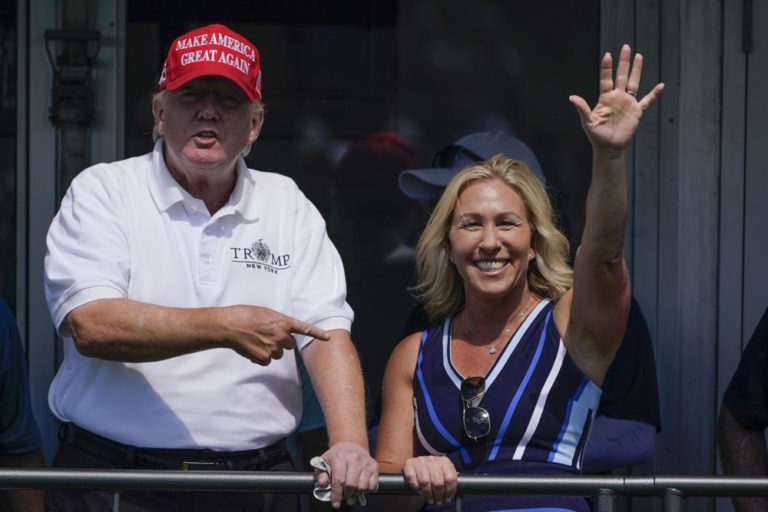
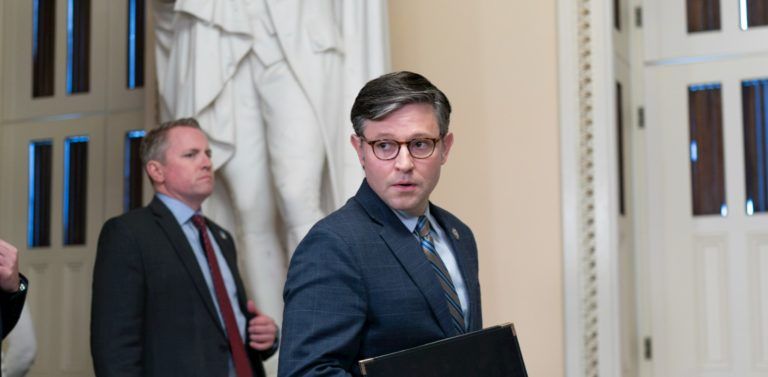
(Molly Bruns, Headline USA) Former President Donald Trump may come to the rescue of House Speaker Mike Johnson (R-La.) as Rep. Marjorie Taylor-Greene, R-Ga., and other members of the Freedom Caucus attempt to oust him from the most powerful seat in the House, according to Politico.
Trump and Johnson do not have an apparent friendship, but will reportedly appear together at Mar-a-Lago on Friday to promote election integrity.
Sources close to Trump slammed Greene for encouraging reckless infighting, indicating that the former president did not appreciate her brazen attempt.
“One hundred percent distraction. Unwanted. And just stupid,” one of Trump’s officials said. “We’re not going to get trapped in this cycle of bulls**t that comes out of members of the House.”
Another member of the team indicated Trump did not “think she’s being constructive.”
Trump himself did not make a public statement on the situation.
Greene sent a five-page letter explaining her rationale for Johnson’s removal, even hinting at a vote, after he acquiesced to a bipartisan spending bill to avoid a government shut down.
She quoted Johnson’s seven tenants for his speakership and summarized each way she believed he failed.
“If these actions by the leader of our conference continue, then we are not a Republican party–we are a Uniparty,” she wrote. “I will neither support nor take part in any of that, and neither will the people we represent.”
Greene did not indicate when she plans to force the vote.
In an interview on CBN News, Johnson said he attempted to speak to Greene in person and she refused.
He also discussed the possibility of a Democrat replacing him as House speaker if they vote him out of the position.
“She’s frustrated that we can’t score touchdowns on every single play, but the reality of the situation is that we have to do this incrementally,” he said. “We have to demonstrate to the American people that we can keep the train on the tracks. Pulling a motion to vacate or removing a speaker right now is exactly the opposite of what we need.”
JUST IN: House Speaker Mike Johnson on reaching out to Congresswoman Marjorie Taylor Greene over her motion to vacate: "I tried over the two-week break. She wasn't interested in speaking.” @SpeakerJohnson tells me, "pulling a motion to vacate or removing a speaker right now is… pic.twitter.com/vvmxiAf70t
(Money Metals News Service) In a high-stakes showdown with Gov. Andy Beshear over a gold and silver sales tax exemption, the Kentucky legislature today deemed his attempted line-item veto as an illegal act — and directed the Secretary of State to enroll the exemption into law.
This action makes the Bluegrass State the 45th state in the nation to enact this sound money policy – and the second this year.
Originally introduced by Rep. Steven Doan as a standalone bill, the sales tax exemption on purchases of gold, silver, platinum, and palladium coins, bars, and rounds enjoyed strong grassroots support — thanks, in large part, to the hard work of the Sound Money Defense League, Money Metals Exchange, and in-state activists.
Ultimately, Kentucky House and Senate leaders added the popular sound money provision into House Bill 8, an overarching revenue bill that also involved other tax matters, and sent the bill to the governor.
However, Beshear, a progressive Democrat, attempted to line-item veto the sales tax exemption on Tuesday. In his veto message, he even went out of his way to smear small-time Kentucky savers (who are desperately trying to protect themselves from Bidenflation) as rich people.
Under the Kentucky constitution, however, governors only have a line item veto power with respect to appropriations (or spending) bills — and HB 8 was not such a bill.
Moreover, a formal opinion of the state’s Attorney General further affirms that a line-item veto power does not exist for revenue bills, giving further weight to the legislature’s action to deem Beshear’s veto attempt illegal.
Once it takes effect on August 1, the sales tax exemption covers bullion as well as “coins or currency made of gold, silver, platinum, palladium, or other metal or paper money that is, or has been, used as legal tender and is sold based on its value as a collectible item rather than its value as a medium of exchange.”
Bill sponsor Rep. Doan explained, “Sound money is the bedrock of economic stability, ensuring the preservation of wealth and purchasing power over time. For Kentuckians and businesses in the state, sound money fosters confidence in transactions, encourages savings, and facilitates long-term investment, ultimately driving sustainable economic growth.
“As enshrined in the Constitution, sound money protects against the corrosive effects of inflation, safeguarding the financial well-being of individuals, families, and enterprises alike,” he continued.
“Kentucky lawmakers finally listened to the overwhelming grassroots pressure and common sense and got this done,” said Jp Cortez, executive director of the Sound Money Defense League. “Sound money is a winning political issue, the voters want it, and our nation desperately needs it.”
Including Kentucky, eight states in the last three years have enacted laws to reduce or eliminate the sales tax on purchases of precious metals (Wisconsin and Kentucky in 2024, Mississippi in 2023, Tennessee, Alabama, and Virginia in 2022, and Arkansas and Ohio in 2021).
Kentucky had been completely surrounded by states that had already ended this controversial tax.
Ending the sales tax on purchases of gold and silver is good policy for several reasons:
Other types of savings or investments do not carry a sales tax. Gold and silver are held as forms of savings and investment. Kentucky already does not assess a sales tax on the purchase of stocks, bonds, ETFs, real estate, currencies, and other financial instruments.
Levying sales taxes on precious metals makes no sense because they are held for resale. Sales taxes are typically levied on final consumer goods. Computers, shirts, and shoes carry sales taxes because the consumer is “consuming” the goods. Precious metals are inherently held for resale, not “consumption,” making the imposition of sales taxes on precious metals illogical from the start.
Studies have shown that taxing precious metals is an inefficient form of revenue collection. The results of a Michigan study, for example, demonstrated that any sales tax proceeds a state collects on precious metals may be surpassed by the state revenue lost from conventions, businesses, and economic activity that are driven out of the state.
Taxing gold and silver harms in-state businesses. It’s a competitive marketplace, so buyers will take their business to neighboring states, thereby undermining jobs. By going elsewhere, investors can easily avoid paying $132 in sales taxes, for example, on a $2,200 purchase of a one-ounce gold bar.
Gold and silver are the only money mentioned in the U.S. Constitution. Article 1, Section 10 states that “no state shall make any Thing but Gold and Silver a tender in payment of debts.” Exchanging one form of U.S. money for another should not be a taxable event.
Taxing precious metals is harmful to small-time savers. Purchasers of precious metals aren’t generally fat-cat investors. Most who buy precious metals do so in small increments as a way of saving money. Inflation harms everyone, but especially pensioners, wage earners, savers, and small business folks.
“We’re nowhere near done. Politicians in the remaining ‘hold-out states’ – New Jersey, Maine, Vermont, Hawaii, and New Mexico – should expect to hear from sound money activists and constituents very soon,” added Stefan Gleason, CEO of Money Metals and Chairman of the Sound Money Defense League.
It’s still possible that New Jersey could become the third state to end sales taxes on precious metals this year. Such a bill has already passed through the New Jersey Senate.
More than two dozen other states have considered pro-sound money legislation in 2024 so far, including Alaska, Indiana, Iowa, Georgia, Kansas, Missouri, Idaho, Arizona, Utah, New Hampshire, Oklahoma, Nebraska, Kansas, Vermont, West Virginia, and Wisconsin.
Kentucky was tied for 45th out of 50 in the 2024 Sound Money Index. Enactment of this measure is expected to boost the state’s ranking dramatically.
As of this writing, it’s unclear whether Governor Beshear will file suit against the legislature for refusing to accept his line-item veto as valid.
(Mike Gleason, Money Metals News Service) As inflation continues to come in hotter than expected, gold and silver markets continue to gain upside momentum. Gold busted through to a new record milestone above $2,400 an ounce on Friday while silver rocketed to $29.50.
On Wednesday, the government’s Consumer Price Index for March came in at an annual rate of 3.5%. The CPI jumped sharply from the 3.2% print in February. It also rose more than the projected 3.4% increase. It was the third straight month in which CPI readings topped economist forecasts.
Last month, Federal Reserve Chairman Powell attempted to redefine what progress toward achieving the central bank’s inflation objective means. Instead of needing to see inflation actually come down toward 2%, Powell declared the Fed would consider it to be good enough if inflation just remains where it’s at.
Jerome Powell:We’re not looking for inflation to go all the way down to 2%. That’s not what we’re looking for. We’re not looking for better inflation readings than we’ve had, we’re just looking for more of them.
Powell’s flip-flopping on the Fed’s longstanding 2% inflation target was of course meant to lay the groundwork for rate cuts.Central bankers desperately want to find some rationale for cutting despite inflation remaining elevated.
But now with the CPI accelerating higher, the Fed may have to get even more creative with language to try to justify a pivot toward monetary easing ahead of the 2024 election.
Fed central planners swear up and down that they don’t consider politics when making interest rate decisions. But a top economist for the central bank was recently caught on a hidden camera suggesting that Powell wants to help stop Donald Trump from returning to the White House.
Investigative journalist James O’Keefe released bombshell footage this week featuring Aurel Hizmo. Hizmo has helped write some of Jerome Powell’s speeches – and has also helped push the Powell Fed to embrace Woke politics.
Bandicam.com Report:Aurel Hizmo, Principal Economist at the Federal Reserve, talks about how the Federal Reserve has changed to think about environmental issues, equity issues, and racial equality.
Undercover Reporter:Even though he’s Republican on paper, Democrats still love him.
Aurel Hizmo:Yeah, because he’s responsive. Under Powell, the Fed has changed to think about equity issues, like racial issues. Think about wealth inequality as part of the mandate, as part of the issues we’re following. Think about climate change. So, the feeling is this, we don’t want Trump to be in the government.
Bandicam.com Report:Aurel Hizmo, Principal Economist for the Federal Reserve, says Jerome Powell wants to go down in history as someone who “held the line against Donald Trump.”
Even though Powell was originally appointed Fed chairman by President Trump, the two had a falling out after Powell began raising interest rates. Powell and other Fed officials fear that Trump would try to shake things up at the central bank if he becomes President again. They have no such worries under a Joe Biden presidency.
Biden himself expressed confidence this week that the Fed would bring down interest rates. It was a not-so-subtle reminder to Jerome Powell and company that he is counting on them to help stimulate the economy ahead of his re-election bid.
The Fed may very well be willing to throw whatever inflation-fighting credibility it still has out the window in order to try to give the economy a boost.It may win accolades from the White House and from short-term-oriented traders on Wall Street.
But letting inflation run hot is no gift to long-term investors. It certainly doesn’t help consumers struggling with higher costs of living. And any artificial boost it gives to GDP will be transitory – to borrow a term Jay Powell once used to describe inflation.
The stock market may still be riding high for now, but history shows that stocks can suffer massive bear markets in real terms during periods of high inflation. And in recent weeks, the S&P 500 has actually been losing ground when priced in terms of both gold and silver. Bonds are faring even worse versus sound money.
The risk for holders of financial assets is that whatever nominal positive returns they generate fail to keep pace with rising inflation over time.
Although the returns of precious metals markets are not guaranteed, gold and silver have plenty of history on their side to suggest that they will continue to perform an essential role in protecting investors from the ravages of inflation.
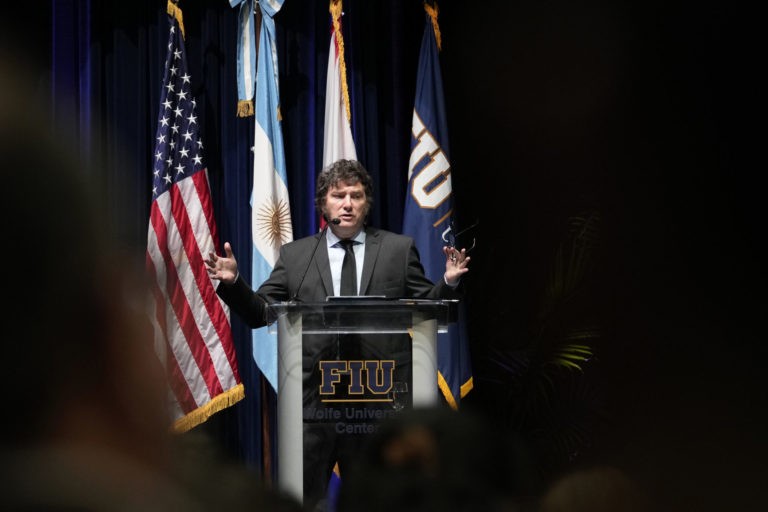
(Headline USA) President Javier Milei of Argentina kicked off a visit Wednesday to the United States, where he’ll meet with tech billionaire Elon Musk to discuss possible collaborations between one of the world’s leading lithium exporters and one of its leading producers of electric vehicles.
Such a collaboration could once again send Tesla stock soaring after the stock, which peaked around $372 per share in November 2021, hit a slump that has sent it down to approximately $172, with many financial forecasters predicting it will go lower.
The populist president started his four-day trip in Miami, which hosts one of the largest Argentine population in the US, and home to soccer superstar Lionel Messi.
In an event closed to the press, a Miami chapter of the Hasidic group Chabad–Lubavitch honored the Argentinian president along with Karina Milei, his sister and presidential adviser, at a local synagogue for their “tireless efforts for Israel.”
On Friday, Milei was due to meet with Musk in Texas, the president’s spokesperson said, where he will also tour a factory for Tesla, Musk’s electric car company.
Milei’s third trip to the U.S. in merely four months as president comes as he reshapes Argentine foreign policy in line with Washington.
Standing beside Gen. Laura Richardson, head of the U.S. Southern Command, at the southernmost tip of South America last week, Milei vowed to boost the nations’ “strategic alliance.”
He sees U.S. support as vital to the economic overhaul on which he has staked his presidency.
“We took advantage to present a new foreign doctrine for Argentina,” Milei tweeted Wednesday of his meeting with Richardson.
In the same post, apparently directed at Twitter CEO Musk—a self-declared free speech absolutist—Milei said he promoted “true freedom of expression” and slammed journalists critical of his administration as trying to “stop us from speaking.”
“We are not going to remain silent in the face of slander, insult or defamation,” he wrote.
LIBERTAD DE EXPRESIÓN. PARA TODOS.
Hace algunos días cuando recibimos a la General Richardson en Buenos Aires aprovechamos la oportunidad para presentar una nueva Doctrina de Política Exterior para la Argentina.
Durante esa presentación dijimos que parte de nuestra visión es…
Musk recently became embroiled in a standoff with a corrupt Brazilian judge who had demanded that Twitter take down posts critical of the current leftist government or expressing support for embattled ex-president Jair Bolsonaro—whose tenure overlapped with, and closely paralleled, that of former U.S. President Donald Trump.
Milei’s barnstorm campaign shocked many in South America and elsewhere after the country spent the past four years under the leadership of the socialist Justicialist Party, which was founded by former President Juan Perón and his wife, Eva, in 1946.
In recent decades, it has been a dominant force in Argentinian politics, having held power for all but three terms since 1989, including Milei’s ascension with the Libertarian Party.
Despite Milei’s clear mandate for reform, however, his plan to slash spending has encountered resistance in a nation where annual inflation tops 276%. On Wednesday, police forcibly dispersed anti-government protestors blocking a main Buenos Aires artery.
The United States, the biggest investor in Argentina, also has the most influence over the International Monetary Fund, to which Argentina owes $42 billion. The IMF has endorsed Milei’s shock therapy for Argentina, agreeing to disburse $4.7 billion from a bailout package the country took out six years ago.
The State Department’s investment climate statement last year noted “capital controls, trade restrictions, and price controls” hampered investors in Argentina. Milei has vowed to roll back interventionist policies with market-oriented changes favored by business executives, like Musk, one of the world’s richest men.
Milei and Musk—who share a brash personality-driven style and distaste for government overreach—have expressed mutual admiration. Ahead of his inauguration last December, Milei praised Musk as an “icon of freedom.” Musk gushed over Milei’s speech lambasting socialism at the World Economic Forum in Davos, Switzerland, commenting “So hot” with a meme of a couple having sex while watching Milei speak.
That’s in sharp contrast to Musk’s clash with Brazilian authorities, who threatened to regulate social-media sites and accused Musk of obstruction this week.
With its vast mineral reserves, Argentina has much to offer Musk, a dominant player in the auto industry who has referred to lithium—indispensable for electric car batteries — as “the new oil.”
Milei’s free-market policies have raised hopes in the U.S. that the metal and other badly needed raw materials like lithium can be extracted closer to home, breaking China’s dominance of the battery supply chain. The Biden administration said it was exploring investment opportunities in Argentine lithium earlier this year.
(Headline USA) The House on Friday rejected adding a warrant requirement to a key U.S. government surveillance tool, turning aside a proposal that was strongly opposed by the White House, which has deemed the Fourth Amendment to be a “national security threat.”
Republican Speaker Mike Johnson brought forward the revised proposal, which would reform and extend a section of the Foreign Intelligence Surveillance Act known as Section 702 for a shortened period of two years, instead of the full five-year reauthorization first proposed. Johnson hoped that the shorter timeline would sway GOP critics by pushing any future debate on the issue to the presidency of Donald Trump if he were to win back the White House in November.
A separate provision, ending warrantless surveillance of Americans, was also offered on the floor Friday but despite gaining support from strange bedfellows from the far-right and far-left, the measure ultimately failed to get a majority of the votes required to pass the House.
The vote was 212 to 212, with Johnson serving as the tiebreaker to defeat the warrant requirements. Johnson was long one of the most vocal proponents for requiring U.S. intelligence agencies to obtain warrants, but he recently changed his position after receiving a “confidential briefing” from U.S. national security officials.
This is how the Constitution dies.
By a tie vote, the amendment to require a warrant to spy on Americans goes down in flames.
This is a sad day for America.
The Speaker doesn’t always vote in the House, but he was the tie breaker today. He voted against warrants. pic.twitter.com/i49GnCzyPm
The bill now goes to the Senate where its future is uncertain. The program is set to expire on April 19 unless Congress acts.
Skepticism of the government’s spy powers has grown dramatically in recent years, particularly on the right. Republicans have clashed for months over what a legislative overhaul of the FISA surveillance program should look like, creating divisions that spilled onto the House floor this week as 19 Republicans broke with their party to prevent the bill from coming up for a vote.
However, the revised proposal with a shortened timeline helped flip some conservative opposition to the legislation.
“The two-year timeframe is a much better landing spot because it gives us two years to see if any of this works rather than kicking it out five years,” Rep. Chip Roy, R-Texas, said Thursday. “They say these reforms are going to work. Well, I guess we’ll find out.”
The legislation in question would permit the U.S. government to collect, without a warrant, the communications of non-Americans located outside the country to gather foreign intelligence. The reauthorization is currently tied to a series of reforms aimed at satisfying critics who complained of civil liberties violations against Americans.
But civil libertarians have complained that those changes did not go far enough. The vocal detractors are some of Johnson’s harshest critics, members of the ultra-conservative House Freedom Caucus, who have railed against the speaker the last several months for reaching across the aisle to carry out the basic functions of the government.
To appease some of those critics, Johnson also plans to bring forward next week a separate proposal that would close a loophole that allows U.S. officials to collect data on Americans from big tech companies without a warrant.
“All of that added up to something that I think gave a greater deal of comfort,” Roy said.
Though the program is technically set to expire next Friday, the Biden administration has said it expects its authority to collect intelligence to remain operational for at least another year, thanks to an opinion earlier this month from the Foreign Intelligence Surveillance Court, which receives surveillance applications.
The Biden adminsitariton has further deemed any attempts to reform FISA via warrant requirements as a “national security threat,” according to a memo circulating online Friday.
Whoa: the White House is calling the 4th Amendment of the Constitution a threat to National Security. This is a real memo sent out today: the yellow-highlighted sections just translate euphemism ("the Biggs Amendment") to plain language (Biggs' warrant req). (Source below in QT) https://t.co/IFMDyeW6C8pic.twitter.com/bzRhqYnEIt
First authorized in 2008, the spy tool has been renewed several times since then as U.S. officials see it as crucial in disrupting terror attacks, cyber intrusions and foreign espionage. It has also produced intelligence that the U.S. has relied on for specific operations.
But the administration’s efforts to secure reauthorization of the program have repeatedly encountered fierce, and bipartisan, pushback, with Democrats like Sen. Ron Wyden who have long championed civil liberties—aligning with Republican supporters of former President Donald Trump, who in a post on Truth Social on Wednesday stated incorrectly that Section 702 had been used to spy on his presidential campaign. A former adviser to his 2016 presidential campaign was targeted for surveillance over potential ties to Russia under a different section of the law.
“Kill FISA,” Trump wrote in all capital letters. “It was illegally used against me, and many others. They spied on my campaign.”
A specific area of concern for lawmakers is the FBI’s use of the vast intelligence repository to search for information about Americans and others in the U.S. Though the surveillance program only targets non-Americans in other countries, it also collects communications of Americans when they are in contact with those targeted foreigners.
In the past year, U.S. officials have revealed a series of abuses and mistakes by FBI analysts in improperly querying the intelligence repository for information about Americans or others in the U.S., including about a member of Congress and participants in the racial justice protests of 2020 and the Jan. 6, 2021, riot at the U.S. Capitol.
Those violations have led to demands for the FBI to have a warrant before conducting database queries on Americans, which FBI director Chris Wray has claimed would effectively gut the program’s effectiveness and would also be legally unnecessary given that the information in the database has already been lawfully collected.
(Molly Bruns, Headline USA) A regional country line-dancing team said it was kicked out of an competition in Seattle last week after organizers objected to the American flag shirts that members planned to wear for the performance.
Authorities at the Emerald City Hoedown disqualified the Borderline Dance Team after attendees complained of feeling “triggered and unsafe” by the shirts, according to the Jason Rantz Show on KTTH.
The Rain Country Dance Association, a group founded to cater to LGBT people, invited the Borderline team, based out of western Washington state, to the competition.
Co-captain Lindsay Stamp said the performance troupe did not intend to make a divisive political statement with the pro-America shirts.
“My team doesn’t take a political stance. We came to dance,” Stamp explained.
“We’re a patriotic group,” she added. “We support our military, our veterans, our first responders. We’re a group of patriots.”
Stamp said that the dance association, while cordial, offered them an ultimatum to either dance in street clothes—not an option for many of their dancers, who went to the stadium in uniform—or leave the premises.
The team agreed they would not remove their shirts, instead opting to leave the stadium.
“Our friends, West Coast Country Heat, who were also scheduled to dance for the convention that evening also did not perform as they too proudly don the colors of our country in the same spirit of patriotism that we do,” the group said in a follow-up Facebook post. “Both of our teams stood in solidarity and put actions to words.”
The Emerald City Hoedown did not directly address the situation, but hinted at it in a Facebook post of its own on Monday, after the story went viral.
“Hi y’all! After the close of another amazing Hoedown weekend, we know there are some questions about the Saturday night performance line-up,” the post said.
“We appreciate y’all giving us the time to clear up misunderstandings and address the situation with people directly involved,” it added. “We will be posting a follow up statement later this week once we are able to have those conversations.”
Ziadee Cambier, president of the RCDA Board, said that officials did not ask the team to leave.
The team said they received a great deal of support from their community after going public, and they expressed hope that they could mend fences with the RCDA.
“I would just love to see more conversations opened about people accepting one another. About being wholly inclusive,” Stamp said.
“You know, every, group of person talks about being inclusive and accepting,” she added. “And I think that we need to work on being inclusive and accepting of people outside of our immediate comfort zones. I would love to see that.”
The information leaked by the ATF was about its “Demand Letter 2 program,” which was created to identify firearms dealers that sell the most crime guns. About 2% of gun dealers nationwide are subject to this program. They’re required to participate if the ATF finds that they sold 25 or more firearms within a calendar year with a “time-to-crime” of three years or less.
The program is supposedly in place to aid law enforcement investigations, but the ATF leaked a list of dealers subject to the program as a “name-and-shame campaign,” according to critics.
“ATF’s release of protected trace data to Brady United and the media in clear violation of federal law enabled an entirely predictable ‘name-and-shame’ media campaign of misleading headlines smearing the reputation of law-abiding firearm retailers by suggesting they are engaged in illegal sales,” said Lawrence G. Keane, the general counsel for the National Shooting Sports Foundation.
“ATF knows these retailers are their allies and are on the front lines combatting the diversion of guns into the illegal black market. ATF’s unlawful release of this data to a gun control group damaged its relationship with the industry. It lends credence to the notion that the Biden administration is weaponizing the whole of government against our industry to score cheap political points.”
Rep. Jeff Duncan, R-S.C., and 31 other House Republicans sent a letter to ATF Director Steve Dettelbach about the matter Wednesday.
“Disclosing information from the National Trace Center for non-law enforcement related purposes can seriously damage the reputation of law-abiding firearms dealers since the information lacks the context of a trace. There are many reasons why a [dealer] may have a higher number of traces. For instance, the [dealer] or customer is a victim of burglary, or the [dealer] has a high volume of sales which will inherently make it more likely to have sold firearms show up in traces.”
The lawmakers asked ATF Director Dettelbach to acknowledge that the disclosure of the gun dealers data was illegal, and to explain what he’s doing to rectify the situation. Dettelbach has 60 days from Wednesday to respond.