(Jacob Bruns, Headline USA) Aaron Bushnell, an Air Force member who set himself ablaze outside the Israeli Embassy in D.C. in February, may have been a transgender, according to one transgender writer and researcher, Assigned Media reported.
Bushnell burned himself alive and recorded the footage on a Facebook live video in protest of the ongoing conflict between Israel and Palestine. “Free Palestine! Free Palestine!” he shouted repeatedly as his flesh burned. Eventually, the blaze was extinguished, but it was too late.
According to Isabelle Moreton of Australia, who spends time on the online world of transgenderism, Bushnell may have had a Twitch account whereby he went by the name “LillyAnarKitty.”
This username, Moreton suggested, indicates a high likelihood that Bushnell identified as transgender.
Moreton called it “the most transfeminine-coded username in existence.”
Though Moreton qualified the claim by saying that nothing has been resolved for sure, research revealed that through a “collective effort,” many people online have discovered that Bushnell’s life arc matches up with several transgender accounts which in some way or another involve the name “Lilly.”
> set yourself on fire > your “comrades” immediately start bickering over your white privilege > people forget you existed in less than two weeks > the only ones keeping your memory alive are telling everyone you wanted to be a woman
“We used external moderating tools to, for example, grab the username history of the Twitch account and match its previous usernames with usernames on other sites,” Moreton said, describing their research method.
“We cross referenced those with Bushnell’s life story as it’s been reported in legacy media, and other information that was public about Bushnell.” They achieved this by matching a “Mastadon” account to Bushnell because the profile picture was his cat–a detail verified by his Facebook profile.
Ultimately, they concluded, “it became pretty clear, pretty quickly, that in some spaces Bushnell was using the name Lilly.”
(Ken Silva, Headline USA) The Biden administration has insisted that the Israel-Iran conflict has yet to spill into a wider regional conflict, but an analysis from The Intercept found that the simmering war already involves at least 16 countries.
The countries involved so far are: Israel, Iran, the U.S., the UK, Syria, Yemen, Iraq, Jordan, Saudi Arabia, Bahrain, Kuwait, the United Arab Emirates, Qatar, Oman, Djibouti and Lebanon
According to The Intercept, the U.S. launched flew aircraft and air defense missiles from at least eight countries in the region. Iran and its proxies, for their part, fired weapons from Iraq, Syria, and Yemen.
Additionally, Oman, Saudi Arabia and Djabouti have been used as ports by the U.S. Navy, while Lebanon has been driven into the war via attacks between Hezbollah and Israel.
However, “Despite this unambiguous regional network, and even after Israel’s attack on Iran’s embassy in Syria earlier this month, the Biden administration has consistently denied that the Hamas war has spread beyond Gaza,” The Intercept noted.
“It is a policy stance—and a deception—that has held since Hamas’s October 7 attack.”
The war could spread farther soon. Axios reported on Monday that Israel told Secretary of Defense Lloyd Austin that it has no choice but to respond to Iran’s missile and drone attack, which came in retaliation for Israel’s bombing of Iran’s consulate in Damascus—as noted by antiwar.com’s Dave DeCamp.
“Israeli TV reported on Monday that the Israeli War Cabinet convened again and agreed to respond to the Iranian attack ‘clearly and forcefully,’ but there are no details on what the response would look like,” DeCamp wrote Tuesday.
“The report said the attack would be designed to send the message that Israel will ‘not allow an attack of that magnitude against it to pass without a reaction.’”
Austin reportedly told Gallant that the US “does not seek escalation,” but that the US will “continue to defend Israel.”
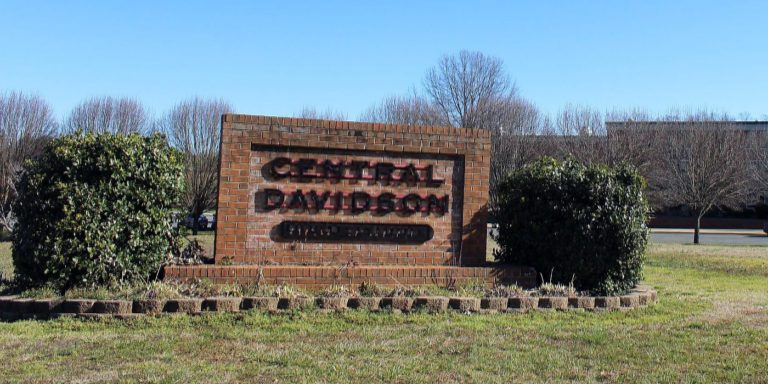
Christian McGhee, a 16-year-old student at Central Davidson High School in Lexington, North Carolina, was asked to define the word “alien” as part of a vocabulary lesson.
He sought clarity by asking his teacher if she meant “space aliens or illegal aliens without green cards?”
The question reportedly triggered one of his classmates, causing things to escalate, nearly ending in a fight before the assistant principal arrived on the scene.
However, it was not until later in the day, after an administrator asked whether the other student felt offended by Christian’s question, that he was called into the office.
As a result, Christian, a member of the track and field team, was suspended his from both school and sports for three days. The suspension, which offered no appeals process, cited as the offense “using/making racially motivated comment which disrupts class.”
Christian said his statement was not meant to insult anyone but was simply an honest question.
“I didn’t make a statement directed towards anyone; I asked a question,” he said, according to the Carolina Journal.
“I wasn’t speaking of Hispanics, because everyone from other countries needs green cards, and the term ‘illegal alien’ is an actual term that I hear on the news and can find in the dictionary.”
Christian’s mother, Leah, told Headline USA that the situation had been stressful, although she said several regional media outlets had reached out since the story broke and that the family was exploring legal options, as well, in an effort to clear Christian’s record.
“This has been a very difficult week for our family,” she said.
In an email to local officials describing the incident, she expressed her concerns about the school’s disciplinary policy, noting that the suspension would likely cost Christian more than just a few school days due to the stigma surrounding the specific allegations.
“Because of his question, our son was disciplined and given THREE days OUT of school suspension for ‘racism,’” she wrote.
She said Christian was worried about being canceled now that he has been labeled a racist.
“Christian is devastated and concerned that the racism label on his school record will harm his future goal of receiving a track scholarship,” she said. “We are concerned that he will fall behind in his classes due to being absent for three consecutive days.”
Central Davidson teachers and administrators offered a form response to Headline USA’s inquiries, saying they were unable to comment on specific student matters due to federal privacy laws.
“Please know that Davidson County Schools administrators take all discipline incidents seriously and investigate each one thoroughly,” they wrote. “Any violation of the code of conduct is handled appropriately by administrators.”
In 2021, the school received backlash for hosting a red-, white- and blue-themed “USA Day” as part of its homecoming week.
Some students wore political attire, with much of it celebrating former President Donald Trump, leaving others to complain that they felt intimidated, according to Davidson Local.
“It was straight up American Day,” said Principal Matthew Colton. “It’s a little unfortunate that they put the political spin on it.”
Headline USA’s Ben Sellers contributed to this report.
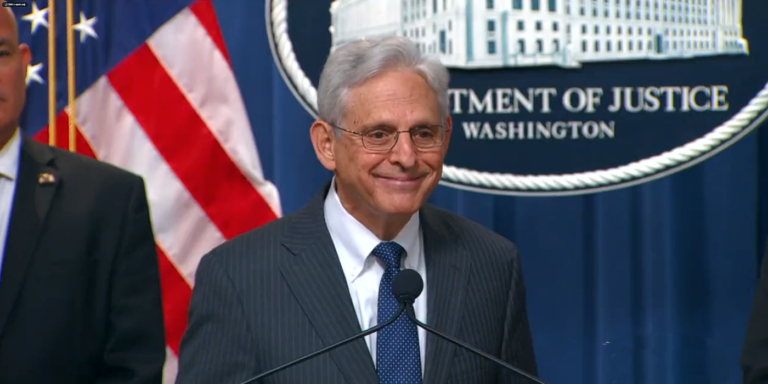
(Ken Silva, Headline USA) Attorney General Merrick Garland told lawmakers Tuesday that he has no knowledge of flyers allegedly distributed by a non-governmental organization that instruct illegal immigrants to vote for Joe Biden in the 2024 election.
Garland was questioned about the matter Tuesday by Rep. Andrew Clyde, R-Ga., during a Justice Department budget hearing. The questions were in relation to flyers reportedly found by a journalist and publicized by the Heritage Foundation’s Oversight Project.
🚨BREAKING – Flyers distributed at NGO in Mexico encouraging illegals to vote for President Biden
The flyers reads:
“Reminder to vote for President Biden when you are in the United States. We need another four years of his term to stay open”
The Spanish-language flyers, which were purportedly discovered around a migrant camp outside the city of Matamoros, Mexico, tell immigrants: “Reminder to vote for President Biden when you are in the United States. We need another four years of his term to stay open.”
The flyers are marked as being published by the Resource Center Matamoras, which is an affiliate NGO of the Soros-funded Hebrew Immigrant Aid Society, according to the Oversight Project. RCM has denied that the flyers are authentic.
Current Homeland Security Secretary Alejandro Mayorkas is a former board member of the HIAD.
However, Garland pled ignorance to all those facts.
“I’ve never seen or heard of that poster. It’s the first time I’ve ever heard of it,” he said Tuesday.
AG Garland claims that he’s never seen the startling flyer encouraging illegals to vote for Joe Biden.
Now that he has, it’s time for the DOJ to investigate.
Garland did say that he doesn’t think illegal immigrants should vote in American elections. But he also told Clyde that voter ID laws are potentially unconstitutional.
Clyde asked Garland how to prevent illegal immigrants from voting without voter ID laws. Garland said he’s never been asked to show ID when voting. An incredulous Clyde responded that he always has had to show ID at the polls.
The interaction between Clyde and Garland comes about a month after the attorney general publicly said the Justice Department will block local attempts to crack down on voter fraud.
Garland told a predominantly black church congregation last month that “the right to vote is still under attack,” referencing states passing requirements for voters to prove their identity, residency and citizenship.
“We are challenging efforts by states and jurisdictions to implement discriminatory, burdensome and unnecessary restrictions on the ballot, including those related to mail-in voting, the use of drop boxes, and voter ID requirements,” he said.
(Stefan Gleason, Money Metals News Service) Miners spend billions of dollars every year pulling precious metals out of the ground. They toil mightily for years on end to produce these stores of value – but then they turn right around and sell all their gold and silver immediately in exchange for fiat currencies.
If you stop to really think about it, this may seem strange.
These businesses quite literally mine real money. But, like nearly every other business or individual, they still seem to be stuck in the fiat currency paradigm.
It takes tremendous risk, capital, and time to find a resource, develop a mining project, and dig up and process the metals. It is extremely difficult to produce gold and silver at a profit.
Inflation constantly pushes up costs and puts pressure on the economics of the miners. They may face tremendous stumbling blocks along the way – from governments, capital markets, indigenous activists, eco-fanatics, union bosses, and many others.
All this underpins the scarcity value of the gold and silver that comes out of the ground – and provides a stark contrast to the amount of work involved in creating fiat money (i.e. none).
Of course, mining companies do need cash to pay bills. But to the extent that it’s not needed immediately, wouldn’t it make sense to hold onto some bullion to preserve purchasing power for future expenses?
Very Few Miners Hold Gold & Silver Rather Than Sell It All
If mining companies believe that gold and silver are better stores of value than fiat currency, then it would seem incumbent on them to hold onto some of their product where they can.
As far as we can tell, though, only a couple mining companies – First Majestic Silver and SilverCrest Metals – have held back a meaningful amount of their production in the past 10 years.
SilverCrest actually does more than delay sales – it has deliberately socked away more than $20 million in gold and silver bullion on its balance sheet, currently representing about 20% of its treasury assets. In other words, these folks eat their own cooking – and plan to eat more.
The company’s president, Chris Ritchie, believes holding gold and silver should become “an additional capital allocation choice that should be considered” for the mining industry.
SilverCrest Metals President Chris Ritchie
“SilverCrest has added this choice alongside our other capital allocation opportunities because of the functionality of our product — and we want to give our investors more of what they want while also hedging against some of the risks associated with mining. The option to hold bullion is available for every individual and business that’s trying to keep up with rising cost pressures.”
“The irony is that the gold and silver mining industry spends huge sums of money over long periods of time, and yet we choose to hold fiat currencies as our preferred store of value versus the product we work so hard to get.”
Miners May Struggle to Produce Future Ounces at Today’s Prices
Discussing this idea with Money Metals, Ritchie argued that the cost to replace the gold and silver ounces sold today is likely to be much higher in the future. If companies were to include these realities in their decision-making processes, financial stability and returns could be significantly improved.
“The industry has a horrible capital allocation track record. Poor business, capital markets, and resource allocation decisions have played an enormous role in creating the lack of interest we see in the sector today,” Ritchie pointed out.
The SilverCrest president points to the undercapitalization of the mining sector more broadly to support his point. Precious metals miners represent a fraction of 1% of the global marketable investment index even though they supply a product that is the best store of value in history.
A change in mentality may take time.
One example of the prevailing mindset is when Idaho-based Money Metals reached out to Hecla, a large silver-focused miner that is likewise based in Idaho, seeking support for a 2018 sound money bill pending in the state legislature. The response: Sorry, gold and silver aren’t money.
Idaho was once the epicenter of the gold and silver mining industry. But projects have faced major obstacles in recent decades, and the Gem State’s current liberal governor seems outright hostile to the monetary metals.
In fact, Idaho Gov. Brad Little just last week vetoed a popular sound money bill in order to prevent his state treasurer from holding gold and silver bullion to help protect the state’s dollar-centric reserve funds.
In doing so, Little parted ways with his counterparts in states like Utah, Tennessee, Texas, and Ohio – and sent a terrible message to the precious metals industry in the state.
Barrick Gold also provides an interesting case study.
The company’s stock is the same price today as it was 20 years ago. Meanwhile, gold itself is up over 600% in the same period of time!
It doesn’t take a financial wizard to see that you would have been a lot better off investing in the end product rather than the mining process.
In fairness, mining is a tough business and Barrick is a survivor. But it’s also one of many large mining companies that has capped its upside potential by hedging exposure to metals prices via futures markets. Hedging means, in effect, selling production early – well before the metals are even brought out of the ground.
Excessive and poorly timed hedges have destroyed shareholder value over the years.
Even when hedges DO pay off in the near term, they work at cross purposes with long-term investors who buy mining stocks because they want to fully participate in a bull market for the underlying asset.
Short-Sighted Thinking Harms Long-Term Industry Health
Quarterly earnings reporting and other pressures on public companies have led to lots of short-term thinking. The benefits of holding gold and silver shine brighter the longer the time frame in which you evaluate them.
Given the years or decades necessary to discover, build, and produce from a mine, the loss of purchasing power over that journey becomes a significant financial drag that is rarely considered.
Mining companies that sell all their gold and silver ounces today usually hope to replace them at a lower cost in the future. But is that a realistic assumption?
Almost no companies hold gold on the balance sheet.
Retaining some bullion on the balance sheet adds leverage. The returns on ounces held above the ground are not burdened by rising costs. They are not exposed to operational risk. And they reliably earn a better “real” yield over the medium to longer term than cash, CDs, and bonds.
Selling every ounce of precious metals mined immediately, regardless of price, is bad business, and it’s no wonder the mining sector struggles.
A strong case can be made that no company (or person or government entity) should hold cash reserves entirely in dollars given their constant devaluation and inherent risk. But so far there are few other examples of public companies holding gold on their balance sheets. Overstock and Palantir are two of them.
If Miners Hold Back Supply, It Could Positively Impact Price
The gold market is small. The silver market is even smaller.
Whereas demand for metals can surge suddenly, the supply response will take a significant amount of time. The capital required to build new projects is large and capital availability has dwindled to a trickle.
Seizing upon supply and demand imbalances is the holy grail for investors in cyclical industries. Mining companies can add value by retaining production while they wait for up-cycles to mature.
A choice to hold back some of their production from the market – especially when spot prices are below the all-in cost of discovery, development, and production – could also positively impact the prices of gold and silver.
That’s particularly true with silver, which is dramatically undervalued versus gold on a historical basis – but now appears poised to catch up. Higher prices would ultimately improve cash flows, supporting the health of the industry.
Here’s the bottom line…
Mining companies that fail to appreciate that they are literally pulling money out of the ground may continue to disappoint metals investors. But miners who stop being kneejerk “price takers” can expect to be rewarded.
Stefan Gleason is President of Money Metals Exchange, the national precious metals company named 2015 “Dealer of the Year” in the United States by an independent global ratings group. A graduate of the University of Florida, Gleason is a seasoned business leader, investor, political strategist, and grassroots activist. Gleason has frequently appeared on national television networks such as CNN, FoxNews, and CNBC, and his writings have appeared in hundreds of publications such as the Wall Street Journal, Detroit News, Washington Times, and National Review.
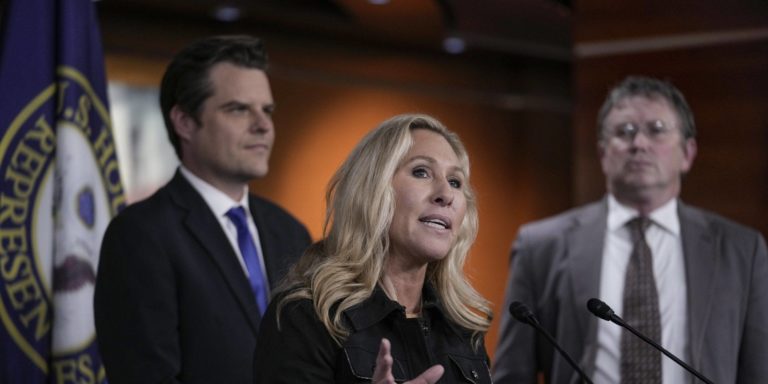
Citing Johnson’s recent failures, Rep. Thomas Massie, R-Ky., said Tuesday that he now supports Greene’s plan to force a vote on Johnson’s removal. When asked what was the motivating issue for Massie—whether it was Johnson’s spending, support for foreign wars or FISA reauthorization—the congressman responded, “All of the above.”
I just told Mike Johnson in conference that I’m cosponsoring the Motion to Vacate that was introduced by @RepMTG.
He should pre-announce his resignation (as Boehner did), so we can pick a new Speaker without ever being without a GOP Speaker.
Massie’s announcement comes the day after the House voted against reconsidering a FISA bill that would have required U.S. agencies to obtain warrants before spying on Americans.
But Massie’s move also comes on the heels of Donald Trump expressing continued support for Johnson. Trump has criticized Greene’s efforts to impeach the Speaker as “unwanted” and “stupid,” according to sources close to Trump.
“One hundred percent distraction. Unwanted. And just stupid,” one of Trump’s officials said earlier this month. “We’re not going to get trapped in this cycle of bulls**t that comes out of members of the House.”
However, other GOP leaders have come out against Johnson. Sen. Rand Paul, R-Ky., said in an interview on Fox News’s Sunday Morning Futures with Maria Bartiromo that there was no difference between Johnson’s leadership and that of a hypothetical Democrat.
“We also have Speaker Johnson voting for the spending package once again with the majority of the Democrats. If as I see it now, I’m not sure there’s a difference between Mike Johnson being in charge and the Democrats being in charge,” Paul said.
Greene has explained her rationale for seeking Johnson’s removal in a five-page letter she released earlier this month.
She quoted Johnson’s seven tenants for his speakership and summarized each way she believed he failed.
“If these actions by the leader of our conference continue, then we are not a Republican party–we are a Uniparty,” she wrote. “I will neither support nor take part in any of that, and neither will the people we represent.”
Greene has not indicated when she plans to force the vote.
(Mike Maharrey, Money Metals News Service) It was deja vu all over again. The Biden administration ran yet another massive budget deficit in March.
Tax receipts were up last month compared to February, but so was spending. That led to a $236.46 billion budget shortfall, according to the latest Monthly Treasury Statement.
With another huge monthly deficit on the books, the budget shortfall for fiscal 2024 eclipsed $1 trillion ($1.06 trillion) just halfway through the fiscal year.
Federal tax receipts were healthy in March at $332.09 billion. That was a 6 percent increase over March 2023.
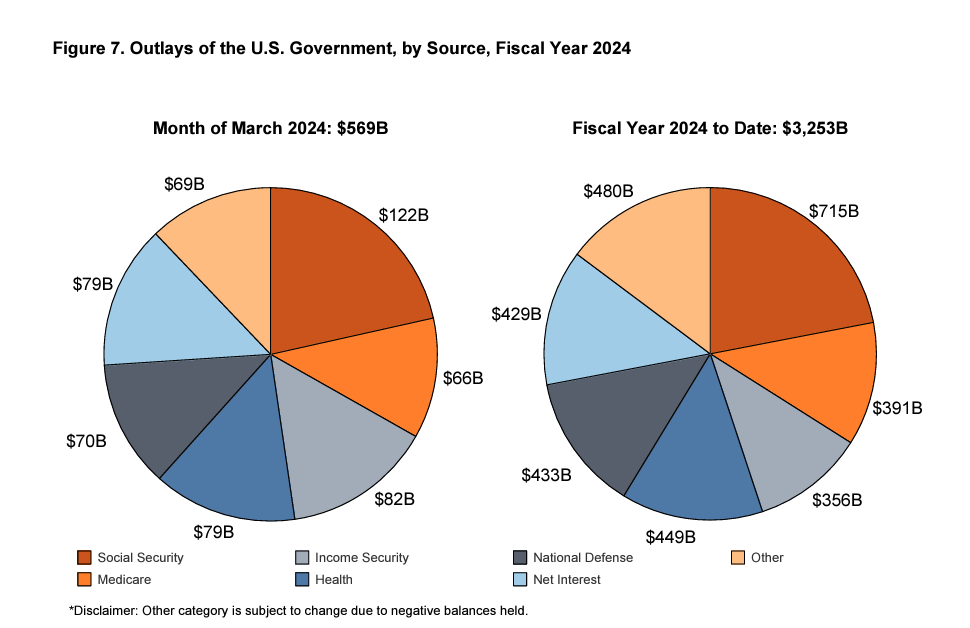
But President Biden and his minions blew through $568.55 billion last month. That was the highest spending total so far this year and inflated total spending for fiscal 2024 to $3.25 trillion.
Outlays of the U.S. Government, by Source, Fiscal Year 2024. March 2024 vs Fiscal Year 2024 to Date.
Spending is up 3.3 percent compared to the half of fiscal 2023. This despite the [pretend] spending cuts and promises from the Biden administration that it would save “hundreds of billions” with the debt ceiling deal (aka the [misnamed] Fiscal Responsibility Act.)
This reveals the ugly truth in Washington D.C. No matter what you hear about spending cuts, the federal government always finds new reasons to spend more and more money.
I should note that this problem isn’t specific to Biden or Democrats in general. The Trump administration was running $1 trillion deficits before the pandemic. In other words, Trump was generating Obamaesque deficits despite having what he claimed was the strongest economy in history.
According to the CBO, debt held by the public is projected to balloon from $26.2 trillion to $48.3 trillion by the end of 2034. That would represent 116 percent of GDP and would be the highest level on record.
The Interest Problem
Higher interest rates are creating an even bigger problem for Uncle Sam. With price inflation still running hot, it appears likely the Federal Reserve will put off interest rate cuts until later this year. But the federal government desperately needs interest rate cuts.
The ugly truth is the federal government is going to have a hard time maintaining the pace of borrowing with rates this high. (And from a historical perspective, they aren’t even all that high.)
The U.S. government spent $88.65 billion on interest expenses alone in March. This was more than the amount spent on national defense ($70 billion) and more than Medicare ($66 billion). The only spending category higher than interest expense was Social Security.
The government has shelled out $522.02 billion on interest payments so far in fiscal 2024. That’s a 35.9 percent increase over the same period in fiscal 2023. Again, the only category with higher spending was Social Security.
Net interest expense, excluding intragovernmental transfers to trust funds, was $429 billion through the six months of the fiscal year, still nearly as much as the government spent on national defense ($433 billion).
To put this into a different perspective, the federal government is spending over 1/3 of its tax receipts on interest expense alone.
And interest expenses will only continue to climb.
Much of the debt currently on the books was financed at very low rates before the Federal Reserve started its hiking cycle. Every month, some of that super-low-yielding paper matures and has to be replaced by bonds yielding much higher rates.
The weighted average interest rate on the government’s outstanding Treasury securities rose to 3.28 percent as of the end of March. That compares with a weighted average rate of 2.58 percent in February 2023.
The only way out of this fiscal death spiral is significant spending cuts and/or major tax hikes. If you think that will happen, I have some beachfront property in New Mexico to sell you.
Mike Maharrey is a journalist and market analyst for MoneyMetals.com with over a decade of experience in precious metals. He holds a BS in accounting from the University of Kentucky and a BA in journalism from the University of South Florida.
(Mike Maharrey, Money Metals News Service) Silver endured a significant selloff last Friday. Was this another step forward in the bull market?
This may seem counterintuitive, but GoldMoney founder James Turk thinks it was a positive sign for silver bulls.
The spot price of silver fell from just over $29.60 per ounce to just under $27 before rebounding late in the day on Friday.
The timing of the fall was more significant than the extent of the selloff. It indicates that the shorts and price manipulators in the paper market drove the selling action.
Silver was arguably overbought in the short term going into Friday, and it was above a significant resistance level at $28. A correction wasn’t a surprise given the conditions. But it also set the stage for shorts and price manipulators to strike.
Silver and gold operate within two distinct markets – the physical market that deals in real metal and the paper market that buys and sells promises to deliver silver at a future date. Because the silver market is much more volatile than gold, the paper market has significant sway over pricing. On the other hand, the aboveground stock of silver is extremely small compared to the gold market. That means rising demand for physical metal can put a significant squeeze on paper-holders.
As Turk put it, “It is easy to sell a promise, but you need to own metal if you intend to sell the real thing.”
Therein lies the rub. The paper market shorts don’t have enough silver to deliver all the promises.
The timing of selling on Friday indicates that the paper market drove the selloff.
The price was still climbing during the trading day in Asia. The demand for physical metal remained strong and the market in the East focuses much more on the metal. But when London closed and the COMEX took over, the selloff began. As Turk explained, “Once London closed, the price manipulators began selling.”
“They then piled on until the end of the day when they started buying back their shorts at $28, more or less stabilizing prices.”
Despite the big selloff, the spot price of silver still closed above $28. It was the first weekly close above $28 since 2013. Turk said this is significant.
“It signals to me that despite the attempt by the shorts and price manipulators to paint the tape on Friday, silver’s bull market has taken another step forward.”
Turk thinks the shorts and price manipulators have run out of runway. Although anything is possible, he said he doesn’t think they will try another overt manipulation by slamming the paper markets.
“It would be foolhardy for them to do so. It would just add to their problem of having more promises to deliver physical metal than they own. The physical market is gaining the upper hand over the paper market. The trustworthiness of those never-ending promises to deliver metal in the future are becoming doubted. More and more people are demanding physical metal, both gold and silver.”
Turk makes another point that I’ve been hammering on for months. Silver is underpriced based on the supply and demand fundamentals.
Silver demand set a record in 2023, and it is expected to remain robust this year. In fact, the Silver Institute projects another record year in industrial silver demand.
Industrial silver demand is projected to rise 8 percent to a record of 632 million ounces this year, pushing overall offtake to near-record levels.
According to the Silver Institute, investment in photovoltaics, power grid, and 5G networks, growth in consumer electronics, and rising vehicle production all helped drive industrial demand higher.
And there is no sign that demand will lag in the foreseeable future.
According to a 2022 research paper by scientists at the University of New South Wales, solar manufacturers could consume over 20 percent of the current annual silver supply by 2027. And by 2050, solar panel production will use approximately 85–98 percent of the current global silver reserves.
On the supply side, global mined silver is anticipated to fall by 2 percent year-on-year to 820 million ounces, driven by lower output from operations in Mexico and Peru.
With a combination of historically high demand and falling mine output, there was a 140 million-ounce market deficit in 2023. And that deficit appears likely to widen further in 2024.
Even with the big bull run, the gold-silver ratio is still over 83-1. That means it takes over 83 ounces of silver to buy a single ounce of gold.
In the modern era, the gold-silver ratio has averaged between 40-1 and 60-1. Historically, the ratio has always returned to that mean. And when it does, it does it with a vengeance. The ratio fell to 30-1 in 2011 and below 20-1 in 1979.
Given the current silver price, the silver-gold ratio, and the supply and demand dynamics, silver still appears to be on sale, even with the recent bull run.
And if Turk is right, Friday’s selloff is yet another indication that the bull run is just getting started and the paper pushers are losing control.
Mike Maharrey is a journalist and market analyst for MoneyMetals.com with over a decade of experience in precious metals. He holds a BS in accounting from the University of Kentucky and a BA in journalism from the University of South Florida.
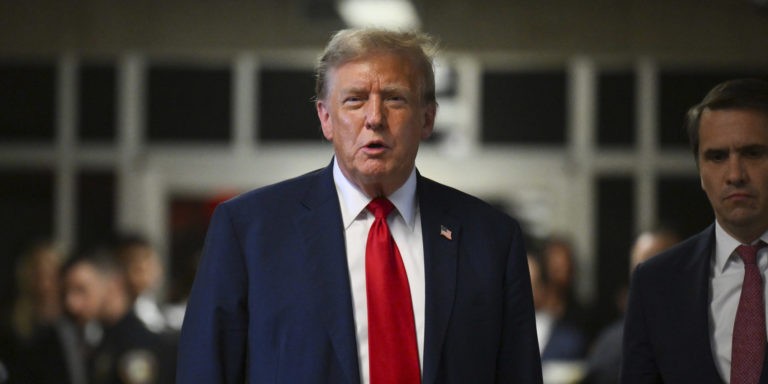
(Luis Cornelio, Headline USA) Former President Donald Trump might miss his youngest son Barron Trump’s high school graduation, as embattled Manhattan Judge Juan Merchan declined to clarify if Trump would be permitted to attend the ceremony.
Trump made the heartfelt announcement on Monday outside the courtroom following the launch of the criminal trial over alleged hush money payments.
“As you know, my son is graduating from high school. It looks like the judge will not let me go to the graduation of my son, who’s worked very, very hard and he is a great student,” Trump told reporters stationed outside the courtroom.
Leftist NYC Judge won’t allow President Trump to attend Barron’s high school graduation
This is going to backfire huge
The American people are sick of this Marxist tyranny
Trump is currently embroiled in a trial over what has been widely described as “flawed” and dubious criminal charges concerning the so-called hush money.
This case, spearheaded by Manhattan District Attorney Alvin Bragg, signifies the first instance a former president faces criminal charges.
While it remains plausible that Merchan could decide to allow Trump to attend the high school ceremony, he stated on Monday that it was premature to make such a determination. His response followed a request from Trump’s attorneys for a decision on the matter.
“It really depends on if we are on time and where we are in the trial,” Merchan stated, as reported by Business Insider.
According to Fox News, Barron Trump is scheduled to graduate from Oxbridge Academy of the Palm Beaches later this month, coinciding with his father’s attendance at the criminal trial.
“I’m very proud of the fact he did so well. I was looking forward for years to have his graduation with his mother and father,” Trump added. “It looks like the judge isn’t going to allow me to escape this scam. It’s a scam trial.”
Trump currently faces 34 felony counts for allegedly falsifying business records in the hush money payments to Stormy Daniels and Karen McDougal.
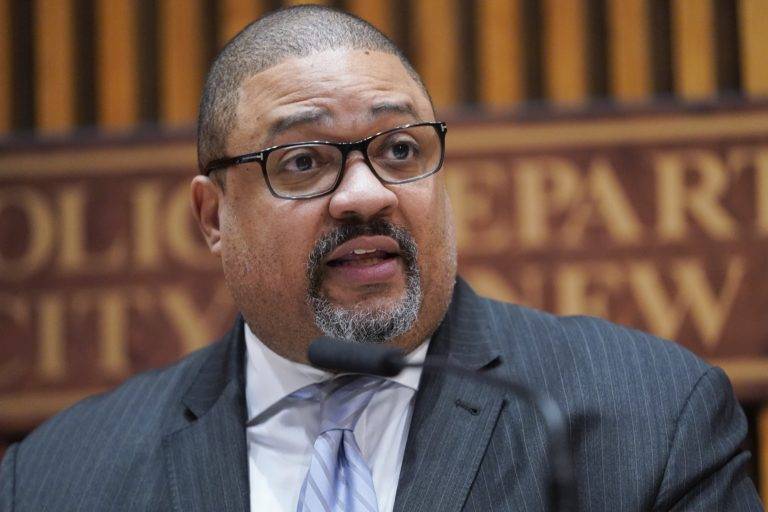
(Luis Cornelio, Headline USA) Manhattan District Attorney Alvin Bragg has achieved the milestone of being the first prosecutor in American history to file criminal charges against a former president. However, he has notably avoided making media appearances and refrained from offering public commentary on the case.
Why the silence, many Americans may wonder? A Monday report by Politico suggests that Bragg, lacking media acumen, may be avoiding scrutiny—or praise—for his decision to hijack the judicial system to bring what many have criticized as dubious and “flawed” charges against former President Donald Trump.
During an interview with Rev. Al Sharpton, Bragg reportedly cautioned against questions concerning the case stemming from Trump’s alleged involvement in the payments made by convicted felon and serial perjurer Michael Cohen to adult actress Stormy Daniels and Karen McDougal.
“I only talk about that matter in court filings and in the court. That’s what we do,” Bragg stated shortly after the meeting with Sharpton. He later implied that his media silence is driven by a so-called concern for maintaining the perception of an independent judiciary, according to Politico.
“I’ve been an officer of the court going on more than 20 years, and the way we comport ourselves is important,” Bragg claimed, as reported by the outlet. “In the courtroom first and foremost, [but] obviously, there’s a public dimension. So we are guided by the rules of the court and fair play.”
Despite Bragg’s assertions, he campaigned for Manhattan district attorney with a pledge to prosecute Trump. “If elected, I will indict Donald J. Trump,” Bragg proclaimed at the time. During an 2021 interview on Hot 97’s Ebro in the Morning, Bragg, in reference to Trump, asserted, “I believe he must be held accountable.”
Bragg has emerged as a central figure in the criminal proceedings against Trump, being the first to indict him over the hush money payments. The case lay dormant for years amid debates over the legal basis of the alleged offenses.
Bragg’s predecessor, Cyrus Vance Jr., opted against prosecuting Trump and announced his retirement in 2021, paving the way for Bragg to bring forth the criminal charges years after the alleged crime occurred.
Former federal prosecutor Mark Pomerantz, whom Vance enlisted to probe the matter, described the hush money investigation as a “zombie case—having oscillated between viability and obscurity,” as reported by the New York Times.