Trump Honors Fallen Service Members, Vows Iran will not Obtain Nuclear Weapons

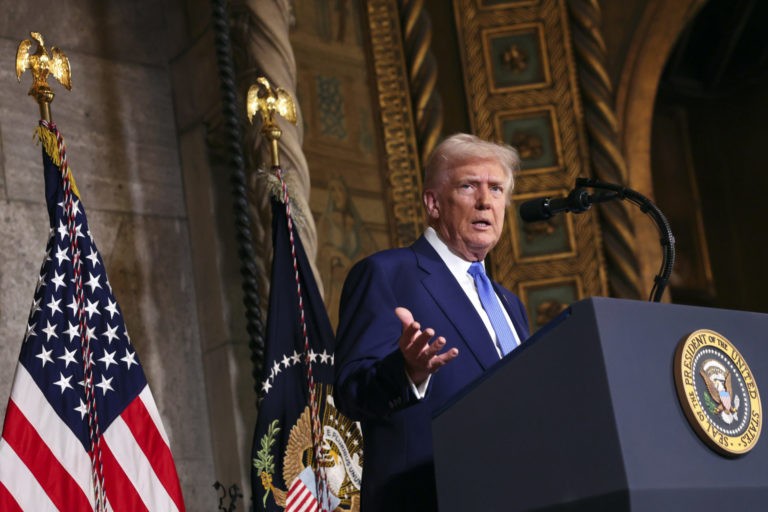
(Andrew Rice, The Center Square) President Donald Trump, Vice President JD Vance and other top cabinet officials honored fallen American service members in celebration of Memorial Day and vowed Iran would not obtain a nuclear weapon.

Trump and Vance spoke at Arlington National Cemetery in Arlington, Va., on Monday to recognize the families of soldiers who died in wars throughout American history. Trump also recognized service members who died in Operation Epic Fury and vowed the U.S. conflict against Iran would “not be in vain.”

Trump recognized Air Force Captain Ariana Sevino, who was among six individuals who died in a March 12 plane crash in Iraq.

“Ariana’s selfless gift will not be in vain,” Trump said. “Our debt to you is everlasting and it will always end in victory.”

In total, 13 service members have died since Feb. 28, when the conflict began. On March 1, six other American service members died following an Iranian strike in Kuwait. Benjamin Pennington died on March 7 from injuries following an Iranian drone strike at a military base in Saudi Arabia.

Trump promised Iran would not obtain a nuclear weapon. He said the service members who died were aware of the war’s goal of preventing that from happening.

“These incredible men and women gave their lives to ensure that the world’s number-one state sponsor of terror will never have a nuclear weapon,” Trump said. “They will never have a nuclear weapon.”

Trump’s commitment was met with cheers from the audience at Arlington National Cemetery, which included families of deceased service members and veterans. Dan Caine, chairman of the Joint Chiefs of Staff, also honored those killed since the beginning of Operation Epic Fury.

“We remember and honor those who made the ultimate sacrifice, adding their names to the story of American heroism,” Caine said. “It’s that same war-fighting spirit we saw in Operation Epic Fury.”

The Trump administration’s insistence that Iran cannot obtain a nuclear weapon has been a continued hang-up in negotiations to end fighting between the two countries and reopen the Strait of Hormuz. A top Iranian official said Monday a deal to end the conflict is not imminent.

Trump also honored deceased service members from the Vietnam War, World War II, and the conflict in Afghanistan. Trump recognized the family of Matthew McClintock, who was killed in Afghanistan in 2016 while attempting a rescue of fellow service members.

“Matthew fell that day, but the soldiers he gave his life to save survived and thrived,” Trump said. “These are tremendous people. They are brave, brave people.”

Vance, a former Marine, said Memorial Day is one of the most “somber and sacred days on the American calendar.” He thanked the families of deceased service members and called for Americans to take a moment for remembrance of those who died.

“The good life I have, and my family have, is fundamentally because you paid a debt that I can never repay,” Vance said. “I’ll never forget that all the moments that I’m able to have with my family, they’re not able to have with theirs.”

Trump also highlighted the upcoming celebrations for America’s 250th anniversary.

“From 1776 to 2026, America has always stood as a great and moral cause,” Trump said. “Wherever the American soldier walks, wherever he fights and wherever he falls, he does it for the destiny of a nation like no other.

“By their deaths, those who have gone before us in battle have redeemed the promise of our founding for each future generation,” Trump continued. “They’ve not just made the ultimate sacrifice, they’ve offered the ultimate proof that we Americans do indeed love liberty, we do cherish the self-government given to us by our forefathers, we do believe with all our souls in the mission that God has given to America, and we do intend with all our strength and heart to hold high the torch our heroes handed to us. And we will never ever let it fall.”


Illegal Alien Truck Driver From India Accused of Killing Two

(José Niño, Headline USA) An Indian national living illegally in the United States faces vehicular manslaughter charges after allegedly causing a crash that killed a 16 year old and a 20 year old in California, with federal officials revealing that the Biden administration released him into the country three years ago, Breitbart reported.

Manvir Singh, 24, was apprehended by California Highway Patrol and hit with charges of vehicular manslaughter with gross negligence, hit and run resulting in death or injury, and obstructing or resisting a police officer.

The crash unfolded on May 19 when Singh, operating a semi-truck, allegedly drifted off the roadway and collided with a guardrail, sparking a multi-vehicle accident. Prosecutors say Singh then attempted to escape from the scene. Both victims, a teenager and a young man, were killed instantly. Their names have not been made public.

Singh originally entered the United States by crossing the southern border in Arizona in July 2023. The Biden administration’s catch and release framework, administered by then DHS Secretary Alejandro Mayorkas, resulted in Singh being set free inside the country instead of being detained or removed.

Department of Homeland Security spokesperson Lauren Bis condemned the incident. “This criminal illegal alien from India should never have been behind the wheel of a semi-truck and allowed to kill two innocent people in a multi-vehicle crash in California,” Bis declared.

Bis continued pressing for legislative action. “He is now charged with vehicular manslaughter, hit and run resulting in death or injury, and resisting a police officer. This is yet another example of why illegal aliens should not be operating trucks on American highways. We need Congress to pass Dalilah’s Law to prohibit states from granting illegal aliens commercial driver’s licenses.”

Immigration and Customs Enforcement has placed a detainer on Singh and is urging California Governor Gavin Newsom to guarantee the suspect remains incarcerated instead of being turned loose into the community. Breitbart noted that California’s sanctuary policies have frequently put state officials at odds with federal immigration enforcement, making ICE’s request all the more urgent.

Dalilah’s Law, which Bis referenced, would create a federal prohibition on states granting commercial driving credentials to individuals who lack legal immigration status. Advocates argue the legislation would prevent tragedies like this one by keeping unlicensed foreign nationals off American roads.

José Niño is the deputy editor of Headline USA. Follow him at x.com/JoseAlNino 

Rubio’s Visit to India Focuses on US Trade Tensions, the Quad Alliance and Sightseeing

(Headline USA) U.S. Secretary of State Marco Rubio’s visit to India marks an effort by Washington and New Delhi to steady strained relations as the two countries seek to reinforce strategic and economic ties despite recent trade tensions.

In meetings Sunday with Indian Prime Minister Narendra Modi and Foreign Minister Subrahmanyam Jaishankar, Rubio stressed cooperation on trade, energy, defense and maritime security. Rubio said the countries remained strategically aligned and expressed optimism about a broader trade deal.

Rubio’s four-day trip also includes talks with members from the Quadrilateral Security Dialogue, the Indo-Pacific alliance more commonly known as the Quad.

Here is what Rubio’s visit means for India-U.S. ties:

Relations between India and the United States have strained in recent months after the Trump administration imposed steep tariffs on Indian exports, partly over New Delhi’s continued purchases of Russian oil. The move angered Indian officials and fueled concerns in the Indian government over Washington’s reliability.

The two countries later reached an interim trade arrangement that eased some tariffs and expanded Indian purchases of U.S. goods, including energy products. But talks on a broader trade deal remain unresolved.

Despite the tensions, India and the U.S. continue to strengthen defense and technology ties, with Washington viewing India as a key counterweight to China in the Indo-Pacific region.

During his talks with Jaishankar on Sunday, Rubio described India as one of Washington’s most important strategic partners and said he was optimistic the two countries would finalize a bilateral trade deal soon. Rubio also conveyed an invitation from U.S. President Donald Trump for Modi to visit Washington later this year.

Rubio’s visit also is expected to include talks on Tuesday with foreign ministers from India, Australia and Japan, which are member nations of the Quad alliance along with the United States.

The grouping has become a key platform for cooperation on maritime security, supply chains and regional strategy as China expands its military and economic influence in the Indo-Pacific.

The Quad has repeatedly criticized China’s actions in the South China Sea, accusing Beijing of militarizing disputed waters. The Chinese government has accused the Quad of trying to contain China’s rise and regional influence.

Recent trade tensions between Washington and New Delhi, along with Trump’s recent visit to China, have prompted renewed attention to the grouping.

Praveen Donthi, a senior analyst at the International Crisis Group, said India’s growing global influence has been largely tied to its role in balancing China’s power in the region and any shift in U.S. policy toward Beijing could affect New Delhi’s strategic value to Washington.

“If the U.S. changes its approach towards China, it will diminish India’s importance,” Donthi said.

The Iran war has added to India’s energy concerns, raising worries about shipments through the Strait of Hormuz, a vital route for the country’s crude imports. Rising fuel costs have increased pressure on the Indian economy.

Jaishankar said Sunday that India would continue expanding energy imports, including from the U.S., while diversifying suppliers to keep markets stable and prices affordable. He said New Delhi wants energy markets to remain open and unconstrained to support global economic growth.

India’s purchase of discounted Russian crude since the start of the Ukraine war has at times strained relations with the U.S.

Washington has urged India to increase purchases of U.S. oil and gas as part of broader efforts to diversify energy supplies, with Rubio emphasizing stronger energy cooperation during meetings in New Delhi.

Alongside official meetings, Rubio’s visit also has included cultural engagements.

He began the trip in eastern city Kolkata and visited the Missionaries of Charity headquarters founded by Mother Teresa. He also attended a gala reception in New Delhi marking the 250th anniversary of U.S. independence.

Rubio’s itinerary includes stops in the cities of Agra and Jaipur, two of India’s most visited tourist destinations known for monuments, forts and palaces.

Adapted from reporting by the Associated Press

U.S. Sees Progress in Iran Talks, Tehran Says no Deal Yet

(Elyse S. Apel, The Center Square) A top Iranian official says a deal to end the conflict between the United States and Iran is not imminent, despite earlier suggestions from U.S. officials that an agreement could come as soon as Monday.

The comments come after reports surfaced that negotiators were nearing a breakthrough as talks continued over a potential ceasefire extension and an end to the blockade at the Strait of Hormuz.

Iranian Foreign Ministry spokesman Esmail Baqai said Monday that, while negotiators have made progress, no final agreement has been reached.

“It is correct to say that we have reached a conclusion on a large portion of the issues under discussion,” Baqai said in Tehran on Monday. “But to say that this means the signing of an agreement is imminent – no one can make such a claim.”

His remarks came after Secretary of State Marco Rubio told reporters in Delhi on Monday that a “pretty solid” proposal is on the table.

“We thought we might have some news last night, maybe today,” Rubio said. “I wouldn’t read too much into it. Takes a little while to get back.”

Rubio said U.S. officials are not in a hurry to make a deal.

“The president said he’s not in a hurry,” Rubio said. “He’s not going to make a bad deal, and the president’s not going to make a bad agreement. So let’s see what happens. We’re going to give diplomacy every chance to succeed before we explore the alternatives.”

One of the likely hangups with negotiations remains the Trump administration’s insistence that Iran cannot be allowed to obtain a nuclear weapon.

Last week, President Donald Trump told The Center Square the U.S. would secure that outcome “one way or the other.”

“We cannot let Iran have a nuclear weapon,” Trump said from the Oval Office on Thursday. “That’s more important than anything else.”

Trump made the comments after The Center Square asked for clarification on Vice President JD Vance’s earlier statements about uncertainty around a future deal.

“It’s not sometimes totally clear what the negotiating position of the team is, and I don’t know if that’s sometimes bad communication, if that’s bad faith,” Vance said last Tuesday. “It’s sometimes hard to figure out exactly what it is that the Iranians want to accomplish out of the negotiation.”

The conflict with Iran first broke out 86 days ago, on February 28. In early March, Trump promised America would not be involved for long.

“We took a little excursion because we felt we had to do that to get rid of some evil,” Trump said regarding the war in Iran. “And I think you’ll see it’s going to be a short-term excursion.”

SpaceX Launches its Biggest, Most Beefed-up Starship Yet on a Test Flight

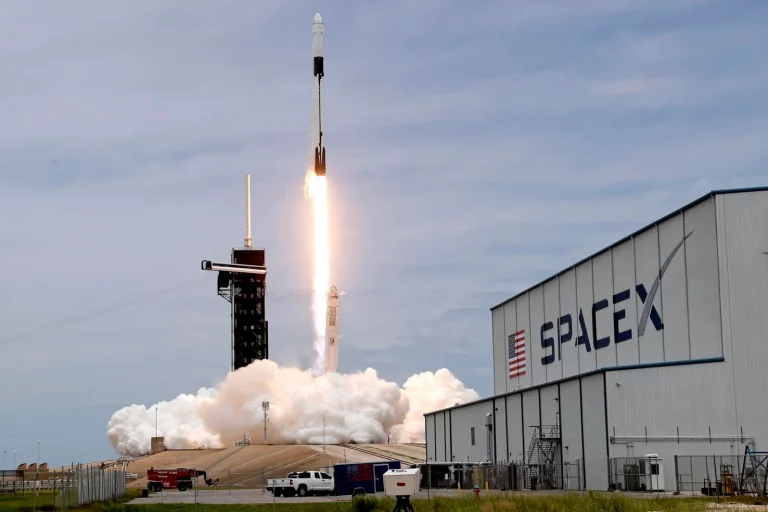
(Headline USA) SpaceX launched its biggest, most powerful Starship yet on a test flight Friday, an upgraded version that NASA is counting on to land astronauts on the moon.

The redesigned mega rocket made its debut two days after SpaceX CEO Elon Musk announced he’s taking the company public. It blasted off from the southern tip of Texas, carrying 20 mock Starlink satellites that were released midway through the hourlong spaceflight that stretched halfway around the world.

The spacecraft reached its final destination — the Indian Ocean — despite some engine trouble, before erupting in flames upon impact. That last part was not unexpected, according to SpaceX.

Musk called it “an epic” launch and landing.

“You scored a goal for humanity,” he told his team via X.

It’s the 12th test flight of the rocket that Musk is building to get people to Mars one day. But first comes the moon and NASA’s Artemis program.

NASA Administrator Jared Isaacman flew in for the launch, saying Starship is now one step closer to the moon.

The last of the old space-skimming Starships lifted off in October. SpaceX’s third-generation Starship — a souped-up version dubbed V3 — soared from a brand-new launch pad at Starbase, near the Mexican border. Last-minute pad issues thwarted Thursday evening’s launch attempt.

SpaceX was hoping to avoid the fireworks it experienced during back-to-back launches last year when midair explosions rained wreckage down on the Atlantic. Earlier flights also ended in flames.

There was no fireball this time until the very end. The spacecraft plummeted upright into the Indian Ocean under seemingly full control, then toppled over and ignited.

While the liftoff itself went well, not all of the engines fired as the booster attempted a controlled return. The spacecraft also had to make do with fewer engines, but kept heading eastward 120 miles (194 kilometers) up. A pair of modified, camera-equipped Starlinks ejected from Starship provided brief views of the spacecraft in flight — a remarkable first.

At 407 feet (124 meters), the latest model eclipses the older Starship lines by several feet (more than 1 meter) and packs more engine thrust.

The revamped booster sports fewer but bigger and stronger grid fins for steering it back to Earth following liftoff, and a larger and more robust fuel transfer line to feed the 33 main engines. This fuel line is the size of SpaceX’s Falcon 9 first-stage booster. The retro-looking, stainless steel spacecraft also has more of everything — more cameras and more navigation and computer power — as well as docking cones for future rendezvous and moon missions.

Starship is meant to be fully reusable, with giant mechanical arms at the launch pads to catch the returning rocket stages. But on this latest trial run, nothing was being recovered. The Gulf of Mexico marked the end of the road for the redesigned first-stage booster, and the Indian Ocean for the spacecraft and its satellite demos.

NASA is paying SpaceX billions of dollars — and also Jeff Bezos’ Blue Origin — to provide the lunar landers that will be used to land Artemis astronauts on the moon.

The two companies are scrambling to be first.

While Starship has reached the fringes of space on multiple flights lasting an hour at most, Bezos’ Blue Moon has yet to lift off, although a prototype is being readied for a moonshot later this year.

NASA is following April’s successful lunar flyaround by four astronauts with a docking trial run in orbit around Earth planned for next year. For that Artemis III mission, astronauts will practice docking their Orion capsule with Starship, Blue Moon or both.

A moon landing by two astronauts — Artemis IV — could follow as soon as 2028 using either Starship or Blue Moon, whichever lander is safer and ready first. It will be NASA’s first lunar landing with a crew since 1972’s Apollo 17. The goal this time is a moon base near the lunar south pole, staffed by astronauts as well as robots.

SpaceX is already taking reservations for private flights to the moon and Mars on Starship.

The world’s first space tourist, California businessman Dennis Tito, and his wife signed up 3 1/2 years ago for a flight around the moon. The timing is uncertain.

This week, another wealthy space tourist — Chinese-born bitcoin investor Chun Wang — announced he will fly to Mars on Starship’s first interplanetary mission. Wang previously chartered a SpaceX polar flight in a Dragon capsule last year and, along with his hand-picked crew, became the first to orbit above the north and south poles.

No price tag or date was revealed for his Mars cruise.

Adapted from reporting by the Associated Press.

NASA Reorganizes to Accelerate Moon Base, Lunar Programs

(Brett Rowland, The Center Square) NASA announced a reorganization of the agency Friday, restructuring key mission directorates to accelerate its lunar exploration program even as Congress and the White House remain divided over the agency’s $24.4 billion budget.

NASA said it will consolidate its human spaceflight and space operations directorates into a single Human Spaceflight Mission Directorate and merge its aeronautics and space technology offices into a new Research and Technology Mission Directorate. The Science Mission Directorate will remain unchanged.

“There will be no reduction in force, no program cancellations, no closures, but we will achieve cost savings through more efficient execution,” NASA Administrator Jared Isaacman said in a statement. “This is how we deliver on the mission, meet the moment, and continue to make history on behalf of the American people.”

The restructuring comes as NASA faces a contested budget request in Washington. The White House has proposed cutting the agency’s budget from $24.4 billion to $18.8 billion – a 23% reduction – while the House Appropriations Committee has advanced legislation keeping funding flat, rejecting the administration’s request.

Under the changes, mission directorates will now report directly to Isaacman rather than through the associate administrator, a move the agency said would streamline decision-making and improve coordination across NASA’s centers and international partnerships. The associate administrator will also serve as NASA’s chief engineer under the new structure.

NASA said the realignment implements directives under the National Space Policy, including acceleration of the Artemis program and development of a lunar base.

NASA also named Carlos García-Galán as program manager for its Moon Base effort within the Human Spaceflight Mission Directorate, according to the agency.

NASA is expected to provide additional details on its lunar exploration strategy during a news conference Tuesday in Washington featuring Isaacman and other senior officials. In March, Isaacman said NASA planned to invest about $20 billion over seven years to support development of a long-term lunar base.

The United States and China are racing to land astronauts on the moon. Isaacman told lawmakers in April that the competition could be decided “in months, not years,” and warned that China is aiming to reach the lunar surface before the end of the decade.

The Senate is expected to take up its own NASA spending legislation in June, setting up negotiations with the House later this year over the agency’s final funding levels and the future of its lunar exploration plans.

Offices for Rep. Brian Babin, R-Texas, and Sen. Ted Cruz, R-Texas, did not immediately respond to requests for comment.

Powell Out, Warsh in as New Chair of Federal Reserve

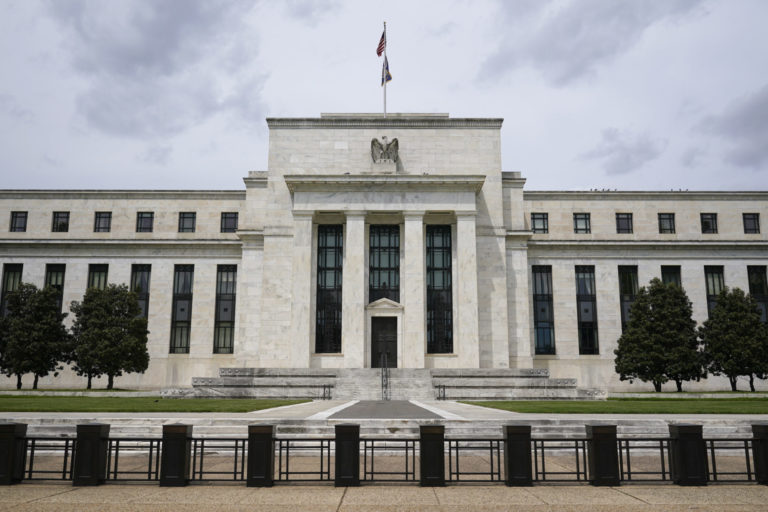
(Morgan Sweeney, The Center Square) Kevin Warsh, an economist and former member of the Federal Reserve Board of Governors, is now chair of the central bank, replacing longtime chair, Jerome Powell. 

Warsh was sworn in at the White House Friday with a large crowd in attendance after completing the confirmation process. 

“I expect he will go down as one of the truly great chairmen of the Federal Reserve that we’ve ever had,” Donald Trump said at the event. “I think he’s got abilities that very few people have.”

Warsh will replace Powell, after a years-long feud between the president and the now former chair.

Powell was nominated to the Fed’s board of governors by former President Barack Obama, but he was nominated to serve as the chair by Trump in 2017. But Trump often criticized Powell’s decisions as head of the Fed during his first term, and that continued into his second. Trump has publicly pressured Powell for months to lower interest rates more aggressively, saying it would supercharge the economy, while the Fed held rates steady and then began intermittently and cautiously lowering them. However, because the Fed is an independent federal institution, Trump waited until Powell’s term ended before replacing him with Warsh.

Trump said the Fed allowed political concerns to interfere with policy in recent years, leading to the inflation Americans have faced.

“In the eyes of many, the Fed lost its way in recent years … drifting into matters such as climate policy and DEI initiatives,” Trump said. 

It was this “straying from its mandate while the last administration blew out the deficit” that led to “Americans [suffering] the worst inflation that we’ve had in history,” according to Trump.

The first Trump administration also added to the deficit each year it was in place, as it has in his second term. The president did not mention the COVID-19 pandemic or the federal government’s response to it.

But Trump hopes that Warsh will be more aligned with the administration’s economic vision and boost economic growth. The president has often criticized the Fed’s reluctance to aggressively lower interest rates as an encumbrance to the kind of growth he believes his administration can achieve, though rapid lowering of interest rates can foster inflation. But Trump still believes the Fed has been too cautious.

“We have some debt we’d like to take care of, and the way you do that is through growth. We’re going to grow our way out of it so fast,” Trump said. “We want to stop inflation, but we don’t want to stop greatness, and … that’s what [Kevin] is looking to do.”

After earning his undergraduate degree from Stanford University in 1992 followed by a law degree from Harvard Law School, Warsh eventually became the vice president and executive director of global investment bank Morgan Stanley.

In February 2002, he joined the National Economic Council, where he served as special assistant for economic policy to President George W. Bush. Bush later nominated Warsh for the reserve’s board of governors, where Warsh served from 2006-2011, helping craft the Fed’s response to the 2008 economic crisis.

US Holds Military Drill in Venezuela’s Capital

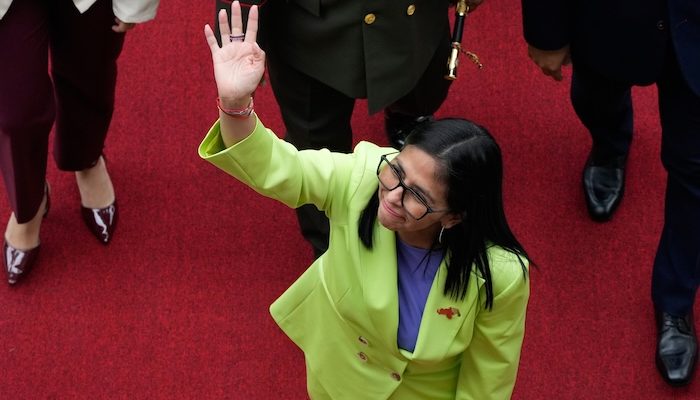
(Dave DeCamp, Antiwar.com) The US military on Saturday conducted a drill in the Venezuelan capital of Caracas, marking the first known US military exercise in the country since the January 3 attack to abduct Venezuelan President Nicolas Maduro.

The drill involved two US Marine Corps Osprey aircraft landing near the US Embassy in Caracas, which the United States officially reopened in March. The Venezuelan government, led by Acting President Delcy Rodriguez, Maduro’s vice president, said that it approved the exercise and that the US conducted it to prepare for “medical emergencies or catastrophic emergencies.”

The US Embassy said that Gen. Francis L. Donovan, the head of US Southern Command, was brought to the city on board one of the Ospreys, marking his second visit to Venezuela since the US attack, which killed at least 83 people, including Venezuelan military personnel, Cuban presidential guards, and four civilians.

“[Donovan] participated in bilateral talks with high-ranking representatives of the interim government, met with the leadership and staff of the United States Embassy, and observed the joint force conducting a military response exercise,” the US Embassy said in a post on X.

The US military drill in Venezuela comes as the US appears to be moving toward launching a war against Cuba, which has been deprived of Venezuelan and Mexican oil as part of a ramped-up US oil embargo, causing a devastating humanitarian crisis. CIA Director John Ratcliffe recently visited Cuba and reportedly brought along a paramilitary leader who was introduced to the Cuban officials as the one who killed their people in Venezuela.

This article originally appeared at Antiwar.com.

Sen. Lindsey Graham Backs Trump’s Suggestion To Tie Any Iran Deal To Expanding Abraham Accords

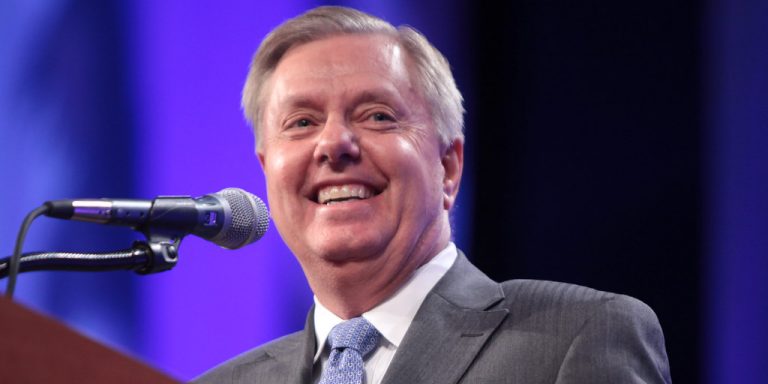
(Dave DeCamp, Antiwar.com) Sen. Lindsey Graham on Sunday backed President Donald Trump’s suggestion that any deal with Iran could be tied to expanding the Abraham Accords, the diplomatic deals under which the UAE and Bahrain normalized relations with Israel in 2020.

But the idea of normalizing relations with Israel has very little support among the Gulf Arab countries that have not done so, which include Saudi Arabia, Qatar, and Oman, as Israel continues its occupation of territory in Gaza, the expansion of settlements in the West Bank, and its war in Lebanon.

According to a report from Axios, Trump suggested the idea in a call with regional leaders and was met with silence. “There was silence on the line and Trump joked and asked if they are still there,” an unnamed US official told Ravid.

Despite the lack of support for expanding the Abraham Accords, Graham showed strong support for the idea. “If in fact as a result of these negotiations to end the Iranian conflict, our Arab and Muslim allies in the region agreed to join the Abraham Accords, it would make this agreement one of the most consequential in the history of the Middle East,” he wrote on X.

“To Saudi Arabia and others: Now is the time to be bold for the future of a new Middle East. I expect, as President Trump has suggested, you will in fact join the Abraham Accords effectively ending the Arab-Israeli conflict,” Graham added.

The notoriously hawkish senator also said that if regional countries refuse to open diplomatic relations with Israel, it “will have severe repercussions for our future relationships and make this peace proposal unacceptable” and urged President Trump to “stick to your guns in getting a good deal with Iran. Equally important, stick to your guns in insisting Saudi Arabia and others join the Abraham Accords as part of these negotiations.”

Graham’s praise for Trump’s Iran strategy came just a day after he expressed alarm over reports that the US and Iran were close to a deal that would end the US blockade of Iranian ports and open the Strait of Hormuz to more traffic as the two sides hold negotiations on the nuclear issue.

“If a deal is struck to end the Iranian conflict because it is believed that the Strait of Hormuz cannot be protected from Iranian terrorism and Iran still possesses the capability to destroy major Gulf oil infrastructure, then Iran will be perceived as being a dominate force requiring a diplomatic solution,” Graham said on Saturday.

He said such a situation would be a “major shift of the balance of power in the region and over time will be a nightmare for Israel” and questioned what the point of the war would have been. “Also, it makes one wonder why the war started to begin with if these perceptions are accurate. I personally am a skeptic of the idea that Iran cannot be denied the ability to terrorize the Strait and the region cannot protect itself against Iranian military capability,” he added.

Graham’s change in tune reflects reporting that a deal appears to be less likely now than it was on Saturday. It also suggests he may have spoken to Trump about the situation, as the two are known to be in close contact, though the president appeared to respond to the criticism of a potential deal from Iran hawks.

“If I make a deal with Iran, it will be a good and proper one, not like the one made by Obama, which gave Iran massive amounts of CASH, and a clear and open path to a Nuclear Weapon. Our deal is the exact opposite, but nobody has seen it, or knows what it is. It isn’t even fully negotiated yet,” Trump wrote on Truth Social.

“So don’t listen to the losers, who are critical about something they know nothing about. Unlike those before me who should have solved this problem many years ago, I don’t make bad deals!” he added.

This article originally appeared at Antiwar.com. 

Trump Says He Told US Negotiators Not to ‘Rush Into a Deal’ With Iran

(Dave DeCamp, Antiwar.com) President Donald Trump said in a post on Truth Social on Sunday that he told his negotiators not to “rush into a deal” with Iran, comments that come after a series of reports said that a memorandum of understanding between Washington and Tehran could be reached soon.

“The negotiations are proceeding in an orderly and constructive manner, and I have informed my representatives not to rush into a deal in that time is on our side,” the president wrote.

“The Blockade will remain in full force and effect until an agreement is reached, certified, and signed. Both sides must take their time and get it right. There can be no mistakes! Our relationship with Iran is becoming a much more professional and productive one,” Trump added.

According to media reports, the potential deal that’s on the table would essentially bring the region into a status that was supposed to be achieved under the initial US-Iran ceasefire by ending the US blockade of Iranian ports and opening the Strait of Hormuz to more commercial traffic.

Amjaj Media reported on Saturday that the deal would also release billions in frozen Iranian funds, withdraw American forces from the immediate vicinity of Iran, start a 30-day period for negotiating nuclear issues that could be extended, and bring a real ceasefire in Lebanon, though it’s unlikely Israel will agree to end its occupation of southern Lebanon and attacks in the country.

While both US and Iranian sources spoke positively of the negotiations on Saturday and notable Iran hawks in the US expressed panic, the chances of a deal seemed less likely on Sunday. Ali Hashem, a reporter for Al Jazeera, cited an Iranian source who told him that the US was now backing away from two key tenets of the potential deal: the unfreezing of Iranian assets and a real truce in Lebanon.

“According to the source, the memorandum includes a Lebanon ceasefire framework, but Israel is reportedly uncomfortable with the arrangement and is pushing Washington to include language allowing it to carry out military operations in Lebanon under the justification of responding to ‘any threat.’ Iran is rejecting that formulation and insisting on a sustainable and lasting ceasefire,” Hashem wrote on X.

Hashem added that the “overall picture suggests Tehran increasingly views Washington as backing away from earlier understandings reached through mediators.”

A statement from Israeli Prime Minister Benjamin Netanyahu also cast doubt on a deal, as he said that he and Trump spoke on Saturday night and agreed on certain conditions for an agreement that Tehran would likely reject.

“President Trump and I agreed that any final agreement with Iran must eliminate the nuclear danger. That means dismantling Iran’s nuclear enrichment sites and removing its enriched nuclear material from its territory,” Netanyahu wrote on X. He added that Trump also “reaffirmed Israel’s right to defend itself against threats on every front, including Lebanon.”

US sources also told Axios reporter Barak Ravid that a deal was not expected to be signed on Sunday, as some reports initially suggested, and said that an agreement could still be signed within days, though they expressed that the negotiations could still fall apart. “We are in a very good place — but there are ways in which the deal can be undermined,” a senior Trump official told Ravid.

The threat of a resumption of the full-scale US-Israeli bombing campaign remains, though Trump isn’t expected to do so until after the Hajj, the annual Islamic pilgrimage to Mecca, Saudi Arabia, which will end on May 29. According to a report from Middle East Eye, the US’s Gulf allies warned Trump not to resume the attacks during the pilgrimage.

This article originally appeared at Antiwar.com.