Joe Biden’s pro-open border policies that allowed people from all over the world to come into the United States was a possible reason why the disease is currently on American soil, Blaze Media reported.
Even though the bacterium responsible, Yersinia pestis, is found in rodents, it can be transmitted to humans through the bite of infected fleas. Humans can spread the plague among themselves through unprotected contact with an infected person’s bodily fluids or through inhalation of respiratory droplets expelled by someone stricken with the pneumonic plague.
In modern history, the plague had its outbreaks in countries such as Madagascar, Peru and the Democratic Republic of the Congo, according to the World Health Organization.
On July 9, 2024, public health officials in Pueblo County, Colo., confirmed that one person was infected with the plague.
The Pueblo Department of Public Health and Environment advised locals to eliminate places rodents can breed or hide (rock piles, brush and trash), avoid contact with dead animals, use insect repellent to avoid flea bites, treat pets for fleas, keep pets away from rodent-infested areas, including prairie dog colonies, and don’t sleep with pets, the news source reported.
“If you develop symptoms of plague, see a health care provider immediately. Plague can be treated successfully with antibiotics, but an infected person must be treated promptly to avoid serious complications or death,” Alice Solis, program manager of the county’s office of communicable disease and emergency preparedness, said.
The news source reported that infection is brutal and frequently lethal, with systemic infection caused by the bacteria in the bloodstream and lung-based forms having a case-fatality ratio ranging from 30% to 100% if not treated.
Among the possible symptoms of the plague are swollen, tender lymph glands, fever, headache, weakness, chest pain, chills, a cough, difficulty breathing, an upset stomach, lung failure, shock, profuse bleeding and death.
Even though the U.S. currently doesn’t have a plague vaccine available for use, streptomycin, gentamicin, tetracyclines and chloramphenicol are reportedly all effective against pneumonic plague.
“Okay, so who had ‘Bubonic Plague’ on their 2024 Disaster Bingo Card?” Michael Snyder of The Most Important News wrote.
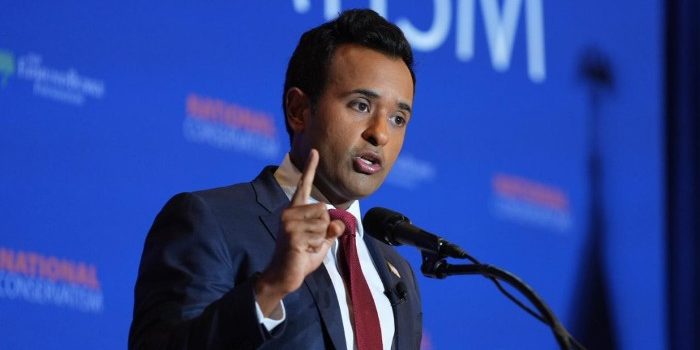
(Elias Irizarry, Headline USA) With the Democrat Party imploding under the weight of its gerontocracy, led by 81-year-old presumptive presidential nominee Joe Biden, 38-year-old businessman Vivek Ramaswamy is on a mission to ensure that the GOP keeps its focus on the future, as well as the present.
The mood at the NatCon4 conference—sponsored by the Edmund Burke Foundation this week in Washington, D.C.—may have been on driven largely by anticipation and enthusiasm for the coming election after several years of dues-paying during the corrupt Biden administration.
Top conservative thought-leaders and policymakers led discussions on topics such as “revenge lawfare.”
Ramaswamy, on the other hand, declared in his keynote speech Tuesday that he came not to tell the crowd what they wanted to hear, but rather to challenge them.
He urged Republicans to start preparing for the future after Trump and explained what he saw as a growing rift in the GOP between what he described as “national protectionists” and “national libertarians.”
Although the two factions may be unified under a second Trump term due to the would-be leader’s unique charisma and cult of personality, the vaccuum that ensues in Trump’s eventual retirement might amplify the fundamental philosophical differences between them.
“Both reject the neoliberal consensus on foreign policy, on trade, on immigration, but for different reasons, and with very different implications for the future direction of America First policy,” Ramaswamy said.
Unlike the other candidates, President Trump didn't just blindly parrot the Republican party's orthodoxy with fancy verbiage. He offered a new worldview that shattered the NeoCon consensus.
He reimagined our relationships with other countries and looked at international… pic.twitter.com/rjZKstn0c2
— National Conservatism (@NatConTalk) July 9, 2024
Ramaswamy argued that national protectionists are too wary of international trade, and that the priority should be decoupling from China—which, he said, currently accounts for the export of 40% of the U.S. military semiconductor supply and could cut the plug in a time of war.
“If we’re really serious about reducing our economic dependence on China—not just talking about it, but actually serious about doing it—that necessarily means more, not less, trade with allies,” Ramaswamy said.
“But if your top priority is to protect American manufacturers from the effects of foreign competition, then that impedes our ability to decouple from China,” he added.
After speaking on foreign trade, he moved to the concerns of immigration by the two different wings. He said that there were three main priorities for national libertarians: “Protect national security, preserve national identity and promote economic growth—in that order.”
Neoliberals favor economic growth over everything, he pointed out. Meanwhile, national protectionists favor wage growth over the expense of other interests.
However, Ramaswamy argued that national identity should be just as important. He called for prioritization of quality over quantity when it comes to immigration policy.
In support of what he calls national libertarianism @VivekGRamaswamy calls for the end of of birthright and duel citizenship along with civic tests for citizens before voting but opposes protectionist immigration policies pic.twitter.com/5k24xLzjti
“The overwhelming majority of immigrants will have to be turned away,” he said.
“But it won’t be because domestic labor unions are scared of foreign competition,” he added. “It’ll be because we have national boundaries, a national identity, and a rule of law to preserve in America. Immigration should not be labor policy.”
Ramaswamy went on to warn that “national protectionists” were turning toward big government to reach their goals—a trend that he felt needed to be nipped in the bud.
“We don’t believe in reshaping the American regulatory state. We believe in dismantling the American regulatory state,” he said. “I don’t care to replace a left-wing nanny state with a right-wing nanny state.”
Two polls conducted in a swing New York House district in September 2023 and March 2024 found that Trump was leading Biden by one point, the Daily Caller News Foundation reported. Other public polling conducted in recent months found Biden’s lead over Trump shrunk to eight points.
In the 2020 election, Biden won the state by 23 points, but Democrats are now reportedly urging Biden’s team to reallocate resources to boost both his campaign and the candidates running in swing districts, the news source reported.
“We’re still acting like this is a one-party state, which for pretty much 20, 25 years it has been. I truly believe we’re a battleground state now,” Democratic Manhattan Borough President Mark Levine said.
An anonymous high-level New York Democrat agreed with Levine.
“It’s never been more important for a Democratic House member to focus on building their own local brand and to run on that. Biden isn’t going to be handing out coattails no matter what. He’s only got anchors,” the Democrat said.
Rep. Jerry Nadler, D-N.Y., and Rep. Joe Morelle, D-N.Y., previously supported the idea of Biden being replaced during a July 7, 2024, conference call with other House Democrats.
The news source reported that a tight race in a once-far-left state would take time and money away from being spent in the nation’s other six battleground states.
“The money that needs to be spent here will be subtracted from other areas he’s going to lose,” former Gov. David Paterson, D-N.Y., said.
In the 2022 election, Republicans managed to flip four congressional seats in New York. The same year, Republican gubernatorial challenger Lee Zeldin lost by less than 6% compared to the double-digit losses Republicans experienced in previous years.
“If I’m a Democrat in some of these suburban races, I’d run the hell away from Joe Biden,” Laura Curran, former Nassau County executive, said.
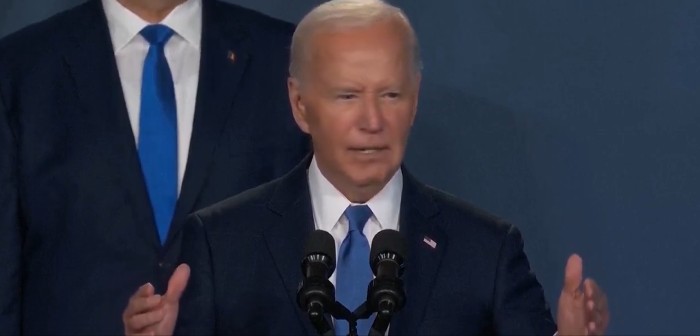
“And now I want to hand it over to the president of Ukraine, who has as much courage as he does determination,” President Biden stated, as he prepared to introduce the Ukrainian leader. “President Putin.”
When he began to walk off the stage, he quickly turned back to the podium, catching his error, and stating “He’s gonna beat President Putin. President Zelensky. I’m so focused on beating Putin, we gotta worry about it.”
Zelensky could be seen nervously laughing at the embarrassing mistake that suggested Putin is the President of Ukraine.
“I’m better.” the Ukrainian President declared, before smiling and shaking Biden’s hand and taking the podium.
(Ken Silva, Headline USA) After asking for 20 years to comply with a records request about its involvement with the Oklahoma City bombing, the FBI now wants to entirely pause a lawsuit seeking to force production of those records.
As Headline USA reported in February, Utah attorney Jesse Trentadue initially filed a Freedom of Information Act request in 2016 for records about a CIA asset and FBI informant who helped fund the OKC bombing, as well as for records about a neo-Nazi bank-robbery gang also involved in the attack.
Trentaudue sued the FBI over the matter in February, demanding the bureau to produce the 69,375 pages of documents that it’s holding. In response, the FBI asked a judge to take another nearly 12 years to fork over those documents to him, which means that it would take at least 20 years for the bureau to comply with his initial FOIA request.
After Trentadue strenuously objected to the FBI’s desired timeline in a June court filing, the FBI finally responded on Tuesday—now seeking to pause the lawsuit altogether.
“Mr. Trentadue does not oppose a rolling production schedule, but wants the United States to review and process all records within one year. Mr. Trentadue indicated that he would file an opposition,” Assistant U.S. Attorney Melina Shiraldi said in a Tuesday court filing on behalf of the FBI.
“For the foregoing reasons, the United States respectfully requests a Status Conference to determine an interim release rate for FBI and to stay the schedule of this litigation until after all the responsive documents are produced.”
Attached to the DOJ’s court filing was a declaration from FBI FOIA official Michael Seidel, who told the judge about the backlog unfinished FOIA requests the bureau is struggling to process.
According to Seidel, the FBI had more than 12,000 unaddressed requests at the end of 2023. Only 236 FBI employees and 108 contractors are currently available to process those requests, he said.
“Accordingly, the FBI respectfully requests that this court allow the FBI to process at 500 pages per month,” he concluded, asking for a production timeline that wouldn’t be finished until Trentadue is about 90 years old.
Trentadue told Headline USA he plans to respond to the FBI soon.
“I plan on raising a blister on the Boo-row’s ass so big that it’ll take ten doctors to pick it,” he said.
Along with Seidel’s declaration, the DOJ also included the death certificates of OKC bomber Timothy McVeigh; McVeigh’s former business colleague, CIA asset Roger Moore; and deceased Nazi bank robber Richard Lee Guthrie, who’s suspected of having helped fund the bombing.
The DOJ surprisingly filed death certificates for CIA asset Roger Moore and ARA bank robber Richard Lee Guthrie in a filing related to Jesse Trentadue's OKC bombing litigation.
According to Trentadue’s lawsuit, Moore was an FBI informant as part of the bureau’s 1980s- and early 90s-era Operation Punchout, which was designed to identify and apprehend surplus dealers that bought and sold government property stolen from Department of Defense facilities in Utah.
Furthermore, Moore build patrol boats for use by the US Navy in the Vietnam War, as well as speedboats for the CIA, according to Aberration in the Heartland of the Real—historian Wendy Painting’s PhD thesis-turned-book about OKC bomber Tim McVeigh.
As for the Aryan Republican Army and Richard Lee Guthrie, Trentadue believes they were FBI assets that also helped fund the bombing. To his point, at least one FBI informant and one Secret Service informant were members of the ARA.
Trentadue’s June filing elaborated further on the ARA’s connection to McVeigh.
“During 1993, 1994 and 1995, a gang known as the Aryan Republican Army or “ARA” robbed banks and armored cars in the mid-west. Timothy McVeigh participated in some of those robberies and is reported to have used money obtained from these crimes to help fund the bombing of the Murrah Federal Building in Oklahoma City on April 19, 1995,” he said.
“According to Peter Langan, several members of the ARA assisted McVeigh in carrying out the bombing of the Murrah Federal Building.”
(Ken Silva, Headline USA) Headline USA has uncovered the identity of an anonymous Georgia prison inmate suing the state for a sex change, and can reveal that the plaintiff is a convicted violent sodomizer who was indicted in April on multiple federal charges for constructing and mailing bombs to federal facilities.
The plaintiff, David Cassady, 55, an inmate at Phillips State Prison in Georgia, is represented by the big law firm Baker Botts, as well as the Murell Law Firm and the Florida-based group Rights Behind Bars. Additionally, the ACLU and the Justice Department have filed amicus briefs in support of Cassady’s lawsuit.
Ironically, the DOJ filed its brief in support of Cassady in January, while the inmate was presumably still under DOJ investigation for alleged bomb-making. Even more ironically, the inmate was under investigation for sending a bomb to 1400 New York Avenue NW in Washington, D.C.—a building that houses a DOJ office.
🚨EXCLUSIVE🚨Headline USA has identified the anonymous transgender inmate supported by the DOJ and ACLU in a sex-change lawsuit against Georgia's prison system. Ironically, the inmate was recently charged for sending a bomb to the DOJ
In other words, the DOJ filed an amicus brief in support of an inmate who apparently tried bombing the DOJ, according to the DOJ. To add a drop of stupidity, the DOJ refers to Cassady as a female in the sex-change litigation, but calls him a man in the bombing case.
The DOJ declined to comment, while the non-profit groups didn’t respond to an email inquiry. Georgia’s Department of Corrections also declined to comment, citing the pending litigation.
As Headline USA reported in May, a U.S. district judge ordered the Georgia DOC to provide Cassady—who was still anonymous at the time—with “breast and buttock padding.” That judge did deny Cassady’s motion to be transferred to a female prison, noting that the inmate was transferred to Phillips State Prison—a “Special Mission Facility”—in 2022, specifically because that facility was “uniquely situated to manage Plaintiff, given her history of violence.”
Headline USA was able to uncover Cassady’s identity thanks to a recent affidavit filed by attorney Thomas Vaseliou, one of the attorneys representing Georgia DOC.
In his affidavit filed on Wednesday, Vaseliou referenced several exhibits still under seal, including a court record of Plaintiff’s conviction in 1988 for aggravated sodomy; court record of Plaintiff’s conviction in 2020 for violation of the Street Gang Terrorism and Prevention Act; and an April 4, 2024, press release announcing the most recent indictment against the inmate. Headline USA found that April 4 press release, which identified Cassady.
“Cassady was an inmate in the now-closed Georgia State Prison in Reidsville, Ga., in Tattnall County, when he constructed destructive devices and mailed two of them via U.S. Mail to the United States Courthouse and Federal Building in Anchorage, Alaska, and to a federal facility at 1400 New York Avenue NW in Washington, D.C.,” the DOJ’s press release said, identifying Cassady as a man.
According to the DOJ’s website, 1400 New York Avenue NW is the Bond Building, where packages are sent for the DOJ’s “Fraud Section, Criminal Division.”
“The indictment alleges the bombs were sent in an attempt ‘to maliciously damage or destroy, by means of fire or explosive, a building in whole or in part owned or possessed by, or leased to, the United States,’ and ‘created substantial risk of injury to a person,’” the DOJ said in its press release.
According to the DOJ’s indictment, Cassady’s bomb-making occurred from September 2019 to January 2020. He faces one count of making an unregistered destructive device, two counts of mailing a destructive device, and one count of attempted malicious use of an explosive.
When the indictment was unsealed in April, WSB-TV in Atlanta revealed that Cassady sent a bomb to the widow of a man he sexually assaulted as a teenager.
“How is somebody who is in prison for life, for horrific acts against the community, how is possible that he can still terrorize members of the community from behind bars?” the widow reportedly said. “And now somehow, he was able to access all of this and mail it out of prison. Somebody needs to look at the bigger picture of who he is.”
Cassady has pleaded not guilty to the charges, according to the court docket. The inmate is already serving a life sentence.
Cassady isn’t the only trans bomber to receive DOJ support in a sex-change lawsuit. As Headline USA exclusively documented last year, former neo-Nazi bank robber Pete/Donna Langan, who has ties to the Oklahoma City bombing, reached a settlement with the DOJ to become the first federal inmate in history to receive a sex change.
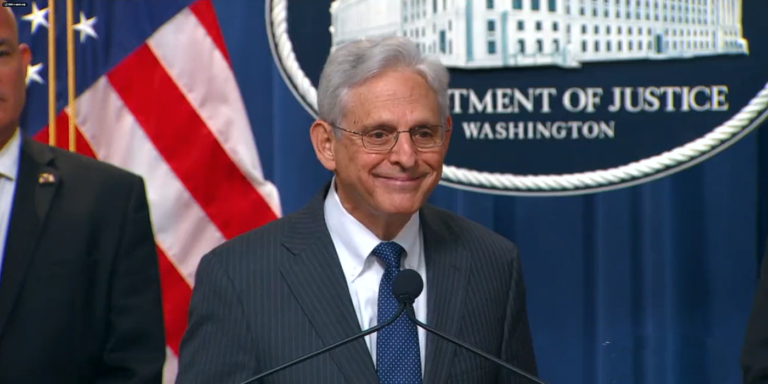
(Headline USA) An “inherent contempt” resolution drafted by Rep. Anna Paulina Luna, R-Fla., to impose actual accountability on corrupt Attorney General Merrick Garland, failed Thursdy after several House Republicans missed the vote.
BREAKING: Rep. Luna Refiles Inherent Contempt Resolution Against AG Merrick Garland
"Today’s vote on my inherent contempt resolution and the legislative appropriations bill did not pass due to some Republican absences. An overwhelming majority of the party supports this… pic.twitter.com/Hs3CFij4NZ
Despite the disappointment, Luna remained optimistic, noting the broad support for her effort among fellow Republicans.
“An overwhelming majority of the party supports this resolution, and it already survived multiple kill-shot attempts by Democrats,” she said in a statement posted on X.
“Our efforts have not been futile, and I thank all the Members who have been fighting alongside me to restore justice and order in our institutions,” she added. “I have refiled the resolution and will be calling it up again in a couple of weeks when Congress is back in session and Members return.”
House Speaker Mike Johnson, R-La., said lawmakers would continue using other tools to obtain the audio recording.
“We expected it to pass, but we’ve been very aggressive on enforcing the subpoena against Merrick Garland and seeking to hold him accountable,” he told the Associated Press after the vote. “We are using every tool in the arsenal to ensure that he follows the law and that we can complete our constitutional responsibility.”
Luna’s proposal sought to fine $10,000 a day until he turned over audio of President Joe Biden’s interview with special counsel Robert Hur in his classified documents case.
Although prosecuting a sitting president undoubtedly would have created other complications, Hur cited the interview as his main reason for opting not to seek charges against Biden, saying his mental state made him appear unfit to stand trial.
Garland, who released a written transcript of the interview, was previously held in contempt of Congress for his refusal to release the audio recordings. However, his Justice Department opted not to prosecute, claiming he was protected by executive privilege.
“No one is above the law,” Luna said during the debate that preceded the vote on the resolution. “This is not a decision that we have reached lightly, but the actions of the attorney general cannot be ignored.”
White House lawyers used the flimsy pretense that they feared release of the audio might be doctored using artificial intelligence and manipulated to make Biden look bad.
Nonetheless, the president’s implosion in a recent debate may have changed the dynamics, shifting the mood among media and many Democrats who had been laying cover for him.
While there is growing acceptance of Biden’s mental infirmities, no Democrats voted in support of the measure, and four Republicans voted against it in the 204-210 defeat.
The vote to hold Merrick Garland in inherent contempt for concealing the Biden/Hur tapes just failed because 12 House Republicans decided to skip the vote.
Based on an earlier Tuesday night vote, they are likely to have been Reps. John Duarte and Tom McClintock of California, and Reps. Dave Joyce and Mike Turner of Ohio.
Garland’s impunity chafed many on the Right in particular due to its parallels with the matter involving Trump advisers Steve Bannon and Peter Navarro, both of whom went to prison after ignoring subpoenas in Democrats’ partisan Jan. 6 commission while citing executive privilege. Critics have said the committee itself was illegitimately formed and that its work was invalid due to countless procedural violations.
Luna herself compared Garland’s abuses to another double standard in the long continuum of two-tiered justice enacted by deep-state Democrats against Republicans. She noted that his actions were precisely those that had been the focus of the 1970s-era Watergate hearings, which ultimately forced the resignation of President Richard Nixon.
Ironic no one in the media is drawing parallels between what Garland is doing and Watergate is insane and deliberate. Turning over edited transcripts of tapes and not the actual recordings was at the heart of the Nixon impeachment. Nixon’s AG resigned when ordered to defy a…
— Anna Paulina Luna (@realannapaulina) July 11, 2024
Appropriately enough, Garland’s alteration of transcripts likewise stem from an impeachment investigation into the sitting president.
Democrats blasted the GOP effort as a political stunt. Rep. Jim McGovern, D-Mass., claimed that the resolution was unjustified in the case of Garland because he had complied with subpoena.
“Their frustration is that they can’t get their hands on an audio recording that they think they could turn into an RNC attack ad,” McGovern said in reference to the Republican National Committee. “When you start making a mockery of things like inherent contempt, you diminish this institution.”
Garland himself has insisted Justice Department went to extraordinary lengths to provide information to the committees about Hur’s classified documents investigation, including the transcript of Biden’s interview. However, Garland has said releasing the audio could jeopardize future sensitive investigations because witnesses might be less likely to cooperate if they know their interviews might become public.
House Republicans sued Garland earlier this month in an attempt to force the release of the recording.
Republicans have accused Biden of suppressing the recording because he’s afraid to have voters hear it during an election year.
The congressional inquiry began with the release of Hur’s report in February, which found evidence that Biden willfully retained and shared highly classified information when he was a private citizen.
Beyond the bitingly critical assessment of Biden’s handling of sensitive government records, Hur offered unflattering characterizations of the Democratic president’s memory in his report, sparking fresh questions about his competency and age that cut at voters’ most deep-seated concerns about the 81-year-old seeking a second term.
(Mike Maharrey, Money Metals News Service) By all accounts, the June Consumer Price Index (CPI) report was great news, but you might want to take it with a grain of salt.
This apparent victory over price inflation likely means the Fed will surrender to inflation.
This CPI report likely tees up a much-anticipated interest rate cut in September. In other words, the apparent victory over rising prices means the Fed can go back to creating inflation.
The June CPI Numbers
CPI came in cooler than expected by every major metric.
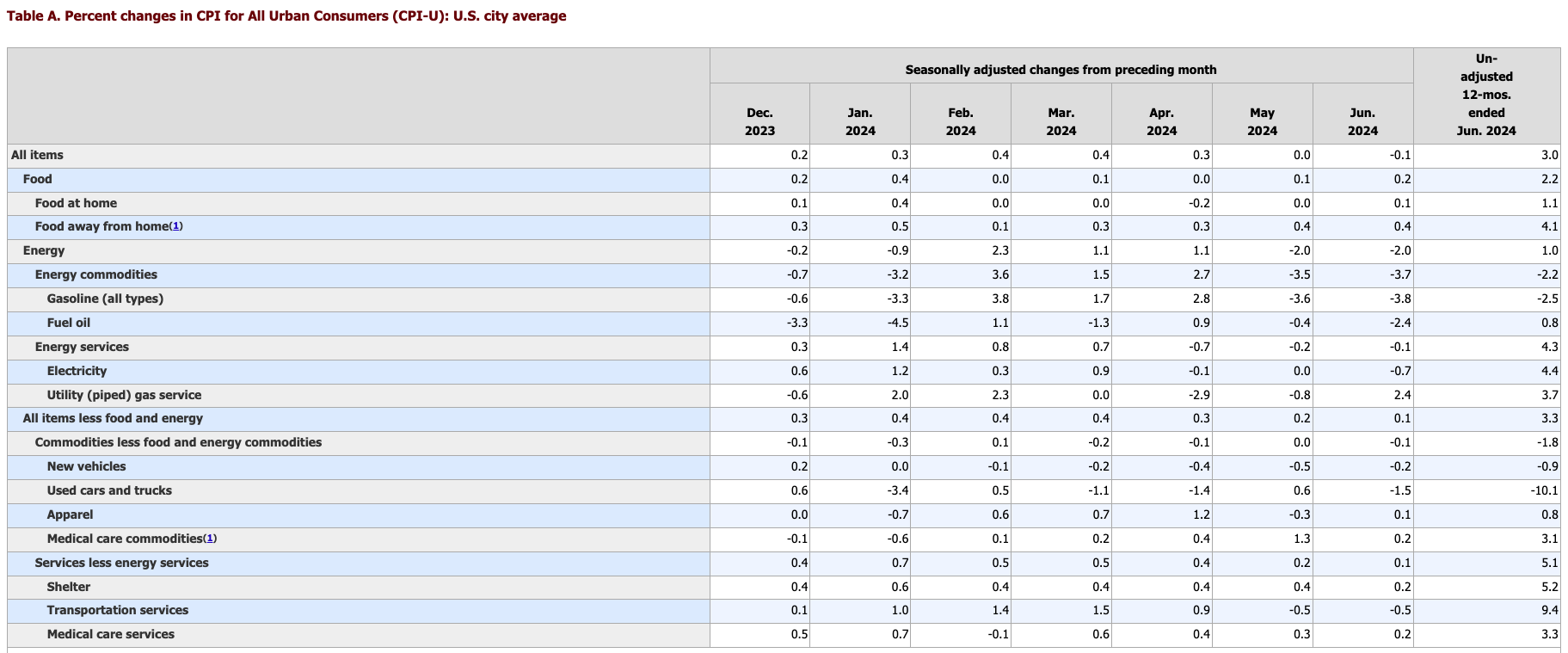
Month-on-month, CPI fell by -0.1 percent in June, according to the Bureau of Labor Statistics (BLS) report. The expectation was for prices to rise 0.1 percent. The last time we saw a negative month-on-month CPI print was in December 2022.
On an annual basis, CPI was 3.0 percent. That compares to a 3.1 percent projection.
Core CPI was up slightly by 0.1 percent. The expectation was for a 0.2 percent rise.
On an annual basis, core CPI came in at 3.1 percent, slightly better than the 3.2 percent projection.
There are a couple of things to note as you digest these numbers.
All of the annual numbers remain well above the mythical 2 percent target. Nevertheless, they are likely low enough for the Fed to justify declaring victory over inflation and moving forward with an interest rate cut in September.
Inflation is worse than the government data suggest. The government revised the CPI formula in the 1990s so that it understates the actual rise in prices. Based on the formula used in the 1970s, CPI is closer to double the official numbers. So, if the BLS was using the old formula, we’re looking at CPI closer to 6 percent. And using an honest formula, it would probably be worse than that.
The Fed doesn’t want to get rid of price inflation. It just wants it low enough that you don’t notice.
Digging deeper into the numbers, we find falling energy prices drove overall CPI lower. Gasoline prices fell by -3.7 percent in June. Overall energy prices dropped by -2 percent month-on-month.
Food prices continued to rise, with food at home up 0.1 percent on the month and food away from home up 0.4 percent.
Shelter prices also continued to rise.
The Grain of Salt
We can debate whether or not price inflation is really dead, however, this CPI report creates the impression that it’s time to start performing last rights.
The problem is the moment we start throwing dirt on inflation’s grave, the Fed is going to begin inflation’s resurrection.
As the Washington Post put it, the June CPI helps “cement the path to rate cuts.” One analyst told the New York Times, “The latest inflation numbers put us firmly on the path for a September Fed rate cut.”
Here’s the grain of salt in all of this good news: rate cuts mean more inflation.
Because most people think inflation simply means “rising prices,” they miss what’s going on. If CPI isn’t going up more than 2 percent, they believe there is no inflation. But Rising prices (price inflation) are merely a symptom of monetary inflation.
Monetary inflation is an increase in the amount of money and credit in the economy. When you get the definition of inflation right, it becomes clear that the Fed creates inflation with a loose monetary policy and this leads to rising prices.
When the Fed starts cutting interest rates, it incentivizes borrowing. That means more credit, and that increases the money supply. So, rate cuts mean inflation.
This is why I say a declaration of victory over inflation is really a surrender.
The central bank pumped nearly $5 trillion into the economy during the pandemic in quantitative easing alone. That was on top of nearly $4 trillion created in the years after the 2008 financial crisis. Meanwhile, the Fed held rates at zero for nearly a decade. They had just gotten started normalizing rates when they started cutting again in 2019 after the stock market got wobbly. Then it went back to zero during the pandemic. This recent tightening cycle did little to wring all of that money out of the economy. The inflation created since 2008 is still sloshing around out there.
Now it’s set to add more.
That’s inflation!
While the Fed did tighten monetary policy when price inflation became too hot to ignore, it never did make monetary policy tight. Even before rate cuts, monetary policy is currently loose by historic standards, as indicated by the Chicago Fed’s own financial conditions index. The NFCI was –0.53 as of July 5. A negative number means financial conditions are loose by historic standards.
While the central bank hasn’t done enough to slay the inflation dragon, it has raised rates high enough to break things in this debt-riddled bubble economy.
In other words, the Fed is stuck between a rock and a hard place.
Federal Reserve Chairman Jerome Powell even admitted this during his testimony on Capitol Hill, saying, “We are well aware that we now face two-sided risks.”
Powell went on to say, “Reducing policy restraint too late or too little could unduly weaken economic activity and employment.” But lowering interest rates too soon could “stall or even reverse the progress we’ve seen on inflation.”
Can the Fed really thread this needle? It seems unlikely.
None of this indicates you should stop worrying about price inflation.
In fact, this is all more reason to worry.
The Fed is about to declare victory over price inflation based on some sketchy CPI data so that it can go back to creating inflation.
Mike Maharrey is a journalist and market analyst for MoneyMetals.com with over a decade of experience in precious metals. He holds a BS in accounting from the University of Kentucky and a BA in journalism from the University of South Florida.
(Mike Maharrey, Money Metals News Service) Gold-backed exchange-traded funds (ETFs) reported net inflows of gold for the second straight month in June.
With European funds leading the way, net gold holdings by ETFs globally increased by 17.5 tons last month.
May was the first month of positive flows into ETFs in 12 months.
ETFs globally hold 3,105.5 tons of gold.
Assets under management (AUM) by gold-backed ETFs stand at $233.3 billion. This was a modest decrease from May due to a slight month-on-month dip in gold prices.
European funds charted the biggest inflows of gold, increasing collective holdings by 17.9 tons.
Interest rate cuts by the European Central Bank (ECB) along with political uncertainty helped drive higher gold investment in the region, according to the World Gold Council.
“Lowering yields were a key contributor to the region’s inflows. Additionally, falling equities and political uncertainties related to elections in the UK and France, which sparked notable inflows there, also pushed up investor interest in gold.”
Asian ETFs increased their collective gold holdings by 7.2 tons in June. It was the 16th straight month of increased gold holdings by Asian funds. It is the only region with positive gold inflows for the year, indicative of the movement of gold from the West to the East.
China was the primary driver of Asian inflows, with Chinese funds adding $429 million of gold in June. Japanese funds also reported strong inflows. Weakening currencies in both countries are helping drive gold investment.
Collective Asian fund gold holdings increased by 41 tons through H1, increasing AUM by $3.1 billion. It was the largest dollar increase in Asian ETF gold holdings on record.
The combination of record-breaking inflows and a higher gold price drove the total AUM of Asian funds to $14 billion, also the highest ever.
Gold flowed out of funds based in North America last month to the tune of 8.2 tons. About $4.9 billion in gold flowed out of North American ETFs through the first half of the year. However, AUM increased by 7.7 percent during H1 thanks to a 13 percent rise in the price of gold.
According to the World Gold Council, “Dollar strength and the continued equity rally may have drawn investor attention away from gold despite falling Treasury yields. Nonetheless, flare-ups in geopolitical risk prompted sporadic inflows, partially offsetting larger outflows during the month.”
Funds in other regions, including Australia, increased by 0.7 tons in June.
Inflows of gold into ETFs can have a significant impact on the global gold market by pushing overall demand higher.
A gold ETF is backed by a trust company that holds metal owned and stored by the trust. In most cases, investing in an ETF does not entitle you to any amount of physical gold. You own a share of the ETF, not gold itself.
ETFs are relatively liquid. You can buy or sell an ETF with a couple of mouse clicks. You don’t have to worry about transporting or storing metal. In a nutshell, it allows investors to play the gold market without buying full ounces of metal at the spot price.
Since you are just buying a number in a computer, you can easily trade your ETF shares for another stock or cash whenever you want, even multiple times on the same day. Many speculative investors take advantage of this liquidity.
But while a gold ETF is a convenient way to play the price of gold on the market, you don’t actually possess any gold. You have paper. And you don’t know for sure that the fund has all the gold either, especially when the fund sees inflows. In such a scenario, there have been difficulties or delays in obtaining physical metal.
Mike Maharrey is a journalist and market analyst for MoneyMetals.com with over a decade of experience in precious metals. He holds a BS in accounting from the University of Kentucky and a BA in journalism from the University of South Florida.
(Ken Silva, Headline USA) NashvilleJudge I’Ashea Myles caused an uproar among transparency advocates earlier this month, when she decided that evidence left behind by trans school shooter Audrey Hale should be kept secret. Judge Myles accepted the dubious argument that Hale’s victims have copyrights to the material—even though the victims haven’t registered with the federal copyright office.
But why are the victims’ families pushing so hard to keep the evidence secret? The Tennessee Star suggested on Wednesday that Vanderbilt University Medical Center, where Hale was treated for more than two decades, might be behind the push for secrecy.
The Star said it contacted attorney Ed Yarbrough, who works at the Spencer Fane firm and represented the Covenant Children’s Trust, to ask whether his client, the Covenant School or Covenant Presbyterian Church were approached by VUMC.
“The Star additionally asked Yarbrough whether VUMC made any financial payments or other form of settlement with the Covenant Children’s Trust or if it was aware of any arrangements between VUMC and the Covenant School, Covenant Presbyterian Church, or any family members of Hale’s victims,” the newspaper reported Wednesday.
“Yarbrough told The Star, ‘Not able to comment.’”
Hale began receiving treatment at Vanderbilt University Medical Center on April 23, 2001, when the shooter was just six years old.
While there, at one point Hale told psych workers about “recent thoughts of going into a school and shooting a bunch of people,” according to The Star, which cited an internal police report that described documents seized from Vanderbilt University Medical Center.
According to The Star, Nashville police may be investigating VUMC staff members for failing to report Hale’s warning signs.
Hale, a 28-year-old woman who was identifying as a man at the time of the mass shooting, gunned down three Christian children and three adults before being killed by law enforcement. In the subsequent investigation, officials discovered the manifesto in Hale’s apartment.
Public interest and concern over what drove the trans mass shooter’s rage has led to intensified calls for the release of the manifesto, which reveals in chilling details what Hale had planned.