Gold’s Breaking Records: But This Metal May Beat It…

(Lau Vegys, Money Metals News Service) 102% – That’s how much silver has rallied since it bottomed during the pandemic crash in March 2020.

If you haven’t been following silver, this may come as a surprise. After all, gold’s been getting most of the attention after it hit new all-time highs, surging past $2,400 an ounce earlier this year.

But the poor man’s gold still has a significant upside from its current levels. And I’m not the only one saying that.

Just yesterday, I read an article featuring Jim Rogers. As you may know, Rogers is a legendary investor, billionaire, and bona fide international man who has successfully completed two round-the-world trips and visited 116 countries. A longtime friend of Doug Casey’s, he is someone worth paying attention to.

In said article, Jim Rogers said something that I found quite interesting. Here’s the quote:

I have some gold, I want to buy some more gold, too. If I were buying one today, I would buy silver. Because you know silver is cheaper. I think silver is down 40% from its all-time high. Gold is near its all-time high. So, I would prefer to buy silver now. I bought some silver yesterday. I hope I buy some more if they go down.

Jim Rogers is, of course, absolutely correct that gold has not yet hit its all-time high when adjusted for inflation.

At any rate, silver’s discount relative to gold becomes even more obvious when you look at its price in real terms. In fact, its current price of $30 per ounce is 48% below its 2011 high of $57.11, adjusted for inflation. But that’s not even the highest price silver has ever reached. Just take a look at the next chart.
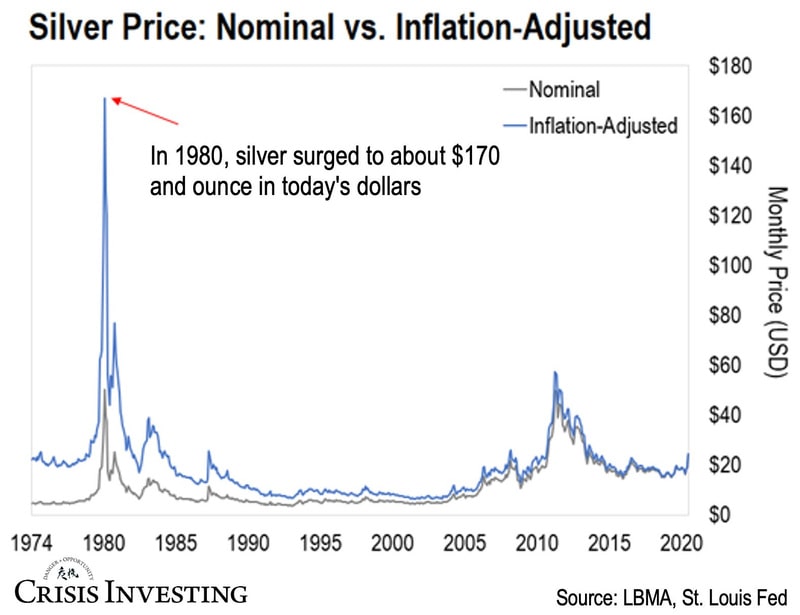
Silver Price: Nominal vs Inflation - Adjusted (Chart)

Back in 1980, silver shot up to $50.36, which would be about $170 in today’s dollars.

Put another way, silver would need to rise 5.8 times from its current price to match its inflation-adjusted peak.

This makes it easy to see why Jim Rogers is so bullish on silver right now. But let’s look deeper to understand why his silver versus gold investment thesis holds even more weight than it appears at first glance.

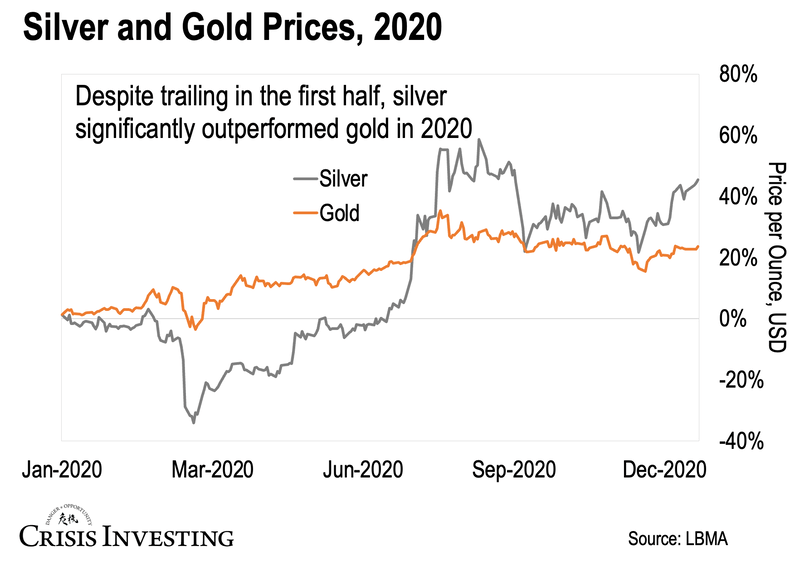
Many people don’t know, but silver tends to trail behind gold in performance. That’s why it didn’t perform as well as gold in both 2022 and 2023 but surpassed it in 2024. And historically, when silver catches up to gold, it tends to blow it out of the water. Just take a look at the chart below, showing silver and gold performance during the pandemic year of 2020.
Silver and Gold Prices, 2020 (Chart)

As you can see, silver trailed behind gold for much of the year, only to decisively overtake it in July/August. By year-end, silver had significantly outperformed gold, gaining 45% compared to gold’s 24%.

But let’s rewind further back in time so you don’t think I’m cherry-picking… to the late 1970s and early 1980s when both gold and silver reached their all-time highs in real terms.

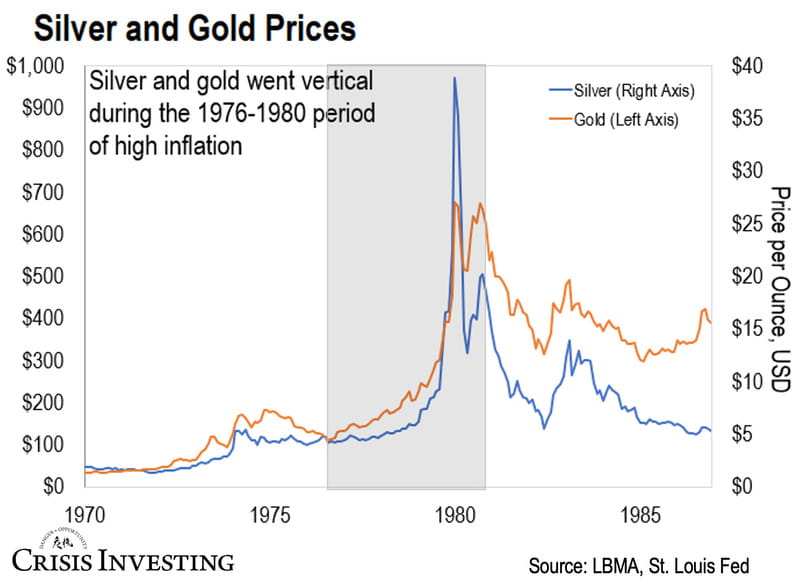
During those years, we had high inflation, geopolitical tensions, and economic uncertainty – much like today. So, investors flocked to gold and silver as safe-haven assets. In the next chart, you can see how both metals shot up during that period.
Silver and Gold Prices (Chart)

Gold gained 415%… with silver returning more than double that – 857%. And it all followed the same pattern: starting off behind gold, silver gradually caught up and surged ahead as the world entered the final year of the 1970s.

Now, there are several reasons why silver tends to start slower but ends up outperforming gold historically… and why I think it’ll happen again this time around.

First, like gold, silver is a precious metal. The word literally means “money” in dozens of languages, and that’s no coincidence. But unlike gold, about 80% of silver is actually mined as a byproduct of industrial metal mining or gold itself. So, the silver supply doesn’t react as directly – or as quickly – to higher prices, like gold usually does.

Then there’s the size of the silver market.

Doug Casey: The market dynamics of silver are very different from those of gold in a number of ways. One important consideration for an investor is that silver is a much smaller market, partly because an ounce of gold is worth about 80 times more than an ounce of silver. When people get interested in it, it tends to move explosively.

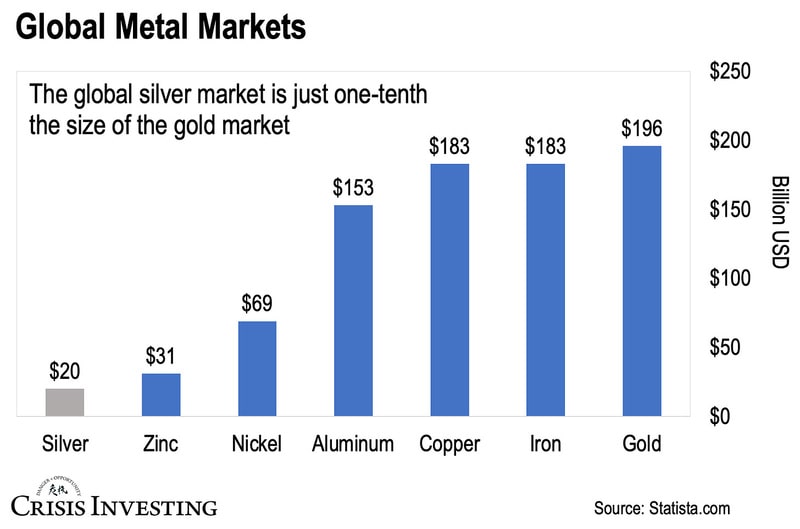
Doug is right on the money. The next chart illustrates just how small silver is compared to other metals. Take a look.
Global Metal Markets (Chart)

You can see that the silver market is only one-tenth the size of the global gold market. It’s even smaller than the zinc and nickel markets.

With a market this small, it only takes a small amount of money to push the price around. And large amounts of money can dramatically impact prices. This makes gold’s more volatile cousin prone to sharper upside explosions.

Now, If you’re looking to invest in silver, it’s crucial to know that not all bets on the silver price are created equal.

Doug Casey always recommends holding precious metals in your long-term investment portfolio. But he also recommends investing in precious metal stocks for even more profits.

That’s because miners tend to do better than the physical commodities when prices rise, as their extraction costs become cheaper. This gives investors more leverage for higher profits… but it also means greater risk.


This article was originally published by the Silver Academy Substack.
Lau Vegys is a financial analyst whose work supports Rogue Economics’ publications. He previously wrote for Crisis Investing, The Casey Report, International Man, and Casey Daily Dispatch, among other newsletters. Lau has an extensive track record of investing in stocks, cryptocurrencies, and financial derivatives. He specializes in spotting megatrends in sectors like precious metals, mining, and tech.


Fort Liberty Tries to Walk Back Military Training that Labeled Pro-Lifers as ‘Terrorists’

(Headline USA) Military officials reportedly tried to walk back a briefing given this month at Fort Liberty in North Carolina, which described pro-life organizations as “terrorist groups.”

A slide from the anti-terrorism awareness briefing was leaked this week by Defense Department whistleblower Samuel Shoemate, who received it from a U.S. Army soldier required to undergo the training at Fort Liberty, formerly known as Fort Bragg.

The training was supposed to be a simple class on “how to be a gate guard and what to look for when on duty,” the U.S. Army soldier said. 

But it quickly became political when a slide titled “Terrorist Groups” showed the logos of the National Right to LIie and Operation Rescue, both pro-life groups. The slide claimed the groups “oppose Row [sic] v. Wade” and are tied to “bombings of clinics” and “attempted murders.”

The slide came directly after a section on ISIS, according to the U.S. Army soldier.

“It’s pretty unsettling that they’d try and conflate pro-life groups to the level of ISIS, but this is the kind of thing we now see all the time,” the Fort Liberty soldier reportedly said. “We’re regularly given briefings that include stuff like, ‘If your co-workers are expressing support for the Second Amendment, keep an eye on them. They could be a danger.’” 

Fort Liberty officials claimed the briefing had not been properly “vetted by the appropriate approval authorities” and said the slides “do not reflect the views of the XVIII Airborne Corps and Fort Liberty, the U.S. Army or the Department of Defense.”

Officials blamed the briefing on a “local garrison employee” and said the “slides will no longer be used and all future training products will be reviewed to ensure they align with the current DoD anti-terrorism guidance.”

The National Right to Life blasted the briefing as “deeply offensive” and said officials’ statement on the matter doesn’t suffice.

“Only under the Biden administration can peaceful law-abiding citizens and their peaceful activities be considered ‘terrorism,’” NRL President Carol Tobias said in a statement. “The Biden administration promotes the deaths of preborn babies and advocates for unlimited abortion, but peaceful pro-life Americans are labeled ‘terrorists.’”

White Rapper Eminem Accuses Candace Owens of Forgetting She’s Black

(Jacob Bruns, Headline USA) Celebrity white rapper Eminem, following the latest trends, made a “diss track” accusing conservative commentator Candace Owens of betraying black people by being at outspoken Republican who supports 2024 candidate Donald Trump, OK Magazine reported Friday.

The aging rapper penned a song named after Satan, called Lucifer, wherein he slammed Owens for not being “black” enough.


The lyrics of Lucifer include the following derogatory lines about Owens:

“And Candace O, I ain’t mad at her, I an’t got’ throw the fact that b—- forgot she was Black back at her. Laugh at her, like them crackers she’s backin’ after her back is turned on a cute MAGA hat with her brand new White Lives Matter shirt. Or say this MAGA dirtbag in a skirt just opened the biggest can of worms on the whole planet Earth.”

The white rapper then continued on to call Owens “Klandace,” a “Grand Wizard,” presumably alluding to the Ku Klux Klan, snidely suggesting that she is a member of the infamous group.

He concluded his remarks about Owens by suggesting that he has plans “to get in her pants.”

Eminem may have been triggered by Owens’ prior mockery of him when he threatened to sue then-Republican presidential candidate Vivek Ramaswamy for using his music at rallies.

At the time, Owens said that “Eminem, the once hardcore rapper” is “getting older and gayer.”

“Sometimes Grandpa needs to sit down,” she added. “He is definitely deteriorating with age.”

Eminem, who made a career out of pretending to be a rebel, has in recent years shown himself to be an establishment hack.

From kneeling during his 2022 Super Bowl halftime performance to the Ramaswamy threat Eminem has exposed himself as an attention-starved fraud who will do whatever it takes to stay in the spotlight as he ages.

Senator Cruz Opens Investigation into Big Tech Funding Biden Administration Staff Salaries

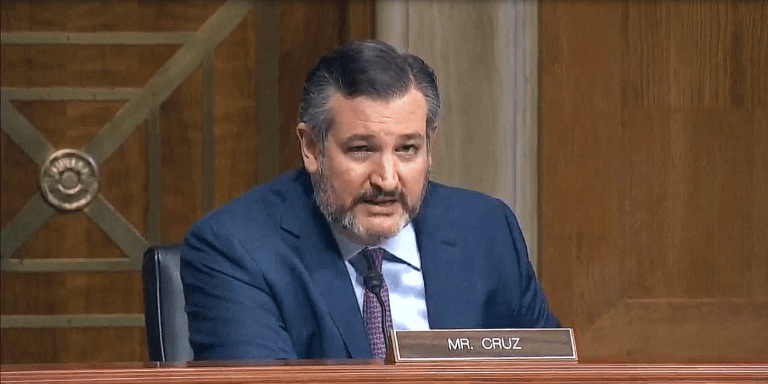
(Bethany Blankley, The Center Square) U.S. Sen. Ted Cruz, R-TX, a ranking member of the U.S. Senate Commerce Committee, has opened an investigation into “‘Big Tech’ companies’ funding of Biden administration staff salaries through an obscure program.”

Cruz, R-Texas, sent letters to the heads of four federal agencies to obtain information on whether the Biden administration was using an Intergovernmental Personnel Act (IPA) program to temporarily hire Big Tech Artificial Intelligence employees to implement an executive order the president issued last October.

The order on “Safe, Secure, and Trustworthy Artificial Intelligence” directed federal agencies to take more than 100 actions to establish AI-related guidance across various policy areas. In April, the White House announced the agencies had completed all required actions on time and hired over 150 AI and AI-enabling professionals. Working with tech talent programs, they were “on track to hire hundreds by Summer 2024.”

Cruz sent letters to the heads of the Federal Trade Commission, Department of Commerce, National Science Foundation, and Department of Transportation.

“To complete every action, agencies would have had to … bring on AI fellows by recruiting temporary – but influential – AI staff from external organizations through the … IPA program,” he said. “Critics, however, have raised reasonable concerns that these influential AI fellows are shaping federal policy to benefit their organizations’ funders and not the American people. Moreover, as federal agencies request increased funding for AI hiring, it is important Congress understand the extent to which, and how, agencies have already acquired AI staff in response to the expansive and demanding AI Executive Order.”

He also said hiring the Big Tech employees created “serious conflicts of interest.”

“The administration’s reported use of the IPA program to obtain AI staff, however, raises the question whether outside AI groups are improperly influencing federal AI policy,” he said.

Citing a March 2022 Politico report, Cruz notes that Google’s former CEO, Eric Schmidt, “was using the IPA program to fund his associates’ placement at the Office of Scientific and Technology Policy in the White House, which ‘is executing on an aggressive agenda’ regarding ‘algorithmic discrimination in the use of artificial intelligence’ – an alarmist phrase meant to justify the unelected bureaucracy’s policing and potential censorship of AI algorithms.”

He also cites a March 2024 report that revealed that through the IPA program, Facebook billionaire Dustin Moskovitz was paying the salaries of his fellows who were working in AI roles at the National Security Council, the Department of Defense, and the Department of Commerce.

“In effect, large AI technology companies are influencing the Biden administration’s AI policy from the inside and advancing their own anti-competitive agenda to shape the future of the AI industry,” Cruz said.

Because federal agencies are not required to report their IPA assignments, the Biden administration “can utilize these Big-Tech funded AI fellows with zero transparency to the American people,” Cruz warned.

The letters request the heads of the FTC, Commerce, NSF, and DOT to provide documentation and respond to questions about employees or IPA program fellows hired in response to the AI executive order no later than July 15.

The investigation was launched after U.S. House committees have held hearings and launched investigations on Big Tech’s role in a range of issues from censorship to child safety.

Privacy Groups: DOJ Gagging Twitter about Trump Search Warrant Was Unconstitutional

(Ken Silva, Headline USA) At least two major privacy organizations have come to support Elon Musk’s challenge to the gag order the Justice Department put on Twitter/X last year, when the DOJ issued a search warrant for Donald Trump’s Twitter account.

Musk’s challenge stems from Special Counsel Jack Smith obtaining a search warrant for Trump’s Twitter account in January 2023 as part of his investigation into the former president. As Headline USA exclusively reported last November, the DOJ obtained a vast trove of data about the former President’s social media activity, including info on every account to like, follow or retweet him.

Twitter tried challenging the broad search warrant, as well as a gag order preventing the company from notifying Trump, and the company held in contempt for its troubles. Last July, the Washington DC Appeals Court upheld a $350,000 fine against Twitter issued by Obama-appointed District Judge Beryl Howell.

Twitter’s challenge isn’t over yet. In a petition filed with the U.S. Supreme Court on May 30, the company asked for SCOTUS to review the gag order.

According to Twitter’s attorneys, the gag order violated Trump’s executive privilege, along with the First Amendment.

“The government can now circumvent the [Presidential Records Act] and deny privilege-holders their opportunity to assert privilege by seeking communications from, and gagging, third parties,” Twitter argued in its petition.

“And in the tens of thousands of other cases where the government obtains nondisclosure orders, the government can invade other privileges—including attorney-client, journalist-source, and doctor-patient— without notice,” the company added.

“Meanwhile, the First Amendment rights of service providers like Twitter to notify users in time for them to assert privileges can be irreparably injured.”

Two privacy groups have filed amicus briefs in support of Twitter’s challenge: the Electronic Frontier Foundation and the Project for Privacy & Surveillance Accountability, or PPSA.

In a press release, PPSA explained why it’s supporting Musk’s challenge.

“In the case of X, the government has seized the company’s records on customer communications and then slapped the company with an NDO to force it to shut up about it,” the group said.

“The government claims this secrecy is needed to protect the investigation, even though the government itself has already publicized the details of its investigation. Whatever you think of Donald Trump, this is an Orwellian practice.”

EFF made a similar argument in its amicus brief, which was filed on July 2.

“In barring Twitter from speaking before that speech occurred, the nondisclosure order acted as a quintessential prior restraint: ‘the most serious and the least tolerable infringement on First Amendment rights,’” the group said, quoting from SCOTUS case law.

Jack Smith issued his own response on July 3, arguing that the gag order on Twitter was appropriate. Smith asked SCOTUS to deny Twitter’s petition.

There’s no public indication of when SCOTUS might decide on the matter.

Ken Silva is a staff writer at Headline USA. Follow him at twitter.com/jd_cashless.

Navigating Inflation and Precious Metals: Insights from David Morgan on Gold, Silver, and Platinum Markets

(Money Metals News Service) In a recent episode of the Money Metals Podcast, host Mike Maharrey interviewed David Morgan, a renowned precious metals analyst and founder of the Morgan Report.

The conversation covered a wide array of topics, from inflation and its impacts on precious metals to the dynamics of the silver market and the potential for platinum. Morgan shared his insights on current economic trends, historical perspectives, and future predictions.

(Interview Begins Around 5:50 Mark)

Who is David Morgan?

David Morgan
David Morgan

David Morgan is a highly respected analyst in the precious metals sector and the founder of the Morgan Report, a research and advisory publication dedicated to the precious metals market. With decades of experience, Morgan is known for his in-depth analysis of silver, gold, and other metals. He has been a featured speaker at investment conferences worldwide and is a frequent guest on financial news programs.

Morgan’s expertise extends beyond market analysis; he is also a passionate advocate for sound money and economic freedom, often highlighting the historical and monetary significance of precious metals. His work aims to educate investors on the intricacies of the market and the importance of maintaining a diversified portfolio.

Key Questions and Answers:

How do you see the recent CPI data playing out in the precious metals market? 

Morgan expressed skepticism about the CPI numbers, noting that the way inflation is measured today is significantly diluted compared to 1980. He mentioned John Williams from Shadowstats.com, who suggests the true inflation rate is likely double the reported figures. Morgan emphasized that while the official rate might be around 3%, the cumulative inflation over the past few years still heavily impacts consumers.

  • David Morgan: “The way they measure the CPI now has been diluted greatly from the way it used to be measured in 1980. The true inflation rate is at least double what purportedly we’re at.”
What are your thoughts on the gold-silver ratio and its historical context? 

Morgan explained that historically, the gold-silver ratio never exceeded 20 when silver was used as money. He believes that silver’s dual role as money and an industrial metal keeps its price at production cost rather than market value. He predicted a bullish future for silver due to increasing industrial demand, particularly in photovoltaics, and rising investment interest, especially from China.

  • David Morgan: “When it was money, the ratio never got above 20 for thousands of years… Silver is more than money; it’s money and an industrial essential commodity.”
How do you view the potential of the platinum market?

Morgan highlighted that 70% of platinum comes from South Africa, which faces significant energy and political challenges. He sees this as an opportunity, suggesting that any disruption in supply could lead to a substantial increase in platinum prices. He also noted that platinum has historically been more expensive than gold and that its demand is likely to rise with a shift back to hybrid vehicles requiring catalytic converters.

  • David Morgan: “Seventy percent of it comes from South Africa, and they’re having energy problems, they’re having political problems. It wouldn’t take much for something to go awry… where all of a sudden, that small supply would drain to a much smaller one.”
What will it take to boost gold stocks and align them with the physical metal market?

Morgan noted that gold stocks are currently undervalued, making them attractive to value investors. He suggested that as gold prices continue to rise, interest in gold stocks will naturally follow, potentially leading to a significant rally. He emphasized the importance of recognizing the value in mining shares, which are highly leveraged to gold.

  • David Morgan: “The cure for low prices is low prices… the earnings on these gold stocks are pretty phenomenal in some cases, and they’re highly leveraged to gold.”
How might the upcoming presidential election impact the precious metals market? 

Morgan discussed the potential impact of the presidential election on the precious metals market. He suggested that while the election might temporarily influence market sentiment, the underlying economic issues will remain. He emphasized the importance of realistic expectations and long-term planning, regardless of who wins the election.

  • David Morgan: “Regardless of who gets in, this 3% inflation but groceries are up 400% in the most recent years… I think we have hit that point where almost everyone in the United States knows this inflation thing is for real and there’s no way out.”

Morgan Report and Upcoming Projects

Towards the end of the interview, Maharrey asked Morgan to share more about the Morgan Report. Morgan explained that the report offers both free and paid services, providing valuable insights into the precious metals market. He also mentioned his upcoming documentary, “Silver Sunrise,” which aims to present a holistic view of the monetary system, incorporating both factual and spiritual perspectives.

  • David Morgan: “The best place to go to the main page is themorganreport.com. There’s a free service as well as a paid service… My documentary, ‘Silver Sunrise,’ aims to relieve the stress and control of money, kind of get rid of the fear.”
Conclusion

The interview concluded with Maharrey expressing his appreciation for Morgan’s insights and looking forward to future discussions. Morgan’s comprehensive analysis and historical perspective offered listeners a deep understanding of the precious metals market and the broader economic context. To get started investing in precious metals, visit moneymetals.com.

‘Morning Joe’ Admits Obama Secretly Working Behind the Scenes to Smear Biden

(Jacob Bruns, Headline USA) As pressure builds for President Joe Biden to step aside, rumors abound that former President Barack Obama is secretly attempting to undercut his 81-year-old ex-running mate.

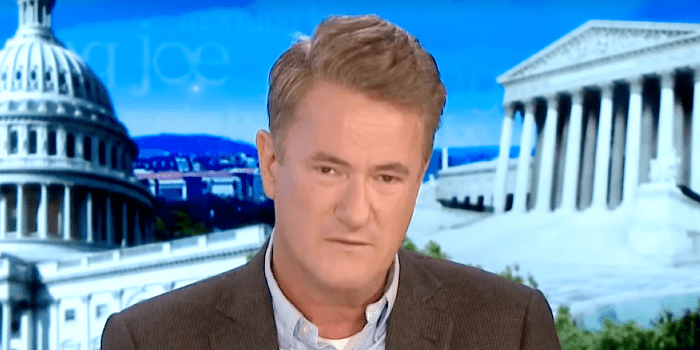
In a Thursday segment of MSNBC’s Morning Joe, host Joe Scarborough admitted, “many Democratic officials do believe that Barack Obama is quietly working behind the scenes to orchestrate” Biden’s ouster.

According to Scarborough, however, if that were true, it would only cause Biden to dig in deeper.

“The pathway to Joe Biden graciously stepping aside does not go through the Obamas or the Clintons,” he said.

Obama’s precise motives remain unclear, although speculation that his wife, Michelle, could enter the field has been rampant—in spite of her frequent denials to that effect.

There is also talk that the Obamas and Bidens maintain a deeply strained and distrustful relationship, with the latter living in constant fear that the sitting president could “f**k things up” at any moment and destroy all that he built in the process.

Either way, it is undeniable that some of Obama’s closest surrogates and advisers have been among the most vocal attack dogs in questioning Biden’s ability to remain atop the 2024 presidential ticket, even if Obama himself has largely kept his powder dry thus far.

Obama himself appeared to defend Biden following his disasterous debate last month, reasurring Democrat voters that even the incarnate Messiah himself might have an off night from time to time.

Meanwhile, according to multiple reports including a recent Politico account, Obama is quietly encouraging select allies to ratched up the pressure campaign.

One such figure, A-list Hollywood actor George Clooney, published a scathing New York Times op-ed that confirmed Biden was “the same man we all witnessed at the debate.”

Despite Clooney’s earlier silence on the matter, while urging deep-pocketed donors to shell out some $30 billion on behalf of the vegetative commander-in-chief, the Batman and Robin star confessed that Biden appeared vacant during a recent fundraiser in Los Angeles.

Former House Speaker Nancy Pelosi, D-Calif., may also be surreptitiously rallying the Democratic establishment to oust the president while publicly insisting he has her full support.

During a Wednesday morning appearance on Morning Joe (reportedly Biden’s preferred source of “information”), Pelosi’s language was noncommittal and vague—even coming off as passive aggressive.

“It’s up to the president to decide if he’s going to run,” she offered, despite the fact that Biden has repeatedly emphasized that he is committed to staying in the race. “We’re all encouraging him to make that decision, because time is running short.”

Get Ready for Lower Interest Rates as Fed Loses Its Nerve

(Mike Gleason, Money Metals News Service) As the Federal Reserve signals it is moving closer to cutting rates, the gold market is moving closer to hitting a new record.

On Thursday, the monetary metal catapulted back above the $2,400 level, trading about $25 shy of a new all-time high. Meanwhile, silver is following its nice midweek gains by giving back a portion of that today.  

We saw something of a bifurcation take place in metals markets yesterday as the platinum group metals, along with copper, fell. Meanwhile, the monetary metals, along with mining stocks, rose.

At the same time, equity investors dumped shares of high-flying market leaders including Nvidia. The tech-heavy Nasdaq lost 2% on the day. 

Investors may be concerned that recent signs of a weakening job market and softening manufacturing activity could point to trouble ahead for economically sensitive sectors. Of course, Wall Street perma-bulls will interpret bad news on the economic front as good news for markets because the Federal Reserve will be more inclined to cut interest rates. 

Comments from Fed chairman Jay Powell and a host of other current and former central bank policymakers this week suggest a rate cut could come in September. 

Jerome Powell Angry. ChatGPT. Joshua D Glawson.

Central bankers feel encouraged by Thursday’s Consumer Price Index report.  That particular measure of inflation eased in June, with the CPI coming in at an annual rate of 3%. That’s a significant improvement from the 3.3% reading in the previous month’s report.

It’s still a long way from the Fed’s stated target of 2%. But Chairman Powell reiterated this week that he doesn’t need to see the 2% target hit before cutting rates. All he needs is to see some progress toward the objective and then project that progress neatly and conveniently into the future.

Whether inflation as the government calculates it ever actually does go down to 2% on a sustained basis is another question. Powell doesn’t know the answer to it. But that won’t stop him from making arbitrary projections about inflation continuing to come down even after he starts cutting rates. 

Maybe he’ll be right this time. But the Fed does have a history of getting things wrong when it comes to things like forecasting what the economy will do.

Central planners imagine that they know more than what the market knows at any given time. They imagine that their interventions can produce better outcomes for the economy than if it were left to its own devices.

The truth is that not even a group of the most brilliant economists in the world could devise a formula for determining what the inflation rate will be a year from now or when the next recession or financial crisis will hit.  No one knows what the optimal interest rate is at any given time.

In assuming the role of setting short-term rates for the entire economy, the Federal Reserve has prevented market forces from balancing all the factors the Fed supposedly weighs – along with others that central planners may be overlooking. Instead, market resources have been misdirected from responding to real factors in the economy to responding to decrees from central bankers. 

Trying to predict the Fed’s next policy move or properly interpret the latest Fedspeak verbiage has become the biggest game on Wall Street.

Investors who hold gold and silver do so in part because they distrust the Fed. They don’t think central bankers have the ability to see the future or the willingness to genuinely pursue their mandate of price stability.

Precious metals investors also tend to be humble enough to admit that they are uncertain about the future. That’s why they hold core positions in bullion regardless of prevailing market conditions. 

Though often derided as “doom and gloomers” by Wall Street cheerleaders, most hard money holders own financial assets as well. They just don’t like the idea of having 100% exposure to the risks inherent in the financial system. 

Some people who own gold and silver are also bullish on the stock market. But they know that a bullish trend can be upended at any time by black swan events that no one saw coming.

Investors who want to be financially resilient in uncertain times should be well diversified into a mix of asset classes, including physical precious metals held outside the banking system.


Mike Gleason is a Director with Money Metals Exchange, a national precious metals dealer with over 500,000 customers. Gleason is a hard money advocate and a strong proponent of personal liberty, limited government, and the Austrian School of Economics. A graduate of the University of Florida, Gleason has extensive experience in management, sales, and logistics, as well as precious metals investing. He also puts his longtime broadcasting background to good use, hosting a weekly precious metals podcast since 2011, a program listened to by tens of thousands each week.

The Federal Government Is Spending Us Into Oblivion

(Mike Maharrey, Money Metals News Service) The June federal budget deficit was “only” $66 billion. This looks like a big improvement, but it wasn’t. 

Even more concerning is the fact that interest on the accumulating debt is eating up nearly one-third of federal tax receipts. 

The deficit came in lower because $93 billion in June payments were pushed back into May with the last day of the month falling on a Saturday. This resulted in the largest May deficit on record.

Accounting for the calendar effects, the June deficit was in the $158 billion range.

The June deficit pushed the fiscal 2024 budget shortfall to $1.27 trillion with three months remaining. 

The deficit was also mitigated somewhat by strong receipts in June. The U.S. government collected $466.26 billion last month, according to the latest monthly Treasury statement. This was an 11.5 percent increase in revenue compared to June 2023. 

June’s big year-on-year revenue increase wasn’t an anomaly. To give you an idea of how well the Treasury is doing, in April, Uncle Sam ran a surplus thanks to tax day. Tax receipts came in at $776.2 billion in April, a 22 percent increase over last year.

This blows apart the notion often bandied about that the deficits are because of tax cuts. The real problem is on the spending side of the ledger.

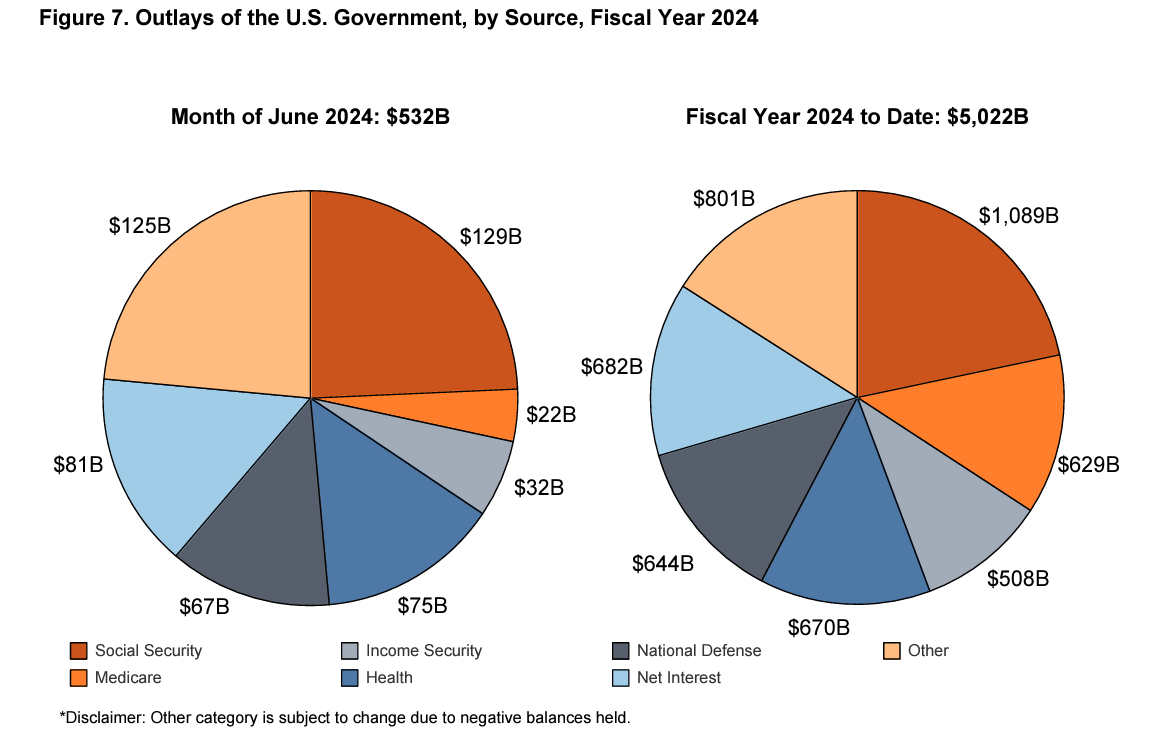
Even with some June payments pushed back into May, the Biden administration still managed to blow through $532 billion last month.

Through eight months of fiscal 2024, the federal government has spent a staggering $5 trillion. That’s up 8 percent over the same period last year.

And there is no end to the spending in sight. 

Outlays continue to increase despite the [pretend] spending cuts and promises from the Biden administration that it would save “hundreds of billions” with the debt ceiling deal (aka the [misnamed] Fiscal Responsibility Act).

This reveals the ugly truth. No matter what you hear about spending cuts in Washington D.C., the federal government always finds new reasons to spend more and more money. Whether it’s a disaster, an emergency, or somebody else’s war, the spending train never reaches the station.

This problem isn’t specific to Biden or Democrats in general. The Trump administration was running $1 trillion deficits before the pandemic. In other words, Trump was generating Obamaesque deficits despite having what he claimed was the strongest economy in history. 

Borrowing and spending is a bipartisan sport. 

The problem is the only way to whittle down spending would be to address the biggest outlays – entitlements, national defense, and the interest on the debt. Congress lacks the political will to cut defense or reform Social Security and Medicare. And it can’t do anything about the interest on the debt other than lower the debt.

Speaking of the debt, massive monthly budget shortfalls are pushing it higher at a dizzying pace. On December 29, the national debt eclipsed $34 trillion for the first time. When Congress effectively eliminated the debt ceiling on June 5, 2023, the national debt stood at a “mere” $31.46 trillion. As of June 13, the national debt stood at over $34.86 trillion.

The Interest Problem

The federal government spent $140.2 billion paying interest on the national debt in June. That is just over 30 percent of the month’s total tax receipts.

So far in fiscal 2024, it has paid $867.7 billion. That is a 33 percent increase over last year.

So far this year, the federal government has spent more on interest than it has on national defense ($644 billion) or Medicare ($629 billion). The only spending category bigger than interest is Social Security. 

And interest expenses will only continue to climb.

Much of the debt currently on the books was financed at very low rates before the Federal Reserve started its hiking cycle. Every month, some of that super-low-yielding paper matures and has to be replaced by bonds yielding much higher rates.

Anybody who says “deficits don’t matter” is deluded.

And the only way out of this fiscal death spiral is significant spending cuts and/or major tax hikes.

What’s It to You?

A lot of people think deficits and debt don’t matter. After all, we’ve been dealing with them for years, and “nothing bad has happened.” 

But as economist Daniel Lacalle pointed out in an article published by the Mises Wire, bad things are happening.

The CBO projects spending to soar to $10.3 trillion annually by 2034. Even with an overly optimistic expectation of solid economic growth. That would be 24.9 percent of GDP.

As Lacalle points out the ramifications of this government spending spree:

“The CBO projections prove without a doubt that there is no way in which the United States could balance the budget through revenue measures. There is no set of revenue measures that can collect $2 trillion per year in additional annual receipts. Increases in taxes would inevitably slow down investment and growth and reduce long-term potential receipts. Furthermore, even if the United States government was able to increase revenues, the likelihood of a recession in the next ten years, added to the promises of more “extraordinary” expenses in election years, would make the deficit soar regardless of any revenue improvement. An economy that generates an annual deficit of 6 percent of GDP to achieve a mere 2 percent annual growth is on a dangerous path, even if that kind of growth is sustained. Inevitably, at the first sign of a recession, the government would spend even more.”

This may sound like a lot of accounting blah, blah, blah. Why should you care about the borrowing and spending? Isn’t that Washington D.C.’s problem?

Lacalle says three things should concern you. 

  1. Higher taxes
  2. Weaker economic growth
  3. Declining purchasing power of your salary and savings (Price inflation)

“If you hail deficit spending, you are embracing impoverishment. If you defend this kind of deficit spending, you are actively supporting stagnation.”


Mike Maharrey is a journalist and market analyst for MoneyMetals.com with over a decade of experience in precious metals. He holds a BS in accounting from the University of Kentucky and a BA in journalism from the University of South Florida.

House GOP Subpoenas Biden’s Alleged White House Handlers

(Ken Silva, Headline USA) House Oversight Chairman James Comer, R-Ky., issued subpoenas Wednesday to three White House staffers who are reportedly “running interference” for President Joe Biden and performing his duties amid his declining cognitive state.

Citing a July 5 Axios article, Comer said the three White House staffers—Annie Tomasini, Anthony Bernal, and Ashley Williams—have created “a protective bubble around” Biden, who is “staffed so closely that he’s lost all independence.”

“The White House has shielded three key aides from testifying about President Biden’s mishandling of classified documents and now we’ve learned through reporting these same aides are also seeking to cover up President Biden’s declining cognitive state inside the White House,” Comer said in a Wednesday press release.

“President Biden is clearly unfit for office, yet his staff are trying to hide the truth from the American people. Key White House staff must come before our committee so we can provide the transparency and accountability that Americans deserve.”

Comer asked the White House staffers to contact his committee by this coming Wednesday to schedule their depositions.

Meanwhile, the Oversight chairman is also seeking information from Biden’s personal physician, Dr. Kevin O’Connor.

In a letter earlier this month, Comer accused Dr. O’Connor of participating in shady Biden business deals, suggesting that could have motivated the physician to sugarcoat his health assessment of the president.

“The [committee] is investigating circumstances surrounding your assessment in February of this year that ‘President Biden is a healthy, active, robust 81-year-old-male, who remains fit to successfully execute the duties of the Presidency …’  Recently, it was reported that you have ‘never recommended that [President] Biden take a cognitive test,’” Comer told O’Connor.

“The Oversight Committee is concerned your medical assessments have been influenced by your private business endeavors with the Biden family.”

Comer asked Dr. O’Connor to contact his staff by this Sunday. Comer also seeks all documents and communications in your possession regarding Americore and James Biden.

Ken Silva is a staff writer at Headline USA. Follow him at twitter.com/jd_cashless.