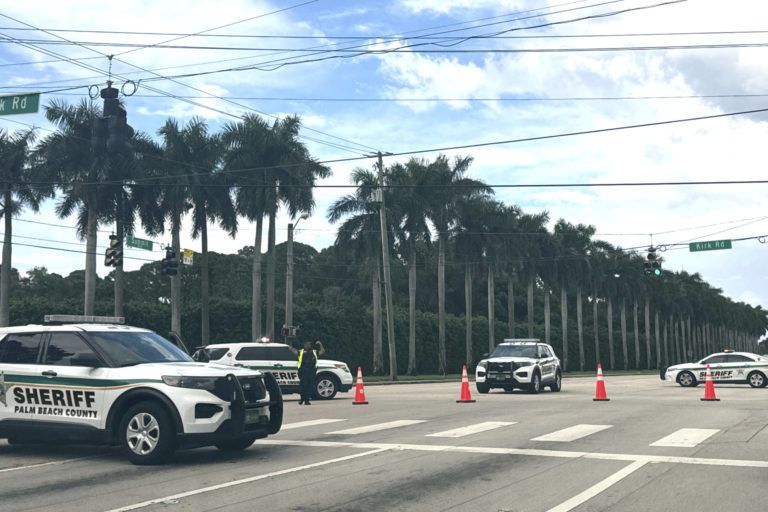
(Ken Silva, Headline USA) A whistleblower has come forward to alleged that the Secret Service failed to protect “known vulnerabilities” at the West Palm Beach on Sunday, which led to Donald Trump nearly being assassinated—again.
Sen. Josh Hawley, R-Mo., revealed the whistleblower allegation in a Wednesday letter to Secret Service Acting Director Ronald Rowe. Hawley said the whistleblower has protected Trump at that same golf course where Ryan Routh allegedly attempted to kill Trump.
According to Hawley, the whistleblower told him that there are “known vulnerabilities” in the fence line surrounding Trump’s golf course—places that offer a clear line of sight to the former president and others playing the course.
🚨🚨 NEW – A whistleblower now tells me that Secret Service apparently ignored “known vulnerabilities” surrounding Trump’s golf course, leading to the assassin spending 12 hours in wait
“As a result, the whistleblower alleges it has been Secret Service protocol to ‘post up’ agents at these vulnerable spots when Trump visits the course. That apparently did not happen on September 15. Instead, the gunman was permitted to remain along or near the fence line for some 12 hours,” Hawley told Rowe.
“It is further unclear from your recent press conference whether agents swept the perimeter of the golf course at any point, or whether drones were used to surveil the fence line. The reality is that the would-be assassin should never have been able to linger around the course for that long undetected.”
At a Monday press conference, Rowe seemed to blame Trump’s last-minute decision to golf on the lack of security preparations.
“The president wasn’t even really supposed to go there,” Rowe said. “It was not on his official schedule.”
Unnamed sources in the federal government are also blaming Trump’s golfing habits for Sunday’s security failure.
“Soon after Donald Trump became president, authorities tried to warn him about the risks posed by golfing at his own courses because of their proximity to public roads. Secret Service agents came armed with unusual evidence: not suspect profiles or spent bullet casings, but simple photographs taken by news crews of him golfing at his private club in Sterling, Va,” the Washington Post reported Monday, citing unnamed sources.
“They reasoned that if photographers with long-range lenses could get the president in their sights while he golfed, so too could potential gunmen, according to former U.S. officials involved in the discussions who, like most others interviewed for this story, spoke on the condition of anonymity because of the matter’s sensitivity.”
Trump has not indicated that he will stop golfing. Meanwhile, Hawley told Rowe in his letter that he’s demanding answers “immediately.”
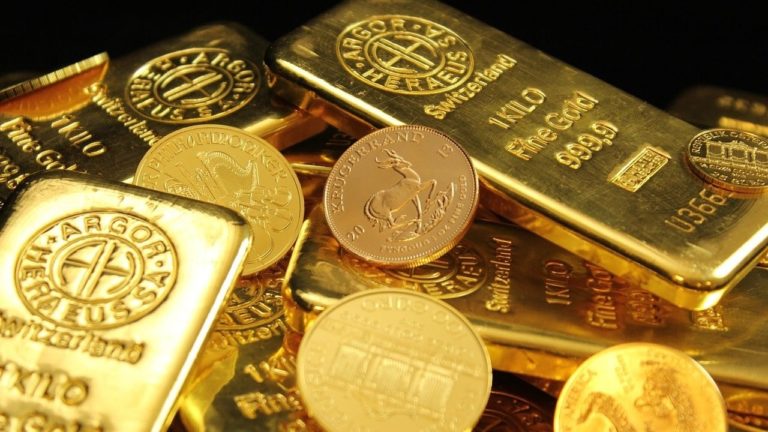
(Mike Maharrey, Money Metals News Service) Hedge fund billionaire John Paulson said he would pull his money out of the stock market and go into cash and gold if Kamala Harris wins the election.
The Paulson and Co. founder and CEO has been called “one of the most prominent names in high finance.” He’s best known for making billions by betting against the subprime mortgage lending market in 2007.
Paulson appeared on Fox Business’s Claman Countdown and told Liz Claman that he would be “very concerned” if Harris wins the White House and pursues the tax plans and economic policies she’s outlined.
Harris has floated several economic policies on the campaign trail, including raising the corporate tax rate from 21 to 28 percent, taxing unrealized capital gains, and banning grocery “price gouging.”
“I think the uncertainty regarding the plans they outlined would create a lot of uncertainty in the markets and likely lower markets.”
Paulson said the proposed tax on unrealized capital gains on individuals making $100 million or more was particularly troubling and “would cause mass selling of almost everything – stocks, bonds, homes, art – I think it would result in a crash in the markets and an immediate, pretty quick recession.“
When Claman pressed him, Paulson reiterated that he would pull money from the liquid assets from the market and go heavy into gold.
“I think if Harris was elected, I would pull my money from the market. I’d go into cash, and I’d go into gold.”
Paulson is a prominent fundraiser for the Trump campaign, and there is speculation that he would be a candidate for Secretary of the Treasury in a Trump administration.
Mike Maharrey is a journalist and market analyst for MoneyMetals.com with over a decade of experience in precious metals. He holds a BS in accounting from the University of Kentucky and a BA in journalism from the University of South Florida.
(Mike Maharrey, Money Metals News Service) Jerome Powell says the economy is in “solid shape.” Jerome Powell says inflation is still elevated. Jerome Powell says he doesn’t see a recession risk.
And yet the Federal Reserve just supersized its rate cut, indicating that the central bankers are more worried about the impact of higher interest rates on this debt-riddled, bubble economy than they’re letting on.
And as the saying goes, actions speak louder than words.
What the Federal Reserve People Did
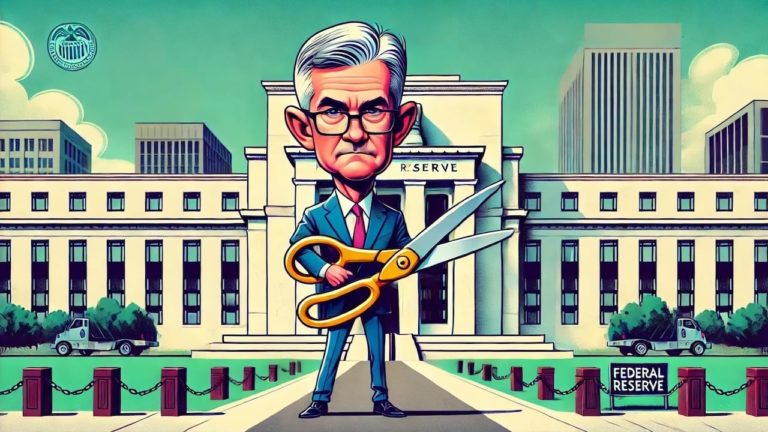
As expected, the FOMC wrapped up its September meeting by announcing an interest rate cut. It was the first cut since 2020.
However, somewhat unexpectedly, the Fed committee went big and slashed rates by half a percentage point, setting the federal funds rate in a range between 4.75 and 5 percent.
While there was growing speculation that the FOMC might go for a 50-basis point cut, most analysts expected the central bank to ease into easing with a 25-basis point cut.
The FOMC also indicated that it plans to cut further.
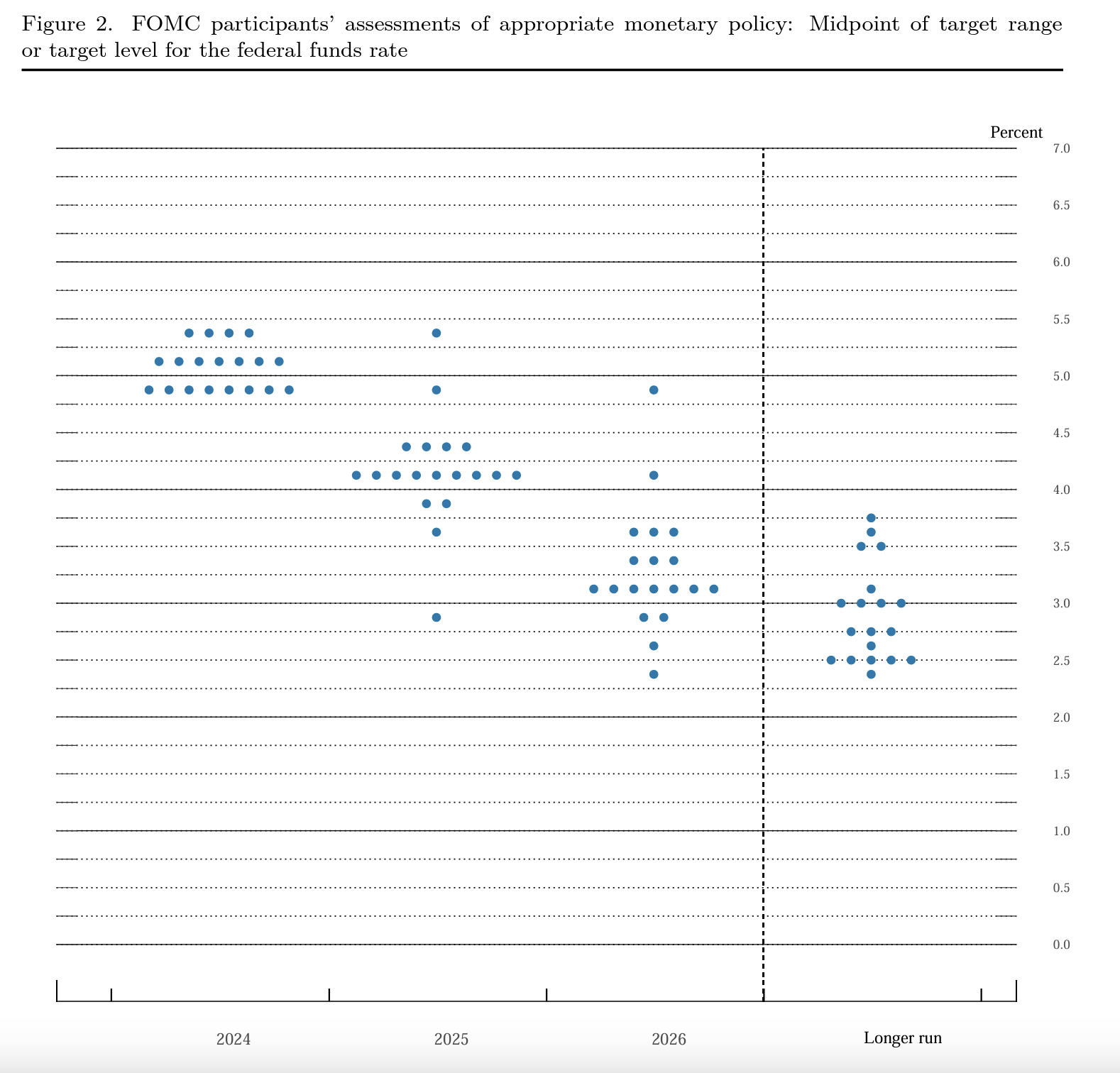
Based on the newly released “dot plot” showing the expected trajectory of interest rates, 17 FOMC members indicated they expected further cuts this year, with the rate coming down to 4.4 percent. That would mean another half-percent cut this year.
The committee also projects further cutting in 2025, with rates dropping to 3.4 percent. This is lower than the 4.1 percent projection in the last set of dot plots.
I should note that these projections are notoriously bad.
How bad?
Fund manager David Hay analyzed past dot plots and found the FOMC only got interest rate projections right 37 percent of the time. And as Hay pointed out, “They control interest rates!”
For instance, in March 2021, the FOMC projected the interest rate would still be zero in 2022. The actual 2022 rate was 1.75 percent. And in 2023, the vast majority of FOMC members thought the rate would still be at zero. The actual rate was over 5 percent.
What the Federal Reserve People Said
Even as they supersized the interest rate cut, Powell & Company talked about an ongoing elevated inflation risk and a strong economy.
The official FOMC statement noted, “Inflation has made further progress toward the Committee’s 2 percent objective but remains somewhat elevated.”
As far as the economy, Powell & Company spun a positive narrative. The FOMC statement said the economy is continuing “to expand at a solid pace,” and Powell downplayed the possibility of a recession – or an economic downturn.
“I don’t see anything in the economy right now that suggests that the likelihood of a recession, sorry, of a downturn, is elevated. I don’t see that. You see growth at a solid rate. You see inflation coming down. You see a labor market that’s still at very solid levels. So, I don’t really see that now.”
Powell characterized the Fed’s rate cut move as a “Goldilocks” policy – just right.
“This recalibration of our policy stance will help maintain the strength of the economy and the labor market and will continue to enable further progress on inflation as we begin the process of moving toward a more neutral stance. We are not on any preset course. We will continue to make our decisions meeting by meeting.”
Powell reiterated that “our job is to support the economy on behalf of the American people,” and he assured us, “If we get it right, this will benefit the American people significantly.“
If.
Powell said we shouldn’t expect the ultra-low interest rates that characterized the decade after the 2008 financial crisis. He said the “neutral rate” is higher than it was back then.
“Intuitively, most — many, many people anyway — would say we are probably not going back to that era where there were trillions of dollars of sovereign bonds trading at negative rates, long-term bonds trading at negative rates.”
Of course, it’s easy to say that now. We’ll see what happens when the central bank faces the next economic crisis – which, despite the rate cut, is still barreling down the tracks.
Their Actions Don’t Match Their Words
When you put the Fed’s actions and the central bankers’ words together, it doesn’t make a lick of sense.
Principle Asset Management chief global strategist Seema Shah told CNBC that a 50-basis point rate cut with no sign of economic turmoil is “a unique move in history.”
In fact, the last two times the Fed started an easing cycle with a half-percent rate cut, it was a prelude to a crisis.
In January 2001, the Fed cut from 6.5 percent to 6 percent. Over the next year, the S&P 500 crashed by 39 percent, and unemployment skyrocketed, leading into a recession.
In September 2007, the Fed cut rates from 5.25 to 4.75 percent. A year later, we had the financial crisis and the Great Recession.
While Powell and Company are saying the economy is strong and inflation isn’t quite beat, they’re acting like they don’t care about inflation at all, and we are in the midst of an economic downturn.
At the least, the central bankers are worried about an economic crash.
Simply put, you don’t aggressively ease monetary policy in a booming economy.
But the markets were pleased that the easy-money drug has started flowing again. Shah called it a cause for celebration.
“We have a Fed that will go to historic lengths to avoid a hard landing. Recession, what recession?”
Because that’s exactly what the Fed did; it waved the white flag and sounded the retreat trumpet.
Even before the rate cuts, the Fed was already winding down the inflation fight. The central bank loosened monetary policy when it quietly announced that it would begin to taper balance sheet reduction in June.
The balance sheet serves as a direct pipeline to the money supply. When the Fed buys assets – primarily U.S. Treasuries and mortgage-backed securities – it does so with money created out of thin air. Those assets go on the balance sheet, and the new money gets injected into the economy.
This expansion of the money supply is, by definition, inflation.
If expanding the money supply is inflationary, it logically follows that to slay price inflation, the Fed needed to significantly shrink the balance sheet. Rate hikes aren’t enough to ring all the liquidity out of the economy. In other words, if the Fed was serious about taming inflation, it would be talking about additional rate hikes and ramping up efforts to reduce the size of the balance sheet. It needs to undo the money creation of the past decade-plus.
I didn’t, and it won’t.
If the Fed was all in on the inflation fight, it wouldn’t be “recalibrating policy” to create more inflation.
Keep in mind – inflation is an expansion of money and credit. Price inflation is one symptom of inflationary policy.
The Fed has tightened things up just enough to slow rising prices, but as we can see from the balance sheet, most of the inflation created during the pandemic is still sloshing around in the economy. And that’s on top of all the inflation it created in the wake of the 2008 financial crisis that the central bank never managed to wring out of the economy.
But by slowing balance sheet reduction and super-sizing its initial rate cut, the Fed is telling you it plans to ramp up the inflation machine.
And why would it do that?
Because, while they won’t say it out loud, the central bankers know the economy is addicted to easy money. They know the economy can’t function in a higher interest rate environment. (In fact, 5.5 percent is close to “normal” from a historical perspective.) And they know that they have probably already broken things in the economy.
I’m not the only one who realizes the Fed’s actions signal the central bankers aren’t telling us the full story. Nomura Capital Assets analyst Matthew Rowe told Reuters, “Many market participants see this as an aggressive move that is not justified by what normal market participants can see.”
And he asked the operative question:
“So, what is it that they see, and we cannot, that would spur this level of aggressive action.”
The Fed people are clearly trying to get out in front of the damage they have caused. (They caused it when they held rates artificially low for more than a decade – not when they raised rates.) They’re telling you that everything is great. But their actions speak louder than their words.
Mike Maharrey is a journalist and market analyst for MoneyMetals.com with over a decade of experience in precious metals. He holds a BS in accounting from the University of Kentucky and a BA in journalism from the University of South Florida.
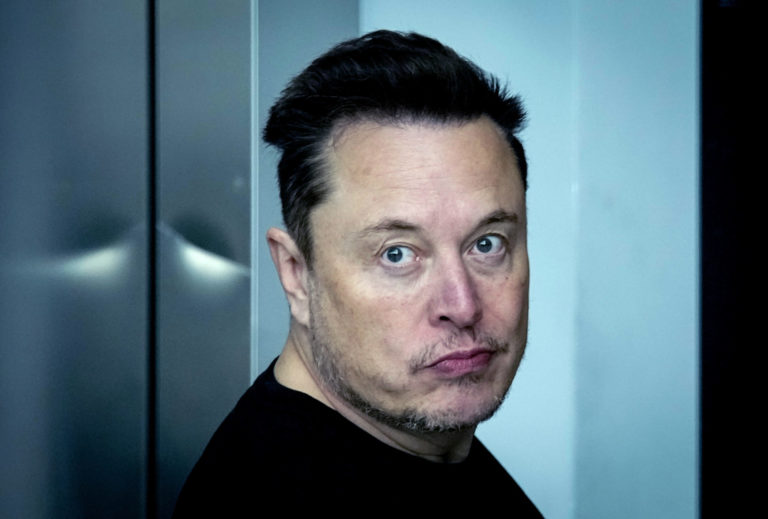
(Ken Silva, Headline USA) Bloomberg reporter and open records expert Jason Leopold revealed Thursday that the Secret Service is apparently investigating Elon Musk over his recent joke about the lack of assassination attempts against regime Democrats.
Responding to someone asking why so people want to kill Donald Trump, on Sunday Musk posted: “And no one is even trying to assassinate Biden/Kamala.” Musk later deleted the post and clarified that he was joking.
Well, one lesson I’ve learned is that just because I say something to a group and they laugh doesn’t mean it’s going to be all that hilarious as a post on 𝕏
But the Secret Service may not find Musk’s joke to be a laughing matter. Leopold said he filed a Freedom of Information Act request for the Secret Service’s records on Musk’s post, but was denied the records because they’re subject to law enforcement proceedings.
“On Wednesday, the agency responded to the requests by saying records it has about Musk’s post were ‘compiled for law enforcement purposes’ and are being withheld because ‘disclosure could reasonably be expected to interfere with enforcement proceedings,’” Leopold wrote on Thursday.
Nate Herring, a spokesperson for the Secret Service, also told Leopold that his agency “is aware of the social media post made by Elon Musk.”
“As a matter of practice, we do not comment on matters involving protective intelligence. We can say, however, that the Secret Service investigates all threats related to our protectees,” Herring reportedly said.
Don’t expect any criminal charges against Musk. Leopold said in his experience, the worst that will likely happen will be that agents visit Musk to make sure he doesn’t pose a threat to Joe Biden or Kamala Harris.
Leopold also said he requested records on a Sunday Twitter/X post from the Libertarian Party of New Hampshire, which said that “anyone who murders Kamala Harris would be considered an American hero.” That post, too, has since been deleted.
The Secret Service also withheld records from Leopold on the grounds that they were subject to law enforcement proceedings. And sure enough, FBI agents visited one of the LPNH Twitter account administrators, Jeremy Kauffman. The agents’ interaction with the poster didn’t go as they planned.
“Nothing we did is against the law, and you guys are fu— heads,” Kauffman said to the agents in a video that has gone viral.
The FBI visited my house today for free speech acts they knew were not crimes.
(Ken Silva, Headline USA) The New York Times published an investigation Wednesday into the Secret Service’s security failures at the deadly July 13 Trump rally in Butler, Pennsylvania—revealing the identity of some agents, including two who have hired lawyers.
Much of the NYT investigation retreads the same information about Secret Service’s lack of planning ahead of the rally, as well as its lack of communication with local law enforcement. NYT also aired the opposing opinions about whether the Secret Service or local law enforcement was to blame for not securing the AGR building used as a perch by Trump shooter Thomas Crooks.
More interestingly, NYT revealed the name of the Secret Service’s lead counter-sniper at the rally, John Marciniak; the agency’s lead advance agent, Meredith Bank; and two site agents, Myosoty Perez and Dana DuBrey—the latter two who have hired lawyers.
DuBrey and Bank have been put on administrative duties along with the agency’s Pittsburgh boss, Timothy Burke.
FBI whistleblower Greg Roman told Headline USA that the Secret Service agents lawyering up is an indication that the agency may be looking to scapegoat them for the Butler failures.
“The Secret Service higher ups will gladly sacrifice a few of their own just to placate Congress and some in the media to put this thing to bed as soon as possible. At least one of the scalps will have to be a bit higher in rank/position, such as Burke … so it doesn’t appear lower level line agents get all the blame,” Roman said.
“It’s smart for them to lawyer up while they’re on administrative leave. They obviously smell the stench of whatever is being cooked up against them. They’ve been isolated and virtually excommunicated and I doubt the Secret Service HR department is of any help to them whatsoever.”
According to NYT, Perez hired Larry Berger—a lawyer who’s represented embattled Secret Service agents in the past—while DuBrey has hired notorious anti-Trump lawyer Mark Zaid.
Readers may be well familiar with Zaid.
A self-described advocate for whistleblowers, Zaid has worked on a wide variety of politically charged matters, including the first Trump impeachment. His clients have included Facebook’s dubious pro-censorship whistleblower, Frances Haugen; the brother of impeacher-turned-war profiteer Alexander Vindman; and a slew of CIA agents who’ve made numerous unfounded claims about having so-called “Havana Syndrome.”
Additionally, Zaid has been accused of spreading disinformation about the assassination of John F. Kennedy. According to acclaimed JFK researcher James DiEugenio, Zaid once gave a speech arguing against the probability that Lee Harvey Oswald was an intelligence asset—despite his numerous links to the CIA.
“At this same conference, Mark Zaid then went down to Dealey Plaza where some of the witnesses were arrayed, and handed out literature saying why they were not credible,” DiEugenio wrote in December 2022.
“And this is the guy demanding cred and calling the witness he never met ‘garbage.’ I guarantee you if this witness said, ‘I saw the files and there is nothing in there incriminating the CIA,’ Zaid would have a grin on his face.”
(Ken Silva, Headline USA) The DOJ Inspector General released a disturbing report Tuesday about a Bureau of Prisons medical doctor’s malpractice, which led to the death of an inmate.
The DOJ-OIG received a complaint that a BOP medical doctor failed to provide adequate medical care to an inmate, who died later that day.
“The medical doctor did not respond in a timely manner to medically assess the inmate, or even make contact with the inmate, after a correctional officer and another inmate alerted the medical doctor that an inmate in the medical isolation cell of the health services unit of the BOP facility was complaining of chest pains,” the DOJ-OIG report found.
The DOJ-OIG has released a disturbing report about a Bureau of Prisons medical doctor who ignored an inmate's chest pains, which led to the inmate dying.
Gordon Kahl suffered two heart attacks when he was a political prisoner in the 70s. He believed the government was trying to… pic.twitter.com/hhxKxNxZGj
“The OIG investigation also found that the medical doctor deleted without reading an email sent the prior day notifying the medical doctor that an inmate had been placed in the medical isolation cell.”
The Inspector General further found that the doctor “lacked candor” when interviewed for its investigation. However, criminal prosecution of the medical doctor was declined, according to the report.
In February, a DOJ-OIG report revealed that 344 inmate deaths took place in the federal prisons system from 2014 to 2021—at least 12 inmates involving mysterious circumstances.
According to the DOJ-OIG’s report, 187 inmates committed suicide, 89 died by homicide, 56 died by an accident and 12 died from unknown causes.
“In 12 of the 344 deaths (less than 4 percent), there was not sufficient information to definitively determine the manner of death, even after autopsies were conducted in most cases,” the February DOJ-OIG report said. “Accordingly, the manner of these deaths is categorized as ‘Unknown.’”
The Inspector General attributed some of the unknown deaths to drug overdoses, explaining that certain abused substances can cause death but cannot be detected by standard toxicological analytic methods. However, that only explained eight of the unknown deaths, leaving four unexplained.
At the time, the BOP largely blamed staffing shortages and resource constraints.
“Operational challenges include staffing shortages; an outdated security camera system; staff failure to follow BOP policies and procedures; and an ineffective, untimely staff disciplinary process. One or more of these challenges was a contributing factor in many of the inmate deaths in our scope,” the February report said.
Iranian hackers sought to interest President Joe Biden’s campaign in information stolen from rival Donald Trump’s campaign, sending unsolicited emails to people associated with the then-Democratic candidate in an effort to interfere in the 2024 election, the FBI and other federal agencies said Wednesday.
There’s no indication that any of the recipients responded, officials said, and several media organizations who have said they also were approached with stolen material did not publish it. Kamala Harris’ presidential campaign called the emails from Iran “unwelcome and unacceptable malicious activity” that were received by only a few people who regarded them as spam or phishing attempts.
The emails were received before the hack of the Trump campaign was publicly acknowledged, and there’s no evidence the recipients of the emails knew their origin.
The announcement is the latest U.S. government effort to call out what officials say is Iran’s brazen, ongoing work to interfere in the election, including a hack-and-leak campaign that the FBI and other federal agencies linked last month to Tehran.
U.S. officials in recent months have used criminal charges, sanctions and public advisories to detail actions taken by foreign adversaries to influence the election, including an indictment targeting a covert Russian effort to spread pro-Russia content to U.S. audiences.
It’s a stark turnabout from the government’s response in 2016, when Obama administration officials were criticized for not being forthcoming about the Russian interference they were seeing on Trump’s behalf as he ran against Democrat Hillary Clinton.
In this case, the hackers sent emails in late June and early July to people who were associated with Biden’s campaign before he dropped out. The emails “contained an excerpt taken from stolen, non-public material from former President Trump’s campaign as text in the emails,” according to a statement released by the FBI, the Office of the Director of National Intelligence and the Cybersecurity and Infrastructure Security Agency.
The agencies have said the Trump campaign hack and an attempted breach of the Biden-Harris campaign are part of an effort to undermine voters’ faith in the election and to stoke discord.
The FBI informed Trump aides within the last 48 hours that information hacked by Iran had been sent to the Biden campaign, according to a senior campaign official granted anonymity to speak because of the sensitive nature of the investigation.
The Trump campaign disclosed on Aug. 10 that it had been hacked and said Iranian actors had stolen and distributed sensitive internal documents. At least three news outlets — Politico, The New York Times and The Washington Post — were leaked confidential material from inside the Trump campaign. So far, each has refused to reveal any details about what it received.
Politico reported that it began receiving emails on July 22 from an anonymous account. The source — an AOL email account identified only as “Robert” — passed along what appeared to be a research dossier that the campaign had apparently done on the Republican vice presidential nominee, Ohio Sen. JD Vance. The document was dated Feb. 23, almost five months before Trump selected Vance as his running mate.
In a statement, Harris campaign spokesperson Morgan Finkelstein said the campaign has cooperated with law enforcement since learning that people associated with Biden’s team were among the recipients of the emails.
“We’re not aware of any material being sent directly to the campaign; a few individuals were targeted on their personal emails with what looked like a spam or phishing attempt,” Finkelstein said. “We condemn in the strongest terms any effort by foreign actors to interfere in U.S. elections including this unwelcome and unacceptable malicious activity.
Trump campaign national press secretary Karoline Leavitt called the effort to dangle stolen information to the Biden campaign “further proof the Iranians are actively interfering in the election” to help Harris.
Intelligence officials have said Iran opposes Trump’s reelection, seeing him as more likely to increase tension between Washington and Tehran. Trump’s administration ended a nuclear deal with Iran, reimposed sanctions and ordered the killing of Iranian Gen. Qassem Soleimani, an act that prompted Iran’s leaders to vow revenge.
Iran’s intrusion on the Trump campaign was cited as just one of the cyberattacks and disinformation campaigns identified by tech companies and national security officials at a hearing Wednesday of the Senate Intelligence Committee. Executives from Meta, Google and Microsoft briefed lawmakers on their plans for safeguarding the election, and the attacks they’d seen so far.
“The most perilous time I think will come 48 hours before the election,” Microsoft President Brad Smith told lawmakers during the hearing, which focused on American tech companies’ efforts to safeguard the election from foreign disinformation and cyberattacks.
The move drew harsh backlash from critics who called it a blatantly unconstitutional violation of First Amendment free-speech rights, as well as a shamelessly partisan ploy to target Elon Musk and his X platform in retaliation for Musk’s support of Republican nominee Donald Trump.
FREE SPEECH: California Democrats just passed a law making free speech illegal when it relates to politics within 60 days of an election. AB 2655 prohibits Americans from distributing parody or satire related to a political candidate within 60 days of an election.
A new law, set to take effect immediately, made it illegal to create and publish deepfakes related to elections 120 days before Election Day and 60 days thereafter. It also allowed courts to stop distribution of the materials and impose civil penalties.
“Safeguarding the integrity of elections is essential to democracy, and it’s critical that we ensure AI is not deployed to undermine the public’s trust through disinformation—especially in today’s fraught political climate,” Newsom said in a statement.
“These measures will help to combat the harmful use of deepfakes in political ads and other content, one of several areas in which the state is being proactive to foster transparent and trustworthy AI,” he added.
It isn’t the first time that the Left has audaciously sought to criminalize meme content on social media under the guise of safeguarding against “disinformation.”
In 2021, shortly after the Biden administration took power, federal authorities showed up at the doorstep of Douglass Mackey, who had operated an anonymous social-media account posting conservative humor content during the 2016 election to his roughly 58,000 followers.
In one post, he told Hillary Clinton supporters that they could text in their votes. Five years later, he was sentenced to seven months imprisonment.
Newsom’s new regulations sought not only to target individual posters, but also the companies that hosted them. Large social media platforms were expected to remove any deceptive material under a first-in-the-nation law set to be enacted next year.
Musk has scoffed at previous attempts to censor him in leftist regimes like Brazil, although having Twitter currently headquartered in San Francisco may complicate matters.
The law, at any rate, is sure to be met with ample legal challenges, particularly if California attempts to impose its diktats on users in other parts of the country.
If and when a court decision could offer clarity remained to be seen—although Musk reacted to the new law by defiantly reposting a popular AI-based meme mocking Vice President Kamala Harris.
The viral video’s popularity triggered Newsom in July, prompting him to issue a stark warning at the time about the pending legislation.
Manipulating a voice in an “ad” like this one should be illegal.
The governor signed the bills to loud applause during a conversation with Salesforce CEO Marc Benioff, a notorious anti-conservative cancel-culture advocate, during the software company’s annual conference in San Francisco.
The state also was the first in the U.S. to ban manipulated videos and pictures related to elections, in 2019.
In many cases—and particularly when it comes to regulating Big Tech—other blue states have followed suit.
The new California laws come the same day as lawmakers in the U.S. House pushed their own bipartisan bill aimed at curbing the spread of AI deepfakes.
The AI Ads Act would give the Federal Election Commission the power to regulate the use of AI in elections in the same way it has regulated other political misrepresentation for decades.
Newsom has touted California as an early adopter as well as regulator of AI, saying the state could soon deploy generative AI tools to address highway congestion and provide tax guidance, even as his administration considers new rules against AI discrimination in hiring practices.
He also signed two other bills Tuesday to protect Hollywood performers from unauthorized AI use without their consent.
(Headline USA) The House on Wednesday night rejected a bill to fund federal government for six months that was packaged alongside election-integrity measures such as proof-of-citizenship requirements.
The bill failed after 14 Republicans joined Democrats to reject it—including some who stood on principal in opposition to any short-term funding extensions.
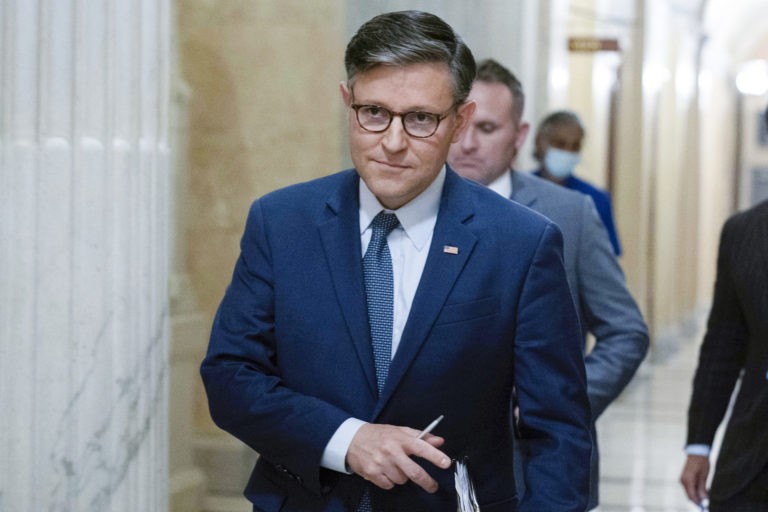
Speaker Mike Johnson, R-La., now has until Sept. 30 to rally Republicans in order to avert a shutdown, or at least one for which the GOP would bear the brunt of the blame.
Johnson pulled the bill from consideration last week because it lacked the votes to pass. He said then he would work over the weekend to build consensus within the Republican ranks.
Democrats overwhelmingly opposed the SAVE Act, sponsored by Rep. Chip Roy, R-Texas, which would require new voters to provide proof of citizenship—a leading election-year priority for Republicans amid concerns that the millions of illegal immigrants allowed in under the Biden administration will seek to disrupt the political balance by voting illegally.
Even if a tiny percentage of noncitizens vote, it could determine the outcome of an extremely close race. Johnson noted that Republican Rep. Mariannette Miller–Meeks, R-Iowa, won her seat back in 2020 by six votes.
“It’s very, very serious stuff and that’s why we’re going to do the right thing,” Johnson said. “We’re going to responsibly fund the government, and we’re going to stop noncitizens voting in elections.”
Meanwhile, Republican presidential nominee Donald Trump weighed in just hours before the vote, seemingly encouraging House Republicans to let a partial government shutdown begin at the end of the month unless the SAVE Act is included in the continuing resolution bill.
“If Republicans don’t get the SAVE Act, and every ounce of it, they should not agree to a Continuing Resolution in any way, shape, or form,” Trump said on the social media platform Truth Social.
Johnson told reporters prior to the vote that he was not ready to discuss an alternative plan to keep the government funded.
“Let’s see what happens with the bill, all right. We’re on the field in the middle of the game. The quarterback is calling the play. We’re going to run the play,” Johnson said.
House Democrats said the proof-of-citizenship mandate should not be part of the continuing resolution to keep the government funded and urged Johnson to work with them on a bill that can pass both chambers.
“This is not going to become law,” said Rep. Pete Aguilar, D-Calif. “This is Republican theatrics that are meant to appease the most extreme members of their conference, to show them that they are working on something and that they’re continuing to support the former president of the United States in his bid to demonize immigrants.”
Lawmakers were not close to completing work on the dozen annual appropriations bills that will fund the agencies during the next fiscal year, so they’ll need to approve a stopgap measure to prevent a partial shutdown when the new fiscal year begins Oct. 1.
Senate Majority Leader Chuck Schumer, D-N.Y., said the only way to prevent a government shutdown was for both sides to work together on an agreement. He said the House vote announced by Johnson was doomed to fail.
“The only thing that will accomplish is make clear that he’s running into a dead end,” Schumer said. “We must have a bipartisan plan instead.”
The legislation would have funded agencies generally at current levels while lawmakers work out their differences on a full-year spending agreement.
Democrats, and some Republicans, were pushing for a short extension. A temporary fix would allow the current Congress to hammer out a final bill after the election and get it to Democratic President Joe Biden’s desk for his signature.
But Johnson and some of the more conservative members of his conference were pushing for a six-month extension in the hopes that Republican nominee Donald Trump will win the election and give them more leverage when crafting the full-year bill.
Senate Republican leader Mitch McConnell of Kentucky declined to weigh in on how long to extend funding. He said Schumer and Johnson, ultimately, will have to work out a final agreement that can pass both chambers.
“The one thing you cannot have is a government shutdown,” McConnell said. “It would be politically beyond stupid for us to do that right before the election because certainly we would get the blame.”
Regardless of the vote’s failure, Republican lawmakers sought to allay any concerns there would be a shutdown at the end of the month. Rep. Mike Lawler, R-N.Y., said another stopgap bill should be voted on that would allow lawmakers to come back to Washington after the election and finish the appropriations work.
“The bottom line is we’re not shutting the government down,” Lawler said.
The House approved a bill with the proof of citizenship mandate back in July. Some Republicans who view the issue as popular with their constituents have been pushing for another chance to show their support for the measure.
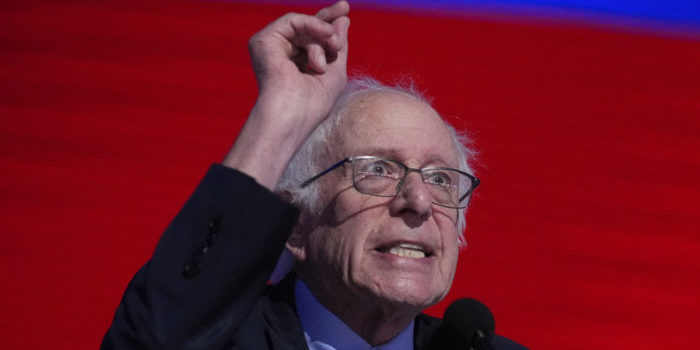
(Headline USA) Sen. Bernie Sanders, I-Vt., was preparing several resolutions that would stop more than $20 billion in U.S. arms sales to Israel.
In a letter to Senate colleagues on Wednesday, Sanders said the U.S. could not be “complicit in this humanitarian disaster.”
Sanders’s resolutions would halt sales of missile systems, tank rounds and other weaponry, as well as new fighter jets to Israel, though its passage was highly unlikely.
“Much of this carnage in Gaza has been carried out with U.S.-provided military equipment,” Sanders wrote.
The letter followed an attack earlier this week on Iran-backed Hezbollah, presumed to have originated with the Israeli intelligence, in which hundreds of militants were injured and roughly a dozen killed after the pager devices they were carrying simultaneously exploded.
As Israel’s military campaign in Gaza grinds toward a second year, the outcome of lame-duck President Joe Biden’s efforts to broker a cease-fire deal and hostage release remain uncertain.
The resolutions from Sanders would seek to rein in Israeli Prime Minister Benjamin Netanyahu’s strike on Gaza, which commenced shortly after Hamas’s surprise Oct. 7 attack on Israel last year that left 1,200 people dead, and took 250 others hostage. The Palestinian terrorist organization still holds around 100 hostages.
The move by Sanders was designed to send a message to the Netanyahu government that America’s longtime bipartisan support for Israel was eroding. Sanders said he was working with other colleagues on the measures.
House Speaker Mike Johnson invited Netanyahu to deliver a speech before the U.S. Congress earlier this year, but about 50 Democrats boycotted it, along with the socialist independent Sanders.
Under the Senate rules, once Sanders introduces the resolutions next week, he can force a vote almost instantly for consideration. The measures were being proposed as a joint resolution of disapproval of the arms sales, which is a mechanism that allows congressional oversight of foreign affairs.
Sanders said he would have some backing for his proposal. But it was not expected to have support from a majority, 51 votes, in the Senate to pass.
In the House, blocking the Israeli arms sales would face even tougher odds, where Republicans hold the majority, and have largely sided with Netanyahu.