Federal Trade Commission Sues Leading Transgender Health Group

(Headline USA) The Federal Trade Commission and four states sued the World Professional Association for Transgender Health on Wednesday, in the latest push by President Donald Trump’s administration and others to limit treatments for transgender minors.

The suit alleges the group, known widely as WPATH, made deceptive claims about treatments for minors and its members profited off the claims. Alaska, Iowa, Nebraska and Texas filed along with the FTC.

“Parents have a right to make informed decisions about their children’s health,” FTC Chairman Andrew Ferguson said on X. “The FTC will not allow parents and children to be deceived by medical organizations and providers who are prioritizing profit over children’s health and safety.”

The suit also alleges the group didn’t disclose the side effects of certain pediatric medical transition services, including those related to hormone treatments, and doctors then repeated to consumers “false, misleading or unsubstantiated statements about safety and efficacy found in WPATH guidelines.”

It asks a federal judge to block WPATH from “future violations of the FTC Act” and other laws, and to award civil penalties and other financial awards to each of the states.

In a statement WPATH said its guidelines call for treatment that is tailored to individual patients, rather than a “one size fits all” approach.

“Transgender and gender-diverse patients deserve the highest level of care from their medical professionals,” the group said, saying its standards are “designed to promote this through open dialogue and clear communication.”

Leaders at the Department of Health and Human Services applauded the FTC’s move, pointing to an HHS review that questioned WPATH standards. 

The suit comes following an investigation by the agency into WPATH. The group sued to block the probe, alleging the agency was violating its First Amendment rights. A federal judge in May ruled in favor of WPATH to temporarily block the probe from continuing.

The FTC also launched investigations into the American Academy of Pediatrics and the Endocrine Society over their guidelines on transgender procedures. Both of those groups also sued.

WPATH noted in a statement that a federal court has already ruled against the FTC over this effort when it blocked the investigation.

“WPATH is in a strong position to prove that the FTC is acting out of pure retaliation as part of the federal government’s relentless and targeted campaign to undermine gender-affirming care by attacking the First Amendment rights and the independence of professional medical organizations,” the statement said. “We expect the same result when we oppose this latest attack on WPATH and its mission to promote evidence-informed care and guidance for doctors and their patients.”

Fewer than 1 in 1,000 adolescents in the U.S. received medication— puberty blockers or hormones—according to a five-year study of those on commercial insurance released this year. About 1,200 patients underwent transgender surgeries in one recent year, according to another study.

While the nation’s largest professional organization for plastic surgeons in February recommended that transgender surgeries be delayed until patients turn 19, most other major groups have stood by their guidelines to act on a case-by-case basis and use caution when considering surgery for minors.

Adapted from reporting by the Associated Press

Gas and Fuel Costs Concern Over 75% of Voters, Poll Finds

(Alton Wallace, The Center Square) More than three-quarters of American voters say high gas and fuel prices have dealt a direct blow to their household finances, according to a new opinion poll. A 61% majority of registered voters said they are “very concerned” by recent high fuel price increases while 25% of respondents are “somewhat concerned,” according to The Center Square Voters’ Voice Poll, a survey conducted June 1-4 by Noble Predictive Insights, a nonpartisan polling firm.

Another 9% of respondents said they are “not too concerned” by the recent fuel price increases and 3% are “not at all concerned,” the data shows. Americans could soon get relief from high prices at the pump, however, after an announcement Monday of a 60-day ceasefire in the U.S.-Israel war with Iran, energy market experts say.

The survey data shows the level of anxiety over fuel costs is similar across age groups, with those saying that they are either “very concerned” or “somewhat concerned” ranging between 84% for young adults to 87% of respondents 65 years of age and older.

The poll was conducted at the launch of the summer driving season, when U.S. fuel demand is at the annual peak. While the survey data shows concern over fuel prices spans all ages and demographic groups, approximately two-thirds of the respondents said the issue will directly influence their votes in Novembers midterm elections.

“Average gasoline prices fell in 47 states over the last week, with the national average dropping below $4 per gallon late Sunday for the first time since mid-April,” Patrick De Haan, head of petroleum analysis at GasBuddy, told The Center Square. “The decline came as oil prices moved sharply lower in reaction to news of a potential deal between the United States and Iran, though it remains to be seen whether the agreement will hold.”

Among voters identifying as Republican, 49% said they are very concerned by gas and fuel costs compared to 72% of those who say they are Democrats. Among voters identifying as Independent, 58% said they are “very concerned” about fuel costs, with 72% reporting a direct budget strain, and 56% indicating the issue will influence their vote, the polling data shows.

The polling firm surveyed 2,585 registered voters nationwide through opt-in online panels and text-to-web cellphone messages, compiling data from 1,013 Democrats, 915 Republicans, 297 self-identified Independents, and 360 respondents with no party affiliation. Women expressed higher overall concern about fuel prices than men, with 89% of females saying they are either “very concerned” or “somewhat concerned” while 83% of men did so. Minorities are most acutely stressed by rising fuel costs, with 69% of Hispanic or Latino respondents and 64% of Black respondents saying they are “very concerned.”

Respondents who cast ballots for Democrat Kamala Harris said high fuel costs are creating financial strain, with 45% of these registered voters saying their household budgets are impacted “a great deal.” Meanwhile, 34% of Donald Trump voters reported the same elevated level of financial strain. Geographically, voters in the West are the most stressed, with 66% indicating they are “very concerned” about rising fuel costs and 45% saying the prices hit their household budgets “a great deal.”

The anxiety level registers at 61% in the South, with 41% of voters saying they are experiencing a “great deal” of financial impact. In both the Midwest and Northeast, an identical 38% of respondents say they are experiencing a “great deal” of financial strain.  

New Mexico Deepens Probe into Jeffrey Epstein’s ‘Zorro Ranch’

(Ken Silva, Headline USA) The Wall Street Journal reported Wednesday that New Mexico’s attorney general has ordered more than two dozen companies to preserve their records about deceased sex criminal Jeffrey Epstein’s property known as Zorro Ranch.

The companies, including JP Morgan, Google and American Express, are reportedly required to preserve records while the state pursues subpoenas. New Mexico re-opened an investigation into Epstein earlier this year. In March, state investigators searched the property.

“Reopening the investigation into allegations at Jeffrey Epstein’s Zorro Ranch was undertaken with deep respect for survivors and a commitment to accountability,” Attorney General Raúl Torrez told the Journal.

The probe comes after the Trump administration’s partial release of the Epstein files. Several victims said they were abused at the ranch, while former New Mexico Attorney General Hector Balderas revealed recently that prosecutors from the Southern District of New York pressured his office to close its Epstein probe in September 2019, the month after Epstein was found dead in a prison cell.

Epstein bought the property in 1993 through a company named Zorro Trust, later renamed Cypress Inc. There are rumors he conducted science experiments there, and that dead bodies may even be buried on the land—though solid evidence of that hasn’t been produced.

The property is currently owned by Don Huffines, a Dallas real estate millionaire and former Texas state legislator who is now running for Texas comptroller.

The state’s investigation is running parallel to a separate effort in the New Mexico legislature, which voted unanimously to create a bipartisan four-member commission to examine allegations tied to the ranch.

The state has also published an online form where potential witnesses can submit “credible information” to investigators.

“If you have information that may assist this investigation, we encourage you to submit a tip using the form below,” the page states. “Investigators may follow up with individuals who provide information if additional details are needed.”

Ken Silva is the editor of Headline USA. Follow him at x.com/jd_cashless.

California Threatens to Jail People if They Can’t Prove They Are Gay Enough

(Luis CornelioHeadline USA) In California, being a gay business owner comes with some special perks, including a preferred shot at utilities contracts worth hundreds of millions of dollars. There’s just one catch: you have to prove your homosexuality.

The program, highlighted by City Journal’s Christopher Rufo on June 16, operates from the California Public Utilities Commission. The agency oversees private utility companies and urges them to increase diversity.

According to Rufo, the diversity program dates back to several previous governors, but Newsom expanded its scope in 2019.

The CPUC, on the orders of California Gov. Gavin Newsom, effectively directed companies to allocate 1.5% of procurement to LGBT-owned firms in 2024. In practice, the companies spent $633 million on LGBT firms that year alone.

To qualify, business owners must submit evidence intended to prove they qualify for the LGBT program. Among the required materials are letters from friends, on company letterhead, who can “vouch/attest to LGBT status.”

Paperwork states that individuals who misrepresent or falsify information in documentation could face penalties, including up to one year in state prison and a $5,000 fine.

Other more traditional paperwork includes marriage certificates, evidence of “family-building efforts,” including surrogacy, adoption or IVF, as well as documentation showing that partners reside in the same home, according to screenshots shared online.

The CPUC program also seeks to benefit racial minorities, gender-based categories, veterans, and others.

The puzzling program has drawn scrutiny from Harmeet Dhillon, the associate attorney general for the Civil Rights Division, who urged the CPUC to “carefully assess” the program, noting that aggrieved companies could pursue legal action alleging discrimination.

The program also sparked immediate negative reactions on social media.

Critics on X questioned the idea of a public agency certifying businesses based on sexual orientation, saying that the program does not pass legal muster.

MoU Released by the US Says Enriched Uranium Will Be Downblended Inside Iran

(Dave DeCamp, Antiwar.comThe 14-point US-Iran Memorandum of Understanding, which US officials detailed to reporters on Wednesday, says that under the potential deal, Iran’s enriched uranium will be downblended “on site,” as the US has backed off on its demand to take it out of the country.

The MoU states that the “have agreed to resolve the disposition of stockpiled enriched material pursuant to a mechanism that will be mutually agreed upon in accordance with the schedule mentioned in paragraph seven with the minimum methodology to be down-blending on site under the supervision of the [International Atomic Energy Agency].”

Iran had offered to downblend its uranium enriched at the 60% level before the US launched the war, something Oman’s foreign minister, who was mediating US-Iran negotiations, told US media the day before the first US-Israeli strikes hit Iran.

“There is agreement now that this will be downblended to the lowest level possible. And converted into fuel and that fuel will be irreversible. … I think we have agreement on that in my view,” Omani Foreign Minister Badr al-Busaidi said on “Face the Nation” on February 27, 2026.

Despite the offer being on the table before the war, Trump administration officials are selling the downblending as a “major win,” as the deal is under intense scrutiny from hawks in the US and Israel. “They’re saying: ‘We will destroy the enriched stockpile, and this is how we’re going to do it, at a minimum,” a US official told reporters on Wednesday.

President Trump also signaled he was backing off on his demand for the US to obtain the enriched uranium, which is believed to be buried deep under rubble at nuclear facilities the US bombed in June 2025. “You could make the case, why even bother? It’s not very valuable stuff.” Trump said at the G7 summit on Tuesday.

This article originally appeared at Antiwar.com.

Gas Prices Fall Below $4 for First Time Since March

(Headline USAU.S. gas prices fell below $4 a gallon on average Thursday.

It is the first time since March that the average cost for a regular gallon has been that low. Prices fell overnight after President Donald Trump signed an agreement with Iran that calls for Tehran to dilute its stockpile of highly enriched uranium and waives U.S.-backed sanctions on the country.

Gas prices are at $3.999 on average in the U.S., according to motor club AAA.

But fluctuations in gas prices remain across the country. In California, gas prices are averaging $5.64 per gallon, while in South Carolina it’s $3.58 per gallon.

The agreement between the U.S. and Iran calls for a permanent end to hostilities and starts a 60-day negotiating clock to reach a final deal on the future of Iran’s nuclear program, though Trump left the door open to resume attacks. It appears to offer Iran several benefits up front while extracting little in return.

The price for a barrel of U.S. crude has tumbled 14% this month.

Oil prices fell Monday to about $80 for a barrel of U.S. benchmark crude. That compares to $67 per barrel before the war and the price of over $120 a barrel reached earlier in the conflict.

Even as gas prices start to decline, it is anticipated to take weeks or months for oil to start flowing through the Strait of Hormuz again.

Before the war, the strait carried a fifth of the world’s crude oil. Now, it will take time for hundreds of ships trapped in the Persian Gulf to exit through the narrow strait. And Gulf oil producers that throttled back production will need time to get the oil moving again. Analysts also say ship captains may take their time to decide if passage is safe and that the threat of attack from Iran has truly receded.

In addition, refineries typically pay for crude oil a month or more in advance, so even after oil prices drop, they won’t immediately be processing cheaper products.

Fighting over the Strait of Hormuz disrupted not only supplies of crude and refined fuel but also the supply chains for fertilizer, food and even footwear. Businesses expect higher costs to linger, which means their customers might need to prepare for that too.

Adapted from reporting by the Associated Press

Trump and Iran’s Pezeshkian Sign US-Iran MoU

(Dave DeCamp, Antiwar.comPresident Trump signed the Memorandum of Understanding with Iran while in France on Wednesday night, and Iran confirmed that Iranian President Masoud Pezeshkian had also signed the agreement.

Esmaeil Baghaei, Iran’s Foreign Ministry spokesman, said there will no longer be a formal signing ceremony in Geneva, which was initially scheduled for Friday. He said that the agreement is now officially in effect, which should mean an end to the US blockade of Iran and an increase in the number of ships passing through the Strait of Hormuz in the coming days and weeks. The US and Iran are also set to begin nuclear negotiations for a period of at least 60 days.

Baghaei stressed that the MoU includes an end to Israel’s war in Lebanon, where Israeli strikes continued on Wednesday. “For us, the ceasefire and end of war in Lebanon were as important as in Iran. In the first article of the MoU, Lebanon is mentioned three times. Respect for Lebanon’s territorial integrity and national sovereignty is included,” he said.

Earlier on Wednesday, President Trump said that the Memorandum of Understanding (MoU) between Washington and Tehran was “not final” and warned the US could return to “dropping bombs” on Iran if the country “didn’t behave.”

“It’s a Memorandum of Understanding. If I don’t like it, if they don’t behave, we’ll go right back to dropping bombs right smack in the middle of their head, okay? Because they’ve misbehaved for 47 years,” the president told reporters on the sidelines of the G7 summit in France while meeting with Egyptian President Abdel-Fattah el-Sissi, according to The Associated Press.

US President Donald Trump attends a bilateral meeting with Egyptian President Abdel Fattah el-Sisi on the sidelines of the G7 Summit in Evian-les-Bains, France, June 17, 2026. REUTERS/Evelyn Hockstein

Trump said the deal is a “great deal for a lot of reasons” and appeared to suggest that what has been published in the media is not the actual text by saying that “nobody knows what it is,” though later, US officials released the full MoU text, and it was very similar to what was published in Al Arabiya a day earlier.

The president also acknowledged in his remarks that if the US continued the blockade on Iran and the Strait of Hormuz remained closed, it would cause a “worldwide depression.”

Iranian media reported on Wednesday that since the announcement of the MoU, 11 ships have been able to “break through the US blockade,” including eight that departed Iranian ports and three that arrived in Iran. The US military issued a notice to mariners on Monday, saying the blockade was still in place and advising ships not to cross the area “until explicit direction is given.”

This article originally appeared at Antiwar.com.

Clayton Confirmation as New DNI Delayed after Trump Social Media Post

(Thérèse Boudreaux, The Center Square) Only days after urging the U.S. Senate to confirm Jay Clayton as Director of National Intelligence, President Donald Trump ordered senators to halt the process until Congress confirms a replacement U.S. Attorney for the southern district of New York.

“Regarding the approval of our Great Patriot, Jay Clayton, we are cancelling the Senate Hearing RE: DNI today, and will not be going forward until Jamie McDonald is approved to be U.S. Attorney,” Trump declared in a Wednesday morning social media post. “In the meantime, Bill Pulte will remain as the Acting Director of National Intelligence.”

Clayton was originally set to appear Wednesday before the Senate Intelligence Committee. Republican leadership had hoped to speedrun Clayton’s confirmation to prevent the inexperienced Bill Pulte from ever taking the helm.

Democrats are demanding Pulte’s removal in exchange for their votes to renew a critical government surveillance authority, Section 702 of the Foreign Intelligence Surveillance Act, which expired last week.

Senate Intelligence Committee Chairman Tom Cotton, R-Ark., expressed disappointment with Trump’s decision on social media, calling it “regrettable.”

“Mr. Clayton is a patriot and a highly qualified nominee, as the president has said repeatedly,” Cotton said. “While today’s hearing is now unfortunately postponed, I look forward to proceeding with his confirmation in the near future.”

Trump further complicated matters, however, by doubling down on his previous demand that Congress attach the SAVE America Act, Republicans’ doomed voter-ID bill, to any FISA 702 extension.

“[T]o add a slight bit of intrigue but, for the Good of the Nation, and the People of our Country, I will not approve FISA without THE SAVE AMERICA ACT going along with it. Not complicated, actually,” Trump added in his post.

The directive is politically impossible for Republicans, who don’t have enough votes in the Senate for the House-passed legislation to overcome the 60-vote threshold.

“The only way you can get this done is to nuke the legislative filibuster. And this is not something that we have anywhere close to the votes to do,” Senate Majority Leader John Thune, R-S.D., told Fox News Wednesday. “We are bound by arithmetic in the United States Senate. The votes currently aren’t there.”

Democrats lambasted Trump’s cancellation of the hearing, with Senate Intelligence Committee Vice Chairman Mark Warner, D-Va., dubbing the action “an extraordinary display of dysfunction from a president who seems determined to turn America’s national security into a political bargaining chip.”

“National security cannot be governed by social media post,” Warner added. “The president’s latest intervention only underscores a simple reality: the biggest obstacle to resolving these issues has not been Senate Democrats or Senate Republicans. It has been the chaos and confusion coming from the White House itself.”

Although congressional authorization for FISA Section 702 has expired, government surveillance and data collection activities can still continue without interruption through March 2027.

That’s because the FISA Court approves year-long certifications for Section 702, which remain in effect even if the underlying authority has expired.

Democrats’ support for reauthorization is crucial, given that dozens of Republicans in Congress have opposed a clean extension due to concerns that it violates the Fourth Amendment.

On paper, FISA Section 702 allows federal intelligence agencies to conduct warrantless electronic surveillance on foreign nationals of suspicion.

In practice, however, the electronic data of American citizens – including emails, text messages, and phone calls – are routinely collected as well.

Not only can intelligence agencies store that data for up to five years, but intelligence agents can and do routinely search that data without obtaining a warrant, known as “backdoor searches.”

Declassified government documents and reports from agencies like the Privacy and Civil Liberties Oversight Board show that federal intelligence agencies have performed millions of “backdoor” searches over the span of decades, including 57,000 in 2023 alone.

Victims of Deadly B-52 Crash Identified

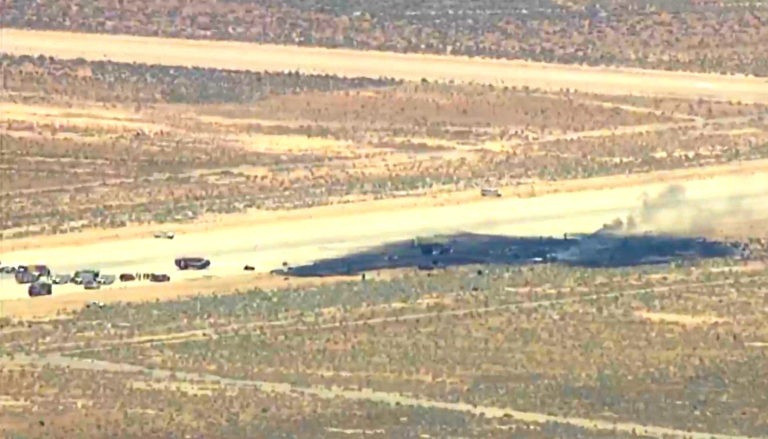
(Headline USA) The eight men killed in this week’s fiery crash of a B-52 during a test flight at California’s Edwards Air Force Base included four active duty airmen, a reservist and three civilians who were on a team devoted to keeping the bomber flying for decades to come, military officials said Wednesday.

The airfield where the Boeing B-52 Stratofortress crashed shortly after takeoff on Monday remained closed but other base operations have resumed, according to a base spokesperson. No cause has been determined. Officials said it could take six months to complete the investigation.

The victims were identified as: Col. Gregory Watson, 53; Retired Lt. Col. Miles Middleton, 50; Lt. Col. Gabriel Estrella, 40; Maj. Alexander Davis, 34; Maj. Robert Dee, 40; Maj. Brad Hovey, 35; Jeromy Smith, 32; and Christopher Rischar, 41.

“They were dedicated professionals, beloved family members and irreplaceable teammates,” Col. Thomas Tauer, commander of the 412th Test Wing at Edwards, said in a statement.

Watson, a weapons systems officer, and Middleton, a pilot, were Boeing employees and the company said their loss “is deeply felt across our teams, and our hearts remain with their families, loved ones and those who worked with them.”

Rischar was a flight test engineer with government contractor JT4 who had worked at Edwards for 10 years, said his wife, Rebecca Rischar. She said he loved going to airplane museums and showing their two children, 15 and 14, different types of aircraft and how they functioned.

She recalled how her husband’s father, who also works at the base and had seen the crash, called her to ask if Christopher had been flying.

“I knew he was on that flight,” she said Wednesday. “It was routine, and if the plane went up, he was going up with it.”

Rebecca and Christopher met at a church youth group while attending the same high school in nearby Lancaster and had celebrated their 17th wedding anniversary in April. He had just started helping their teenage daughter learn how to drive.

“Our marriage is not just for this life here on Earth but for eternity, so we are sealed together,” she told The Associated Press.

The B-52 that crashed Monday was taking part in a test mission as part of a program aimed at making the 65-year-old bomber fleet operable through at least 2050. The bomber had arrived at Edwards in December after having a modernized radar installed at Boeing’s facility in San Antonio, an Air Force press release said at the time.

The plan was to use the bomber as a testbed throughout 2026 to help military officials decide whether to proceed with the B-52 Radar Modernization Program, the Air Force said.

For almost a decade before the plane served as a testing platform, it was based in Barksdale Air Force Base, Louisiana, where the bomber was the flagship of the 307th Bomb Wing.

Its pilot, Col. Bruce Cox — an alumni of Texas A&M — dubbed the bomber “The Spirit of Aggieland.” An Air Force press release from 2015 said that the bomber was “dedicated to former and future cadets that graduated from Texas A&M; University’s Corps of Cadets Program.”

Cox would go on to take his final flight aboard the bomber in 2017 before retirement, according to the unit’s Facebook page.

The aircraft took off shortly before noon on a clear day, heading southwest into the prevailing winds. It flew straight and crashed on the same 15,000-foot (4,572-meter) runway. The compact wreckage indicates the plane dropped sharply.

Aviation safety experts have said their first thoughts about what might have caused the crash were about a malfunction in the flight controls or engines, but it is much too early to know. Investigators will consider several factors, including the age and maintenance of the plane.

Aerial footage showed virtually nothing left of the aircraft that went down at the base in the Mojave Desert about 100 miles (161 km) northeast of Los Angeles.

Lauren Smith told Eyewitness News KBAK-CBS and FOX58 that her husband, Jeromy Smith, was a flight test engineer for the U.S. Department of Defense and died doing what he loved.

“It is such a horrible hurt, and I’m still processing everything that happened,” she said Tuesday.

The B-52, a long-range bomber that entered service in 1955, is designed to carry both conventional and nuclear weapons. It has been used in conflicts involving the U.S. military from Vietnam to Iran. 

Edwards is home to the 412th Test Wing, which conducts regular developmental testing of all Air Force aircraft, weapons systems, software and components before purchase by the service as well as throughout their life span. Test missions take place at Edwards daily, officials said.

The base is where Air Force test pilot Chuck Yeager reached a speed of Mach 1.05 and broke the sound barrier in 1947.

Adapted from reporting by the Associated Press


Luigi Mangione to Assert Psychiatric Defense in UnitedHealthcare CEO’s Killing

(Headline USA) Luigi Mangione plans to assert a psychiatric defense at his state murder trial, claiming he was suffering from extreme emotional disturbance when he gunned down UnitedHealthcare CEO Brian Thompson, a judge said Wednesday. It wouldn’t absolve him of the Dec. 4, 2024, killing, but could free him from prison sooner.

If a jury accepts that defense, the panel would convict Mangione of manslaughter and he would face up to 25 years in prison. Alternatively, the jury could reject the extreme emotional disturbance defense and convict him of murder, which carries a potential life sentence. That defense isn’t available in his federal case.

Judge Gregory Carro announced the decision in court Wednesday, two weeks after holding a secret hearing on the matter at the defense’s request. He said he will unseal a transcript and other records from that proceeding once redactions are made.

Mangione’s lawyers first raised the possibility of a psychiatric defense in a sealed letter in September and confirmed the decision at the June 3 hearing, Carro said. They could still change their minds. Prosecutors want Mangione evaluated by a psychiatric expert.

“The reasons for the sealing was to give the defense an opportunity to determine whether they were going forth with that defense and the nature of that defense,” Carro said.

Carro said he didn’t expect the development to delay Mangione’s trial, which is scheduled to start Sept. 8. The federal trial, which involves stalking charges, is set to begin on Oct. 13.

Mangione, 28, has pleaded not guilty in both cases.

Sitting between his lawyers and wearing a blue suit, he tried to block his face with a large envelope as news photographers crowded near him at the start of Wednesday’s hearing. He didn’t appear to have any reaction as Carro spoke about the planned psychiatric defense.

At a February hearing, Mangione had railed against the prospect of two trials, telling Carro: “It’s the same trial twice. One plus one is two. Double jeopardy by any commonsense definition.”

An emotional disturbance defense is not the same as a not guilty by reason of insanity defense, which would allow a defendant to go to a psychiatric facility instead of prison.

To establish an emotional disturbance defense, Mangione’s lawyers must demonstrate that the disturbance was so extreme it robbed him of self-control; that, in his mind, there was a reasonable explanation for the disturbance; and that it influenced him to kill Thompson.

Heather Cucolo, a New York Law School professor and expert in mental health law, said Mangione’s lawyers could try to accomplish that by having a psychologist testify about his mental state at the time of the killing and the extent of any trauma, abuse or emotional instability he’s suffered. But, she said, they aren’t required to show any proof of a mental illness or show he was in danger.

The circumstances of Mangione’s case could make it tough for his lawyers to convince jurors to accept a defense that people often associate with crimes of passion or a sudden outburst where someone is given shocking information that evokes a strong response, Cucolo said.

Prosecutors say Mangione planned the attack, wrote in a notebook about wanting to “wack” a health insurance executive and traveled from out of state to ambush Thompson, 50, as the CEO walked to a Manhattan hotel for an investor conference. “Delay,” “deny” and “depose” were written on the ammunition, police said, mimicking a phrase describing how insurers avoid paying claims.

“People want to view this within a relatively short period of time and they want it to be simply laid out,” Cucolo said, giving the example of a spousal killing over infidelity. As time passes, she said, “people are not as willing to accept this emotional response that ends up in the death of a human being.”

Mangione’s lawyer, Karen Friedman Agnifilo, protested Carro’s decision to unseal materials related to his psychiatric defense, saying it will be “prejudicial to his defense to the exact same facts” in his federal case.

Last month, Carro ruled that the notebook and a 3D-printed pistol, which prosecutors say matches the gun used to kill Thompson, can be used as evidence against Mangione. But he said a loaded gun magazine and other items were seized during an “improper warrantless search” when he was arrested in Pennsylvania five days after the killing.

On Wednesday, Carro dismissed a charge related to the magazine.

Adapted from reporting by the Associated Press