Alleged UFC White House Ringleader Was in US Illegally

(The Center Square) The alleged ringleader of a planned terrorist attack targeting the White House was in the country illegally, had overstayed his tourist visa for more than 10 years, and is a DACA recipient, the U.S. Department of Homeland Security confirmed Thursday.

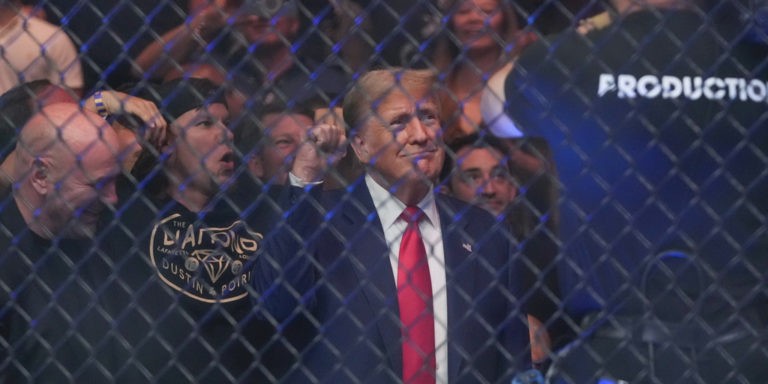
On Tuesday, the Department of Justice charged five men for their alleged roles in a plan to kill government officials and others attending an Ultimate Fighting Championship (UFC) Freedom 250 event held at the White House on Sunday. The FBI arrested five men in Ohio, Missouri, Nebraska and California for their alleged roles in the thwarted attack.

The alleged ringleader, Abraham Hermosillo Alvarez, 31, of Omaha, Nebraska, “was responsible for planning, organizing, and directing the planned attack, based on conversation excerpts in June when [he] posted, ‘This is the best action I see. Position your teams in the purple dots (counter sniper and drones) Long range (circled area) (great shot) Easy out into the river.’” He also posted other messages “including replying to another member on making drones with explosives, ‘As many and as deadly as we can get’; that he was working on drones; and had one drone and was working on more,” according to charges filed in Nebraska.

On Thursday, DHS confirmed that Alvarez was a Mexican national who was in the country illegally after he overstayed a B-2 temporary tourism visa for more than 10 years.

A B-2 visa requires applicants “to demonstrate that they have ties to their home country that they do not intend to abandon, have enough funds to support themselves during their stay in the US, and that they intend to leave the US at the end of their visit. The maximum stay for a B-2 visa is typically six months,” the U.S. Citizenship and Immigration Services explains.

Instead, Alvarez and his family overstayed the visa for more than a decade.

Alvarez entered the U.S. on a B-2 visitor visa and failed to depart before it expired in December 2001, DHS said. He and his family remained in the country illegally and in 2014, former President Barack Obama granted him and hundreds of thousands of other children in the country illegally Deferred Action for Childhood Arrivals (DACA) status.

After Alvarez’s arrest this weekend, U.S. Immigration and Customs Enforcement (ICE) lodged a detainer request with the jail where he is being detained.

“This illegal alien from Mexico should never have been allowed in our country. He was the ringleader of a failed terror attack targeting UFC Freedom 250 at the White House,” DHS Acting Assistant Secretary Lauren Bis said“He and his co-conspirators now face charges of conspiracy to commit murder and conspiracy to commit violence on White House grounds. He will face justice and swiftly be removed from our country.”

The arrests were made as the Trump administration is cracking down on visa fraud, including the B-1/B-2 visa program, The Center Square reported.

They were also made after other DACA recipients have been arrested for a range of crimes. This is after nearly 80,000 DACA recipients were released into the U.S. with arrest records raising concerns about a lack of vetting, The Center Square reported.

Obama created DACA via executive order to shield children from deportation who were brought into the country illegally by their parents. The program has been in litigation for more than a decade.

Texas and a coalition of states were the first to sue, arguing DACA is illegal and must be terminated. Other lawsuits were also filed over the program. In each one, federal judges ruled the executive action creating DACA, extending it, amending it or ending it, is illegal because only Congress can create or amend laws related to immigration.

In several ongoing cases, federal judges continue to rule that DACA is illegal. The Fifth Circuit Court of Appeals has twice ruled it is illegal.

The Biden administration sought to expand it, attempting to require that DACA recipients be provided with taxpayer-funded healthcare. Multiple states sued and a federal judge ruled the scheme was illegal, The Center Square reported.

President Donald Trump has waffled on the issue. In his first administration he sought to end DACA. In his second administration, he’s vowed to deport illegal foreign nationals while also saying Republicans support so-called “dreamers,” DACA recipients.

Republican attorneys general disagree, including Texas Attorney General Ken Paxton, who sued to end DACA years ago. Texas and other Republican-led states have won their cases in multiple federal courts, with judges only curtailing, not ending, the program, The Center Square reported.

According to a 2019 report by the Center for American Progress, within five years of Obama creating the program, more than 825,000 children, at an average age of 6, were brought to the U.S. illegally, enrolled in DACA and received temporary relief from being deported. Since then, DACA recipients have had more than 250,000 children born in the U.S., the center estimates.
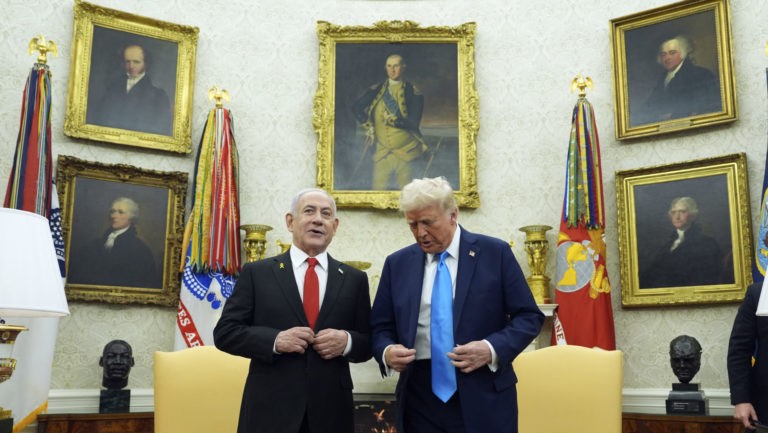
Report: Netanyahu Aims To Influence US-Iran Deal Through US Media Figures, Senators

(Dave DeCamp, Antiwar.comIsraeli Prime Minister Benjamin Netanyahu is aiming to influence the terms of the final US-Iran deal through pro-Israel “right-wing” media figures, CNN reported on Thursday, citing an Israeli official.

The only media figure mentioned by name in the report was Mark Levin, a long-time radio broadcaster and Fox News host, who is extremely pro-war and pro-Israel and has been harshly critical of the US-Iran Memorandum of Understanding to end the conflict.

Levin suggested in a post on X on Thursday that the US should pursue a different strategy to get through the midterm elections and then restart the war.

“Time for a change in strategy. We should consider slow walking the enemy, building up our munitions, our oil reserves, get the price of gasoline down, get through the midterms, then knock them out,” Levin said. “Instead of rushing to a deal, building up their oil industry, transferring billions to them, etc.”

During the US-Israeli bombing campaign against Iran, Trump defended Levin from criticism from other conservative commentators who opposed the war. “Mark Levin, a truly Great American Patriot, is somewhat under siege by other people with far less Intellect, Capability, and Love for our Country,” Trump said in a long post on Truth Social in March.

The CNN report said that Netanyahu will also aim to lean on pro-Israel senators to influence the deal, such as Sen. Lindsey Graham (R-SC), who maintains close contact with the Israeli leader.

Graham said in a post on X on Wednesday that he supported the US signing the MoU with Iran but expressed skepticism that a final deal could be reached.

“Whether or not the United States can reach an acceptable, verifiable deal with Iran regarding its nuclear program and other issues is yet to be determined, but I see little downside to trying,” Graham said.

This article originally appeared at Antiwar.com.

Vance: Israel Must Realize Trump Is the Only Leader Still ‘Sympathetic’ to Israel

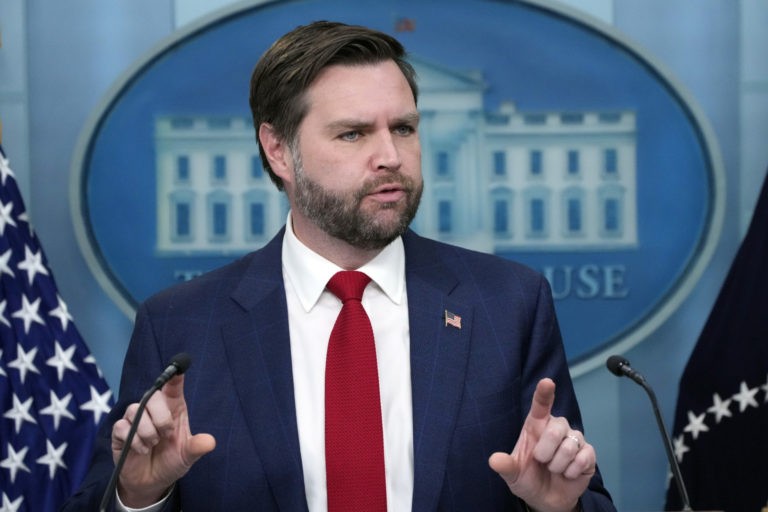
(Dave DeCamp, Antiwar.comVice President JD Vance said at a press briefing at the White House on Thursday that members of the Israeli government should realize that President Trump is the only head of state in the world who is still “sympathetic” to Israel.

The vice president made the comments when discussing Israeli officials who have been harshly critical of the Memorandum of Understanding President Trump signed with Iran on Wednesday.

“I guess my message to them would be twofold. Number one, Donald J. Trump is the only head of state in the entire world who is sympathetic to the nation of Israel at this moment in time, and he happens to be the head of state of the world’s superpower. If I was in the cabinet of the Israeli government, I might not be attacking the only powerful ally that I have anywhere left in the entire world,” Vance said.

Vance also pointed to the fact that Israel is extremely reliant on US military support. “The other thing that I would say is that over the last three months, two-thirds of the defensive weapons that have protected your homeland have been built by American hands and paid for by American tax dollars,” he said.

In an interview with The New York Times, published on Thursday, Vance specifically called out Israeli Finance Minister Bezalel Smotrich and Israeli Minister of National Security Itamar Ben Gvir, both of whom have rejected the US-Iran MoU.

“And I guess my response to them would be: What is your exact proposal? You’re a country of nine million people. You can’t just kill your way out of solving every single national security problem that you have,” Vance said.

The US vice president added that the Israeli ministers should “give a little bit of credit to the United States of America, which I think has been an incredible partner for the Israeli government for a long time.”

While Vance had some harsh words for Israeli officials, there’s still no sign that the Trump administration is willing to leverage military aid to Israel or threaten to cut it off to get Israel to end its war in southern Lebanon, which has continued, though at a lower intensity, since the announcement of the US-Iran MoU, which calls for a complete halt to the conflict.

Iranian officials have said that the MoU hinges on ending the Lebanon was and an Israeli withdrawal from the country. “The end of the war includes the end of occupation. Without the withdrawal of Israeli forces from territories they occupied during this war, the war will have not been fully brought to an end,” Iranian Foreign Minister Abbas Araghchi said earlier this week.

This article originally appeared at Antiwar.com.

Stranded Ships Have Begun Transiting the Strait of Hormuz, Maritime Data Company Says

(Headline USA) Major shipowners have begun moving vessels through the Strait of Hormuz since the U.S. and Iran signed an interim agreement to end their war, maritime data company Lloyd’s List Intelligence said Thursday.

In a media briefing, Richard Meade, editor in chief of Lloyd’s List, said for the first time in 110 days, ships owned by major companies were crossing the strait after effectively being marooned there since February.

The strait is a critical passageway for the world’s oil and natural gas. Before the war, the waterway off Iran’s coast carried a fifth of the world’s crude oil. Its closure during the war has created a historic energy crisis.

Lloyd’s List did not say how many ships were transiting through or had passed through the strait as of Thursday. It said tankers controlled by major ship owners Grimaldi Group, Cosco, Knutsen and NYK had passed through the strait. Two Iran-flagged, National Iranian Tanker Company-owned, sanctioned crude oil tankers entered the strait, according to Lloyd’s List.

Meanwhile, U.S. Vice President JD Vance said Thursday that the U.S. Navy lifted its blockade of the strait to allow some ships through Iranian ports.

Italian Foreign Minister Antonio Tajani wrote on X that an Italian merchant ship owned by the Grimaldi Group was among the first vessels to transit the strait after the agreement’s signing.

Maritime data and tracking company Kpler said it observed six verified ship crossings on Wednesday and another 11 on Thursday.

Phillip Belcher, marine director of Intertanko, a trade group for global independent tanker owners, said the main central route of the Strait of Hormuz was still closed and has an estimated 80 mines that need to be cleared. But ships have been passing through the smaller northern route, which goes through Iranian waters, and the southern route, which goes through Omani waters.

“Those two routes now seem to be fully open,” Belcher said.

However, it will take weeks or months to fully reopen the strait, and the two alternative routes don’t have as much capacity as the central passage in the Strait of Hormuz.

“This is like a highway where the road in the middle is closed and you’re using that hard shoulder,” Belcher said. “That’s now being used as the main route. We need to get back to having the highway open.”

Lloyd’s List estimated that 550 merchant ships will need to prepare to exit the Persian Gulf, including 160 tankers, 200 bulk carriers, 60 container ships and 10 vehicle carriers.

Adapted from reporting by the Associated Press


Michigan Republicans Blast Whitmer’s Europe Trip as Budget Deadline Nears

(Elyse Apel, The Center Square) Michigan Gov. Gretchen Whitmer is facing criticism from Republicans for traveling to Europe as critical state budget negotiations are ongoing ahead of a July 1 deadline.

This comes as Whitmer, a Democrat, is currently leading a “Team Michigan” delegation to France, Belgium and Luxembourg for a week-long trip. The delegation includes officials from the Michigan Economic Development Corp. and representatives from Michigan’s health care sector.

Whitmer’s office argues the trip is critical for business relations.

“On this investment mission, we’ll strengthen ties with European allies, showcase Michigan’s leadership in advanced manufacturing, aerospace, defense, and innovation, and bring home new opportunities that create good-paying jobs for Michiganders,” Whitmer said earlier this week.

Republican lawmakers argue the timing is inappropriate with lawmakers in the divided state legislature still negotiating the state’s budget.

State Reps. Greg Markkanen, R-Hancock, and Tim Kelly, R-Saginaw Township, who chair House budget committees responsible for education funding, said budget talks have stalled while Whitmer is overseas.

“Productive budget negotiations are on hold because the governor wanted to go vacation in Europe,” Markkanen said. “Our schools are waiting on us to get the budget done; we don’t have time for state-funded croissant tastings or TikTok videos in front of the Eiffel Tower.”

Kelly said school districts need budget certainty soon.

“The House did its part,” Kelly said. “We’re ready to finish the job, but we can’t do it alone. We need Gov. Whitmer to get back to Lansing, so we can give schools clarity.”

Whitmer’s office has defended the trip as an “international investment mission.”

The trip began with the delegation’s attendance at Eurosatory, a major defense and security conference in Paris. According to the governor’s office, Whitmer is the only American governor attending Eurosatory this year.

“Michigan’s ongoing relationships across Europe continue to create opportunities for our businesses, workers, and communities,” said MEDC CEO Quentin L. Messer, Jr. “As an international-facing state, these engagements help position Michigan businesses of all sizes for growth, thus creating more opportunities for Michiganders while reinforcing our state’s reputation as a trusted global partner.”

State Rep. Matt Maddock, R-Milford, vice chair of the House Appropriations Committee, is also criticizing Whitmer’s travel, calling it “globe-trotting across Europe at the worst possible time.”

“We are 15 days from the July 1 budget deadline, and Governor Whitmer is AWOL yet again, spending nearly half of the time between now and then overseas on her third European excursion of the year and holding up budget negotiations,” Maddock said.

The criticism was echoed by the conservative nonprofit Michigan Forward Network.

“Gretchen Whitmer will do anything to avoid being in the state she’s supposed to be leading,” Michigan Forward Network spokesman Gabe Butzke said in a statement. “Our students are struggling to read, our income growth is in the toilet, and our unemployment rate is one of the worst in the country, but the governor would rather be in Paris.”

This is not the first time Whitmer has faced criticism over her international travel, which reportedly cost roughly $1 million in 2025.

Whitmer’s office said 12 Michigan-based companies exhibited at Eurosatory through the state’s international trade program.

While in Paris, Whitmer met with executives from several companies that have recently expanded or announced investments in Michigan, including Saab, American Rheinmetall and RENK Group.

The governor’s office said the companies represented in those meetings have committed hundreds of millions of dollars in investment and more than 800 jobs to Michigan communities.

“Across the globe, we’re telling Michigan’s story and showing the world that Michigan is the best place to build, grow, and innovate,” Whitmer said on Wednesday. “Let’s keep working together to build on our economic momentum and help more families and businesses ‘make it’ in Michigan.”

Whitmer is scheduled to travel to Belgium and Luxembourg before returning to Michigan.

Illegal Immigrants Across U.S. Get Financial Aid for College

(Esther Wickham, The Center Square) State financial aid continues to expand within higher education, allowing money to go to eligible illegal immigrant students.

The increased spending is heating up debate over who should receive state taxpayers-funded higher education benefits.

Currently, around 21 states and the District of Columbia offer in-state tuition eligibility to certain illegal immigrant students, and 18 states and D.C. provide access to state financial aid programs, according to Higher Ed immigration.

For example, at a University of California school, the base in-state tuition is roughly $15,000 annually. For nonresidents, the base tuition is over $31,000, which means eligible illegal immigrants are essentially receiving $16,000 a year in aid.

The policies are part of a broader effort that has expanded over the past two decades to increase college access for immigrant students, including recipients of the Deferred Action for Childhood Arrivals program. DACA provides temporary protection from deportation and renewable work permits to certain immigrants who were brought to the United States as children.

More than 900,000 of these individuals are estimated to be eligible for DACA. In addition, over 500,000 illegal immigrant students are enrolled in U.S. colleges and universities.

Critics argue that the programs impose costs on taxpayers and divert limited higher education resources away from U.S. citizens.

A 2025 report by the Federation for American Immigration Reform estimated that education-related expenses associated with illegal immigration total $5.7 billion nationally.

Ira Mehlman, media director for FAIR, pointed to the 1996 Illegal Immigration Reform and Immigrant Responsibility Act, which specifically created a provision requiring any state offering in-state tuition rates to illegal immigrants to make the same benefit available to U.S. citizen students, regardless of which state they happen to live in.

States keep “finding new ways to provide benefits to illegal aliens,” Mehlman told The Center Square. “A lot of American students are being shut out of those state universities because those seats are now occupied by illegal aliens, and then taxpayers are being forced to pay for it.”

Texas pioneered this loophole that conditioned in-state tuition on having completed three years of high school in the state rather than looking at immigration status, Mehlman added.

Texas became the first state to adopt such a policy in 2001 through what became known as the Texas Dream Act.

In June 2025, the U.S. Department of Justice sued Texas, arguing the program violated federal law. A federal court subsequently blocked enforcement of the Texas Dream Act. The lawsuit is currently on appeal at the U.S. District Court for the Northern District of Texas.

Advocacy groups have sought to intervene, arguing the case was resolved without sufficient judicial review.

In Texas, state records show that colleges and universities distributed $635.2 million in state-funded gift aid to 133,989 students in 2023. According to a report by Every Texan, 3,566 Texas Dream Act students received $17.5 million in state-supported grants, accounting for less than 3% of total state gift aid distributed that year.

The taxpayer cost associated with the Development, Relief and Education for Alien Minors or DREAM Act program and others varies by state.

Lance Izumi, senior director of education studies at Pasadena-based Pacific Research Institute, argued that taxpayer-funded aid for illegal immigrant students raises concerns about fairness and state spending priorities.

“Government financial aid to illegal immigrant students is wrong on three counts: fairness, fiscal policy and planning for higher education’s future,” Izumi told The Center Square.

Izumi noted that American students collectively hold roughly $1.8 trillion in student loan debt and argued that taxpayer-funded scholarships for illegal immigrant students may reduce resources available for citizens.

“It is also not fair to give lower in-state tuition to an illegal immigrant who broke the law to enter this country, while denying that lower tuition to a law-abiding American citizen in another state,” he said.

Izumi also questioned whether colleges facing enrollment declines have expanded outreach to Illegal immigrant students, partly to offset falling student populations.

“In reality, pushing illegal-immigrant enrollment is a way for adults in higher education to save their jobs by finding a new pool of potential students rather than addressing the core reasons for falling college enrollment: politicization of courses, economic irrelevance of many courses and majors, and deteriorating academic rigor,” Izumi said.

Kassandra Gonzalez, senior attorney with the Texas Civil Rights Project’s Beyond Borders Program, working on the Texas lawsuit, told The Center Square that the issue is complicated because there is a distinction between immigrants who are “lawfully present” and those who have “lawful status.”

“The misinformation and the frankly wrong narrative of this idea that dreamers or students who are able to take higher education with the Dream Act are taking opportunities from others is not the reality of economics,” Gonzalez said.

Immigrant students contribute to local economies and give back to their communities, Gonzalez added.

“I think the fiction that we hear in the immigration debate in general, like, ‘Oh, well, they’re taking something from someone else,’ I always go back to, well, this idea that they don’t pay taxes, or that these students aren’t contributing. It’s like there’s actual data that they are giving back to the economy of Texas,” Gonzalez added.

According to Every Texan, immigrants in Texas who hold bachelor’s degrees earn substantially higher incomes than those with only high school diplomas. The organization estimates that the higher earnings associated with a college degree generate additional state and local tax revenue.

The Every Texan report estimated that Texas Dream Act students enrolled in 2023 could ultimately generate more than $43 million in additional annual state and local tax revenue through higher educational attainment and earnings.

According to the California Budget and Policy Center, illegal immigrants paid an estimated $8.5 billion in state and local taxes in 2022.

That same year, California residents paid an average of $3,734.82 in state income taxes. With roughly 19.6 million taxpaying residents, that equates to about $73.2 billion in state income tax revenue, not including sales taxes or higher-income tax brackets.

Mehlman told The Center Square that tax payments do not place illegal immigrants with citizens when it comes to public benefits.

Just because illegal immigrants pay taxes, “that doesn’t put them on an equal footing with legal residents and citizens,” Mehlman said.

Along with Texas, several other states have expanded access to higher-education assistance in recent years.

California, Colorado, Connecticut, the District of Columbia, Hawaii, Illinois, Maryland, Massachusetts, Minnesota, Nevada, New Jersey, New Mexico, New York, Oregon, Rhode Island, Utah, Vermont, Virginia and Washington are among the jurisdictions that provide broad access to state financial aid and grant programs for illegal immigrant students who meet applicable eligibility requirements.

In New York, lawmakers enacted the José Peralta New York State DREAM Act, expanding access to state financial aid for eligible illegal immigrant students. The DREAM Act allows immigrant students to apply for state financial aid for undergraduate or graduate study at eligible colleges and universities.

The state’s 2019-20 budget, when it was first enacted, included $27 million to support implementation of the DREAM Act.

New York is home to an estimated 21,250 Deferred Action for Childhood Arrivals, or DACA, recipients.

Through the DREAM Act, eligible illegal immigrant students may receive awards through the state’s Tuition Assistance Program, which provides up to $5,665 annually.

For the 2025–26 budget, TAP alone provides more than $698 million annually to roughly 255,000 New York students. DREAM Act recipients are funded through these broader aid programs rather than through a standalone DREAM Act appropriation.

A New York City fact sheet reported that individuals eligible for the DREAM Act contributed an estimated $1.3 billion to the city’s gross domestic product in 2017 and earned more than $873 million collectively, with average annual earnings of about $18,600.

In Illinois, access to state financial aid through House Bill 460 was signed into law by the Gov. J.B. Pritzker in December 2025.

The bill added in the Retention of Illinois Students and Equity Act, allowing eligible illegal immigrant students to apply for state-administered financial aid programs regardless of immigration status.

The change made illegal immigrant students eligible for state programs such as the Monetary Award Program grant, which provides need-based financial assistance for higher education.

Illinois allocated over $700 million for MAP grants during the 2024 fiscal year.

The states of Alabama, Georgia and South Carolina prohibit enrollment of illegal immigrant students into state financial aid programs, according to Higher Ed Immigration.

The Center Square reached out to the American Immigration Council and the U.S. Department of Education for comment but did not receive a response.

Congressional Candidate Caught in ‘Teen Takeover’

(Jim Talamonti, The Center Square) An Illinois candidate for Congress says a teen takeover arrived like a storm at a Chicago grocery store where she was shopping this week.

Christian Maxwell is the Republican nominee for the House seat currently held by U.S. Rep. Jonathan Jackson, D-Chicago.

Maxwell said there were a few teens and police units outside the Hyde Park Trader Joe’s when she entered the store with her four children Monday evening, but the dynamic quickly changed.

“I didn’t know initially, but it was because the full teen takeover had arrived kind of like a storm. It was that quick.  It went from being a few kids to hundreds of kids at this location,” Maxwell told The Center Square.

Maxwell said there were adult men mixed in with the teens.

“They have on balaclavas or they have on masks like the COVID-19 mask. They’re in full black attire and they have bags as well.  So these are not just children who are making some TikToks and having fun,” Maxwell said.

Maxwell said she was able to check out and exit the store. She said there were teens all over the parking lot and men walking by as she got her kids into the car.

She posted a video with brief footage of the incident on social media.

Although she was not aware of any injuries, Maxwell said the takeover devolved into brawls at several area businesses.

“When I drove past, I saw merchandise on the ground in front of the Walgreens. Those kids actually had fights all throughout Hyde Park. They kept traveling.  They travel like a horde,” Maxwell said.

She said teens have stolen “a good amount” of Chicago Transit Authority fare because they bum rush the bus or train to avoid paying.

When asked by The Center Square about a potential solution to the teen takeover issue, Maxwell said more rules are not needed.

“You have to enforce the laws we already have.  It has never been ok for parents to not know where their children are. These are minors,” Maxwell said.

Maxwell said parents should be held accountable if their minor children are picked up for entering a business and stealing.

SCOTUS: It’s Not a Crime for Marijuana Users to Have Guns

(Headline USA) The Supreme Court ruled Thursday against a broad federal ban on gun ownership by marijuana users, the latest in a line of firearm cases from a court that has expanded gun rights.

The justices decided unanimously in favor of Ali Danial Hemani, a Texas man who argued that a law barring guns from anyone who regularly uses illegal drugs violates the Second Amendment.

Justice Neil Gorsuch wrote that his opinion narrowly limits the government’s power to take guns away from drug users who are not considered dangerous. Hemani, who was not charged with any other crimes or accused of using the weapon under the influence, is thankful he “finally has closure,” lawyer Zachary Newland said.

The decision is a loss for President Donald Trump’s Republican administration, which had defended the 1968 law despite arguing against other gun restrictions. Its core argument “fails under every measure,” Gorsuch wrote.

The law was originally meant to keep guns away from dangerous people, but millions of people now use marijuana, Gorsuch wrote. It is broadly legal in about half the states and has gained widespread use for health purposes.

“Whatever one thinks of these developments, the federal government has not just tolerated them; it helped fuel them,” Gorsuch wrote. “All of which leaves it awkwardly positioned to suggest that the millions of Americans who now regularly use marijuana are categorically and unusually dangerous.”

The law was also used in a case against Hunter Biden, who was convicted in Wilmington, Delaware, of buying a gun while addicted to cocaine in 2018. He was later pardoned by his father, Democratic President Joe Biden.

Someone addicted to an illegal drug could potentially still be prosecuted after Thursday’s decision.

“We do not address efforts to ban addicts, or those presently intoxicated, from possessing a firearm,” Gorsuch wrote. Prosecutors could charge a marijuana user if they had evidence the person was dangerous, he said.

Recreational use remains illegal on a federal level even after the Trump administration reclassified medical marijuana as a less-dangerous drug in April.

The case made for some unusual political alliances.

The American Civil Liberties Union and the National Rifle Association supported Hemani’s case, as did cannabis legalization groups such as NORML. On the other side were gun safety groups including Everytown that usually oppose the administration on Second Amendment issues.

The ACLU applauded the ruling, saying that nearly half of Americans have reported using marijuana at some point in their lives.

“The court has sent a strong message that the government cannot criminalize the conduct of large numbers of people by making categorical and unfounded assumptions about whether they are dangerous,” said Cecillia Wang, legal director at the ACLU.

The Second Amendment Foundation called it a “major victory for gun owners.”

The group Smart Approaches to Marijuana, which opposes legalization of the drug, condemned the court’s decision.

“While the justices in this case appear to be most concerned with historical battles over Second Amendment rights, public health and safety are the collateral damage in this decision,” said CEO Kevin Sabet.

Gun control groups were more muted, with Everytown saying that the decision still recognizes that “drugs and guns can make for a dangerous mix.”

It is rare to see standalone criminal charges filed against people accused solely of owning guns and using drugs. The charge is more often filed against people also accused of other crimes.

The opinion is the latest in a series of firearm cases to reach the Supreme Court since its landmark ruling expanding gun rights in 2022 led to a wave of challenges around the country.

Since then, the high court has upheld a law aimed at protecting victims of domestic violence and strict regulations on ghost gun kits but has struck down a ban on bump stocks, an accessory that enables rapid fire. The justices are also considering a second firearm case this term over strict regulations on carrying guns in Hawaii.

Adapted from reporting by the Associated Press


Trump Says Iran ‘Has To Have Some’ Ballistic Missiles

(Dave DeCamp, Antiwar.com) President Donald Trump said on Wednesday that Iran has to be able to have “some” ballistic missiles when discussing future negotiations for the potential US-Iran deal.

The president told reporters that after the US-Iran Memorandum of Understanding is signed, the US will work with its Gulf allies on “non-nuclear” issues, including ballistic missiles.

“I mean, they have to have some because other people have some, you gotta have some,” the president said at the G7 summit in France.

Iran’s ballistic missile program was frequently cited by senior US officials as one of the reasons why the US launched the war. Secretary of State Marco Rubio, who was standing alongside Trump at the G7 summit, told reporters in the first days of the bombing campaign that one purpose was to “destroy Iran’s missile capability,” something Trump also vowed to do when announcing the first wave of airstrikes.

“We’re going to destroy their missiles and raze their missile industry to the ground. It will be totally, again, obliterated,” Trump said on February 28 after the first wave of US-Israeli airstrikes.

But now the president appears to have realized the goal isn’t achievable as Iran’s missile capability withstood the heavy US-Israeli bombing campaign. According to recent media reports, US intelligence estimates say that Iran retains more than 70% of its missiles and missile launchers.

In his remarks on Wednesday, the president appeared to make fun of his aides who were still insisting that Iran must give up its ballistic missiles. “I have guys, I like some of these guys, but I don’t think they’re smart. ‘Sir, you shouldn’t let them have any missiles.’ I say, what am I gonna do? Am I gonna let Saudi Arabia have missiles, but they can’t have any? … It doesn’t work that way,” he said.

When reporters later asked about the comments, Trump doubled down. “I’m saying that ⁠if other countries have ​them, it’s a little bit ​unfair for them not to have some. If ​Saudi Arabia and Qatar, and ​they all have some, I would ‌say ⁠in relative proportion, I think it’s okay,” he said.

The idea of Iran giving up its ballistic missile program as part of a deal with the US is a long-standing Israeli demand meant to sabotage the chances of a deal, since Tehran’s missiles and drones are its only way to strike back at the US and Israel. Any efforts to impose limits or restrictions on Iran’s missiles would almost certainly fail since they are now Iran’s primary deterrent to more US and Israeli attacks.

This article originally appeared at Antiwar.com.  

Mexican Human Smuggling Rings Busted Nationwide

(Bethany Blankley, The Center Square) Mexican-based human smuggling rings have been busted in multiple states. One involved smuggling hundreds of people from Central America, Africa and the Middle East into Arizona; another involved holding hostage foreign nationals in a ransom scheme where they were killed. Another involved a $200 million forced labor scheme on U.S. farms.

In California, San Diego resident Isaac Jimenez pleaded guilty to a transnational human smuggling conspiracy in which foreign nationals were held hostage in Mexico, families paid “tens of thousands of dollars in vain” in ransom payments only for their loved ones to “never to be seen again.”

“In at least two cases, the victims – a father of four U.S. citizen children and a young woman from Tijuana – disappeared after their families made multiple ransom payments to secure their freedom,” the U.S. Attorney’s Office for the Southern District of California announced.

In one case in September 2024, he “personally collected $15,000 in ransom payments from the U.S. citizen wife of the father of four who was being held against his will in Mexico by the smuggling organization,” and transported and delivered the money to coconspirators in Mexico. After ransom demands were met, more demands were made. Once the family couldn’t pay any more, communication was cut off, and the man is believed to have been killed, according to the complaint.

In December 2024, he agreed to coordinate the smuggling of a 20-year-old woman from Tijuana, Mexico, in exchange for $7,000. Instead, she was held hostage with a $30,000 ransom demand. Smugglers sent video calls to her “fiancé and family members showing them pointing firearms at her and kicking her in the chest and head” and threatened to kill her if the ransom wasn’t paid. After her family sent $10,000, she wasn’t released and is believed to have been killed, the complaint states. Sentencing is scheduled for September.

In Arizona, the latest of two Mexican nationals involved in a transnational human smuggling ring extradited from Mexico was sentenced to 87 months in prison. The scheme involved smuggling foreign nationals from Central Asia, Africa and the Middle East into the U.S. between 2018 and 2022, charging each “as much as tens of thousands of dollars.”

They smuggled hundreds from Bangladesh, Yemen, Pakistan, Eritrea, India, the United Arab Emirates, Uzbekistan, Russia, Egypt, Brazil, Peru, Ecuador, Colombia, Costa Rica, Nicaragua, Honduras, El Salvador, Guatemala, and Mexico, according to the indictment.

The latest to be sentenced is Mexican national Raul Saucedo-Huipio, a manager or supervisor overseeing the smuggling route. He and his co-conspirators directed foreign nationals to illegally cross into the U.S. from Mexico through the U.S. Customs and Border Protection Yuma Sector of Arizona – a region hard hit during the Biden administration. Foreign nationals were provided a ladder to climb over a border fence, directed to crawl through holes in the fence and use a plank for waterway crossings. They were also robbed at gun and knifepoint, according to the indictment.

He and his coconspirator, Ofelia Hernandez-Salas, were arrested in Mexico in response to a March 2023 U.S. extradition request. In December 2024, he pleaded guilty to human smuggling charges. Hernandez-Salas was sentenced to 11 years in prison in May.

In Georgia, three people were sentenced to between 10 and 51 months in prison for their roles in a human smuggling and labor trafficking operation that involved illegally transporting foreign nationals to work on South Georgia farms as agricultural workers.

The scheme dates to 2015, involving conspirators engaging “in mail fraud, international forced labor trafficking, and money laundering, among other crimes,” and fraudulently using the H-2A work visa program to transport foreign nationals from Mexico, Guatemala, and Honduras into the U.S. under the guise of agricultural work, according to the charges.

The sentencing is part of a larger multi-state fraudulent visa, forced labor and money laundering scheme being prosecuted in the Southern, Middle, and Northern Districts of Georgia, the Middle District of Florida, and Southern District of Texas. Crimes are also being prosecuted in Mexico, Guatemala, Honduras and elsewhere, the Department of Justice said.

The scheme involved requiring foreign nationals to pay fees for transportation, food, and housing and once they got to the U.S., withholding their travel and identification documents. They were then forced to perform “physically demanding work for little or no pay,” live in crowded, unsanitary, and degrading living conditions” and threatened with deportation and violence, according to the charges.

The conspirators earned more than $200 million through the scheme, laundering the funds through cash purchases of land, homes, vehicles, and businesses; cashier’s checks and funneling millions of dollars through a casino, according to the charges.

In other cases in Florida, North Carolina and Virginia, three Mexican nationals were charged on 35 counts of trafficking Mexican farmworkers into forced labor conditions and detaining them after their visas expired for financial gain, The Center Square reported. In another case, six people in Washington state were indicted on 61 charges of operating a similar scheme, also abusing the H-2A visa program, The Center Square reported.