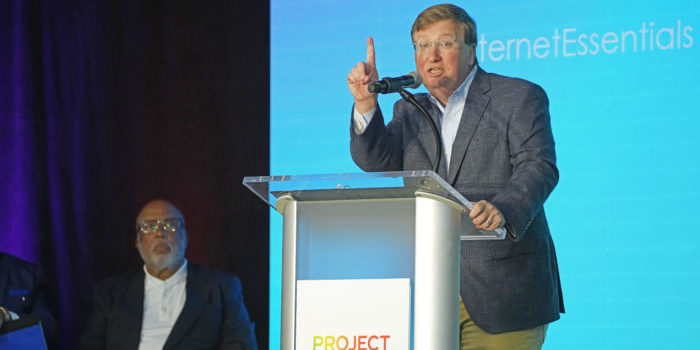
(Ben Sellers, Headline USA) Mississippi Gov. Tate Reeves pledged on Friday to convene a special session of the state legislature in order to eliminate the congressional seat held by notorious ex-Jan. 6 Committee chairman Bennie Thompson, a Democrat.
I don’t typically make news on a Friday afternoon, but today I am going to make an exception:
I’m calling a special session.
During the recently completed regular session, the Legislature discussed drawing new maps to comply with a decision from a federal judge from the… pic.twitter.com/wEnFw5xkHk
— Governor Tate Reeves (@tatereeves) April 24, 2026
Reeves referenced a potentially landmark Supreme Court decision, Louisiana v. Callais, which is currently awaiting release. Some have suggested that the court’s liberal arm may be intentionally delaying it to meddle in the upcoming midterm election.
The decision is likely to overturn key sections of the segregation-era Voting Rights Act that require certain states to carve out race-based districts in order to assure minority representation.
An overturn of the law would have potentially far-reaching implications for allowing majority red states, such as Mississippi, to redraw districts where the law currently mandates specially drawn safe-blue seats.
“It is a decision that could (and in my view should) forever change the way we draw electoral maps,” Reeves wrote.
Johnson’s is the only Democrat-held congressional seat in Mississippi, which went for President Donald Trump with roughly 61% of the vote in 2024.
Mississippi could easily eliminate Bennie Thompson’s seat and redraw the map to a 4R–0D split with little risk in a post-VRA environment. In this configuration, every district would be Trump +22 or higher, making all seats safely Republican.
District breakdown:
MS1 (Kelly, R):… https://t.co/nkrPcopL1r pic.twitter.com/RAhmm70B13— Erickson (@erickson_68) April 24, 2026
While the Constitution notably delegates district-drawing powers to the individual states, the 1965 VRA requires that federal authorities sign off on any voting laws in former “Jim Crow” states, making it a stark departure from what the framers intended.
“It is my belief and federal law requires that the Mississippi Legislature be given the first opportunity to draw these maps. And the fact is, they haven’t had a fair opportunity to do that because of the pending Callais decision,” Reeves wrote.
“For those reasons, I am using my constitutional authority to allow the Mississippi Legislature to use their constitutionally recognized right to draw these maps once the new rules of the game are known following Callais,” he added.
Reeves said the special session would occur three weeks after the release of the Callais decision, whenever that may be.
Several recent cases from the Supreme Court have advanced the idea that race-based gerrymandering is unconstitutional.
In 2019’s Rucho v. Common Cause, the court said that North Carolina’s GOP legislature had violated the Voting Rights Act by using racial demographics to carve out district that would reduce the number of Democratic seats by further concentrating and consolidating black voters.
In 2020’s Brnovich v. Democratic National Committee, the court ruled that Arizona did not need federal approval for a law that banned controversial ballot harvesting practices, with justices hinting in the majority opinion that the archaic VRA mandates should not apply in perpetuity.
Reeves concurred, noting that while the law’s intent may have been noble at the time, it was now being weaponized by Democrats to reduce red-state voting power, while also effectively disfranchising black conservatives.
“[I]t engages in the offensive and demeaning assumption that Americans of a particular race, because of their race, think alike and share the same interests and preferences – a concept that is odious to a free people whose institutions are founded upon the doctrine of equality,” he wrote.
Mississippi’s redistricting follows a recent attempt by Democrats in Virginia to eliminate four GOP-held seats, in open defiance of their own state law granting that authority to a bipartisan redistricting commission.
The brazen power-grab by newly elected Gov. Abigail Spanberger, a hard-left Democrat who ran as a moderate, has triggered Republican governors like Florida’s Ron DeSantis to pledge an in-kind response.
🚨 HOLY CRAP! Gov. Ron DeSantis just BODIED Hakeem Jeffries threatening Florida if we re-draw our 2026 maps
"'Oh, we're gonna go after Florida.' PLEASE. BE MY GUEST. I will PAY you to come campaign! I'll put you up in the Florida governor's mansion! We'll take you fishing.… pic.twitter.com/uAN8gVXVHR
— Eric Daugherty (@EricLDaugh) April 22, 2026
Meanwhile, a judge in Virginia placed an injunction on its gerrymandering resolution pending a determination from the state Supreme Court as to whether Democrats violated any laws in its passage.
UPDATE on referendum lawsuits: The Tazewell Circuit Court just ruled the referendum unconstitutional. The Judge entered an injunction blocking certification of the election & denied a motion to stay pending appeal. A final order will be entered once drafted, & it will be…
— Ken Cuccinelli II (@KenCuccinelli) April 22, 2026
Democrats have declared that if they retake the U.S. House majority next session they will immediately launch proceedings to impeach Trump for the third time, potentially derailing his agenda in the final two years of his presidency.
Ben Sellers is a freelance writer and former editor of Headline USA. Follow him at x.com/realbensellers.