(Ben Sellers, Headline USA) Two weeks since Democrats finally ended the longest federal shutdown in history — surpassing by more than a month the record they set last year — the Senate unanimously passed a resolution via voice vote that would stop its own members from receiving paychecks during future shutdowns.
🚨 JUST IN — IT’S OFFICIAL: The U.S. Senate has BARRED members from receiving paychecks when the government shuts down
The ONLY useful thing the Senate has done in a long time.
I’m genuinely surprised! pic.twitter.com/XuvPvUkiPM
— Nick Sortor (@nicksortor) May 14, 2026
Senate Resolution 526 updates the Congressional Register to require the secretary of the Senate to withhold all payments to the senators themselves until “practicable after the date on which the Government shutdown ends.”
It will take effect on Nov. 4, the day following the next general election.
The measure, sponsored by Sen. John Kennedy, R-La., was well received in the public, although critics said it was largely performative since most senators did not need their paychecks to live month-to-month, as many U.S. workers do.
Kennedy himself ranks as the 62nd wealthiest member of Congress, with an estimated net worth of just over $21 million. His fellow Louisianan, House Majority Leader Steve Scalise, is among the poorest, with a reported net worth of $8,000.
Sen. Alex Padilla, D-Calif. is reported as the most penurious member of the upper chamber, with a net worth of around $86,690.
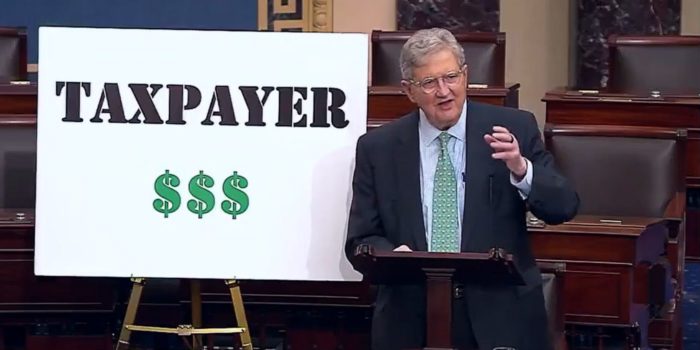
Kennedy acknowledged in a floor speech Wednesday that in order to get the votes to pass the resolution, it ultimately had to have little practical impact.
“Frankly, if I were king for a day and I wanted to stop government shutdowns, I’d do more than this. I would do two things,” he said.
“If government shuts down, a senator loses his pay. It’s not escrowed (you get it back later) — you just don’t get your pay,” he added. “I’m also saying you can’t leave Washington, can’t go home.”
My resolution to stop senators' pay during government shutdowns cleared a key procedural vote today, moving it one step closer to final passage.
Fair-minded Americans know senators should feel the pain of a shutdown with the American people. pic.twitter.com/hI7maEtaIM
— John Kennedy (@SenJohnKennedy) May 13, 2026
The most recent shutdown, spearheaded by Senate Minority Leader Charles Schumer, D-N.Y., lasted from Feb. 14 to April 30, a period of 76 days, and was designed to undermine the efforts of Immigration and Customs Enforcement as they pursued mass deportation of criminal illegal immigrants.
Instead, it put Americans at greater risk for acts of terrorism, including an April 25 assassination attempt on President Donald Trump during the White House Correspondents’ Dinner at the Washington Hilton.
The shutdown, targeting only the Department of Homeland Security, also resulted in massive wait times at the airport screening stations operated by the Transportation Security Administration. Trump was able to ease the strain, in part, by dispatching ICE agents to fill in for absent TSA screeners.
The dysfunction came on the heels of a then-record-breaking full government shutdown last year, which lasted 43 days from Oct. 1 to Nov. 12.
Both were part of a disturbing trend of Democrats lurching farther leftward and opting to weaponize chaos over compromise, at the expense of U.S. citizens. Schumer caught flack in early 2025 for capitulating to the GOP majority, which led to calls from his socialist-leaning base that he resign or be primaried.
Coincidentally, the third-longest shutdown also was ushered by the Democrat minority during the halfway point of Trump’s first presidential term. It lasted 35 days, from Dec. 22, 2018, to Jan. 25, 2019. Trump famously got back at then-House Speaker Nancy Pelosi, D-Calif., by grounding her flight on an international public-relations trip after she canceled his State of the Union address.
Ben Sellers is a freelance writer and former editor of Headline USA. Follow him at x.com/realbensellers.