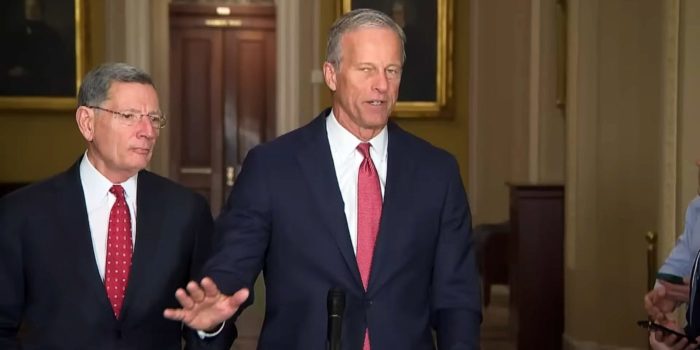
(Ben Sellers, Headline USA) A report from federal agencies showing discrepancies between population and voter registration in a dozen states may help to explain why Senate Majority Leader John Thune, R-S.D., has forced the election-integrity reform bill known as the SAVE Act off the legislative agenda.
Nearly a quarter of all U.S. senators live in states that have more registered voters than voting-age citizens, according to a viral chart shared by Shiloh Marx, founder and president of the Integrity First Alliance. The chart was based on data from the U.S. Election Assistance Commission and the U.S. Census Bureau.
Senators of the 12 states with more registered voters than voting-age citizens pic.twitter.com/ij8a944fMd
— Shiloh Marx (@Shilohmarx) May 15, 2026
Eight of the 12 states (two-thirds) were those with two Democrat senators, while three of the 12 (one-fourth) states had two Republican senators. Maine, which currently has Republican Susan Collins and Independent Angus King, was the only split state.
The fact that the dodgy data broke in Democrats’ favor likely surprised few, considering the Left has become steadfast in its opposition to enforcement of both immigration and election-integrity laws.
But tellingly, it showed that four of the five high-profile Republican opponents of the SAVE Act also stood to benefit from less scrutinized elections.
In addition to Collins and Thune, Alaska Sen. Lisa Murkowski and Kentucky Sen. Mitch McConnell made the chart, leaving retiring North Carolina Sen. Thom Tillis as the only outlier. (Tillis’s Trump Derangement Syndrome has been credited as a prime motivator in his insistence on sabotaging GOP political prospects.)
Like Tillis, McConnell, 84, plans to retire at the end of his current term. However, his hand-picked successor, Rep. Andy Barr, is favored to secure the nomination in Kentucky’s Republican primary on Tuesday over more conservative choices like former state Attorney General Daniel Cameron.
Murkowski’s path to power, meanwhile, has been notoriously spotty, particularly due to the possible manipulation of Alaska’s confusing ranked-choice voting system, which eliminates parties’ ability to select their candidates via primary.
Some X users took note of the overlap between averred RINOs who had received an “F” rating on the Conservative Review’s Liberty Scorecard and those who lived in states with dirty voter rolls.
“Is this how they usually beat challengers in GOP Primaries?” wrote user @doug86027, a lifelong conservative and Marine veteran from Minnesota. “Hmm….I wonder if they are connected.”
Imagine that many of these Rino's made both lists? Is this how they usually beat challengers in GOP Primaries? Hmm….I wonder if they are connected. pic.twitter.com/ecgo5I45O0
— Douglas (@doug86027) May 15, 2026
The SAVE Act, championed by President Donald Trump and his allies, would close several election loopholes by requiring photo ID and in-person submission of voter registration. It also would add new mandates for states to clean their voter rolls.
The bill already has cleared the House, but it lacks the 60 votes needed to end debate in the Senate, effectively allowing an informal “silent filibuster” to block it with all 47 Democrats (including Independents) opposing it.
Proponents of the SAVE Act have said that Thune should either abolish the filibuster altogether or impose a traditional “talking filibuster” that would allow the bill to leave its debate phase once opponents had exhausted their allotted opportunities to speak.
However, Thune has insisted that enforcing the normal filibuster rules would be too time consuming.
The lengthy process famously was deployed by Democrats in 1957 as part of a doomed effort to block the Civil Rights Act.
Other SAVE Act supporters have suggested attaching it to an appropriations bill or other legislation, such as renewal of the controversial FISA spying powers, that deep-state RINOs would have no choice but to get behind.
Ben Sellers is a freelance writer and former editor of Headline USA. Follow him at x.com/realbensellers.