SELLERS: After Godwin’s Law, Dems May Try One Last ‘Get Trump’ Gambit on Election Day

(Ben Sellers, Headline USA) Apart from getting booed by Beyoncé fans and heckled by Hamas supporters, nothing could have been more pathetic than the Kamala Harris campaign’s pivot back to Bidenesque fearmongering in the desperate final stretch of the 2024 election.

The Adolf Hitler trope now being deployed by Democrats is so overwrought that, since 1991, it has had its own special name in online culture: Godwin’s law.

And yes, the eponymous law’s creator, Mike Godwin—a former senior fellow at the R Street Institute and contributing editor at Reason magazine— has often addressed, in response to media inquiries, whether former President Donald Trump deserves a special-exception rider.

“My name gets cited in a lot of these discussions. And of course my ears are burning,” Godwin explained in a 2018 op-ed for the newly neutral Los Angeles Times.

“It hasn’t mattered that I’ve explained GL countless times,” Godwin continued. “Some critics on the left have blamed me for (supposedly) having shut down valid comparisons to the Holocaust or previous atrocities.”

The problem the Democrats have is that they sought precisely the same carve-out for many other Republicans: Ronald Reagan, John McCain, Mitt Romney, George W. Bush and, of course, Dick Cheney. Four have since become staunch Trump critics, and one is now actively campaigning for the Democrats.

“They’ve been saying that about Trump for years,” observed conservative pundit Megyn Kelly during a recent interview with Bill Maher. “They’ve been saying that about Republican candidates for years. … If you are at all center or center-right, you are used to having your candidate of choice completely demonized.”

As Godwin clarified, his law was never intended to suggest that all comparisons to Hitler and the Nazi regime were spurious—only that most were.

Republicans have countered the constant barrage of ad hominem attacks by pointing to the very valid ways in which the Democrats have, themselves, become the party of anti-liberal, authoritarian values, using their Trump Derangement Syndrome as justification to act on their worst impulses by shutting down all criticism and debate, while pursuing a Stalin-inspired “ends justifies the means” approach to politics.

“I saw the party that used to have courageous voices and leaders, calling for peace, now becoming the party of warmongers,” said newly red-pilled Republican Tulsi Gabbard at a rally Saturday in Charlotte, N.C.

“It has become the party of war,” the one-time Democratic presidential candidate added. “It used to be the party of working people.”

INCOMPATIBLE WITH DEMOCRACY

The resulting death spiral has left the Democratic Party in a condition where, without significant reform, it is no longer compatible with the precepts of democracy because its ideas, when it bothers presenting any, are so far on the fringe that they are rejected by the public.

They have, instead, fallen back on astroturfing, gaslighting and importing new voters through a complex ploy that involves simultaneously undermining U.S. border security and election-integrity laws, while actively attacking any efforts by the states to address their negligence.

Although they have set themselves up with the capabilities to steal any election, relying on both traditional ballot-harvesting methods and technological manipulation of equipment, their one vulnerability could be a landslide election in which, given the loss of credibility in the media and many government institutions, the American public outright fails to accept a fraudulent outcome.

While polls still suggest a tight race, many other bellwethers now indicate a potential Trump blowout, at least in the Electoral College.

With Trump notably leading polls in the critical battleground of Pennsylvania, even Sen. John Fetterman, D-Pa., recently acknowledged the GOP nominee’s strong position to hold the Keystone State, according to a New York Times interview.

Trump need only secure his 2020 states, along with Pennsylvania and Georgia, to reclaim the presidency, with four additional “swing states”—Arizona, Michigan, Wisconsin and Nevada—only bolstering his advantage.
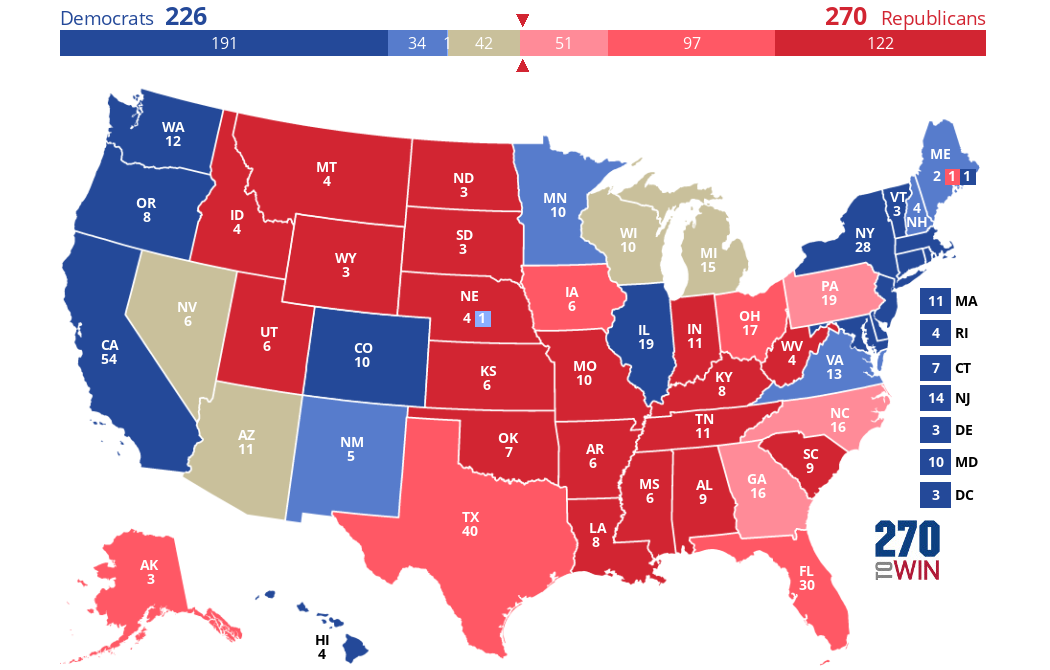
As of Sunday, the latest polling averages from RealClear Politics indicated that Trump had narrow leads in all of them. He had a 0.1% lead nationally.

By contrast, on Oct. 27, 2020, President Joe Biden reflected a 7.4% lead nationally. Hillary Clinton, who lost to Trump in 2016, had a 5.6% advantage.

IMPLAUSIBLE DENIABILITY

Trump’s success, moreover, in clinching key minority demographics creates an optical problem for Democrats, who can no longer use the fig leaf of “voting rights” as a pretense to undermine election integrity.

Democrats who disfranchise voters in the black and Hispanic communities now risk losing them permanently and incurring the same level of minority-driven anger and outrage against them that they weaponized against Trump during the 2020 Black Lives Matter riots.

Most worrisome of all for Democrats may be that in Arizona, Nevada and North Carolina, early voting indicated that more Republicans had turned out as of Friday, Oct. 25, according to Bloomberg.

Three other battleground states—Georgia, Michigan and Wisconsin—do not track party registration for early voting, suggesting Trump may be leading there, as well.

This trend could further explode the narrative pushed during recent election cycles that Republicans simply waited until Election Day and were bested by Democrats’ early get-out-the-vote initiatives.

If Trump is leading by a notable margin even going into Nov. 5 and Republicans continue to turn out at higher levels, there will be no plausible deniability for Democrats (and some corrupt GOP election officials) to delay releasing the results as they continue to scrounge up late-surfacing ballots in blue enclaves such as Arizona’s Maricopa County and Nevada’s Clark County, both of which have previously pulled last-minute reversals in 2020 and 2022.

Having already tipped their hand to their tactics, all eyes will be watching to see whether they have the temerity to engage in what could be deemed nothing less than a seditious conspiracy.

DESPERATE MEASURES

With all other options exhausted, Democrats’ only hope now may be to drive massive turnout on Election Day itself. But that is a task not easily accomplished. Undoubtedly, they would need some sort of precipitating event to rally any remaining voters to the polls.

What could it be? Here are a few possibilities that they might still pull off with just over a week remaining.

  • Escalation of war/act of terrorism:

“I have not permitted myself, gentlemen, to conclude that I am the best man in the country; but I am reminded, in this connection, of a story of an old Dutch farmer, who remarked to a companion once that ‘it was not best to swap horses when crossing streams,”’ wrote Abraham Lincoln in a June 1864 letter making his case for reelection.

The axiom has led other presidents, while politically flailing, to try to “wag the dog” by using war as a means to drive patriotic sentiment. In the Biden–Harris regime, while the patriotism may not be present, the anxiety of a foreign attack is still a powerful tool for manipulation.

Both China and Iran have made clear their preference for the current administration—of which Kamala Harris would be, at best, an extension—over Trump’s “America First” presidency. A false flag attack on Ukraine to stir up anti-Russian sentiment is another possibility. Trump has pledged to end the war there even before taking office.

  • Intel psy-op

We are all too familiar with the intelligence community’s role in fomenting violence at events like the 2017 Charlottesville “Unite the Right” protest and the Jan. 6, 2021 “Save America” rally. Perhaps the Harris campaign’s decision to feature them as a focal point in its closing argument is not so much an act of desperation but portention.

There are several signals indicating that there may be a heightened presence of election-meddling FBI operatives and others on-site at polling places, who are specifically tasked with monitoring MAGA. Might the goal be to instigate some sort of unrest during the election as a weapon of mass distraction?

  • Executive Order 14019

The Biden administration has been abjectly dishonest about many things, but its unusually opaque approach to President Joe Biden’s March 2021 edict has long raised suspicions that it could weaponize the entire federal bureaucracy as a de-facto ballot-harvesting operation for Democrats.

In keeping with the blueprints of anti-American subversive Saul Alinsky, the Left has sought to pre-emptively accuse the Trump campaign of a nefarious plot to reshape the government through talking points about the Heritage Foundation’s Project 2025. Yet, Executive Order 14019 could be everything that it accuses Project 2025 of being and then some. The only problem is that the lack of transparency makes it impossible to tell just how Democrats intend to use this.

  • Presidential death/health crisis

The Democrats and their deep-state allies have failed, thus far, in killing Trump, and to do so now would undoubtedly turn him into one of the greatest martyrs in U.S. history. JD Vance would coast to victory in a landslide, and with trusted college pal Vivek Ramaswamy at his side, he would set up the GOP for generations of political dominance.

Yet, assuming Biden hasn’t been actively trying to torpedo the Harris campaign, he might be persuaded to step aside early due to a health emergency, installing the current veep as the incumbent, which would allow her to finish the final stretch with images being sworn in by Justice Ketanji Brown Jackson, shoring up the identity politics vote. It would, of course, leave little time for her to actually implement any policies that would sour voters further against her.

Although Biden has recently indicated the need to “lock up” Trump—politically, he claims—Trump shrewdly hinted that he might be open to considering a presidential pardon for Hunter Biden, which could prove to be a powerful bargaining chip.

Nonetheless, there is another president who could similarly stir up superficial sentiment at the last minute. Centenarian Jimmy Carter may, in fact, already be dead.

Barring further proof of life, one might be hard-pressed to believe that Carter—his mouth agape, and his skin appearing jaundiced or discolored as he lay in state at his 100th birthday celebration—still inhabits this mortal plane.

However, maintaining the illusion is necessary, for now, since Carter already cast an early ballot for Kamala Harris, which would be invalidated, in theory, if he were to die before Election Day.

Carter’s passing, followed by a prompt cremation, could be announced next Tuesday as voters in Georgia are heading to the polls, throwing in to disarray a must-win state that Trump appears to have locked in.

  • Literally locking Trump up

This risky move may backfire, as all the earlier lawfare actions taken against Trump only helped to further bolster his popular support due to backlash. Nonetheless, the psychological impact of having their candidate in detention could cast enough doubt to keep some Republicans home, and would certainly motivate Democrats.

As it stands, corrupt New York Judge Juan Merchan has pushed back Trump’s sentencing in his porn-star case to Nov. 26. The GOP leader also still remains under gag order in the D.C. trial led by dubiously appointed special counsel Jack Smith, whom Trump recently called a “scoundrel.”

Smith and his accomplice, D.C. District Judge Tanya Chutkan, might unseal additional accusations to bait Trump into a response of some kind that could violate the order and land him in the gulag with countless other Jan. 6 detainees.

Ben Sellers is the editor of Headline USA. Follow him at x.com/realbensellers.

Americans Are Living in Fear of ‘Crimeflation’

(Stefan Gleason, Money Metals News Service) Government statistics portraying robust jobs growth, shrinking inflation, and a booming economy aren’t squaring with Americans’ real-world experiences. The vast majority say their standard of living in recent years has gotten worse, not better.

A similar disconnect reveals itself on the subject of crime. For months, the White House and the mainstream media have been citing FBI statistics that purport to show the crime rate is coming down.

But ask residents of big cities whether they feel safer walking down the streets at night. Ask residents of border states whether they notice fewer problems with illegal immigration.

Ask mothers whether they feel more comfortable allowing their children to ride mass transit. Ask retail store managers whether shoplifting is occurring less frequently. Ask senior citizens whether they feel less likely to be targeted by scam artists.

The answer to all these questions would likely be a resounding “NO!”

Crime isn’t, in fact, going down. It turns out the FBI’s numbers were phony from the beginning.

The Bureau had initially reported there was a 2.1% drop in violent crimes in 2022. But after a revision to the data set, it admitted in a September 2024 press release that there was actually a 4.5% increase!

As John R. Lott of the Crime Prevention Research Center documents, even this reported increase in crime masks the true extent of it. That’s because an increasing number of crimes are going unreported and unprosecuted.

In some jurisdictions, entire categories of crime (such as thefts below a certain dollar threshold) are effectively being ignored by law enforcement.

National Crime Victimization Survey numbers show that total violent crime has risen by a 55% since Joe Biden assumed office.

Robberies, as reported by victims themselves, are up a grim 63%.

If you don’t want to become another addition to those “crimeflation” statistics, then you need to take precautions.

For example, flashing your wealth around by wearing expensive jewelry or watches out in public may no longer be safe (many police departments now specifically warn against it).

Owners of physical precious metals should take care to keep quiet about their holdings. They should also realize that a typical home safe doesn’t actually offer much protection from a burglar armed with basic tools such as a crowbar and drill.

Don’t put all your eggs in one basket!

Anyone who owns significant quantities of bullion should consider storing at least some of their sound money reserves in a highly secure storage facility that is regularly audited and fully insured.

Money Metals Depository meets those criteria. It is now literally bigger than Fort Knox!

Check out the USA's Largest Gold Depository. See It Now!

Precious metals investors also need to be careful to avoid scams. Some have been around a long time in different forms. Others are newly proliferating now that gold is hitting records.

Last week, the Commodity Futures Trading Commission announced it has obtained a judgment in federal court against a predatory firm called Regal Assets:

Regal Assets solicited customers to transfer funds primarily from their tax-deferred retirement accounts to purchase precious metals from Regal Assets through self-directed IRAs. Rather than using all of the customers’ funds to purchase precious metals, the defendants misappropriated more than $21 million from more than 120 customers.

Money Metals has long been aware of Regal Assets’ corrupt practices. At one point, we took legal action against one of its affiliates for fraud and unfair trade practices after it published libelous, negative online “reviews” about our company to promote Regal Assets.

Gold Fraud

While the victims of the multi-million dollar fraud at Regal Assets can now seek restitution, they may never be made whole. (Best we can tell, the government never located the owner, Tyler Gallagher, who reportedly fled the country.) Nor will the victims of countless other scams, whose perpetrators may never be brought to justice.

Your best protection against getting fleeced when buying precious metals is to ignore the slick pitches that sound too good to be true. For safety, avoid doing business with dealers who advertise on cable TV using celebrity spokesmen.

Stick with bullion-focused dealers who have built up a reputation for stellar customer service and exhibit a genuine commitment to sound money principles.

Judy Shelton on the Power of Sound Money: A Case for a Gold Standard

(Money Metals News Service) In a recent episode of the Money Metals podcast, host Mike Maharrey interviews economist Judy Shelton, a prominent advocate for returning to the gold standard and a former economic advisor to President Trump.

Shelton, who has a new book, Good as Gold: How to Unleash the Power of Sound Money, shares her views on how a stable currency backed by gold can restore financial integrity in the United States.

(Interview Begins Around 6:50 Mark)

Who is Judy Shelton?

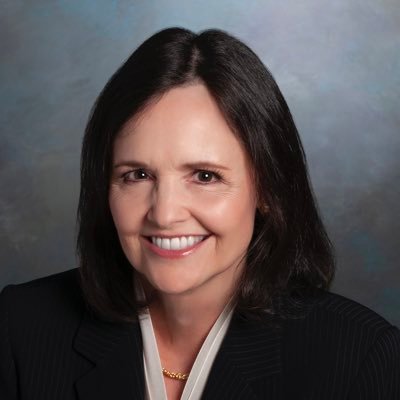
Judy Shelton
Judy Shelton

Judy Shelton (Judy Lynn Shelton) is an American economist known for her advocacy of the gold standard and her criticism of the Federal Reserve. Born in Los Angeles, California, and raised in the San Fernando Valley, she earned her Bachelor’s degree in business from Portland State University and went on to earn her MBA and PhD in business administration from the University of Utah.

Shelton has held prominent roles in both the public and private sectors. She was a senior fellow at the Independent Institute and worked with the Hoover Institution. Notably, she served as an economic advisor to President Donald Trump and was nominated by him to the Federal Reserve Board in 2019, although her nomination was ultimately unsuccessful in the Senate. Shelton was also appointed as the U.S. director for the European Bank for Reconstruction and Development in 2018.

An outspoken proponent of “sound money,” Shelton argues for a stable currency backed by gold rather than the current fiat system. She’s known for her stance against the Fed’s 2% inflation target, which she sees as a gradual reduction of purchasing power. Her views are considered controversial by many in mainstream economics, and she has frequently highlighted the benefits of returning to a gold standard, suggesting it would curb inflation and restrict government spending.

Shelton is also the author of several books, including Money Meltdown, The Coming Soviet Crash, and Good as Gold: How to Unleash the Power of Sound Money. Through her writings and public statements, she advocates for sound monetary policies and fiscal discipline, often challenging conventional economic perspectives on currency and government finance.

Why Gold Matters in a Modern Economy

Despite the dominance of Keynesian economics today, Shelton argues that gold-backed monetary systems have historically provided stability. Citing former Federal Reserve Chair Alan Greenspan and Nobel laureate Robert Mundell as influences, Shelton emphasizes that gold remains a key asset for central banks globally. This is a signal, she says, that gold is a trusted measure of value even today.

“Gold provides a level of monetary credibility that fiat currencies do not,” Shelton notes, criticizing the Federal Reserve’s current inflation-targeting policy.

The Federal Reserve’s 2% Inflation Target: A “Gimmick” on Purchasing Power

A primary criticism Shelton raises is the Federal Reserve’s inflation target of 2% per year. She argues this policy effectively erodes the dollar’s purchasing power, gradually costing Americans 2% of their wealth annually.

Historically, Shelton says, Congress’s mandate for “stable prices” aimed for 0% inflation, not 2%. She explains that the current policy undermines the dollar’s reliability as a store of value, while unfairly benefiting government finances over citizens.

“People should be upset about this,” Shelton asserts, calling the Fed’s policy a clear “expropriation of private property.”

How Fiat Currency Fuels Big Government Spending

Shelton believes that the fiat currency system enables excessive government spending. By auctioning debt at high interest rates, the government can continue deficit spending, regardless of mounting costs. She points out that debt financing costs now rival major budget items, such as defense, and are only projected to grow.

In Shelton’s view, fiscal accountability is impossible without sound money. High interest rates, while restrictive for private businesses, are manageable for government spending. The result, she warns, is that the fiat system props up big government, creating an unfair playing field between public and private sectors.

A Gold-Backed Solution: Treasury Trust Bonds

Shelton proposes a practical first step towards monetary reform: issuing “Treasury Trust Bonds” backed by the U.S. gold reserves. With the U.S. holding 261 million ounces of gold worth over $700 billion, Shelton suggests leveraging these assets to issue 50-year bonds, maturing in 2076. Such bonds would signal the U.S. government’s commitment to restoring fiscal and monetary discipline.

These bonds, she argues, would provide a useful benchmark for the Federal Reserve by showing the public’s expectations for dollar stability. She compares this to Treasury Inflation-Protected Securities (TIPS), which are tied to the Consumer Price Index but suggests that a gold-based metric could offer a more stable, real-world benchmark.

State-Level Movements for Sound Money

Shelton also praises efforts by organizations like Money Metals Exchange and the Sound Money Defense League, which are working with states to remove sales taxes on precious metals and recognize gold and silver as legal tender – as noted by the Sound Money Index.

She highlights Texas’s bullion depository as an example of how states are advancing sound money initiatives and sees such measures as foundational for a return to monetary stability.

“We’re seeing a real push at the state level toward sound money, and I think these movements are crucial for raising public awareness,” Shelton says.

The Moral Responsibility of Sound Money

Shelton frames sound money as a moral obligation, stating that the U.S. government, which requires citizens to use the dollar, has a duty to ensure its value remains stable. The alternative, she contends, is unfair tax treatment of gold as a monetary asset. She advocates for ending this inequity to allow Americans to protect their wealth in a system that honors financial integrity.

A Call for National Debate on Monetary Reform

As Shelton continues her advocacy through her work at the Independent Institute and her book, Good as Gold, she hopes to inspire broader discussions and policy actions to reform the U.S. monetary system.

Shelton and Maharrey conclude that a national debate on monetary reform is essential for building a fiscally stable future.

By focusing on the fundamentals of sound money and making a practical case for a gold-backed bond, Shelton offers a roadmap for restoring monetary integrity in the U.S.—one actionable step at a time.

Key Questions & Answers

Money Metals Exchange Podcast ai image portraying Mike Maharrey and Judy Shelton Podcast by Joshua D Glawson Sound Money Defense League Independent Institute Gold Standard

Here are the key questions and answers from Judy Shelton’s interview on the Money Metals podcast:

What’s wrong with the current monetary system?

Shelton believes the Federal Reserve has compromised the primary functions of money by treating it as a government tool, rather than a stable unit for measuring value in a free market. The Fed’s 2% inflation target effectively reduces purchasing power, making the dollar an unreliable store of value. Shelton calls for restoring monetary integrity by making the dollar a dependable unit across borders, a fundamental purpose the Fed has abandoned.

Why advocate for a return to the gold standard?

Shelton sees gold as a long-trusted store of value and cites historical monetary systems backed by gold, like the classical gold standard and the Bretton Woods system, as models for economic stability and growth. Unlike fiat currency, gold-backed systems resist arbitrary manipulation, offering a check on government spending. She believes that a gold-linked system could improve the dollar’s credibility.

Why is the Federal Reserve’s 2% inflation target problematic?

Shelton argues the 2% target is a “gimmick” that gradually reduces Americans’ purchasing power. She points out that former Fed chair Paul Volcker and other monetary experts favored a 0% inflation target as consistent with price stability. Shelton describes the Fed’s approach as a subtle form of wealth expropriation that goes against the Fed’s original mandate for stable prices.

Does fiat currency benefit the government over citizens?

Yes, Shelton asserts that fiat currency enables big government spending because high interest rates deter private-sector borrowing but don’t stop government deficit spending. The government simply raises funds through debt auctions, disregarding debt’s mounting costs. This dynamic, Shelton warns, fuels government expansion and undermines fiscal accountability.

What is the Treasury Trust Bond proposal?

Shelton suggests issuing “Treasury Trust Bonds” backed by U.S. gold reserves to symbolize a commitment to sound money. These bonds would mature in 50 years, offering a practical way for the U.S. to signal its fiscal responsibility. By linking these bonds to gold, Shelton believes they could serve as a benchmark for dollar stability and help align the Federal Reserve’s policies with public expectations for long-term value preservation.

Are there significant state-level sound money movements?

Yes, Shelton commends efforts by groups like the Sound Money Defense League to remove sales taxes on precious metals and declare gold and silver legal tender in states. She mentions Texas’s bullion depository as a leading example and supports states’ initiatives to push for sound money policies, seeing them as essential steps toward broader monetary reform.

Why is sound money a moral obligation?

Since the government requires citizens to use the dollar as legal tender, Shelton argues it has a moral duty to maintain the dollar’s stability. She believes that taxing gold and silver holdings as monetary assets is inequitable, especially given gold’s historical role as a store of value, and calls for reforms to align the dollar’s value with sound money principles.

How can people access Judy Shelton’s work?

Shelton’s work is available through the Independent Institute, and her book Good as Gold can be found on major retailers like Amazon, where it is currently popular in the categories of monetary policy, economic theory, and economic policy development.

Gold & Silver Are Consolidating Ahead of the U.S. Presidential Election

(Jesse Colombo, Money Metals News Service) Gold and silver trading remained subdued this past week, with traders holding back from significant moves as they await the upcoming U.S. presidential election.

With only seven trading days left until the U.S. presidential election, financial markets have become quiet as they anticipate the outcome. In this environment, traders are hesitant to make large bets, often resulting in slowed, range-bound trading until the results are announced.

This behavior, known as a “volatility squeeze,” has been particularly evident in gold and silver over the past week. The encouraging news is that gold and silver are poised to resume their upward trends soon, once they break out of their consolidation ranges.

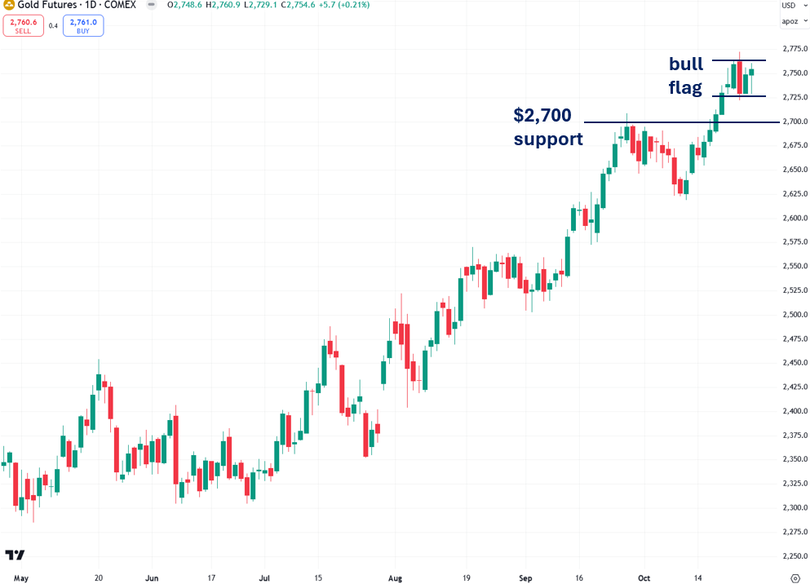
Gold has performed so steadily over the past few months that its orderly ascent has almost become predictable—talk about a good problem to have! COMEX gold futures recently closed above the critical $2,700 level, issuing yet another bullish technical signal.

Over the past week, gold has traded sideways and now sits just $18 shy of its all-time high reached on Wednesday. Interestingly, gold’s consolidation over the past week is forming what looks like a bull flag—a continuation pattern that suggests further gains once gold breaks out on strong volume.

Now, we’re just waiting for the breakout, which could be triggered by the U.S. presidential election results or potentially even sooner. I anticipate gold reaching $3,000 fairly soon—a gain of just 9.2% from its current level.

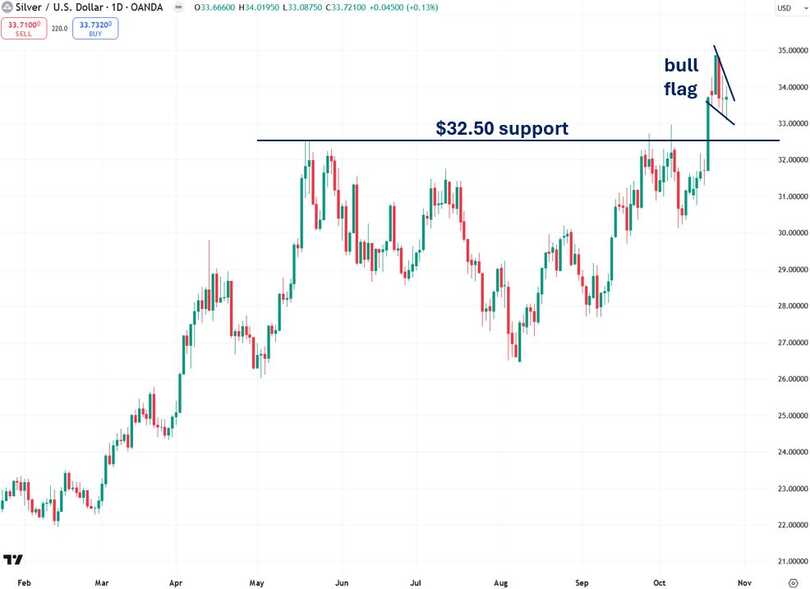
Similar to gold, silver also seems to be forming a bull flag pattern following its strong breakout above the critical $32.50 level on Friday, October 18th.

As I stated after that breakout, silver is on the verge of a powerful bull run that should push it to roughly $50 quite quickly. I stand by this outlook—the recent pause over the past week doesn’t diminish that potential at all.

I’ve noticed some people grow frustrated and impatient toward silver this past week, but it’s essential to remember that any asset is bound to take a breather after a hefty 15% surge in just a few weeks. As long as silver holds above the critical $32.50 support level, its breakout remains intact—we’re simply waiting for it to push past the bull flag pattern.

When it comes to which political party is best for gold and silver, there’s no straightforward answer. It’s not as simple as “Democrats are good for precious metals, Republicans are bad,” or vice versa.

As the World Gold Council points out, “Elections have not, historically, had a significant or immediate effect on gold’s performance…”

Meanwhile, both parties have shown a knack for increasing national debt, making either outcome generally favorable for precious metals. It’s also worth noting that gold and silver have surged over the past month as Donald Trump’s election odds have significantly improved.

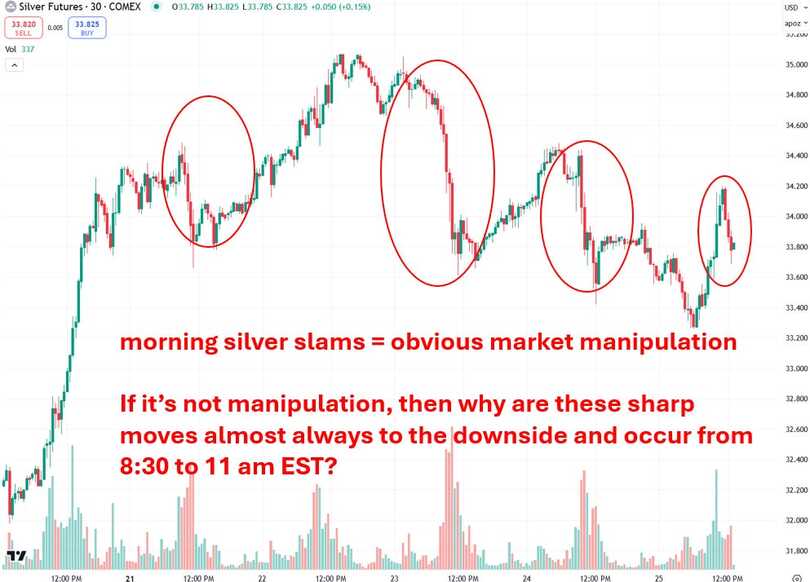
On a related note from last week’s trading, I wanted to share an observation that many of us in the industry have observed for quite some time: on a significant percentage of trading days, typically between 8:30 and 11 a.m. EST, silver—and, to a lesser extent, gold—often experience sudden, sharp declines.

The day often begins positively, with silver up nicely, but once the U.S. trading session opens, silver can get hit so hard and abruptly that it will make your head spin. One moment, it’s up—you step away to grab a coffee, and when you return, it’s plunged! I’m speaking from ample experience here.

This pattern frequently unfolds without any news catalyst, leading me to believe it’s evidence of market manipulation by the U.S. Federal Reserve via bullion banks aiming to suppress silver prices to strengthen the dollar’s comparative appeal.

I call it manipulation because of its consistently one-sided nature—almost always driving prices down rather than up, almost always at the same time each morning. This pattern appeared in four out of five trading sessions last week, which I believe is the banking cartel’s attempt to hold silver back following its recent breakout:

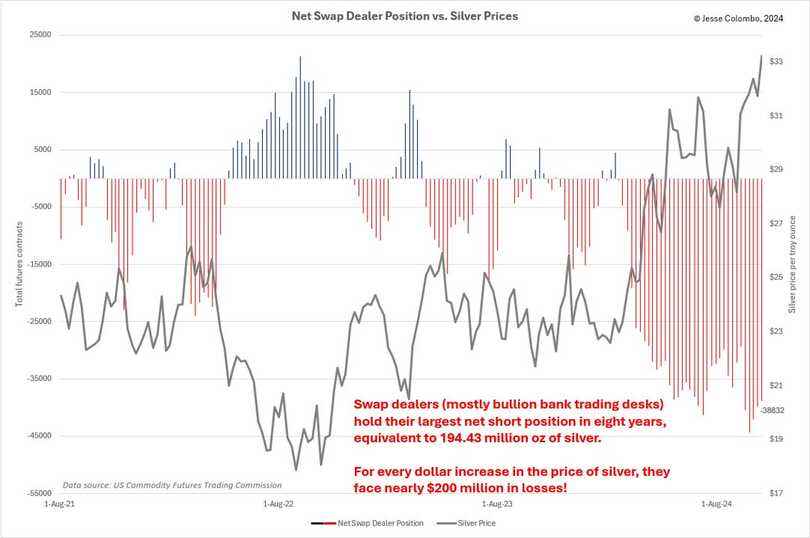
Since March, silver has risen over 50%, yet bullion banks have made considerable efforts to suppress its climb by flooding the market with a substantial amount of “paper” silver—equivalent to 194.43 million ounces.

The chart below highlights the sizable silver futures short position they’ve accumulated since March, illustrating the scale of this effort:

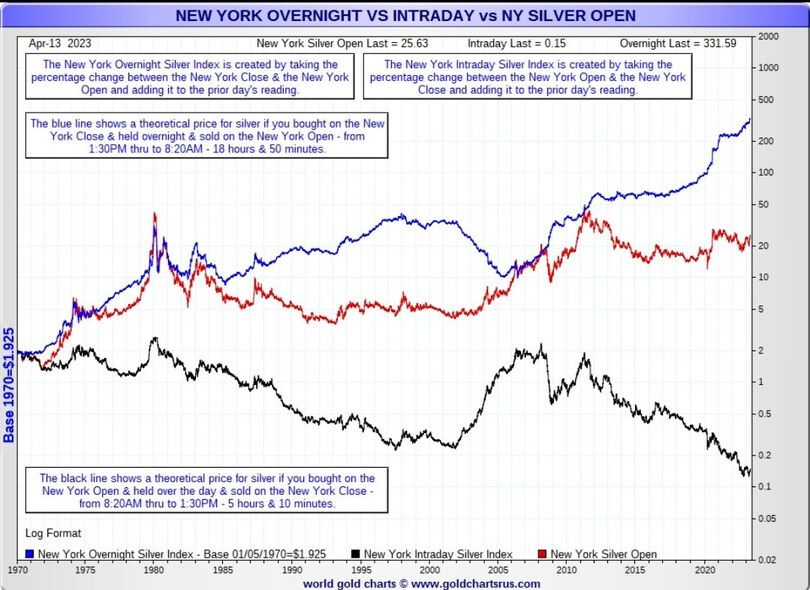
While some in the financial world deny silver manipulation, data from GoldChartsRUs provides compelling evidence to the contrary. Their New York Overnight vs. Intraday vs. New York Silver Open data and charts offer a statistical view of silver’s downward manipulation.

The black line in the chart below represents the theoretical price of silver if bought at the New York open and held through the day until sold at the close, showing a clear downward trend over time.

The blue line represents the New York Overnight Silver Index, calculated by taking the percentage change between the New York close and the following New York open, adding it to the previous day’s value—demonstrating an upward trend.

The red line shows the standard spot price of silver for baseline comparison.

In summary, this chart illustrates that silver prices tend to rise during Asian and European trading hours but are consistently driven down during U.S. trading hours. Interesting.

Chinese Economic Stimulus Plan Could Boost Gold Demand

(Mike Maharrey, Money Metals News Service) A recently announced Chinese economy stimulus package could provide a shot in the arm for the Chinese gold market.

China ranks as the world’s number one gold consumer.

World Gold Council China analyst Ray Jia called it a “stimulus bazooka.” Reuters called it “the biggest stimulus since the pandemic.”

The stimulus plan includes a package of interest rate cuts by the People’s Bank of China to boost consumer spending. The package includes provisions to shore up the floundering housing market, along with fiscal stimulus, including a special government debt issuance to help low-income households and support to ease local government debt.

The Chinese CSI300 Stock Index jumped by 16 percent when the government announced the stimulus program late last month.

The Chinese gold market has been under pressure in recent months. Withdrawals from the Shanghai Gold Exchange (SGE), a proxy for wholesale demand, have been below average for several months. Record-high gold prices have supported investment demand but put a big dent in China’s gold jewelry market.

Jia said the stimulus measure would likely provide support for Chinese economic growth, which in turn would create “tailwinds” for the gold market.

“The anticipated rebound in economic growth will likely boost China’s gold demand. And as the largest components of that demand, we believe gold jewelry and bar and coin will be impacted the most.”

Jewelry, along with bar and coin sales, are the primary drivers in the Chinese gold market.

According to the World Gold Council, economic growth is the fundamental driver of Chinese gold demand. Every percentage point of growth in China’s annual GDP leads to a 5.2 percent rise in gold jewelry consumption and a similar 5.1 percent increase in bar and coin buying, with all other factors held constant.

Jia sums up the potential impact of the “bazooka” stimulus.

“Although it may take some time for the economy to fully digest the positive impact of the current and potential future stimuli, we believe improved consumer confidence and GDP growth should bode well for China’s gold demand in general.”

There were already some signs of improvement in the Chinese gold market. Gold withdrawals from the SGE totaled 118 tons in September, an 11 percent month-on-month increase. The World Gold Council called it a “seasonal rebound amid active replenishment from jewelers in preparation for the expected sales boost during the National Day Holiday in October.

Inflows of gold into Chinese ETFs also flipped positive in September, with inflows totaling 1.2 tons.

The fourth quarter is the peak season for Chinese gold buying.

De-Dollarization: The Spirit Is Willing, the BRICS Is Still Weak

(Mike Maharrey, Money Metals News Service) The desire to unseat the dollar as the global reserve currency is strong, but it’s easier said than done. And it doesn’t appear the BRICS bloc is quite up to the task – yet.

Russia, in particular, has pushed hard for the BRICS nations to create alternatives to the dollar-dominated global financial system, but the willingness of other BRICS nations to push aggressively in that direction seems to be limited, at least for the time being.

That’s not to say the BRICS fall summit in Kazan, Russia, rejected de-dollarization. The idea remains very much on the table.

However, it appears getting there won’t be as quick and easy as the Russian delegation may like. As a report by the South China Morning Post put it, “Few countries in the grouping seem ready to ditch the U.S. dollar despite Russian President Vladimir Putin’s recent efforts to encourage an alternative system of payment among members.”

Russia was pushing hard for BRICS to consider an alternative payment system to replace the dollar-denominated SWIFT system. But after the summit, Russian President Vladimir Putin conceded that there was no immediate plan, saying the economic bloc “have not and are not” creating such a system.

Nevertheless, there plenty of rhetoric came out of the meeting indicating that the U.S. shouldn’t think de-dollarization is off the table.

Leaders and representatives of 36 nations attended the summit, including BRICS members, along with leaders from countries interested in joining the bloc.

BRICS is an economic cooperation bloc originally made up of Brazil, Russia, India, China, and South Africa. As of Jan. 1, 2024, the bloc expanded to include Egypt, the UAE, Iran, and Ethiopia. Saudi Arabia has also been formally invited to join but has yet to formally accept the invitation. Turkey, Azerbaijan, and Malaysia have formally applied to become members

The BRICS summit adopted “The Kazan Declaration,” outlining some of the areas of agreement by members of the bloc.

While the bloc adopted no formal plan for an alternative payment system, it did declare the need for reform, condemning “the disruptive effect of unlawful unilateral coercive measures, including illegal sanctions.”

“We underscore the need to reform the current international financial architecture to meet the global financial challenges, including global economic governance, to make the international financial architecture more inclusive and just.”

It also left the door open for the development of a BRICS payments system in the future.

“We recognize the widespread benefits of faster, low cost, more efficient, transparent, safe, and inclusive cross-border payment instruments built upon the principle of minimizing trade barriers and non-discriminatory access. We welcome the use of local currencies in financial transactions between BRICS countries and their trading partners.”

In that spirit, the summit agreed to “discuss and study the feasibility of establishment of an independent cross-border settlement and depositary infrastructure, BRICS Clear, an initiative to complement the existing financial market infrastructure, as well as BRICS independent reinsurance capacity, including BRICS (Re)Insurance Company, with participation on a voluntary basis.”

The Kazan Declaration affirmed support for a Russian proposal to create a grain trading exchange as an alternative to Western exchanges that currently set international prices for agricultural economies.

“We welcome the initiative of the Russian side to establish a grain (commodities) trading platform within BRICS (the BRICS Grain Exchange) and to subsequently develop it, including expanding it to other agricultural sectors.”

Why didn’t the summit follow Russia’s lead and more aggressively pursue an alternative payment system?

University of Tasmania professor of Asian Studies James Chin told the South China Morning Post that few countries are willing to give up the U.S. dollar entirely. Their economies are too tightly bound to the greenback. “It’s very difficult to bypass the U.S. dollar,” Chin said.

Chin speculated that a bilateral currency agreement seems like a more reasonable path forward. The dollar would likely continue as the global reserve currency but on a smaller scale, with other currencies gaining an increasingly important role.

“A bilateral currency agreement seems to be the easiest way. In some ways, it is a bit clumsy, but it can be done if the amount is big enough.”

This dovetails with the existing China’s Cross-Border Interbank Payment System (Cips). HSBC Hong Kong announced it will formally join Cips. It is one of the world’s largest banking and financial institutions.

There is also mBridge, an instant cross-border payment system established by the Bank for International Settlements (BIS) Innovation Hub in Hong Kong. Currently, there are five full members—Thailand, China, Hong Kong, Saudi Arabia, and the U.A.E.—and over 30 observing members.

One of the most interesting proposals to come out of the BRICS summit was the development of a precious metals exchange to compete with the COMEX. According to Russia’s Finance Minister, Anton Siluanov, “The mechanism will include the creation of price indicators for metals, standards for the production and trade of bullion, and instruments for accrediting market participants, clearing, and auditing within BRICS.”

While it appears the BRICS nations won’t move quickly to implement alternatives to dollar systems, it would be unwise to write the bloc off. It is clearly gaining clout and influence globally. It may prove difficult to bring all of the BRICS nations together in agreement on specific policies or systems, but it is clear they are concerned about the weaponization of the dollar and that there is a growing desire for dollar alternatives.

In fact, the Atlantic Council identifies the rise of BRICS as a threat to long-term dollar dominance.

“The project identifies the BRICS as a potential challenge to the dollar’s status due to the individual members’ signal of intent to trade more in national currencies and the BRICS’ growing share of global GDP.”

Even before the summit, BRICS+ Analytics think tank founder Yaroslav Lissovolik told Reuters that an alternative payment system is undoubtedly feasible, but it will likely take time to develop.

“After the significant expansion of BRICS membership last year, the attainment of consensus is arguably harder.”

Of course, in the world of geopolitics, things often happen slowly and then all at once.

And even the relatively small decline in the dollar’s status with an increasingly multi-polar global financial system where the dollar is no longer the only rooster in the hen house could prove harmful to the U.S. economy.

We were seeing this long before the BRICS summit. Dollar reserves globally have dropped by 14 percent since 2002, and de-dollarization accelerated after the U.S. and her Western allies aggressively sanctioned Russia.

Because the global financial system runs on dollars, the world needs a lot of them, and the United States depends on this global demand to underpin its bloated government. The only reason the U.S. can borrow, spend, and run massive budget deficits to the extent that it does is the dollar’s role as the world reserve currency. It creates a built-in global demand for dollars and dollar-denominated assets. This absorbs the Federal Reserve’s money creation and helps maintain dollar strength despite the Federal Reserve’s inflationary policies.

But what happens if that demand drops? What happens if BRICS nations and other countries don’t need as many dollars?

A de-dollarization of the world economy would cause a dollar glut. The value of the U.S. currency would further depreciate. At the extreme, global de-dollarization could spark a currency crisis. You and I would feel the impact through more price inflation eating away at the purchasing power of the dollar. In the worst-case scenario, it could lead to hyperinflation.

The world doesn’t have to completely abandon the dollar to create negative impacts. Even a modest drop in the demand for dollars will ripple through the U.S. economy.

It would be easy to analyze the Kazan summit and conclude that worries about BRICS undermining dollar dominance are overblown, but I don’t think it’s wise to completely discount the evolution of the bloc.

It won’t happen overnight, but the rise of BRICS reveals a growing dissatisfaction with the way the U.S. uses its monetary clout as a foreign policy tool and increasing worries about the country’s fiscal irresponsibility. These varying movements to de-dollarize and minimize dependence on the greenback will likely continue to percolate. U.S. policymakers should be wary.

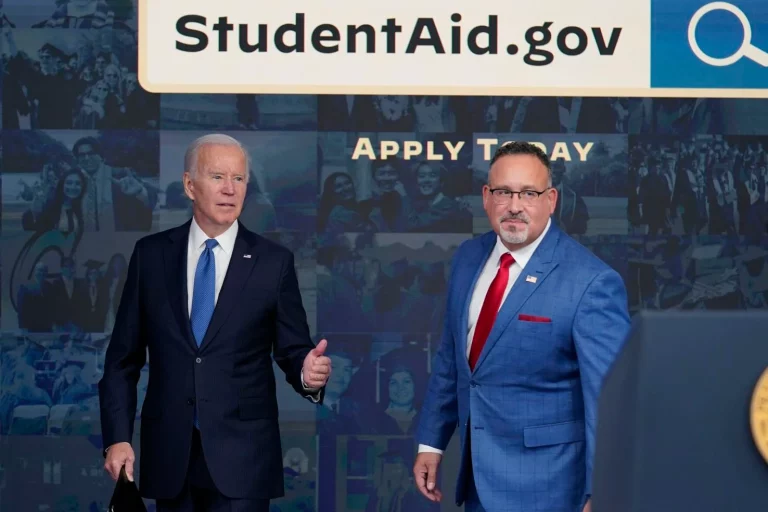
WATCHDOG: Biden Admin’s Illegal Student-Loan Amnesty to Cost Taxpayers $600B

(The U.S. Department of Education’s proposed rules for student-loan forgiveness could cost taxpayers up to $600 billion, far more than the department estimated, according to budget watchdogs.

The Department of Education announced Friday another amnesty effort, despite a ruling from the U.S. Supreme Court that said it was unconstitutional for it to do so without congressional authorization.

The set of proposed rules, if finalized, would transfer the obligation for the student debt of about 8 million borrowers experiencing “hardship” onto taxpayers.

If these rules were finalized as proposed, the secretary of Education could waive up to the entire outstanding balance of a student loan when the department determined a hardship was likely to impair the borrower’s ability to fully repay the loan or render the costs of continued collection of the loan unjustified.

The Committee for a Responsible Federal Budget, a nonprofit budget-based think tank, said the plan could cost far more than the Department of Education’s estimate of $112 billion over 10 years. The group’s previous estimate was up to $600 billion.

“The rules proposed by the Biden-Harris Administration today would provide hope to millions of struggling Americans whose challenges may make them eligible for student debt relief,” U.S. Secretary of Education Miguel Cardona said. “President Biden, Vice President Harris, and I will not stop fighting to deliver student debt relief and create a fairer, more just, and more affordable student loan system for all borrowers.”

Maya MacGuineas, president of the Committee for a Responsible Federal Budget, called the department’s plan irresponsible.

“The Biden Administration continues to unilaterally introduce costly and counterproductive student loan giveaways—but this one is particularly brazen,” she said. “Today’s rule would practically grant the Secretary of Education unlimited loan forgiveness authority, creating a dangerous precedent that could lead to perpetual debt cancellation.”

The proposed rules would create two pathways to eliminate some student debt.

The first pathway would recognize the Education secretary’s authority to grant individualized, automatic relief without an application. The secretary could provide relief on a one-time basis to borrowers whom the department determined had at least an 80% chance of sliding into default within the next two years.

The second pathway would allow existing and future borrowers to get relief based on an assessment of their hardship. It would be application-based.

The department would assess whether a borrower was highly likely to be in default or experience similarly severe negative and persistent circumstances. If no other payment relief option exists to address the hardship, the secretary could waive the loan.

MacGuineas said the plan could contribute to future challenges.

“Today the Biden Administration has sent a clear message to schools and borrowers: charge as much as you want, borrow as much as you can, and let your grandchildren worry about the bill,” she said. “This is no way to run a student loan program or to be good stewards of taxpayer dollars.”

Va. Files Emergency SCOTUS Appeal over DOJ’s Lawsuit Protecting Noncitizen Voters

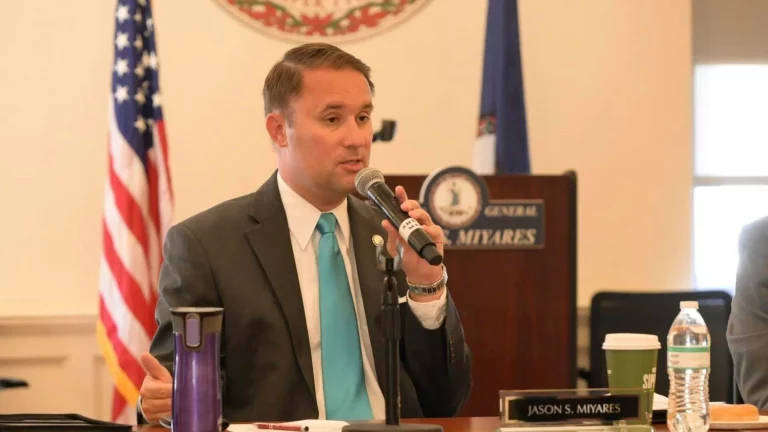
(Virginia Attorney General Jason Miyares announced late Sunday the commonwealth will file an emergency appeal with the U.S. Supreme Court in a last-ditch effort to block the return of more than 1,500 noncitizens to voter rolls.

The appeal follows a unanimous panel ruling Sunday from the 4th Circuit Court of Appeals rejecting Virginia’s request to stop an order from a lower court to reinstate noncitizens removed from voter rolls within 90 days of an election.

The latest ruling comes two days after the commonwealth filed an emergency motion to the 4th Circuit on Friday night to stay a ruling from the district court, recently issued by Biden appointed Judge Patricia Tolliver Giles.

Shortly after Friday’s ruling, Miyares defended the commonwealth’s removal of noncitizens from the voter rolls, arguing the ruling was “politically motivated” by an activist court in collusion with the partisan DOJ.

“It should never be illegal to remove an illegal voter,” said Miyares. “The Department of Justice pulled this shameful, politically motivated stunt 25 days before Election Day, challenging a Virginia process signed into law 18 years ago by a Democrat governor and approved by the Department of Justice in 2006.”

The Friday ruling drew criticism from Republicans, including former president Donald Trump, who claimed the move was an attempt by the Biden Administration to “weaponize” the Justice Department.

“Now their truly Weaponized Department of ‘Injustice,’ and a Judge (appointed by Joe), have ORDERED the Great Commonwealth of Virginia to PUT NON-CITIZEN VOTERS BACK ON THE ROLLS. This is a totally unacceptable travesty,” Trump posted on  Truth Social.

The former president commended Gov. Glenn Youngkin’s vow to appeal the “illegal order,” while calling on SCOTUS to remedy the situation.

“Gov. Youngkin is absolutely right to appeal this ILLEGAL ORDER, and the U.S. Supreme Court will hopefully fix it! Only U.S. Citizens should be allowed to vote,” he wrote. “Keep fighting, Glenn – AND REPUBLICANS IN VIRGINIA, KEEP VOTING EARLY!”

Shortly after Miyares’s announcement, Youngkin commended the attorney general for taking decisive action.

“It’s commonsense noncitizens shouldn’t be our voter rolls,” Youngkin posted on X late Sunday evening.

“Thank you [Jason Miyares] for filing immediately with the U.S. Supreme Court for an emergency appeal of the order for Virginia to put over 1,500 people who self-identified as non-citizens back on the voter rolls,” he added.

The lawsuit filed by the Justice Department the commonwealth unlawfully removed individuals deemed “noncitizens” from voter rolls within 90 days before an election, citing a “quiet period” in the National Voter Registration Act that mandates “no such voter cancelation or list maintenance programs may be conducted” within that time period.

It’s unclear if there is enough time for the Supreme to rule on the matter before Nov. 5.

Trump Casts an Eye Toward History in Sold-Out Madison Square Garden Rally

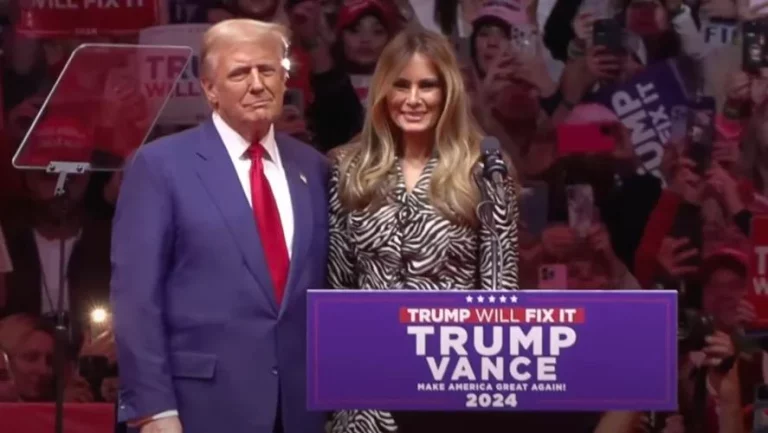
(With just over a week until Election Day, former President Donald Trump headlined a star-studded rally in a jammed-packed Madison Square Garden in New York City.

Supporters filled the arena, which can hold up to nearly 20,000 people, in the heart of a deep blue state that hasn’t voted for a Republican president since Ronald Reagan.

The former president was joined by an all-star line-up, including Elon Musk, Robert F. Kennedy Jr., Tucker Carlson, Hulk Hogan, Dr. Phil McGraw, Dana White, running mate Sen. JD Vance and former first lady Melania Trump.

Earlier in the week, the former president’s critics—including Hillary Clinton and Democratic vice president hopeful Tim Walz—likened the event to a Nazi rally organized by the German American Bund in 1939.

Vance drew a different comparison, recalling Muhammad Ali’s “fight of the century” against Joe Frazier in 1971 and Elvis Presley’s concert in 1972. Both events unfolded before a sold-out crowd, the latter four nights in a row.

“Now on the eve of the most important election of our history, the greatest champion of them all Donald J. Trump has come to Madison Square Garden,” Vance told the crowd.

Trump took the stage two hours into the rally and wasted no time dropping a new policy alert, saying he will support a tax credit for family caregivers “who take care of a parent or a loved one,” saying that it’s “about time that they were recognized.”

The speech hit all the familiar notes as Trump promised to control inflation, protect the border, reform the immigration system and bring back the American dream, claiming the country “will be bigger, better, bolder.”

He also called for giving the death penalty to illegal immigrants convicted of killing American citizens and law-enforcement officers, as well as imprisoning flag burners for one year.

Attacks on Vice President Kamala Harris also abounded as Trump admonished her intelligence and called her “purely a vessel” for the Democratic party.

Criticism of the Biden administration and the party writ large aside, Trump extended an olive branch to New York City Democratic Mayor Eric Adams, who he said was being “treated pretty badly” for describing the influx of undocumented migrants into the city as “not sustainable.”

And while Trump’s immigration rhetoric has drawn plenty of critics since he first launched his political career in the 2016 presidential race, solving the border crisis appears to resonate across the country.

According to a recent Voter’s Voice Poll, 40% of respondents say “illegal immigration” is one of the top three issues facing the country. The numbers are more pronounced for Republican voters, 62% of whom consider it the most pressing concern. Forty-three percent of Democrats cite abortion as a leading issue, while half of independents think inflation is the country’s biggest problem.

Meanwhile, the race for the White House remains in a dead heat.

RealClear Polling averages place Trump 0.1 percentage points ahead of Harris nationally. In the seven swing states—Arizona, Georgia, Michigan, Nevada, North Carolina, Pennsylvania and Wisconsin – the former president leads by an average of 0.9 percentage points.

Man Down: JD Vance Delivers Blunt Lesson to Jake Tapper in On-Air Exchange

(Luis Cornelio, Headline USA) Republican vice-presidential candidate Sen. JD Vance took on another leftist news anchor in a viral on-air smackdown on Sunday.  

During an interview on CNN’s State of the Union, Vance refused to let anchor Jake Tapper corner him with questions framing Trump as a “fascist.” 

Vance accused Tapper of mischaracterizing Trump’s comments about holding Liz Cheney, John Kelly, Jim Mattis and Mark A. Milley accountable.

“None of that sounds fascist to you, at all?” Tapper asked Vance, after paraphrasing Trump’s quotes about Cheney.

Vance had none of it in response. He said, “First of all, I don’t buy into the premise of what you’re saying, Jake. … On things that I know that he said, you’re imputing things. You’re taking words out of context.”

Vance rebuked Tapper for cherry-picking Trump’s remarks on Cheney, Kelly, Mattis and Milley to imply somehow the former president would weaponize a second term against his enemies. 

“You’re taking two separate conversations and pretending that they were made at the exact same time,” Vance said. “So, I’m rejecting the premise of your question.”

He continued, “I frankly don’t believe what you’re saying about Donald Trump’s words. If you’d like to put up a clip, and actually put him in context, I think the American people would realize that Donald Trump is a hell of a lot more reasonable than the people like Liz Cheney who would like to lie us into war.” 

Vance then delved into CNN’s past promotion of the Russian collusion hoax, which Democrats and legacy media pushed for nearly Trump’s entire first term. 

“Ask yourself a basic question about network integrity. You guys talked about the Russia hoax non-stop,” Vance said. 

In response, Tapper defended CNN’s coverage, claiming that the “FBI was investigating it, so we covered them.”  

Vance wasn’t having it: “So, you took the words of unnamed FBI agents and put them on your network as if they were the gospel truth. You did it again and again. A viewer of your network would have believed that Donald Trump and Vladimir Putin conspired in 2016. That was totally and preposterously false.” 

Tapper countered, claiming Vance’s remarks were false. They weren’t. Watch the Maze’s video below. 

This marked the third time Vance rebuked partisan hacks in the legacy media in a matter of three weeks.