Saturday, April 18, 2026

Pausing White House Ballroom Construction Would Harm National Security, Judge Told

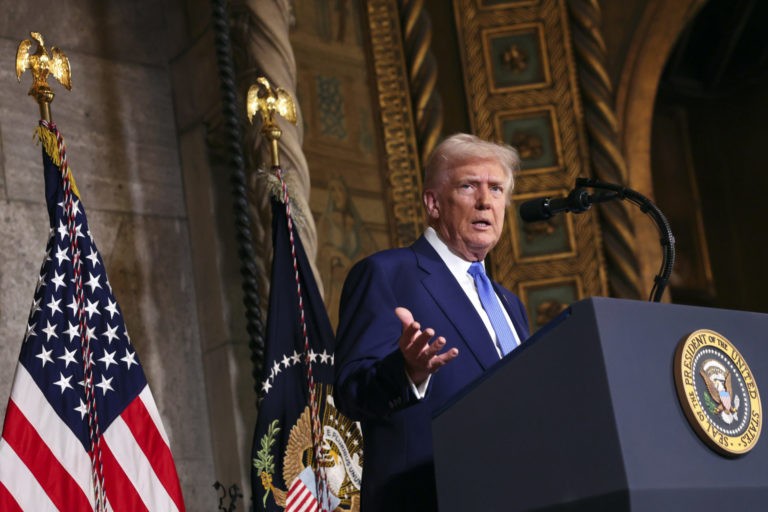
(Headline USAA federal judge must reconsider the possible national security implications of halting construction of President Donald Trump’s $400 million White House ballroom, an appeals court ruled on Saturday.

A three-judge panel from the U.S. Court of Appeals for the District of Columbia Circuit said it did not have enough information to decide how much of the project can be suspended without jeopardizing the safety of the president, his family or the White House staff.

The case was returned to the trial judge who, in a March 31 ruling, barred work from proceeding without congressional approval, but suspended enforcement of that order for 14 days. The appeals court extended that for three days, to April 17, to allow the Trump administration to seek Supreme Court review.

The panel instructed U.S. District Judge Richard Leon to clarify whether — and how — his injunction interferes with the administration’s plans for safety and security.

Government lawyers had argued that the project includes critical security features to guard against a range of possible threats, such as drones, ballistic missiles and biohazards and that holding up construction “would imperil the President and others who live and work in the White House,.”

President Donald Trump revealed last month that the military is building a “massive complex” underneath the property.

“The military is building a massive complex under the ballroom, and that’s under construction, and we’re doing very well,” Trump told journalists on Air Force One, as reported by NBC News. “So we’re ahead of schedule.”

Trump added that “the ballroom essentially becomes a shed for what’s being built under.”

However, Judge Leon, in issuing the temporary pause, concluded that the preservationist group behind the legal challenge was likely to succeed because the president lacks the authority to build the ballroom without approval from Congress.

Leon exempted any construction work necessary to ensure the safety and security of the White House, but said he reviewed material the government privately submitted before determining that a halt would not jeopardize national security.

The Republican administration’s appeal cited materials that would be installed to make a “heavily fortified” facility and said construction included bomb shelters, military installations and a medical facility underneath the ballroom.

The appeals panel noted that much of the government’s concerns focused on that below-ground security work, which the White House argued was “distinct from construction of the ballroom itself and could proceed independently.”

Now, however, the White House seems to suggest those security upgrades are “inseparable” from the project as whole, the appeals court said, making it unclear “whether and to what extent” moving forward with certain aspects of the ballroom is necessary for the safety and security of those upgrades.

Carol Quillen, president and CEO of the National Trust for Historic Preservation, said in a statement that the organization awaited further clarification from the district court. She said the group was committed “to honoring the historic significance of the White House, advocating for our collective role as stewards, and demonstrating how broad consultation, including with the American people, results in a better overall outcome.”

The organization sued in December, a week after the White House finished demolishing the East Wing for a 90,000-square-foot (8,400-square-meter) ballroom that Trump said would fit 999 people. The administration said aboveground construction on the ballroom would begin in April.

Leon concluded last month that the lawsuit was likely to succeed because “no statute comes close to giving the President the authority he claims to have.”

“The President of the United States is the steward of the White House for future generations of First Families. He is not, however, the owner!” wrote Leon, who was nominated by President George W. Bush, a Republican.

Two days after Leon’s ruling, the ballroom project won final approval from a key agency that Trump had stocked with allies. Another oversight entity constituted with Trump loyalists had approved the project earlier this year. But the president had proceeded with the biggest structural change to the White House in more than 70 years before seeking input from the commissions.

Trump says the project is funded by private donations, although public money is paying for construction of underground bunkers and security upgrades.

The three-judge appeals court panel was made up of Patricia Millett, Neomi Rao and Bradley Garcia. Millett was nominated by President Barack Obama, a Democrat. Rao was nominated by Trump. Garcia was nominated by President Joe Biden, a Democrat.

Rao wrote a dissenting opinion, which cited a statute that allows the president to undertake improvements to the White House.

“Importantly, the government has presented credible evidence of ongoing security vulnerabilities at the White House that would be prolonged by halting construction,” Rao wrote, adding that such concerns outweigh the “generalized aesthetic harms” presented in the lawsuit.

Adapted from reporting by the Associated Press

War to Resume as Iran and US Leave Peace Talks w/ No Deal

(Headline USAThe United States and Iran ended face-to-face talks on Sunday without an agreement to end the war, leaving a fragile two-week ceasefire in doubt.

U.S. officials said the negotiations collapsed over what they described as Iran’s refusal to commit to abandoning its nuclear program, while Iranian officials blamed the U.S. for talks breaking down without specifying the sticking points.

Neither side indicated what will happen after the 14-day ceasefire expires on April 22. Pakistani mediators urged all parties to maintain it. Both said their positions were clear and put the onus on the other side, underscoring how little the gap had narrowed throughout the talks.

“We need to see an affirmative commitment that they will not seek a nuclear weapon, and they will not seek the tools that would enable them to quickly achieve a nuclear weapon,” Vice President JD Vance said after the 21-hour-long talks.

Iran’s parliament speaker Mohammad Bagher Qalibaf, who led Iran in the negotiations, said it was time for the United States “to decide whether it can gain our trust or not.”

He did not mention the core disputes in a series of social media posts, though Iranian officials earlier said the talks fell apart over two or three key issues, blaming what they called U.S. overreach.

Iran has long denied seeking nuclear weapons but has insisted on its right to a civilian nuclear program. Experts say its stockpile of enriched uranium, though not weapons-grade, is only a short technical step away.

Since the U.S. and Israel launched the war on Feb. 28, it has killed at least 3,000 people in Iran, 2,020 in Lebanon, 23 in Israel and more than a dozen in Gulf Arab states, and caused lasting damage to infrastructure in half a dozen Middle Eastern countries. Iran’s grip on the Strait of Hormuz has largely cut off the Persian Gulf and its oil and gas exports from the global economy, sending energy prices soaring.

Pakistani Foreign Minister Ishaq Dar said his country will try to facilitate a new dialogue between Iran and the U.S. in the coming days.

“It is imperative that the parties continue to uphold their commitment to cease fire,” Dar said.

The deadlock — and Vance’s take-it-or-leave-it proposal that Iran end its nuclear program — mirrored February’s nuclear talks in Switzerland. Though President Donald Trump has said the subsequent war was meant to compel Iran’s leaders to abandon nuclear ambitions, each side’s positions appeared unchanged in negotiations following six weeks of fighting.

There was no word on whether they would resume, though Iran said it was open to continuing the dialogue, Iran’s state-run IRNA news agency reported.

“We have never sought war. But if they try to win what they failed to win on the battlefield through talks, that’s absolutely unacceptable,” 60-year-old Mohammad Bagher Karami said in downtown Tehran.

US moves to shift status quo in Strait of Hormuz

The United States and Iran entered talks with sharply different proposals and contrasting assumptions about their leverage to end the war. Before negotiations began, the ceasefire was already threatened by deep disagreements and Israel’s continued attacks against the Iranian-backed Hezbollah in Lebanon.

Iran’s 10-point proposal ahead of the talks called for a guaranteed end to the war and sought control over the Strait of Hormuz. It included ending fighting against Iran’s “regional allies,” explicitly calling for a halt to Israeli strikes on Hezbollah.

Pakistani officials told The Associated Press in March that the U.S. 15-point proposal included monitoring mechanisms and a rollback of Iran’s nuclear program. Speaking on condition of anonymity as they weren’t authorized to discuss details, they said it also covered reopening the Strait of Hormuz.

Indeed, Iran’s closure of the strait has proved its biggest strategic advantage in the war. Around a fifth of the world’s traded oil had typically passed through on over 100 ships a day.

During the talks, the U.S. military said two destroyers transited the critical waterway ahead of mine-clearing work, a first since the war began. Iran’s state media, however, reported the country’s joint military command denied that.

“We’re sweeping the strait. Whether we make a deal or not makes no difference to me,” Trump said as talks extended into early Sunday morning.

Israel presses ahead in Lebanon

The impasse raises new questions about fighting in Lebanon. Israel pressed ahead with strikes after the ceasefire was announced, saying the agreement did not apply there. Iran and Pakistan claimed otherwise.

Lebanon’s state-run National News Agency reported six people were killed Sunday morning in an Israeli strike in Maaroub, a village near the southern coastal city of Tyre. Though Israel’s strikes over Beirut have calmed in recent days, its attacks on southern Lebanon have intensified alongside a ground invasion it renewed after Hezbollah launched rockets toward Israel in the opening days of the Iran war.

Negotiations between Israel and Lebanon are expected to begin Tuesday in Washington, Lebanese President Joseph Aoun’s office has said, after Israel’s surprise announcement authorizing talks despite the lack of official relations between the countries. Protests erupted in Beirut on Saturday over the planned negotiations.

Israel wants Lebanon’s government to assume responsibility for disarming Hezbollah, much like was envisaged in a November 2024 ceasefire. But the militant group has survived efforts to curb its strength for decades.

The day the Iran ceasefire deal was announced, Israel pounded Beirut with airstrikes, killing more than 300 people in the deadliest day in Lebanon since the war began, according to the country’s Health Ministry.

Adapted from reporting by the Associated Press

Charge Dropped Against Minnesota Mom Who Used Racial Slur Towards Somali

(Ken Silva, Headline USA) One count of disorderly conduct has been dropped against the Minnesota mother who was criminally charged for using a racial slur against a 5-year-old black child who took her property.

The mother, Shiloh Hendrix, still faces two other counts of disorderly conduct. Her trial was initially set to begin Monday, but has been postponed until June 15.

The charges stem from a video that went viral last April. In the video, she berated a 5-year-old black child for allegedly taking items from her 18-month-old son’s diaper bag—calling the kid the “N-word.” The recording went viral soon thereafter.

The city of Rochester announced the charges last August. Hendrix faces 90 days in jail and a $1,000 fine.

According to the criminal complaint filed by Rochester police officer Dylan Beck, the incident started at a local park, where a 5-year-old autistic child took apple sauce from Hendrix’s bag. Hendrix chased after the boy. So did the boy’s father, Somali national Sharmake Beyle Omar, according to the police complaint.

“[Hendrix] became very angry while chasing [the child]. [Hendrix] shouted at him and repeatedly used a racial epithet (the N-word; [the child] is of Somali background) … Based on her anger and words, [Omar] feared that defendant may strike [the child],” the complaint says. “[Hendrix angrily grabbed the food item from [the child].”

That’s when Omar began filming Hendrix in a video that would go viral.

“Don’t dig into people’s shit, you dumb fuck,” Hendrix told the Somali man. “He took my son’s stuff.”

In a press release, Rochester Mayor Kim Norton said the incident has affected her community.

“This was a situation that deeply affected many people, especially our communities of color, and caused real turmoil in our community,” Rochester Mayor Kim Norton said in a press release.

“We acknowledge the lasting impact this incident has had, not only on those directly involved and across our community, but also in the broader conversations happening at the state and national level. These moments remind us of the complexity and far-reaching impacts of situations like this,” she added.

Following the video’s viral dissemination, Hendrix established a GiveSendGo fundraiser titled “Help Me Protect My Family.” Originally setting a goal of $1,000,000, she has raised over $600,000 as of the time of this writing.

In her fundraiser description, Hendrix claims she has been “put into a very dire situation” following the incident. She alleges her personal information has been compromised: “My SSN has been leaked. My address, and phone number have been given out freely. My family members are being attacked. My eldest child may not be going back to school. Even where I exercise has been exposed.”

Ken Silva is the editor of Headline USA. Follow him at x.com/jd_cashless.

Trump Shares Footage of Haitian Illegal Immigrant Murdering Woman w/ Hammer

(Headline USAVideo has been released of a Haitian immigrant accused of bludgeoning a woman with a hammer at a Florida gas station earlier this month. The Trump administration is sharing the footage to underscore the consequences of the Biden admin’s open borders policies.

Rolbert Joachin, 40, was arrested and charged with killing a woman on April 2 in Fort Myers, about 160 miles northwest of Miami. Authorities said the man was from Haiti and arrived in the U.S. in 2022. The woman who was killed was identified as a 51-year-old immigrant from Bangladesh and a mother of two adult daughters.

President Trump posted the video late Thursday to his Truth Social account, and the DHS shared the footage on Twitter/X.

“The video of her brutal slaying is one of the most vicious things you will ever see,” Trump said in his post, describing the man as an “animal.”

Graphic video captured woman’s killing

The woman who was killed was working as a clerk at the convenience store of the gas station, according to court documents. The killing happened outside the store and the man was arrested the same day.

In security camera footage of her killing posted on the Department of Homeland Security’s X feed, the man can be seen repeatedly slamming the hammer into a black vehicle parked in front of the gas station. Eventually, a woman in black pants and a pink shirt comes out and appears to question him.

The man, wearing a yellow shirt and black shorts, walks up to the woman and immediately swings the hammer at her head. The woman falls down on the sidewalk in front of the gas station’s front doors. The man attacks the woman with the hammer multiple times before stepping over her unmoving body and walking away, out of the frame of the camera.

The victim was later ıdentified in a police report as Nilufa Easmın, 51. A GoFundMe started by Samir Bahadur Syed, the President of the Bangladesh Association of Southwest Florida, described her as a “devoted mother who worked tirelessly to provide for her two young daughters.”

Syed said that Easmin arrived in the United States about three decades ago and resided in Miami and Palm Beach before moving to Florida’s west coast. She was a single mother, and her two daughters — one 23 years old and the other about 26 — were born in the U.S., Syed told The Associated Press.

He added that Easmin had been working at the convenience store for nearly five months and that she also held another job.

Fort Myers police said they responded to a report of a woman being hit with a hammer at a Chevron gas station. When officers arrived, they found a woman on the ground with blood around her head and multiple cuts.

Officers later located Joachin walking on the street and took him into custody. The police said he has confessed. He was charged with murder and property damage and appeared in court on Wednesday. His arraignment is set for May 4.

An email message sent to the public defender listed in court records as Joachin’s lawyer seeking comment was not immediately returned.

Trump administration criticizes temporary deportation protections

Trump blamed Biden for granting the man temporary protection to stay in the U.S.

Kelei Walker, acting field office director for ICE enforcement and removal operations in Miami, said during a news conference Friday that Joachin arrived in a “water vessel” near Key West, Florida, in August 2022. He was arrested and given Temporary Protective Status in 2023. That status was revoked this week, Walker said.

“We’ll make sure he never gets to the streets of the United States and gets back to his home country,” she said.

The Trump administration has harshly criticized the use of Temporary Protected Status, which can be granted by the administration to citizens of a country experiencing turmoil or strife. Immigrants who qualify are allowed to stay in the U.S. and work for a temporary period, although Republican critics contend that the Biden administration misused its TPS authorities to broadly allow hundreds of thousands of people to stay in the country.

There are several lawsuits in the federal courts challenging Trump’s efforts to terminate TPS for more than one million people, including 350,000 Haitians. In March, a federal appeals court sided with a lower judge’s ruling against the end of temporary status for Haitians, and the U.S. Supreme Court will hear arguments on April 29.

The Department of Homeland Security and the Trump administration have often highlighted crimes committed by immigrants and created a website where people can look up people arrested by Immigration and Customs Enforcement and the crimes they’ve committed in the U.S.

The administration often highlights “Angel Families” who have lost family members to crimes committed by immigrants.

On Thursday, ICE held an event marking the one-year anniversary of the reopening of an office dedicated to assisting those families, including emotional testimony from some of the surviving family members.

Adapted from reporting by the Associated Press

Buyers Fret as the Average Cost of a New Car Nears $50K

(Headline USAAfter a few years of sharing a 2019 Chevrolet Trax, Dana Eble and Tyler Marcus are finally looking for a second car. But as they jump into the market, the young married couple isn’t sure what they can afford.

“I just keep seeing a lot of different aspects of life getting more expensive, and it’s harder,” said Eble, an account manager for a public relations agency.

Car ownership has long been integral to the American dream. But as automakers slash the production of inexpensive models to cater to customers who can afford oversized pickups and sport utility vehicles, buyers find themselves facing sticker shock at the same time they are already frustrated by the lingering effects of high inflation.

Consumer prices rose 3.3% in March, the biggest yearly increase since May 2024, while new car prices were up 12.6% from a year ago, the Labor Department reported Friday.

New vehicles now sell for an average of nearly $50,000, up 30% in six years, and average monthly payments — based on 10% down and a 6-year note — recently hit $775. Looking for something on the cheap end? The share of vehicles listing for less than $30,000 is about 13% — down from 40% five years ago, per the car review site CarGurus.

To cope, buyers are spreading their payments out longer. Consumers choosing 7-year loans make up more than 12% of all sales, up from nearly 8% a year ago, according to auto buying resource J.D. Power. Such contracts wind up costing more in the long run because of interest payments.

“The ability to buy transportation is still out there. The question is just, what do you get for your money?” Charlie Chesbrough, a senior economist at Cox Automotive, said.

The rising cost of cars is contributing to increased concerns about affordability throughout American life. Consumers, especially young people, say they feel like everyday needs like housing, food, utilities and child care are getting costlier and wages aren’t keeping up.

It is a vulnerable position for Republicans ahead of this year’s midterm elections, especially as the Iran war has pumped up gas prices that makes getting behind the wheel even more expensive.

Size, technology and ‘must-have’ features add to costs

Sticker prices have been rising since automakers discovered Americans are willing to pay more for bigger, more expensive SUVs and pickup trucks that bring the companies more profit from each sale. They have largely phased out smaller, cheaper sedans.

That is especially true for domestic carmakers; the average selling prices for many vehicles from Ford Motor Co., General Motors and Jeep-maker Stellantis have generally trended higher than those for Asian companies Honda, Hyundai, Mazda and Subaru.

Car companies are also savvy about placing desired options in more expensive trim levels that can lure consumers into a vehicle that costs more than they planned, said David Undercoffler, the head of consumer insights at CarGurus.

Advanced safety technology — lane-keep assist, automatic emergency braking, blind-spot monitoring, collision warnings and more — all add to the cost of a vehicle. Automakers are required by federal industry rules to add some features, such as rear-view cameras.

The COVID-19 pandemic pushed up auto prices because production fell, affecting both the new and used markets. Though production recovered, other supply chain disruptions and tariffs have affected prices. Meanwhile, government data shows that car insurance prices have soared 55% compared with six years ago, or just before the pandemic, driving up the number of Americans going without. Car repairs, on average, are 48% more expensive.

The share of new car buyers earning below $100,000 fell to 37% last year, down from 50% in 2020, according to Cox Automotive.

Some carmakers have acknowledged affordability concerns. In February, Ford said it would have several vehicles prices under $40,000 by the end of the decade. GM has pointed to vehicles from Buick and Chevrolet, including the Trax, as cheaper options.

Looking to used market for relief

Chesbrough thinks consumers are sometimes unrealistic in their wants.

“There are vehicles out there for less than $30,000. What everybody wants is the mid-sized SUV with leather seats and the sunroof for $25,000, and that’s not available,” Chesbrough said.

Those buyers, he said, are being pushed into the used market.

But as those buyers shift to used, they are finding fewer affordable options there, too. The share of used vehicles priced less than $30,000 fell from 78% in 2021 to 69% in February, according to CarGurus. The average used vehicle sold for about $25,000 in February, and the average used monthly payments hit $560.

The inventory of used cars is being hit by a couple of trends. One is that consumers keen to avoid a big expense are hanging on to their cars longer — nearly 13 years on average now, 18 months longer than a decade ago, according to the Bureau of Transportation Statistics. And a downturn in the popularity of leasing means fewer two- and three-year-old cars hitting the market after leases expire.

J.D. Power estimates that consumers might spend up to $140 less on a lease payment than the average finance commitment, a good option especially for drivers whose annual mileage is predictable. But experts say there is still an affordability challenge.

What buyers can do

Sam Dykhuis, 27, of Chicago, needed to buy her first car recently when she started a new job as a scheduler for United Airlines. She searched for something used under $20,000, and eventually paid a little more than that for a 2021 Mazda CX-5. To hold down the cost, she tapped savings to buy the car outright. She pays insurance six months at a time to save a few bucks, too.

Still, “My paycheck went down and my expenses went up,” Dykhuis said. “Certainly, I have to be more just on top of it than I was previously.”

Eble, 30, and Marcus, 31, say they appreciate cool vehicles but don’t consider themselves “car people” and are hoping their search is easier as a result. Still, finding something in their $20,000 to $30,000 budget might not be as easy as it once was.

They are considering cars such as a newer Trax, a Mazda or maybe an electric vehicle. New EVs generally cost more upfront, but consumers can save in the long run. The used EV market will also soon be flooded with two- or three-year-old EVs that were leased at the time federal credits were generous.

Like Dykhuis, they say they also might buy their new ride outright to avoid a new monthly payment.

“It feels like if anything happens out of our control … it just seems so much more difficult to figure out how to orient our finances,” Eble said.

Adapted from reporting by the Associated Press

Machete-Wielding Maniac Slashes 3 on NYC Subway before Cops Kill Him

(Headline USAA man with a machete who attacked three people randomly at a major New York City subway station on Saturday morning was shot and killed by police, authorities said.

Officers responding to a 9:40 a.m. emergency call of an assault at the 42nd Street-Grand Central station encountered the man. He was behaving erratically, repeatedly claiming he was “Lucifer,” said Police Commissioner Jessica Tisch at a news conference. He was ordered to drop his weapon 20 times but refused to comply.

At that point, an officer shot him twice.

“Our officers were confronted with an armed individual who had already injured multiple people and was continuing to pose a threat,” Tisch said. “They gave clear commands. They attempted to de-escalate. And when that threat did not stop, they took decisive action to stop it and to protect New Yorkers on one of the busiest train platforms in the city.”

The three stabbing victims — an 84 year-old male, 65-year-old male and 70-year-old female — sustained injuries that were not thought to be life-threatening, Tisch said. One man sustained “significant lacerations to the head and face,” the other man had similar injuries and an open skull fracture and the third victim had a laceration to the shoulder.

Tisch said the suspect slashed one person on a platform at the Grand Central station before going upstairs and slashing the other victims on another platform.

Chief of Transit Joseph Gulotta said the attacks appear to be random acts.

New York Gov. Kathy Hochul said on social media that she was “grateful to our brave officers who acted quickly to stop the suspect. We’re working closely with the NYPD as the investigation unfolds.”

The police department, posting on X, had urged travelers to avoid the area Saturday morning due to a police investigation and to expect delays and heavy traffic. The Metropolitan Transit Authority said some subway trains were not stopping at the station which is separate from regional train service at Grand Central.

Adapted from reporting by the Associated Press.

The Kristi Noem Spousal Fetish Scandal Just Got Even Weirder

(Ken Silva, Headline USA) The Daily Mail published more details on Friday about the sexual fetishes of Bryon Noem, the husband of former Homeland Security Secretary Kristi Noem—revealing that Byron had a secret online relationship with a left-wing dominatrix for more than nine years.

Friday’s report follows the news that Byron’s a secret crossdresser who wore fake breasts and pink shorts while paying adult performers for explicit conversations.

According to the Daily Mail, one of those adult performers is Shy Sotomayor, a 5-foot-tall sex worker known as Raelynn Riley with extra-large 2500cc breast implants. Sotomayor shared a trove of messages and recordings with the Daily Mail, showing that she repeatedly dissed the Noem family, Byron fantasized about leaving Kristi, and also contemplated becoming a woman.

“Bryon was apparently so unfazed by Sotomayor ridiculing Kristi that he told the dominatrix she was ‘so much better’ than his wife and that he didn’t ‘think [his] family stands a chance compared to [her],’” the Daily Mail reported.

At one point, Byron asked Sotomayor: “Do you want me to be a woman?”

“Do you want to be a woman for me[?]” she asked.

“I think I do,” he replied.

National security analysts cautioned that his activities may have exposed the former DHS secretary to blackmail risks.

“If a media organization can find this out, you can assume with a high degree of confidence that a hostile intelligence service knows this as well,” warned former CIA officer Marc Polymeropoulos.

Jack Barsky, a former Soviet spy who became a US counterintelligence asset, told The Daily Mail the blackmail potential was disturbing.

When the Daily Mail contacted Bryon by phone, he did not dispute having explicit exchanges or distributing photos of himself dressed as a woman. Asked whether he had made careless comments about his wife and potentially compromised national security, he answered, “Yeah, I made no comments like that, that would lead to that. I deny the second part of that.” He then ended the call.

“Mrs. Noem is devastated,” a spokesperson for the former DHS Secretary stated. “The family was blindsided by this. They ask for privacy and prayers at this time.”

Ken Silva is the editor of Headline USA. Follow him at x.com/jd_cashless.

Ex-NYC Mayor Adams Becomes an Albanian

(Headline USAFormer New York City Mayor Eric Adams announced Friday that he had become a citizen of Albania, putting him one step closer to his oft-repeated dream of leaving politics behind for a life abroad.

Adams, a Democrat, received the honorary citizenship “at his request,” according to an official decree from the country’s president, Bajram Begaj.

The news was first reported in the Albanian press and confirmed by a spokesperson for Adams, who said the ex-mayor had “long been a friend and ally of the Albanian-American community.”

“The decision by the Republic of Albania to grant Mayor Adams citizenship reflects that enduring relationship and mutual respect,” the spokesperson, Todd Shapiro, said in a text message, adding that the recognition “further strengthens the bond between New York and Albania.”

Adams, who once described himself as an “international mayor,” has previously expressed an affinity for the small Balkan nation. His adult son lived in the country while competing in Albania’s version of “American Idol.” Adams traveled there himself in October — one of several international trips taken in his final months in office.

The purpose, he said at the time, was “to say hello to a friend and learn from a friend and build a relationship with a friendship that will not allow our oceans or seas to divide us.”

It wasn’t immediately clear what, if anything, Adams planned to do with his new citizenship. But he has previously expressed a desire to move far from his hometown of New York City.

“When I retire from government, I’m going to live in Baku,” Adams, then Brooklyn Borough President, said at an event honoring the Azerbaijan community in 2018. A few years later, in an interview with a Jewish publication, Adams said he would like to retire in the Israeli-occupied Golan Heights.

As mayor, Adams’ penchant for international trips to Turkey prompted a federal indictment focused, in part, on allegations that he accepted improper travel benefits from foreign nationals.

Adams denied the allegations, and the case was later ordered dropped by President Donald Trump’s Justice Department. Adams later met with Trump administration officials about the possibility of taking an ambassadorship, which did not materialize.

Shortly after dropping his ailing bid for reelection, Adams embarked on a four-day trip to Albania, meeting with the country’s Prime Minister Edi Rama and members of his Cabinet, along with local business leaders. The trip was paid for in part by the Albanian government.

Since leaving office, Adams has been spotted in Dubai and the Democratic Republic of Congo. He also told reporters that he planned to fly to Senegal for a business opportunity, which he declined to discuss further.

In January, he launched a cryptocurrency coin that he said would beat back antisemitism and “anti-Americanism,” but it drew scrutiny after losing millions of dollars in value.

Adapted from reporting by the Associated Press.

WATCH: Artemis II Returns From the Moon

(Headline USAArtemis II’s astronauts closed out humanity’s first lunar voyage in more than half a century with a Pacific splashdown on Friday, blazing new records near the moon with grace and joy.

It was a dramatic grand finale to a mission that revealed not only swaths of the lunar far side never seen before by human eyes, but a total solar eclipse and a parade of planets, most notably our own shimmering Earth against the endless black void of space.

With their flight now complete, the four astronauts have set NASA up for a moon landing by another crew in just two years and a full-blown moon base within the decade.

The triumphant moon-farers — commander Reid Wiseman, pilot Victor Glover, Christina Koch and Canada’s Jeremy Hansen — emerged from their bobbing capsule into the sunlight off the coast of San Diego.

In a scene reminiscent of NASA’s Apollo moonshots of yesteryear, military helicopters hoisted the astronauts one by one from an inflatable raft docked to the capsule, hauling them aboard for the short trip to the Navy’s awaiting recovery ship, the USS John P. Murtha.

“These were the ambassadors from humanity to the stars that we sent out there right now, and I can’t imagine a better crew,” NASA Administrator Jared Isaacman said from the recovery ship.

NASA’s Mission Control erupted in celebration, with hundreds pouring in from the back support rooms. “We did it,” NASA’s Lori Glaze rejoiced at a news conference. “Welcome to our moonshot.”

Their Orion capsule, dubbed Integrity, made the entire plunge on automatic pilot. The lunar cruiser hit the atmosphere traveling Mach 33 — or 33 times the speed of sound — a blistering blur not seen since the 1960s and 1970s Apollo.

The tension in Mission Control mounted as the capsule became engulfed in red-hot plasma during peak heating and entered a planned communication blackout. All eyes were on the capsule’s life-protecting heat shield that had to withstand thousands of degrees during reentry.

Watching the drama unfold nearly 2,000 miles away, the astronauts’ families huddled in Mission Control’s viewing room, cheering when the capsule emerged from its six-minute blackout and again at splashdown.

The last time NASA and the Defense Department teamed up for a lunar crew’s reentry was Apollo 17 in 1972. Artemis II came screaming back at 36,174 feet per second — or 24,664 mph — just shy of the record before slowing to a 19 mph splashdown.

Until Artemis II, NASA’s fresh-from-the-moon homecomings starred only white male pilots. Intent on reflecting changes in society, NASA chose a diverse, multinational crew for its lunar comeback.

Koch became the first woman to fly to the moon, Glover the first Black astronaut and Hansen the first non-U.S. citizen, bursting Canada with pride. They laughed, cried and hugged all the way there and back, striving to take the entire world along with them.

Artemis II’s record flyby and views of the moon

Launched from Florida on April 1, the astronauts racked up one win after another as they deftly navigated NASA’s long-awaited lunar comeback, the first major step in establishing a sustainable moon base.

Artemis II didn’t land on the moon or even orbit it. But it broke Apollo 13’s distance record and marked the farthest that humans have ever journeyed from Earth when the crew reached 252,756 miles. Then in the mission’s most heart-tugging scene, the teary astronauts asked permission to name a pair of craters after their moonship and Wiseman’s late wife, Carroll.

During Monday’s record-breaking flyby, they documented scenes of the moon’s far side never seen before by the human eye along with a total solar eclipse. The eclipse, in particular, “just blew all of us away,” Glover said.

Their sense of wonder and love awed everyone, as did their breathtaking pictures of the moon and Earth. The Artemis II crew channeled Apollo 8’s first lunar explorers with Earthset, showing our Blue Marble setting behind the gray moon. It was reminiscent of Apollo 8’s famous Earthrise shot from 1968.

Born a decade after Apollo, Isaacman greeted the astronauts with hugs as they headed from the helicopters to the ship’s medical bay for routine checks. They walked by themselves, refusing the wheelchairs offered them.

“We are back in the business of sending astronauts to the moon, bringing them back safely and to set up for a series more,” Isaacman said. “This is just the beginning.”

Their moonshot drew global attention as well as star power, earning props from President Donald Trump; Canadian Prime Minister Mark Carney; Britain’s King Charles III; Ryan Gosling, star of the latest space flick “Project Hail Mary”; Scarlett Johansson of the Marvel Cinematic Universe; and even Captain Kirk himself, William Shatner of TV’s original “Star Trek.”

Artemis II was a test flight for future moon missions

Despite its rich scientific yield, the nearly 10-day flight was not without technical issues. Both the capsule’s drinking water and propellant systems were hit with valve problems. In perhaps the most high-profile predicament, the toilet kept malfunctioning, but the astronauts shrugged it all off.

As for the heat shield, military aircraft crews photographed it from afar during reentry, and divers checked it from underneath as the capsule floated in the Pacific. More detailed examinations are planned.

“We can’t explore deeper unless we are doing a few things that are inconvenient,” Koch said, “unless we’re making a few sacrifices, unless we’re taking a few risks, and those things are all worth it.”

Added Hansen: “You do a lot of testing on the ground, but your final test is when you get this hardware to space and it’s a doozy.”

Under the revamped Artemis program, next year’s Artemis III will see astronauts practice docking their capsule with a lunar lander or two in orbit around Earth. Artemis IV will attempt to land a crew of two near the moon’s south pole in 2028.

The Artemis II astronauts’ allegiance was to those future crews, Wiseman said.

“But we really hoped in our soul is that we could for just for a moment have the world pause and remember that this is a beautiful planet and a very special place in our universe, and we should all cherish what we have been gifted,” he said.

Adapted from reporting by the Associated Press

Gold, Geopolitics, and Volatility: Insights from Joe Cavatoni

(Money Metals News Service) In a rapidly shifting geopolitical environment, gold continues to demonstrate both its resilience and its complexity as a financial asset.

In a recent episode of the Money Metals Podcast, host Mike Maharrey spoke with Joe Cavatoni, Market Strategist for North America at the World Gold Council, to unpack gold’s behavior amid the Iran–U.S.–Israel conflict and broader macroeconomic uncertainty.

Recorded against the backdrop of a potential ceasefire and volatile global headlines, the discussion explored gold’s recent price movements, investor behavior, and the evolving role of the metal in modern portfolios.

(Interview Starts Around 6:35 Mark) 

Gold’s “Unexpected” Behavior Was Actually Expected

Despite widespread confusion among investors, Cavatoni emphasized that gold has behaved largely as expected during the conflict. While many questioned why gold appeared to “tank” during a geopolitical crisis, he explained that the real anomaly occurred earlier in the year.

Gold surged roughly 30% in January to near-record levels around $5,500, driven largely by momentum and speculative activity. This was followed by a logical correction of about 20%, setting the stage for subsequent volatility.

When the Iran conflict escalated, gold initially reacted as a classic safe-haven asset, spiking approximately 3–5% in a single day. However, as markets began assessing the broader implications, particularly the impact of oil shocks on global economies, gold retreated. Investors shifted into a “get-to-cash” mindset, selling assets, including gold, to meet liquidity needs and margin calls.

Cavatoni noted that gold’s decline to around $4,100–$4,200 reflected both earlier profit-taking and this liquidity-driven selling. As geopolitical tensions eased with ceasefire discussions, gold began climbing again, resuming its longer-term upward trajectory.

Safe Haven Doesn’t Mean “Never Sold”

A key takeaway from the discussion is that gold’s role as a safe haven includes being a source of liquidity. Investors often misunderstand this dynamic, expecting gold to rise continuously during crises.

Cavatoni explained that during periods of stress, investors frequently sell gold precisely because it is a reliable store of value. This behavior was evident not only among private investors but also at the institutional level.

Countries like Turkey reportedly liquidated portions of their gold reserves to manage economic shocks, while Poland explored using profits from its expanding gold holdings to support government spending. These actions highlight gold’s dual function as both a defensive asset and a financial resource in times of need.

The Era of “Regime Uncertainty” and Rising Volatility

The conversation also addressed what Maharrey described as “regime uncertainty,” referring to unpredictable policy shifts and geopolitical developments. Cavatoni agreed that unpredictability is now a defining feature of the market landscape.

He emphasized that investors should expect sustained volatility across all asset classes, including gold. Contrary to its historical reputation as a “boring” asset, gold now trades within wider price ranges and is increasingly central to both institutional and retail portfolios.

Despite short-term fluctuations, Cavatoni maintains a bullish long-term outlook. He suggested that gold could deliver annual gains in the range of 10% to 20%, with potential upside as high as 30% under current macroeconomic conditions. As of early April, gold was already up approximately 8–9% for the year.

ETF Flows Reveal Diverging Global Strategies

Gold-backed ETFs provided another lens into investor behavior. While North American funds experienced notable outflows following the January peak, Asian markets showed continued inflows through much of the first quarter.

Cavatoni attributed this divergence to differing investment approaches. In North America, ETFs such as GLD and IAU are often used as tactical trading instruments, leading to more pronounced inflows and outflows.

In contrast, Asian investors are increasingly adopting ETFs as long-term portfolio holdings, reflecting a structural shift away from physical gold and jewelry toward financial instruments.

He also noted that ETFs represent less than 10% of the overall gold investment market, underscoring their importance as a transparent but limited indicator of broader trends.

The Rising Influence of Eastern Markets

A major theme in the episode was the growing influence of Eastern investors on gold demand. Cavatoni highlighted a “decoupling” between gold prices and traditional drivers like U.S. interest rates and the dollar, largely due to increased demand from Asia.

He explained that cultural and economic factors shape this demand. In many Asian markets, gold is viewed as a generational store of wealth and a hedge against currency instability. This contrasts with the U.S., where investors often rely more heavily on financial instruments like Treasuries and equities.

At the same time, European investors have remained relatively quiet, though Cavatoni expects this to change as fiscal pressures, rising deficits, and currency concerns intensify across the region.

Modeling Markets in an Unpredictable World

From a professional standpoint, Cavatoni acknowledged that the current environment poses significant challenges for market modeling. Traditional frameworks struggle to fully capture the momentum-driven and globally interconnected nature of today’s gold market.

He stressed the importance of continuously recalibrating models and maintaining humility in analysis. Drawing on past crises such as the 1997 Asian financial crisis, he noted that excluding key historical events can lead to flawed assumptions and missed risks.

The World Gold Council, he said, is actively refining its approach to better account for political uncertainty and momentum-driven price movements.

Gold’s Expanding Role in a Complex Global Economy

Ultimately, the episode underscores that gold is no longer a passive asset sitting on the sidelines of the financial system. It is deeply integrated into global markets, influenced by everything from geopolitical conflicts and oil prices to logistics, central bank policies, and technological shifts.

Joe Cavatoni’s outlook remains clear. While short-term volatility is inevitable, the long-term fundamentals supporting gold remain strong. In an era defined by uncertainty, gold’s role as both a store of value and a source of liquidity ensures its continued relevance.

For investors, the message is straightforward. Understanding gold requires a global perspective, an appreciation for its multiple roles, and a willingness to look beyond short-term price movements.