Fla. Woman Charged w/ Threatening Health Insurance Co. Using ‘Delay, Deny, Depose’

(Headline USA) A Florida woman has been charged with threatening her health insurance provider during a phone conversation after police say she uttered the same words found on the bullet casings used in the killing of an insurance executive in New York.

Briana Boston, 42, told a representative of Blue Cross Blue Shield, “Delay, deny, depose. You people are next” as they ended a phone call Tuesday in which she unsuccessfully challenged the company’s denial of her insurance claim, Lakeland police say a recording shows.

The words “delay,” “deny” and “depose” were written on the casings left at the scene of the shooting of UnitedHealthcare CEO Brian Thompson on a New York City street on Dec. 4.

The words reflect the “delay, deny, defend” strategy some insurance companies use in dealing with expensive claims: Delay the decision, deny the claim and aggressively defend themselves.

Luigi Mangione, 26, is charged with murder in Thompson’s killing.

According to police, when Boston was questioned by officers Wednesday, she told them she used the words because “it is what is in the news right now.”

She told officers she owns no guns and is accused of adding that insurance companies “are evil” and “deserve karma.”

Boston was arrested and charged with threatening to conduct an act of terrorism. She was being held without bail Friday at the Polk County jail.

Court records do not show whether she has an attorney, and a phone listing at her home address was disconnected.

The charge is a second-degree felony, which could be punished by up to 15 years in prison if she is convicted.

Adapted from reporting by the Associated Press

Lisa Murkowski Admits She Isn’t Really a Republican

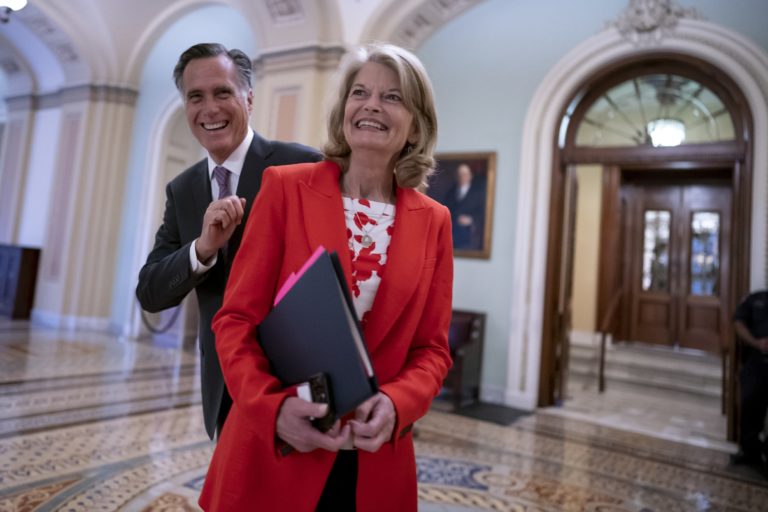
(Jacob Bruns, Headline USA) Alaska Sen. Lisa Murkowski told the press on Thursday that she was not particularly attached to the Republican Party, Politico reported.

Murkowski admitted that she felt “more comfortable” with no party label during a Thursday event for the centrist group “No Labels” at the Mayflower Hotel in Washington, D.C.

“I’m not attached to a label, I’d rather be that ‘no label,’” the embattled senator added. “I’d rather be that person that is just known for trying to do right by the state and the people that I serve, regardless of party, and I’m totally good and comfortable with that.”

However, Murkowski later backed off her initial anti-Republican statement, telling the group that she had little choice but to reluctantly accept a party label.

“We’ve got a system in the Senate where there are two sides of the aisle, and I have to sit on one side or I have to sit on the other,” she said, clarifying that she does not support Trump.

“I don’t think I’ve made any secret of the fact that I’m more of a Ronald Reagan Republican than I am a Trump Republican,” Murkowski added, noting that “you can call me whatever you want to call me.”

Murkowski, whom president-elect Donald Trump has called the “disaster from Alaska,” has a lengthy history of opposing Republican Party principles, but perhaps most notorious was her support of Democrats’ efforts to impeach Trump after he already had left office in 2021.

Along with Sen. Susan Collins of Maine, Murkowski also has a dubious record of voting against conservatives and for radical Democrats during tight confirmation battles. The two both initially refused to support Justice Amy Coney Barrett for the Supreme Court (although Murkowski later relented). Neither had any hesitation, however, backing Biden nominee Ketanji Brown Jackson.

Murkowski has continued her RINO ways in recent days, casting doubt on Trump Cabinet selections such as Pete Hegseth, the nominee for Defense secretary, even though she did not hesitate to confirm Biden nominee Lloyd Austin.

According to the senator, the Hegseth dispute was the first of many that she and her D.C. colleagues expected to have with the Trump administration after he became just the third Republican presidential candidate in the past 50 years to win re-election and to win the popular vote.

“It’s going to be hard in these next four years,” she told the No Labels audience, alluding to time working with the Trump administration, because Republicans will be unfairly expected to “tow the line” on major issues.

“Don’t get on Santa’s naughty list here, because we will primary you,” she added.

Fortunately for Murkowski, Alaska’s peculiar political dynamics have enabled her to pad herself somewhat against political accountability.

She was initially appointed to the job in 2002 to finish the term of her father, Sen. Frank Murkowski, after he was elected governor. After narrowly winning re-election in 2004, she lost her primary in 2010 but subsequently staged a write-in campaign, stealing the election from Republican nominee Joe Miller under highly suspicious circumstances.

Miller and Murkowski faced off again in 2016, with the former as a libertarian and Murkowski clinching the GOP primary, edging him out again in the general election. In 2022, she faced a challenge from Trump-endorsed Kelly Tshibaka, who led Murkowski among Republican voters.

However, ahead of the election, Murkowski allies had helped lead a ballot referendum for ranked-choice voting—a system that inherently favors centrist candidates and well-funded establishment candidates. After a two-week tallying period, Murkowski was declared the winner over Tshibaka. Gov. Sarah Palin, who had been running to fill the state’s only House seat, lost her race as well.

Headline USA’s Ben Sellers contributed to this report.

Gold Scammer Sentenced to 10 Years in Prison

(Mike Maharrey, Money Metals News Service) They threw the book at him. I hope it hurt.

A Maryland circuit court judge sentenced Ravinklejeet Mathon, 26, to 10 years in prison for his part in an elaborate gold scam. Five years of the sentence was suspended, but he will still likely serve about five years behind bars.

The sentence was unusually harsh based on sentencing guidelines. Typically, the penalty for this kind of crime would range between probation and one year in jail. But State’s Attorney John McCarthy said that sentencing guidelines for non-violent white-collar crimes are “typically low” and “not designed to deal with crimes of this magnitude and complexity.”

“The gold bar scams are unique due to the level of international, organized crime involved. In addition, there was special vulnerability in this case due to the victim’s advanced age of 94.”

I have to admit, I don’t feel sorry for Mathon. Not a bit. In fact, a person who would stoop so low as to scam a 94-year-old out of his life savings deserves that punishment and more. I’m not going to say flogging might be in order, but…

The Scam

The scam started with a phone call.

Mathon contacted the 94-year-old victim, posing as a federal agent. He managed to convince the victim that his identity had been stolen, putting his savings in jeopardy. Mathon told the victim he needed to buy three gold bars valued at about $230,000 and then transfer them to a “federal agent” who would hold them for safekeeping while the government issued the victim a new Social Security number.

The old fella bought the gold bars, but fortunately, the first handoff fell through. The victim apparently became suspicious and contacted police. Authorities then set up a sting operation.

Here’s how MoCo360 described the bust:

“Detectives then helped set up a sting operation to catch the scammer by placing metal hand tools in the cardboard box in which the gold bars had arrived ‘to give it weight and the feeling of gold,’ charging documents said. Then, a detective posed as the man at his home and handed off the box to a courier in a Toyota Prius.

“‘The vehicle then quickly drove away from the residence and was stopped a short time later by [county] detectives on Briggs Chaney Road,’ the charging documents said. The driver of the Prius, later identified as Mathon, was taken into custody and interviewed by detectives.”

This kind of scam is more common than you might think. In October, a Montgomery County court sentenced a California man in a similar scheme involving $800,000 in gold bars.

Police in Montgomery County, Maryland, say they have identified seven cases involving residents who lost more than a total of $6.3 million in gold bar schemes.

I have to admit, being a skeptical person, I have a hard time understanding how these scams work. I mean, there is no way I’m handing gold bars to some dude in a Prius. My advice to you is don’t do that.

But from the scammer’s perspective, gold is the way to go. Once he has possession of the gold bars, they are virtually impossible to track and can easily be converted to any currency. It’s also an easy way to hide and transport large amounts of money. And while most scammers probably aren’t thinking in these terms, stealing gold instead of cash protects their ill-gotten gains from the relentless decrease in purchasing power due to inflation.

Sophisticated scammers can be convincing, but there are ways to avoid getting sucked in.

First, never click on a link you don’t recognize. If somebody texts you a link that appears to be from a legitimate company, ignore the link and go directly to that company’s website.

And if somebody calls claiming to be from this or that government agency, hang up and call the agency directly.

Simply put, don’t trust anybody who contacts you out of the blue.

And when it comes to buying gold and silver, only use trusted dealers such as Money Metals Exchange. This should go without saying, but never buy gold from some guy hawking it out of his trunk in a gas station parking lot. (Yes, this is a thing.)

Finally, if it sounds too good to be true – well – it probably is.

Nancy Pelosi Rushed to Foreign Hospital after Sustaining Injury

(Julianna Frieman, Headline USA) Former House Speaker Nancy Pelosi was reportedly rushed to the hospital after sustaining an injury in Luxembourg, her office revealed Friday.

Sources said she fell and fractured her hip, according to the New York Times.

Pelosi, 84, “sustained an injury” and was “admitted to the hospital for evaluation” during a trip with bipartisan lawmakers to memorialize the Battle of the Bulge at a World War II battlefield, according to her spokesman Ian Krager.

“While traveling with a bipartisan Congressional delegation in Luxembourg to mark the 80th anniversary of the Battle of the Bulge, Speaker Emerita Nancy Pelosi sustained an injury during an official engagement and was admitted to the hospital for evaluation,” Krager said in a statement.

The Pelosi spokesman said the influential Democrat received “excellent” medical care.

However, he revealed that Pelosi will be unable to participate in trip activities with the co-delegation.

“Speaker Emerita Pelosi is currently receiving excellent treatment from doctors and medical professionals,” Krager said. “She continues to work and regrets that she is unable to attend the remainder of the CODEL engagements to honor the courage of our service members during one of the greatest acts of American heroism in our nation’s history.”

On Pelosi’s behalf, her spokesman praised the California representative’s fellow lawmakers for traveling in honor of the cause.

“Speaker Emerita Pelosi was personally and officially honored to travel with the distinguished delegation, many of whom had family members who fought in World War II—including her uncle, Johnny,” he said.

Krager added, “She looks forward to returning home to the U.S. soon.”

The extent of Pelosi’s injuries has not yet been reported.

Pelosi’s injury comes days after Republican Senate Minority Leader Mitch McConnell, 82, reportedly fell Tuesday during a lunch event with GOP lawmakers.

The elderly senator sprained his wrist and suffered a cut on his face, a spokesperson told Scripps News congressional correspondent Nathaniel Reed.

Julianna Frieman is a freelance writer published by the Daily Caller, Headline USA, The Federalist, and the American Spectator. Follow her on Twitter at @JuliannaFrieman.

Duke Lacrosse Rape Hoaxer Finally Admits to 18-Year-Old Lie

(Julianna Frieman, Headline USA) Crystal Mangum, a former strip-tease dancer, admitted Wednesday that she falsely accused three Duke Lacrosse players of raping her at a team party.

On the Let’s Talk with Kat podcast, Mangum came clean and said she lied about her March 2006 story that then-students David Evans, Collin Finnerty and Reade Seligmann raped her because she wanted attention, according to the Duke Basketball Report.

“I testified falsely against them by saying that they raped me when they didn’t, and that was wrong, and I betrayed the trust of a lot of other people who believed in me,” Mangum told host Katerina DePasquale. “[I] made up a story that wasn’t true because I wanted validation from people and not from God.”

DePasquale interviewed the Duke lacrosse hoaxer from Raleigh’s Central Prison, where she has been confined since her 2013 conviction for killing her boyfriend, the outlet noted.

Mangum is set to be released in 2026.

Mangum referenced God again when she was setting up the interview, according to the Duke Chronicle, saying, “[I]t’s been on my heart to do a public apology concerning the Duke lacrosse case. I actually lied about the incident to the public, my family, my friends and to God about it, and I’m not proud about it.”

Then-North Carolina Attorney General Roy Cooper, now the state’s outgoing governor, ultimately dropped all charges against Evans, Finnerty and Seligmann.

He declared the three lacrosse players “innocent” and blasted the media circus that rushed to accuse them of guilt.

The former lead prosecutor of the case, then-Durham County District Attorney Mike Nifong, resigned in disgrace.

In June 2007, Duke University reached an undisclosed financial settlement with the three victims of Mangum’s lie.

Julianna Frieman is a freelance writer published by the Daily Caller, Headline USA, The Federalist, and the American Spectator. Follow her on Twitter at @JuliannaFrieman.

African Banks Establish Presence in China amid Push for De-Dollarization

(Mike Maharrey, Money Metals News Service) African banks are opening branches in Chinese cities in an effort to tap into growing trade ties between African nations and China.

Meanwhile, China is encouraging more yuan-based transactions, hoping to push the dollar to the sidelines.

In October, Access Bank UK, a Nigerian Access Bank subsidiary, opened a Hong Kong branch. Bank officials said the move was meant to “foster stronger economic ties between Asia and Africa under China’s Belt and Road Initiative.”

The Belt and Road Initiative is a global infrastructure strategy launched by China in 2013. Drawing its inspiration from the ancient Silk Road, the initiative is meant to improve connectivity and cooperation between Asia, Europe, Africa, and other regions through a network of trade routes, investment projects, and cultural exchanges. The project includes a land-based transportation route featuring roads, rails, and pipelines connecting China to Central Asia, South Asia, Africa, the Middle East, and Europe. The initiative also includes a “Maritime Silk Road.”

Over 140 countries have signed agreements to participate in the BRI.

Access Bank isn’t the only African financial institution putting down roots in China. South Africa-based Absa Group recently opened a non-banking subsidiary in Beijing. Absa ranks as one of the largest lenders in Africa.

According to the South China Morning Post, the new office will “provide general advisory services to clients in China for conducting transactions across Africa.” Absa officials said they hope to position the lender as “a facilitator of trade flows into Africa.”

There are several other African banks already operating in China, including the Morocco-based Bank of Africa and the National Bank of Egypt. Standard Bank, the largest African bank by assets, has a subsidiary in China.

Analysts say the presence of African banks in China will help them better serve Chinese businesses in their own countries. For instance, Zambian National Commercial Bank has extended over $176 million in loans to Chinese businesses operating in the country.

Mihaela Papa, director of research and principal research scientist at the MIT Centre for International Studies, said banks are cashing in on the growing partnership between Africa and China, adding that a physical presence in China will “facilitate trade and investment flows, providing financial services to Chinese clients operating in Africa, and supporting African businesses engaging with Chinese markets.”

Meanwhile, several Chinese banks have established offices in Africa. The Bank of China operates branches in Morocco, Angola, Zambia, and South Africa.

“The motivation behind this expansion [in Africa] is to provide loans to Chinese companies in local economies,” Kai Xue, a Beijing-based corporate lawyer who advises on foreign direct investment and cross-border financing, told the South China Morning Post.

“BOC in Zambia has tended to fund infrastructure projects in mining, smelting, water and roads,” he added.

China’s Bid for De-Dollarization

According to the Post, China is encouraging African countries to use local currencies in a bid to “de-dollarize” trade.

During the September Forum on China-Africa Cooperation (FOCAC) summit held in Beijing, China’s financing and investment commitments were given in yuan instead of U.S. dollars as President Xi Jinping committed 360 billion yuan in financial support for Africa. This equals around $49.5 billion.

China is also encouraging African countries to issue “Panda Bonds,” a renminbi-denominated bond sold in China by non-Chinese issuers. These bonds pay 2.5 percent interest. The hope is the bonds will help “internationalize” the yuan.

An Australian professor specializing in China-Africa relations told the Post that African banks establishing a presence in China helps them prepare for “an expanded role of the renminbi in Africa-related financial markets.”

Another analyst said we should expect more yuan transactions between Chinese and African parties in the near future, especially with Chinese monetary easing and dropping interest rates in that country.

This is happening despite threats by incoming President Donald Trump to apply 100 percent tariffs on any country that attempts de-dollarization.

Trump Tariffs – A U.S. Counterpunch 

The Chinese push for de-dollarization doesn’t likely threaten the dollar’s dominant role in global trade – yet.

The U.S. has plenty of arrows in its quiver to protect the dollar.

In the first place, the dollar dominates global trade, and most countries aren’t willing to completely cut themselves off. Abandoning the dollar completely would have severe consequences, even for large countries such as China. In fact, the Chinese economy relies heavily on exports to the U.S. This fact alone forces countries to walk a fine line. They want to minimize their dependence and exposure to the greenback, but they can’t afford to be cut off from the U.S. completely.

The mere threat of Trump tariffs could also slow the pace of de-dollarization, particularly for countries heavily dependent on U.S. trade.

Nevertheless, aggressive tariffs could backfire on the U.S., leading to trade wars and rising domestic costs that could strangle the import-dependent U.S. economy. Bullying other countries with tariffs could also accelerate efforts by other countries to minimize dependence on the U.S. and its currency.

Just how much Trump policies can slow de-dollarization remains to be seen.

The Rise of BRICS

BRICS countries are already moving quickly toward increased internal trade among member nations. This could erode American influence over time.

BRICS is an economic cooperation bloc originally made up of Brazil, Russia, India, China, and South Africa. As of Jan. 1, 2024, the bloc expanded to include Egypt, the UAE, Iran, and Ethiopia. Saudi Arabia has also been formally invited to join but has yet to formally accept the invitation. Turkey, Azerbaijan, and Malaysia have formally applied to become members.

The BRICS fall summit adopted “The Kazan Declaration,” outlining some of the areas of agreement by members of the bloc. The blueprint could eventually elevate the power and influence of the bloc.

Russia was pushing hard for BRICS to consider an alternative payment system to replace the dollar-denominated SWIFT system before the fall summit. But after the meeting, Russian President Vladimir Putin conceded that there was no immediate plan, saying the economic bloc “have not and are not” creating such a system.

Nevertheless, plenty of rhetoric came out of the meeting indicating that the U.S. shouldn’t think de-dollarization is off the table.

After the summit, University of Tasmania professor of Asian Studies James Chin told the South China Morning Post that few countries are willing to give up the U.S. dollar entirely. Their economies are too tightly bound to the greenback. “It’s very difficult to bypass the U.S. dollar,” Chin said.

Although it may prove difficult to bring all of the BRICS nations together in agreement on specific policies or systems, it is clear they are concerned about the weaponization of the dollar and that there is a growing desire for dollar alternatives.

In fact, the Atlantic Council identifies the rise of BRICS as a threat to long-term dollar dominance.

“The project identifies the BRICS as a potential challenge to the dollar’s status due to the individual members’ signal of intent to trade more in national currencies and the BRICS’ growing share of global GDP.”

Even Modest De-Dollarization Would Be a Problem for the U.S.

Even a relatively small decline in the dollar’s status with an increasingly multi-polar global financial system where the dollar is no longer the only rooster in the hen house could prove harmful to the U.S. economy.

We were seeing this long before the BRICS summit. Dollar reserves globally have dropped by 14 percent since 2002, and de-dollarization accelerated after the U.S. and her Western allies aggressively sanctioned Russia.

Because the global financial system runs on dollars, the world needs a lot of them, and the United States depends on this global demand to underpin its bloated government. The only reason the U.S. can borrow, spend, and run massive budget deficits to the extent that it does is the dollar’s role as the world reserve currency. It creates a built-in global demand for dollars and dollar-denominated assets. This absorbs the Federal Reserve’s money creation and helps maintain dollar strength despite the Federal Reserve’s inflationary policies.

But what happens if that demand drops? What happens if BRICS nations and other countries don’t need as many dollars?

A de-dollarization of the world economy would cause a dollar glut. The value of the U.S. currency would further depreciate. At the extreme, global de-dollarization could spark a currency crisis. You and I would feel the impact through more price inflation eating away at the purchasing power of the dollar. In the worst-case scenario, it could lead to hyperinflation.

The world doesn’t have to completely abandon the dollar to create negative impacts. Even a modest drop in the demand for dollars would ripple through the U.S. economy.


Gold Price Likely Suppressed by Concentrated Shorting, Could Explode

(Chris Powell, Money Metals News Service) At long last, complaints of gold price manipulation and suppression got some respect this week from the Official Monetary and Financial Institutions Forum, a London-based group connected with central banks.

The group published a long paper heralding gold’s restoration to the center of the world financial system, “Gold and the New World Disorder,” and the paper’s chapter titled “Market Disruption — The Short Squeeze” has this to say about the topic at hand:

“With record demand for gold, much of it from BRICS-related countries, the risks of a squeeze are increasing. This could have several catalysts.

‘Bullion banks’ holding concentrated gold short positions might need to buy back the metal during another price run.

Analysts have long argued that these short positions suggest market manipulation, citing the disproportionate control held by a few entities.

Lawsuits against banks for manipulating the precious metals markets have yielded some success in recent years. During these lawsuits, some former ‘bullion bank’ traders have commented about how these gold market strategies might make the market vulnerable to a short squeeze — either by accident or design.

Academic and other studies provide evidence that ‘shorting gold’ has historically been used to suppress the gold price, often linked to central bank sales and futures contracts on commodity exchanges.

There is also room for market disruption from imbalances stemming from allocated and unallocated gold accounts, when market participants own just a claim on gold rather than specific bars. Recent analysis suggests that the unallocated-to-allocated gold ratio at the London Bullion Market Association could range from 20:1 to even 100:1. For every ounce of physical gold backing these accounts, there might be 20 to 100 ounces of unallocated paper gold claims.

This indicates a fractional-reserve system where future claims may far exceed the physical gold available. Predicting the timing of such a squeeze is speculative, given the size of some of these positions and growing world financial and economic tensions. However, with suspicions rising that some BRICS countries could be considering ‘weaponizing’ gold against the West, financial markets could be in for a bumpy ride.”

Ya think? The Gold Anti-Trust Action Committee (GATA) has been documenting and screaming about this for 25 years. For example, here and here.

If even these “official” guys now can acknowledge not only that the gold market has been heavily influenced by central banks and their bullion bank agents but also that the world has foolishly been depending on a lot of imaginary metal, the racket may be quickly coming to an end — no thanks to OMFIF itself, which for years has been ignoring all the incriminating information placed in the public domain by GATA.

“Gold and the New World Disorder” is posted in PDF format at OMFIF’s internet site here.

Biden Slammed for Commuting Sentences of Notorious Fraudsters

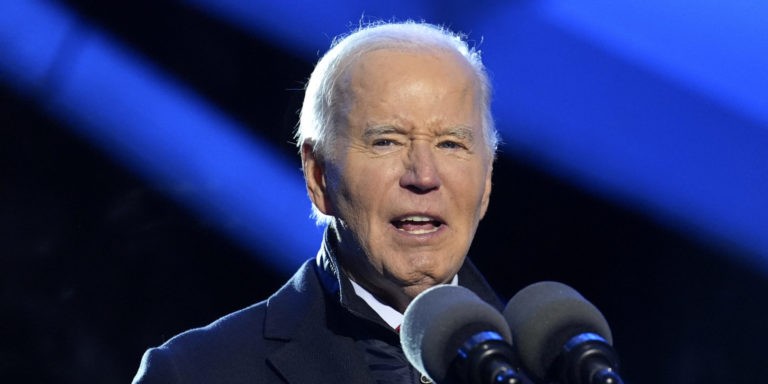
(Julianna Frieman, Headline USA) President Joe Biden commuted the sentences of two of Chicago’s most notorious fraudsters who swindled millions of dollars Thursday morning, among hundreds of other acts of clemency.

The president pardoned 39 criminals and commuted the sentences of nearly 1,500 prisoners placed on home confinement during the COVID-19 pandemic in what his administration called “the largest single-day grant of clemency in modern history,” according to a White House fact sheet.

Among Biden’s commutations were former Dixon Comptroller Rita Crundwell, who embezzled roughly $54 million to fund her opulent lifestyle, and Eric Bloom, who defrauded Northbrook management firm investors of more than $665 million, according to the Chicago Tribune.

Although Biden’s action did not erase the felony convictions of Crundwell and Bloom, it ended their sentences effective immediately.

Crundwell, 71, pleaded guilty to stealing $53.4 million to use for her own personal expenses, including her quarter horse business, according to the outlet.

She was sentenced to 20 years in prison in 2013, released in 2021 to a halfway house in Downers Grove after convincing a judge of her poor health.

“While many families in Dixon were living paycheck to paycheck, she took advantage of their trust in government and used her access to live an unearned life of luxury, in what the FBI still believes to be the largest theft of public funds in U.S. history,” Rep. Darin LaHood, R-Ill., said in a statement Thursday. “Commuting her 20-year sentence is a slap in the face to all the hardworking police officers, firefighters, city workers, and residents of Dixon.”

Crundwell was supposed to serve her sentence until Oct. 2028, according to the outlet.

Bloom, the head of since-collapsed Sentinel Management Group, was sentence to 14 years in prison in 2015.

When he was convicted in 2012, prosecutors called Bloom reckless act of exposing customers to increasingly risky 2003 deals as the largest single financial fraud in Chicago history, the outlet reported.

Bloom, 59, was supposed to serve his sentence until May 2026, according to the outlet.

Julianna Frieman is a freelance writer published by the Daily Caller, Headline USA, The Federalist, and the American Spectator. Follow her on Twitter at @JuliannaFrieman.

Pentagon Announces New Initiative: Combating Climate Change in Africa

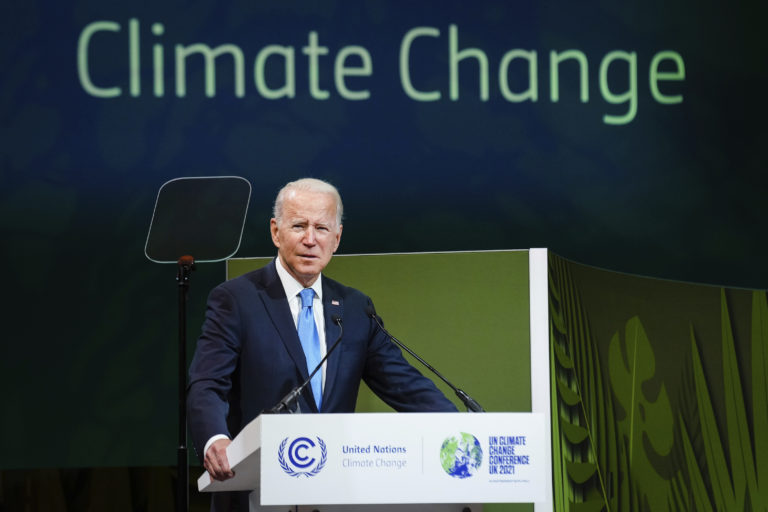
(Ken Silva, Headline USA) With World War 3 brewing, the Pentagon announced on Wednesday a new initiative: combating climate change in Africa.

“It’s an issue that our African colleagues raise to us repeatedly in almost every engagement we have overseas,” Maureen Farrell, the deputy assistant secretary of defense for African affairs, said in a DOD article Wednesday.

“We’re focused with our African partners on addressing their environmental and climate security concerns, and we’re integrating climate in how we engage with our partners on training, assistance, our key leader engagements, and then also looking at some of the innovative solutions that our partners are developing on the ground,” she said.

While the Pentagon insisted that climate change is a top priority for Africans, the countries the U.S. does business with apparently beg to differ. For example, the U.S. was booted from Chad earlier this year, in large part because the Defense Department had stopped helping the country’s government fight insurgents. Niger has also been pushing for the U.S. to leave its country, in favor of an increased presence for Russia and China.

But according to the Pentagon, climate change could account for the extremists in Chad and elsewhere in Africa.

“Candidly, these are environments where violent extremists can thrive,” Farrell said in the Pentagon’s Wednesday article, which didn’t mention that the Defense Department has the largest carbon footprint in the world.

“When people, when families, when communities, reach a sense of desperation because of a lack of economic opportunity or agricultural failure or a lack of sustainable water sources, they are more easily lured by some of the offerings from violent extremists,” she said. “Climate-stressed areas are a recruiting opportunity for terrorist groups.”

The Pentagon’s article—which didn’t say how it was helping address climate change—was widely mocked online.

“Trump can’t come soon enough,” said Trump supporter Greg Smith.

Ken Silva is a staff writer at Headline USA. Follow him at x.com/jd_cashless.

REPORT: Nancy Pelosi ‘Actively Working’ to Tank AOC’s Leadership Bid

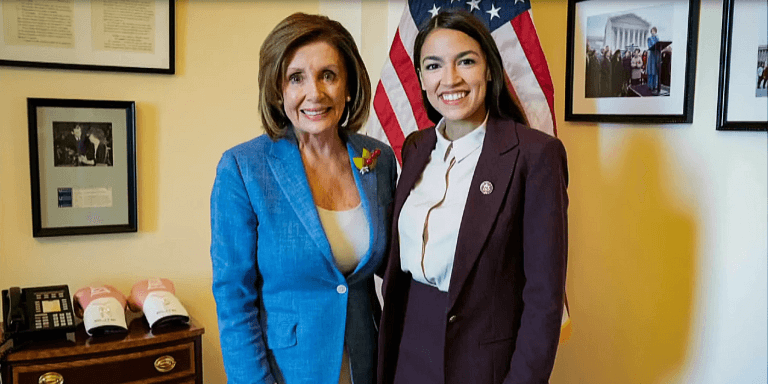
(Julianna Frieman, Headline USA) Former House Speaker Nancy Pelosi is reportedly “actively working to tank” Rep. Alexandria Ocasio–Cortez, D-N.Y., in her bid to serve as the top Democrat on the House Oversight Committee.

Pelosi, 84, is working behind the scenes to torpedo the youthful Ocasio–Cortez, 35, instead for the 74-year-old Rep. Gerry Connolly, D-Va., to take the role, Punchbowl News reported on Thursday.

The former House speaker has been “making calls” to colleagues to try to stop Ocasio–Cortez, who is currently in the lead, from replacing 62-year-old Rep. Jamie Raskin, D-Md., according to the outlet.

This comes as decades-old Democrats desperately try to cling onto power against their younger colleagues, Axios noted.

“Many members are concerned about [the] precedent these races are setting,” one senior House Democrat told the outlet.

Ocasio–Cortez’s leadership bid is reportedly supported by “pretty much the entire [Oversight] Committee” and a majority of Democrat lawmakers, according to Axios.

One House Democrat told the outlet their “gut tells me she gets it.”

House Oversight Committee Chairman James Comer, R-Ky., told CNN on Thursday that he supported Ocasio–Cortez’s bid to be top Democrat on the committee.

“I’m a big AOC fan,” Comer said. “Obviously, I don’t agree with very much of her policy, but I think she’s a good person, I think she’s very well-spoken.”

Comer mentioned his poor relationship with Raskin and said he expects to have a “good working relationship” with Ocasio–Cortez if she is successful in achieving the No. 2 spot.

“I tell the press when they ask about the race for ranking member, the Democrats have nowhere to go but up after having Jamie Raskin for the last four years, so, I think AOC would be great,” Comer said.

Julianna Frieman is a freelance writer published by the Daily Caller, Headline USA, The Federalist, and the American Spectator. Follow her on Twitter at @JuliannaFrieman.