Donald Trump Raked in Billions While Investors Lost Out

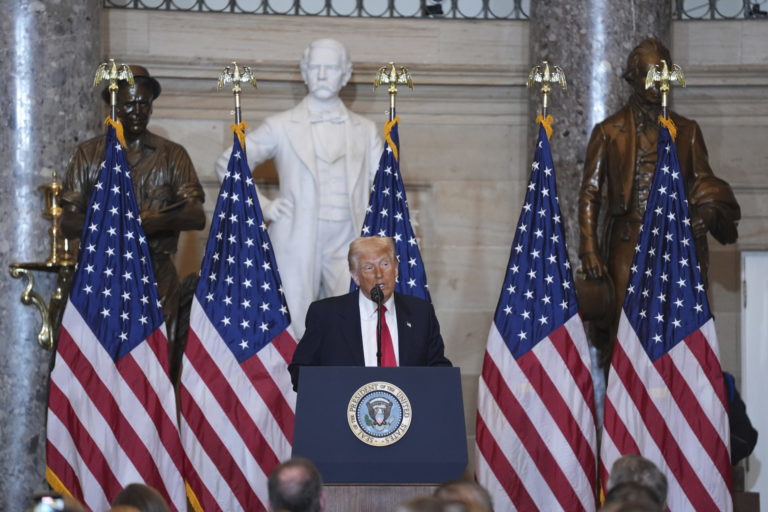
(José Niño, Headline USA) Cryptocurrency investments delivered President Donald Trump earnings exceeding $1 billion during 2025, the Wall Street Journal reported, representing a historic income spike that accompanied gains from royalties, property holdings, and corporate lawsuit resolutions.

Trump and his relatives dove deeply into digital currency enterprises during his opening year in the White House. These ventures yielded tangible profits rather than just paper wealth.

Federal ethics filings documented $635 million flowing to Trump through an entity tied to his memecoin, which went live mere days ahead of his swearing in ceremony. World Liberty Financial, the primary crypto operation run by Trump alongside his sons, brought in over $500 million through token offerings.

Corporate legal battles also proved lucrative, delivering the president no less than $86.5 million in settlements. Meta handed over $24.5 million while both Paramount and Disney paid $16 million each.

Ethics monitors expressed alarm at Trump building his business empire from the Oval Office. “The president’s conflicts of interest with the crypto industry are unprecedented,” declared Kedric Payne, senior director of ethics at the Campaign Legal Center. “We have never seen a president have direct conflicts of interest with his financial holdings and the policies he supports, and it’s another example why we need widespread ethics reform now.”

Anna Kelly, speaking for the White House, asserted Tuesday that Trump converted America into the “crypto capital of the world.” She maintained that “Neither the President nor his family has ever engaged—or will ever engage—in conflicts of interest. All actions by President Trump and his administration are taken in the best interest of the American people.”

The president dismissed concerns about his soaring income, pointing to market conditions. “You know why I’m profiting? Because the stock market is going up,” he stated to journalists. “We’re all profiting. I’m profiting because I have a lot of money and a lot of cash.”

Other revenue sources included $4.7 million from watches bearing the Trump name, $1.9 million from his “Save America” book, and $77 million from Mar-a-Lago compared to $50 million the previous year. The Trump National Doral property in Miami pulled in $122 million. First Lady Melania Trump received $10.7 million connected to her Amazon MGM Studios documentary along with $6 million from NFT licensing arrangements.

However, ordinary investors who wagered on Trump branded crypto projects experienced crushing setbacks. The memecoin briefly reached a market capitalization approaching $15 billion before values cratered within days, recently sinking below $400 million.

José Niño is the deputy editor of Headline USA. Follow him at x.com/JoseAlNino 

Jewish Lawmaker Accuses Trans Activists of Antisemitism

(José Niño, Headline USA) California State Senator Scott Wiener informed CBS News that pro-Palestinian demonstrators who accosted him at San Francisco’s Trans March deployed antisemitic rhetoric that “went beyond free speech,” Information Liberation reported on X.

“They [said] I have ‘Israeli handlers’—which is a classic anti-Semitic trope,” Wiener explained during his appearance on CBS News anchor Major Garrett’s podcast “The Takeout.”

The altercation took place last Saturday, as Wiener crossed Dolores Park en route to a trans-led Pride Shabbat observance tied to the annual Trans March. The homosexual Jewish Democrat seeking to fill retiring Rep. Nancy Pelosi’s, D-Calif., seat had participated in the event annually since its 2004 inception.

Footage that spread rapidly online depicted protesters encircling Wiener, hurling profanities and insults while recording him. Activist Dimitry Yakoushkin recognized Wiener’s extensive pro-trans record before assailing him regarding Gaza. “It breaks my heart that someone who wrote your legislation for queers is so f—ing terrible on Gaza, Scott,” Yakoushkin declared. Demonstrators branded Wiener “genocidal,” gestured obscenely, and alleged he possessed “Israeli handlers” and “Zionist handlers.” 

Wiener departed the park and broke his 22-year attendance streak at the Trans March. He submitted a police report concerning the physical contact.

His campaign spokesperson informed J Weekly it was “clear that the intentions were antisemitic and that their goal was to push Senator Wiener out of the march because of his Jewish background.”

Wiener stands among California’s most accomplished LGBTQ rights legislators and had previously characterized Israel’s conduct in Gaza as “genocide” earlier in 2026, generating pushback from Bay Area Jewish groups, as the CNN reported. The activists drove out a Jewish trans-rights champion who had already embraced their stance on Gaza.

As J Weekly, San Francisco Mayor Daniel Lurie labeled the protesters’ words “targeted, hateful, and antisemitic.” The California Legislative Jewish Caucus characterized the incident as part of a “broader effort to exclude, isolate, and ostracize him because of his Jewish identity.” The American Jewish Committee’s Northern California chapter denounced the “acts of intimidation rooted in age-old antisemitic tropes.”

José Niño is the deputy editor of Headline USA. Follow him at x.com/JoseAlNino 

Tucker Carlson Unveils Major Political Plan

(Luis CornelioHeadline USA) Popular podcast host Tucker Carlson has long dismissed questions about whether he would ever seek public office. But this week, he hinted at a major political move, though don’t expect to see his name on the ballot.

Speaking with the Columbia Journalism Review in an interview published Wednesday, Carlson said he plans to “help build a third party,” just months after publicly breaking with President Donald Trump over the U.S.’s involvement in the Israel-Iran war.

“I’m going to help build a third party. There should be a good-faith effort to figure out what benefits the country,” Carlson said.

During the same interview, Carlson insisted that he still has no interest in seeking public office.

“I don’t want to be a candidate,” he said. “Before I did the Times interview, someone said to me, ‘They’re going to ask you if you’re running for president.’ I was very tempted to say ‘I am running—on the pro-patriarchy ticket.’ Just to make sure I gain no new fans.”

Carlson’s support for a third party stems from what he rebuked as bipartisan support from both Democratic and Republican parties for foreign intervention.

He accused Republicans and Democrats of being “in lockstep solidarity with each other” when it comes to foreign wars.

“That’s not a democracy,” Carlson stated. “That’s a one-party state posing as a democracy, and it needs to be broken, and there’s going to be a third party, and I’m going to do everything I can to bring that about.”

He pointed to Trump’s support for Israel’s military campaign against Iran as a “lesson.”

“If you vote for Trump and you still wind up in a regime-change war,” Carlson added, “if Chuck Schumer is strongly behind Trump’s foreign policy, which he is—then we need options, or else let’s just give up and be ruled by the most unscrupulous people. And I’m just too young to accept that. We need a third party.”

Carlson joins a growing list of political figures and pundits who have publicly argued that the country needs a viable third political party to challenge the two-party system.

Billionaire Elon Musk announced the creation of the America Party after his falling out with Trump over federal spending. While the announcement generated widespread headlines, the party has shown little visible activity since its launch.

Others who have voiced support for a third-party alternative include former Rep. Marjorie Taylor Greene, R-Ga.; former Sen. Joe Manchin, D-W.Va.; and former Democratic presidential contender Andrew Yang.

Minnesota Gov. Tim Walz Pardons Illegal Child Rapist

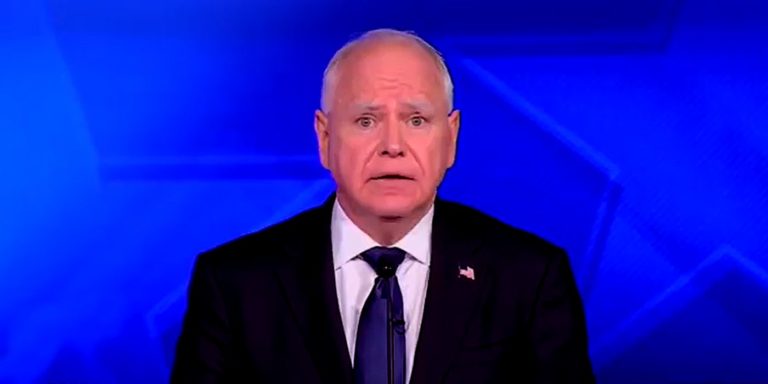
(Luis CornelioHeadline USA) Minnesota Gov. Tim Walz last month issued a controversial pardon to a foreign national who pleaded guilty to raping a 10-year-old girl, in a head-scratching decision that effectively blocked his deportation.

The recipient of Walz’s pardon, Tou Lue Vang, was facing removal proceedings as the Trump administration moved to deport him to Laos, DHS said Wednesday.

Walz issued the pardon through the Minnesota Board of Pardons on June 10. The board is composed of three members: Walz, Minnesota Attorney General Keith Ellison and Minnesota Supreme Court Chief Justice Natalie Hudson.

In 2005, Vang pleaded guilty to first-degree criminal sexual abuse of a 10-year-old girl, with the abuse reportedly occurring between 2002 and 2005, according to KSTP

Despite the severity of Vang’s acts, he received a 30-year probation sentence after prosecutors said the victim, then 12-years-old, “was experiencing pressure from her family to not cooperate.”

According to DHS, court records showed that Vang once tried to offer the girl “$10 to keep quiet about the sexual assaults” and reportedly tried to say the abuse was part of a “cultural thing.” He also reportedly told authorities that the girl should be arrested as well.

An immigration judge ordered Vang removed on Oct. 31, 2006. However, DHS spokesperson Lauren Bis said that Walz’s pardon effectively blocks his immediate deportation.

Vang entered the United States in 1994 and was granted legal status under the Clinton administration, according to DHS.

The Laotian national had not been deported previously because Laos did not accept deportees at the time, though that policy has since changed under the second Trump administration.

Vang himself cited the deportation threats as the reason he needed the pardon. He also claimed he had no living relatives in Laos, according to the left-wing New York Times.

Democratic prosecutors, including officials in the Ramsey County Attorney’s office, opposed the pardon because Vang had already received a lenient sentence. The elected prosecutor in that office, John Choi, is a Democrat.

Susan Gaertner, Choi’s predecessor and who led Vang’s prosecution at the time, also criticized the decision, calling it “unusual given the seriousness of the offense and the fact that the defendant did not receive significant consequences after he pled guilty.”


This Air Conditioning Strategy is the Sweet Spot for Saving Energy and Money

(Headline USA) Having air conditioning at home is a luxury that keeps people comfortable during the hottest months of the year, and it’s debated whether the AC should stay blasting or be turned off when people head to work during the day.

Some swear that turning off the AC when they’re gone for a few hours is the most energy-efficient, cost-saving method. Others say it’s better to leave it running continuously, preventing the system from straining to rapidly cool the house down after the home has gotten warmer throughout the day.

Three experts interviewed by The Associated Press agreed that setting the thermostat a few degrees higher than normal while you’re away is generally the best way to balance energy efficiency against comfort and humidity.

While turning an AC unit off for several hours and turning it back on can save money and energy compared to continuously running it, that approach can lead to mold problems in humid environments as well as wear and tear that can cause more frequent repairs. The equation can also vary depending on other factors including comfort level, AC unit type and building insulation.

According to the U.S. Department of Energy, adjusting your thermostat by 7-10 degrees Fahrenheit (4-6 degrees Celsius) for eight hours a day can save up to 10% a year on heating and cooling.

Experts say there are a lot of factors to consider when deciding what AC habits save the most energy and money.

“If you’re gone for like 15 minutes to go to the grocery store, you don’t get any gain” by turning off your AC, said Elizabeth Hewitt, professor and urban planning expert at Stony Brook University.

But as a general rule, “if you’re going for your work day, say for eight hours or so, you’ll almost always save more energy and money by turning things off,” she said.

In some climates, however, turning off the AC might not be feasible, so residents can set back their AC a few degrees instead of blasting cold air all day.

In dry places like Arizona, you can let the home warm up more by raising the thermostat a few degrees higher. But in humid climates like Florida, air inside the home can become damp and harder to cool, and turning the AC off for long periods can increase the risk of mold since the system helps control indoor moisture.

Bumping up the thermostat by 1 degree Fahrenheit (0.6 degrees Celsius) yields about a 3% savings in cooling costs, said Patrick Phelan, mechanical engineering professor at Arizona State University.

Phelan also said leaving your AC off for hours and then turning it back on could lead to wear that results in more frequent repairs. That is because it can take AC systems 15 to 30 minutes after they are turned on to perform most efficiently.

How much energy and money you can save depends on the kind of home you live in, said Gregor Henze, an architectural engineering professor at the University of Colorado Boulder.

Homes built with heavy materials like concrete or brick hold in cool air longer, while older, draftier houses heat up faster. In less insulated homes, Henze said, it makes sense to adjust the thermostat even if you’re stepping out for just a few hours, because the indoor temperature can rise quickly.

Whether you have a window unit, a smart thermometer or central air could influence your savings.

Window units are generally less efficient because they’re installed in an open window, making it difficult to seal out hot air completely, said Hewitt. She added that spraying “cheap foam spray insulation in open windows or areas that are drafty is a really low-hanging fruit that doesn’t cost a lot of money and really helps retain the indoor temperature in your home.”

Phelan says smart thermostats are a handy tool to remove the mental burden of tinkering with your manual thermostat multiple times a day. Smart thermostats “learn” by monitoring the occupancy with a sensor and raise the temperature when no one is home to conserve energy and lower it when people return.

“If you’re going from just an ordinary manual thermostat to installing a smart one like a Nest, then you can expect something like 10% savings,” said Phelan.

Each expert said simple steps like blocking sunlight can go a long way in keeping homes cool.

Henze pointed to “time-honored strategies” such as opening windows at night when it’s cooler. In dry climates, that night air doesn’t add much moisture, but in humid regions it can bring in dampness the AC will later need to remove.

Hewitt added that closing your blinds can make a difference of several degrees.

Phelan also noted that some blinds are designed to reflect sunlight and said tinted window films are another option.

Adapted from reporting by the Associated Press

US Employers Still Reluctant to Add Many Jobs as Hiring Slows in June

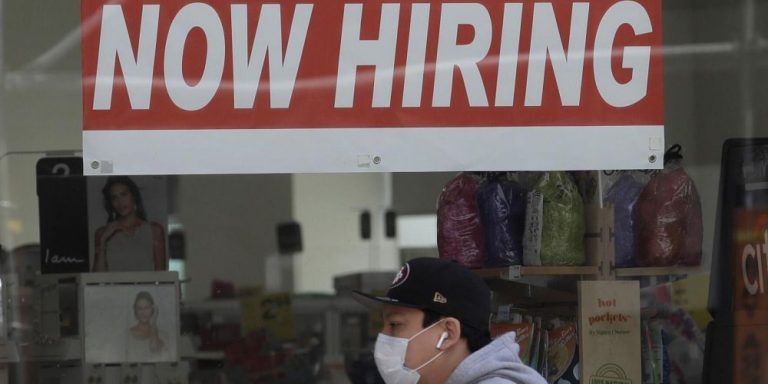
(Headline USA) U.S. employers slowed hiring last month and added only 57,000 jobs, less than half the previous month’s total and a sign companies still have a cautious economic outlook.

The Labor Department said Thursday that the unemployment rate declined to a low 4.2% from 4.3% in May, though the drop mostly occurred because many people out of work gave up looking and were no longer counted as unemployed.

The figures suggest businesses remain wary of the economy’s health, with inflation at a three-year high and consumer confidence near post-pandemic lows. The job market has been stuck in a “low-hire, low-fire” rut in which the employed enjoy some job security with layoffs low, but those out of work are struggling to get hired. Strong hiring in the spring raised hopes the economy was escaping that dynamic, but Thursday’s report suggests job gains are still muted.

“We are in a market that is still very fragile, and still susceptible to shocks happening,” Nicole Bachaud, labor economist at ZipRecruiter, an online job platform, said. “There is still a lot of hesitation on the part of employers and workers themselves to make any moves.” She noted that other government data shows companies are posting more jobs but not filling them.

Hiring has improved from last year, when employers added fewer than 10,000 jobs a month, on average. In this year’s first half the pace improved to 92,000. Yet healthy job gains that were initially reported in April and May were revised lower, from 172,000 down to 129,000 in May and from 179,000 to 148,000 in April.

Restaurants, bars, and hotels cut 61,000 jobs, a sharp disappointment for those who expected the World Cup tournament that is taking place in multiple U.S. cities would lead to at least temporary job gains. Retailers also shed 7,500 jobs.

Chad Moutray, chief economist at the National Restaurant Association, said member companies are seeing signs consumers are pulling back on eating out, particularly outside higher-income households. It reflects a “K-shaped” economy, where wealthier households pull ahead of middle- and lower-income ones.

“We continue to hear that a lot of Americans are struggling to make ends meet,” he said. “If you’re catering to the upper-end of the K, you’re doing fine. If you’re catering to the lower part of the K, you’re seeing some challenges in the last couple of months.”

Moutray’s group has forecast that restaurants will hire 450,000 seasonal workers this summer, slightly below last year’s 470,000.

Denise Beckson, a vice president at Morey’s Piers and Beachfront Water Parks in Wildwood, New Jersey, said her company has hired about 1,500 summer employees this year, roughly the same as last year. But she said many restaurants and hotels are struggling with higher food costs and minimum wage increases that have limited their ability to hire.

“Costs continue to rise, and one way to control that is to pull back on staffing,” she said.

Many Americans worry about the impact of artificial intelligence on employment, but for now AI may actually be adding jobs. Last month professional and business services, a category that includes architecture, engineering, and software development — occupations expected to be vulnerable to AI — added 36,000 jobs.

Blue-collar industries added a modest number of jobs, with manufacturers adding 3,000 positions and construction firms 11,000.

Scottsville, New York-based Power & Construction Group added some of those jobs as it seeks to keep up with the demand for greater electrical capacity in the state. Thomas “Murph” Murphy, the company’s vice president, said they are looking to hire another 15-20 workers after adding 47 in the past two months.

The company is seeking more electricians, laborers, and heavy equipment operators to join the 350 workers on staff, Murphy said.

Murphy said his company is competing for workers with firms building data centers in other states — not many are being built in New York — and he has to work to convince young people to choose construction as a career. The firm recently built a training center to bring newer, younger workers up to speed.

“The grid can’t handle all the new power that everybody’s using,” Murphy said, noting the increase in laptops, phones, and tablets in many Americans’ homes. “We need to continuously build the grid. But it does take time.”

Thursday’s report suggests that hiring and wage gains aren’t accelerating enough to worsen inflationary pressures in the economy, which could allow the Federal Reserve to keep its key rate unchanged at its current level of about 3.6%.

Previously, many Wall Street investors had expected the central bank to lift its key rate this year as hiring appeared to be accelerating. The prospect of no rate cuts lifted the stock market in mid-morning trading, with the broad S&P 500 index up 0.7%.

“Today’s data hit the sweet spot for markets — strong enough to keep worries about growth at bay, but soft enough to reduce the probability of a rate hike,” said Eric Winograd, chief U.S. economist at AB Global, an asset management firm.

Fed chair Kevin Warsh in Portugal Wednesday reiterated that he would push inflation back to the Fed’s 2% target, though he wouldn’t comment on whether the Fed would raise rates at its next meeting, later this month.

Average paychecks, meanwhile, rose 3.5% from a year ago, a decent gain but one that still trailed inflation, leaving many Americans struggling to keep up with rising costs for necessities such as food, gas, and housing.

Historically, a job gain of just 57,000 would be seen as weak. Yet as more Americans retire and new immigration has dropped sharply, the U.S. workforce has shrunk in the past year. As a result, even gains at that level are enough to keep the unemployment rate unchanged over time.

Last month, in fact, the workforce declined sharply, with the percentage of Americans working or looking for jobs falling to 61.5%, down from 61.8% in May. It’s the lowest level in five years.

Much of the decline reflected the aging of the population, as more than 10,000 Americans turn 65 every day and many retire. Yet the proportion of Americans aged 25 through 54 who are working or searching for jobs also fell last month.

Adapted from reporting by the Associated Press


Former Olympian Indicted on Felony Charge Over Alleged Reflecting Pool Vandalism

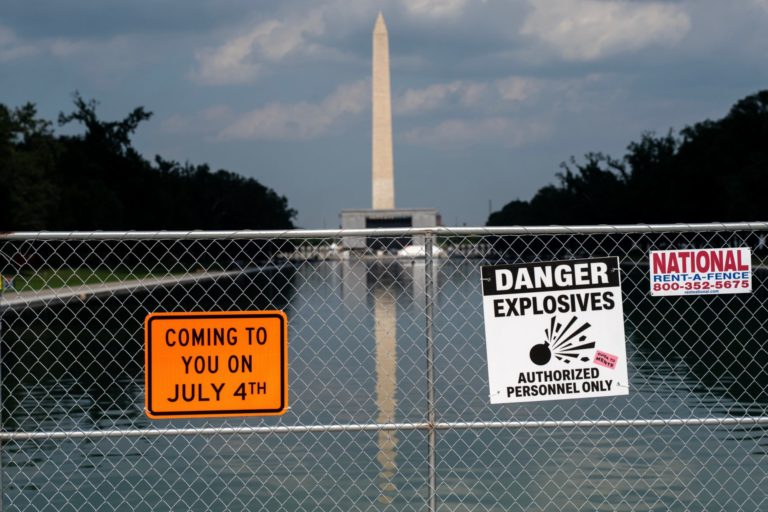
(Headline USA) A former Olympian was indicted Thursday on a felony charge in what President Donald Trump has called vandalism of the Lincoln Memorial Reflecting Pool, where a renovation project he launched has been riddled with problems.

David Hearn, a former Olympic canoe racer, was indicted on a single count of property destruction in Washington, D.C., court.

District of Columbia U.S. Attorney Jeanine Pirro said Hearn ripped up recently installed sealant on the pool in “a deliberate act” that caused more than $1,000 in damage. She accused him of “forcefully and violently” pulling up the bottom liner “with both hands” and acting belligerently toward an employee who told him to stop.

“This is a case with tremendous evidence,” she said, adding that authorities have made about six other misdemeanor arrests.

In a statement, Democracy Defenders Fund co-founder Norm Eisen and Mary Dohrmann, senior counsel at Washington Litigation Group, said that they represented Hearn and that the charges were “outrageous and should be alarming to every American.” Eisen and Dohrmann construed the case as representative of “the misuse of government power against an ordinary citizen based on a concocted narrative.”

Hearn didn’t immediately return a phone call seeking comment. He previously told The Associated Press that he reached into the pool on June 19 to examine the newly peeled coating. He said he briefly touched a chunk that was still attached to the side of the pool, then let go shortly after a park worker told him to.

“I’m a curious citizen,” Hearn said in a telephone interview last month. “I reached down to see what it felt like. It was very rubbery.”

Hearn, 67, of Bethesda, Maryland, owned a company that made composite materials used to build watercraft.

Saying that he stopped by the pool during a 64-mile bike ride, Hearn said he was detained by National Guard troops and Park Police for five hours before being released.

Trump said last month that federal authorities made “multiple arrests” of people he accused of vandalizing the Reflecting Pool as he struggled to explain why the $16-million rehabilitation project he launched for the nation’s 250th anniversary seemingly backfired. Without providing any substantiation, he also said vandals dumped fertilizer into the pool and slashed the coating with a box cutter.

In subsequent days, National Guard members and U.S. Park Police patrolled the deck around the Reflecting Pool as Trump’s administration faced a self-imposed deadline to fix a botched renovation before the nation’s 250th anniversary celebration. 

Contractors and federal workers used chemicals and ozone nanobubbles to combat an algae bloom, and Trump has said that problems most likely require draining the pool again for liner repairs.

Adapted from reporting by the Associated Press

GOP Lawmaker Wants Omar Records After Fraud Arrest

(Elyse S. Apel, The Center Square) The recent arrest of an alleged top figure in Minnesota’s Feeding Our Future fraud scheme is leading to renewed calls for the release of communications with U.S. Rep. Ilhan Omar’s office.

State Rep. Kristin Robbins, R-Maple Grove, chair of the Minnesota House Fraud Prevention and State Oversight Committee, told The Center Square in an exclusive interview that the arrest of Abdikerm Eidleh shows the importance that communications between Omar’s office and Eidleh to be made public.

“He’s clearly a very important player in this, and we should understand what his communications were with Ilhan Omar’s office,” Robbins said.

Federal authorities announced June 26 that Eidleh, who was originally indicted in September 2022, was taken into custody in Somalia after fleeing the U.S.

“Eidleh’s capture shows that, if you commit fraud against the American taxpayer, and try hiding across the globe, the long arm of justice will find you,” said United States Attorney Daniel N. Rosen. “We salute the FBI’s work in finding Eidleh, and are grateful to all our federal and international partners that help us hold accountable those who defraud our government.”

Prosecutors have described him as one of the key organizers of the Feeding Our Future fraud scheme, which has been described by federal officials as one of the largest pandemic-era fraud schemes in the country – siphoning off more than $250 million in taxpayer funds.

The indictment includes 31 counts of conspiracy to commit wire fraud, wire fraud, conspiracy to commit federal programs bribery, federal programs bribery, conspiracy to commit money laundering, and money laundering.

It alleges Eidleh recruited fraudulent meal sites, solicited bribes and kickbacks from operators seeking approval under Feeding Our Future’s sponsorship, and created shell companies to launder fraud proceeds – all while an employee of Feeding Our Future.

“This defendant was a central figure in one of the largest fraud schemes in Minnesota history,” said Assistant Attorney General Colin M. McDonald of the Department of Justice’s National Fraud Enforcement Division. “He not only stole taxpayer dollars, but he also robbed vulnerable children of critical resources they desperately needed.

For Robbins, Eidleh’s arrest underscores questions she has pursued for months regarding communications between Eidleh and Omar’s congressional office.

“It would be very important to get these communications,” Robbins said.

Robbins explained that trial exhibits introduced during the federal prosecution of Feeding Our Future ringleader Aimee Bock include details of communications between Omar’s office and Eidleh. Those materials are subject to a court order restricting their release by parties in the case.

However, Robbins said that does not prevent their disclosure by others.

“I’m not bound by the court order. Omar is not bound by the court order,” she said. “So, we should continue to pressure her to voluntarily turn them over.”

Eidleh’s arrest also comes just weeks after Said Abdullahi Ereg became the first fugitive apprehended after being placed on the FBI’s “Most Wanted Fraudsters” list. Ereg surrendered to FBI agents at Minneapolis-St. Paul International Airport after spending years overseas.

Federal prosecutors allege Ereg fraudulently obtained more than $4.2 million in taxpayer dollars by submitting false reimbursement claims. Robbins noted charging documents allege Eidleh recruited Ereg into the Feeding Our Future scheme and accepted $100,000 in kickbacks from him.

“I think showing that thread is important,” Robbins said, referring to the connection between Ereg, Eidleh, and Omar’s office. She has also long pointed to Omar’s role in federal policy changes.

“She took all the guardrails off the federal nutrition program by passing the MEALS Act back in March of 2020,” Robbins said. “She’s at the epicenter of this, because she, by passing the MEALS Act, created the conditions that allowed Feeding Our Future to happen in the first place.”

As previously reported by The Center Square, the Minnesota House Fraud Prevention and State Oversight Committee attempted to subpoena Omar over those records earlier this year. That effort fell one vote short after Democrat members opposed it.

Following the failed vote, Robbins asked U.S. congressional oversight leaders to assist in obtaining the records after repeated requests to Omar’s office went unanswered. Robbins is also calling on Omar to release the communications voluntarily.

“Omar says she’s had nothing to do with it,” Robbins said. “Well, then she should release them to clear her name. If there’s nothing there, put them out.”

In May, the Minnesota House Fraud Prevention and State Oversight Committee adopted the Republicans’ majority report. That report concluded that repeated failures in oversight across multiple state agencies left taxpayer-funded programs in Minnesota vulnerable to fraud.

Democrat members of the committee pushed back against those allegations and the concerns with Omar.

Rep. Emma Greenman, DFL-Minneapolis, said that committee’s work had drifted away from fraud prevention for a broader political agenda.

“This committee is called the Fraud Prevention and Government Oversight Committee, not the make the case and picture what you think the Democratic Party is,” Greenman said in May. “This report turned into . . . no Democratic leader left un-disparaged.”

Robbins disagreed. She called Minnesota a “canary in the coal mine” of widespread fraud and highlighted how Minnesotans are still concerned, despite some prosecutions.

“Minnesotans are incredibly frustrated. They’ve had well over $9 billion of their tax dollars stolen, and it hurts actual vulnerable Minnesotans who do need real services,” Robbins told The Center Square. “Rep. Omar, [Gov.] Tim Walz, and his agencies created the conditions, they enabled the fraud, and they have not been held accountable.”

While there has been progress in prosecuting individuals accused of fraud, Robbins explained, public officials have not yet been held accountable.

“We have not seen any accountability for the politicians, and Minnesotans are fed up with that,” she said. “We can’t say ‘We’ve got all these convictions on the criminal side. It’s good enough.’ We need to get to the root of how this started.”

Robbins said she is hopeful that accountability is coming.

“We have to keep the pressure on,” she said. “The people want justice.”

Shapiro Says ‘Radical Reform’ Needed on U.S. Supreme Court

(John Cole, The Center Square) Following several consequential decisions made by the U.S. Supreme Court this week, Gov. Josh Shapiro is open to reform.

“I think everything needs to be on the table,” Shapiro said in a Wednesday morning interview on MS NOW’s Morning Joe.

“I think we need radical reform that’s actually going to ensure that the voices of the people are heard from, that the voices of the people are represented in the three branches of government,” he continued. “We don’t have that right now.”

The response was from a question posed by the New York Times’ Mara Gay who asked the governor if expanding the U.S. Supreme Court or setting term limits should be on the table if Democrats regain a majority in Congress.

Shapiro argued that a previous Supreme Court decision about presidential immunity was “one of the worst decisions over the last century,” believing it is giving the executive branch too much power.

“We can begin to change that by voting, and after we vote, I think we need dramatic reform to give the voice back to the people,” Shapiro said.

One of the marquee decisions made this week was a ruling that upheld birthright citizenship, striking down an executive order made by Trump after he was sworn in for a second term.

Shapiro said that decision should have been 9-0 in upholding the 14th Amendment.

“It’s one of the reasons why we have to win the United States Senate and not let them appoint a justice should there be a vacancy, who would be younger, who would be there for a long time and be more dangerous when it comes to eviscerating the rights of Americans,” Shapiro said. “So, bottom line here is we need real reform in this country.”

“It’s got to be people-centered and people-powered, and it’s got to come as a result of people rising up, showing up at the ballot box, demanding more from their elected officials, and ushering in a new chapter in this country, one that gets us back to our roots of being more hopeful, more inclusive, and more just,” he continued.

Americans are divided on the prospect of adding justices to the U.S. Supreme Court.

A Marquette Law School poll conducted in late May showed that 50% of Americans are in favor of adding more justices, while 50% opposed.

However, 79% favor fixed-term limits for justices, while 21% oppose.

Shapiro, who is seeking a second term as governor in November, is often mentioned as a potential candidate for president in 2028.

JD Vance Reported Up to $7.4 Million in Book Earnings

(José Niño, Headline USA) JD Vance pulled in as much as $7.4 million during 2025 from royalties on his bestselling book combined with returns from investments and his venture capital enterprise, the Wall Street Journal reported after reviewing his most recent financial disclosure.

The vice president keeps drawing considerable sums from “Hillbilly Elegy” while also profiting from a portfolio that includes real estate holdings and exchange traded funds, Tuesday’s federal filing showed.

Donald Trump’s 2025 haul vastly outpaced what his vice president brought in. The president made more than $1 billion through cryptocurrency transactions alone per his own disclosure. Vance filed 17 pages of financial information compared to Trump’s 927 page submission.

Most of Vance’s money originated from his 2016 book, an examination of poverty and other struggles confronting working class communities across America. Royalties from the memoir totaled between $1 million and $5 million last year based on his filing. Hollywood produced a film adaptation in 2020 using the same title.

These figures mark a substantial increase over 2024, when Vance disclosed earnings between $212,000 and $1.3 million.

White House officials offered no immediate comment Tuesday.

Vance has built a multimillion dollar fortune through multiple residential properties and diversified investments in real estate and digital currencies. His filing documented bitcoin assets valued between $250,000 and $500,000 plus rental income reaching $50,000 from a Washington, D.C. property. He deployed as much as $2.6 million purchasing positions in various ETFs and investment portfolios.

His venture capital firm Narya Capital Management paid Vance no salary according to the documents. Instead he obtained a promissory note from the fund yielding up to $1 million in 2025 income. He also unloaded a position worth as much as $250,000 in a seed fund associated with AOL co-founder Steve Case.

Vice presidents typically receive $235,100 annually. Trump signed an executive order boosting Vance’s salary to $292,300 for this year.

José Niño is the deputy editor of Headline USA. Follow him at x.com/JoseAlNino