Newsom Flies to D.C. Seeking Wildfire Relief after Calif. Passes His ‘Trump-Proofing’ Bills

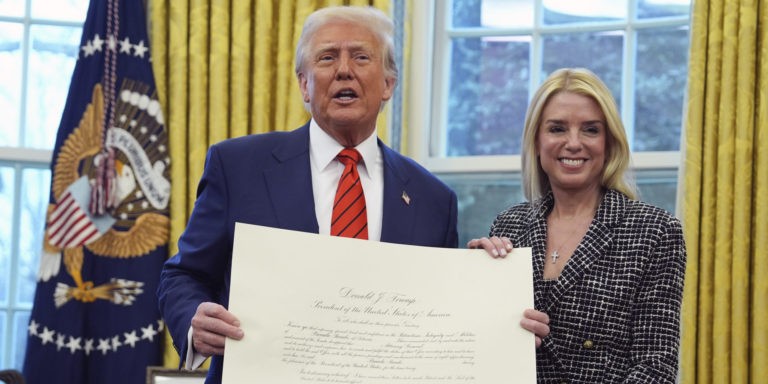
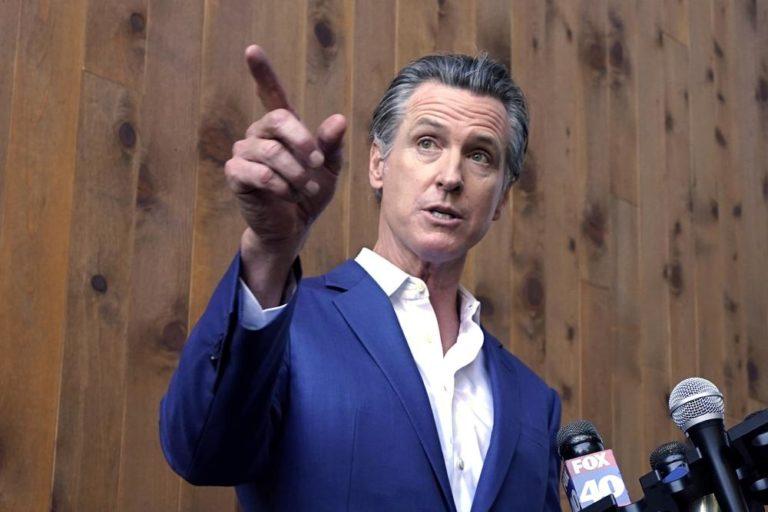
(Kenneth Schrupp, The Center Square) California Gov. Gavin Newsom is visiting President Donald Trump in Washington, D.C. to seek wildfire relief funding just after the state legislature passed bills to fund lawsuits against the Trump administration and deportation defense of illegal immigrants in a Newsom-called “Trump-proofing” special session.

Trump has said he supports placing conditions on California wildfire aid, including the adoption of voter identification laws and better water management, and announced that he is seeking a federal investigation into the state’s high speed rail program.

“I want to see two things in Los Angeles. Voter ID, so that the people have a chance to vote, and I want to see the water be released and come down into Los Angeles and throughout the state,” said Trump while visiting North Carolina communities devastated by Hurricane Helene on his way to Southern California.

In response to the coastal Southern California city of Huntington Beach adopting a voter ID requirement for local elections, the California legislature passed a ban on voter ID. While courts upheld Huntington Beach’s law before the new state law took effect, the state has appealed the ruling under the new law.

Speaking at the White House from the Oval Office, Trump also called for an investigation into the state’s high speed rail program, which is now estimated to cost over $100 billion to complete and was noted as being significantly behind schedule in a new state report.

“The train that’s being built between Los Angeles and San Francisco is the worst-managed project I think I’ve ever seen, and I’ve seen some of the worst,” said Trump. “It’s impossible that something could cost that much.”

Newsom signed a $2.5 billion aid package for the Los Angeles area fires, which are estimated to have caused hundreds of billions of dollars in damage, making the fires the costliest natural disaster in American history. Further federal aid could assist with accelerating the removal of debris and rebuilding in the communities ravaged by the wildfires.

“This morning, I met with both Democratic and Republican members of Congress to secure expedited disaster aid to recover and rebuild from the Los Angeles firestorms,” said Newsom in a statement. “Our nation is better off when we hold together and support our fellow Americans in times of crisis.

Before Newsom’s trip, the California Assembly passed $50 million in funding during a Newsom-called “Trump-proofing” special session for lawsuits against the Trump administration and legal aid that largely could go to deportation defense for illegal immigrants, highlighting the tense relationship between the governor and the president.


Gold Serving as a Lifeline for Russians Coping With a Wartime Economy

(Mike Maharrey, Money Metals News Service) Gold has served as a lifeline for the Russian government and economy in the wake of aggressive sanctions after it invaded Ukraine.

It has also served as a lifeline for the Russian people.

Russians bought a record amount of gold in 2024. According to a report by Bloomberg, consumers gobbled up nearly a quarter of the country’s annual gold production. In 2023, Russia was tied for second in global gold output.

Russian consumers bought 75.6 tonnes of gold last year in the form of coins, bullion, and jewelry, a 6 percent annual increase.

Russian retail gold demand in 2024 ranked fifth in the world.

Since its invasion of Ukraine, gold demand in Russia has skyrocketed by 60 percent.

According to Bloomberg, Russians have turned to gold seeking “alternative ways of securing their savings instead of traditional investments in dollars or euros.”

Aggressive Western sanctions have made it difficult to secure dollar and euro-denominated assets, sending average Russian people scrambling to protect their wealth. Gold provides the perfect alternative. It is recognized as money around the world, is accepted virtually everywhere, and comes with no counterparty risk.

Holding gold also shields Russians from spiking price inflation. Russia’s CPI came in at over 9 percent on an annual basis in December. This has forced the Russian central bank to raise interest rates, now set at 21 percent.

The price of gold jumped by 28 percent in ruble terms in 2024 and is already up by 10 percent so far in 2025.

The Russian gold rush underscores the nature of gold as money and its important role in the global economy. When fiat currencies are cut off or fail, gold will always remain a viable alternative.

This is precisely why so many Russians are accumulating gold at a rapid pace.


Mike Maharrey is a journalist and market analyst for MoneyMetals.com with over a decade of experience in precious metals. He holds a BS in accounting from the University of Kentucky and a BA in journalism from the University of South Florida.

Gold Demand Set Record in 2024

(Mike Maharrey, Money Metals News Service) Gold demand followed prices higher and set a new record in 2024.

According to data compiled by the World Gold Council, total gold demand rose by 1 percent to 4,974 tonnes, driven by robust central bank buying and surging investor interest in the East.

Gold recorded high prices 40 times during the year and edged out U.S. stocks to rank first among traditional asset classes. Gold also performed better than U.S. bonds, dollars, commodities, and global treasuries.

The average gold price in Q4 was a record $2,663. For the entire year, gold averaged $2,386, a 23 percent increase over 2023.

The combination of record prices and record demand volumes drove demand in value terms to its highest-ever level – $382 billion.

Central Bank Buying

As the World Gold Council put it, central banks seem to have an “insatiable appetite” for gold.

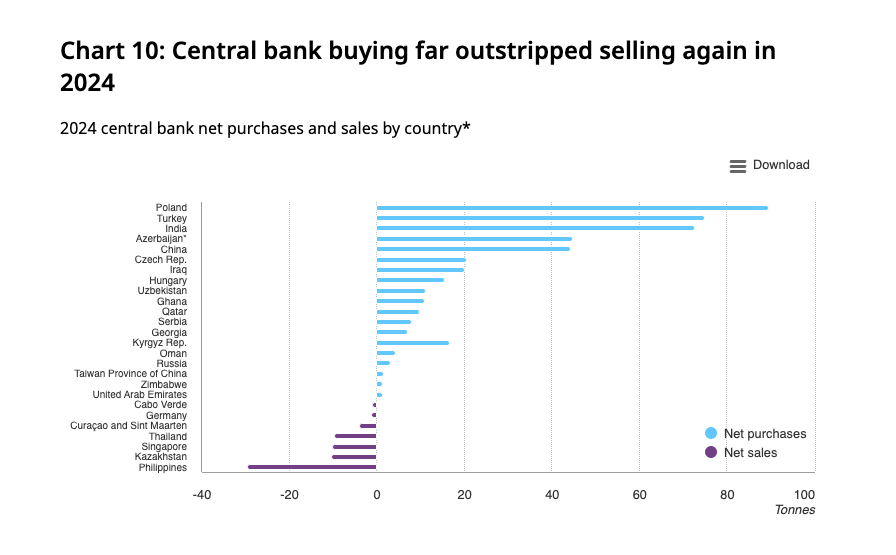
Central banks added more than 1,000 tonnes to their holdings for the third straight year. At 1,044.6 tonnes, central bank purchases came in just slightly below the 2023 total of 1,050.8 tons.

To put the last three years into perspective, the annual average central bank gold purchases between 2010 and 2021 were only 473 tonnes.

Last year marked the 15th straight year of net central bank gold buying.

Poland led the way, adding 90 tonnes to its reserves. Earlier this year, National Bank of Poland Governor Adam Glapiński indicated the central bank plans to increase its gold holdings to 20 percent of its reserves.

“This makes Poland a more credible country, we have a better standing in all ratings, we are a very serious partner, and we will continue to buy gold.”

Investment Demand

Global gold investment hit a 4-year high in 2024, coming in at 1,179.5 tons. That represented a 25 percent annual increase.

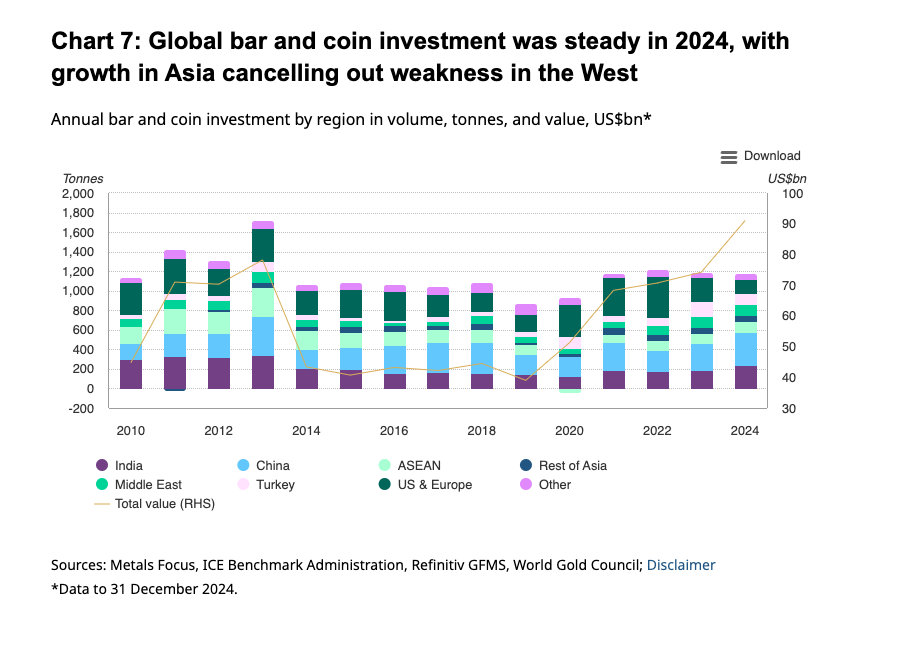
Bar and coin demand was unchanged at 1,186 tonnes. However, the value of physical gold investment surged 23 percent to a record $91 billion.

There was a shift in buying, with coin sales falling by 31 percent as bar sales grew by 10 percent. This reflects the source of physical demand, which was primarily in the East. Asian investors tend to favor gold bars.

Bar and coin demand in India grew by 29 percent. Indian demand got a big boost from a cut in the excise tax that went into effect in July.

Chinese physical gold demand hit its highest total in a decade, rising by 20 percent.

Meanwhile, in the U.S., bar and coin demand fell by 33 percent and hit the lowest level since 2020.

Retail gold demand hit a 17-year low in Europe, halving from an already low base in 2023.

The flow of physical gold from West to East was particularly pronounced in the early months of the gold bull run.

ETF investing rebounded in the second half of 2024, with funds reporting net gold inflows in the third and fourth quarters.

For the year, funds globally reported a modest net 7-tonne outflow of gold.

After sinking to a four-year low of 3,080 tonnes in April, global ETF gold holdings recovered throughout the remainder of 2024, ending the year very close to where they had started (3,219t vs 3,226t).

Jewelry Demand

Jewelry demand fell by 11 percent to 1,877 tonnes. High prices created significant headwinds in the jewelry market.

However, those high prices also drove the total value of jewelry demand up by 9 percent last year to $144 billion.

Except for 2020, at the height of the pandemic, jewelry demand was at the lowest level since the Great Recession in 2009.

China drove this demand weakness with a 24 percent drop. For the second time in three years, China ceded its position to India as the largest jewelry market.

Indian gold jewelry demand was also down, although much more modestly at just a 2 percent decline, thanks to the strongest third quarter since 2015.

Jewelry demand was also tepid in the U.S. The market reported its 11th consecutive quarter of declining demand, pushing annual jewelry purchases to a five-year low. However, rising prices pushed the value of U.S. jewelry demand to a record high of $10 billion.

Gold In Tech

Annual demand for gold in technology rose by 7 percent to 326.1 tonnes.

The use of gold in electronics increased by 9 percent to 270.6 tonnes, driven higher by a surge in demand for AI applications. There was also some recovery in the consumer electronics market after a weak 2023.

Global demand for gold in other industrial and decorative applications fell by 4 percent in Q4. This was chiefly driven by sagging demand in Italy and East Asia due to slow sales of branded accessories and de-stocking by retailers. On the plus side, Indian demand grew by 5 percent as high gold prices impacted the affordability of fine gold items and prompted greater demand for gold-plated articles and jewelry.


Mike Maharrey is a journalist and market analyst for MoneyMetals.com with over a decade of experience in precious metals. He holds a BS in accounting from the University of Kentucky and a BA in journalism from the University of South Florida.

DOJ Lawyer Caught Having ‘Sexual Contact’ w/ Intern

(Ken Silva, Headline USA) The DOJ Inspector General recently caught an attorney emulating former President Bill Clinton.

On Tuesday, the DOJ-OIG released a report that found that an attorney advisor for the Justice Department had engaged in inappropriate sexual contact with an intern in the Attorney Advisor’s office. Attorney advisors help with the DOJ’s internal rulemaking and policies, according to the department’s website.

“The OIG investigation substantiated the allegation that the then Attorney Advisor had engaged in inappropriate sexual contact with an intern while in the Attorney Advisor’s office and determined that this behavior constituted conduct prejudicial to the government in violation of federal ethics regulations,” the DOJ-OIG said in its report.

“The Attorney Advisor resigned while the OIG’s investigation was ongoing.”

Reports from the DOJ’s Office of the Inspector General in recent years suggest that the DOJ and FBI have a widespread culture of sexual misconduct.

For example, last October the DOJ-OIG released a report about how a federal prosecutor had a sexual relationship with the target of a police investigation.

According to that report, the DOJ-OIG received information from a local police department that a U.S. Attorney used his government-issued mobile device to engage in extensive, sexually explicit communications with someone who later became the target of a police investigation.

The DOJ-OIG said its investigation substantiated the local police department’s tip.

And according to a 2020 Associated Press article entitled, ‘Under the rug:’ Sexual misconduct shakes FBI’s senior ranks, the last time the OIG did an extensive probe of sexual misconduct within the FBI, it tallied 343 “offenses” from fiscal years 2009 to 2012, including three instances of “videotaping undressed women without consent.”

That AP investigation identified at least six sexual misconduct allegations involving senior FBI officials over the past five years, including two new claims brought by women who say they were sexually assaulted by ranking agents.

“Each of the accused FBI officials appears to have avoided discipline, the AP found, and several were quietly transferred or retired, keeping their full pensions and benefits even when probes substantiated the sexual misconduct claims against them,” the AP reported in December 2020.

Ken Silva is a staff writer at Headline USA. Follow him at x.com/jd_cashless.

Why a Chinese Gold Mania May Be Starting

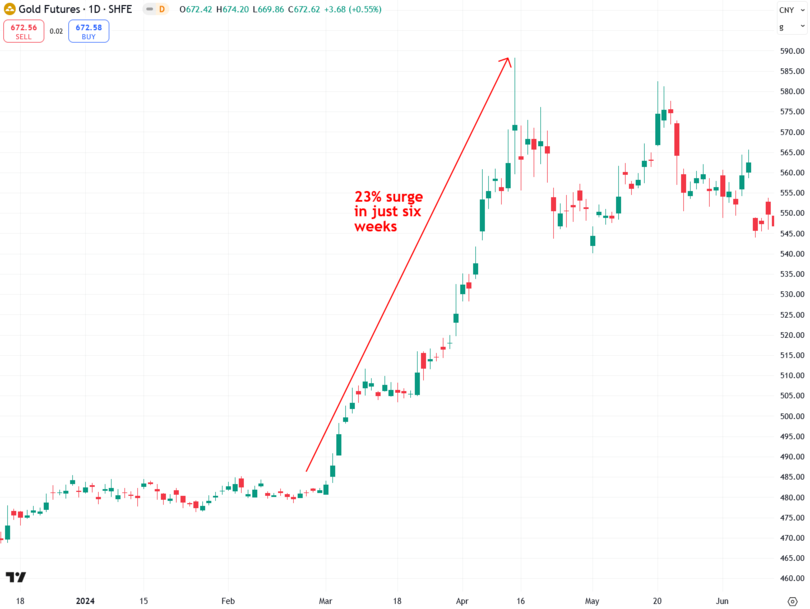
(Jesse Colombo, Money Metals News Service) The current gold bull market began in the spring of 2024, fueled in large part by aggressive Chinese futures traders on the Shanghai Futures Exchange (SHFE), while Western investors remained largely on the sidelines.

In just six weeks between March and April, these traders propelled gold prices up by $400, or 23%—an extraordinary surge for the yellow metal. Since then, their activity has quieted, but I’ve anticipated their return, expecting them to push gold to truly staggering levels.

That moment may have arrived. Fresh off the week-long Chinese Lunar New Year holiday, these traders are reentering the market—just as gold was already heating up without them.

The Shanghai Futures Exchange gold futures were the primary vehicle behind the spring 2024 gold frenzy, a surge that subsequently spilled over into international gold prices:

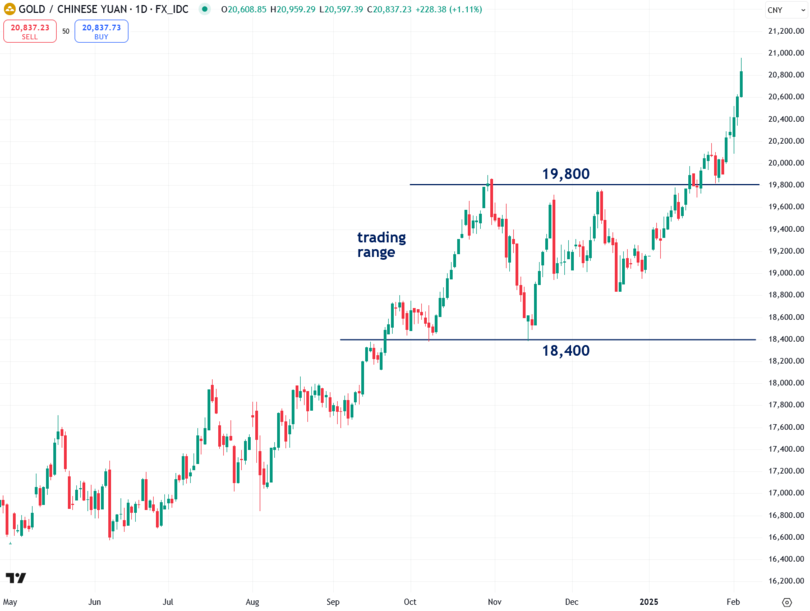
Over the past year, SHFE gold futures have mirrored the international gold price, steadily rising before consolidating in a trading range from late October to January.

But as soon as China’s financial markets reopened this week after the Lunar New Year holiday, SHFE gold futures gapped higher, swiftly catching up to the international rally that unfolded while China was offline.

This breakout signals strong bullish momentum, suggesting even greater gains lie ahead.

The trading range and recent breakout are also evident in the international spot gold price denominated in Chinese yuan, providing further confirmation of the bullish trend:

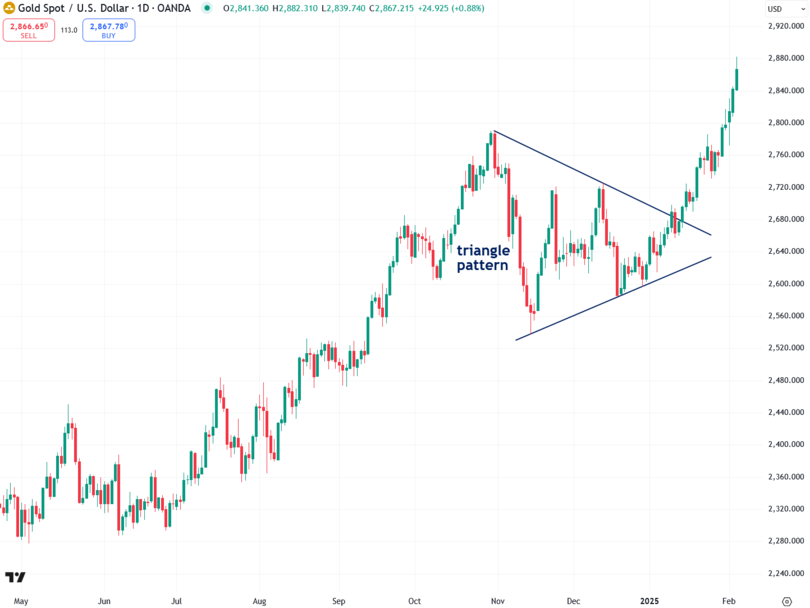
The spot price of gold in U.S. dollars also recently broke out of a triangle consolidation pattern, confirming the bullish momentum:

I believe all the key ingredients for another China-driven gold mania—similar to last spring—are now in place. It may only be a matter of time.

A key indicator to watch is trading volume in SHFE gold futures. Last spring, a surge in volume accompanied gold’s explosive rally. So far, volume has remained subdued, but it’s likely to increase as the rally gains momentum.

For confirmation, I’m looking for a significant spike in volume to validate this thesis.

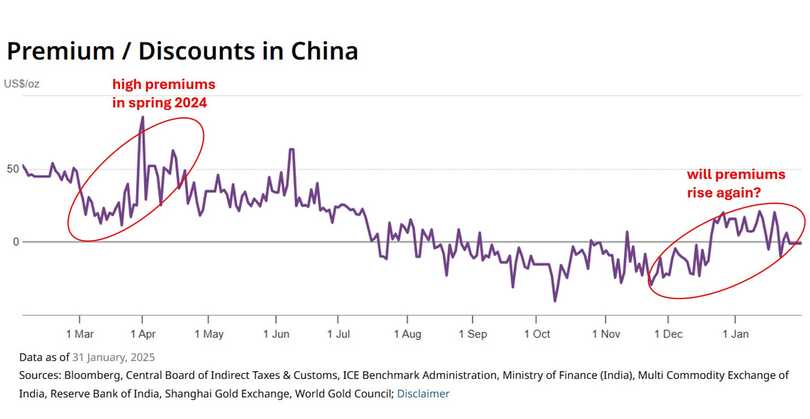
Another key indicator of a potential Chinese gold mania is whether the domestic Chinese gold price trades at a premium to the international price.

During last spring’s explosive rally, the domestic price carried a premium of approximately $50 over the international price. Currently, there is little to no premium or discount, but it’s worth watching closely.

If a significant premium emerges, it would likely signal that Chinese demand is once again driving gold higher.

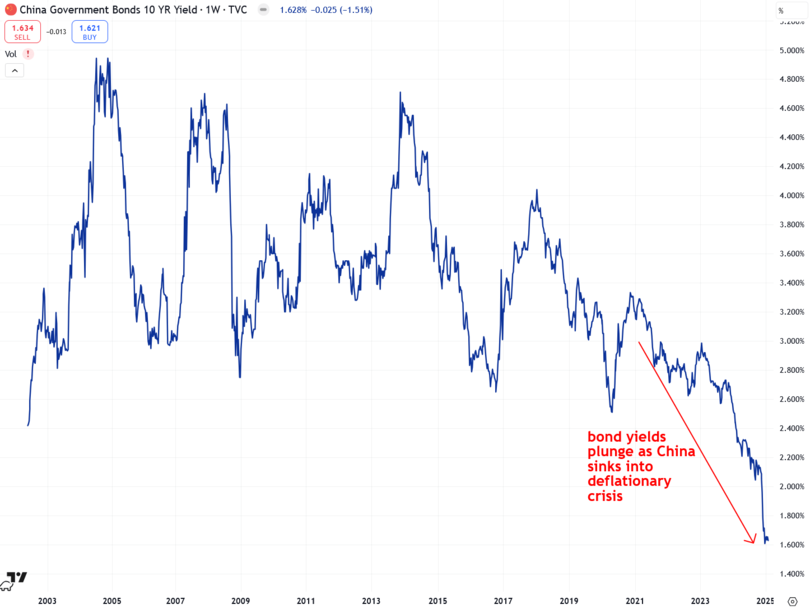
A major catalyst for a potential Chinese gold mania is the country’s severe economic turmoil. With its real estate and stock markets plunging, an estimated $18 trillion in household wealth has been wiped out—an economic crisis akin to China’s version of the 2008 Great Recession.

Meanwhile, government bond yields have collapsed to record lows, signaling a deepening deflationary spiral. In low-interest-rate environments like China’s, gold— which generates no yield—becomes more attractive as the opportunity cost of holding it diminishes.

Additionally, China is likely to respond with a massive stimulus “bazooka” to combat deflation, which should provide a powerful tailwind for gold, silver, and other commodities.

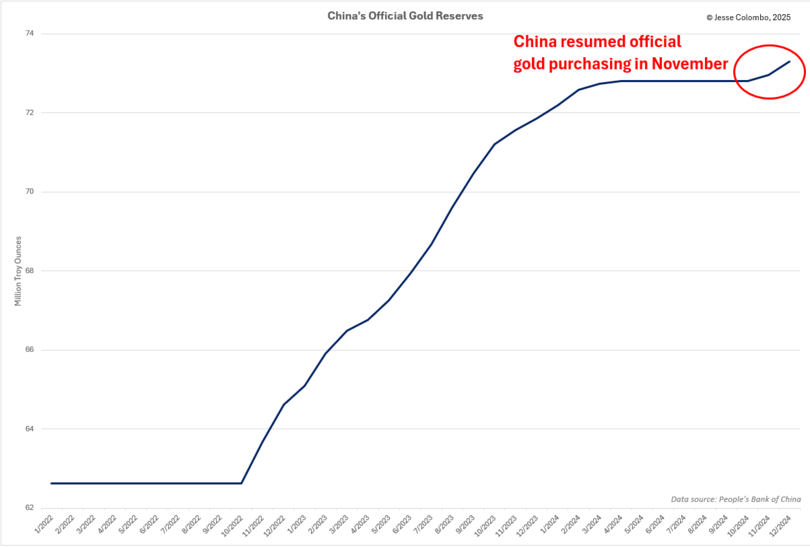
Another potential catalyst for a Chinese gold mania is the People’s Bank of China’s (PBOC) recent resumption of official gold purchases after a six-month pause.

The PBOC was likely accumulating gold all along, but its decision to publicly announce renewed purchases appears to be a strategic move aimed at encouraging domestic gold buying.

This aligns with China’s broader strategy of diversifying away from U.S. dollars and increasing gold holdings across all levels of society.

All signs point to the potential for another explosive gold rally driven by Chinese traders, much like what unfolded last spring.

With SHFE gold futures breaking out, the possibility of rising trading volumes, and the return of a Chinese gold price premium, the conditions for another bullish episode are falling into place.

China’s economic crisis, record-low bond yields, and the looming prospect of massive stimulus only strengthen the case for gold’s continued ascent. Meanwhile, the PBOC’s renewed gold purchases reinforce the broader shift toward gold as a preferred asset.

If these factors align as expected, the next phase of this bull market could be even more dramatic than what we saw in 2024.


Jesse Colombo is a financial analyst and investor writing on macro-economics and precious metals markets. Recognized by The Times of London, he has built a reputation for warning about economic bubbles and future financial crises. An advocate for free markets and sound money, Colombo was also named one of LinkedIn’s Top Voices in Economy & Finance. His Substack can be accessed here.

Israel Wants Western Countries to Accept Refugees from Gaza

(Ken Silva, Headline USA) Israel has begun preparations for the departure of large numbers of Palestinians from Gaza. Western countries might not be too happy about where Israel wants to send them.

Israeli defense minister Israel Katz said on Thursday that many of the Palestinians should be sent to countries such as Spain, Ireland, Norway, “and others.” He said those countries have “falsely” accused Israel of committing war crimes, and so they are legally obligated to allow Gazans to enter their territory. Katz was referring to the fact that the countries he mentioned have joined South Africa, which filed a case with the International Criminal Court formally accusing Israel of genocide.

“Their hypocrisy will be exposed if they refuse,” Katz said—failing to explain why it’s hypocritical for Western countries to not want the victims of Israel’s war crimes.

Even though he didn’t suggest that the refugees be sent to the U.S., Katz’s proposal was met with criticism from Americans. Some recycled a quote from historian Daryl Cooper, who said: “Israel has entire government agencies devoted to convincing us that Palestinians are demons who all [deserve] death, but also Western countries should take them all in because they’re just good folks who want a better life.”

Israel’s calls for the West to accept Palestinian refugees comes as Donald Trump pushes a plan for Israel to turn Gaza over to the United States after the war.

The Trump administration has already dialed back aspects of the proposal after it was widely rejected internationally. U.S. officials have provided few details about how or when the plan would be carried out.

The Palestinians have vehemently rejected Trump’s proposal, fearing that Israel would never allow refugees to return. Egypt has warned that an expulsion of Palestinians would destabilize the region and undermine its peace treaty with Israel, a cornerstone of stability and American influence for decades.

Saudi Arabia, another key U.S. ally, has also rejected any mass transfer of Palestinians and says it will not normalize relations with Israel — a key goal of the Trump administration — without the creation of a Palestinian state that includes Gaza.

Yet another U.S. ally, Jordan, reportedly would rather have total war than accept the Palestinians.

“The last thing Jordan wants is war and it is eager for a peaceful solution. But they are adamant that the Jordanians will close the border if refugees begin to cross into the country,” Middle East Eye reported earlier this week, citing “well-placed sources in Amman and Jerusalem.”

“If the Israelis seek to re-open it, that would be ‘a casus belli,’ one source said. The Jordanians are under no illusion they could win a war with Israel, but believe they would have no choice but to fight.”

Trump and Israeli officials have not said how they would respond if Palestinians refuse to leave. But Human Rights Watch and other groups say the plan, if implemented, would amount to “ethnic cleansing,” the forcible relocation of the civilian population of an ethnic group from a geographic area.

Ken Silva is a staff writer at Headline USA. Follow him at x.com/jd_cashless.

Gold and Silver: Timeless Guardians of Wealth in an Inflated World

(Money Metals News Service) In the latest episode of Money Metals Midweek Memo, host Mike Maharrey takes a deep dive into the enduring value of gold and silver in a fiat-driven monetary world. Here are the key takeaways from the episode.

Gold and Silver vs. Fiat Currency

Maharrey opens the episode by addressing a common question: “Why gold and silver?” He compares it to asking why people hold dollars, underscoring that gold and silver have always functioned as sound money. Unlike fiat currencies such as the U.S. dollar, which steadily lose purchasing power due to government-induced inflation, gold and silver hold their value over time.

To emphasize this point, Maharrey uses a striking “fine suit” analogy. In 1900, one ounce of gold could purchase a fine suit for $20-$30. Today, that same ounce still buys a fine suit, now priced at over $2,000. While the suit itself hasn’t changed in value, the purchasing power of the dollar has been drastically reduced through currency devaluation.

This comparison highlights how fiat currency’s value erodes, while precious metals remain a stable store of wealth.

Gold’s Record Performance

Gold’s performance over the past year underscores its role as a reliable hedge against currency risk. Maharrey reports that gold set record highs globally, significantly outperforming traditional investment assets.

  • In U.S. dollar terms, gold rose by 26%, making it one of the best-performing investments of the year.
  • In Australian dollars, gold surged 38%, surpassing the performance of Australian equities by about 10%.
  • The Australian dollar also depreciated by 10% relative to the U.S. dollar, a sign of broader global currency devaluation.

Maharrey explains that although the U.S. dollar is often seen as the “cleanest dirty shirt,” it still suffers from depreciation, albeit at a slower pace than other global currencies. Gold, by contrast, remains the “clean shirt,” consistently holding its value as fiat money weakens.

The Federal Reserve and Inflation

In this segment, Maharrey identifies the Federal Reserve as the main culprit behind inflation, which he defines as an increase in the money supply. He references economists such as Milton Friedman and Ludwig von Mises, who famously argued that inflation is always and everywhere a monetary phenomenon.

Despite recent claims of monetary tightening, Maharrey points out that the M2 money supply rose to $21.5 trillion in December 2024, an increase of nearly $1 trillion in just one year. This represents an annual inflation rate of approximately 5%. Maharrey emphasizes that this monetary inflation inevitably leads to higher prices across the board, further eroding the purchasing power of the dollar.

The central bank, he argues, is trapped in a “catch-22.” While it needs to raise interest rates to curb inflation, it simultaneously needs to lower rates to support an economy addicted to cheap debt. Ultimately, Maharrey believes the Federal Reserve will prioritize inflation over preventing an economic collapse.

Tariffs and Inflation Myths

Maharrey addresses recent concerns that tariffs could fuel inflation. He explains the confusion between “price inflation” and “monetary inflation.” While tariffs can cause localized price increases, they don’t lead to broad-based inflation unless accompanied by an increase in the money supply.

He provides a hypothetical example: if tariffs raise the price of certain goods, consumers may cut spending on other items to compensate. This dynamic prevents a general rise in prices across the entire economy. True inflation, Maharrey asserts, is caused solely by the central bank’s expansion of the money supply.

To reinforce this point, he quotes economist Henry Hazlitt, who wrote that monetary inflation is directly responsible for price increases. Maharrey notes that policymakers often conflate these concepts to shift blame for inflation onto external factors like tariffs, supply chain disruptions, or corporate greed, rather than acknowledging the role of monetary policy.

Systemic Risk and Gold as a Hedge

In this section, Maharrey cautions listeners against complacency, even during periods of political stability. He acknowledges that while some investors have confidence in current economic policies, systemic risks tied to the fiat monetary system persist. The constant devaluation of currency, fueled by government borrowing and central bank money creation, presents a significant threat to long-term wealth.

Maharrey underscores the importance of holding gold and silver as a hedge against these risks. Precious metals, unlike fiat currency, are not subject to arbitrary inflation and maintain their value during economic crises. He highlights how past financial collapses, such as the 2008 housing bubble, were exacerbated by excessive money creation—a pattern that continues today.

Final Thoughts and Call to Action

As the episode concludes, Maharrey urges listeners to consider adding gold and silver to their investment portfolios. Despite record-high prices, he believes precious metals remain an essential safeguard against inflation and economic uncertainty.

He advises listeners to contact Money Metals Exchange to explore their options, emphasizing the availability of both physical delivery and secure storage services.

Maharrey also invites listeners to visit moneymetals.com/news for additional resources and to subscribe to the podcast for regular updates. He concludes by thanking his audience for their time and attention, reiterating the importance of sound money in preserving wealth.

New AG Bondi to Sanctuary Cities: No Mas Cash for You

(Luis Cornelio, Headline USA) Newly sworn-in Attorney General Pam Bondi has ordered the DOJ to halt funding to sanctuary jurisdictions and non-governmental organizations that aid illegal immigrants. 

In a three-page memo titled Sanctuary Jurisdiction Directives, Bondi signaled a zero-tolerance policy toward cities that refuse to cooperate with federal immigration authorities in removing violent criminal illegal aliens. 

“Consistent with applicable statutes, regulations, court orders, and terms, the Department of Justice shall pause the distribution of all funds until a review has been completed, terminate any agreements that are in violation of law or are the source of waste, fraud, or abuse, and initiate clawback or recoupment procedures, where appropriate,” Bondi wrote. 

The new attorney general stated that the pause would last for 60 days and clarified that it aligns with President Donald Trump’s priority to secure the border and enforce federal immigration law.

“Unlawful border crossings and illegal migration into the United States have reached record levels, resulting in a substantial and unacceptable threat to our national security and public safety,” Bondi said. 

According to the New York Post, cities like New York City, Chicago, Philadelphia and Washington, D.C., along with states like New York, California and Connecticut, are among those most likely to be impacted by the funding freeze.

Bondi’s memo also targeted non-government organizations receiving DOJ funding, ordering an immediate pause on future grants or contracts. 

“Effective immediately, consistent with applicable law, the Department of Justice shall not enter into any new contract, grant, or other agreement to provide Federal funding to non-governmental organizations that support or provide services, either directly or indirectly (e.g., through sub-contracting or other arrangements), to removable or illegal aliens)” she added. 

Bondi, a former attorney general of Florida, was sworn in as Trump’s attorney general on Feb. 5. 

Bondi’s memo comes at a critical time for so-called sanctuary cities. Under former President Joe Biden, these cities spent years complaining about the surge of illegal immigrants draining their resources. Yet, after Trump’s landslide victory in November 2024, they quickly reverted to their old talking points on immigration. 

Chicago Mayor Brandon Johnson is among the Democrats who rebuked Biden’s open border policies but changed his tune after the election. 

“Regardless of who is in the White House, Chicago is a city that opens its arms to people from around the globe,” Johnson said at a press conference in defense of Chicago’s sanctuary law in 2025. 

“The Welcoming City Ordinance is a law, and it is the law of the land here in Chicago. We will uphold it, along with the complementary Illinois Trust Act to ensure that our immigrant communities are safe,” he added. 

In contrast, Johnson sent a letter demanding federal intervention following the illegal alien surge in 2023. 

“Without real, significant investment from our federal government, it won’t just be the city of Chicago that won’t be able to maintain this mission,” Johnson told CNN in 2023 in response to illegal immigration. “It’s the entire country that is now at stake.” 

Biden’s Pardon Flops: Fauci Still Faces Criminal Investigation from 17 States

(Luis Cornelio, Headline USA) Former President Joe Biden’s astonishing pardon of Anthony Fauci may have backfired, as more than a dozen state prosecutors are investigating what exactly the former White House COVID czar did that required exoneration. 

A coalition of 17 state attorneys general launched a criminal investigation into whether Fauci violated state laws in his work during the pandemic, Headline USA has learned.

The group, led by South Carolina Attorney General Alan Wilson, is demanding accountability for potential mismanagement, misleading statements and suppression of scientific debate.

They announced the probe in a letter to House Speaker Mike Johnson and Senate Majority Leader John Thune, requesting documents that could lead to “potential prosecutions.”

“As state Attorneys General, we possess the authority to address violations of state law or breaches of public trust,” they wrote. “We are fully committed to investigating any malfeasance that may have occurred to the fullest extent of our authority and are prepared to collaborate with you in further efforts.” 

Wilson blasted Biden’s pardon as a “shameful attempt to prevent accountability,” according to a press statement. Wilson warned that if evidence shows Fauci violated state statutes, prosecutors will be “fully prepared to take appropriate action to ensure justice is served.”  

In the waning hours of his presidency, Biden issued a sweeping pardon covering all criminal offenses Fauci may have committed dating back to Jan. 1, 2014. 

Fauci unashamedly welcomed the pardon, all the while saying he had not broken any laws. “It feels good and I’m grateful to the president for doing it,” he told CNN. “I have done nothing wrong. Certainly nothing criminal. No grounds at all.” 

The pardon—much like those granted to the Biden family—was broad and preemptive. Never before had a president granted such extensive immunity for crimes that hadn’t even been uncovered.  

Former President Gerald Ford’s pardon of his predecessor, Richard Nixon, covered offenses from Jan. 20, 1969, through Aug. 8, 1974. 

Tellingly, Biden’s pardon came just weeks after the House Select Subcommittee on the Coronavirus Pandemic released a bombshell report exposing several government falsehoods about COVID-19. 

“To say we are troubled by the scope and timing of the pardon—on the heels of the Subcommittee’s Final Report—would be a gross understatement,” the attorneys general wrote. 

They urged Congress to use “all available tools” to ensure that Biden’s “shameful pardon does not frustrate accountability.” 

The letter’s signatories are: 

  • Jonathan Skrmetti, attorney general of Tennessee 
  • John Guard, acting attorney general of Florida 
  • Liz Murrill, attorney general of Louisiana 
  • Ken Paxton, attorney general of Texas 
  • Steve Marshall, attorney general of Alabama 
  • Raúl Labrador, attorney general of Idaho 
  • Drew Wrigley, attorney general of North Dakota 
  • Derek E. Brown, attorney general of Utah 
  • Todd Rokita, attorney general of Indiana 
  • Marty Jackley, attorney general of South Dakota 
  • Tim Griffin, attorney general of Arkansas 
  • Austin Knudson, attorney general of Montana 
  • Andrew Bailey, attorney general of Missouri 
  • Kris Kobach, attorney general of Kansas 
  • John B. McCuskey, attorney general of West Virginia 
  • Mike Hilgers, attorney general of Nebraska 

NTSB Update: Black Hawk Pilot too High at Time of Deadly D.C. Collision

0

The National Transportation Safety Board said the Army Black Hawk helicopter that collided with an American Airlines jet over the Potomac River last Wednesday was flying about 100 feet above the permitted flight ceiling.

The permitted flight ceiling for helicopters flying over the Potomac River in the vicinity of Reagan National Airport (DCA) is 200 feet, which is meant to keep military and law enforcement helicopters clear of commercial aircraft landing and taking off in the already tightly restricted airspace around the nation’s capital.

The Black Hawk, which was on a training mission flying out of Fort Belvoir, Va., believed to be practicing emergency evacuation routes, was flying at about 300 feet at the time of the collision

The NTSB said it relied on “multiple radar sensors and ADS-B data,” which provided the “best quality flight track data to air traffic control.”

The information fed by Potomac Terminal Radar Approach Control Facilities (TRACON) based in Warrenton, Va., showed the helicopter “was at 300 feet on the air traffic control display at the time of the collision.” They noted the flight path was rounded to the nearest 100 feet.

The latest revelation comes on the heels of an announcement from the Unified Command that all 67 victims of the collision have been recovered, including 64 from the plane and three soldiers from the helicopter. All but one of the victims have been positively identified.

“NTSB needs additional information to verify data points from the Black Hawk. In order to obtain this information, the Black Hawk needs to be recovered from the water, which is expected to take place later this week,” according to the NTSB.

NTSB has also obtained “training and flight logs for both flight crews and maintenance logs for both aircraft,” according to an update from the investigative team.

“The human performance group is building several day histories for both flight crews to include their daily activities,” said the NTSB update. “The Air Traffic Control group has completed interviews of all five staffed positions in the tower.”

The investigators will continue to “synchronize flight data recorder and cockpit voice recorder data from both aircraft, ATC communications and radar scope data” in an effort to piece together a “detailed timeframe.”

In addition, during Tuesday’s NTSB update, they revealed that Navy salvage and diving crews continued to recover wreckage from the downed plane.

So far, crews have recovered larger portions of the aircraft, including the right wing, center fuselage, part of the left-wing and left fuselage, “significant portions of the forward cabin and cockpit,” and TCAS computer and quick access recorder.

The NTSB noted that the recovered pieces will be moved to a secure location for “a wreckage layout examination.”

The latest confirmation on the Black Hawk’s altitude at the time of collision comes days after Transportation Secretary Sean Duffy announced the Federal Aviation Administration would be restricting helicopter traffic over the Potomac River stretching from Memorial Bridge to the Woodrow Wilson Bridge between the District of Columbia and Virginia in response to the collision.

Duffy said the move would ensure safety following the mid-air collision between American Airlines flight 5342 en route from Wichita, Kan., and an Army Black Hawk helicopter while the commercial jet was on approach to land at DCA.

“Today’s decision will immediately help secure the airspace near Reagan Airport, ensuring the safety of airplane and helicopter traffic,” said Duffy. The secretary said the restriction was a step in “restoring” the American people’s confidence in air travel.

“This is part of the U.S. Department of Transportation’s ongoing commitment to safeguarding our nation’s skies and upholding the highest standards of air travel safety,” he said.