(Headline USA) The apparent leader of a terroristic, cult-like group known as the Zizians has been arrested in Maryland along with another member of the group, Maryland State Police said Monday.
Jack Lasota, 34, was arrested Sunday along with Michelle Zajko, 33, of Media, Pennsylvania. They face multiple charges including trespassing, obstructing and hindering and possession of a handgun in the vehicle.
A bail hearing for the the two is scheduled for 11 a.m. Tuesday at Allegany District Court.
The Zizians have been tied to the killing of U.S. Border Patrol Agent David Maland near the Canadian border in January and five other homicides in Vermont, Pennsylvania and California.
Maland, 44, was killed in a Jan. 20 shootout following a traffic stop in Coventry, Vermont, a small town about 20 miles from the Canadian border.
Officials have offered few details of the cross-country investigation, which broke open after the Jan. 20 shooting death of Maland. Associated Press interviews and a review of court records and online postings tell the story of how a group of young, highly intelligent computer scientists, most of them in their 20s and 30s, met online, shared anarchist beliefs, and became increasingly violent.
Their goals aren’t clear, but online writings span topics from radical veganism and gender identity to artificial intelligence. Conservative journalist Andy Ngo coined the term “Trantifa” —a play on the words “transgender” and “Antifa.”
At the middle of it all is “Ziz,” who appears to be the leader of the strange group members who called themselves “Zizians.” She has been seen near multiple crime scenes and has connections to various suspects.
Are you confused by who's involved in the "antifascist" trans terror cult linked to multiple brutal homicides? The @nypost published a graphic with my new report showing the key players, including the so-called cult leader, Jack "Andrea" "Ziz" LaSota. Read:… pic.twitter.com/QUFxlaYqYR
LaSota published a dark and sometimes violent blog under the name Ziz and, in one section, described her theory that the two hemispheres of the brain could hold separate values and genders and “often desire to kill each other.”
LaSota, who used she/her pronouns, and in her writings says she is a transgender woman, railed against perceived enemies, including so-called rationalist groups, which operate mostly online and seek to understand human cognition through reason and knowledge. Some are concerned with the potential dangers of artificial intelligence.
LaSota, 34, has not responded to multiple Associated Press emails in recent weeks, and her attorney Daniel McGarrigle declined to comment when asked whether she is connected to any of the deaths. Before her weekend arrest, she missed court appearances in two states, and bench warrants have been issued for her arrest.
Reached on Monday, McGarrigle would only confirm that he has represented LaSota and wouldn’t confirm her arrest or any details of the latest case.
Adapted from reporting by the Associated Press. Ken Silva contributed to this report.
(Headline USA) Conservative activist Ed Martin, who defended the rights of Jan. 6 protestors over the last four years, was nominated by the President on Monday to be the top federal prosecutor in Washington on a permanent basis.
Martin had been serving as U.S. attorney for the District of Columbia on an interim basis since just after Trump, a Republican, was sworn in for his second term on Jan. 20. His appointment must be confirmed by the U.S. Senate.
“Since Inauguration Day, Ed has been doing a great job as Interim U.S. Attorney, fighting tirelessly to restore Law and Order, and make our Nation’s Capital Safe and Beautiful Again,” Trump wrote in a post on his Truth Social platform. “He will get the job done.”
Meet Trump's new pick to lead the U.S. Attorney's office in DC: Ed Martin, Jr.
-He's promised law & order in DC. -He's told 'thugs with guns' to get the hell out of town. -He's also defended Jan 6 suspects & 'Stop the Steal'.
Martin, who grew up in New Jersey, has an English degree from the College of the Holy Cross and spent two years studying at the Gregorian Pontifical University in Rome as a Rotary Scholar. He earned a law degree from St. Louis University.
Martin supervised legal clinics for low-income residents as director of the human rights office for the Roman Catholic Archdiocese of St. Louis and, for two decades before becoming U.S. attorney, ran his own law practice and was active in Republican politics, including as the head of the Missouri Republican Party.
As interim U.S. attorney, Martin oversaw the dismissals of hundreds of Jan. 6 cases after Trump pardoned defendants, commuted sentences or vowed to throw them out. He also ordered an internal review of prosecutors’ use of a felony charge against hundreds of Capitol rioters and directed employees to hand over files, emails and other documents.
As U.S. attorney, Martin has also defended the work of Elon Musk’s Department of Government Efficiency, or DOGE, saying that prosecutors would “pursue any and all legal action against anyone who impedes” the group’s work, which includes accessing government computer systems and scrutinizing spending.
Lawyer Mike Davis, a Trump ally, heralded Martin in a social media post as the “perfect choice” to serve as U.S. attorney in Washington. Martin, he said, “will bring much-needed accountability and refocus the office on DC violent street crimes — making DC safe again for all Americans.”
Alexis Loeb, the former deputy chief of the section that prosecuted the Jan. 6 cases, said when Martin was appointed on an interim basis that he appears to be in the role “purely to execute on the president’s political priorities more so than the work of protecting public safety in Washington.”
In a social media post, Martin appeared to describe federal prosecutors as “the President’s lawyers.”
Martin led a chant at a “Stop the Steal” rally on Jan. 5, 2021, telling the crowd of Trump supporters: “What they’re stealing is not just an election. It’s our future, and it’s our republic.” The next day, he attended Trump’s rally near the White House and remarked on social media: “Rowdy crowd but nothing out of hand. Ignore the #FakeNews.”
Martin later served on the board of the Patriot Freedom Project, which has raised money to support Jan. 6 defendants and their families, and he was listed in court filings as a lawyer for at least three Jan. 6 defendants, including a Proud Boys member who pleaded guilty to felony charges.
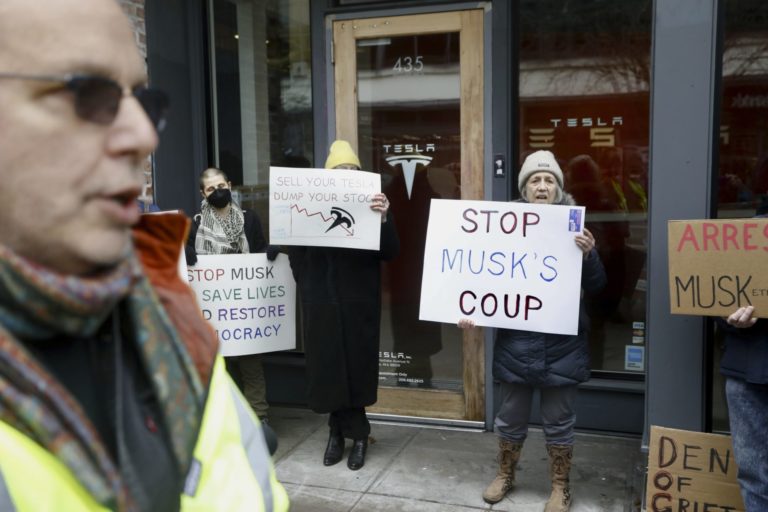
(Headline USA) Donald Trump is the president, but billionaire Elon Musk is the focus for thousands of Democratic activists launching a protest campaign this week to fight the Trump administration’s push to gut federal health, education and human services agencies.
Hundreds of protests are scheduled outside congressional offices and Tesla dealerships, with organizers hoping to send a pointed message to members of Congress who are on recess this week.
Already, the protests have turned into mob-like calls for violence. At a rally in DC, a reporter for conservative personality Laura Loomer spotted one protestor holding a sign featuring a picture of the Luigi cartoon character coupled with the slogan, “Deny, Defend, Depose”—a reference to alleged left-wing assassin, Luigi Mangione, and the words he wrote on the bullets he used to murder an insurance CEO.
EXCLUSIVE VIDEO:
Anti-Trump & anti-@elonmusk protesters in DC are calling for someone to “Luigi Mangione” Trump and Musk at a protest that was organized by the Women’s March called “NOT MY President- No Kings In America National Action”.@LoomerUnleashed captured this today. pic.twitter.com/J8Cuvxg8DJ
The backlash still hasn’t approached the intensity of protests during and after Trump’s first inauguration eight years ago. But a loose coalition of Democrats and progressives is coalescing around Musk’s rise as Trump’s top lieutenant and his purge of the federal bureaucracy.
“He’s a major weak link in the MAGA coalition,” Ezra Levin, co-founder of the progressive group Indivisible, said of Musk. “I can’t think of something that polls worse than the richest man in the world is coming after your Social Security check or your Meals on Wheels or your Head Start.”
Indivisible, which claims more than 1,300 local chapters nationwide, is encouraging members to protest at the offices of their members of Congress, regardless of political party. The group also offered a step-by-step guide for protesting at dealerships for Tesla, Musk’s electric vehicle company.
The memo encourages protesters to stay on sidewalks and public spaces and to avoid any actions that might directly interfere with business operations, such as blocking entrances or trespassing on private property. It also calls for Tesla protesters to stay on message: “This is about Musk’s political takeover, not Tesla, SpaceX, or X as companies.”
Vermont Sen. Bernie Sanders is launching what he’s calling “a national tour to fight oligarchy” with stops in working-class districts of Iowa and Nebraska this week.
🚨 Leftist “protestors” in DC today are OPENLY calling for the ass*ssinations of both Trump and Musk
This man is literally dragging around a Trump figure with a noose around its neck
Democratic National Committee Chair Ken Martin will hit the road for the first time as party leader as well. The newly elected DNC chair will travel to Pennsylvania, Texas, Illinois, Wisconsin and Missouri in the coming days to meet with local Democratic officials and labor leaders, spokesperson Hannah Muldavin said.
Like the protesters, Martin is expected to seize on Musk’s role. During a meeting with labor leaders in Pittsburgh, for example, he plans to highlight Musk’s recent focus on the Department of Labor, which could put “the integrity of data like the unemployment rate and inflation rate at risk, which is important for a stable U.S. economy and, by extension, working people,” Muldavin said.
Aware of the intense displeasure from their party’s base, many House Democrats plan to be proactive.
The House Democratic Policy and Communications Committee issued a memo ahead of the recess instructing Democrats to embrace “nine days of visibility” and said it was essential for members to host one town hall, in-person or via telephone, and at least one community event that highlights the “devastating impacts” of Trump and Musk’s actions.
The wave of protests comes at a critical moment as fractured Democrats struggle to stop the Republican president’s purge of the federal bureaucracy, which features thousands of layoffs inside departments focused on public health, education, veterans affairs and human services, among others.
Firings in recent days at the Department of Veterans Affairs include researchers working on cancer treatment, opioid addiction, prosthetics and burn pit exposure, according to U.S. Sen. Patty Murray, a Democrat from Washington state. The cuts also include more than 5,000 employees at the Department of Health and Human Services and roughly one-tenth of the workforce at the Centers for Disease Control and Prevention.
In some cases, Musk’s team is trying — with Trump’s blessing but without congressional approval — to shutter entire agencies, including the U.S. Agency for International Development, the Department of Education and the U.S. Consumer Financial Protection Bureau.
Trump has defended the cuts as necessary to eliminate waste and fraud. And he has praised Musk’s work with his Department of Government Efficiency, or DOGE, saying it has found “shocking” evidence of wasteful spending. He signed an executive order expanding Musk’s influence.
Musk, meanwhile, has defended the swift and extensive cuts he’s pushing across the federal government while acknowledging there have been mistakes.
Democrats in Congress condemn the moves as dangerous, but without control of either chamber of Congress, there is little they can do to stop the Trump administration aside from turning to the courts. Still, three of the nation’s largest progressive groups — Indivisible, MoveOn and the Working Families Party — are coordinating this week’s protests to send a clear message to elected officials in both major political parties that they must do more.
(The Center Square) – More than 60 Chinese Communist Party-related cases of espionage and acts of transnational repression have been reported in 20 states according to a new report published by the U.S. House Committee on Homeland Security.
That’s in addition to 224 reported incidents of Chinese espionage directed at the U.S. between 2000 and 2023, according to the report. Examples include transmission of sensitive military information to the People’s Republic of China (PRC), theft of U.S. trade secrets to benefit the PRC, transnational repression schemes to target PRC dissidents and obstruction of justice.
The Department of Justice has prosecuted Chinese espionage cases in Alabama, Arkansas, California, District or Columbia, Florida, Georgia, Hawaii, Illinois, Indiana, Kentucky, Maryland, Massachusetts, Michigan, Missouri, New Jersey, New York, Ohio, Pennsylvania, Tennessee and Washington, according to the report.
Over the past four years, there have been more than 60 CCP-related espionage cases in the United States, including: ❌ Transmission of sensitive military info to the PRC ❌ Stealing of trade secrets to benefit the PRC ❌ Transnational repression schemes to target PRC dissidents pic.twitter.com/8PbFG52mYS
Outgoing FBI Director Christopher Wray’s parting warning to Americans was that China remains one of the greatest threats to U.S. national security, a warning he consistently issued.
“The greatest long-term threat facing our country, in my view, is represented by the People’s Republic of China, the Chinese government, which I consider to be the defining threat of our generation,” he said, The Center Square reported.
The DOJ says it opens new cases to counter PRC intelligence operations roughly every 12 hours. Of the espionage cases it’s prosecuted since 2018, it says 80% allege the PRC would benefit; 60% of trade secret theft cases are linked to China.
“The PRC has gained significant ground in its information warfare on American soil over the past four years,” Committee Chairman Rep. Mark Green, R-TN, said.
“If you think the U.S. military and our government are the only targets of the Chinese Communist Party, think again. The shadow of Beijing’s malign influence falls upon American businesses, university campuses, and the critical infrastructure we rely on – not to mention those on U.S. soil who dare to speak out against the CCP. Thankfully, the Trump administration has put Beijing on notice; the days of freely undermining our sovereignty are over.”
The DOJ lists examples of indictments of Chinese nationals conspiring to and committing economic espionage and theft of trade secrets going back to 2018.
The House report cites more recent DOJ examples, including one from this month of a Chinese national who was indicted for allegedly stealing AI secrets from Google.
Last December, a Chinese national and resident of New York City pleaded guilty to conspiring to act as an illegal agent for the PRC by opening a PRC police station in lower Manhattan “to further the nefarious and repressive aims of the PRC in direct violation of American sovereignty,” according to the DOJ. The DOJ took action after a nonprofit organization exposed PRC police stations illegally operating in major cities nationwide and worldwide, The Center Square reported.
Another DOJ case from last December involves a Chinese national and lawful permanent resident of California who was arrested for flying a drone over Vandenberg Space Force Base and taking photographs. He was arrested for violating national defense airspace prior to boarding a flight to China.
Another example involves a Chinese national illegally living in the U.S. who was arrested for allegedly shipping weapons and ammunition to North Korea, The Center Square reported.
Others include a PRC spy arrested in California who worked for a state lawmaker and Chinese operatives arrested in Guam near a U.S. military installation on the same day as a live ballistic missile interception test, The Center Square reported.
The House report also cites additional cases from last December, including a PRC national sentenced to 24 months in prison for conspiring to send trade secrets that belonged to a U.S.-based electric vehicle company; and a Chinese national and U.S. legal permanent resident who was charged with conspiring to export defense-related technical data to the PRC and unlawfully supplying the Pentagon with Chinese-made rare earth magnets for aviation systems and military items, the report notes.
The increased PRC threats arose as the greatest number of Chinese nationals illegally entered the U.S. in recorded history under the Biden administration – more than 176,000 nationwide, The Center Square first reported.
(Clint Siegner, Money Metals News Service) Ayn Rand thought a lot about the philosophy of money. She understood gold as money functioned beyond providing safe haven, a store of value, and a medium of exchange. It has moral and cultural implications. People refer to it as “honest money” for a reason.
Below is an excerpt from Francisco’s money speech in the novel Atlas Shrugged. It would be wonderful if the entire speech were read and understood widely. As American taxpayers wake up to how badly officials have treated their money, Rand’s words are timely:
“Whenever destroyers appear among men, they start by destroying money, for money is men’s protection and the base of a moral existence.
Destroyers seize gold and leave to its owners a counterfeit pile of paper. This kills all objective standards and delivers men into the arbitrary power of an arbitrary setter of values.
Gold was an objective value, an equivalent of wealth produced. Paper is a mortgage on wealth that does not exist, backed by a gun aimed at those who are expected to produce it.”
Most Americans, particularly those in Washington, DC, have never considered the moral implications of our current monetary system. They aren’t good.
Money and those who earn it should garner more respect than they do today – especially among bureaucrats and politicians.
This respect was once commonplace. The dollar used to be as “good as gold.”
People proudly traded their labor and invested their capital in exchange for something real, beautiful, scarce, and valuable.
Their time and effort were precious, and they exchanged them for something equally as precious – gold (and silver) dollars.
Now, Americans exchange time and effort for fiat dollars, which get closer to their true value of zero every year. And they shoulder a portion of the perpetual servitude inherent in a system of debt-based money, income taxation, and unlimited government.
The rest of that burden will be shouldered by future generations when they inherit the paper IOU money, the mountain of debt, and the corrupt system backing it all, instead of gold.
What should we expect when so much money is simply borrowed into existence?
Americans have mostly stood by as the national debt exploded to $36 trillion. Would they have allowed that if all the borrowing had to be repaid with money which could not be printed and had to be earned?
Should we be surprised when bureaucrats, with no vested interest in the outcomes, treat the billions of borrowed and printed dollars like monopoly money?
Politicians and bureaucrats spent a lot less on boondoggles when dollars were backed by gold. That is no accident. Those dollars were hard to come by, even in government.
At one time, printing and borrowing was not an easy option for politicians. And few had the temerity to attempt a tax increase. Citizens would never have stood for it – handing over their precious coins to be spent on such nonsense.
If Americans want lasting honesty in Washington, DC, reinstituting honest money will have to be part of the answer.
Clint Siegner is a Director at Money Metals Exchange, a precious metals dealer recently named “Best in the USA” by an independent global ratings group. A graduate of Linfield College in Oregon, Siegner puts his experience in business management along with his passion for personal liberty, limited government, and honest money into the development of Money Metals’ brand and reach. This includes writing extensively on the bullion markets and their intersection with policy and world affairs.
(Money Metals News Service) In a recent episode of the Money Metals podcast, host Mike Maharrey sat down with financial analyst Greg Weldon to discuss the state of global markets, gold’s record-breaking rally, and the looming debt crisis threatening economic stability.
Weldon, a veteran trader and macroeconomic expert, shared critical insights into gold, inflation, government debt, and what investors should expect moving into 2025.
(Interview Starts Around 6:34 Mark)
Who is Greg Weldon? A Veteran in Global Markets
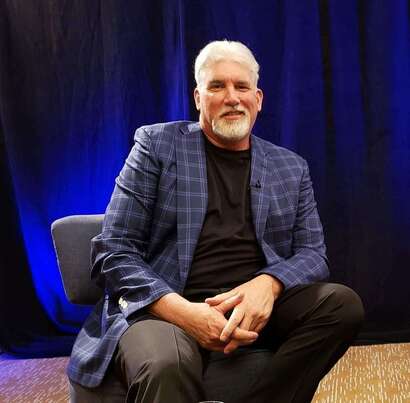
Greg T. Weldon
Greg T. Weldon is a highly respected figure in financial markets, with decades of experience spanning multiple sectors. His career has included roles as a floor trader, hedge fund manager, commodity trading advisor, institutional broker, and portfolio manager. As a financial investor, his deep understanding of macroeconomic trends has made him a sought-after analyst, particularly in commodities, currencies, and interest rate markets.
As the founder of Weldon Financial, he provides high-level market research for hedge funds, institutional investors, and individual traders. His analysis goes beyond surface-level headlines, digging into economic data and global monetary policy to uncover the forces shaping financial markets. Weldon is also a published author, having accurately forecasted major financial crises, including the 2008 recession, in his book Gold Trading Boot Camp. His ability to recognize trends before they become mainstream narratives has cemented his reputation as a leading voice in macroeconomic forecasting.
With this expertise, Weldon offers a unique perspective on today’s economic challenges, particularly in gold, inflation, and government debt. His insights are invaluable for investors looking to navigate the uncertain financial landscape ahead.
Gold’s Meteoric Rise: What’s Driving the Rally?
Gold has surged past $2,900 per ounce, breaking multiple record highs. The mainstream narrative suggests that tariffs are fueling safe-haven demand, but Weldon argues that deeper structural forces are at play. While trade wars and economic tensions certainly contribute to market jitters, the bigger picture reveals a global shift away from reliance on the U.S. dollar.
One major driver of gold’s ascent is the trend of de-dollarization. Many central banks, particularly those aligned with BRICS nations, are actively reducing their holdings of U.S. Treasuries and accumulating gold. This shift is part of an effort to establish alternative trade currencies backed in part by gold, challenging the dominance of the dollar in global transactions. Additionally, Weldon highlights the massive outflow of physical gold from London bullion banks, indicating a growing preference for direct possession of metal rather than paper contracts. Reports from sources like Bloomberg even suggest that gold and silver bars are arriving in bulk shipments at U.S. airports, further underscoring the demand for tangible assets.
A crucial distinction in this gold rally is that it has not been fueled by speculative investment. Unlike previous surges where hedge funds and retail investors piled into gold-backed ETFs, this time, the demand is being driven primarily by sovereign institutions and central banks. U.S. investors have actually been net sellers of gold ETFs, with outflows totaling $3.2 billion in 2023. Weldon warns that gold’s true breakout will come when the U.S. dollar weakens—an inevitable scenario given the nation’s fiscal trajectory.
The U.S. Debt Crisis: A Black Hole of No Return
Perhaps the most alarming part of the discussion centered on the unsustainable trajectory of U.S. debt. Weldon describes the current situation as a “macro event horizon,” comparing it to a black hole from which there is no escape. The problem, he explains, is that the U.S. now requires $1.86 in new debt to generate just $1 of GDP growth. This debt dependency has reached a critical threshold where the economy can no longer grow without continuously expanding the money supply.
Government debt has ballooned to $36 trillion, while household debt sits at a staggering $18 trillion. The consumer debt crisis is just as severe, with credit card debt reaching an all-time high of $1.4 trillion—far outpacing the total personal savings of just $980 billion. This gap highlights the financial strain facing American households, as more people rely on credit to maintain their standard of living.
One of the most concerning shifts has been in consumer spending versus disposable income. Historically, Americans earned significantly more than they spent, maintaining a healthy buffer for financial security. However, for the first time in modern history, this ratio has flipped.
Today, Americans are spending $20.4 trillion annually while earning just $17.7 trillion—a stark reversal from the surpluses seen in past decades. This means that consumer spending is now being propped up by debt rather than income growth, a dynamic that is ultimately unsustainable.
Federal Reserve’s Tightrope Act: A Losing Game?
Despite the Federal Reserve’s public stance on maintaining high interest rates to combat inflation, Weldon argues that their actual policies tell a different story. While officials claim to be keeping rates “higher for longer,” the Fed has already cut interest rates by an effective 1% when considering its monetary interventions. At the same time, money supply growth, which had briefly contracted, is once again rising—suggesting a return to accommodative policies.
This creates what Weldon describes as a “Three-Card Monte” scenario, where the Fed simultaneously presents conflicting narratives. One side of the policy equation suggests tight monetary conditions through interest rate hikes, while another side—through increased liquidity injections—points to a more dovish stance. The result is market confusion, with many investors unsure of the Fed’s real intentions.
The biggest risk, according to Weldon, is that the economy reaches a point where the government has no choice but to resort to large-scale money printing. If economic conditions deteriorate to the point where financial markets collapse or consumer spending grinds to a halt, the Fed could be forced to intervene aggressively. In this scenario, inflation would spiral out of control, leading to a dramatic loss in purchasing power—potentially pushing the cost of basic goods, like a loaf of bread, to $50.
Stock Market Disconnect & Corporate Debt Bomb
While the stock market continues to rally, Weldon sees a glaring disconnect between economic fundamentals and stock valuations. He points to the S&P Retail Index (XRT), which has been breaking down relative to the broader market. This signals a weakening consumer sector, despite continued stock market gains. Additionally, corporate bankruptcies have now exceeded their 2020 pandemic levels, yet credit spreads—historically a measure of financial risk—remain unusually tight, suggesting that investors are underpricing the likelihood of economic distress.
One of Weldon’s biggest concerns is the artificial boost that AI-related stocks have provided to the market. While he acknowledges the long-term potential of artificial intelligence, he sees alarming similarities to the dot-com bubble of 2000. Companies like Nvidia have led a speculative frenzy, driving valuations to unsustainable levels. The danger, he warns, is that if market sentiment shifts, a wave of selling could trigger a significant stock market correction, wiping out a large portion of recent gains.
Silver & Copper: The Next Moves?
Silver has remained stuck in a historically high gold-silver ratio above 90, meaning it continues to be undervalued compared to gold. Weldon believes silver’s move will come, but only when broader market participation shifts beyond central banks to institutional and retail investors. He sees $32.50 per ounce as the critical breakout level. If silver can push past this resistance, it could see a rapid and explosive price surge.
Copper, meanwhile, has seen a strong rally in recent weeks, though its fundamentals remain clouded by economic uncertainty. Weldon remains cautiously bullish, pointing out that inventories have been steadily declining, signaling tightening supply. However, he warns that copper’s future price action will depend heavily on macroeconomic trends, particularly in industrial demand.
Final Thoughts: Preparing for What’s Coming
Weldon’s bottom-line message is clear: the current financial system is unsustainable, and investors must be prepared. Whether through gold, silver, commodities, or strategic market positioning, those who recognize these trends early will have a significant advantage.
For those seeking deeper insights, Weldon offers market research and specific investment recommendations through his service at WeldonOnline.com, and can be followed on Twitter at @WeldonLive. His research covers global stock indexes, bond markets, currencies, and commodities, providing investors with the tools needed to navigate the unfolding financial landscape.
As the world teeters on the edge of a debt spiral, one thing is becoming increasingly clear—gold is no longer just an asset; it is a necessity.
Key Questions & Answers
The following are the key questions from the Money Metals podcast with host Mike Maharrey interviewing financial analyst Greg Weldon:
What is driving gold’s record-breaking rally?
Gold recently surged past $2,900 per ounce, setting new all-time highs. While mainstream analysts attribute this rally primarily to safe-haven demand driven by tariffs, Greg Weldon believes the true catalyst is a deeper global shift away from reliance on the U.S. dollar. Many central banks, particularly those associated with BRICS nations, are moving to reduce their exposure to U.S. Treasuries and instead accumulate gold as a hedge against potential currency instability.
This de-dollarization effort is leading to a significant drain of physical gold from London bullion banks, as many nations are now opting to take direct possession of their reserves rather than holding them in Western vaults. Weldon cited reports of large shipments of gold and silver arriving in the U.S., underscoring the growing demand for tangible assets. Additionally, lease rates for gold have spiked to 12%, indicating a tightening supply. Unlike past gold rallies driven by speculative investment, this surge has been led by sovereign entities rather than hedge funds or retail investors. U.S. investors, in fact, have been net sellers of gold ETFs, with outflows of $3.2 billion in 2023. Weldon warns that the real breakout in gold’s price will come when the U.S. dollar begins to weaken—a shift he sees as inevitable given the country’s worsening fiscal position.
How severe is the U.S. debt crisis, and what does it mean for the economy?
Weldon describes the current U.S. debt situation as a “macro event horizon,” likening it to a black hole from which there is no escape. The fundamental problem, he explains, is that the U.S. now requires $1.86 in new debt to generate just $1 of GDP growth. This level of debt dependency has created a vicious cycle where economic expansion is only possible through ever-increasing borrowing.
Government debt has skyrocketed to $36 trillion, while household debt sits at an alarming $18 trillion. Consumers are also struggling under unprecedented levels of credit card debt, which now exceeds $1.4 trillion—far surpassing total personal savings of just $980 billion. For the first time in modern history, Americans are spending more than they earn. The ratio of consumer spending to disposable income has flipped, with annual expenditures of $20.4 trillion outpacing total earnings of $17.7 trillion.
This debt-fueled economy is unsustainable, according to Weldon. He warns that if this trajectory continues, the Federal Reserve will eventually be forced to intervene with aggressive monetary easing, leading to severe inflation and a dramatic loss of purchasing power.
Is the Federal Reserve tightening or easing?
Although the Federal Reserve publicly maintains a stance of keeping interest rates “higher for longer” to combat inflation, Weldon argues that their actual policy actions tell a different story. While officials claim to be committed to restrictive monetary policy, the Fed has already effectively cut interest rates by 1% when considering its various interventions. Additionally, money supply growth, which had been contracting, is now expanding again.
Weldon describes the Fed’s strategy as a “Three-Card Monte” game, where different parts of its policy framework send mixed signals. On one hand, rate policy remains elevated, which gives the appearance of restraint. On the other hand, Quantitative Tightening (QT) continues, though at a slower pace. Meanwhile, money supply expansion suggests that liquidity is actually being injected into the system. This contradictory approach confuses investors, as the Fed appears to be both tightening and easing simultaneously.
The most significant danger, according to Weldon, is that the economy could reach a crisis point where the government is forced into full-scale money printing. If financial markets experience severe stress or consumer spending collapses, the Fed would likely step in with extreme measures, leading to an inflationary spiral that could push the cost of basic goods, such as a loaf of bread, to $50.
Why is there a disconnect between the stock market and economic fundamentals?
Despite mounting economic risks, the stock market continues to rally. Weldon believes this disconnect between Wall Street and Main Street is unsustainable and that a correction is inevitable. He points to the S&P Retail Index (XRT), which has broken down relative to the broader market. This signals a weakening consumer sector, even as stock prices remain elevated.
Adding to the concerns, corporate bankruptcies have now surpassed their 2020 pandemic levels. Despite this, credit spreads—historically an indicator of financial risk—remain tight, suggesting that investors are failing to account for potential economic distress.
Weldon also sees an alarming parallel between today’s AI-driven stock boom and the dot-com bubble of 2000. He acknowledges the long-term potential of artificial intelligence but warns that stocks like Nvidia have been propelled to unsustainable valuations. If sentiment shifts, a wave of selling could trigger a significant stock market correction, wiping out a large portion of recent gains.
Will silver finally catch up to gold’s rally?
Silver has remained undervalued relative to gold, with the gold-silver ratio still hovering above 90—far above historical norms. While many analysts expect silver to eventually catch up, Weldon argues that the metal’s price movement has been constrained by the fact that central banks, which have been driving the gold rally, do not buy silver.
That being said, Weldon remains optimistic about silver’s potential. He believes that once broader investor participation increases, silver could experience a rapid surge. He identifies $32.50 per ounce as a critical breakout level. If silver can push past this resistance, he expects an explosive rally to follow.
Another factor to watch is the performance of silver mining stocks. Companies like Pan American Silver, Mag Silver, and Fortuna Silver Mines have shown strength recently, which Weldon sees as a bullish indicator. Historically, mining stocks tend to move ahead of the metal itself, suggesting that silver’s next big run could be on the horizon.
Is copper signaling a shift in the metals market?
Copper has experienced a strong rally in recent weeks, but Weldon warns that it remains in a volatile trading environment. Unlike gold and silver, which are driven primarily by monetary factors, copper is more closely tied to industrial demand. This makes it particularly sensitive to macroeconomic conditions.
One of the key trends Weldon is watching is the decline in copper inventories. While a sharp increase in stockpiles earlier in the year temporarily pushed prices down, recent data shows that inventories are once again falling. This suggests that supply is tightening, which could provide further support for copper prices.
Despite his generally bullish stance, Weldon remains cautious due to the broader economic uncertainty. He notes that copper has yet to outperform the industrial sector of the stock market, which is often a warning sign. If the global economy slows, copper demand could weaken, making its rally short-lived.
What can investors do to protect themselves from financial instability?
Weldon’s primary message to investors is that the current financial system is unsustainable, and those who recognize the warning signs early will be best positioned to protect their wealth. He sees gold as a crucial hedge against economic instability and believes that silver, copper, and other commodities can also play a role in preserving purchasing power.
For those looking for deeper insights, Weldon offers extensive market research through Weldon Financial, where he provides analysis on global stock indexes, bond markets, currencies, and commodities. His work is followed by major hedge funds and institutional investors, but he also provides guidance for individual traders and self-directed investors.
As the global economy edges closer to a potential financial crisis, Weldon’s key takeaway is clear: gold is not just an asset—it is a necessity.
(Mike Maharrey, Money Metals News Service) Christmas 2024 was brought to you by Visa, Mastercard, et al. Was this the last gasp of an American consumer buried under mountains of debt?
Retail sales were strong in December (up 0.7 percent). Economists and pundits lauded the “strength” of American consumers and their willingness to spend for the holidays. But based on the December consumer credit report, much of that spending was put on credit cards.
Americans are now buried under $5.15 trillion in consumer debt.
The Federal Reserve consumer debt figures include credit card debt, student loans, and auto loans but do not factor in mortgage debt. When you include mortgages, U.S. households are buried under a record level of debt. As of the end of 2024, total household debt stood at $18.4 trillion.
Revolving credit, primarily made up of credit card balances, grew by $18 billion in December, a 20.2 percent increase. This came on the heels of a big decrease in revolving credit in November. It appears Americans paid down credit card debt in November only to run it back up again for the holidays.
Americans currently owe $1.38 trillion in revolving debt.
The double whammy of rising debt and interest rates exacerbates the debt problem. The average annual percentage rate (APR) currently stands at 20.10 percent, with some companies charging rates as high as 28 percent. That’s only slightly down from the record high of 20.79 percent set in August.
Rates aren’t coming down much even with Federal Reserve rate cuts. According to an ABC News report, despite a full percentage point in rate cuts, credit card companies are charging a higher margin “to weather default risk, cover overhead costs and recoup profits, experts added.”
“Credit card rates are high, and they’re staying high,” Bankrate analyst Ted Rossman told ABC News.
The big jump in credit card spending broke a recent trend for declining credit card use, often the prelude to a recession. However, there is some indication December spending was an anomaly. Retail sales cratered in January, falling by the largest amount in nearly two years.
Meanwhile, according to the New York Fed, “Aggregate delinquency rates ticked up 0.1 percentage point (ppt) from the previous quarter to 3.6 percent of outstanding debt in some stage of delinquency.”
Subprime credit card borrowers are struggling the most, with delinquency rates nudging upward by about 5.6 percent since the Federal Reserve began raising rates to battle price inflation.
Despite strong retail spending in December, the bigger picture reveals a consumer under stress.
Non-revolving debt, primarily reflecting outstanding auto loans, student loans, and loans for other big-ticket durable goods, increased by 5.8 percent in December, also breaking a trend. Non-revolving debt rose at a relatively tepid pace of under 2 percent for most of the year as consumers cut back on big-ticket spending to cover the increasing costs of day-to-day necessities.
We will have to wait for the January data to see if the Christmas spending was a one-off last-gasp spending spree, or if Americans still have some space left under their credit card limits. Regardless, credit cards do have a limit. An economy run on Mastercard and Vise simply isn’t sustainable.
Mike Maharrey is a journalist and market analyst for MoneyMetals.com with over a decade of experience in precious metals. He holds a BS in accounting from the University of Kentucky and a BA in journalism from the University of South Florida.
(Ken Silva, Headline USA) The Trump administration may have secured the borders, but its deportation numbers are leaving many MAGA diehards wanting.
According to a Sunday report in the Washington Post, the U.S. Immigration and Customs Enforcement’s daily arrests declined from about 800 per day in late January to fewer than 600 during the first 13 days of February. Such numbers are well below the Trump administration’s goal of 1,200 to 1,500 arrests per day, the Post noted.
Deportation Update:
ICE arrests have collapsed to <600 per day in February, or ~220k per year. Not counting the hundreds of illegals they are releasing weekly.
The admin says it stopped publishing daily numbers to “conserve resources.” Sure. pic.twitter.com/gZsUyn87JZ
According to Trump’s “border czar,” Tom Homan, some 14,000 immigrants have been arrested in Trump’s first three weeks. By contrast, the Biden administration arrested more than 21,000 unauthorized immigrants last November—though, again, government was also allowing illegals to flood into the country unabated during that time.
What could explain the discrepancy? According to Homan, there aren’t as many illegals being caught because few of them are even trying to cross the border. Homan reportedly said last week that illegal border crossings have dropped 92% since Jan. 20. Homan reiterated that point Monday morning on Twitter/X.
In the last 24 hours the US Border Patrol has encountered a total of 229 aliens across the entire southwest border. That is down from a high of over 11,000 a day under Biden. I started as a Border Patrol Agent in 1984 and I don’t remember the numbers ever being that low.…
“In the last 24 hours the US Border Patrol has encountered a total of 229 aliens across the entire southwest border. That is down from a high of over 11,000 a day under Biden. I started as a Border Patrol Agent in 1984 and I don’t remember the numbers ever being that low,” he said. “President Trump promised a secure border and he is delivering.”
Further complicating the Trump administration’s deportation drive is the allegedly illegal activity from FBI agents assigned to help the cause.
Last week, Key details of the “large scale” ICE-led operations were leaked to the Los Angeles Times and subsequently published, exposing internal plans.
While the LA Times did not specify who leaked the information, it quoted an anonymous “federal law enforcement” source who spoke on condition of anonymity “for fear of reprisals”—leading many, including those in the Trump administration, to suspect the FBI.
“The FBI is so corrupt,” DHS Secretary Kristi Noem said last week. “We will work with any and every agency to stop leaks and prosecute these crooked deep state agents to the fullest extent of the law.”
In any event, the Post reported that ICE has stopped publishing daily numbers, and will instead release the data on a monthly basis to “conserve resources.”
Meanwhile, Google is apparently misleading its users into thinking that Trump is carrying out a wave of deportations unlike anything ever seen before. According to the Guardian, Google search results is returning nearly decade-old cases when users search for news of mass immigration arrests.
Ken Silva is the editor of Headline USA. Follow him at x.com/jd_cashless.
(Mike Maharrey, Money Metals News Service) It’s clear that the Federal Reserve hasn’t won the inflation fight. With the CPI trending higher for four straight months, the markets aren’t pricing in another interest rate cut until September.
Isn’t a “higher for longer” interest rate environment bearish for gold?
The short answer is no because real interest rates are falling with price inflation on the upswing.
Why Do Higher Interest Rates Create Headwinds for Gold
Gold is a “non-yielding” asset, meaning it does not generate interest income or dividends. Its value is determined by price appreciation. Conventional wisdom is that investors turn to bonds and other yielding assets in a higher interest rate environment, creating headwinds for gold.
We saw this phenomenon play out when the Fed was hiking rates to battle price inflation a couple of years ago. Every time we got bad inflation data, gold sold off with the expectation of more rate increases.
But when the January CPI data came in higher than expected last week, gold’s price dip was short-lived, and it quickly recovered to $2,900. It appears that at least some investors have figured out that inflation isn’t going anywhere, and they need gold as an inflation hedge despite the higher interest rate environment.
Real Interest Rates Are Falling
There is another factor in play. With price inflation increasing, real interest rates are falling even as the Federal Reserve puts rate cuts on hold.
The real interest rate is simply the stated rate you see on the news adjusted for price inflation.
To calculate the real interest rate, you take the quoted interest rate and subtract CPI.
The Federal funds rate is currently set at 4.5 percent. When you factor in the CPI of 3 percent, the real rate is only 1.5 percent. (4.5-3=1.5). If the CPI moves to 3.5 percent and the Fed holds rates steady, the real interest rate will fall to 1.0 percent.
Note that in a low interest rate environment or if price inflation is particularly high, real interest rates can go negative.
For instance, if the Fed cut rates to 2 percent while the CPI remained at 3 percent, the real interest rate would be -1.0 percent.
Keep in mind that the CPI doesn’t tell the entire story of inflation. The government revised the CPI formula in the 1990s so that it understated the actual rise in prices. Based on the formula used in the 1970s, CPI is closer to double the official numbers. So, if the BLS was using the old formula, we’re looking at CPI closer to 6 percent. And using an honest formula, it would probably be worse than that.
This means that as price inflation creeps up, the opportunity cost of holding gold is dropping even if the Fed holds interest rates steady. (Opportunity cost refers to the interest you could have earned if you had bought a bond instead of a bar of gold.)
Will the Fed Hike Rates?
The Federal Reserve could counter falling real rates by pushing the federal funds rate higher. But so far, the central bank has given no indication that rate hikes are on the table. In fact, the consensus is that the Fed has merely put cuts on hold for the time being and will likely resume monetary easing in the fall.
Given the trajectory of price inflation and the fact that the central bank never did enough to slay the inflation dragon, the central bank probably should consider pushing rates higher to get price inflation under control.
Given the level of debt in the economy, coupled with all the malinvestments caused by well over a decade of artificially low interest rates, the economy can’t function even in a moderately tight interest rate environment. Simply put, the economy is addicted to easy money.
This is precisely why everybody is desperate for rate cuts, and the Fed delivered in December while simultaneously jawboning about caution and trying to dampen expectations of more rate cuts in 2025.
On the other hand, it’s clear that inflation remains stubbornly sticky.
“Extreme bond market agitation has put the Federal Reserve in a bind. It can either cool long-term inflation fears or acquiesce to President-elect Donald Trump’s complaints about interest rates being “far too high.” It can’t do both and will likely opt to tackle the former, potentially setting up a running verbal battle with the White House over the coming year.” [Emphasis added]
The Reuters report goes on to say, “The Fed has routinely stated that containing inflation expectations is one of its primary roles,” and it’s “hard to imagine” the central bank will ignore signs of revived price inflation.
They can say that now, but it becomes easier to “imagine” when the economy starts to crack under the weight of high interest rates.
Simply put, the Fed needs to simultaneously cut rates and keep rates higher.
Good luck with that.
The bottom line is that even with price inflation warming up and rate cuts on hold, it is highly unlikely that the central bank will start raising rates.
If they do start talking more rate hikes, this would likely cause headwinds for gold. But given the current environment, inflation is in control, and real rates are falling.
This is bullish for gold and likely contributing to the push toward $3,000 per ounce.
Mike Maharrey is a journalist and market analyst for MoneyMetals.com with over a decade of experience in precious metals. He holds a BS in accounting from the University of Kentucky and a BA in journalism from the University of South Florida.
(Ken Silva, Headline USA) In 2020, a photo of a portly FBI agent kneeling in support of the Black Lives Matter movement took the internet by storm—both for the ridiculous imagery, and the fact that the bureau was playing politics at a time when many of the country’s major cities were overrun by crime and violent demonstrators.
A few years later, that agent, Sarah Linden, was made assistant special agent in charge of the FBI’s Washington Field Office. And now, she’s in an even more powerful position: deputy assistant director of the FBI headquarters. She’s also in charge of Russian counterintelligence in the national security branch, according to the Washington Examiner.
“In other words, Linden is now the top U.S. counterspy against the Kremlin,” the Examiner reported Friday.
As absurd as Linden’s promotions may seem, she has a low bar to meet at the Russian counterintelligence division. A little over a year ago, the former head of the FBI’s New York counterintelligence division, Charles McGonigal, was sentenced to 50 months in prison for helping a Russian oligarch avoid U.S. sanctions.
McGonigal had been one of the key agents in the FBI’s politically motivated a baseless investigation into whether Trump colluded with Russia to steal the 2016 election.
“He was one of the first officials to learn that a Trump campaign official had bragged that the Russians had dirt on Hillary Clinton, sparking the investigation known as Operation Crossfire Hurricane,” Business Insider reported in September 2022.
“Later that year, FBI Director James Comey promoted McGonigal to oversee counterintelligence operations in New York.”
Ken Silva is the editor of Headline USA. Follow him at x.com/jd_cashless.