


Trump Fixed the Penny Problem But Now We Have a Nickel Problem

(Mike Maharrey, Money Metals News Service) My grandfather used to say, “Don’t take any wooden nickels.” The idiom basically meant, “Be careful! Don’t get cheated.”

Back in the day, small banks and merchants sometimes handed out novelty wooden nickels as promotional items. Of course, they had no value. You didn’t want to get tricked into taking a wooden nickel instead of real money.

Today, you could just as accurately say, “Don’t take any nickels.”

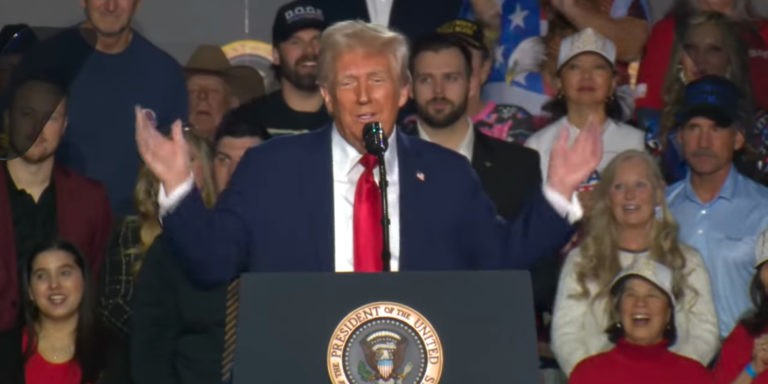
President Donald Trump recently announced the demise of the penny, directing the U.S. Mint to stop producing the 1-cent coin due to the cost. According to the Mint, it costs 3.69 cents to mint and distribute one penny.

But there’s still a problem – the nickel.

The Nickel Problem

By phasing out the penny, the Mint will need to produce more 5-cent coins. The problem is it costs more to make than it does a penny.

In fact, a “pro-penny” group called Americans for Common Cents argues that eliminating the penny will cost the government more than continuing to produce them.

“Without the penny, the volume of nickels in circulation would have to rise to fill the gap in small-value transactions. Far from saving money, eliminating the penny shifts and amplifies the financial burden.”

(Full disclosure: According to CNN, Americans for Common Cents is primarily funded by Artazn, the company that has the contract to supply banks used to mint pennies.)

Potential bias aside, Americans for Common Cents isn’t wrong about the cost of the nickel.

According to the most recent annual report produced by the U.S. Mint, it costs 13.8 cents to produce and distribute one nickel.

To cut costs, the Mint cut the number of nickels it produced last year by 86 percent. It churned out 202 million 5-cent coins, compared to 3.2 billion pennies.

Here’s the rub.

If the Mint must produce just 850,000 more nickels to fill the gap left by the penny, it will completely wipe out the savings promised by eliminating the 1-cent coin. According to calculations by the AP, if the Mint goes back up to making 1.4 million nickels a year, it will cost $78 million more than the cost of pennies it is no longer minting.

Americans for Common Cents claims it will have to produce 2 to 2.5 million more nickels to replace the penny.

Why Are Nickels So Expensive?

The higher cost is primarily due to the metal that goes into producing the coin. Nickels are formed of about 75 percent copper and 25 percent nickel.

Meanwhile, the “copper” penny now has very little copper.

In 1982, the mint removed most of the copper from the penny. Before that year, pennies were composed of 95 percent copper and 5 percent zinc. Due to rising copper costs (a result of inflation), the mint changed the composition to 97.5 percent zinc with 2.5 percent copper plating.

What Is the Government Doing to Your Money?

CNN notes that one of the reasons the U.S. Mint makes so many pennies is that they quickly fall out of circulation. People tend to throw them in a jar or a junk drawer. At stores, people often toss them in the “leave a penny, take a penny” dish. And by the way, you increasingly see nickels in those dishes.

An economist told CNN, “When people start leaving a monetary unit at the cash register for the next customer, the unit is too small to be useful.”

But why have nickels and pennies become “useless?”

Because the government is constantly devaluing your money.

Based on the CPI, an item that cost a nickel in 1970 costs about 41 cents today.

Keep in mind that the CPI doesn’t tell the entire story of inflation. The government revised the CPI formula in the 1990s so that it understated the actual rise in prices. Based on the formula used in the 1970s, CPI is closer to double the official numbers.

In other words, when somebody hands you a nickel today, it’s not worth much more than the wooden nickel my grandfather warned me about.

This is precisely why the government removed copper from the penny, and the nickel costs so much more to produce than it’s worth.

And, of course, the problem isn’t just with the penny and nickel. The government has devalued all your money.

Under the Coinage Act of 1965 signed by President Lyndon B. Johnson, the U.S. Treasury removed all the silver from dimes, quarters, and half-dollars. Instead, the government now mints coins from “composites, with faces of the same alloy used in our 5-cent piece that is bonded to a core of pure copper.”

Today, you will sometimes hear coins minted before 1965 referred to as “junk silver.”

In reality, we should call modern American coins junk.

In fact, it’s difficult to find pre-1965 silver coins in the wild. They have been driven out of circulation by Gresham’s law – bad money drives out good.

If you run across one of these old silver coins, hold on to it. A metal in a silver quarter is worth more than 23 times the coin’s face value.

The Money Problem

Removing silver and copper from U.S. coinage is the symptom of a bigger problem – government money printing.

The government and its central bank constantly expand the money supply. This is, by definition, inflation. More dollars in circulation means each dollar is worth less. We experience this phenomenon in the form of rising prices.

Of course, as each dollar becomes worth less, each fraction of a dollar becomes worth less – and eventually worthless.

Currency devaluation benefits the government because it allows it to borrow and spend far beyond what it could in a sound money system. This is precisely why President Franklin D. Roosevelt began the process of severing the dollar from the gold standard, and Richard Nixon cut the final tie in 1971.

When you boil it all down, we don’t really have a penny problem. We don’t have a nickel problem. We have a money problem.


Mike Maharrey is a journalist and market analyst for MoneyMetals.com with over a decade of experience in precious metals. He holds a BS in accounting from the University of Kentucky and a BA in journalism from the University of South Florida.

CIA Flying Drones over Mexico to Hunt for Fentanyl Labs

(Ken Silva, Headline USA) The New York Times reported Tuesday that the CIA is conducting “secret” drone flights over Mexico to hunt for fentanyl labs.

Citing unnamed sources, the Times reported that the covert drone program began under the Biden administration, but that Trump is taking it to the next level.

The Times report comes as the Trump administration promises to crack down on drug cartels, going so far as to contemplate invading Mexico. But for now, the CIA drones are simply collecting data that’s passed to Mexican authorities, according to the Times.

“The drones have proved adept at identifying labs, according to people with knowledge of the program. Fentanyl labs emit chemicals that make them easy to find from the air,” the Times reported.

“However, during the Biden administration, the Mexican government was slow to take action against labs identified by the Americans, although it did use the information to make arrests.”

The U.S. military is also flying drones around the border, but isn’t encroaching into sovereign Mexico territory as much as the CIA, the Times added.

The Trump administration is reportedly set to designate a half-dozen cartels as foreign terrorist organizations this week. If cooperation with the Mexican government fails to bring these organizations to heel, the U.S. could consider more drastic options, the Times reported.

“Former officials say they believe that the U.S. military and intelligence agencies are likely to increase training with Mexican authorities in the coming months. Conducting an airstrike on fentanyl labs would probably cause catastrophic fatalities, as they are often inside homes in urban areas,” the Times added.

“The possibility for violence also exists if the Mexican military or police move against the lab. But the purpose of providing the intelligence to Mexican authorities is not to kill cartel members, but instead to disable the labs.”

Ken Silva is the editor of Headline USA. Follow him at x.com/jd_cashless.

What You Need to Know About a Possible U.S. Gold Revaluation

(Jesse Colombo, Money Metals News Service) Since 1973, America’s gold has been officially valued at just $42 per troy ounce—but that may soon change.

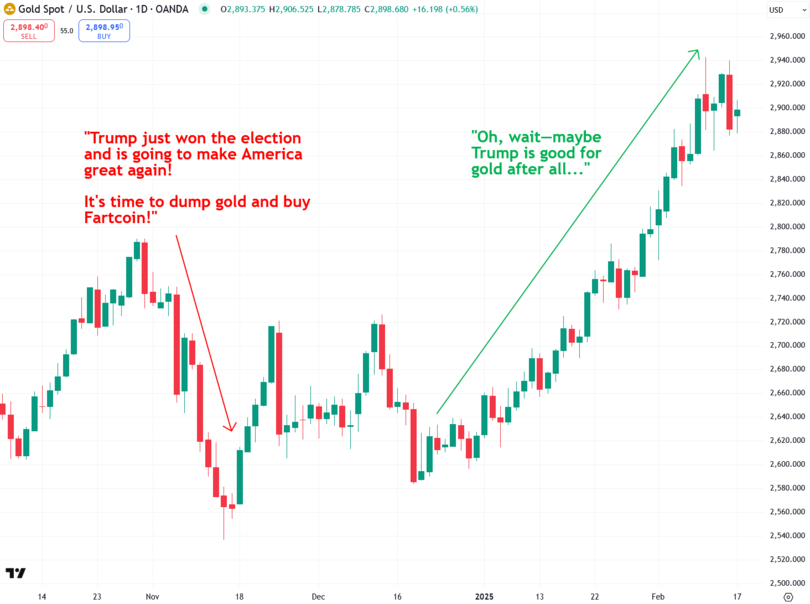
When Donald Trump won the U.S. presidential election on November 5th, gold and silver immediately plummeted—down 9% and 15%, respectively—as many investors soured on precious metals. They believed a Trump presidency and the promise of “Making America Great Again” signaled an era of prosperity, stability, and fiscal prudence, eliminating the need for crisis hedges like gold and silver.

Of course, I had been adamant that his victory was no reason to turn bearish on precious metals. I even pointed to his first term, during which gold soared an impressive 83%.

Following this mindset, they eagerly poured into the riskiest assets, chasing overinflated tech stocks and speculative cryptocurrencies like Bitcoin, Dogecoin, and even Fartcoin—a reckless move.

Yet, how wrong they were! Gold not only erased its election-related losses but has surged to a new record—now roughly $100 above its pre-election high in late October—while silver is close behind.

Gold and silver have surged since Trump took office for several key reasons, many of which I’ve covered extensively. These include the potential impact of tariffs on imported precious metals and a massive inflow of gold and silver into the U.S. ahead of those tariffs, which is draining London’s vaults. Additionally, soaring inflation expectations and mounting fears of a recession alongside persistent inflation have fueled concerns about stagflation—a scenario historically very bullish for precious metals.

I’m not going to lie—it’s a highly confusing and chaotic time, with countless crosscurrents and major developments as Trump rolls out his policies and reshapes the government.

Another potential reason for gold’s surge is emerging: the very real possibility that the Trump administration could revalue America’s gold—a move that aligns with its goal to “Make America Great Again.”

The U.S. federal government officially holds 8,133 metric tons of gold. What’s striking, however, is that since 1973, it has remained valued on the books at just $42 per troy ounce, giving it a paper worth of only about $11 billion.

If the official reserve figure is accurate, the U.S. holds the world’s largest gold stockpile by a wide margin, with Germany trailing in second place at 3,352 metric tons.

But here’s the thing: with gold now trading at $2,900 per ounce, revaluing America’s gold reserves to market prices would push its worth to approximately $760 billion—creating a staggering $749 billion windfall. This aligns with the February 3rd remarks by newly appointed Treasury Secretary Scott Bessent, who is known for his pro-gold stance and personal investments in the metal.

He stated that the government would “monetize the asset side of the U.S. balance sheet,” which essentially means revaluing the country’s gold reserves at a higher price.

This could allow the government to either sell some of its gold holdings or simply strengthen its financial position by increasing assets relative to debt, thereby reducing leverage.

I must emphasize that while revaluing America’s gold would benefit the country and makes perfect sense, the resulting $749 billion windfall would barely make a dent in our fiscal challenges.

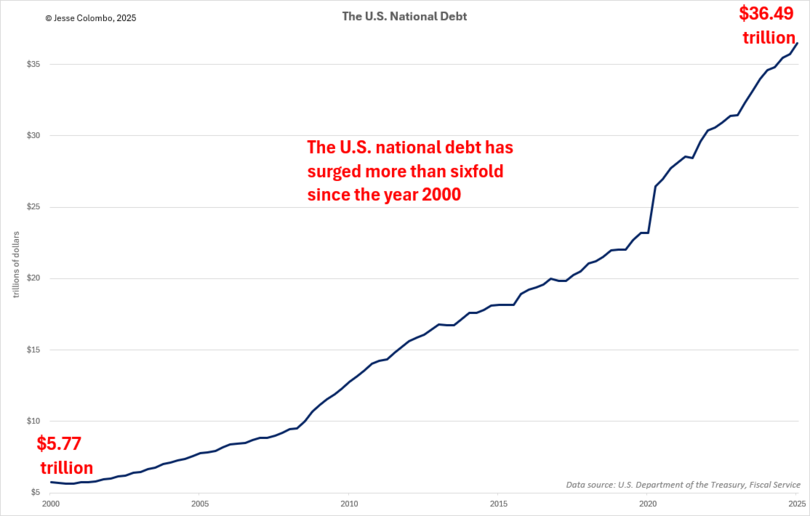
With the national debt now at $36.49 trillion—growing by roughly $1 trillion every 100 days—and unfunded obligations reaching approximately $73.2 trillion, this measure alone would be a mere drop in the bucket.

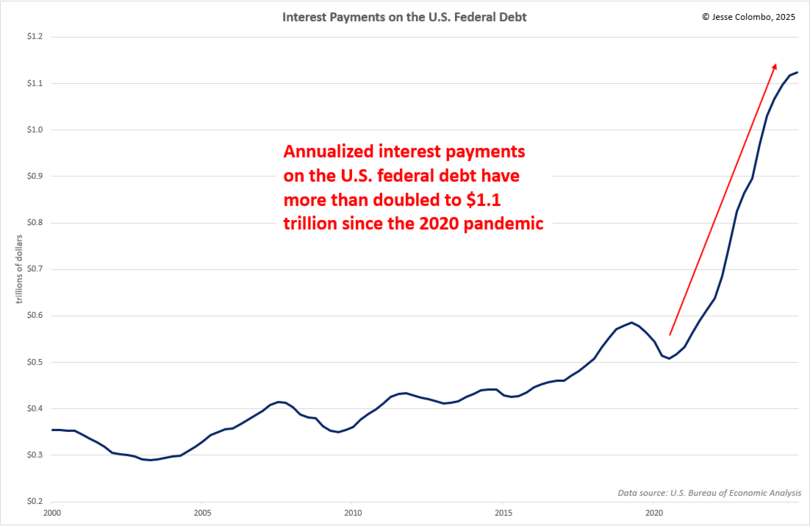
In addition, since the 2020 pandemic, America’s surging national debt, combined with rising interest rates, has more than doubled annual interest payments to over $1.1 trillion.

In 2024, gross interest on U.S. debt exceeded spending on defense, income security, health, veterans’ benefits, and even Medicare—making it the second-largest expense for the U.S. government, trailing only Social Security.

One theory gaining traction is that the U.S. could revalue its gold reserves to partially fund a sovereign wealth fund, which would include a stockpile of digital assets.

This idea has been championed by Wyoming Senator Cynthia Lummis, along with outspoken Bitcoin advocate and billionaire Michael Saylor. However, recent comments suggest that Bitcoin may play a smaller role in this digital asset portfolio than initially expected.

Instead, U.S.-founded digital assets like Solana, USDC, and Ripple’s XRP are likely to take center stage—a shift that has frustrated Bitcoin-only advocates.

I am personally horrified by—and strongly caution against—the prospect of selling America’s gold, an asset that has served as a reliable store of wealth for 6,000 years, in favor of cryptocurrencies.

Furthermore, cryptos have never caught on as actual currencies used for making real-world purchases as originally intended; instead, I see them as flimsy digital tokens propped up by the “greater fool theory” to justify their price.

Even the most established cryptocurrency—Bitcoin—has existed for only sixteen years, meaning it has yet to stand the test of time. America should not be allocating its resources to something so unproven.

Moreover, anyone can create a crypto token, leading to an ever-expanding supply. This makes them inherently cheap and flimsy compared to gold, which is truly scarce.

Moving along, if America is to revalue its gold, it’s crucial to first verify that it actually exists—something that isn’t necessarily a given. For decades, speculation has swirled over whether the U.S. Bullion Depository, commonly known as Fort Knox, along with other government vaults, truly holds the gold the government claims.

One of the last so-called “audits” of America’s gold reserves took place on September 23, 1974, when the U.S. Treasury briefly opened just one of Fort Knox’s 15 vaults, allowing politicians and reporters a two-hour photo-op with roughly 6% of the alleged holdings.

U.S. Bullion Depository at Fort Knox, Kentucky

For years, the precious metals community has called for an audit of U.S. gold reserves, only to be dismissed, ridiculed, and labeled as conspiracy theorists for merely questioning whether the gold exists in the quantities claimed.

However, with the Trump administration in the White House and the Department of Government Efficiency (DOGE), led by Elon Musk, uncovering rampant waste and fraud in government spending, the Overton Window has swung wide open for a long-overdue audit of America’s gold reserves.

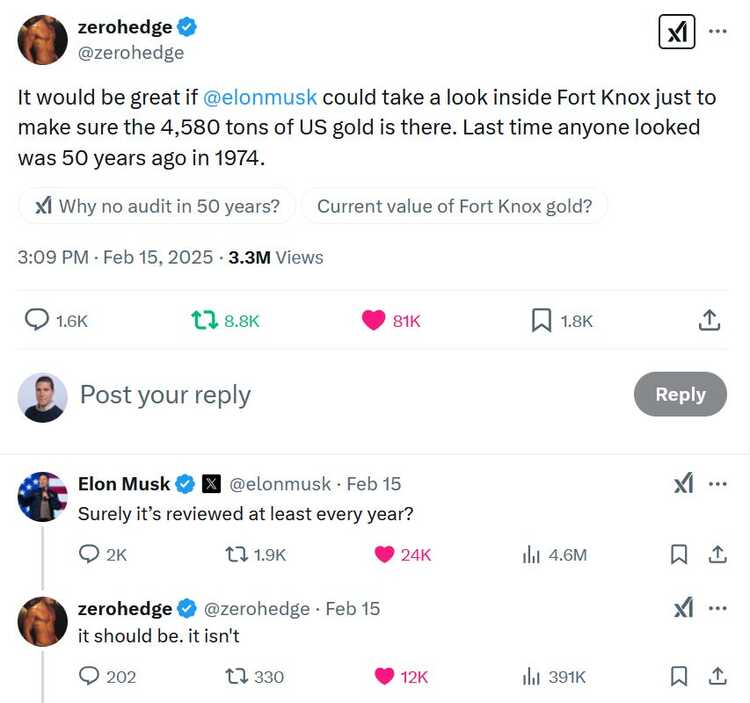
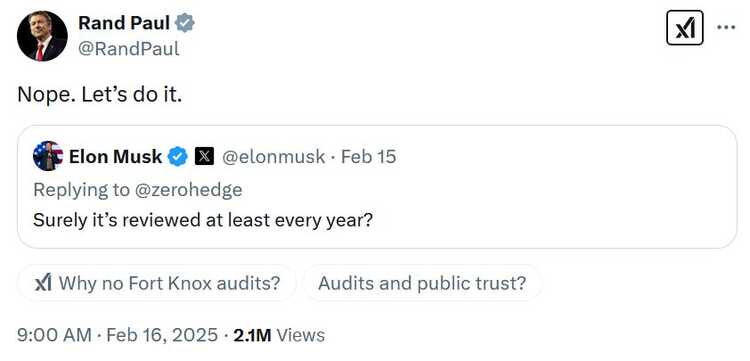
The push for an imminent audit of Fort Knox gained momentum on Saturday when the popular financial blog ZeroHedge—where I have been a long-time and frequent contributor— publicly called on Elon Musk via X to launch an audit and verify whether the U.S. gold reserves are truly there.

I was thrilled to see this unfold and fully supported the effort, reposting the entire exchange to my 174,000 followers. Many others in the community did the same, causing the post to go viral and sparking serious discussions about the need for a full audit.

Shortly after, Senator Rand Paul (R-KY) responded, expressing his support for the audit:

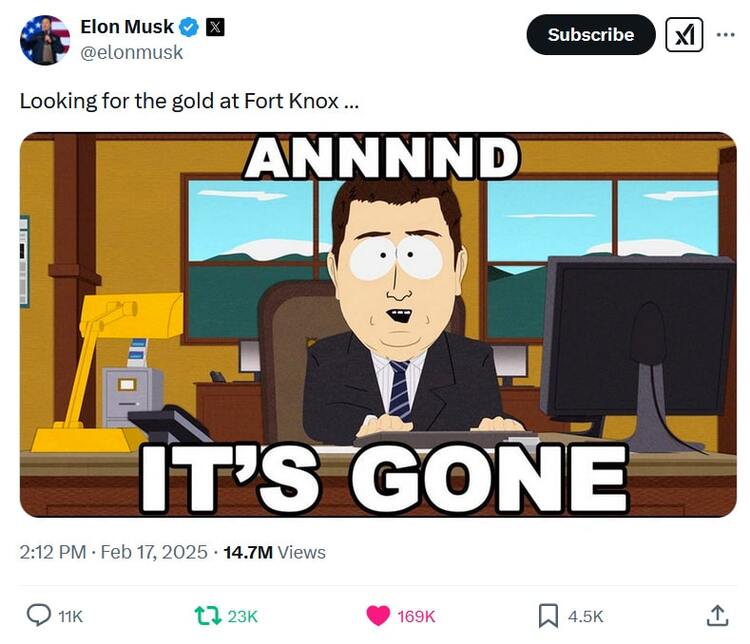
After decades of speculation, the precious metals community—along with concerned citizens and even Elon Musk—is now asking a critical question: What happens if the Fort Knox gold audit takes place and reveals that the reserves are missing or significantly lower than expected?

Then, a fascinating old clip from the 1996 documentary The Money Masters, produced by William T. Still, began circulating on X.

The clip suggested that the gold in Fort Knox had been stolen and made an intriguing claim: Ian Fleming, author of the James Bond series and alleged head of the UK’s MI5 Security Service, was aware of the theft.

According to the theory, Fleming embedded this revelation into his fiction as a warning that Fort Knox had been robbed of its gold.

Just a few hours ago, a new bet was launched on the betting market platform Polymarket, allowing people to wager on whether Fort Knox is indeed missing its gold.

So far, the odds imply only an 18% chance that the gold is gone, but as this saga unfolds, it will be worth watching—especially as we await the audit, assuming it actually takes place.

I’m not a forensic accountant, nor do I enjoy speculating about conspiracy theories that I can’t personally verify—and there are many in the gold and silver space. However, I have a deep distrust of the official narratives presented by the government, central banks, and similar institutions. So, if Fort Knox were missing some or all of its gold, I wouldn’t be so shocked. But that’s precisely why audits matter—to eliminate speculation and guesswork.

Regular audits of the U.S. gold reserves should have been conducted all along to dispel conspiracy theories, assuming they weren’t true. The fact that they weren’t raises serious questions.

What I do know for certain is that I fully support an audit of U.S. gold reserves, as it would strengthen fiscal transparency and improve confidence in both the nation’s financial integrity and the precious metals market.


Jesse Colombo is a financial analyst and investor writing on macro-economics and precious metals markets. Recognized by The Times of London, he has built a reputation for warning about economic bubbles and future financial crises. An advocate for free markets and sound money, Colombo was also named one of LinkedIn’s Top Voices in Economy & Finance. His Substack can be accessed here.

DOGE’s Next Target: the IRS

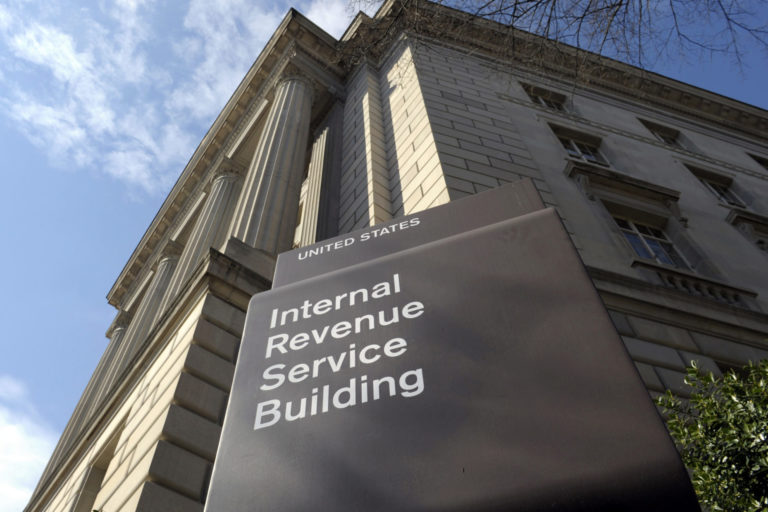
(Headline USA) Elon Musk’s Department of Government Efficiency is seeking access to taxpayer data at the IRS, two people familiar with the inner workings of the plan who were not authorized to discuss the matter publicly told The Associated Press on Monday.

If successful, Musk and his group would have access to millions of tightly controlled files that include taxpayer information, bank records and other sensitive records. The people who spoke to the AP and requested anonymity said DOGE is specifically seeking to access the IRS’ Integrated Data Retrieval System, which enables employees “to have instantaneous visual access to certain taxpayer accounts,” according to the IRS website.

Harrison Fields, a White House spokesman, said in an emailed statement that “waste, fraud, and abuse have been deeply entrenched in our broken system for far too long. It takes direct access to the system to identify and fix it.”

“DOGE will continue to shine a light on the fraud they uncover as the American people deserve to know what their government has been spending their hard earned tax dollars on,” he said.

Democratic lawmakers are trying to fight against DOGE plans to access IRS data. Sens. Ron Wyden, D-Ore., and Elizabeth Warren, D-Mass., sent a letter Monday to acting IRS Commissioner Douglas O’Donnell, demanding copies of any memos that would grant IRS system access to Musk or DOGE. The senators are also seeking justifications for DOGE efforts to inspect tax returns and private bank records.

Jan. 27 was the official start date of the 2025 tax season, and the IRS expects more than 140 million tax returns to be filed by the April 15 deadline.

The Washington Post on Sunday first reported on DOGE’s plans to access taxpayer data.

The news comes as the IRS plans to lay off thousands of probationary workers in the middle of tax season, according to two sources familiar with the agency’s plans who were unauthorized to discuss them publicly. Cuts could happen as soon as this week.

Previously, IRS employees involved in the 2025 tax season were told they will not be allowed to accept a buyout offerfrom the Trump administration until after the taxpayer filing deadline, according to a letter sent recently to IRS employees.

Additionally, attorneys general from 14 states challenged the authority of DOGE to access sensitive government data housed at Treasury and exercise “virtually unchecked power” in a lawsuit filed Thursday.

The lawsuit, filed in federal court in Washington, says the actions taken by Musk at the helm of DOGE can only be taken by a nominated and Senate-confirmed official. It cites constitutional provisions that delineate the powers of Congress and the president.

A new account on Musk’s social media site X, called DOGE IRS, says, “DOGE is seeking help from the public!” The account asks users to reach out “with insights on finding and fixing waste, fraud and abuse relating to the Internal Revenue Service.”

Adapted from reporting by the Associated Press

Trump’s Ethnic Cleansing Plan for Gaza Will Start ‘Within Weeks,’ Israeli Minister Claims

(Dave DeCamp, Antiwar.com) Over the weekend, Israeli Finance Minister Bezalel Smotrich claimed a plan to forcibly displace Palestinians from Gaza in line with President Trump’s plans for the territory would begin in the coming weeks.

“Preparations have started amongst our teams, alongside teams of the US President Donald Trump,” Smotrich said on Saturday, according to Middle East Eye.

Smotrich said the plan requires two components: “One is to find countries that can receive people, and two, it’s a huge logistical operation to take such a large number of people out of here.”

Trump has repeatedly called for Palestinians to leave Gaza permanently, which would require an ethnic cleansing campaign. Palestinians have rejected Trump’s plan, which also involves the US “taking over” Gaza, but Smotrich claimed they would want to leave.

“I think most of them will want to,” Smotrich said. “It is a process that is going to start in the coming weeks, even if it starts at a slower pace, bit by bit it will gather speed and intensify.”

Smotrich cited the massive destruction Israel has inflicted on Gaza as a reason why the Palestinians would want to leave and said it would only get worse after a “return to fighting,” signaling he expects Israel to restart its genocidal war.

He has previously said Prime Minister Benjamin Netanyahu gave him a guarantee that the bombing campaign and siege would resume after the first phase of the current hostage and ceasefire deal.

Arab countries have strongly rejected Trump’s proposal for Gaza and are calling for a plan that allows Palestinians to remain in the territory during reconstruction.

This article originally appeared at Antiwar.com.

Israel Calls on America to ‘Finish the Job’ against Iran

(Dave DeCamp, Antiwar.com) The Iranian Foreign Ministry on Monday hit back at Israeli Prime Minister Benjamin Netanyahu for threatening that the US and Israel will “finish the job” against Iran.

“Threatening others is both a gross violation of international law and the United Nations Charter,” said Iranian Foreign Ministry spokesman Esmail Baghaei. He added that the US and Israel could “not do a damn thing” against Iran.

Referring to President Trump’s calls for a deal with Iran, Baghaei said, “You cannot threaten Iran on one hand and claim to support dialogue on the other hand.” Trump has also increased sanctions on Iran by reinstating his so-called “maximum pressure campaign.”

Netanyahu made the threat against Iran while hosting US Secretary of State Marco Rubio in Jerusalem on Sunday.

“Over the last 16 months, Israel has dealt a mighty blow to Iran’s terror axis. Under the strong leadership of President Trump and with your unflinching support, I have no doubt that we can and will finish the job,” Netanyahu said.

Rubio also took aim at Iran in his remarks to the press, claiming the Islamic Republic was the “single greatest source of instability in the region.”

The threat from Netanyahu came after a report from The Washington Post said the US expects Israel to launch an attack on Iran’s nuclear facilities in the coming months.

The report, which cited US intelligence, said the idea would be to bomb Iran’s nuclear facilities even though there’s no evidence Tehran has decided to build a nuclear weapon. President Trump even recently acknowledged that Iranian leadership doesn’t want a nuclear bomb.

Iran is also a signatory to the Non-Proliferation Treaty (NPT), which Israel refuses to sign due to its secret nuclear weapons program that the US doesn’t officially acknowledge.

This article originally appeared at Antiwar.com.

Multi-Millionaires Obama, Clinton May Soon Be Cut Off from Taxpayer-Funded Pensions

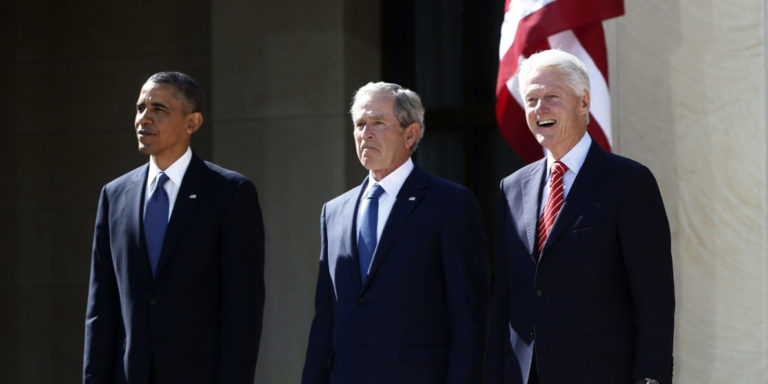
(Luis Cornelio, Headline USA) Taxpayers could soon be relieved of footing the bill for the generous pensions and annual allowances of former presidents Barack Obama, George Bush, and Bill Clinton, thanks to proposed legislation by Sen. Joni Ernst, R-Iowa. 

Titled the Presidential Allowance Modernization Act, the proposed law would cap pensions and allowances for former commanders-in-chief earning less than $400,000 annually. Both would be set at $200,000.  

Individuals who make more than the limit could see their taxpayer-funded perks reduced, effectively affecting all current former presidents. Ernst has not clarified whether disgraced former President Joe Biden would also be targeted.

“From speaking gigs to Netflix deals and much more, former presidents have been raking in the dough,” Ernst said in an interview with the Daily Caller, which was first to report on the legislation. “Americans should not be on the hook to support those who clearly are having no issues supporting themselves.” 

Ernst described the bill as “commonsense,” arguing it “flips Washington on its head by finally prioritizing taxpayers over politicians.” She introduced the bill on Wednesday, according to Congress.gov.

Under current law—the Former Presidents Act of 1958—former presidents receive an annual pension of $246,000, equal to a cabinet secretary’s salary. They also receive an office allowance of $115,000 per year for the first two and a half years after leaving the White House. 

According to the National Taxpayers Union Foundation, the widows of former presidents can receive $20,000 annually, though Ernst’s bill would increase it to $100,000. 

These perks pale in comparison to the multi-million dollar deals former presidents have secured since their elected office ended. 

For instance, take Obama, who signed a $65 million book deal with Penguin Random House after 2016. He, along with his wife, Michelle Obama, inked a multi-year deal with Netflix. 

Bill and Hillary Clinton, the twice-failed presidential candidate, made $240 million from 2001 to 2016, according to Forbes. 

Bush is no average Joe either.

With a net worth of approximately $40 million, Bush owns a 1,600-acre ranch in Texas and purchased a home in Dallas that is currently valued at $2.5 million. He made $15 million within the first two years of leaving office, according to CNBC.

Despite their high-paying deals, none of these former presidents have renounced their taxpayer-funded pensions.  

In stark contrast, President Donald Trump donated his entire salary during his first term. “If I’m elected president, I’m accepting no salary,” Trump said before taking office in 2017. 

NYT Scholars Concede Trump’s Birthright Citizenship Order Is Legally ‘Strong’

(Luis Cornelio, Headline USA) Two legal scholars writing for the liberal New York Times warned Democrats that President Donald Trump’s executive order clarifying who qualifies for birthright citizenship is not as legally flawed as critics claim. 

Randy E. Barnett and Ilan Wurman—the respective professors of constitutional law at Georgetown University Law and the University of Minnesota—wrote Saturday that Trump’s mandate does not necessarily contradict the 14th Amendment of the Constitution. Trump’s order seeks to award citizenship to the children of Americans and lawful immigrants. 

While some federal judges and leftist activists argue the amendment guarantees birthright citizenship to nearly all those born on U.S. soil—including so-called anchor babies—Barnett and Wurman opined differently. They noted that Trump’s legal stance has not yet been reviewed by the Supreme Court.

“The Supreme Court has held, in the 1898 case United States v. Wong Kim Ark, that children born here to permanent residents are citizens. But it has never squarely held that children born to those illegally present are citizens,” the two scholars wrote. 

Although Barnett and Wurman approached the issue from a legal and historical perspective, they also clarified that the 14th Amendment was originally intended to extend birthright citizenship to African Americans following the Civil War. 

They explained the ongoing debate over the “subject to the jurisdiction thereof” in the Citizenship Clause Doctrine. This language excludes the children of diplomats, members of invading armies and (formerly) Native Americans, groups that owe allegiance to foreign nations and were not considered subject to U.S. laws.

Enter the question of illegal aliens and “anchor babies.”

“Has a citizen of another country who violated the laws of this country to gain entry and unlawfully remain here pledged obedience to the laws in exchange for the protection and benefit of those laws?” Barnett and Wurman asked.  

“Clearly, the parents are not enemies in the sense of an invading army, but they did not come in amity.” they added. “They gave no obedience or allegiance to the country when they entered — one cannot give allegiance and promise to be bound by the laws through an act of defiance of those laws.” 

The scholars also pointed out that illegal aliens can be “summarily removed from the country without judicial procedures of the sort that would protect citizens.” 

Barnett and Wurman concluded that the Supreme Court has never formally ruled on whether the 14th Amendment applies to children of illegal aliens. Though, they warned, “When they finally consider this question, the justices will find that the case for Mr. Trump’s order is stronger than his critics realize.” 

The column comes less than a month after Trump signed an executive order barring federal agencies from granting U.S. citizenship to individuals whose parents are not U.S. citizens or lawful permanent residents. It also excludes individuals whose parents are in the country legally but temporarily, such as visa holders. 

Under current legal interpretations, a woman can become pregnant in her home country, wait nine months, and enter the U.S. illegally just before giving birth. Her child would then be granted U.S. citizenship, permanently linking the foreign individual to the country. 

Among the 32 member countries of NATO, only the U.S. and Canada offer unrestricted birthright citizenship, according to The Hill. Not even Haiti, the poorest country in Latin America, has such a policy.

Child Badly Injured in Yet ANOTHER Plane Crash

(Headline USA) A badly injured child is among eight people who were hurt Monday when a Delta Airlines plane flipped upon arrival at Toronto’s Pearson Airport.

The airport confirmed on X that an “incident” occurred with the Delta flight from Minneapolis and that all 80 passengers and crew are accounted for. Three of the eight people hurt are critically injured, paramedics said. Delta said in a statement the accident happened at 3:30 p.m.

Video from the scene shows the Mitsubishi CRJ-900LR upside down on the snowy tarmac as emergency workers hose it down. The plane was somewhat obscured by snow from a winter storm that hit Toronto over the weekend.

Ornge air ambulance said it was transporting one pediatric patient to Toronto’s SickKids hospital and two adults with critical injuries to other hospitals in the city.

“Emergency teams are responding,” the airport said in a post on the social platform X. “All passengers and crew are accounted for.”

It is too early to say what caused the plane to flip but weather may have played a factor. According to the Meteorological Service of Canada, the airport was experiencing blowing snow and winds of 32 mph (51 kph) gusting to 40 mph (65 kph). The temperature was about 16.5 degrees Fahrenheit (-8.6 Celsius).

The U.S. Federal Aviation Administration said in a statement that the Transportation Safety Board of Canada will head up the investigation and provide any updates. The National Transportation Safety Board said it is leading a team of U.S. investigators to assist in the Canadian investigation.

It is at least the fourth major aviation mishap in North America in the past month. A commercial jetliner and an Army helicopter collided near the nation’s capital on Jan. 29, killing 67 people. A medical transportation plane crashed in Philadelphia on Jan. 31, killing the six people on board and another person on the ground and 10 were killed in a plane crash in Alaska.

Delta said in a statement that “initial reports were that there are no fatalities.”

“Several customers with injuries were transported to area hospitals. Our primary focus is taking care of those impacted,” the airline added.

Ontario’s Premier Doug Ford said on X he is “relieved there are no casualties after the incident at Toronto Pearson.” Toronto is the capital of Ontario.

“Provincial officials are in contact with the airport and local authorities and will provide any help that’s needed,” Ford said.

Endeavor Air, based in Minneapolis, is a subsidiary of Delta Air Lines and the world’s largest operator of CRJ-900 aircraft. The airline operates 130 regional jets on 700 daily flights to over 126 cities in the U.S., Canada and the Caribbean, according to the company’s website.

The CRJ900, a popular regional jet, was developed by Canadian aerospace company Bombardier. It’s in the same family of aircraft as the CRJ700, the type of plane involved in the midair collision near Reagan National Airport on Jan. 29.

Adapted from reporting by the Associated Press

Major California Republican Announces Bid for Governor

(Headline USA) Riverside County Sheriff Chad Bianco said Monday he is running for governor of California in 2026, becoming the first major Republican to announce a bid for an election nearly two years away.

Bianco, an outspoken supporter of President Donald Trump and his policies, was first elected sheriff in 2018 and has been in law enforcement for more than 30 years. He is joining a growing number of candidates looking to replace Gov. Gavin Newsom as the GOP struggles to field a serious statewide candidate.

During his campaign announcement in downtown Riverside, Bianco criticized Democratic policies that he says have led to the homeless crisis on city streets and the state’s housing affordability problems.

“It is only our Democrat elected officials who are responsible for the decline of California,” he said. “What is it they have given us? Rampant crime, higher taxes, the highest cost of living in our nation, tent encampments in every major city, more fentanyl deaths, catastrophic fires, a broken home insurance market and people across our state are struggling to afford groceries and gas. Californians deserve better.”

Bianco, a law-and-order conservative, said his campaign won’t focus on the divide between Republicans and Democrats but on a common goal of having “a better California.”

“We will take our message of restoring sanity to every corner of our beautiful state,” he said.

The Democratic candidates include former Los Angeles Mayor and Assembly Speaker Antonio Villaraigosa, Lt. Gov. Eleni Kounalakis, former Senate President Pro Tem Toni Atkins, former state Controller Betty Yee and state Superintendent of Public Instruction Tony Thurmond. Polling from the Public Policy Institute of California shows former Vice President Kamala Harris would be in a strong position if she runs, but she hasn’t said what she’ll do.

The race to replace Newsom, whose term limit runs out in 2027, will be a Democratic free-for-all sure to attract the party’s top talent for the chance to lead the nation’s most populous state and the world’s fifth largest economy.

Adapted from reporting by the Associated Press