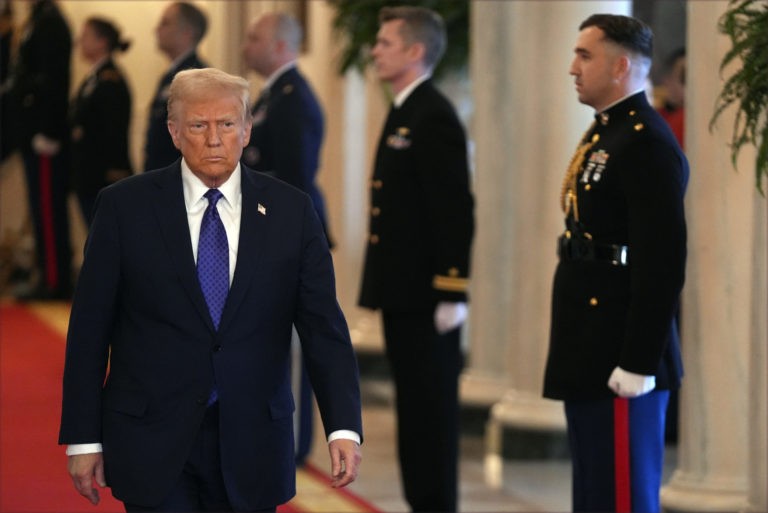
(Headline USA) A federal judge in Washington has allowed President Donald Trump’s mass firings of federal workers to move forward.
U.S. District Judge Christopher Cooper decided Thursday he could not grant a motion from unions representing the workers to temporarily block the layoffs. He found that their complaint amounted to an employment dispute and must follow a different process outlined in federal employment law.
Cooper acknowledged that the Republican president’s second term “has been defined by an onslaught of executive actions that have caused, some say by design, disruption and even chaos in widespread quarters of American society.”
But Cooper, who was appointed by President Barack Obama, a Democrat, wrote that judges are “duty-bound to decide legal issues based on even-handed application of law and precedent — no matter the identity of the litigants or, regrettably at times, the consequences of their rulings for average people.”
The ruling comes as thousands of federal government employees have been shown the door during in the first month of Trump’s second administration.
The administration argued in court the unions failed to show that they were facing the kind of irreparable, immediate harm that would justify an emergency order stopping layoffs.
The unions, representing hundreds of thousands of federal workers, maintain that Trump’s efforts to slash the federal workforce conflicts with Congress’s power to shape the size and direction of agencies through funding decisions, as well as laws detailing how such layoffs must be carried out.
The president of the National Treasury Employees’ Union, Doreen Greenwald, said that Cooper’s decision was a temporary setback and that “federal employees will get their day in court to challenge the unlawful mass firings and other attacks on their jobs, their agencies, and their service to the country.”
The lawsuit is among more than 80 challenging a range of actions Trump has undertaken with his blitz of executive orders. Unions also filed a separate suit challenging mass firings in California this week.
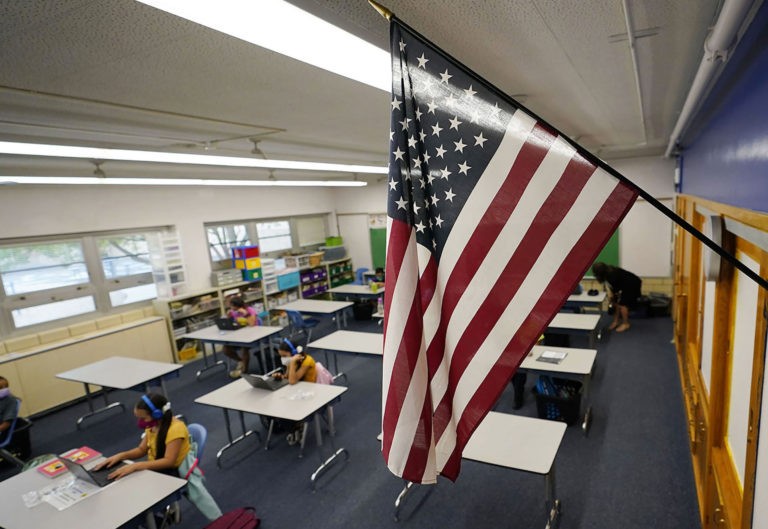
President Donald Trump’s recent executive order means those schools must drop the policies or face losing federal funding.
Parents Defending Education, a parental rights education group, reported it has so far found 21,232 schools implementing DEI across 610 school districts in 46 states and the District of Columbia affecting more than 13 million students.
It’s unclear how many districts may have ended the policies this week in response to Trump’s order but have not yet publicly posted or updated their documents and websites. Some schools may have updated their policies since PDE found the DEI pledges and policies in recent years.
Regardless, the report shows codified DEI policies have become widespread in school districts around the country.
According to an official warning last week from the Department of Education, schools that don’t end their DEI policies could lose federal funding.
“In recent years, American educational institutions have discriminated against students on the basis of race, including white and Asian students, many of whom come from disadvantaged backgrounds and low-income families,” Education Department Acting Assistant Secretary for Civil Rights Craig Trainor said in a ‘Dear Colleague’ letter, essentially putting schools on notice. “These institutions’ embrace of pervasive and repugnant race-based preferences and other forms of racial discrimination have emanated throughout every facet of academia.
“Institutions that fail to comply with federal civil rights law may, consistent with applicable law, face potential loss of federal funding,” he added.
PDE documented an extensive list of schools that “implement diversity, equity, and inclusion (DEI) through policy, strategic plans, or practice in general.”
The group has documents to prove it, linking in its report to online diversity statements or documents showing the DEI emphasis or policies in each school district.
PDE has only documented a handful of school districts in some states. For instance, Arkansas has one school district pushing DEI, Alabama has four, and Louisiana has two.
Meanwhile, California has at least 390 districts using DEI, according to PDE.
“The Department intends to take appropriate measures to assess compliance with the applicable statutes and regulations based on the understanding embodied in this letter beginning no later than 14 days from today’s date, including antidiscrimination requirements that are a condition of receiving federal funding,” reads Trainor’s letter, dated Feb. 14 of this year.
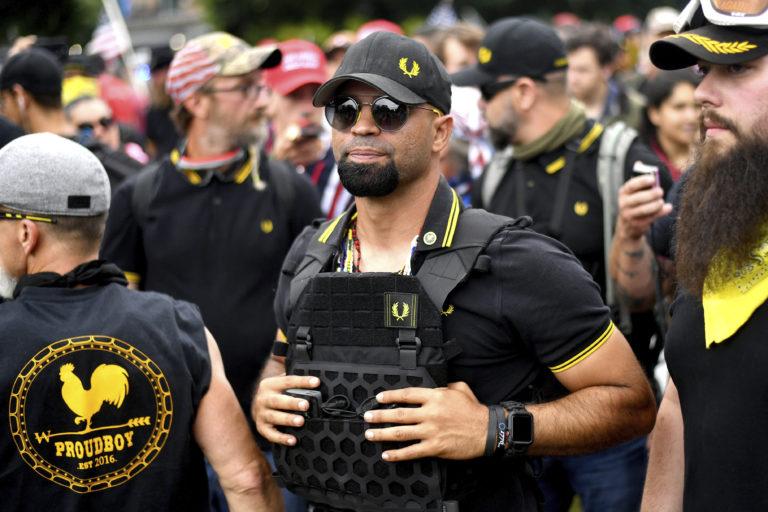
(Ken Silva, Headline USA) Proud Boys leader and confirmed FBI informant Enrique Tarrio, who recently received a pardon from President Donald Trump, was arrested again Friday in Washington DC.
Tarrio and others were in DC on Friday when they encountered apparent counter-protestors. Video footage shows Tarrio taking the phone out of one of the counter-protestor’s hands and throwing it on the ground.
BREAKING: Enrique Tarrio arrested by U.S. Capitol Police after throwing a protester’s phone in DC pic.twitter.com/K7j7mqa9lQ
A Capitol Police officer immediately intervened. “You threw the phone out of her hands, c’mon,” the officer said.
The female counter-protestor then became hysterical.
“You don’t get to just come here and put your hands on people … Good job, you idiot. Where’s your mom?” she said. “Fuck you, Enrique. Fuck you, you little bitch.”
Tarrio was handcuffed and taken away. The woman said she intends to press charges.
Tarrio’s mother, Zuny Tarrio, released a statement after the incident.
“Enrique Tarrio Still Did Nothing Wrong! We are united in our lives with Enrique, and know that the government’s injustices must be exposed!” she said. “That is our fight. This must not continue! We stand with him now and always. Never Give Up! My Son must go Free!”
Statement on arrest:
Enrique Tarrio Still Did Nothing Wrong!
We are united in our lives with Enrique, and know that the government’s injustices must be exposed! That is our fight. This must not continue! We stand with him now and always. Never Give Up!
Tarrio was arrested in March 2022 for allegedly participating in the Jan. 6, 2021, Capitol Hill uprising—even though he wasn’t even in Washington DC on Jan. 6.
He was convicted of sedition in May 2023 after a four-month trial mired in controversy.
In February 2023, it was revealed that the Proud Boys hadn’t actually created their alleged blueprint for storming the Capitol. Rather, a tech entrepreneur with connections to the national security state created the “1776 Returns” document and passed it on to someone else, who gave it to the Proud Boys.
Earlier this year, it was revealed that the man who created the 1776 Returns manifesto is an Israeli intelligence asset.
Still more misconduct was revealed in late March 2023, when defense lawyers discovered that someone close to them was an FBI informant.
But despite these and other examples of misconduct—and despite there were allegedly at least 50 undercover law enforcers or informants in the Jan. 6 crowd—the presiding judge denied every motion for redress filed by the defense.
In addition to Tarrio, a Miami resident, three other Proud Boys were convicted of seditious conspiracy: Ethan Nordean, Joseph Biggs and Zachary Rehl.
They were all pardoned of their lesser charges, while Trump commuted their sentences for the seditious conspiracy convictions.
Previously, Tarrio served as a federal informant from 2012 through at least 2014. According to the Guardian, his informing led to the prosecution of 13 people on federal charges in two separate cases, and had helped local authorities investigate a gambling ring.
Ken Silva is the editor of Headline USA. Follow him at x.com/jd_cashless.
(Headline USA) Tesla recalling more than 375,000 vehicles due to power steering issue
Tesla is recalling more than 375,000 vehicles due to a power steering issue.
The recall is for certain 2023 Model 3 and Model Y vehicles operating software prior to 2023.38.4, according to the National Highway Traffic Safety Administration.
The printed circuit board for the electronic power steering assist may become overstressed, causing a loss of power steering assist when the vehicle reaches a stop and then accelerates again, the agency said.
The loss of power could required more effort to control the car by drivers, particularly at low speeds, increasing the risk of a crash.
Tesla isn’t aware of any crashes, injuries, or deaths related to the condition.
The electric vehicle maker headed by Elon Musk has released a free software update to address the issue.
Letters are expected to be sent to vehicle owners on March 25.
Owners may contact Tesla customer service at 1-877-798-3752 or the NHTSA at 1-888-327-4236.
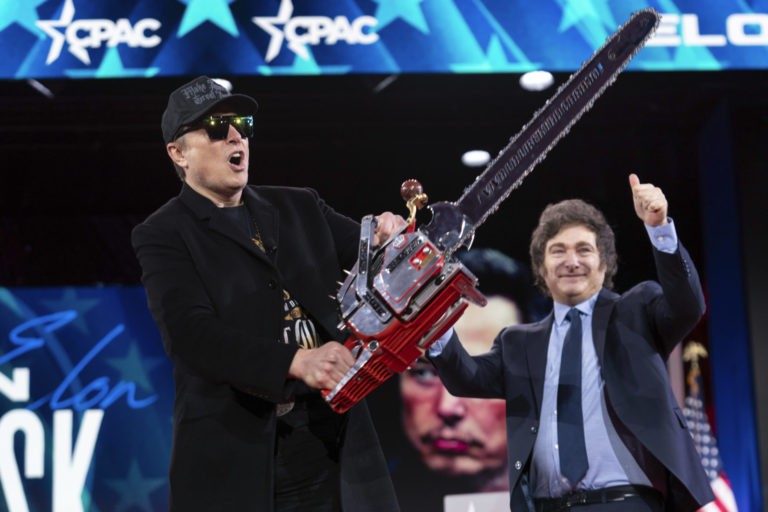
(Headline USA) Billionaire Elon Musk appeared at a conservative gathering outside Washington waving a chainsaw in the air, showing openness to auditing the Federal Reserve and accusing Democrats of “treason.”
Musk, the Tesla CEO who has become perhaps President Donald Trump’s most influential adviser, spoke Thursday about his crusade to cut government spending and downsize the federal workforce with the administration’s Department of Government Efficiency.
The entrepreneur was first announced earlier that day as a speaker, drawing huge cheers from activists gathered at the Conservative Political Action Conference. Before his appearance, he met with Argentine President Javier Milei, who has been frequently praised by Musk and popularized the power tool while campaigning in 2023 and proposing slashing public spending.
After Musk appeared onstage, wearing shades and his trademark black “Make America Great Again” hat, he said Milei had a gift for him. The Argentine leader then walked onstage with the red chainsaw and passed it to Musk. The chainsaw was engraved with Milei’s slogan, “Viva la libertad, carajo,” which is Spanish for “Long live liberty, damn it.”
“This is the chainsaw for bureaucracy,” he said.
Musk slammed the previous Biden administration for its immigration policies, specifically naming an app that was used by nearly 1 million people to be allowed into the U.S. on two-year permits with eligibility to work. He accused Biden and Democrats of doing that as an “investment” to get more support in swing states.
“A lot of people don’t quite appreciate that this was an actual real scam at scale to tilt the scales of democracy in America,” Musk said before Newsmax host Rob Schmitt asked him, “Treason?”
Musk responded, “Treason.”
When Schmitt asked him if he would consider auditing the Federal Reserve, Musk responded, “Yeah, sure, while we’re at it.”
“Waste is pretty much everywhere,” Musk said.
The billionaire joked that Salvadoran President Nayib Bukele has told him he is worried about his security and said he was open to ideas on how to improve his safety measures.
“President Bukele from El Salvador, who managed to put in prison like a hundred thousand murderous thugs, and he called me. ‘I am worried about your security,'” he said the Central American leader told him. “I’m like, ‘Dude, you are worried about my security?'”
When asked to describe what is like inside his mind, Musk replied: “My mind is a storm. It’s a storm.”
Steve Bannon, a popular Trump ally who once served as his chief strategist, followed Musk’s appearance and acknowledged he was not the evening’s top attraction as he took the stage to a far less enthusiastic reception.
“How did I draw the card to follow Elon Musk?” Bannon asked about a man he has frequently criticized as insufficiently loyal to Trump. “C’mon man! You bring out the world’s wealthiest guy, Superman. I’m supposed to follow it? I’m just a crazy Irishman!”
Recently you have expressed an intention to do an audit of the gold at Fort Knox and presumably also the other vaults where the U.S. monetary gold is stored.
If you proceed with this endeavor, you will be misleadingly told by the U.S. Treasury, the owner of the gold, that the metal is annually audited by the Office of Inspector General (OIG) together with an independent public accountant, KPMG LLP.
The 2024 audit report of the “United States Mint’s Schedules of Custodial Deep Storage Gold and Silver Reserves” stored at the U.S. Mint, including the depositories at Fort Knox, West Point, and Denver, can be found on the OIG website here. The report on the gold stored at the Federal Reserve Bank of New York (FRBNY) is here. No need for any new audits, the bureaucrats will say.
But don’t be fooled. While it’s true that currently the OIG inspects the permanent tamper-evident seals covering vault compartments annually, and KPMG has accompanied the OIG during these expeditions, these audits are anything but credible if you would know what happened to those compartments before the last seals were put on.
I have been researching the U.S. gold reserves audits for many years, all the way back to 1974, and submitted countless FOIA requests at the Treasury (owner), Mint (custodian), FRBNY (custodian), and OIG (auditor) that unearthed previously undisclosed documents. In total, I have published nine articles about my findings1.
The full list of anomalies and problems regarding the audits would be too lengthy to discuss here, but below are a few unsettling conclusions:
Repeatedly auditing staff deviated from the prescribed auditing protocol, while the internal controls designed to prevent such deviations were failing.
Numerous audit and assay reports have been lost or destroyed.
For decades, a significant portion of the metal was excluded from verifications without any apparent reason.
The U.S. government went to great lengths to withhold information about the audits.
The permanent tamper-evident seals, placed on vault compartments after they were audited, meant never to be broken again, have repeatedly been broken. The OIG has carefully avoided this subject when it testified under oath, and on another occasion lied about it.
Given the significance of this subject, I would like to expand on the most sensitive issue at hand: the frequent re-opening of vault compartments placed under Official Joint Seal. As such breaches mean there can be no assurance the vault compartments still contain the gold they should.
An Introduction
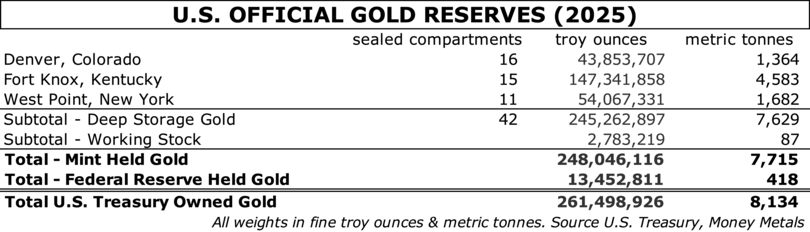
You will know that (on paper) the U.S. holds the largest official gold reserves in the world, accounting for 8,134 metric tonnes. While this gold no longer backs the U.S. dollar at a fixed parity as it did before 1971, it serves as essential support and a final backstop to the dollar, contributing credibility to the dollar’s status as the world reserve currency.
The majority of the gold is stored at a U.S. Mint depository at Fort Knox, while smaller quantities are kept at Mint depositories in Denver and West Point. Collectively, this volume is known as Deep Storage gold and is secured within 42 sealed compartments. The remainder is stored at the FRBNY.
Source: U.S. Treasury. Next to the Deep Storage of gold at the Mint and metal at the FRBNY, there are 87 tonnes stored at the Mint that can be utilized as working stock for producing coins.
The current audits commenced in 1974 and were designed to annually verify 10% of the gold, place verified compartments under “Official Joint Seal,” and after all compartments were attested in 1983 inspect the seals every year (page 36, page 534). But unfortunately, this is not what unfolded.
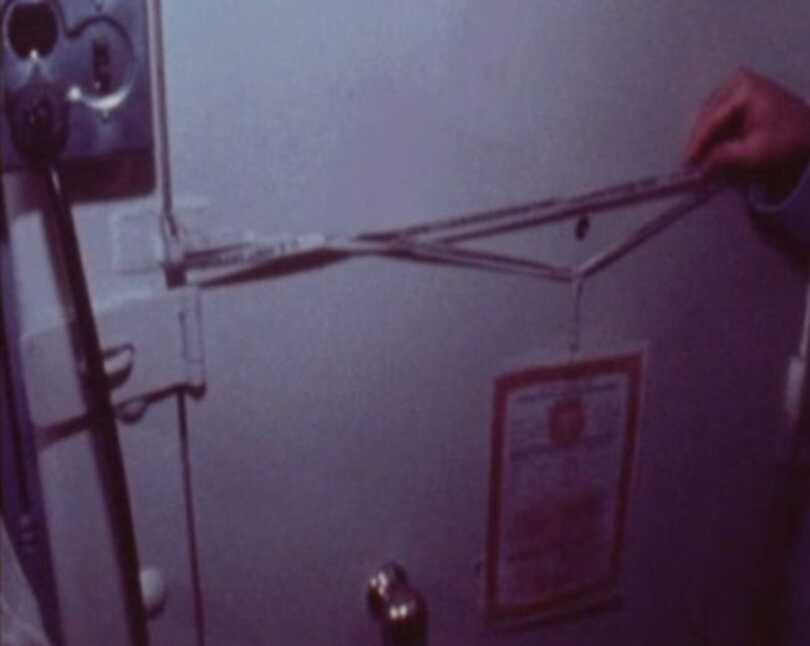
Sealed vault compartment at Fort Knox.
How the Audit Procedures Have Failed
Representing the OIG, Eric M. Thorson attended the congressional hearing for the Gold Transparency Act of 2011 that was initiated by Ron Paul (not enacted). Mr. Thorson’s testimony at the hearing serves as the official statement by the auditor. Having weighed his words carefully, Thorson stated:
… 100 percent of the U.S. Government’s gold reserves in the custody of the Mint has been inventoried and audited.
… the Committee for Continuing Audit of the U.S. Government-owned Gold [The Committee that started the audits] performed annual audits of Treasury’s gold reserves from 1974 to 1986.
… by 1986, 97 percent of the Government-owned gold held by the Mint had been audited and placed under joint seal. So once you have done that, and that seal remains unbroken, then I am not sure what other benefit there would be to going back into it at that point.
Since 1993, when we [OIG] assumed responsibility for the audit, my office has continued to directly observe the inventory and test the gold. In fact, my auditors signed the official joint seals … placed on those compartments.
At the end of Fiscal Year of 2008, all 42 compartments had been audited by … the Committee for Continuing Audit of the U.S. Government-owned Gold, or my office, and placed under official joint seals.
In summary:
From 1974 until 1986, 97 percent of the Deep Storage gold had been verified by the so-called Committee for Continuing Audit.
In 1993 the OIG became responsible for the audits, and by 2008 all compartments had been verified and sealed.
Two assumptions we can derive from Thorson’s testimony:
From 1987 until 1992, there were no audits.
From 1993 until 2008, the remaining 3 percent of the gold was verified.
Thorson didn’t mention anything about vault compartments having ever been re-opened.
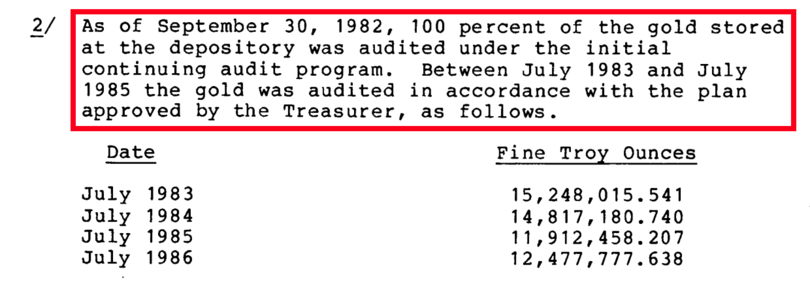
To refute Thorson’s testimony, it’s paramount to first establish the OIG did not assume responsibility for the audits since 1993, but as early as 1982. From one of the few documents that survived the 1980s (page 2):
Effective October 1, 1982, the Internal Audit Staffs of BGFO and the United States Mint [Committee for Continuing Audit] were reorganized under the Department of the Treasury, Office of the Inspector General [OIG].
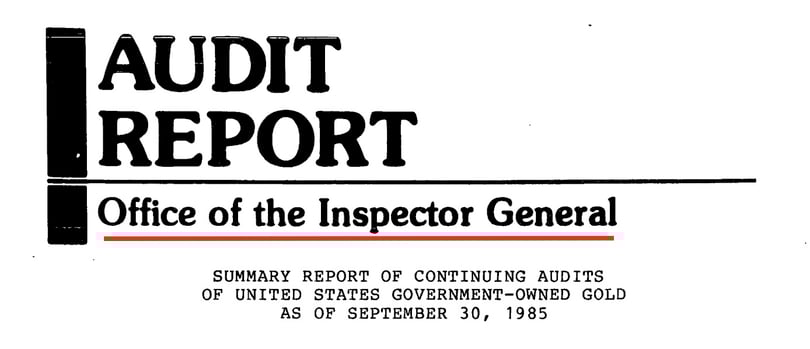
On the front page of an audit report from 1985, we can clearly see the OIG’s name:
Second, ever since the OIG became part of the audits in 1982, exactly what was not supposed to happen, did happen: vault compartments that had been physically verified and sealed were re-opened.
Read with me, from the 1986 audit report with respect to Fort Knox (Pages 7 and 8):
For dubious reasons, from 1983 until 1986 ‘re-audits’ of 1,929 tonnes were performed at Fort Knox and Denver (sealed compartments were re-opened while both depositories were fully audited by then) “in accordance with the plan approved by the Treasurer.” Meanwhile, Deep Storage compartments at West Point had never been audited.
Why didn’t the OIG finish the audits at West Point, as intended, but instead began breaking permanent seals at Fort Knox and Denver? Thorson himself said in 2011 that “once you have done that [placing seals] and that seal remains unbroken, then I am not sure what other benefit there would be to going back into it.”
One more time, to be sure, the purpose of the seals, as we can also read from the Mint’s annual report 1974/1975 (page 36), was that when compartments had been verified and sealed, “these actions having once been performed … will not have to be repeated as long as the assets verified remain under an unimpaired joint seal.”
More Lies by The Auditor
What Thorson meticulously avoided discussing under oath, he included in a written statement for the Gold Transparency Act of 2011 (page 45):
From 1986 to 1992, the Mint continued to perform an annual inventory and verification of the gold reserves in accordance with its own policies over those compartments that had not been placed under Official Joint Seal…
So, the U.S. Mint audited its custodial gold “in accordance with its own policies” from 1987 through 1992, though the OIG was already in charge at the time. This is like a bank opening its customers’ safety deposit boxes while the auditor decided to take a sabbatical.
Also, note that Thorson states that the Mint exclusively opened “those compartments that had not been placed under Official Joint Seal.” This is a lie and I can prove it to you.
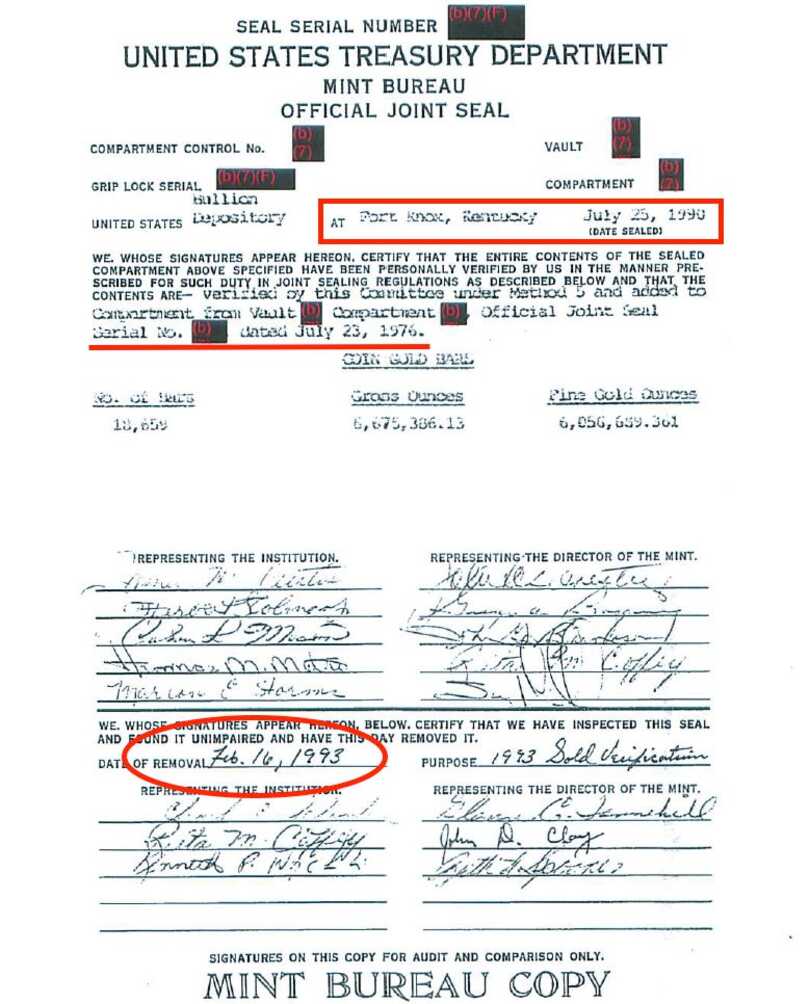
Through FOIAs, I obtained copies of seals that were placed by the Mint on 5 Deep Storage compartments between 1987 and 1992. Thorson is wrong because all these seals were placed at Fort Knox and Denver, which were verified and sealed by late 1982.
Please have a look at one of the seal copies:
At the top you can see the “date sealed”, “July 25, 1990,” and the depository is “Fort Knox, Kentucky,” which was fully audited by 1982 (and some compartments re-audited from 1983 through 1986).
You can also see on the seal when this compartment was “sealed previously.” It was in 1976 (underlined in red), confirming it was a re-audit. There is no possibility that this compartment was audited for the first time in 1990, as suggested by Thorson.
Last but not least, at the very bottom, you can see a date, “February 16, 1993,” which is when this seal was removed by the OIG (presumably for yet another ‘re-audit’). More evidence that the OIG must have known what happened to these compartments between 1987 and 1992. Removing the seal in 1993 by the OIG (after their sabbatical) clearly would have told the history of this compartment.
You will also notice the OIG left a trail so complicated, whereas the audit setup in 1974 seemed so simple. Why?
Conclusion
Physical gold audits are supposed to remove any doubt about the presence of gold at a specific custodian. But when we look beneath the surface of the audits discussed above, we have to conclude they actually raise more doubt than reassurance about the safety of the U.S. official gold reserves.
Sadly, Mr. President, the above-noted problems are just the tip of the iceberg. Why were the physical inventories not completed in 1983? Why did the OIG re-open compartments between 1983 and 1986? Why again between 1987 and 1992? Why was the gold at the FRBNY never audited in 2011? The list is endless and it would take a book to adequately discuss all problems related to the audits.
A new, credible audit could verify that all U.S. Treasury gold is physically accounted for. But the process should not stop there. Another question to be examined and reported about is whether any encumbrances have been placed upon the gold, via swaps, leases, pledges, or any other form of rehypothecation.
Hopefully, this letter contains useful information for you, and your administration will conceive of and execute a new full audit of all the U.S. monetary gold. Then we can all finally put this topic to rest. A template for this was created by Congressman Alex Mooney’s Gold Reserves Transparency Act last introduced in 2021 with the help of the Sound Money Defense League.
For more information please refer to my prior articles that can be found in the notes1.
Notes
In my last article on this subject, “U.S. Official Gold Reserves Auditor Caught Lying,” the links to all my articles spread over several websites are disclosed. For anyone who wants to get a full picture of all issues with the audits make sure to read my last and second to last article: “Audits of U.S. Monetary Gold Severely Lack Credibility.”
The original documents state “1975” but for the sake of simplicity I have changed it to “1974”. Officially, the Committee for Continuing Audit of the U.S. Government-owned Gold started in 1975, but because they accepted the audit performed in 1974 in their program effectively their program started in 1974.
Originally a sound engineer in the Dutch movie industry, Jan Nieuwenhuijs has devoted the last decade to in-depth gold market research. His commentary and analysis has earned him international recognition as a top expert on the Chinese gold market, the COMEX futures market, the London Bullion Market, and the Turkish gold market. At Money Metals, he writes about the international monetary system, central bank gold policies, the mechanics of the global gold market, the gold price, and economics in general.
(Mike Maharrey, Money Metals News Service) With all the attention focused on the wasteful spending being unearthed by DOGE and talk of “rebate” checks, you might think that the Trump administration is finally getting the federal government’s reckless borrowing and spending under control. But if we turn our attention to what’s going on over on Capitol Hill, the news isn’t nearly so good.
Under the Congressional Budget and Impoundment Control Act of 1974, Congress is required to develop annual budget resolutions that set overall spending and revenue targets. House Republicans are engaged in that process as we speak.
The pending resolution directs the four leading House committees to raise the deficit by $6 trillion over the next decade.
Here are the numbers:
Ways and Means Committee for tax cuts: +$4,500 billion.
Judiciary Committee for crime and border control: +$110 billion.
Armed Services Committee for Pentagon increases: +$100 billion.
Homeland Security Committee for border control: +$90 billion.
Implied higher interest expense: +$1,200 billion.
Total Deficit Increase: +$6.0 trillion.
There are spending cuts built into the budget resolution instructions as well, but they pale in comparison to the additional spending. Stockman describes them as “anemic.”
They total $1.502 trillion, which sounds impressive until you put them into context.
That amounts to 1.7 percent of CBO baseline outlays ($89.3 trillion) from fiscal 2026 to fiscal 2035 and 2 percent of total federal outlays even setting aside the $13.8 trillion of interest expense included in the CBO numbers.
Stockman points out that this combination of new spending and tax cuts would be in addition to $22 trillion of cumulative deficits already built into the baseline budget over the next 10 years.
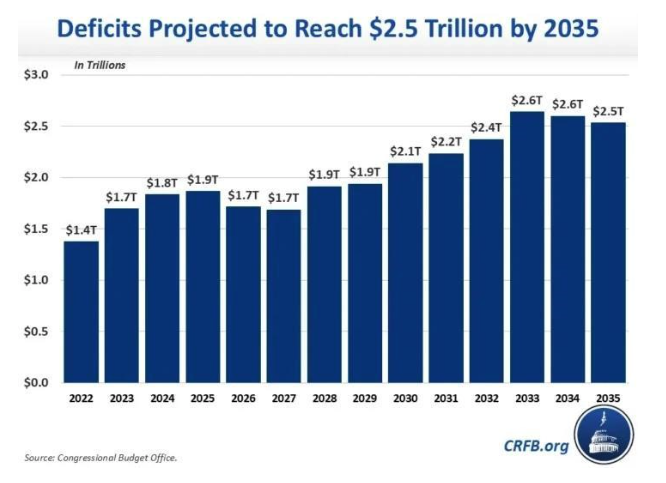
Based on the current Congressional Budget Office (CBO) projections (without any new spending or cuts), today’s $36 trillion national debt will balloon to $60 trillion by the end of the current 10-year budget window.
Keep in mind that the CBO always uses the best-case scenario. It is not projecting any recessions. It does not assume any wars or major disasters that inevitably pump up spending. As Stockman put it, the CBO bases its forecasts on a “performance-perfect” economy for the next 25 years.
Even with that rosy scenario, the public debt is on pace to hit $150 trillion by mid-century.
It’s important to remember that discretionary spending only accounts for 27 percent of total spending. The vast majority is for entitlements, and there is little political will to take the scissors to Social Security or Medicare.
Congressional Republicans are simply ignoring that elephant in the room.
Stockman summed it up this way:
“There is no instruction to cut Social Security, Medicare, Veterans Programs or Federal military and civilian retirement by a single dime—while, as shown above, defense is to be increased by $100 billion. But these five big budget functions add up to $55 trillion over the 10-year budget window or fully 73 percent of total baseline outlays excluding interest on the public debt. In a word, these once and former ‘watchdogs of the U.S. Treasury’ looked at the 10-year budget projections and waved the white flag of surrender on damn near three-fourths of the spending available to cut. Not a single dime of savings in this vast expanse of the budget is embedded in the GOP instructions.”
The Interest Problem
There are actually two elephants in the room. The second is the ballooning interest on the national debt.
Much of the debt currently on the books was financed at very low rates before the Federal Reserve started its hiking cycle. Every month, some of that super-low-yielding paper matures and must be replaced by bonds yielding much higher rates. And even with the recent Federal Reserve rate cuts, Treasury yields have pushed upward as demand for U.S. debt sags.
Uncle Sam paid $1.13 trillion in interest expenses in fiscal 2023. It was the first time interest expense has ever eclipsed $1 trillion. Through the first four months of fiscal 2025, the federal government had already spent more on interest on the debt than it has on national defense or Medicare. The only higher spending category was Social Security.
This is a budget component that Congress has virtually no control over. And with price inflation stubbornly sticky, the Federal Reserve has put rate cuts that would provide some relief on hold.
According to Stockman, interest expense absorbs about 18 cents of every dollar of federal revenue. Based on current projections, that will grow to 22 cents by 2035 and 40 cents by 2052.
Again, this is based on the best-case scenario. Stockman notes that “once it is clear to the bond markets that the Fed can no longer monetize massive gobs of U.S. Treasury paper without re-accelerating inflation, bond yields will lurch skyward.”
If the average interest on the debt were to rise even 250 basis points from the current projection, it would nearly double the debt service to $3.3 trillion per year by 2035.
Stockman calls it a “fiscal doom loop.”
“In other words, we are not dealing with a tad too much borrowing or chronically lax fiscal discipline. What is built-in now is a veritable fiscal doom-loop under which soaring debt fuels an eruption of annual interest expense, which, in turn, drives the public debt and interest expense higher still.”
Smoke and Mirrors
According to Stockman, GOP policy wonks in Congress make the budget outlook seem better than it really is by including “fake deficit cuts.” He flat-out accuses them of “egregiously faking the budget numbers.” He points to $1.8 trillion in discretionary spending cuts “hidden in the fine print.”
“The GOP plan advertises that it is instructing seven committees to make savings of $1.5 trillion as explained above—offset by spending increases of $300 billion over the 10-year period for defense, law enforcement and border control. But if you look at the support document labeled ‘Table 1. Fiscal Year 2-25 Budget Resolution Total Spending and Revenue,’ for this net spending cut of $1.2 trillion, you won’t find it. Instead, the document actually contains a summary line called ‘Government-Wide Savings,’ which shows a figure of $2.99 trillion. That’s $1.8 trillion more than the reconciliation instructions actually provide for on a net basis. The latter amount, therefore, is lurking deep in the budgetary shadows as an unreconciled savings in discretionary spending. Since there is no enforcement mechanism or even annual tracking target by program and budget function, this figure is sure to be promptly forgotten even before the resolution makes its way across the Capitol Building to the U.S. Senate.”
Perhaps some of this will materialize in the DOGE savings, but how much gets cut from the budget when it’s all said and done remains to be seen. And of course, there is talk about some of that savings being distributed to taxpayers in the form of $5,000 checks.
On the other side of the coin, there is almost always additional unplanned spending coming down the pike, whether for disasters, crises, or wars. You might recall that President Biden promised that the [pretend] spending cuts would save “hundreds of billions” with the debt ceiling deal (aka the [misnamed] Fiscal Responsibility Act).
That never happened.
Then there is $2.6 trillion in projected higher federal tax revenues due to economic growth.
In fact, politicians always use “economic growth” to close budget holes. The problem is that economic growth seldom materializes to the extent promised. And again, the projections always assume best-case scenarios with no recessions or economic crises. Given the massive debt bubble blown up by well over a decade of artificially low interest rates and the Fed’s inability to cut rates due to sticky inflation, a major economic meltdown in the next decade seems more likely than not. The economy is addicted to easy money and its drug has been taken away.
When federal revenues do increase, whether through tax hikes or economic growth, Congress always manages to find more ways to spend – as already noted.
Stockman offers a pretty dismal summary of the situation.
“Talk about the elephant in the elephant’s caucus room! In order to justify massive tax cuts that it’s unwilling to back up with politically difficult spending cuts the GOP is just making up the numbers—sweeping under the rug four times more red ink than the entire $930 billion Federal debt at the time that Ronald Reagan became president.”
DOGE is a great start, and President Trump should be lauded for exposing all this wasteful spending. But don’t be fooled. Uncle Sam is not getting his borrowing and spending problem under control.
This is precisely why despite periodic jawboning about cutting spending and getting America’s fiscal house in order, every president since Calvin Coolidge has left the U.S. with a bigger national debt than when he took office.
Stockman pulls no punches.
“In short, the GOP budget resolution is a complete betrayal of any even minimal notion of fiscal sanity. Upon a fresh CBO report (January 2025) showing massive Federal deficits rising skyward as far as the eye can see, these cats in the GOP caucus have proposed— apparently with a straight face—to add a net of $3.3 trillion ($4.8 trillion of tax cuts less $1.5 trillion of spending reductions) of new deficits on top of the $28 trillion of baseline deficits. The very notion is absurd. This plan needs to be subject to a mercy killing on the U.S. House floor and sent back to committee for a long overdue reckoning with reality.”
Mike Maharrey is a journalist and market analyst for MoneyMetals.com with over a decade of experience in precious metals. He holds a BS in accounting from the University of Kentucky and a BA in journalism from the University of South Florida.
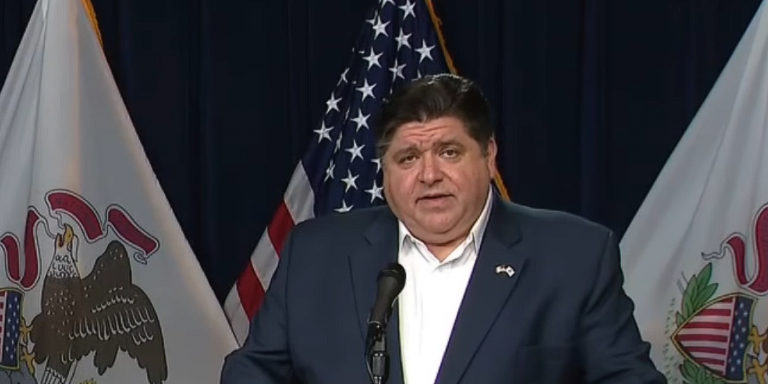
(Greg Bishop, The Center Square) The fallout over comments Illinois Gov. J.B. Pritzker made about Nazis during his budget address spilled onto the House floor Thursday.
For more than five minutes Wednesday, Pritzker ended his address talking about the history of Nazi Germany and warned what he sees as the looming threat in America under the Trump administration.
“It took the Nazis one month, three weeks, two days, eight hours and 40 minutes to dismantle a constitutional republic,” Pritzker said. “All I’m saying is when the five-alarm fire starts to burn, every good person better be ready to man a post with a bucket of water if you want to stop it from raging out of control.”
About 6 million Jews were killed in Nazi Germany in what is known as the Holocaust.
Asked after the speech how those comments are not an insult to more than half of the American public who voted for Trump, Pritzker said “those words never came out of my mouth.”
“That is not true what you just said,” Pritzker said Wednesday. “Here’s what I will say, I think it is important to talk about the destruction of a constitutional republic.”
On the House floor Thursday, state Rep. Steven Reick, R-Woodstock, blasted Pritzker’s comments, saying Republicans are far from anti-semitic and demanded an apology.
“We’ve issued resolutions, we’ve proposed resolutions, supporting the nation of Israel,” Reick said. “To put a not-too-fine point on it, we are part of Team Jew.”
Reick demanded an apology and said Pritzker’s comments were interpreted to cast Trump supporters and Republicans as Nazis and autocrats, and that’s wrong.
“And this is a guy who should know because, what was it during COVID, 40-some consecutive disaster declarations, ruling by executive order for 1,170-some days of his first 1,552 days in office,” Reick said.
Reick’s comments were immediately condemned by Democratic state Daniel Didech, D-Buffalo Grove.
“You are engaging in the most pernicious forms of anti-semitism that exist,” Didech said. “Yes you are. You don’t know what you’re talking about.”
State Rep. Jennifer Gong-Gershowitz, D-Glenview, said Reick’s comments have no place.
“You have no right to use my pain, or the pain of our community, to score political points,” she said.
(Mike Maharrey, Money Metals News Service) If archaeologists 2,000 years from now find a jar of U.S. quarters minted in 2025, how excited would they be?
I’m sure they would find it interesting from a historical perspective. But how much would those quarters really be worth?
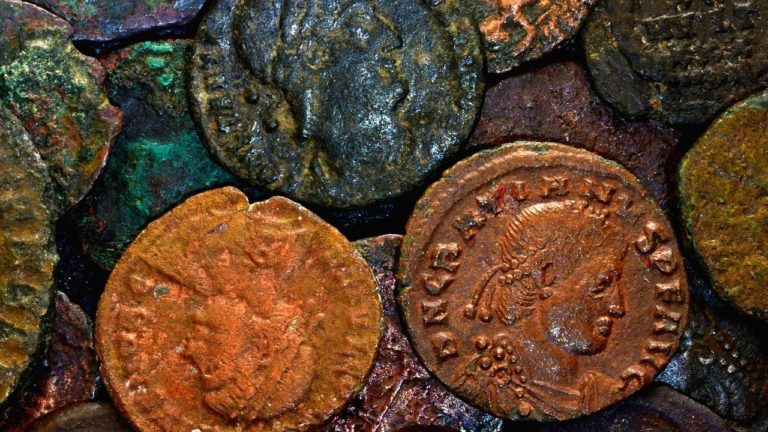
I got to thinking about this after reading about a recent archaeological find in the Netherlands. Two people searching a field with metal detectors found hundreds of Roman-era gold and silver coins.
According to CBS News, the find included a mix of Roman and British coins. The majority were silver Roman denarii minted between 200 B.C. and 47 A.D. There were also 72 gold aurei dated from 18 B.C. and 47 A.D. These gold coins showed no sign of wear and were likely freshly minted according to archaeologists who analyzed the find.
The British coins included what are known as “starters,” minted from an alloy of gold, silver, and copper. These coins were inscribed with the face of the Celtic king Cunobelinus, who reigned between 9 and 40 A.D.
The news report didn’t say how much the coins were worth. From a historical standpoint, they are arguably priceless. But I did a little digging to estimate the value of the gold and silver.
The weight of a silver Roman denarius varied over time from between 4.5 and 3.4 grams. For the sake of calculation, we’ll assume the coins found in the Netherlands averaged 4 grams. At the current silver price, the melt value of these silver coins would be around $4.24, a bit less than the current melt value of a pre-1965 silver (90%) quarter ($5.95).
So, not even taking into account the historical value, our intrepid metal detectorists found nearly $53,000 in gold and $1,696 in silver.
That brings us back to my original question. How much would a similar find of 2025 quarters be worth 2,000 years from now?
Well, how excited do you get about copper?
Copper is worth about 29 cents per ounce today.
Under the Coinage Act of 1965 signed by President Lyndon B. Johnson, the U.S. Treasury removed all the silver from dimes, quarters, and half-dollars. Instead, the government mints coins from “composites, with faces of the same alloy (zinc) used in our 5-cent piece that is bonded to a core of pure copper.”
In reality, we should call modern American coins junk.
So, if a future archaeologist found pre-1965 quarters, he would have quite a windfall in silver. However, if he found modern quarters-not so much.
That’s because gold and silver are real money. They hold their value over time – even 2,000 years!
Finding modern fiat currency in the future won’t yield much in the way of value, but at least future archaeologists can revel in the historical significance of finding a currency that was devalued into nothingness.
Mike Maharrey is a journalist and market analyst for MoneyMetals.com with over a decade of experience in precious metals. He holds a BS in accounting from the University of Kentucky and a BA in journalism from the University of South Florida.
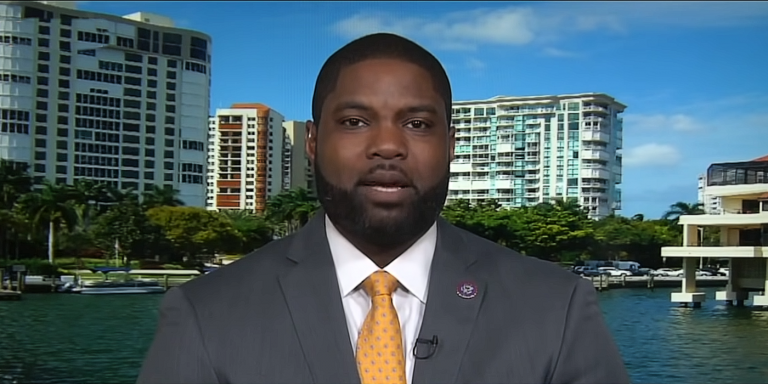
(Luis Cornelio, Headline USA) With less than two years to go before the next gubernatorial election in Florida, Republicans have been searching for their next candidate to replace Ron DeSantis. Luckily for them, President Donald Trump already has his pick.
Trump has endorsed none other than Rep. Byron Donalds, a renowned Florida Republican, as his pick for Florida governor in 2026. The incumbent, DeSantis, is term-limited.
“I know Byron well, have seen him tested at the highest and most difficult levels, and he is a TOTAL WINNER!” Trump said. “As governor, Byron would have a big voice, and would work closely with me to advance our America First Agenda.”
Trump added, “He will fight tirelessly to secure our border, stop migrant crime, strengthen our military, protect our vets, restore our economic power, advance American energy dominance, and defend our always under siege Second Amendment.”
Trump said should Donalds decide to run, he “will have my complete and total endorsement. Run, Byron, run!”
While Donalds has not yet officially announced his candidacy, he has reportedly told donors he planned to run.
After Trump’s endorsement, Donalds tweeted, “President Trump is Making America Great Again. I’m committed to working with him to Keep Florida Great. Announcement coming soon!”
President Trump is Making America Great Again.
I'm committed to working with him to Keep Florida Great.
Donalds, a two-term congressman, is a staunch MAGA supporter and is known for his witty and fiery comebacks in interviews with the leftist media.
He was first elected to the House of Representatives in 2021 after serving two terms in the Florida House of Representatives.
Donalds has been widely speculated as a future leader within the Republican Party. He was once considered a top contender for speaker of the House or even as Trump’s running mate in 2024.
Liberal outlet NBC News alleged that DeSantis had made calls to prop up Florida First Lady Casey DeSantis as a potential candidate for governor. However, it is unlikely that Casey DeSantis would win a primary without the endorsement of Trump, the formidable 47th president.
Other rumored contenders include former Rep. Matt Gaetz and former Florida Lt. Gov. Jeanette Nuñez.