Trump Moves to Shut Down Voice of America, State Media Outlets

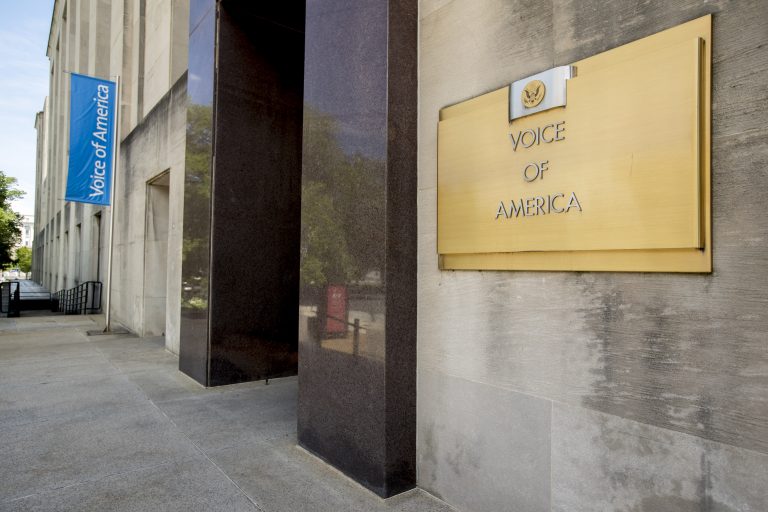
(Kyle Anzalone, Libertarian Institute) President Donald Trump has issued an executive order that will dismantle Voice of America, Radio Free Europe, Radio Free Asia, and other US state media outlets. A press release from the White House said that the outlets have adopted an increasingly progressive agenda.

On Friday, the President signed an executive order instructing “the non-statutory components and functions of the following governmental entities shall be eliminated to the maximum extent consistent with applicable law.” It continues, “And such entities shall reduce the performance of their statutory functions and associated personnel to the minimum presence and function required by law.”

The United States Agency for Global Media and the Woodrow Wilson International Center for Scholars were among the seven agencies facing closure. The US Agency for Global Media runs Voice of America, Radio Free Europe, and Radio Free Asia.

In a press release, the White House quoted long-time Voice of America staffer Dan Robinson who claimed the outlet had adopted a progressive bias. “I have monitored the agency’s bureaucracy along with many of its reporters and concluded that it has essentially become a hubris-filled rogue operation often reflecting a leftist bias aligned with partisan national media,” he said. “It has sought to avoid accountability for violations of journalistic standards and mismanagement.”

Trump recently appointed Keri Lake as the head of Voice of America. The Washington Post expects the executive order to lead to 3,500 employees of the state media outlets to be laid off.

The USAGM outlets are not allowed by law to broadcast in the US because they are Washington-funded propaganda. The outlets were founded during WWII or the Cold War to spread information in nations deemed enemies of the US.

This article originally appeared at The Libertarian Institute.

$3,000 Gold!

(Mike Maharrey, Money Metals News Service) On Friday, the spot price of gold topped $3,000 an ounce for the first time.

This is yet another milestone in a bull run that started last year.

Since the end of 2023, gold has climbed to $3,000 from $2,064, a 45.3 percent increase. The yellow metal is up 14.3 percent in 2025 alone.

Gold was not able to hold the $3,000 level. By the close on Friday, it was hovering around $2,996 an ounce. However, it pushed above $3,000 again Monday morning.

Given the significance of the $3,000 resistance level, it may take several runs to clear that hurdle. However, given the factors driving this bull run, there is every reason to believe it will continue beyond this milestone.

So, what is driving gold higher? And is it sustainable?

Factors Driving Gold Higher

Trade War

The blossoming trade war is the dynamic most often cited as the catalyst for this gold rally by mainstream media. Many analysts worry that increasing tariffs will drive consumer prices higher and drag down economic growth. The fact that President Trump is prone to quickly shift policy has also created a significant level of uncertainty. As Hargreaves Lansdown’s head of research, Victoria Hasler pointed out, “Markets hate uncertainty. This dynamic has helped to drive the gold price to new highs.”

The tariff threat has also contributed to significant structural shifts in the gold market, with tonnes of metal moving from London and Asia to New York.

While the trade war is in the spotlight, it is not the only factor driving gold higher.

“Though it feels like a psychological threshold, gold at $3,000 might just be a stepping-stone if trade wars deepen,” Cosmos Currency Exchange founder Tony Redondo told Yahoo Finance. “That said, it’s not all about Trump. Central banks, interest rate bets, geopolitical tensions, and inflation concerns are all stoking the flames.”

Recession Worries

 After insisting the economy was great for months, the mainstream has suddenly gotten jittery about a potential recession. The Atlanta Fed’s GDPNow forecast plunged from a 2.3 percent growth rate in late February to -2.8 percent within a matter of weeks.
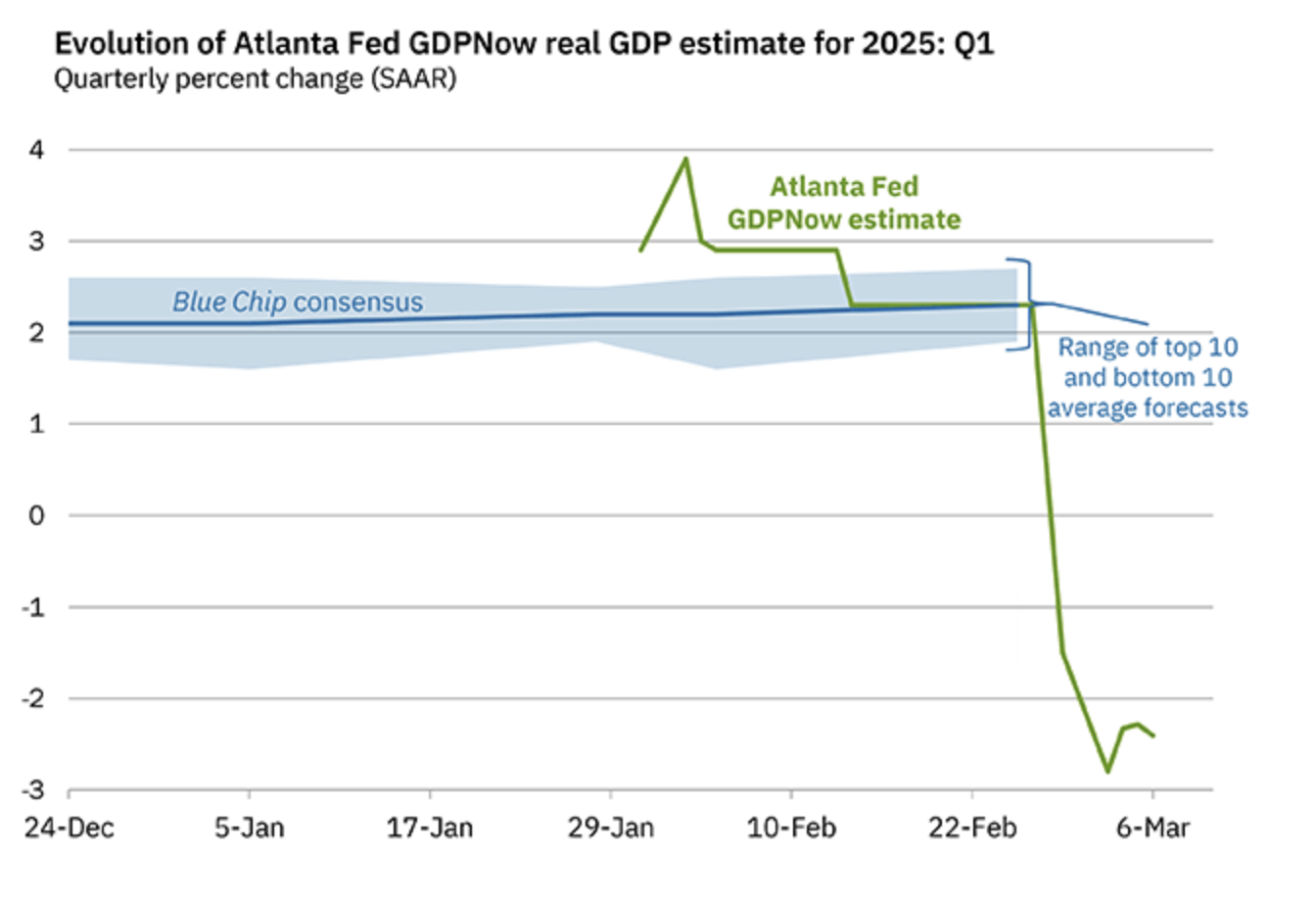
Mainstream analysts tend to blame the trade war for the sudden recession worries, but the economy has been poised for a downturn for well over a year. Decades of easy money in the wake of the 2008 financial crisis created significant distortions and malinvestments in the economy, along with a massive debt bubble. The central bank was forced to take the easy money drug away due to price inflation. However, this economy is not built to operate in a normal interest-rate environment. This is why the markets are desperate for rate cuts.

It’s likely too late for rate cuts to bail out the economy. The damage has been done, and it’s only a matter of time before we have to pay the price for those decades of monetary malfeasance. The economy is like a dry grassland during a drought. All it needs is a spark to catch fire. The trade war could be that spark.

This puts the Federal Reserve in a Catch-22. Given the escalating inflationary pressure, it needs to push hold rates steady or even push them higher. After all, it never did do enough to slay the inflation monster. The bottom line is that the inflation dragon isn’t dead. Sure, the Fed might have knocked it to the mat. But it’s not down for the count.

This is bullish for gold.

On the other hand, the central bank needs to cut rates because the economy is addicted to easy money. Given the levels of debt and the amount of malinvestment, the economy can’t function in this higher interest rate environment. It needs its easy money drug.

This is also bullish for gold.

Inflation Fears

The February CPI data gave markets a glimmer of hope, but price inflation remains well above the Fed’s 2 percent target. It’s also important to note that any “victory” over price inflation sets the stage for the central bank to create more inflation.

Rate cuts encourage borrowing. In turn, this boosts the money supply. This is, by definition, inflation. One of the symptoms of this monetary inflation is price inflation. In other words, any victory over price inflation opens the door for the Fed to resume the very policy that gave us higher price inflation to begin with.

There doesn’t seem to be a lot of mainstream worry about a resurgence of price inflation, but savvy gold investors recognize the fundamentals and are behaving accordingly.

A spokesperson for the World Gold Council summed it up:

“With rising inflation expectations, lower rates, and continued uncertainty, we continue to see support for gold looking ahead.”

Central Bank Gold Buying

Central banks have increased gold reserves by over 1,000 tonnes for three straight years. This constant demand has underpinned this entire gold rally.

To put it into perspective, central bank gold reserves increased by an average of just 473 tonnes annually between 2010 and 2021.

Analyst Adrian Day said there is no reason to think $3,000 gold will slow this institutional demand.

“Strong central bank buying continues, and gold will move above $3,000. That round number is not a barrier for foreign central banks, or indeed foreign buyers who price gold in their own currencies.”

Conclusion

While a significant milestone, $3,000 gold is likely just one more touchstone in a long-term bull market for gold.

Barchart Dot Com senior analyst Darin Newsom said gold is currently moving up on its own momentum.

“Neither fundamental nor technical analysis matters at this point. Gold is the safe-haven market at a time when global economics and politics are in a state of intentional upheaval. That’s the safest way I can describe the situation at this time.”

Walsh Trading co-director Sean Lusk told Kitco News that everything seems to be pointing in gold’s favor.

“You’ve got the central banks supporting it on any kind of sizable dips, increasing their holdings all across the world. On top of the fact that you have the geopolitical concerns that were real, now you have a trade war. It’s inspiring no confidence in equities for the near term here.”

We may see some profit-taking in the near term. Forex.com James Stanley told Kitco News that he thinks $3,000 will bring some sellers into the market, but he emphasized, “I’m only looking for pullbacks at this point rather than full-fledged reversals.”


Mike Maharrey is a journalist and market analyst for Money Metals with over a decade of experience in precious metals. He holds a BS in accounting from the University of Kentucky and a BA in journalism from the University of South Florida.


Trump and Putin To Discuss Potential Ukraine Ceasefire This Week

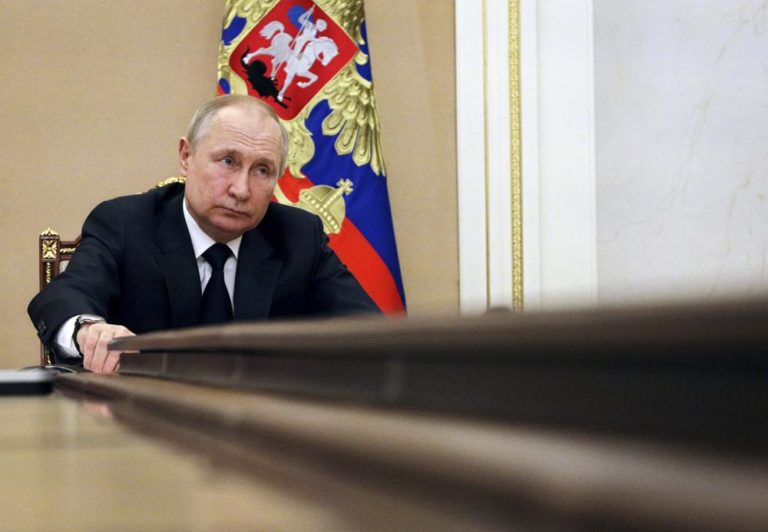
(Dave DeCamp, Antiwar.com) White House envoy Steve Witkoff said Sunday that President Trump will speak with Russian President Vladimir Putin this week to discuss the potential for a ceasefire in Ukraine.

“The two presidents are going to have a really good and positive discussion this week,” Witkoff said in an interview with CNN. “The two sides are a lot closer today than they were a few weeks ago. We narrowed the differences.”

Witkoff met with Putin and Moscow last week following the US announcement that it was resuming military aid and all intelligence to Ukraine and that Ukraine was ready to agree to a 30-day ceasefire.

Putin has welcomed the idea of a ceasefire but said it must include several conditions, including a guarantee that the US wouldn’t ship any new weapons to Ukraine during the truce. He also wants Ukraine not to mobilize new troops or train its forces.

Other Russian officials have made clear that they view the US-Ukraine ceasefire proposal as a chance for Ukraine to rearm and stabilize its lines of defense since the offer came as Russia has the clear advantage on the battlefield and continues to make gains in eastern Ukraine. Russia has also almost finished pushing Ukrainian forces out of Russia’s Kursk Oblast.

Trump said on Friday that he asked Putin to spare the lives of Ukrainian soldiers encircled in Kursk. “I have strongly requested to President Putin that their lives be spared. This would be a horrible massacre, one not seen since World War II,” he wrote on Truth Social.

Putin responded by saying the Ukrainian troops should surrender. “[In] the event of a ceasefire and surrender, they will be guaranteed life and a worthy treatment in accordance with the norms of international law and the laws of the Russian Federation,” he said.

Russia has also made clear that for any long-term peace deal, the US and Ukraine would have to recognize the four Ukrainian Oblasts annexed by Moscow as Russian territory. For their part, Ukrainian officials are insisting they won’t cede any territory.

Despite the differences, Witkoff said he expects a ceasefire to be reached “within weeks.” The idea is to reach a truce and then start negotiating the terms of a long-term deal.

This article originally appeared at Antiwar.com.


U.S. Says It Killed ISIS Second-in-Command in Iraq Airstrike

(Dave DeCamp, Antiwar.com) The US has announced an airstrike in Iraq that it claimed killed the deputy leader of ISIS.

US Central Command said that on March 13, its forces “conducted a precision airstrike in Al Anbar Province, Iraq, that killed the Global ISIS #2 leader, chief of operations and the Delegated Committee Emir – Abdallah Makki Muslih al-Rifai, alias ‘Abu Khadijah.’”

President Trump also announced the killing in a post on Truth Social. “Today the fugitive leader of ISIS in Iraq was killed,” he said. “He was relentlessly hunted down by our intrepid warfighters. His miserable life was terminated, along with another member of ISIS, in coordination with the Iraqi Government and the Kurdish Regional Government. PEACE THROUGH STRENGTH!”

Iraqi Prime Minister Mohammed Shia al-Sudani also announced that Abu Khadijah was killed, describing him as the “deputy caliph” of ISIS and as “one of the most dangerous terrorists in Iraq and the world.”

The US has continued military operations against ISIS in Iraq in recent years despite the government repeatedly saying it doesn’t need the US’s help against ISIS remnants. In 2024, Prime Minister Mohammed Shia al-Sudani called for the withdrawal of US and other foreign troops, and Washington and Baghdad entered talks about the US presence.

Those talks resulted in the US and Iraq announcing a deal to officially end the mission of the US-led anti-ISIS coalition by September 2025, but it said the US will remain in Iraq under a “bilateral partnership.” The Pentagon said at the time that the US was “not withdrawing from Iraq.”

This article originally appeared at Antiwar.com.


Hypocrite Sen. Murphy Confronted w/ Past Comments Opposing Gov’t Shutdown

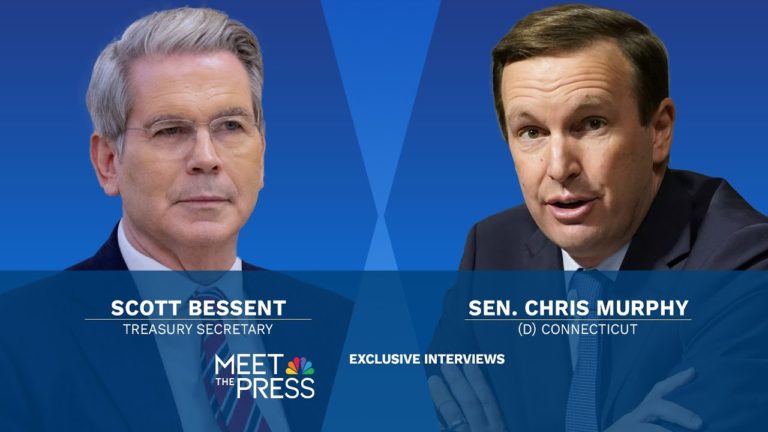
(Luis Cornelio, Headline USA) Sen. Chris Murphy, D-Conn., suddenly discovered his love for government shutdowns last week—but this was not always the case. It turns out that shutdowns are only permissible when Republicans are in power. 

Murphy appeared for an interview on NBC News’s Meet the Press, where host Kristen Welker—credit to her—forced him to eat his own words after he fiercely opposed government shutdowns in past years. 

“You have spoken forcefully in the past actually against shutting down the government. I want to play a little bit of that sound for you. Take a look,” Welker said, before cuing Murphy’s past remarks. 

During a 2013 speech on the Senate floor, Murphy declared: “This is no time to be playing around with people’s lives.” 

In 2019, he also said, “We need to start acting like adults. We need to start doing the job that we were sent here to do because our nation’s security is at stake.” 

In a video posted on X, Murphy added, “It’s hard to explain the ramifications of a shutdown, but they’re enormous. Head Start programs won’t open. Soldiers won’t get paid for defending this country. The consequences are absolutely devastating.” 

Yet, last week, Murphy was among the Democrats opposing a stopgap bill that would have funded the Trump administration through September. The bill passed on Friday, averting a shutdown for which Democrats would have been responsible. 

Asked what changed this time around, Murphy said: “Listen, I don’t think Americans would have understood, but they would have understood why we got there.” 

He continued, “If you are the majority party, you have an obligation to negotiate with the minority. Republicans refuse to do that. Again, never before has a spending bill been written by only one party, and at this moment, when the president is acting so unconstitutionally, it seems like the absolute wrong time to give him these new powers.” 

The Connecticut Democrat claimed he understood a “no” would have risked a government shutdown. “But I think the American public right now want us to stand up—Democrats—to stand up and take some risks,” he claimed. 

Abandonding his decades-long opposition to government shutdowns, Murphy said this time was unique. 

“Every single day, the president is engaging in exceptional tactics and risk-tolerant behavior, and I don’t think you save the republic and save our democracy by playing it straight and maintaining norms when the president is shattering them every single day,” he added. 

Fight against Politically Motivated Debanking Builds Momentum

(Casey Harper, The Center Square) Over the past few years, more Americans were surprised to learn that their bank suddenly closed their accounts, purportedly for their political views.

The process is called debanking, when a bank chooses to kick a customer out, often without any notice or explanation.

Critics say the Biden administration encouraged banks to remove politically controversial customers in the name of reputational risk. Florida’s Chief Financial Officer Jimmy Patronis sent a letter to U.S. Rep. Jim Jordan, R-Ohio, calling on him to investigate federal pressure on banks to oust customers.

“Debanking has exploded under Biden-Harris administration,” the letter said. “It must stop and bad actors must be held accountable.

“When customers are debanked and frozen out of their accounts, it’s often without justification or notice,” he added. “In addition, the use of ‘risk profiles’ likely includes subjective factors, such as political expression or Second Amendment rights, that amount to a social credit system.”

The fight against debanking is picking up steam. JPMorgan Chase last week announced that it is changing its Code of Conduct to prevent debanking for religious or political reasons.

“This is a major victory for free speech and religious freedom in the marketplace,” said Jeremy Tedesco, senior counsel at Alliance Defending Freedom, a religious freedom group that has been active on the issue. “As the nation’s largest bank, Chase sets the platinum standard for financial institutions throughout the country and the world. No American should ever fear losing access to their bank account because of their religious or political views, and we are glad to see Chase taking tangible steps to implement these critical protections. We expect Chase’s new policy to set the standard for the rest of the financial industry.”

Chase never admitted to debanking, but ADF points out that in 2022, U.S. Ambassador Sam Brownback’s National Committee for Religious Freedom was debanked.

U.S. Sen. Tim Scott, R-S.C. introduced legislation to fight the practice of debanking. His bill would remove “reputational risk” as a factor that federal regulators consider for financial institutions.

Scott’s office announced that The American Bankers Association, the Bank Policy Institute, the Blockchain Association, the Financial Services Forum, as well as the Online Lenders Alliance endorsed the bill.

“This discriminatory and un-American practice should concern everyone, which is why I’ve led my colleagues in working to find tangible solutions,” said Scott, who is chair of the Senate Banking Committee. “It’s clear that federal regulators have abused reputational risk by carrying out a political agenda against federally legal businesses. This legislation, which eliminates all references to reputational risk in regulatory supervision, is the first step in ending debanking once and for all.”

The Trump Organization this month filed a lawsuit against Capital One, alleging its accounts at the bank were closed for “political reasons” in June 2021.

“The decision by Capital One to ‘debank’ our company, after well over a decade, was a clear attack on free speech and free enterprise that flies in the face of the bedrock principles and freedoms that define our country,” the president’s son, Eric Trump, wrote on X. “Moreover, the arbitrary closure of these accounts, without justifiable cause, reflects a broader effort to silence and undermine the success of the Trump Organization and those who dare to express their political views.”

Capital One Bank denies the allegations.

Eric Trump went on to argue the lawsuit is necessary to hold companies accountable.

“Businesses should not be targeted or punished for their political affiliations,” the letter said. “The actions taken by Capital One and other major financial institutions represent a dangerous precedent that could threaten the operations of countless businesses across the nation, particularly those with a strong and independent voice.”

Alabama State Auditor Andrew Sorrell and 25 other state officials signed and sent a letter to leaders in the U.S. Congress calling for action on the issue. Sorrel told The Center Square the he, a gun store owner, was debanked multiple times. Sorrell says he was debanked because he is a gun store owner and that other owners are experiencing the same thing.

“As state financial officers, we believe that politicized debanking poses a serious threat not only to our nation’s economy and Americans seeking a fair and competitive financial system, but also to the financial health and reputation of the financial institutions engaging in this practice,” the letter said. “We support efforts that will bring us significantly closer to ending politicized debanking. As such, we enthusiastically support the reforms contained in the FIRM [Financial Integrity and Regulation Management Act] ACT.”

Yet Another Senior Democrat Politician Dies

(Headline USA) Democrats have been dropping like flies lately.

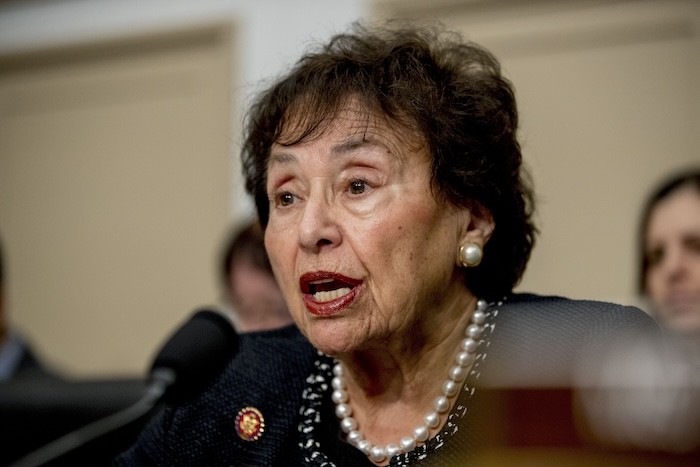
Two days after a sitting member of Congress died in office, former U.S. Rep. Nita Lowey, a long serving New York Democrat, died at the age of 87.

Lowey’s family, in a statement shared by the Westchester County Democratic Committee, said she died Saturday after battling metastatic breast cancer with the “same tenacity and strength that she fought throughout her 32-year career in Congress for women, children and families.”

The family said she passed away peacefully in her home in Harrison, New York, surrounded by her husband, children and grandchildren. Gov. Kathy Hochul, a Democrat who served with Lowey in Congress, ordered flags flown at half-staff Sunday through Monday in honor of her former colleague.

Lowey represented suburban communities north of New York City, including parts of Westchester County and the Hudson River Valley.

She was elected to Congress in 1988 and served until she opted to retire rather than seek reelection in 2020.

Lowey died two days after Rep. Raúl M. Grijalva, D-Ariz., passed away Thursday—making him the second Democrat to die in office in as many weeks.

Grijalva died of complications from cancer treatment, his office said in a statement. The treatments had sidelined him from Congress in recent months.

He stepped down as the top Democrat on the Natural Resources committee earlier this year, after announcing that he planned to retire rather than run for reelection in 2026.

Another Democratic House member, Rep. Sylvester Turner of Texas, died last week from health issues.

Turner, in turn, had replaced U.S. Rep. Sheila Jackson Lee, who died last July after being diagnosed with pancreatic cancer.

Adapted from reporting by the Associated Press

2024 Loser Tim Walz Derisively Refers to Obama’s ‘African Friend’

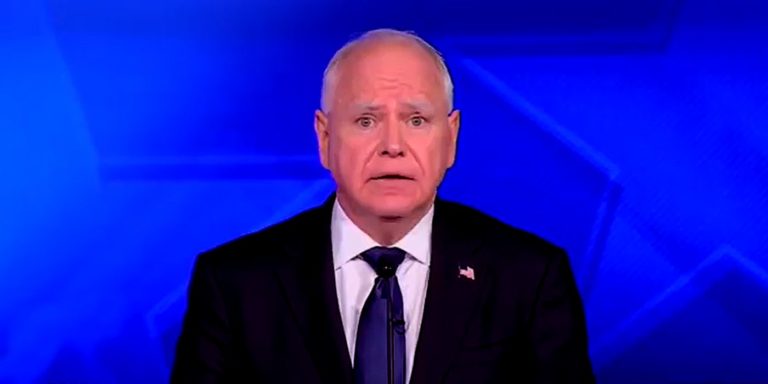
(Luis Cornelio, Headline USA) Minnesota Gov. Tim Walz launched a racially charged attack on tech mogul Elon Musk during an Iowa town hall meeting, even invoking former President Barack Obama in a bizarre analogy. 

Walz—who lost the 2024 vice presidential election—scolded Musk as an “African,” borrowing language from his Democratic colleagues to scold the X owner. 

“There’s nothing conservative about an unelected South African nepo baby firing people at the VA. … Can you imagine if President Barack Obama had brought his unelected African friend to cut—you know what I mean—to cut the government,” Walz told a small crowd of supporters on Friday. 

“This is wrong,” he added. 

Walz’s misleading remarks alluded to Democratic claims that Musk, a senior adviser to President Donald Trump’s DOGE initiative, is carrying out mass firings in the federal government.

In reality, Musk has not fired any workers, as he lacks such authority. Instead, he has been identifying government waste and fraud for Trump to address. 

Walz’s incendiary rhetoric comes as he tries to position himself as a potential candidate for president in 2028. 

Walz joins a growing list of Democratic politicians resorting to racist attacks against Musk—a naturalized U.S. citizen born in South Africa.  

The Musk-targeted onslaught has spurred online petitions demanding that he be deported or denaturalized. 

Rep. Marcy Kaptur, D-Ohio, appeared to endorse these efforts, questioning Musk’s loyalty to the United States based on his South African heritage. 

“Mr. Musk has been here 22 years and he’s a citizen of three countries. I always ask myself the question: with the damage he’s doing here, when push comes to shove, who is he going to be loyal to? South Africa, Canada or the United States?” Kaptur asked in February.

“He’s only been a citizen—I’ll say it again—22 years,” she added. 

These remarks starkly contrast with Kaptur’s past statements defending foreign nationals during the first Trump administration. In 2018, she denounced Trump’s criticism of “sh*thole countries” as “un-American, racist and cruel.” 

On her own website, Kaptur celebrated her foreign ties as the “daughter” of a “Polish-American” family. 

Judge Orders Flight of Illegals to Return; Trump Deports Them Anyway

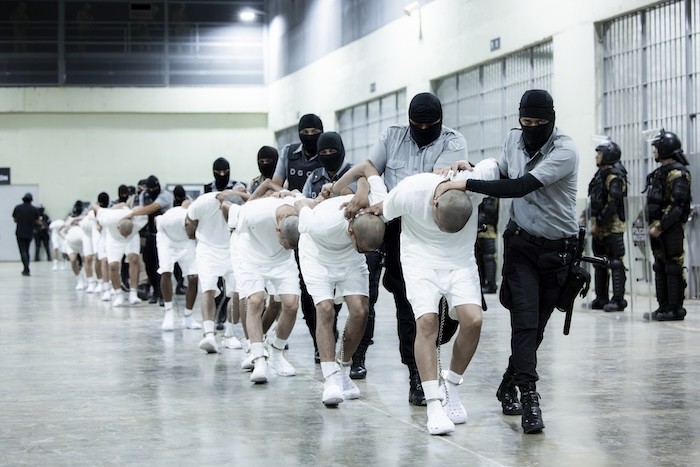
(Luis Cornelio, Headline USA) The Trump administration successfully deported hundreds of violent Venezuelan gang members to El Salvador on Saturday, in opposition to an activist judge’s attempt to keep them on U.S. soil. 

The deported illegal aliens—all accused members of the Tren de Aragua gang—were removed under President Donald Trump’s invocation of the 18th-century Alien Enemies Act.

U.S. District Judge James Boasberg ordered the Trump administration to cease all ongoing deportations and mandated that any flights carrying illegal aliens be returned to the U.S., according to Axios. 

However, the order did not stop the flight carrying 200 illegal aliens bound for El Salvador, as Boasberg’s ruling allegedly lacked jurisdiction over international waters. The White House also maintained that the judge’s mandate exceeded his authority. 

“This is headed to the Supreme Court. And we’re going to win,” a White House official told Axios. 

The ACLU, backed by media support from the Democratic Party, launched legal action challenging Trump’s enactment of the Alien Enemies Act, claiming that he plans to use it unlawfully to expedite the deportation of illegal aliens. 

“The Trump administration’s intent to use a wartime authority for immigration enforcement is as unprecedented as it is lawless. It may be the administration’s most extreme measure yet, and that is saying a lot,” said ACLU attorney Lee Gelernt in a press statement. 

White House press secretary Karoline Leavitt dared Democrats to further support the lawsuit, which explicitly sides with some of the most violent gang members in the U.S. 

“If the Democrats want to argue in favor of turning a plane full of rapists, murderers, and gangsters back to the United States, that’s a fight we are more than happy to take,” Leavitt told Axios. 

El Salvador President Nayib Bukele shared a video on X showing the illegal aliens being removed from an airplane and loaded into police trucks before being transported to high-security prisons. 

In another post, Bukele trolled Boasberg’s ruling that demanded that flights be returned to the U.S.  

“Oopsie… Too late,” he wrote, along with a laughing emoji and a screenshot of a New York Post headline about the order. 

Steve Vladeck, a professor at the Georgetown University Law Center, said that Boasberg’s verbal directive to turn around the planes was not technically part of his final order but that the Trump administration clearly violated the “spirit” of it.

The immigrants were deported after Trump’s declaration of the Alien Enemies Act of 1798, which has been used only three times in U.S. history.

The litigation that led to the hold on deportations was filed on behalf of five Venezuelans held in Texas who lawyers said were concerned they’d be falsely accused of being members of the gang. Once the act is invoked, they warned, Trump could simply declare anyone a Tren de Aragua member and remove them from the country.

Boasberg barred those Venezuelans’ deportations Saturday morning when the suit was filed, but only broadened it to all people in federal custody who could be targeted by the act after his afternoon hearing. He noted that the law has never before been used outside of a congressionally declared war and that plaintiffs may successfully argue Trump exceeded his legal authority in invoking it.

The bar on deportations stands for up to 14 days and the immigrants will remain in federal custody during that time. Boasberg has scheduled a hearing Friday to hear additional arguments in the case.

He said he had to act because the immigrants whose deportations may actually violate the U.S. Constitution deserved a chance to have their pleas heard in court.

The Associated Press contributed to this report.

U.S. Attacks Yemen as Trump Vows ‘Overwhelming Lethal Force’: 24 Killed

(Dave DeCamp, Antiwar.com) US airstrikes are reportedly hitting the Yemeni capital city of Sanaa today, with President Trump promising “overwhelming lethal force” against the Houthi movement in northern Yemen unless they stop all attacks on international shipping.

Early casualty figures indicate a lot of civilians have been killed or wounded. The most recent figures from al-Mayadeen were at least 24 killed and many more wounded.  10 civilians were killed in Sanaa alone.

Trump said that he had decided to launch “decisive and powerful military action” against the “Houthi terrorists,” accusing them of piracy against Americans. He also condemned former President Joe Biden for being “pathetically weak” and said no American commercial ship had gone through the Suez Canal in over a year.

Like many of the important US declarations of war these days, President Trump’s announcement came via a post on his social media application Truth Social, and was punctuated with all caps screeds railing about hell raining down on Yemen “like nothing you have ever seen before!”

Trump also notably took time out from announcing attacks on the Houthis to threaten Iran in the post, insisting that if Iran continues to support the Houthis and the Houthis do anything to threaten Trump “who has received one of the largest mandates in Presidential History” he would hold Iran responsible and “won’t be nice about it.”

The US has been backing military action against the Houthis in Yemen for many years now, dating back to the Saudi-led invasion of Yemen in 2015. That invasion was predicated on the idea of reinstalling President Abd Rabu Mansour Hadi, who was a close ally of the Saudis. Hadi had resigned a few months before the invasion.

The Saudi invasion resulted in a protracted war, leaving Saudis and their allies in control of much of historical Southern Yemen, but the Houthis retained the north, including Sanaa. The US for years backed the on-again, off-again offensives against central Yemen, trying to push toward Sanaa, but that ultimately never happened.

The Houthis became a bigger deal internationally after the Israeli war in the Gaza Strip. The Houthis made of policy of attacking Israeli-linked vessels passing by their area, and picked that up to include many commercial vessels, leading major shipping companies to avoid the area. Under President Biden, the US, Israel and UK launched airstrikes on the Houthis multiple times, though it did not result in any halt of strikes on ships.

The Houthis did, however, briefly stop attacks when the Israel-Gaza ceasefire was announced, though they have resumed attacks on Israelis in recent weeks because Israel is blocking humanitarian aid from entering the Gaza Strip.

The Houthis reportedly sank two boats in 2024, and President Trump claims they cost the US economy “billions of dollars.” It’s difficult to quantify the actual cost, though the Suez Canal was a popular shipping route and many are avoiding it now in favor of safer options.

Multiple strikes hit Sanaa itself, many of the US airstrikes are reportedly targeting the Houthis’ defensive capabilities, including missile systems and air defenses. Details are still coming in regarding the extent of the damage.

This article originally appeared at Antiwar.com.