(José Niño, Headline USA) On Tuesday, Google confirmed that it is buying cloud security startup Wiz for $32 billion in an all-cash transaction. This acquisition is the largest in the tech giant’s history. Wiz is set to operate as an independent platform, maintaining compatibility with multiple cloud providers beyond just Google Cloud.
The deal still needs to go through other regulatory hoops before it is officially closed. The company expects the deal to be fully consummated in 2026. Prior to the Wiz purchase, Google’s biggest acquisition took place in 2011, when it purchased Motorola Mobility for $12.5 billion
The primary actors who midwifed the deal were Thomas Kurian, the CEO of Google Cloud, and Assaf Rappaport, the CEO of Wiz. Although Wiz is headquartered in New York City, Rappaport is an Israel national who served in Unit 8200—an elite intel unit comparable to the U.S. National Security Agency.
“Google Cloud and Wiz share a joint vision to make cybersecurity more accessible and simpler to use for organizations of any size and industry,” Kurian declared in a statement published on March 18. “Enabling more companies to prevent cyber attacks, including in very complex business software environments, will help organizations minimize the cost, disruption and hassle caused by cybersecurity incidents.”
Rappaport’s background immediately caught the attention of independent journalists on Twitter. Nate Bear, the publisher of the Substack newsletter ¡Do Not Panic!, noted that Google’s purchase of “Wiz will mark the single largest transfer of former Unit 8200 Israeli spies into any American company.”
Google's acquisition of Israeli cybersecurity company Wiz will mark the single largest transfer of former Unit 8200 Israeli spies into any American company. All Wiz founders are former 8200 as are dozens of staff, from office managers to product analysts to software engineers https://t.co/FWnWK8XP7T
Rappaport’s connections with fellow Unit 8200 members such as Roy Reznik, Ami Luttwak, and Yinon Costica played a key role in the founding of cloud security company Adallom in 2012, which ended up being sold to Microsoft in September 2015.
Wiz co-founder Luttwak led a “mission critical R&D team” for Unit 8200, a unit that wrote the programming which automated Israel’s punitive military campaign in Gaza.
Wiz co-founder Ami Luttwak led a "mission critical R&D team" for Unit 8200, a unit that wrote the programming which automated the genocide of Gaza. Luttwak and team won the 'Israel Defence Award 2012' for his work in 8200
Bear highlighted that Rappaport, Luttwak, Costica, and Reznik are all former Unit 8200 members who served beyond mandatory service. He also has a list of close to “50 former Unit 8200 members who are current Wiz employees.”
The other co-founders of Wiz – Assaf Rappaport, Yinon Costica and Roy Reznik – are all former Unit 8200 members who served beyond mandatory service. I have a list of around 50 former Unit 8200 members who are current Wiz employees
The U.S. tech sector has become increasingly intertwined with elements of the Israeli government in recent years.
For example, IQT, formerly known as In-Q-Tel, a venture capital firm with a unique and close relationship to the Central Intelligence Agency (CIA) recently made its first investment in Israeli startup Kela, contributing to the total $39 million raised by the company in recent founding rounds.
Kela’s mission consists of integrating “commercial and military technologies, for applications such as border defense.” IQT official Clayton Williams claimed Kela’s experience in helping Israel prosecute its war in Gaza is why the CIA is interested in funding it.
Outside of the tech sector, the Justice Department also announce this week that the FBI is embedding agents in Israel’sNational Bureau for Counter-Terror Financing (NBCTF), which is under the purview of Israel’s Ministry of Defense.
José Niño is the deputy editor of Headline USA. Follow him at x.com/JoseAlNino
(Ken Silva, Headline USA) The Fourth Circuit Appeals Court ruled this week that the son of alleged would-be Trump assassin Ryan Routh is to remain in jail pending his sentencing for possessing child pornography.
The son, Oran Routh, was arrested last September after agents searched his home in connection to his father’s alleged Sept. 15 assassination attempt on Donald Trump at his Florida golf course. Oran pled guilty to one count of possessing child pornography in January.
Up until his guilty plea, Routh had been on house arrest. He’s now in jail, but filed an appeal last month to be released until his official May 14 sentencing on the grounds that he’s in danger from other inmates.
In his appeal, Oran argued that the notoriety of his father has made him a marked man in prison. Being convicted of possessing child porn hasn’t helped his cause, either, he added.
Last week, the DOJ opposed Oran’s appeal, telling the Fourth Circuit that he doesn’t have a valid case to get out of jail.
“Though Routh’s circumstances may be unusual, he has not shown evidence of any specific threats or vulnerabilities during his previous or current detention. Instead, he has pointed only to news articles regarding his and his father’s charges and offered speculation regarding potential harms,” the DOJ’s lawyers argued.
“On this record, the district court did not clearly err in determining Routh’s circumstances do not constitute ‘exceptional reasons’ why his detention is inappropriate, and correctly denied Routh’s motion for release pending sentencing.”
The Fourth Circuit sided with the DOJ in a one-page decision filed Monday.
Unsurprisingly, an appeals court ruled this week that Ryan Routh's son must stay in jail pending his May 14 sentencing for possessing CP. It was a 1-page decision https://t.co/Mt2Lq1pbJ5pic.twitter.com/6Jae1JOpfV
“Upon review of memoranda relative to this bail appeal, the court affirms the district court’s order regarding release,” the appeals panel said.
Law enforcement started investigating Oran for child pornography in late 2023, when the National Center for Missing & Exploited Children, or NCMEC, flagged a video allegedly on his phone. NCMEC passed that tip along to the Guilford County Sheriff’s Office, which visited his mother’s home last February. Law enforcement didn’t follow up until Oran’s father allegedly tried to kill Trump.
Oran faces up to 20 years in prison. His father faces trial for attempted assassination in September.
Ken Silva is the editor of Headline USA. Follow him at x.com/jd_cashless.
(Mike Maharrey, Money Metals News Service) Record prices have dampened Indian gold jewelry demand but continue to drive investment buying.
India ranks as the world’s second-largest gold market.
The gold market dynamics in India are similar to those in China.
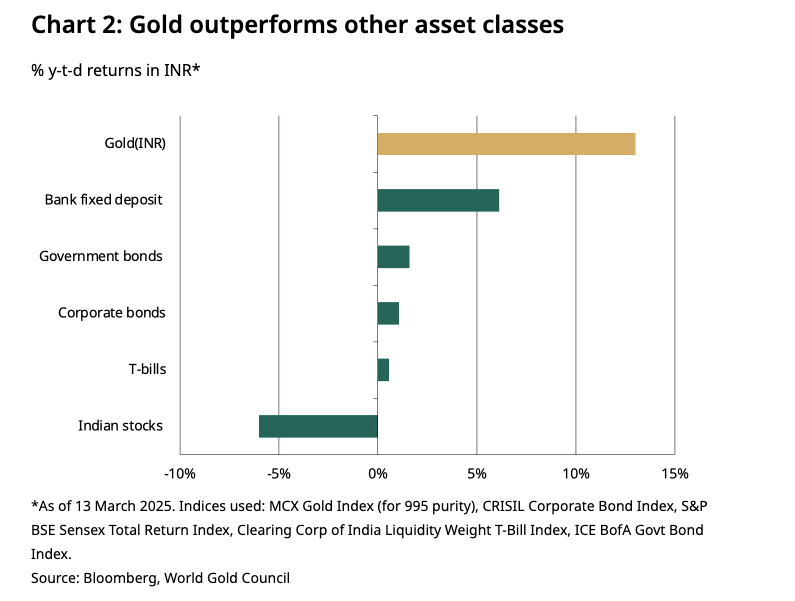
The price of gold is up 13 percent in rupee terms year-to-date, and the yellow metal ranks as the country’s best-performing asset in 2025.
Gold has hit record highs 13 times this year in dollar terms, with the price increasing even faster in rupee terms due to the weakening of the Indian currency against the dollar.
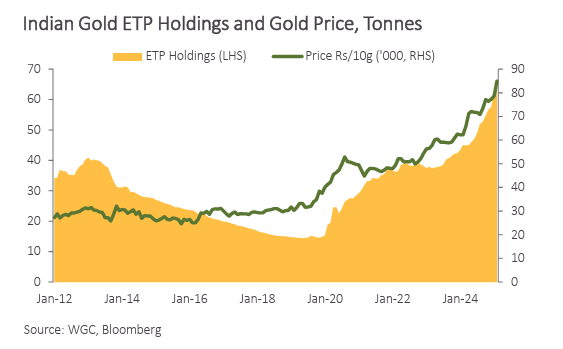
The rising price of gold has attracted significant investment interest as reflected by the growth in Indian gold ETFs.
A gold ETF is backed by a trust company that holds metal owned and stored by the trust. In most cases, investing in an ETF does not entitle you to any amount of physical gold. You own a share of the ETF, not gold itself. ETFs are a convenient way for investors to play the gold market, but owning ETF shares is not the same as holding physical gold.
About 2.2 tonnes of gold flowed into India-based ETFs last month, pushing collective holdings to 64.6 tonnes.
In rupee terms, ETF holding surged by ₹19 billion ($227 million). This was off the record pace in January but still far above average.
This occurred despite significant ETF redemptions, reflecting some profit-taking as gold prices surged.
According to the World Gold Council, broadening investor interest amid global economic and market uncertainty and the positive momentum in the gold price drove ETF inflows.
Demand for gold coins and bars has also remained strong with many investors anticipating further price increases.
While the rising price has sparked investor demand, it is putting a significant drag on the jewelry market. According to the World Gold Council, Indians are limiting themselves to “need-based” purchases, primarily for weddings.
“In addition, financial year-end dynamics, such as statutory payments and tax-saving investments, are curtailing discretionary spending and further weighing on demand. This slowdown is broad-based across both urban and rural areas.”
Along with slowing sales, many Indian jewelers also report increased consumer selling as people rush to lock in profits at higher prices. According to the World Gold Council, “Retailers have reported a significant uptick in scrap or old gold sales, with some attributing up to a third of their sales to the exchange of old jewelry for newer, lighter pieces.”
Many Indian consumers appear to be “waiting on the sidelines,” hoping for a price correction or at least some sign of price stability. However, it is likely demand will return at some point due to the cultural and economic significance of jewelry.
Gold jewelry is viewed differently in India than in the West. It is seen as not only an adornment but also an investment. Much Indian jewelry is made from pure 24-carat gold, as opposed to the 14- and 18-karat pieces more common in the U.S. and Europe. Many Indian families use gold jewelry as savings.
Indian demand is also heavily influenced by cultural and religious traditions that inform the best times for purchases and gift-giving. Some individuals may avoid making major purchases during certain phases of the lunar calendar, believing that these times bring bad luck.
According to the World Gold Council, market dynamics may shift toward higher gold jewelry demand in the next couple of months due to seasonal factors (auspicious days and festivals), along with an increase in wedding-related purchases.
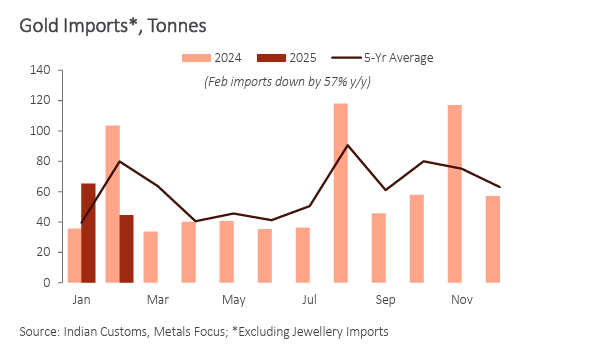
The dip in jewelry demand is reflected in falling gold imports.
Based on preliminary data, between 25 and 30 tonnes of gold flowed into India in February. It was the lowest import level since March 2024 and reflects a downward trend since record high imports in November.
Indians historically have an affinity for gold. While it’s hard to know for sure exactly how much gold Indians hold because of the amount of metal circulating in the underground economy, the best estimate is that Indian households own more than 25,000 tons of gold.
Gold is deeply interwoven into the country’s marriage ceremonies, along with its religious and cultural rituals. Festival seasons typically boost gold demand.
Indians have long valued the yellow metal as a store of wealth, especially in poorer rural regions. Around two-thirds of India’s gold demand comes from beyond the urban centers, where large numbers of people operate outside the tax system. Many Indians use gold jewelry not only as adornment but as a way to preserve wealth.
In the West, gold is generally viewed as a luxury item. Not in India. Even poor Indians buy gold. According to a 2018 ICE 360 survey, one in every two households in India had purchased gold within the last five years. Overall, 87 percent of Indian households own some gold. Even households at the lowest income levels in India hold some of the yellow metal. According to the survey, more than 75 percent of families in the bottom 10 percent of income managed to buy some gold.
The yellow metal was a lifeline for Indians buffeted by the economic storm caused by the government’s response to COVID-19. After the Indian government locked down the country, banks tightened credit to mitigate the default risk. Unable to secure traditional loans, Indians used gold to secure financing. As Indians endured a second wave of lockdowns, many Indians resorted to selling gold outright to make ends meet.
Mike Maharrey is a journalist and market analyst for Money Metals with over a decade of experience in precious metals. He holds a BS in accounting from the University of Kentucky and a BA in journalism from the University of South Florida.
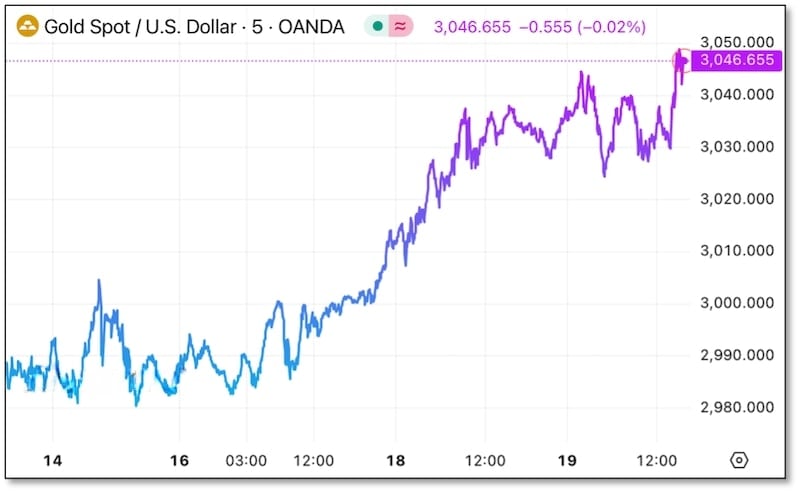
(Brien Lundin, Money Metals News Service) Gold has not only held the lofty $3,000 line, it’s advanced well beyond. This raises the question…why?
After a dizzying run to $3,000 that has stunned even the most ardent gold bulls, the yellow metal has continued to climb.
Count me among the dumbfounded bulls. I stood in awe at how easily gold had achieved the latest millennium number, even as it was hesitating at $3,000. But since then, the run has continued, punctuated by a $34 jump yesterday even as other asset classes were diving.
Today, gold gained once again in the wake of the Fed’s policy statement and during Chairman Powell’s press conference. The reason, I believe, is because there were no big surprises in anything from the Fed today.
Thus, the rationale for higher gold prices remaining the same, and the uptrend quickly reset.
That rationale is multi-faceted, ranging from recognition of the necessity to lower rates in the face of untenable debt service costs at current levels, the inflationary implications of the new tariff policies, and the increasing likelihood of a recession as the economic uncertainty works its way through the economy.
More generally, I believe the tremendous rally we’ve seen in gold over the past two months, and even over the past year, is telling us something about the future. The markets are predictive mechanisms, and none are more sensitive than gold. Just as gold rose post-Covid as it discounted the eventual inflationary reaction to the Fed’s easy-money rescue efforts, it’s predicting something ahead today.
That “something” is likely some combination of easier money and higher inflation.
Being gold bugs and natural contrarians, a move like we’re seeing tends to set our Spidey senses tingling, wondering if gold is getting ahead of itself…and whether the market is about to slap us upside the head with a figurative 2 x 4.
I’m comforted, however, by the fact that we’re starting to see Western investors coming into the metals and miners in force…and those money flows could soon increase substantially.
Consider that gold has far outpaced every other asset class this quarter. Not only has the bloom come off the roses in tech equities, AI stocks, and Bitcoin — all of which have robbed gold of very significant speculative funds — but gold has risen relentlessly even as those assets have fallen.
In the trend-following world of managed money, that outperformance is going to attract ever greater fund allocations like moths to a flame. The trend, already in place, will accelerate after first quarter reporting.
The news will get even better for gold and silver stock investors, as the hot money will look for ways to leverage gold’s move…and they will discover that mining equities remain dramatically undervalued.
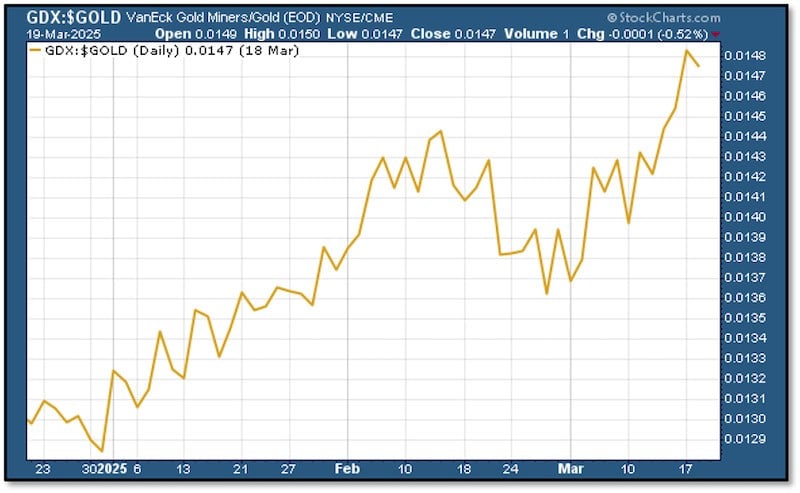
It’s already happening to some extent, as the chart below of the GDX/gold ratio shows how mining stocks have been generally outperforming the metal since the beginning of the year. In short, investors have been aggressively moving into gold equities.
This outperformance is especially remarkable when you consider how steeply gold has been rising. For mining stocks to do even better is quite something.
There’s even better news for readers of our Gold Newsletter and Gold Newsletter Alert service, as the junior mining stocks in our portfolio are leading the charge upward.
I’ve come up with a number of exciting new stock picks over the past few weeks, some of which are already taking off, while others remain on the launch pad.
I cannot emphasize enough how special this opportunity is. The gold equities, and the juniors in particular, remain tremendously undervalued — especially with respect to where gold and silver are now trading.
This is easily the most compelling market environment that I’ve seen in four decades in this sector.
You should view my presentation at the recent Metals Investor Forum to see more details on why…but most importantly, you should click on the link below to subscribe to the Gold Newsletter or our alert service.
Believe me, you’ll be kicking yourself if you miss this opportunity.
To get Brien Lundin’s ongoing commentary on the markets at no charge, click here to subscribe to his free Golden Opportunities newsletter.
Brien Lundin is the publisher and editor of Gold Newsletter, the publication that has been the cornerstone of precious metals advisories since 1971. Mr. Lundin covers not only resource stocks but also the entire world of investing. He also hosts the annual New Orleans Investment Conference. To get Brien Lundin’s ongoing commentary on the markets at no charge, click here to subscribe to his free Golden Opportunities newsletter.
The Federal Reserve loosened monetary policy significantly during the March FOMC meeting that wrapped up Wednesday.
“But wait,” you say. “The Fed held interest rates steady, right?”
Yes. Yes, they did.
The federal funds rate remains set between 4.25 and 4.5 percent. And that was the headline on virtually every mainstream report about the meeting. But that wasn’t the most significant news coming out of the Fed meeting.
So, was the big news that the Fed still anticipates two rate cuts in 2025?
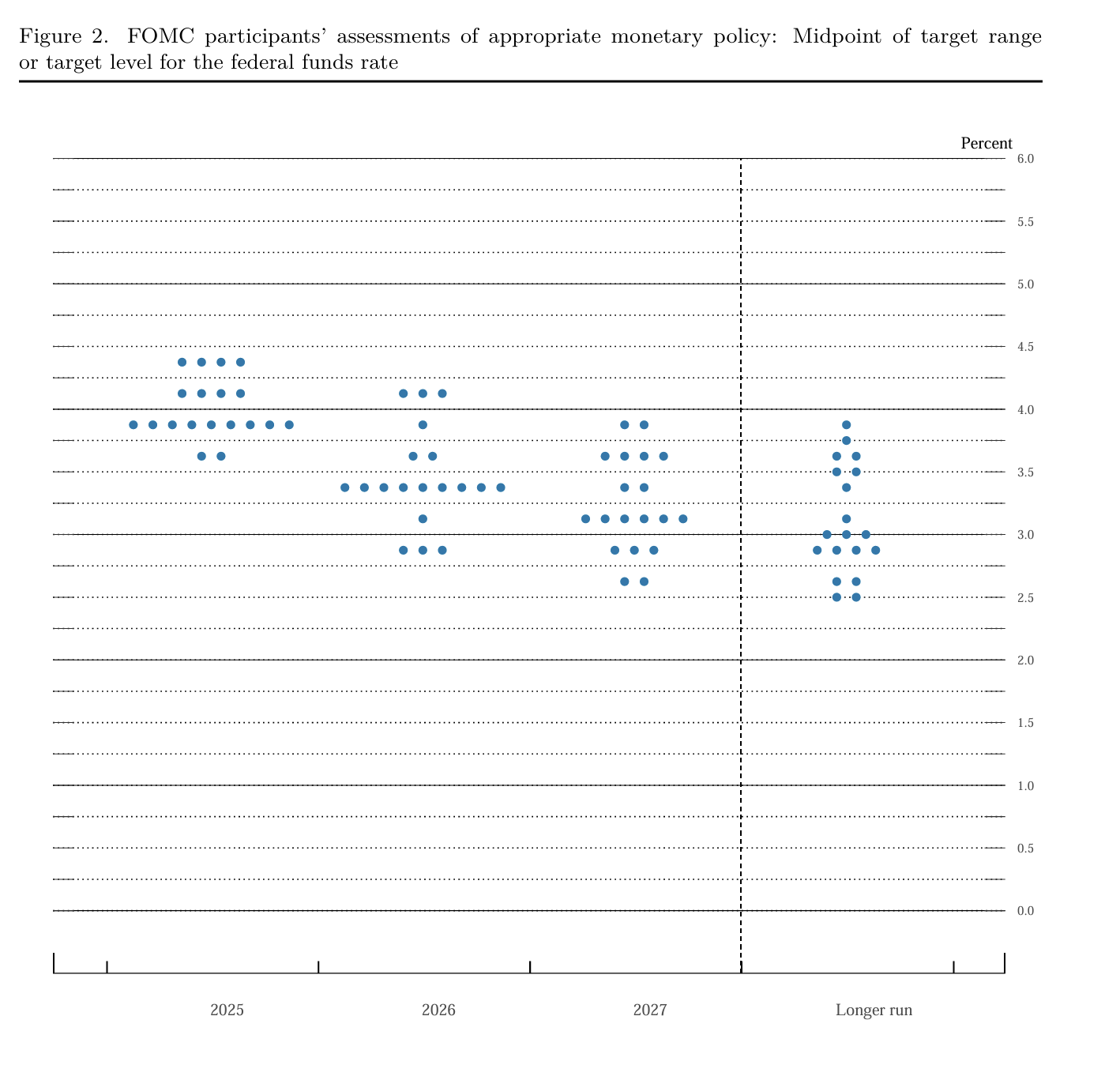
That’s true as well. The FOMC released a new dot plot charting the anticipated trajectory of rates over the next couple of years. The majority of committee members expect a 50-basis point easing of rates this year.
However, Federal Reserve Chairman Jerome Powell left plenty of wiggle room for a shift in policy – in either direction.
“If the economy remains strong, and inflation does not continue to move sustainably toward 2 percent, we can maintain policy restraint for longer. If the labor market were to weaken unexpectedly, or inflation was to fall more quickly than anticipated, we can ease policy accordingly.”
But that wasn’t the big news either.
So, was it the fact that Powell & Company seems really worried about the impact of tariffs?
Well, they are certainly setting up tariffs as a scapegoat for any future resurgence in price inflation. The FOMC statement noted that “uncertainty around the economic outlook has increased,” and during his post-meeting press conference, Powell said, “I do think with the arrival of the tariff inflation, further progress may be delayed.” Powell also claimed that a “good part” of the central bank’s higher inflation expectation comes from tariffs.
However, the fundamental cause of price inflation is monetary policy. Tariffs will put upward pressure on a lot of prices. This will be reflected in the CPI. But tariffs don’t raise all prices. (You can read a detailed explanation of tariffs and inflation here.)
An increase in the supply of money and credit is the source of generalized price inflation. Monetary inflation causes the general price level to rise. Price inflation is a symptom of monetary inflation.
Given that the central bank never did enough to unwind the massive amount of monetary inflation it created in the wake of the 2008 financial crisis and during the pandemic, it will need a convenient scapegoat when price inflation remains above its mythical target.
But that wasn’t the big news either.
The Big News
As I mentioned the Federal Reserve did make a big move during the March meeting, but it largely flew under the radar.
The Fed will drastically slow its balance sheet reduction process beginning in April.
Instead of allowing $25 billion in Treasuries to roll off the balance sheet each month, it will cap the runoff at $5 billion.
In other words, the runoff of Treasuries will slow to a snail’s pace.
The $35 billion cap on the reduction of mortgage-backed securities will remain in place, although the central bank has rarely hit that level.
This is a significant loosening of monetary policy. In fact, I would argue it is far more significant than a quarter-percent rate cut. As one analyst told CNBC, “The Fed indirectly cut rates today by taking action to reduce the pace of runoff of its Treasury holdings.” [Emphasis added]
Inflation and the Fed Balance Sheet
The balance sheet serves as a direct pipeline to the money supply. When the Fed buys assets – primarily U.S. Treasuries and mortgage-backed securities – it does so with money created out of thin air. Those assets go on the balance sheet and the new money gets injected into the financial system and ultimately the broader economy.
Before the 2008 financial crisis and Great Recession, the balance sheet was just over $900 billion. By the end of the pandemic era, it stood at just under $9 trillion.
In other words, the Fed pumped over $8 trillion into the economy in 14 years through QE alone. That was on top of the money created by bank lending incentivized by artificially low interest rates.
When Ben Bernanke launched the first round of QE at the onset of the Great Recession, he assured Congress that the Fed was not monetizing debt. He said the difference between debt monetization and the Fed’s policy was that the central bank was not providing a permanent source of financing. He said the Treasuries would only remain on the Fed’s balance sheet temporarily. He assured Congress that once the crisis was over, the Federal Reserve would sell the bonds it bought during the emergency.
That never happened.
And then the Fed doubled down, expanding the balance sheet by nearly $5 trillion during the pandemic.
The Fed announced a balance sheet reduction plan in March 2022 when it could no longer convince everybody that price inflation was “transitory.” The plan wasn’t exactly ambitious given the amount of inflation it created during the pandemic. If the Fed followed the blueprint (and it didn’t), it would take 7.8 years for the Fed to shrink its balance sheet back to pre-pandemic levels. This doesn’t even account for the trillions added in the wake of the 2008 financial crisis.
The money supply began shrinking in April 2022 due to a combination of quantitative tightening and interest rate hikes. (The first hike of the cycle was in March 2022.)
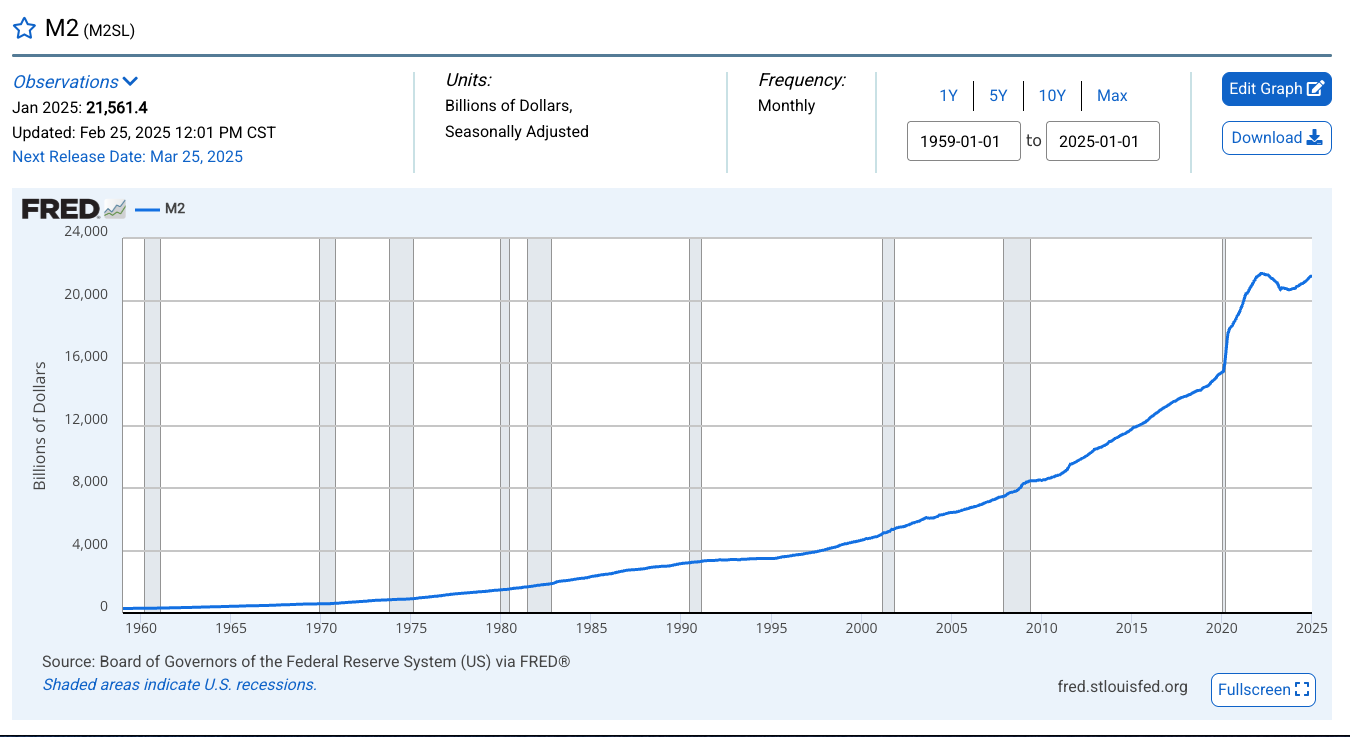
The M2 money supply bottomed in October 2023 at $20.69 trillion. Since then, it has crept upward. As of January, it was at $21.56 trillion. That’s the highest level since January 2022.
In other words, despite all the talk about fighting price inflation, the central bank has been creating monetary inflation (the cause of price inflation) for over a year.
And it just announced plans to speed up that process.
That should be the headline coming out of this Federal Reserve meeting.
Why Slow Balance Sheet Reduction Now?
Given the concerns about sticky price inflation and the conceding that the path forward appears murky at best, why would the central banker make such a significant easing move now?
It’s the national debt, my friends.
The Fed telegraphed this policy shift in the minutes of the January FOMC meeting, which according to Reuters “showed central bankers concerned about how the effort to shed bonds might collide with dynamics around the federal debt ceiling.” Based on the minutes, “various” policymakers said they were open to pausing or slowing the reduction of Fed-owned Treasury and mortgage bonds to navigate uncertain money market conditions as Congress sorts out government finances and a statutory cap on the federal debt that came back into force last month.”
The federal government ran up against the debt ceiling at the beginning of the year. In effect, it means the government can’t borrow any money until Congress raises the ceiling. (You can read more about the debt ceiling, its history, and its ramifications HERE.)
To keep funding federal deficits, the U.S. Treasury is employing “extraordinary measures,” that include pausing some funding, along with redeeming existing investments and suspending future investments in the Civil Service Retirement Disability Fund, the Postal Service Retiree Health Benefits Fund, and federal employee retirement system savings plans. These moves would likely push the hard debt ceiling deadline to the summer of 2025.
However, the current situation is driving “unsettled” money market conditions. According to Reuters, this “increases the risk the Fed could go too far with liquidity withdrawals, something central bank officials do not want, and which opens the door to a shift in the QT process.”
And here we are.
Done deal.
Trying to Have It Both Ways
The Federal Reserve is trying to have its cake and eat it too. On the one hand, it held interest rates steady and said all the right things about inflation worries. On the other hand, it just loosened monetary policy significantly.
The Fed is balanced precariously on a tightrope. The question is which way will it fall?
Mike Maharrey is a journalist and market analyst for Money Metals with over a decade of experience in precious metals. He holds a BS in accounting from the University of Kentucky and a BA in journalism from the University of South Florida.
(Money Metals News Service) The Money Metals Midweek Memo, hosted by Mike Maharrey, delivered a comprehensive analysis of gold’s historic rally, economic uncertainty, and the structural forces driving the surge.
For the first time, gold prices surpassed $3,000 per ounce, marking a significant milestone in the market. Over the past 18 months, gold has demonstrated unprecedented growth, increasing 45.3 percent since the end of 2023. In 2024 alone, gold hit new highs 40 times, and so far in 2025, the price has already broken records 14 times.
The metal surged from $2,500 to $3,000 in just 210 days, a rapid climb compared to the historical average of 1,700 days to reach each previous $500 milestone.
Despite the significance of $3,000 gold, Maharrey notes that this is merely a stepping stone in a long-term bull market.
Gold’s Performance vs. Other Assets
Gold’s rise has outpaced stock market gains over the long term. Since 2005, the price of gold has increased sixfold, averaging 9.97 percent annual growth, while the S&P 500 has averaged an 8.2 percent return during the same period.
Additionally, gold’s 200-day moving average shows its price deviating three standard deviations from the trend—a rarity last seen during the pandemic surge to $2,000 per ounce and the move to $2,500.
Key Drivers of the Gold Rally
Several factors are driving this rally. Inflation remains a primary concern despite the Federal Reserve’s attempts to control it. The long-term effects of decades of easy money policies are now surfacing. Corporate bankruptcies hit a 14-year high in 2024, surpassing COVID-era levels. At the same time, 91 percent of small business owners report struggling with current economic conditions.
Maharrey argues that years of artificially low interest rates, quantitative easing, and massive government spending have created distortions in the economy that must eventually unwind.
Trade tensions have also contributed to market uncertainty. Many analysts cite tariffs, particularly those associated with Trump-era policies, as a significant factor in gold’s rise. Investors often turn to gold in uncertain times, and fluctuating tariff policies have only added to the market’s volatility.
Another major driver of gold’s rally has been central bank gold buying. Global central banks have increased their gold reserves by more than 1,000 tons annually for three consecutive years. This figure is more than double the average yearly increase from 2010 to 2021.
Countries like China are believed to be stockpiling even more gold than officially reported. Central banks are shifting their reserves in response to concerns over the United States’ fiscal instability, with the national debt surpassing $37 trillion and budget deficits continuing to rise.
The de-dollarization trend has also pushed foreign governments toward gold as they seek alternatives to holding US dollars, which the United States has increasingly used as a foreign policy tool.
Silver’s Quiet Strength and Potential
While gold has dominated headlines, silver has quietly outperformed gold in percentage terms during this rally. The gold-to-silver ratio has dropped below 90, suggesting silver is still undervalued compared to gold.
Historically, silver lags behind gold in a bull market but eventually catches up and surpasses it. Many analysts see silver’s current price as a strong buying opportunity, especially since it has yet to break through its key resistance at $35 per ounce. When silver does cross that level, history suggests it could quickly move toward its all-time high of $50 per ounce.
Will Gold Pull Back Before Rising Higher?
Although gold’s rapid rise is impressive, investors should expect short-term pullbacks. Historically, when gold crosses major price thresholds like $1,000 or $2,000, it consolidates before resuming its climb.
Some analysts predict that gold could briefly dip to around $2,956 or even $2,930 in the near term as investors take profits. However, historical trends show that these corrections are often short-lived. In four out of the last five times gold has consolidated at a major level, it recovered to new highs within a few days.
Gold and Silver as Long-Term Investments
Maharrey emphasizes that pullbacks in gold and silver should be seen as buying opportunities, especially as global monetary policies favor continued currency devaluation.
Investors interested in precious metals can explore various options through Money Metals Exchange, which offers physical gold and silver, storage solutions, and monthly accumulation plans starting at $100 per month.
As inflation concerns persist, central banks stockpile gold, and the global economy faces uncertainty, precious metals remain a proven hedge against economic instability. Investors should stay vigilant for pullbacks, but long-term trends point to further gains for both gold and silver.
To stay informed on the latest news about gold, silver, and sound money, visit MoneyMetals.com/NEWS.
To learn more about investing in precious metals, visit MoneyMetals.com.
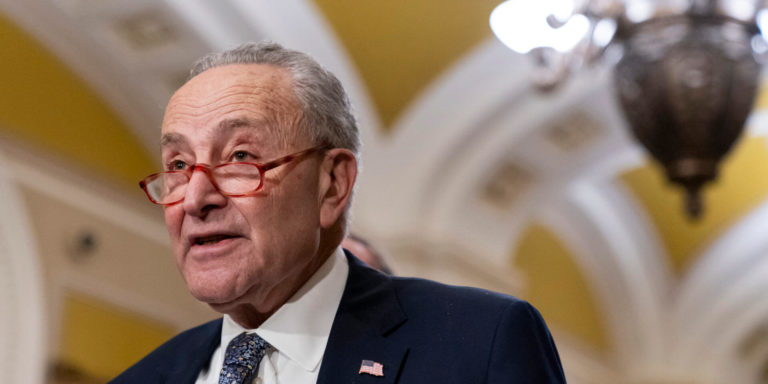
Schumer now finds himself on the receiving end of his own party’s vicious attacks after voting to temporarily fund President Donald Trump’s government through September to avoid a government shutdown.
Democrats wanted Schumer to rally Senate Democrats to block the stopgap bill, even if it meant risking a shutdown of the federal government—something they fiercely opposed when Joe Biden was in the White House.
Former House Speaker Nancy Pelosi, Illinois Gov. J.B. Pritzker and 2024 loser Tim Walz are among the top Democratic politicians leading the charge against Schumer, according to the Daily Beast.
“I, myself, don’t give away anything for nothing. I think that’s what happened the other day,” Pelosi said, referring to Schumer’s common-sense decision to vote for the funding bill. She claimed Senate Democrats could have forced Republicans to support a bipartisan bill that would have funded the government for mere four weeks.
🚨DEMS IN DISARRAY: Nancy Pelosi slams Chuck Schumer:
"I myself don't give away anything for nothing. And I think that's what happened the other day." pic.twitter.com/VU3T1ot8UX
Pritzker, at a speech at the Center for American Progress, echoed Pelosi’s remarks, claiming: “I disagree with what he did—and vehemently so. Having an internecine war in the Democratic Party does not help anyone.”
Walz, in an interview on California Gov. Gavin Newsom’s podcast, added, “I believe that Chuck 100 percent believes that he made a decision that reduced the pain and the risk to Americans. I see it now that we’re in a point where… that pain is coming anyway and I think we gave up our leverage.”
The backlash was so intense that Schumer had to postpone his promo tour for his new book, Antisemitism in America: A Warning, citing security threats.
Schumer’s support for the stopgap bill prompted Reps. Delia Ramirez, D-Ill. and Glenn Ivey, D-Md., to publicly call for him to step down.
“I respect Chuck Schumer. I think he had a great, long-standing career, did a lot of great things, but I’m afraid that it may be time for the Senate Democrats to get a new leader,” Ivey claimed on Tuesday. Ramirez also responded affirmatively when asked if Schumer should retire.
Democrats are all too familiar with throwing one of their own under the bus when it is politically expedient. They forced Biden to exit the 2024 presidential race after their long-running cover-up of his cognitive decline was exposed in his catastrophic debate performance against President Donald Trump.
(Luis Cornelio, Headline USA) Two MSNBC hosts were forced to eat their own words on Tuesday after blindly repeating a now-retracted AP report about Director of National Intelligence Tulsi Gabbard supposedly referring to President Donald Trump and Russian leader Vladimir Putin as “very good friends.”
The AP had to walk back its demonstrably false report, as it was revealed Gabbard had been talking about Trump and Indian Prime Minister Narendra Modi.
Ali Velshi and Stephanie Ruhle, the insufferable anchors of The Last Word and 11th Hour, respectively, were left scrambling after parroting the AP’s debunked claim in a desperate attempt to smear the Trump administration.
As reported by the Daily Caller, Velshi said his show had “reported on excerpts of an interview between the Director of National Intelligence, Tulsi Gabbard, and an Indian TV news network in which she said that Trump was good friends with the world leader.”
He added, “Now we said that world leader was Vladimir Putin, but the full interview was subsequently released and it showed that Gabbard was referring to Donald Trump and the Indian Prime Minister Narendra Modi.”
Ruhle echoed Velshi’s retraction nearly verbatim, which was likely written by attorneys to avoid legal repercussions.
“Last night, we reported on excerpts of an interview between the Director of National Intelligence, Tulsi Gabbard and an Indian TV news network in which she said that Trump was good friends with a world leader,” Ruhle said, according to the Caller.
“Now we said that world leader was Vladimir Putin, but the full interview shows that Gabbard was referring to Trump and Indian Prime Minister Modi. We cleared that up,” she admitted.
The AP itself issued a press statement retracting its false claim: “The Associated Press has withdrawn its story about U.S. Director of National Intelligence Tulsi Gabbard saying President Donald Trump and Russian President Vladimir Putin ‘are very good friends.’ Gabbard was talking about Trump and Indian Prime Minister Narendra Modi. The AP will publish a corrected version of the story.”
Alexa Henning, Gabbard’s spokesperson and seasoned Republican communicator, minced no words in response to the AP, scolding their reporting as “total trash.”
“This is why no one trusts the maliciously incompetent and purposefully bias media,” Henning said. “If this isn’t a clear example of pushing a solely political narrative, then nothing is.”
The AP scandal comes just weeks after Trump revoked the news outlet’s special access to the Oval Office, citing their misleading and false reporting.
Trump on banning the AP from the Oval Office & Air Force One:
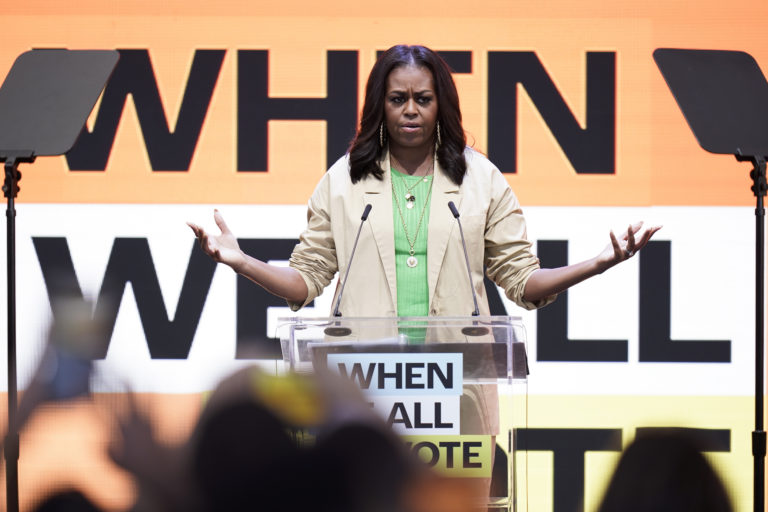
(Luis Cornelio, Headline USA) Former First Lady Michelle Obama admitted in a podcast interview that she and her husband are out of synch in bed—just as speculation about their seemingly fragile marriage continues to swirl.
“Bedtime is the best time of the day,” Michelle said in a sneak peek video of her interview on the Not Gonna Lie with Kylie Kelce podcast. “My husband teases me about how early I can go to bed. He just doesn’t understand.”
The former first lady and Democratic darling said she loves “some good sheets” and prefers the temperature to be “cool.” However, she suggested she stays up later when they have guests.
“I’m talking but, you know, the minute we finish up, I’m just trying not to go to bed before the sun goes down,” Michelle claimed, adding that she is ready for bed “anytime after dinner.” The full interview is set to be released on Thursday.
.@MichelleObama is not gonna lie: bedtime is the best time of the day!
— Not Gonna Lie with Kylie Kelce (@nglwithkylie) March 19, 2025
Her comments come as the online observers suggest the once-influential couple could soon call it quits. The former first lady was notably absent from former President Jimmy Carter’s state funeral and President Donald Trump’s 2025 inauguration.
Indirectly addressing the rumors, Obama posted on Instagram flattering tribute to his wife for her 61st birthday, calling her the “love of his life.”
“You fill every room with warmth, wisdom, humor, and grace — and you look good doing it. I’m so lucky to be able to take on life’s adventures with you. Love you!,” he wrote.
Michelle immediately replied, “Love you, honey!”
However, the post featured a photo that left many critics scratching their heads. The accompanying photo showed the couple sitting down at a restaurant holding hands but apparently distant.
The Obamas have been married since 1992, when the would-be-president was a young attorney in Chicago.
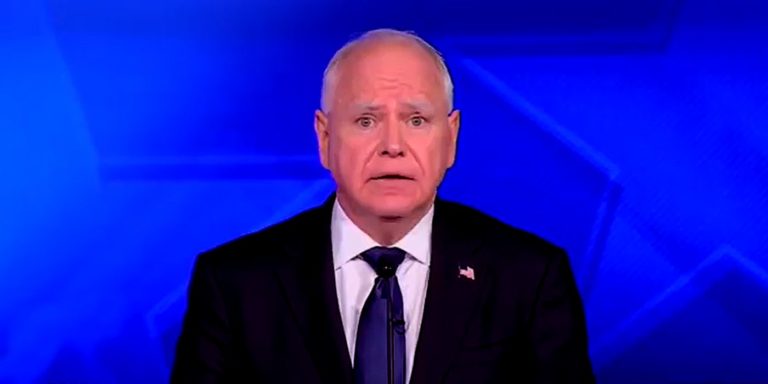
Walz also tried to claim in the interview he was specifically targeted multiple times, and tried to reference Fox News making fun of him for having a straw with a milkshake.
“Hey they spent all their time, these guys on Fox News that ‘Walz is gay, he’s not masculine’ you know, ‘he doesn’t coach football the way he should,'” he continued.
While on the campaign trail in October 2024, Walz had one of his many gaffes while playing Rep. Alexandria Ocasio-Cortez in a Twitch stream and told her she “can run a mean pick 6.” He was blasted over it as it not a play that is run, but instead a defensive move where the ball is intercepted and results in a touchdown.
Walz bizarrely said he thinks the criticism was being he installed fear in MAGA Republicans.
“I think I scare them a little bit, [which is] why they spend so much time on me,” Walz added.