Unstoppable Gold

(Brien Lundin, Money Metals News Service) Gold’s up nearly $100…again…as I write, and even I’m stunned by this rally.

This run in gold, now to over $3,400 on a spot basis, has been so remarkable that even the major media are, well…remarking on it.
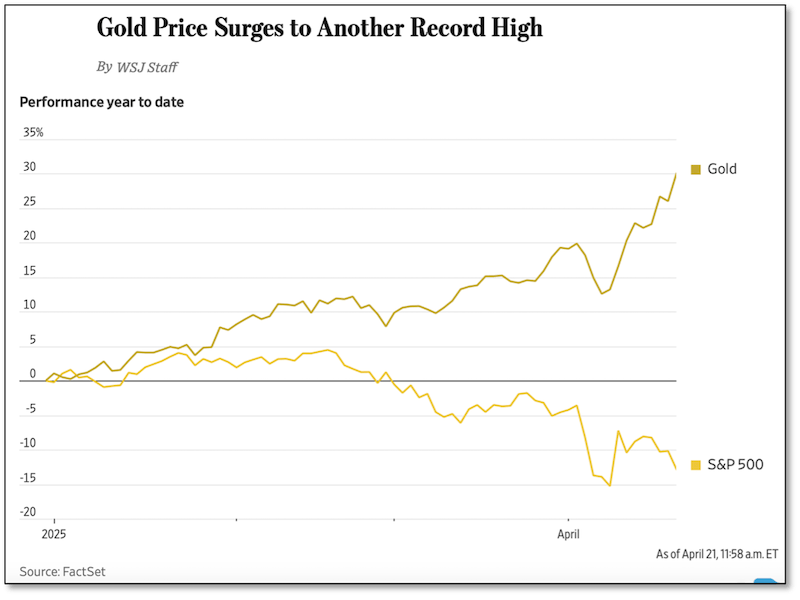
That leads, of course, to the talking heads trying to explain it. And, true to form, they’re taking their shots and badly missing.

Many are crediting the jump in gold to the drop in the U.S. dollar, and given this slide in the greenback, that’s not surprising.
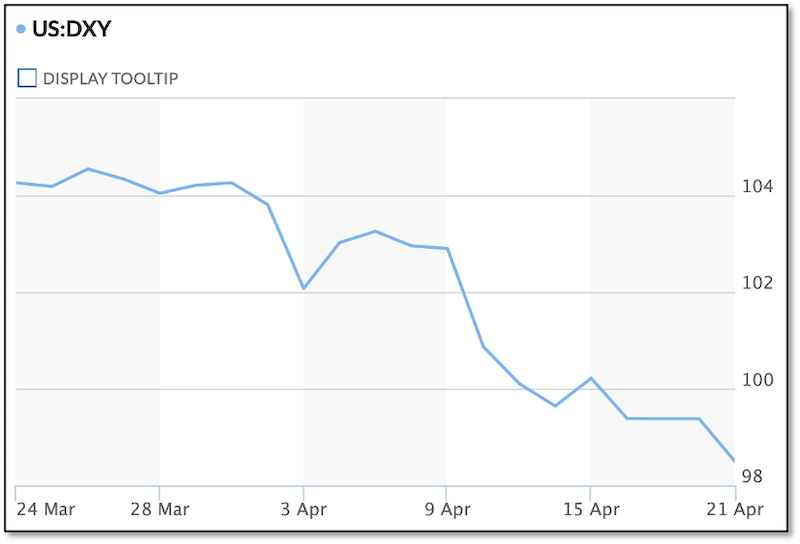
Others are blaming this $100 jump on an escalation in President Trump’s rhetorical war on Fed Chairman Jerome Powell. I’m sure this is a factor for some, but you would think it’s obvious that the strategy behind getting Powell gone would be to get interest rates lower. So if that’s what the market is thinking, then why are stocks selling off and the 10-year yield rising?

Then others are saying that today’s jump in gold — and the coincident nose dives in stocks, the dollar, and bonds — are due to a continuation of the “selling America” theme.

As the Wall Street Journal summed up:

The “Sell America” trade picked back up on Monday.

Stocks fell, with the Dow industrials dropping 1,100 points and on pace for their worst April since 1932, and the dollar hit fresh multiyear lows against the euro and other major currencies. Yields on longer-term Treasurys rose, and gold surged to a fresh record high.

Markets are on edge about President Trump’s tariff war as well as his threats to fire Fed chief Jerome Powell. Trump on Monday demanded lower rates in a post on social media, saying costs are trending downward and the economy could slow “unless Mr. Too Late, a major loser, lowers interest rates, NOW.”

On Friday, when markets were closed, National Economic Council Director Kevin Hassett underscored the White House’s displeasure with Powell, saying officials were studying his removal.

An early set of data from trade bellwether South Korea showed a big drop in exports to the U.S. this month.

Give them credit, because that’s closer to the mark in explaining not only today’s big jump in gold, but its astounding run so far this year.

In my opinion, anyone who focuses on any single factor behind gold’s surge is missing the big picture. As I also wrote last week:

“…Gold has been telling us that
it’s not one thing. It’s everything.”

As I’ve written for decades, one of the hallmarks of a bull market, in any asset, is when every new data point is interpreted bullishly.

By this measure alone, gold is in a historic bull market…because even if a development sends Treasury yields rising or the dollar strengthens, it almost always sends gold rising.

And it’s not just a matter of interpretation — it’s cold, hard facts.

It’s a fact that 45 years of ever-easier money and ever-greater debts have built a debt trap that cannot be escaped without a major devaluation of fiat currencies around the globe.

Smart investors know this. Gold knows this. And gold’s tremendous run over the last 14 months is not so much a prediction of what is to come as it is a recognition of the current situation.

The good news is that you can protect yourself against the coming great currency devaluation by buying gold now to protect those funds against the decline in purchasing power.

To get Brien Lundin’s ongoing commentary on the markets at no charge, click here to subscribe to his free Golden Opportunities newsletter.

Brien Lundin is the publisher and editor of Gold Newsletter, the publication that has been the cornerstone of precious metals advisories since 1971. Mr. Lundin covers not only resource stocks but also the entire world of investing. He also hosts the annual New Orleans Investment Conference. To get Brien Lundin’s ongoing commentary on the markets at no charge, click here to subscribe to his free Golden Opportunities newsletter.

Thief Steals DHS Secretary Kristi Noem’s Purse on Easter Sunday

(Ken Silva, Headline USA) Homeland Security Secretary Kristi Noem apparently can’t even secure her own purse.

The New York Post reported Monday that Noem was eating at The Capital Burger about a mile away from the White House on Easter Sunday, when a thief stole her personal bag, which had $3,000 in cash and her passport in it.

“The DHS secretary had just finished paying when she felt a brush against her leg — which she initially thought was one of her grandchildren before realizing her bag was missing,” the Post reported, citing a person familiar with the matter. “Noem’s bag also contained her driver’s license, passport, DHS badge, makeup, checks, medication, and apartment keys.”

The thief, who was captured on surveillance video, was reportedly still at large as of the publication of this article. The suspect is reportedly a white man who was wearing a surgical mask.

According to RealClearPolitics, Noem had so much cash because she was taking her entire family out shopping.

“Her entire family was in town, including her children and grandchildren — she was using the cash withdrawal to treat her family to dinner, activities, and Easter gifts,” a DHS spokesperson reportedly told RealClearPolitics

It’s unclear whether Noem had protection from the Secret Service. If so, the incident marks yet another security failure for that agency.

The Secret Service, which hasn’t commented on the matter, has reportedly launched an investigation to trace any use of Noem’s credit cards or other financial instruments.

Ken Silva is the editor of Headline USA. Follow him at x.com/jd_cashless.

JD Vance Was among the Last Leaders to Meet w/ Pope Francis

(Headline USA) One of Pope Francis’ final encounters before his death was with U.S. Vice President JD Vance, who visited the Vatican over the weekend.

The meeting took place on Easter Sunday. Vance, a Catholic convert, entered the room and reached down for the pope’s hand. “Hello,” the vice president said. “So good to see you.”

Francis was sitting in a wheelchair, and his words were inaudible in a video released by the Vatican.

“I know you’ve not been feeling great, but it’s good see you in better health,” Vance said.

A priest serving as a translator spoke for the pope.

“These are for your children,” the priest said as someone presented Vance with chocolate eggs. Next came a tray of additional gifts, including rosaries and a Vatican tie.

“Thank you,” Vance said as he held the dark tie. “So beautiful.”

They posed for a photo, Vance standing to the pope’s right before bidding him farewell.

“I pray for you every day,” Vance said. “God bless you.”

Vance’s visit was not without political sensitivities, and he met with Cardinal Pietro Parolin on Saturday for what the Vatican described as “an exchange of opinions.” The Catholic Church, under Francis’ leadership, has championed the rights of migrants, while Vance and President Donald Trump have advocated for crackdowns.

Vance’s office said the vice president and the cardinal “discussed their shared religious faith, Catholicism in the United States, the plight of persecuted Christian communities around the world, and President Trump’s commitment to restoring world peace.”

White House press secretary Karoline Leavitt told reporters that she had spoken to members of Vance’s team on Monday morning after Francis’ death.

“They expressed how excited and grateful they were for the opportunity to have met with the pope just yesterday,” she said.

Leavitt added that Francis “touched millions of lives throughout his tenure as the head of the Catholic Church and so it’s a solemn day for Catholics around the world and we are praying for all those who loved the pope and believed in him.”

Trump issued a statement on Truth Social: “Rest in Peace Pope Francis! May God Bless him and all who loved him!”

At the White House Easter Egg Roll on Monday, Trump said he signed an executive order for U.S. flags to fly at half-staff in the pope’s honor.

“He was a good man,” the president told reporters. “He loved the world and it’s an honor to do that.”

Vance, who continued on to India after Italy, posted additional thoughts on social media.

“I just learned of the passing of Pope Francis. My heart goes out to the millions of Christians all over the world who loved him,” he wrote on X. “I was happy to see him yesterday, though he was obviously very ill.”

Vance shared a link to remarks that Francis gave on March 27, 2020, as COVID-19 was spreading around the globe.

“I’ll always remember him for the below homily he gave in the very early days of COVID,” Vance wrote. “It was really quite beautiful.”

Francis had spoken from St. Peter’s Basilica in Rome.

“Thick darkness has gathered over our squares, our streets and our cities,” he said. “It has taken over our lives, filling everything with a deafening silence and a distressing void.”

He encouraged people to rely on their faith to help then endure “because with God life never dies.”

Adapted from reporting by the Associated Press


Congressman Visits Ukraine Frontlines, Signs Shell ‘To Putin’

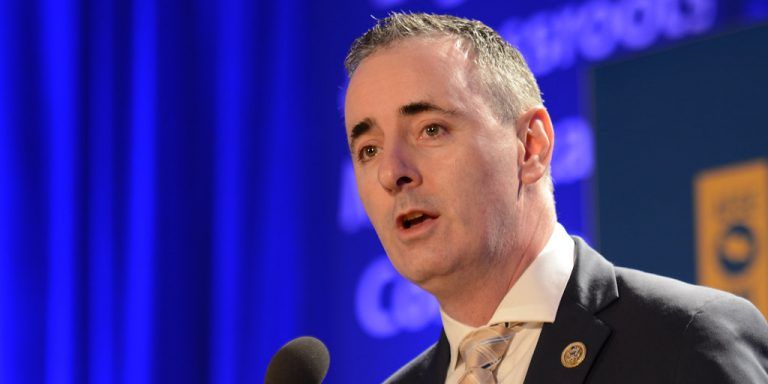
(Kyle Anzalone, Antiwar.com) Congressman Brian Fitzpatrick claims he traveled to Ukraine and spent several days traveling around the frontlines. As a photo op, the Pennsylvania Republican signed an artillery shell “to Putin.”

According to The Philadelphia Inquirer, Rep. Fitzpatrick spent a week visiting Ukrainian frontline soldiers. The Congressman wrote on X, “It was my profound honor to deliver a very ‘personal’ message to Vladimir Putin today, from the front lines of the war near the Russian border, on behalf of our PA-1 community.  The only permissible details to share are that ‘the message was delivered on target.’”

A photo posted to X shows that Fitzpatrick wrote, “To: Putin” on an artillery shell. A video shows the Congressman firing a large weapon, although it’s unclear if this occurred on the frontlines. In a second video, Fitzpatrick said he was traveling around the frontlines and was wearing a bag that appeared to contain small arms ammunition.

Fitzpatrick traveled the frontline with Ukraine’s National Guard Artillery and Third Assault Brigade. The Third Assault Brigade is made up of Azov Special Operations soldiers and is commanded by Andriy Biletsky.

Biletsky is the founder of the Azov movement, a white supremacist and neo-Nazi group. He previously declared himself a “White Ruler.” His vision for Ukraine includes dissolving the country’s democracy and capitalist economy in favor of national socialism.

The Third Assault Brigade commander’s stated goal is “leading the white races of the world in a final crusade… against Semitic-led untermenschen.”

During his time in Ukraine, Fitzpatrick said that he had come under Russian drone fire, forcing an emergency evacuation. He went on to call on other US members of Congress to visit the Ukrainian frontlines.

In a separate post, he said he met with Ukrainian officials to discuss how he could help “advance critical legislative efforts in support of Ukraine.” The Republican Congressman added, “We discussed strengthening US-Ukraine cooperation, backing the American peace initiative, and the enduring principle of peace through strength.”

Fitzpatrick has emerged as one of the most vocal supporters of Ukraine in Congress. Before getting elected to the House in 2017, he had worked for the FBI including posts in Kiev. He co-chairs the Ukraine caucus in the House.

This article originally appeared at Antiwar.com.

Record Gold Prices Driving Chinese Investment Demand

(Mike Maharrey, Money Metals News Service) Investors continued to pour into the Chinese gold market in March as prices surged to new records.

China ranks as the world’s largest gold market.

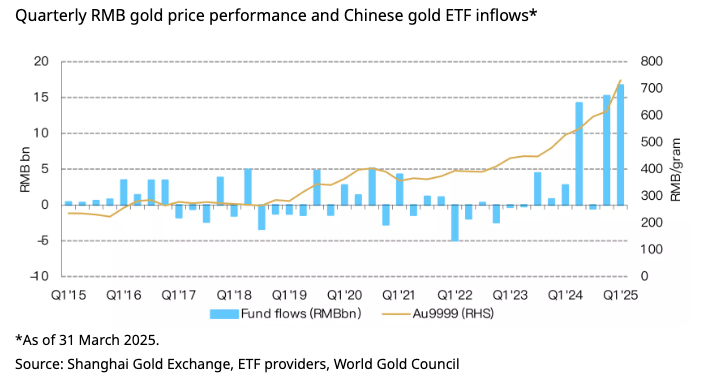
The price of gold climbed 8.4 percent in yuan terms in March. It was the strongest month for the yellow metal since March 2024.

The RMB gold price recorded its strongest Q1 since 2002 when the Shanghai Gold Exchange (SGE) was established.

According to the World Gold Council, “Geopolitical tensions and Trump’s unpredictable trade policies increased gold’s appeal as a safe-haven asset. A weaker dollar and higher gold ETF investments pushed up prices further.”

The fact that gold was up 9.9 percent in dollar terms – more than in yuan terms – last month revealed this dollar weakness.

The rising gold price has created headwinds for the Chinese wholesale gold market. This largely reflects demand for gold jewelry. Price-sensitive consumers have slowed their purchases.

However, there was a rebound in wholesale demand in March as reflected by a 33-tonne month-on-month increase in withdrawals from the SGE.

Gold withdrawals from the SGE totaled 120 tonnes last month. According to the World Gold Council, this primarily reflected an increase in seasonal demand, and jewelers and banks restocked after the Chinese New Year holiday.

Wholesale demand at 336 tonnes in the first quarter was down 36 percent year-on-year, primarily reflecting soft demand due to higher prices.

“The record-shattering gold price hampered gold jewelry demand, a major factor in SGE gold withdrawals, although it did boost gold investment.”

Gold investment has primarily shown up in a surge in ETF demand.

ETFs are a convenient way for investors to play the gold market, but owning ETF shares is not the same as holding physical gold.

Chinese ETFs reported record gold inflows of 23 tonnes totaling ¥16.7 billion ($2.3 billion) in Q1.

According to the WGC, “The unprecedented gold price surge, shaky confidence in other domestic assets, as well as growth concerns stemming from escalating trade conflicts with the U.S., all contributed to strong Q1 flows.”

Investor demand for gold ramped up even more during the first two weeks of April. Preliminary data indicates another 29 tonnes of gold poured into Chinese gold-backed funds, eclipsing the Q1 total. Assets under management (AUM) exploded by 25 percent in those two weeks.

Chinese demand for gold has been so strong over the last few weeks that the government has allocated additional gold import quotas for commercial banks.

Up until last month, gold imports have been rather tepid. They virtually came to a halt in January only 17 tonnes reported. That was the lowest monthly level since February 2021, as imports were hampered by COVID restrictions.

February imports picked up, rising to 76 tonnes.

It will be interesting to see the March numbers when they are reported.

Looking ahead, World Gold Council analyst Ray Jia expects gold investment demand to remain strong, primarily driven by the escalating trade war.

“The global gold price strength, boosted by a restructuring of the world trade order and world market volatility, will provide further support.”

A pilot program that allows insurance funds to invest in gold should also support Chinese demand. To date, four insurance companies have joined the SGE. They executed their first trades of gold contracts the very next day.

According to Jia, “Their participation should sustain long-term investment demand for gold in China, especially amid ongoing economic and trade uncertainties.”

High prices will likely continue to put pressure on gold jewelry demand, but Jia suggested safe haven buying could offer a cushion.


Mike Maharrey is a journalist and market analyst for Money Metals with over a decade of experience in precious metals. He holds a BS in accounting from the University of Kentucky and a BA in journalism from the University of South Florida.

US, Iran Hold Second Round of Talks, Agree to Third

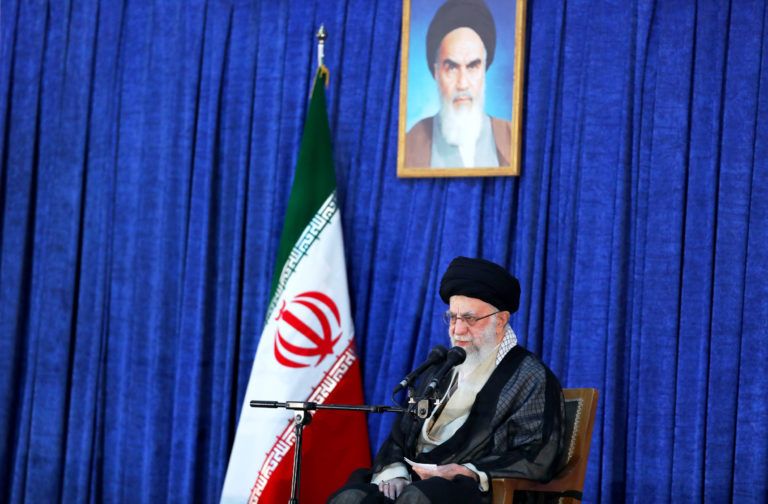
(Kyle Anzalone, Antiwar.com) US and Iranian officials engaged in talks over the weekend in Rome and agreed to more talks later in the week. President Donald Trump says he is only willing to engage with Tehran for a short period before a deal either has to be signed, or the US may attack Iran with Israel.

The second round of talks was held in Italy on Saturday, a week after the initial talks in Oman. Iranian Foreign Ministry spokesman Esmail Baghaei said the talks were “indirect.”

An unnamed American official said the talks were advancing towards a deal. “Today, in Rome over four hours in our second round of talks, we made very good progress in our direct and indirect discussions,” a US official told CBS News. “We agreed to meet again next week and are grateful to our Omani partners for facilitating these talks and to our Italian partners for hosting us today.”

Iranian Foreign Minister Abbas Araghchi also described the talks as positive. “The talks were held in a constructive environment and I can say that is moving forward,” he said. “I hope that we will be in a better position after the technical talks.”

The third round of talks is scheduled to begin in Oman on Wednesday. The two sides plan to engage in lower-level “technical discussions.” Araghchi said higher-level talks would resume next Saturday.

The Trump administration says its top issue in the talks is preventing Iran from developing a nuclear weapon. However, the US intelligence community admits that Tehran is not seeking to weaponize its civilian nuclear energy program.

Still, some members of the Trump administration are arguing that the Islamic Republic is in a weakened position, giving the US and Israel a unique opportunity to take out Iran’s civilian nuclear program by force.

Tehran appears to be attempting to reach a deal similar to the 2015 Iran Nuclear Deal that Trump unilaterally exited seven years ago. Under that agreement, Iran agreed to additional limits and inspections of its nuclear program in exchange for sanctions relief from Washington and its allies.

At times, Trump has appeared receptive to this form of deal. “I’m for stopping Iran, very simply, from having a nuclear weapon,” he said. “I want Iran to be great and prosperous and terrific.”

However, Israeli Prime Minister Benjamin Netanyahu along with some members of the Trump administration have demanded that the Islamic Republic go further and completely dismantle its nuclear program and uranium enrichment capabilities.

The New York Times reported last week that Netanyahu has pushed for an attack on Iran, but Trump pushed back on the idea. On Saturday, Reuters spoke with Israeli officials who said Tel Aviv was still considering a strike on Iran, even without Trump’s endorsement.

An Iranian official said Tehran was aware that Tel Aviv was preparing an attack. “We have intelligence from reliable sources that Israel is planning a major attack on Iran’s nuclear sites.” The source adds, “This stems from dissatisfaction with ongoing diplomatic efforts regarding Iran’s nuclear program, and also from Netanyahu’s need for conflict as a means of political survival.”

A potential deal has been endorsed by other nations in the Middle East, such as Saudi Arabia. Last week, high-ranking officials from the Kingdom traveled to Iran for talks on improving ties. Additionally, Riyadh said an agreement would enhance “peace in the region and the world.”

While talks are progressing, Trump has demanded negotiations move forward at a rapid pace. It is unclear if Tehran is moving fast enough to keep Trump from electing to move to a military option.

This article originally appeared at Antiwar.com.

Gold-Silver Ratio Over 103 Indicates Silver Is Still on Sale!

(Mike Maharrey, Money Metals News Service) As gold marches ever higher, silver continues to lag, like a kid more interested in sniffing flowers than keeping up with his parents’ pace.

Don’t get me wrong. Silver hasn’t done horribly so far this year. It is up a little over 12 percent. However, it has failed to close the gap with gold, and that has many investors questioning what’s going on with the white metal.

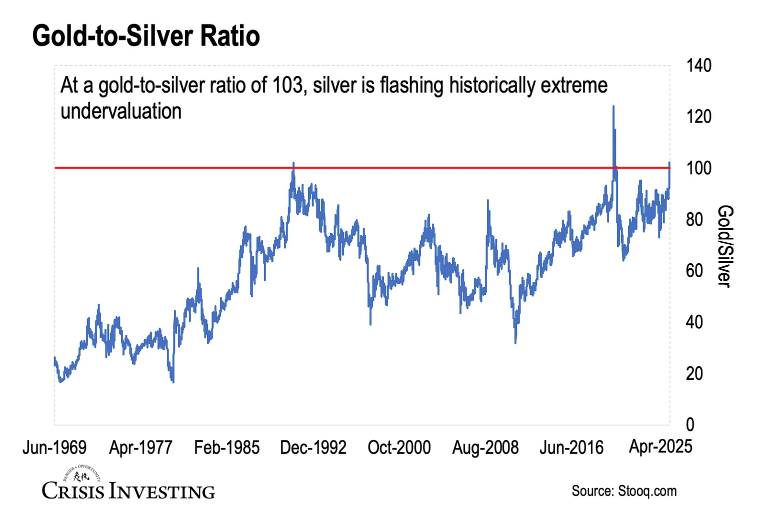
As of this morning, the gold-silver ratio was just over 103:1. That means it takes about 103 ounces of silver to buy an ounce of gold.

This is slightly above the 1991 peak and not too far below the all-time high of 123:1 during the pandemic chaos in 2020.

In other words, this is an extremely wide spread from a historical perspective and indicates that silver remains drastically underpriced compared to gold.

More significantly, these extremely wide gold-silver ratios don’t tend to last long. They eventually snap back to the mean. And when that happens, it’s generally a very fast move.

Historical Gold-Silver Ratio Perspective

Mining industry geologists estimate there are somewhere between 19 and 20 ounces of silver for every ounce of gold in the earth. This provides a natural starting point for a gold-silver ratio of 20:1.

From a mining perspective, annual silver production averages around 800 million ounces per year, and gold production is a little over 100 million ounces. (These are rounded numbers.) That would give a gold-silver ratio of around 8:1.

Analyst Lau Vegys included a chart in a recent article published on Doug Casey’s Crisis Investing website that provides some perspective on the gold-silver ratio. As he noted, “While I don’t have precise data going back centuries, I recently stumbled upon a graphic circulating on X that really drives home just how unusual today’s silver (under)valuation is. Although I haven’t verified every data point myself, it broadly aligns with historical accounts.”

We do know that governments have set gold-silver ratios to control the value of their coinage for centuries. The earliest recorded imposed gold-silver ratio was by King Menes of Ancient Egypt when he set the ratio at 2.5:1.

The U.S. Congress fixed a gold-silver ratio of 15:1 in its 1792 Coinage Act. This compares to a 15.5:1 ratio set by France in 1803.

A bi-metallic monetary system proved to be unwieldy, and European countries began to demonetize silver in the mid-19th century. The U.S. followed the lead of England, Portugal, Germany, and other nations and established a gold standard in the Coinage Act of 1873.

The demonetization left the gold-silver ratio to float freely. By World War II, the gold-silver ratio had spread to as much as 40:1.

In the modern era, the gold-silver ratio has averaged around 60:1.

Returning to the Mean

As I already mentioned, when the gold-silver ratio gets way out of whack, it eventually snaps back to the average.

From a historical perspective, when you see gold-silver ratios well above that historical average, it tells you that silver is underpriced compared to gold, and there is a strong possibility that silver will go on a bull run to close that gap. Historically, this has often happened in the midst of a gold bull rally, with silver outperforming gold. (Of course, past performance does not guarantee future results.)

Vegys noted this as well.

“Historically, extreme ratio levels—like 103 right now—have often preceded significant reversals, with silver typically outperforming gold as the ratio reverts toward its average. A clear recent example was March 2020: after spiking above 120, silver more than doubled within just five months, substantially outperforming gold.”

When it was all said and done, the ratio was back to 60:1.

We’ve seen even more dramatic snapbacks in the past. The gold-silver ratio fell to 30:1 in 2011 after rising to over 80:1 during the money creation of the Great Recession in the wake of the 2008 financial crisis.

Some people have suggested that the gold-silver ratio has broken down. It has been well above the 60:1 average for well over a year. However, nobody has been able to point to any structural change in the gold and silver markets to explain such a breakdown.

Vegys suggested three reasons why the gold-silver ratio tends to return to the mean.

  1. The silver market is relatively small—roughly a tenth the size of gold’s—which means even modest capital inflows can move the price dramatically.
  2. Silver tends to be more volatile, often behaving like a leveraged version of gold. During bull markets, it usually outpaces gold significantly.
  3. Unlike gold, about half of silver’s demand is industrial. As economic activity rebounds after downturns, this industrial usage picks up, providing additional price support.

It’s worth noting that the supply and demand fundamentals are extremely strong for silver.

Industrial demand set a record in 2024, driving the fourth straight annual market deficit. Gold demand outstripped supply by 148.9 million ounces. That drove the four-year market shortfall to 678 million ounces, the equivalent of 10 months of mining supply in 2024.

And this was with tepid investment demand. When investors get in on the action, that supply-demand gap could explode.

Silver isn’t priced for these market dynamics.

Vegys sums up the situation this way:

“Here’s the bottom line. With the gold-silver ratio at such an extreme level, silver looks set for a potential catch-up rally. If the ratio just moves back to its long-term average of 60, silver would need to rise about 70 percent relative to gold. That’s an increase of nearly $23 per ounce from current levels. And if gold keeps climbing too, silver’s upside could go from big to explosive.”

He also makes an important point to those who speculate that the gold-silver ratio has somehow become irrelevant.

“Extremes can last longer than you’d expect, and history doesn’t guarantee what comes next. But at these levels, silver’s risk/reward looks pretty compelling.”

The bottom line is that silver appears to be on sale.  Not to sound like a TV huckster, but these prices probably won’t last. Now is the time to take advantage of this historically wide gold-silver ratio. Nobody knows when it will snap back to more normal levels, but if history is any indication, it will. And when it does, it will happen fast.


Mike Maharrey is a journalist and market analyst for Money Metals with over a decade of experience in precious metals. He holds a BS in accounting from the University of Kentucky and a BA in journalism from the University of South Florida.

DHS Revokes Visas of Over 1,500 Students, None Charged With Any Crimes

(Connor Freeman, Antiwar.com) In recent weeks, more than 1,500 international undergraduate and graduate students from over 240 colleges have had their J-1 or F-1 visas revoked by Washington without notifying students or their respective universities. The revocations mean the students will not be permitted to finish their studies in person and will have to return to their home countries.

A J-1 visa is a non-immigrant visa issued to professors, research scholars and cultural exchange visitors intended for people doing business or medical training. A F-1 visa, on the other hand, is a non-immigrant visa for students from other countries which allows them to pursue their education at American universities and colleges.

The schools became aware of these changes to the students’ legal statuses by checking international student records contained in the Department of Homeland Security’s Student and Exchange Visitor Information System (SEVIS).

Middle East Eye reported that at least three universities received no prior notice about the visa cancellations and were not informed of any reasons for the students’ legal status terminations.

As the outlet noted, “But terminating a record in the SEVIS system doesn’t necessarily mean the individual’s immigrant status in the country has been terminated. All of the revocations share a common thread – none of the students have been charged with a crime.”

Al Jazeera notes that “Many of the targets of the visa revocations and arrests are students who participated in pro-Palestine protests… Others are individuals with more indirect links to Palestine – or those who have shown support for Gaza on social media.”

Beyond the highly publicized cases of Palestinian protesters Mahmoud Khalil and Mohsen Mahdawi, both Columbia students and green card holders, as well as Turkish national and Tufts student Rümeysa Öztürk and others who have been persecuted for their antiwar work, Drop Site News reports that many non-activist students are now facing deportation over arrest records, even if they were never convicted. In some cases, visas have been revoked over minor infractions such as speeding tickets and other traffic violations.

Secretary of State Marco Rubio has been utilizing an immigration act, which has been seldomly invoked, to remove student activists, claiming their presence in the United States poses a threat to Washington’s foreign policy goals. This includes continued support for Israel’s genocidal campaign against the Palestinians, most notably in the besieged Gaza Strip where well over 100,000 men, women, and children have been slaughtered and maimed.

Rubio declared last month that international students participating in protests on college campuses and other activism will have their visas revoked. “We gave you a visa to come and study and get a degree, not to become a social activist that tears up our university campus. We’ve given you a visa and you decide to do that – we’re going to take it away,” he boasted. “At some point, I hope we run out because we’ve gotten rid of all of them, but we’re looking every day for these lunatics that are tearing things up.”

Despite Rubio’s characterization of these students “tearing things up,” thus far it appears the students are not being forced out of the country for crimes committed but rather for their involvement in activism against the bipartisan support for war crimes in Palestine.

A massive movement of protests on college campuses erupted last year in response to President Joe Biden’s unconditional support for the Israeli war on Gaza and across the region. Although the movement has been smeared as anti-Jewish in character by Israel supporters inside and outside the government, groups like Jewish Voice for Peace and If Not Now maintained a huge presence, on and off campus, among the protesters.

Trump’s administration appears to be rounding up foreign activists who opposed Biden’s genocidal policies in Palestine which Trump has inherited and predictably escalated. The current White House has ramped up the bombing campaign in Yemen and launched a build up for war with Iran.

Amir Makled, an attorney based in Michigan representing high-profile pro-Palestinian protesters’ cases, told MEE “What we’re seeing and what we’re witnessing is a coordinated effort to punish student protesting, especially when it comes to pro-Palestinian protests. This used to be very protected political dissent.” He added students are being targeted for their constitutionally protected speech. Makled also noted that immigration lawyers are being targeted concurrently by the administration.

In April, he was interrogated by immigration authorities after returning from a family trip to the Dominican Republic. “I was detained at the border simply because I’m representing a student protester. It was raised in my interview, during my interrogation, that they knew that I was an attorney representing high-profile student protester cases. These are intimidation tactics, attempts by the government to try to dissuade advocates from taking on these roles.”

This article originally appeared at Antiwar.com.

Democrat Judge Caught Harboring Suspected Tren de Aragua Gang Member

(Ken Silva, Headline USA) A county judge in New Mexico has reportedly resigned after Homeland Security Investigations agents arrested a suspected Tren de Aragua gang member and other illegal aliens at his home.

The resignation of Doña Ana County Magistrate Judge Joel Cano comes after HSI agents executed a search warrant at his home on Feb. 28—arresting suspected 23-year-old gang member Cristhian Ortega-Lopez there. Agents also took an undisclosed number of other illegal immigrants into custody, and seized four firearms that he handled illegally.

The details of Ortega-Lopez’s case are wild.

According to court records, the suspected Tren de Aragua member was arrested while entering the U.S. illegally on Dec. 15, 2023. Due to overcrowded Border Patrol facilities, Ortega-Lopez was released three days later.

Ortega-Lopez was supposed to stay in Denver pending removal proceedings. However, he moved to El Paso, Texas, without informing Homeland Security or any other government agency.

It was in El Paso where Ortega-Lopez met Nancy Cano, the wife of Judge Cano. The Canos admitted they hired Ortega-Lopez to install a glass door for them—which is illegal since the Venezuelan was not authorized to work.

Ortega-Lopez was evicted from his apartment last April, after which he moved in with the Canos.

The suspected Tren de Aragua member’s relationship with the Canos became cozy, so much so that he was introduced to their daughter, April Cano, who let him use her guns—which, like him working without authorization, is illegal.

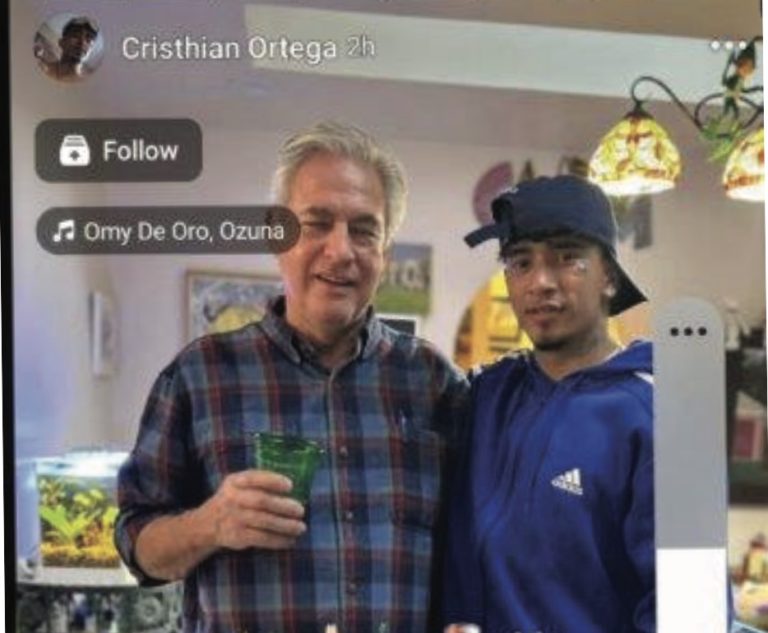
Unfortunately for the Canos, Ortega-Lopez posted pictures of himself with those firearms on social media.

The story became arguably even stranger after the HSI agents executed the Feb. 28 search warrant. On March 13, Nancy Cano wrote to U.S. Judge Damian Martinez, pleading for him to have mercy on Ortega-Lopez. In that letter, Cano seemingly admits that she illegally hired the immigrant—and also hired him out to others.

“Each job he got I was told he did an excellent job. No one was ever disappointed. I started to receive more requests for him to return or referral for more jobs,” she said, also enclosing pictures of Ortega-Lopez with the Cano family.

“On five different occasions he went through Border Patrol check points with no problems,” she added—perhaps disclosing yet more crimes. “I took him in as my own son … Please consider his future and give him a chance.”

During a court hearing the next day, U.S. Judge Damian Martinez asked Justice Department prosecutor Maria Armijio if she knew Judge Cano. When the prosecutor said she didn’t know Judge Cano, Martinez said he did know him—and trusted him.

“I’ve met him before several times and he’s got a BS meter like you – a lot of people have never seen. He knows when somebody is BS’ing him,” Judge Martinez said. “I don’t think Judge Cano has a BS meter and I don’t think he would just let anybody live in his property.”

Judge Martinez found that Ortega-Lopez was not a flight risk, and ordered him to be released. The DOJ appealed on March 28, disclosing more information about Ortega-Lopez’s relationship with the Canos, as well as his affiliation with Tren de Aragua. According to the DOJ, agents found ample evidence of his gang affiliation while searching his cell phones.

“A search of the cellphones revealed the following, which affirms the fact that the Defendant is a TdA member: (1) A conversation with an individual on April 30, 2024, in which he refers to his AK-47 tattoo as an ‘Aragua train,’ and comments that he is worried about telling [Nancy Cano] about it,” the DOJ said in its March 28 appeal.

“(2) A conversation with an individual in which they discuss the $5,000 award offered by the State of Texas for TdA members and joke about the reward money,” the DOJ’s appeal added.

“(3) A conversation with an individual in which the other participant warns Defendant about sending photographs that may jeopardize him in the United States that also includes a request to get a grenade or two 38s.”

Agents also allegedly found photographs of two brutal murder victims that includes mutilated bodies, decapitated heads and dismembered hands on Ortega-Lopez’s cell phones.

A hearing is schedule for April 30 for Judge Martinez to reconsider allowing Ortega-Lopez to remain free on bail. The Canos have reportedly declined to comment on the matter.

Ken Silva is the editor of Headline USA. Follow him at x.com/jd_cashless.

Some Governors Fight to End ‘Taxpayer-Funded Junk Food’

(Casey Harper, The Center Square) – A battle is brewing nationwide over whether recipients of SNAP benefits, also known as “food stamps,” should be allowed to purchase soda and candy with their government food assistance.

Critics of the new push to ban soda and candy purchases under SNAP say it unfairly targets lower income families, limits consumer choice and won’t result in better health outcomes.

Governors in four states are asking the federal government for waivers allowing them to prevent SNAP recipients from using their benefits to purchase what one governor calls “taxpayer-funded junk food.”

SNAP overall costs the federal government about $115 billion per year. A wide array of products are currently disallowed for SNAP users, from alcohol to tobacco products to pet food to vitamins.

Secretary Brooke Rollins, who oversees the U.S. Department of Agriculture, has publicly said she would approve the waivers.

Health and Human Services Secretary Robert F. Kennedy Jr. also said in a recent speech he welcomes the effort from state leaders.

The scope of the bans vary by state. In West Virginia, the ban would restrict soda purchases. In Idaho and Indiana, the limits apply to soda and candy.

Arkansas Gov. Sarah Huckabee-Sanders submitted a waiver to the Trump administration last week asking permission to enact the ban in her state blocking SNAP purchases of soda and candy, as The Center Square previously reported. Notably, Sanders’ waiver “will extend to confectionary products with flour…” which is a more broad definition of candy than in some other states.

Sanders’ waiver also requests SNAP recipients be allowed to purchase rotisserie chickens with their benefits, which are currently blocked under the “hot food” purchase ban at the federal level.

Sanders raised the issue with the Trump administration in December, sending a letter to U.S. Department of Health and Human Services Secretary Robert F. Kennedy Jr. and U.S. Department of Agriculture Secretary Brooke Rollins before they were confirmed by the Senate.

“As Secretaries, I ask that you work collaboratively across the Administration to prohibit the sale of junk food in SNAP and end taxpayer-funded junk food,” the letter said. “I also wish to notify you of my intent to pursue a SNAP Waiver from the U.S. Department of Agriculture’s Food and Nutrition Service that would support fresh fruits, vegetables, eggs, and protein and prohibit using SNAP for junk food.”

Lower-income Americans who receive the benefits could still purchase those snacks and beverages, just with their own cash, not the government assistance.

“In fact, soda, unhealthy snacks, candy, and dessert account for nearly 23 percent, or $25 billion, of all SNAP purchases,” Sanders said. “Given the relationship between junk food and poor health, our federal food assistance policies are fueling obesity, diabetes, heart disease, hypertension, and a wide range of chronic health conditions across America.”

Critics of the new push to ban soda purchases under SNAP say it unfairly targets lower income families and limits consumer choice.

States efforts vary in their approach. Efforts to ban soda and candy are simpler, but language from Huckabee-Sanders and others about “unhealthy snacks” would be much more complicated to regulate.

Determining which foods are “healthy” or not could be tricky. Does trail mix count as candy if it includes some? Does gum count as candy? Generally, definitions are required to make a distinction between sodas and whether certain “juices” are acceptable.

“This policy approach is misguided and not needed when it comes to chocolate and candy,” Chris Gindlesperger, senior vice president of Public Affairs and Communications at the the National Confectioners Association, said in a statement. “SNAP participants and non-SNAP participants alike understand that chocolate and candy are treats – not meal replacements. In fact, candy purchasing patterns are basically equivalent between SNAP and non-SNAP families – with only about 2% of SNAP purchases being candy. Consumers have a unique mindset when they enjoy chocolate and candy that is not present when interacting with other foods – whether or not they are using SNAP benefits for food purchases.”

Besides the four states whose governors have said they are moving forward with some version of restrictions on SNAP purchases, other states have seen similar efforts.

In some cases, only soda is in the crosshairs.

In Ohio, a measure making its way through the legislature would result in blocking SNAP purchases of sugary drinks, efforts the beverage industry says is unfair and won’t improve individuals’ health.

“Make no mistake, this waiver won’t make an ounce of difference on health,” the trade organization American Beverage said. “Obesity has skyrocketed in the last two decades while beverage calories per serving have dropped by 42% – thanks to our industry’s efforts to empower Americans with more choice and information. In fact, 60% of beverages Americans buy today have zero sugar due to our innovation.”

In Michigan, State Rep. Brad Paquette, R-Niles, introduced a bill to prevent SNAP benefits from being used for soda. State leaders are facing opposition from critics as they get the initiative approved at the state level, but so far the Trump administration has said it is happy to approve the waivers when they are submitted.

“Michigan taxpayers should not be required to fund poor food consumption,” Paquette said. “This legislation is in no way calling for low-income individuals to be stripped of the assistance they currently receive to feed themselves and their families, but we have to recognize that this assistance is a privilege and comes at the expense of taxpaying workers.

“We should ensure that SNAP beneficiaries are not using this program in a way that is both exorbitant and palpably harmful to themselves,” Paquette added.