Gang Bangers Go on Wild Shooting Spree in Minneapolis, Kill 4 Native Americans

(Headline USA) Investigators strongly suspect that a pair of shootings three blocks apart in Minneapolis that left four people dead and two others seriously injured were connected and were gang related, the police chief said Wednesday.

The first shooting happened late Tuesday and killed three people. The second, which happened around 1 p.m. Wednesday, killed one person. A bullet fired during that shooting just barely missed two young children in a nearby vehicle, police Chief Brian O’Hara said.

The police chief said at a news conference that investigators believe all of the victims were Native Americans and that the shootings had shaken the large Indigenous community in the Phillips neighborhood south of downtown.

He told reporters that investigators were still trying to establish a link between the shootings, and he declined to speculate on a motive or give details about any suspected gang connections. He said the investigation was still at its early stages. No arrests have been made.

“We’re three blocks away. The community’s saying something’s going on here, ”he said. “We have to follow the evidence. I cannot speculate. You can make your own assumptions based off the facts.”

Minneapolis, like many other cities, saw an increase in crime after the 2020 killing of George Floyd.

But crime fell in many major cities last year, and Minneapolis recently went two months without a homicide until a man was shot to death April 19. It was the city’s longest period without a homicide in a decade, according to police. Authorities have credited the work of community organizations and a federal crackdown on local gang members.

“Our entire city is grieving right now,” Mayor Jacob Frey told reporters. “And we know that our Native community is feeling that trauma quite acutely.”

In the late Tuesday shooting, four people were shot in a vehicle and one on a nearby sidewalk, according to police. O’Hara said a 20-year-old woman, a 17-year-old boy and a 27-year-old man were killed. A 28-year-old man and a 20-year-old woman were taken to a hospital with life-threatening injuries. O’Hara said the man remained in grave condition Wednesday afternoon.

Wednesday’s shooting happened outside an apartment building that houses the Minneapolis offices of the Red Lake Nation tribe. A man in his 30s died, O’Hara said.

“What is even more disturbing,” he added, was that one round from the shooting went through the rear door of an SUV “and passed just beneath the legs of two children in child seats, an infant and a toddler.”

O’Hara reiterated his earlier statements that it was “very clear” that victims of the first shooting were deliberately targeted and that it was “potentially gang related.”

The chief did not say whether the fatal shootings might have been connected with another nearby shooting overnight in which a man was dropped off at a hospital with a non-life-threatening gunshot wound.

O’Hara appealed for anyone with information to come forward.

“We need everyone to stand up and say this is not OK,” he said. “And law enforcement will not rest until everyone involved in both of these incidents is brought into custody.

Adapted from reporting by the Associated Press


Kash Reassigns Woke FBI Agents Who Knelt During George Floyd Riots

(Headline USA) The FBI has reassigned several agents who were photographed kneeling as cities around the country burned during the tumultuous summer of 2020, two people familiar with the matter said Wednesday.

The reasons for the moves were not immediately clear, though they come as the FBI under Director Kash Patel has been undertaking broad personnel changes and as Deputy Director Dan Bongino has repeatedly sought to reassure supporters of President Donald Trump who are critical of the bureau that their complaints are being taken seriously.

“The Director and I are working on a number of significant initiatives to ensure that the mistakes of the past are never repeated, and that many of your open questions are answered,” Bongino wrote in one recent post on X, formerly known as Twitter. He did not specify what mistakes or questions he was referring to.

The reassignments, first reported by CNN, were confirmed to The Associated Press by two people familiar with the matter who insisted on anonymity to discuss non-public personnel moves. An FBI spokesman declined to comment.

The photographs at issue showed a group of agents taking a knee during one of the demonstrations following the May 2020 killing of Floyd.

The kneeling angered some in the FBI but was justified at the time as a possible de-escalation tactic during a period of widespread protests.

Adapted from reporting by the Associated Press

Feds Nab Second Suspect in Kristi Noem’s Gucci Purse Theft 

(Luis Cornelio, Headline USA)  Federal agents have cuffed a second suspect in the puzzling saga of the stolen Gucci purse belonging to DHS Secretary Kristi Noem. 

Cristian Rodrigo Montecino-Sanzana, 51, was taken into custody in Miami Beach, Florida, on Sunday, WSVN reported. His alleged accomplice, 49-year-old Mario Bustamante-Leiva, was arrested earlier in Washington, D.C. 

Bustamante-Leiva, believed to be an illegal alien from Chile, made national headlines after stealing Noem’s bag while she dined with family at Capitol Burger on Easter, according to federal prosecutors. 

On Sunday, Montecino-Sanzana appeared before Florida judge Mindy S. Glazer, who informed him that he was being held “for possession of a stolen or fictitious driver’s license.” 

Prosecutors alleged Montecino-Sanzana and Bustamante-Leiva stole Noem’s designer purse, which contained $3,000 in cash, her keys, medication, driver’s license, passport and Homeland Security badge. 

Investigators later spotted Montecino-Sanzana entering a Walgreens in Miami Beach, according to WSVN. Investigators said they found in his possession an identification that did not match his name. 

The arrest record noted that the suspect had “purchased the California identification card for work purposes.”  

His bond was set at $2,500. It remains unclear whether Montecino-Sanzana will face federal charges. 

Noem condemned the theft in a post on X, calling Bustamante-Leiva a “career criminal who has been in our country illegally for years.” 

She added, “Unfortunately, so many families in this country have been made victims by crime, and that’s why President Trump is working every single day to make America safe and get these criminal aliens off of our streets.” 

Texas Gov. Abbott Threatens City Over Israel Ceasefire Resolution

(José Niño, Headline USA) A city’s call for peace in the Middle East has set off a political firestorm in Texas.

Gov. Greg Abbott, R-TX, has escalated tensions with the City of San Marcos after its council advanced a resolution calling for a ceasefire in the Israel-Hamas war. 

Abbott condemned the measure as “antisemitic” and threatened to cut off state funding if the city adopts the resolution, per a report by Spectrum News 1. 

In the middle of April, the San Marcos City Council voted to move forward a resolution urging an immediate and permanent ceasefire in occupied Palestine, an arms embargo on Israel, and the recognition of Palestinian sovereignty. 

The resolution also references redirecting approximately $4.4 million in local tax dollars from Israel’s military toward domestic priorities. The final council vote is slated for May 6, 2025.

Governor Abbott responded by sending a letter to San Marcos Mayor Jane Hughson, warning that the resolution violates the state’s 2017 anti-BDS (Boycott, Divestment, and Sanctions) law. 

On Tuesday,  Abbott published a post on X, stating, “Anti-Israel policies are anti-Texas policies. [I] sent a letter to the City of San Marcos today condemning its proposed antisemitic resolution openly flouting Texas state law. Texas will NOT tolerate antisemitism.”

The law prohibits Texas government entities from contracting with companies that boycott Israel. Abbott stated in the letter that “the Office of the Governor will not enter into any future grant agreements with the city and will act swiftly to terminate active grants for non-compliance” if the resolution passes.

Abbott’s stance is consistent with his long-standing support for Israel. 

In 2017, he signed House Bill 89, the anti-BDS law, on Israel’s Independence Day, declaring, “Anti-Israel policies are anti-Texas policies.” The law requires all state contracts over $100,000 to include written verification that the contracting party does not and will not boycott Israel.

On top of that, Abbott has also taken executive action to combat antisemitism. In March 2024, he ordered Texas universities to update free speech policies to include the International Holocaust Remembrance Alliance’s definition of antisemitism, following campus protests related to the Israel-Hamas conflict.

The San Marcos council’s upcoming vote will be a key test of local authority versus state power in Texas. Abbott’s threat to withdraw funding underscores how deeply the state’s leadership has tied its identity and policy to support for Israel. 

As debates over Israel policy intensify, Texas’s response may set a precedent for the entire country.

José Niño is the deputy editor of Headline USA. Follow him at x.com/JoseAlNino 

Buffalo Detective Alleges that Local School System is Covering up a Child Sex Abuse Scandal

(José Niño, Headline USA) The Buffalo Public Schools (BPS) district, New York’s second-largest educational system, has been embroiled in a major scandal following allegations that district officials willingly obstructed investigations into child abuse and sexual assault cases.

Buffalo Police Special Victims Unit Detective Richard Hy made the explosive claims Friday on the “Unsubscribe Podcast”, which has attracted over 1 million views. 

Hy alleged that BPS administrators and attorneys failed to report sexual assaults between students and abuse by adults. Additionally, he asserted that BPS employees allegedly deleted surveillance footage of criminal incidents, per a report by BTPM NPR. 

According to the detective, BPS employees ignored subpoenas and refused to cooperate with police investigations and withheld critical information from the families of abuse victims.  

Hy emphasized that his decision to go public, despite potential disciplinary repercussions, stemmed from his frustration that there were no penalties for schools that did not take action against these cases of abuse.

Several cases in the school district stand out.

On February 18, 2025, Shane Cronin, a 30-year-old Illinois resident, allegedly entered the Dr. Charles R. Drew Science Magnet School, attempted to abduct two students — a male and female —, and assaulted an assistant principal who intervened, per a report by 7 News WKBW.

While Cronin faced charges including third-degree assault and endangering a child’s welfare, Hy revealed deeper institutional failures. Notably, the school informed only the female student’s family about the abduction attempt, leaving the male student’s parents unaware until prosecutors discovered a second victim via leaked cellphone footage. 

In October 2024, a high school student reportedly approached her counselor three times about physical abuse by her father.   

The student verbally disclosed beatings, but the counselor — who must report these incidents under New York law — did not alert authorities.  

The student subsequently provided cellphone video evidence of abuse, which the counselor also allegedly ignored. In the third approach, the student arrived “black and blue” , finally prompting the counselor to act, triggering an emergency removal of the child. 

The father was subsequently charged with third-degree assault.  

Hy believes that BPS has a “culture of downplaying violence,” with teachers like Mark Bruno corroborating that the district has historically minimized incidents.  

“I think you always hear this is an isolated incident, we take this very seriously, and I strongly disagree every time they make both of those statements,” Bruno said. “It’s not isolated. It’s happening in many of our schools, and I don’t believe it’s taken seriously.

BPS issued a blanket denial this past weekend, describing Hy’s claims “unfortunate and untrue” while boasting about its “close and professional relationship” with police. The district’s statement emphasized BPS’s size — 60 schools, 30,000 students, 7,000 staff — as evidence of its commitment to safety.  

Facing public outcry, the Buffalo Board of Education convened a 2.5-hour emergency executive session on April 28, leading to the announcement of an independent external investigation, according to a report by Spectrum News 1. 

Board President Dr. Kathy Evans-Brown stated: “The BOE is initiating an independent external investigation and the results will be shared publicly.”  

Edward Speidel, a parent advocate, was not shocked by the latest allegations concerning the Buffalo school district.

“I’m not 100% surprised… I get assault calls, special ed calls-I’m not surprised at all,” Speidel said. 

For Buffalo’s families, the hope is that this crisis leads to lasting, positive change and accountability is brought to all school authorities involved. 

José Niño is the deputy editor of Headline USA. Follow him at x.com/JoseAlNino

Democrat Lawmaker Wants to Decriminalize Welfare Fraud

(Luis Cornelio, Headline USA) Californians who defraud the taxpayer-funded welfare system could soon catch a break—so long as they don’t steal more than $25,000. 

Legislation SB560—introduced by California Democratic state Sen. Lola Smallwood-Cuevas on Friday—would effectively decriminalize welfare fraud up to $25,000, protect potential offenders from perjury charges and block prosecutors from pursuing cases of attempted fraud. 

“This bill would delete the provision that establishes criminal penalties for an attempt to commit welfare fraud,” the legislation states. 

The bill would abolish criminal penalties for welfare fraud “when the total amount of aid obtained or retained is above or below $950. Instead, the bill would make welfare fraud involving aid obtained or retained “in the total amount of $25,000 or more punishable by specified imprisonment in a county jail, by a fine, or by imprisonment and fine.”

Smallwood-Cuevas defended the legislation in a social media post, claiming it is meant to keep “families out of the criminal justice system for making administrative errors.” 

She added, “It offers a smarter, more humane approach by allowing counties to resolve most overpayment cases administratively, holding people accountable without criminalizing poverty.” 

According to Newsweek, welfare fraud isn’t just a paperwork mistake—it often involves concealing income, listing ineligible children or hiding the presence of another parent in the household. 

The outlet noted that Los Angeles County reviews between 15,000 and 20,000 welfare fraud referrals each year. Between 5,000 and 8,000 cases of fraud are confirmed, but only 200 make it to the district attorney. 

Those cases result in convictions 95% of the time. 

The Dollar and Gold Are Building Energy for a Major Move

(Jesse Colombo, Money Metals News Service) After a volatile couple of months filled with relentless news and confusing cross-currents from the Trump administration’s tariff plans and other policies, the financial markets have calmed down in recent weeks—providing a much-needed breather for everyone, myself included.

While it’s been quiet in the precious metals space, numerous indicators are flashing that this is merely the calm before the storm.

As I’ll show in this update, another sharp move is likely right around the corner.

The foundation of my thesis is the U.S. Dollar Index — a measure of the dollar’s exchange rate against a basket of major world currencies (not its domestic purchasing power).

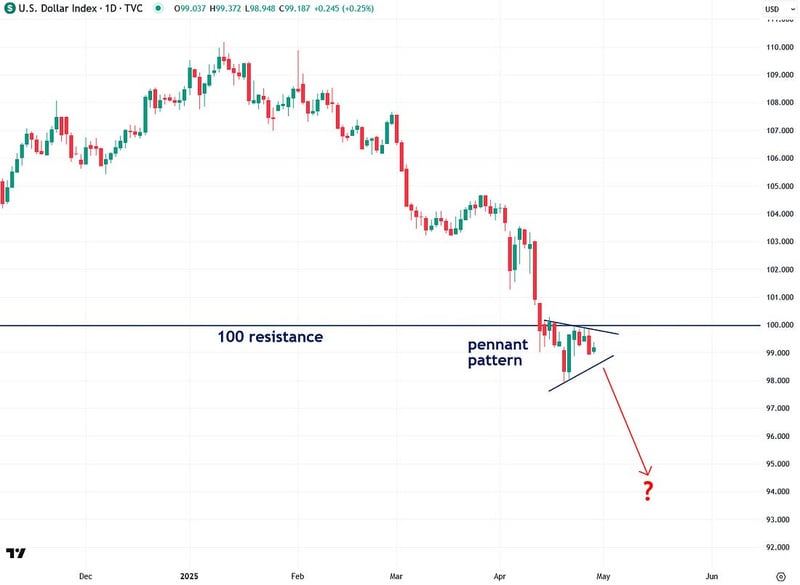
The Dollar Index is now at a critical juncture, hovering just below the key 100 level, which has served as major support and resistance for several years. Historically, rebounds off the 100 level have triggered sharp selloffs in commodities like gold and silver, due to the well-established inverse relationship between the dollar and commodity prices.

What’s especially noteworthy is that the Dollar Index recently broke below the key 100 level—a significant development that raises the likelihood of a dollar bear market (and a commodities bull market).

Also worth noting is that although the dollar didn’t plunge immediately after the breakdown, it began consolidating in a pennant pattern—a technical formation that typically signals a sharp move ahead once a breakout occurs. The odds favor a downside move, as pennants are typically continuation patterns, especially with the significant 100 resistance level now looming just overhead.

My base-case scenario is that the dollar breaks down from this pattern, extending its decline. That said, I’m waiting for confirmation before making any bold calls and remaining flexible to all possible outcomes.

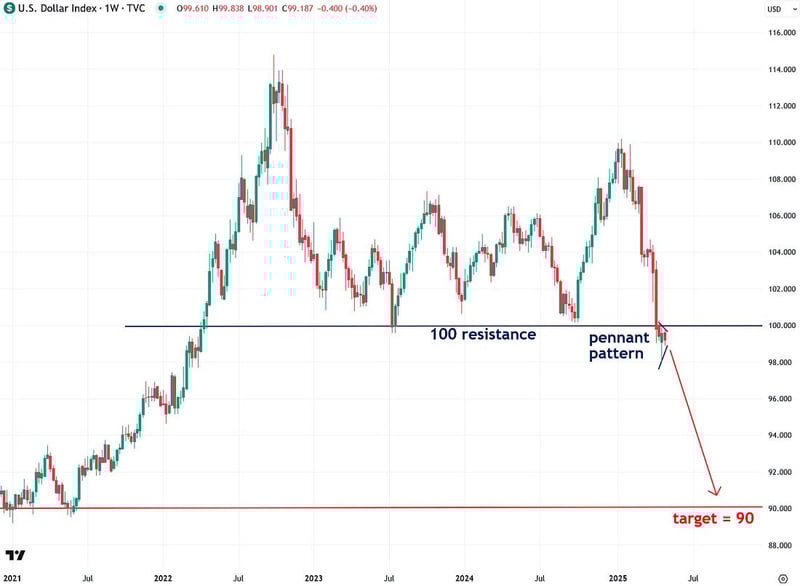
The longer-term weekly chart of the U.S. Dollar Index highlights just how important the 100 level has been in recent years. Several major rebounds have occurred off this level in the past—typically to the detriment of commodities.

If the index breaks down further from here, the next key support level to watch is 90—a move that would mark a 10% decline from current levels. That’s a very realistic target, especially as we move closer to a recession and bear market.

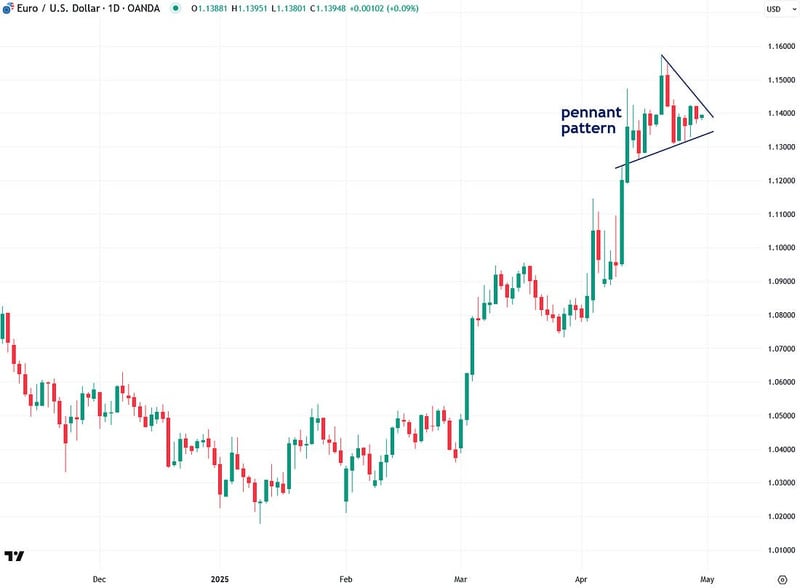
On the flip side of the potential bearish pennant in the U.S. dollar is a possible bullish pennant forming in the euro—which makes sense, given the euro (like commodities) moves inversely to the dollar. If that pattern breaks to the upside, it would signal further appreciation in both the euro and commodities.

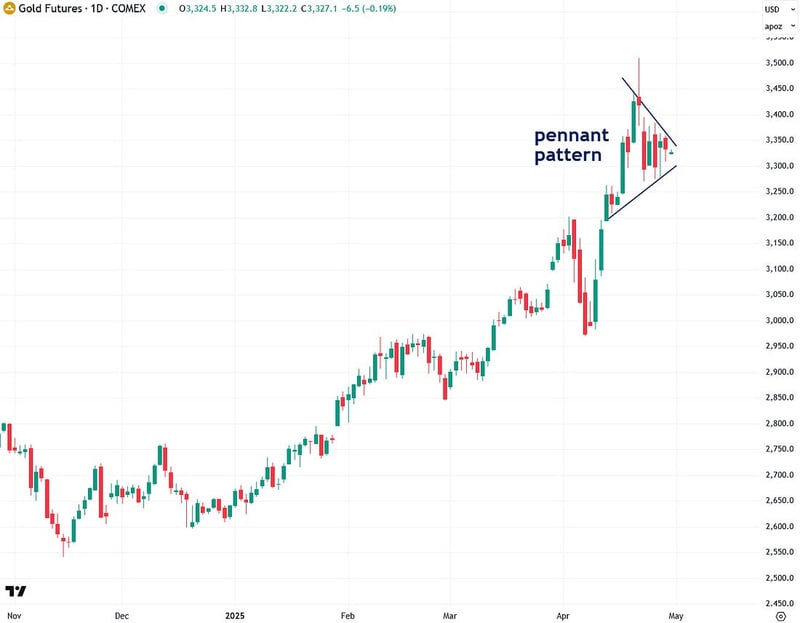
Interestingly—though not surprisingly to those who follow intermarket technical analysis—gold is also forming a pennant pattern, just like the U.S. Dollar Index and the euro. This alignment increases the odds that a major move is imminent across all three markets.

Since gold and the euro tend to move together and both trade inversely to the dollar, the direction of these breakouts will be a key signal for what lies ahead. As mentioned earlier, pennants are typically continuation patterns, which suggests a higher probability of gold breaking to the upside—but it’s crucial to stay flexible and wait for confirmation rather than acting prematurely.

Last week, gold had become technically overbought in the short term—a reason for some caution. However, it’s important to remember that the most explosive bullish moves often occur when an asset is already overbought and has strong momentum behind it.

If gold can confirm its strength by breaking out of its pennant to the upside, I wouldn’t be surprised to see it surge toward $4,000 fairly quickly, based on established pennant pattern measurement techniques.

Now let’s take a look at gold priced in other currencies—a perspective I find valuable because it strips away the influence of the U.S. dollar and often reveals gold’s true underlying strength or weakness.

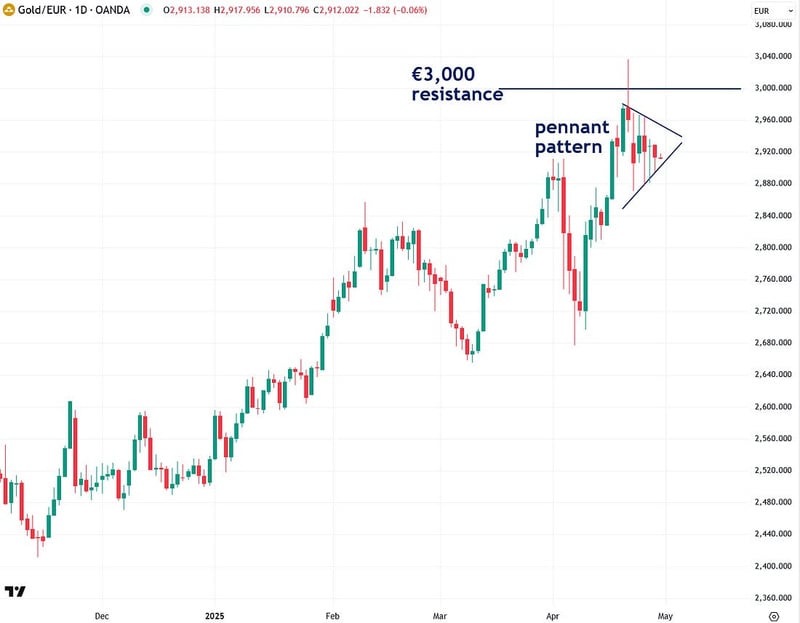
Sure enough, gold priced in euros is also forming a pennant pattern, reinforcing the broader technical setup discussed throughout this article. It’s also worth noting that the critical €3,000 resistance level is just overhead, and a decisive breakout above it would serve as strong bullish confirmation.

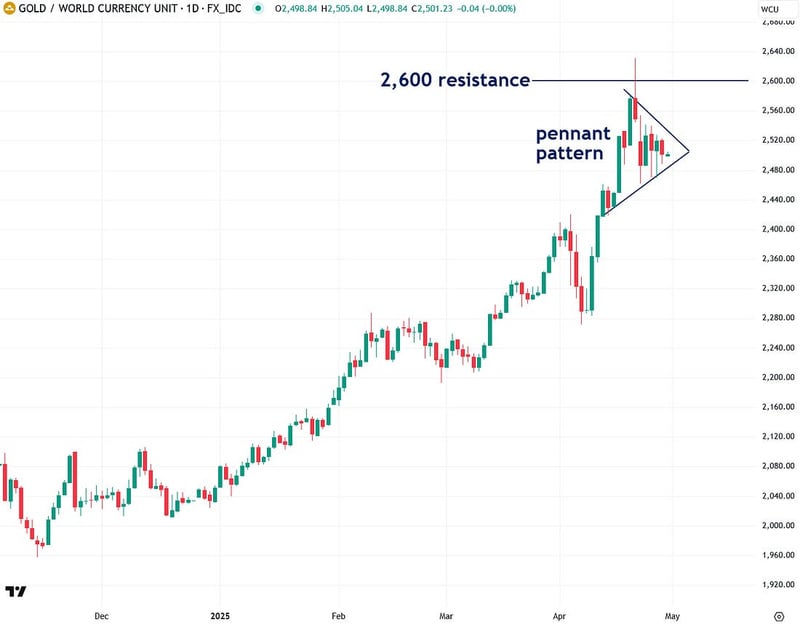
I’ve recently begun tracking gold in World Currency Units (WCU), and it’s also forming a pennant pattern just below the key 2,600 resistance level.

The WCU is a composite global currency unit based on the GDP-weighted average of the top 20 world economies. In many ways, it helps provide the most balanced and accurate measure of gold’s true global performance—which is why I’ve been watching it closely.

To sum up, the U.S. dollar, the euro, and gold are all at a critical juncture, with each forming a pennant pattern that’s likely to resolve very soon. The direction of these breakouts will set the tone for the next major move in all three markets.

Given that pennants are typically continuation patterns, the odds currently favor a downside break in the dollar and continued strength in both gold and the euro—but as always, it’s crucial to wait for confirmation rather than jump the gun.

I believe a major catalyst—perhaps this Wednesday’s U.S. Personal Consumption Expenditures (PCE) report, Friday’s nonfarm payrolls, or a major development on the tariff front—will soon trigger the breakout. One way or another, a big move is coming in both the dollar and precious metals. I’ll continue to keep you updated.

If you found this report valuable, click here to subscribe to The Bubble Bubble Report for more content like it.


Jesse Colombo is a financial analyst and investor writing on macro-economics and precious metals markets. Recognized by The Times of London, he has built a reputation for warning about economic bubbles and future financial crises. An advocate for free markets and sound money, Colombo was also named one of LinkedIn’s Top Voices in Economy & Finance. His Substack can be accessed here.

Is Bitcoin Ready To Retire Gold?

(Walter Donway, Money Metals News Service) Gold has won the competition — a plebiscite as long-running as established civilizations — to be crowned mankind’s universal choice as a store of value and medium of exchange — as real money. Now, in less than two decades, a potential competitor has arisen: Bitcoin, with the arguable potential to rival and even supersede gold.

MicroStrategy CEO Michael J. Saylor asserts that Bitcoin will “displace gold as a non-governmental store of value” and describes it as “the apex property of the human race.”

To be as emphatic as possible, he added: “Bitcoin is digital gold. It’s a million times better than gold, and there’s no reason why anybody wouldn’t want to use it as a store of value over time.”

And in an abrupt policy shift, President Donald Trump, until recently a vocal skeptic of cryptocurrencies, signed an executive order setting up a US Bitcoin reserve. It will comprise some 200,000 bitcoins confiscated in various criminal proceedings, positioning it as a “digital Fort Knox” — a move toward anointing Bitcoin a strategic asset.

For good measure, the Kingdom of Bhutan has embraced Bitcoin, which it will “mine” using its plentiful hydroelectric resources. In effect, Bhutan will turn waterpower into digital gold, doing the alchemists one better, and become one of the first nations to adopt Bitcoin at the national level. Both developments underscore a growing recognition of Bitcoin’s potential role as a store of value akin to gold.

El Salvador President Nayib Bukele’s government argued for making Bitcoin legal tender, implying it could function as a medium of exchange and “bring financial inclusion, investment, tourism, innovation, and economic development to our country.”

Tyler Winklevoss, co-founder of Gemini Exchange, says: “We believe Bitcoin disrupts gold. We think it’s a better gold if you look at the properties of money. And what makes gold gold? Scarcity. Bitcoin is actually fixed in supply, so it’s better than scarce… It’s more portable, it’s more fungible, it’s more durable. It sort of equals a better gold across the board.”

For thousands of years, gold has been civilization’s symbol of beauty and luxury, wealth, power and glory, and reliability. Its distinctive properties — durability, divisibility, portability, and intrinsic value — have won history’s perdurable vote of confidence. Notable is gold’s natural scarcity in contrast to paper currency and government-created bank deposits, which can be multiplied without limit, their value printed on the bill.

Long before modern banking systems, merchants and rulers alike trusted in the weight of gold for exchange and a means of transferring wealth across borders.

Does Bitcoin measure up to this historical role?

Gold’s Career: A Few Highlights

The first gold coins, as far as we know, were minted by the Lydian civilization around 600 BCE. Gold and silver, of course, were currency, plain and simple, in ancient Egypt, Persia, Greece, and Rome, among other empires. During the late Middle Ages, gold became indispensable to commerce, particularly in the vast network of trade fairs that connected Europe’s growing economies.

These fairs, held in cities such as Champagne and Bruges, served as hubs where merchants from across the continent settled debts and negotiated long-distance trade agreements. Gold and silver coins were primary instruments of settlement.

Florentine silk merchants trading with Flemish cloth producers did not rely on local currencies, prone to debasement by monarchs desperate to pay for their wars.

Instead, they would carry gold florins or Venetian ducats, much more broadly recognized and accepted units of gold. The bullion trade underpinned medieval finance, with leading merchant banking families such as the Medici ensuring that gold moved safely between regions through bills of exchange. While these early forms of banking instruments reduced the need for physical transfer, ultimately, settlements still required access to gold.

In the early modern period, the influx of gold and silver into Spain and Portugal from Latin America fueled a historically rare inflation (increase in the money supply) but also global commerce, reinforcing bullion’s significance in trade networks stretching from Europe to China. By the late seventeenth century, gold had become the foundation of European monetary systems. The Bank of England, established in 1694, went far toward formalizing the gold standard, anchoring its currency to gold reserves — although parliament fought over early schemes for paper money and fractional reserves.

The United States, already formally on a bimetallic (gold and silver) standard, switched to gold de facto in 1834 and de jure in 1900 when Congress passed the Gold Standard Act. The system ensured that every dollar in circulation was backed by a fixed amount of gold, reinforcing confidence in the currency. The gold standard of the nineteenth century further institutionalized the metal’s reputation as a stabilizing force in finance. As economist Milton Friedman noted, inflation was virtually nonexistent during this time because gold’s supply increased only gradually, preventing the excessive creation of money. This framework dominated global trade and economic policy until World War I, when the demands of war led many nations to abandon the gold standard in favor of fiat money.

It was only in the twentieth century, however, that governments severed the link between money and gold. In 1933, President Franklin D. Roosevelt ended the direct convertibility of dollars to gold for US citizens. The Bretton Woods system, established after World War II, maintained an indirect gold standard, with the US dollar pegged to gold and other major currencies pegged to the dollar. This system lasted until 1971, when President Richard Nixon closed the “gold exchange window,” severing the last official tie between the US dollar and gold. Since then, the United States (and much of the world) has relied on fiat currencies, backed only by government decree, and inflation has become permanent, rampant, and in the long term, ruinous. Despite this shift, gold remained a critical asset for central banks and investors, underscoring its enduring importance as a store of value.

Estimates suggest that some 244,000 metric tons of gold have been mined throughout history, with a significant portion of extraction in the twentieth and twenty-first centuries, driven by advances in mining technology and increased demand. This surge in production underscores gold’s continued relevance in modern economies. President Trump has vowed to visit Fort Knox, however, to see if the gold really is there — a response to persistent rumors to the contrary.

Enter Bitcoin: 2009

Bitcoin appeared on the scene rather mysteriously in 2009, introduced in a white paper by the pseudonymous Satoshi Nakamoto (an individual or group). Bitcoin was intended to be a decentralized digital currency — an alternative to traditional fiat [“legal tender” as declared by law] currencies. It features a fixed supply cap of 21 million “coins” and a “distributed ledger,” the blockchain, that records all transactions in a seemingly secure, transparent, and immutable manner.

Unlike centralized financial systems, where banks act as intermediaries, Bitcoin transactions are verified by a network of decentralized nodes (individual computer users) using a consensus mechanism known as proof-of-work (PoW).

This process involves “miners” — participants who use a rather huge amount of computational power to solve complex cryptographic puzzles and thus validate by consensus new “blocks” of transactions. Once a block (defined unit of transactions) is verified, it is added to the blockchain.

The permanent limit on the supply of Bitcoins is governed by its protocol, which dictates that 21 million Bitcoins are all that will ever exist. This fixed supply is maintained through a process called halving, which reduces the reward for mining new bitcoins roughly every four years, slowing the rate of new issuance. This scarcity is a fundamental characteristic that proponents argue makes Bitcoin similar to gold in its deflationary nature.

Bitcoin’s market capitalization has reached significant heights, peaking at an all-time high surpassing $1.8 trillion.

The second-largest cryptocurrency, Ethereum, achieved an all-time-high market capitalization of approximately $228 billion. Ethereum does not have a fixed maximum supply, allowing for the continuous issuance of new tokens.

Binance Coin, the third-largest cryptocurrency, reached a market capitalization exceeding $90 billion in 2021. It has an initial maximum supply of 200 million tokens, with a deflationary mechanism that periodically burns tokens to reduce the total supply, aiming to eventually reach 100 million tokens.

Question: Is Bitcoin the contender to displace gold, or are cryptocurrencies the contender?

With no cap on supply, Ethereum does not seem to fill the bill.

Broader Uses

It is important to understand that Bitcoin, which has sold for as much as $109,000, is not a “coin” or a “bill.” It is not a currency, although it is a payment system. It cannot exist or be used outside of cyberspace.

A Bitcoin “wallet” is a computer application. This is utterly unlike gold or any other currency; Bitcoin’s virtues, in fact, are not those of a currency. Its virtues are those of a computer program, its applications, and a network.

Although initially conceived as a peer-to-peer electronic cash system (immediately useful, for example, to cannabis businesses whose accounts banks would not accept), Bitcoin and the blockchain now support a range of applications across industries. It is used in finance for cross-border transactions, remittances, and as a hedge against inflation in economies experiencing currency instability. Blockchain technology enables decentralized finance (DeFi) platforms that enable lending, borrowing, and trading without traditional financial intermediaries.

In supply-chain management, companies use blockchain to monitor the provenance of goods, guarding authenticity against counterfeiting. Luxury brands use blockchain to combat such counterfeiting, and food suppliers use it to track contamination sources. An early user, the pharmaceutical industry, seized upon blockchain to improve the tracing of drugs to guard against counterfeit medicines and ensure regulatory compliance.

Bitcoin remains the best-known application of the blockchain, but the underlying technology has unlocked a multitude of possibilities, many still in early stages of adoption. Its role in shaping the future of digital transactions is undeniable. Bitcoin’s market capitalization has experienced remarkable growth, surpassing $1 trillion during peak periods. Why?

Investors view Bitcoin as a hedge, safeguarding against government inflation, which was gold’s traditional role. Bitcoin has been adopted by corporations and financial institutions, which, in adding Bitcoin to their portfolios, lend it legitimacy.

MicroStrategy, for example, has invested billions in Bitcoin, reflecting a strategic shift towards digital assets. Bitcoin’s underlying blockchain technology has a strong technological appeal, offering transparency and security, and attracting those interested in financial innovation.

Thus, Bitcoin proponents argue that the cryptocurrency fulfills a function similar to gold’s, today — a borderless, decentralized asset immune to government manipulation. Gold’s historical dominance, however, was about far more than scarcity. It was about trust, liquidity, and physical permanence. Unlike Bitcoin, which relies on digital consensus mechanisms and cryptographic integrity, gold’s value is self-evident and tangible.

Distinguishing Bitcoin from Blockchain 

Bitcoin’s value as “money” rests on its acceptance and use. Its worth depends on collective belief. Bitcoin’s rise from an obscure concept to a widely accepted financial asset could not, then, be immediate or automatic.

The Bitcoin white paper by Nakamoto introduced a then-radical idea: a decentralized, “trustless” monetary system. Early adopters, particularly cryptographers and programmers, mined Bitcoin primarily to test the system. The first known Bitcoin transaction on May 22, 2010, was payment of 10,000 BTC for two pizzas (worth $41 then, and almost a billion dollars now) — a real-world use case!

The Dark Web and fringe markets then entered the picture. Bitcoin found a niche “use case” in marketplaces like Silk Road, where users valued its pseudonymity.

This period also tried out Bitcoin’s ability to facilitate transactions outside of traditional banking controls. And some companies highly invested in technology like Overstock, Tesla (briefly), and even some governments recognized Bitcoin as a valid asset.

Then, major companies such as MicroStrategy and Tesla (again) started holding Bitcoin in their corporate treasuries. Bitcoin futures and exchange-traded funds have since made it easier for mainstream investors to buy in.

In truth, much of Bitcoin’s value is not as money, per se, but as a system able, for example, to customize programs such as making irrevocable payments that are escrowed until certain conditions or deliverables are met.

Even better, judging that conditions have been met is entirely digital and automatic. These fall into the category of secure, irreversible transactions that don’t require third-party trust.

Ethereum in particular is associated with these “smart contracts,” while Bitcoin has limited programmability through such features as multi-signature wallets and time clocks, payments not released until certain conditions are met (reaching a future agreed date, obtaining multiple signatures, or verifying the completion of a real-world event/project/deliverable).

These desirable features are not of the cryptocurrency itself; some, for example, are substitutes for legal services — programmable escrow and automated inheritance transfers. These do not speak to Bitcoin as a currency, just as banks, checking accounts, and mortgages are not features of gold, even if gold stands behind them to ensure their stable value.

A True Successor To Gold?

Bitcoin has relatively rapidly carved out an impressive niche as a speculation, but not as a store of value, an inflation hedge. It lacks the universal acceptance gold has enjoyed throughout history. In times of crisis, investors still flock to gold as a safe-haven asset, just as medieval merchants did when facing uncertain trade conditions.

Let’s look at some specifics:

  1. Gold has inherent or intrinsic value because of its physical properties and its uses, including applications in various industries. It is used in jewelry, electronics, dentistry, and industrial applications. In contrast, lacking physical form, Bitcoin’s value is derived from its acceptance, its network, and its online applications. It has no physical applications, no real-world uses, and no value as gauged by any independent marketplace.To encapsulate: gold established its marketability in virtually every time and place. It has high unit value (as does every luxury good), so wealth is easy to transport. Thus, it gradually became chosen as the best of all commodities to trade for anything, knowing it kept its value and always could be used to buy anything else. Crypto has none of these characteristics. No demand but as a medium of exchange, and network of payment. Just its role as “money” in cyberspace. Otherwise, no one wants it. Will that no longer matter in our digital, technological future? It has mattered through all history as much in WWII as in ancient Rome.
  2. Both assets are reckoned “scarce,” but gold’s scarcity is natural. Mining it is arduous and costly, so supply grows at a slow and stable rate, while Bitcoin’s scarcity is algorithmically enforced. Unlike gold, which has no substitute, Bitcoin competes with thousands of other digital currencies. There is no guarantee that another cryptocurrency won’t surpass it in the future. We have not reached Bitcoin mining’s closure point, as yet, to see if other Bitcoins really can never be created, legally or illegally — and what will be the role of dozens of other cryptocurrencies such as Ethereum, which has no cap on supply?
  3. Gold has historically exhibited price stability, maintaining its value during eras of inflation. Bitcoin, while gaining acceptance, remains highly volatile, which can impact its effectiveness as a medium of exchange. But crucially, have we observed that volatility long enough to know if it negatively correlates with fiat-money inflation, the acid test of “real money”?
  4. Gold is universally accepted, whereas Bitcoin’s regulatory status varies globally, influencing its adoption and integration into traditional financial systems. Bitcoin requires internet access and computing power to function, making it vulnerable to technological failures or government-imposed restrictions. Gold ever and always was a nation’s “war chest” — can Bitcoin fill that role?
  5. Gold’s market appeal remains what it has been for millennia. Gold sales correlate strongly with Chinese New Year holidays, Diwali in India, and Western Christmas. That and widespread use in technology (especially printed circuit boards, connectors, and switch contacts) give it the intrinsic value that, throughout history, won its selection as a store of value and a medium of exchange. Capital inflow into Bitcoin is driven by investors seeking to diversify portfolios with intangible assets uncorrelated with other markets; by the appeal of innovative aspects of the blockchain to many tech-savvy investors; and by its potential for rocketing returns in a speculative investment with market volatility.
  6. An often-overlooked strength of gold is highlighted by contrast with Bitcoin. Gold is almost universally understood. The farmer in India and the banker in New York grasp gold’s value. Bitcoin, by contrast, remains esoteric. Understanding blockchain technology, cryptographic security, and private key management is far from intuitive. Any writer about Bitcoin and the blockchain, and I am no exception, knows even as he writes that his readers do not understand either. Excuse me, what is a “block”? What do you mean “mining” for Bitcoins — is that supposed to make it sound like gold? If the concept of “money” becomes hopelessly esoteric to the voter, then the power of his rulers becomes unlimited.

Toward A World Digital Currency System?

Today, governments are exploring or implementing central bank digital currencies (CBDCs), shifting toward digital financial systems.

As of March 2024, central banks in 134 countries, accounting for 98 percent of the world’s GDP, are at various stages of evaluating or launching national digital currencies.

The People’s Bank of China has been at the forefront with its digital yuan (e-CNY), conducting extensive pilots and reporting transactions totaling approximately $987 billion.

The European Central Bank (ECB), not to be left behind by the world’s leading totalitarian dictatorship, has initiated a multi-year digital euro pilot, aiming to enhance the euro’s role as a global reserve currency.

The United States has shown interest in participating in cross-border CBDC initiatives like the mBridge project. Perhaps with a vestige of knowledge from days bygone, the Bank of England has expressed skepticism about launching a digital pound (“Britcoin“) before 2030, citing the privacy of users and costs of the technology.

Projects like mBridge involve multiple central banks, including from Hong Kong, Thailand, the UAE, and China, collaborating to enhance cross-border payments using CBDCs.

The trend is indescribably perilous. Given how politicians deal with money — taxing, borrowing, spending — should money itself become a mystery to most citizens, never in their hands, existing forever in a world of cyberspace?

Even now, many hardcore advocates of gold (not long ago mocked as “goldbugs”) believe that to fulfill its role, gold must be in their physical possession (home). By contrast, how many people (and I include those with significant speculations in crypto) could confidently explain what makes Bitcoin a “safe haven”?

If “digital gold” at least superficially shares certain qualities with gold, it remains unproven; in fact, it has not even demonstrated the theoretical potential to supersede gold. Its fixed supply, independence of government, and decentralization appear to offer an alternative to inflation-prone fiat currencies, but its lack of independent value, volatility, reliance on advanced technology, and family of competing cryptocurrencies raise questions about its long-term viability as “honest money.”

Gold remains the ultimate store of value, as it has been for millennia.

Originally Published on AIER’s The Daily Economy.


Walter Donway was a health program officer for the Commonwealth Fund and the Dana Foundation and the founding editor of Cerebrum: The Dana Forum on Brain Science. He is a widely published editor of the e-zine Savvy Street and publishes his books under the imprint Romantic Revolution Books. His latest book is How Philosophers Change Civilizations: The Age of Enlightenment, based upon more than 50 essays published by the Liberty Fund. He lives in East Hampton, NY.

US Imposes More Sanctions on Iran Despite Negotiations

(Dave DeCamp, Antiwar.com) On Tuesday, the Trump administration imposed new sanctions on companies and individuals based in Iran and China over their alleged role in procuring missile “propellant ingredients” for Iran’s Islamic Revolutionary Guard Corps (IRGC).

“Iran’s aggressive development of missiles and other weapons capabilities imperils the safety of the United States and our partners,” Treasury Secretary Scott Bessent said in a statement on the sanctions.

The administration has maintained its so-called “maximum pressure campaign” against Tehran by adding new sanctions on Iran and threatening potential military action despite the negotiations it has held with Iranian officials.

Last week, the Iranian Foreign Ministry said the increasing US sanctions amid the effort at diplomacy shows a lack of goodwill.

“The continued imposition of sanctions against various economic sectors of Iran is in clear contradiction with the US claim for dialogue and negotiation and indicates the lack of goodwill and seriousness of the US in this regard,” said Iranian Foreign Minister spokesman Esmaeil Baghaei.

So far, the US and Iran have held three rounds of negotiations, but it remains unclear if a deal will be reached. Publicly, US officials have repeatedly called for an agreement that would eliminate Tehran’s nuclear enrichment program, which is a non-starter for Iran. But since negotiations continue to advance, it’s likely the US is not making that demand behind the scenes.

President Trump has repeatedly threatened to bomb Iran if a deal isn’t reached, even though there’s no evidence Tehran is working to build a nuclear weapon, a fact recently reaffirmed by US intelligence agencies.

Israel, which has a secret nuclear weapons program and a stockpile of nuclear warheads, has been trying to influence Trump to demand the complete dismantlement of Tehran’s civilian nuclear program and wants US support for an attack on Iran.

This article originally appeared at Antiwar.com.

Report: Putin Maintains Demand for Full Control of Ukrainian Oblasts Claimed by Russia for Peace Deal

(Dave DeCamp, Antiwar.com) Russian President Vladimir Putin continues to demand full control of four Ukrainian oblasts claimed by Russia as a condition for a potential peace deal, Bloomberg reported on Tuesday.

The report said that President Trump’s envoy, Steve Witkoff, sought to convince Putin to drop the demand and agree to a ceasefire that froze the current battle lines, but the Russian leader declined and maintained his demand for complete control of Donetsk, Luhansk, Kherson, and Zaporizhzhia.

The Financial Times reported last week that Putin was willing to freeze the current battle lines for a peace deal, but the Kremlin quickly signaled that this wasn’t the case.

Ukraine has also appeared to reject the conditions of a US proposal for a potential peace deal. The Bloomberg report said that negotiations are now at an impasse as an agreement seems less and less likely.

When Russian and Ukrainian officials held peace talks in the early days of Russia’s invasion in 2022, Russia’s main demand was for Ukrainian neutrality. Those efforts were discouraged by the US, and later that year, Russia declared its annexation of the four Ukrainian oblasts and added the recognition of that territory as Russia to its demands to end the war.

Since Russia has the momentum on the battlefield, it’s unlikely that it would accept a peace deal with terms dictated by the US. If the negotiations fall apart, it remains unclear if the Trump administration would continue fueling the war by arming Ukraine. As time goes on, the terms of a settlement will likely get less favorable for Ukraine.

On Monday, Russia declared a three-day ceasefire starting on May 8, but Ukraine rejected the idea and proposed a 30-day truce. Russia has dismissed the Ukrainian counteroffer and is casting doubt on whether the three-day ceasefire will hold.

This article originally appeared at Antiwar.com.