Israeli Military Lists Returning Hostages as Least Important Goal for Gaza

(Dave DeCamp, Antiwar.com) The Israeli military has listed the return of the remaining Israeli captives in Gaza as its least important goal in its plans for an escalated assault on the Strip, Haaretz reported on Wednesday.

According to the report, retrieving the hostages was placed last in a list of six objectives. Those goals include:

  1. Defeating Hamas
  2. Operational control over the territory
  3. Demilitarizing the territory
  4. Striking Hamas government targets
  5. Concentrating and moving the population
  6. Returning the captives

News of the Israeli military’s goals comes after Israeli Prime Minister Benjamin Netanyahu admitted that retrieving the hostages was not his priority, something that’s been clear for a long time but hasn’t been explicitly stated by the Israeli leader until last week.

The Israeli military finalized plans for the expanded offensive, dubbed “Gideon’s Chariot,” on Tuesday and Wednesday after the government approved the escalation.

The purpose of the expanded assault is to achieve the full Israeli military occupation of Gaza and concentrate the entire civilian population into a tiny area of southern Gaza with the goal of forcing them to leave to achieve ethnic cleansing.

The inclusion of “concentrating and moving the population” as the fifth goal in the Israeli military’s list makes clear that ethnic cleansing is being prioritized over the hostages.

“The Gazan citizens will be concentrated in the south,” Israeli Finance Minister Bezalel Smotrich said on Tuesday. “They will be totally despairing, understanding that there is no hope and nothing to look for in Gaza, and will be looking for relocation to begin a new life in other places.”

This article originally appeared at Antiwar.com.

A Surge of Gold into Asian ETFs Drove Global Holdings Higher in April

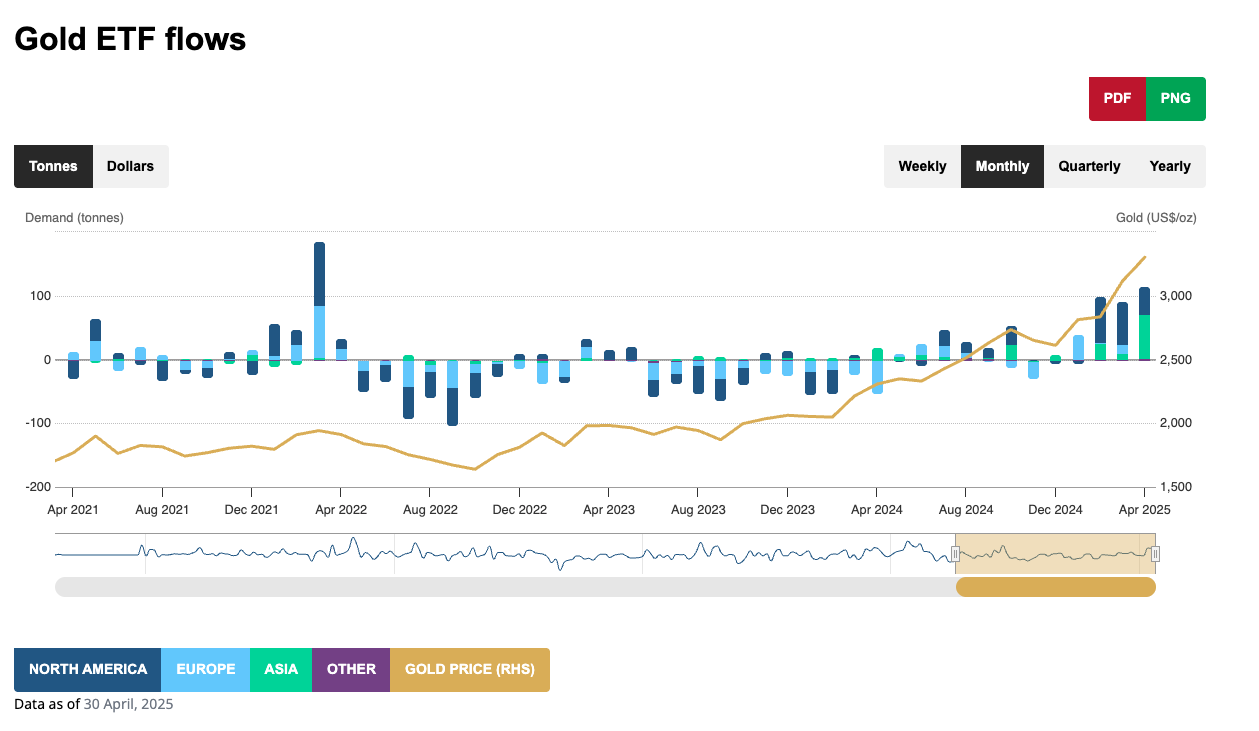
(Mike Maharrey, Money Metals News Service) Flows of gold into Asian ETFs exploded in April, driving global ETF gold holdings higher for the fifth straight month.

Last month, 115.3 tonnes of gold poured into gold-backed funds globally. It was the strongest month since August 2022.

A combination of additional gold and the surging price pushed total assets under management (AUM) by gold ETFs to $379 billion, a 10 percent increase and a month-end record.

Even with the surge of gold into ETFs over the last several months, fund holdings remain 10 percent below the month-end peak of 3,915 tonnes in October 2020.

Asian funds led the way, accounting for 65 percent of the net total. Investment interest in gold has skyrocketed in the East, especially China, where physical bar and coin demand hit the second-highest level on record in the first quarter.

Asian-based funds added 69.6 tonnes of gold last month, a 27.8 percent increase. In dollar terms, Asian gold ETFs upped their AUM by $7.3 billion, the highest monthly increase on record.

To put the move into perspective, April gold flows into Asian funds surpassed the total in Q1 and the full year 2024.

The bulk of that demand came from China-based funds.

According to the World Gold Council, the ongoing trade dispute with the U.S., worries about economic growth, equity volatility, and lower government bond yields have all created tailwinds for gold in China.

Gold also moved into Japanese funds for the seventh straight month, while Indian funds reported positive flows after net outflows in March.

North American ETFs reported strong gold inflows of 44.2 tonnes, totalling $4.5 billion. This was down compared to February and March, but was the second-strongest April on record.

Net cumulative gold flows in North American ETFs through the first four months of the year have already outpaced 2020’s historic performance.

Gold price momentum and stock market volatility are giving gold ETFs a boost in North America, but despite investor interest in gold, this has yet to translate into demand for physical metal. U.S. gold coin and bar demand plunged in the first quarter.

According to the World Gold Council, “Expectations for continued market volatility – driven by concerns such as future trade policy and inflation – should provide a level of support to flows over the medium-to-long term.”

European funds reported modest outflows of gold totaling -0.7 tonnes ($807 million). Gold outflows in the UK were mitigated by inflows in Switzerland and France.

Funds in other regions, including Australia and Africa, reported gold inflows for the fifth straight month, totaling 2.2 tonnes.

ETFs are a convenient way for investors to play the gold market, but owning ETF shares is not the same as holding physical gold.

ETFs are relatively liquid. You can buy or sell an ETF with a couple of mouse clicks. You don’t have to worry about transporting or storing metal. In a nutshell, it allows investors to play the gold market without buying full ounces of metal at the spot price.

Since you are just buying a number in a computer, you can easily trade your ETF shares for another stock or cash whenever you want, even multiple times on the same day. Many speculative investors take advantage of this liquidity.

But while a gold ETF is a convenient way to play the price of gold on the market, you don’t actually possess any gold. You have paper. And you don’t know for sure that the fund has all the gold either, especially when the fund sees inflows. In such a scenario, there have been difficulties or delays in obtaining physical metal.

Gold trading volumes skyrocketed in April, averaging $441 billion per day. This was 48 percent higher month-on-month.

Net long positions held by money managers moved lower, falling to 360 tonnes by the end of the month. This was 35 percent below the 2024 average.

According to the World Gold Council, this was mainly driven by a sharp decline in total longs – likely due to profit taking as gold refreshed new records, along with a mild rise in shorts.


Mike Maharrey is a journalist and market analyst for Money Metals with over a decade of experience in precious metals. He holds a BS in accounting from the University of Kentucky and a BA in journalism from the University of South Florida.


Homeland Security Implements Real ID Enforcement

(Brett Rowland, The Center Square) The Department of Homeland Security announced Wednesday the implementation of its REAL ID enforcement measures at Transportation Security Administration checkpoints nationwide. 

“REAL ID helps ensure that travelers are who they say they are and prevents fraud by criminals, terrorists, and illegal aliens,” Secretary Kristi Noem said. “Enforcing federal law will help keep American travelers safe.”

TSA will “enforce REAL ID and ensure there is no impact to wait times or TSA screening applications,” DHS said.

Passengers who present a state-issued identification that is not REAL ID compliant at TSA checkpoints and who do not have another acceptable alternative form of ID will be notified of their non-compliance and may be directed to a separate area to receive additional screening, according to the agency. But they will still be able to board flights, at least for now, Noem said Tuesday. 

DHS said most travelers won’t notice a difference because 81% are already REAL ID compliant.

Several states had asked for the deadline to be extended, saying they weren’t ready. 

The requirement for REAL IDs comes from legislation passed by Congress in 2005 after the 9/11 attacks, and was intended to make IDs more difficult to fake. The REAL ID Act established minimum security standards for driver’s licenses and other forms of state-issued identification.

REAL IDs have enhanced security features like barcodes, holograms and other anti-counterfeiting measures, but they also typically require more documentation to obtain than earlier forms of ID. Most states require an applicant’s date of birth, proof of identity, proof of a Social Security number and two documents showing residency to issue a REAL ID. A valid U.S. passport or birth certificate, a Social Security card or other federally issued documents or tax documents often satisfy the identity and Social Security requirements.

Americans who don’t yet have a REAL ID can use a passport card or passport book, an enhanced driver’s license, a military ID or select other forms of ID to fly domestically. Minors accompanied by adults carrying acceptable forms of ID also aren’t required to have a REAL ID in order to board domestic flights.

REAL IDs aren’t required to enter federally owned or operated museums, obtain federal benefits or for access to health care, law enforcement or constitutionally protected activities.

Fed Chair Powell Tells the Truth: “We Don’t Know!”

(Mike Maharrey, Money Metals News Service) In a rare moment of honesty, Federal Reserve Chairman Jerome Powell admitted he and his fellow central bankers don’t know what they’re doing as they wrapped up the May Federal Open Market Committee (FOMC) meeting.

As was expected, the Fed held interest rates steady at the meeting, taking a “wait and see” attitude.

“There’s just so much that we don’t know,” Powell conceded. “I think, and we’re in a good position to wait and see, is the thing. We don’t have to be in a hurry.”

Uncertainty was the theme of Powell’s post-meeting press conference, as he focused on the unknown impact of tariffs on the economy.

During a speech at the Economic Club of Chicago last month, Powell set up tariffs as a scapegoat as the inevitable effects of the Fed’s reckless monetary malfeasance during the pandemic and the Great Recession play out. He doubled down on the theme during the post-meeting press conference, lamenting, “There’s so much uncertainty about the scale, scope, timing, and persistence of the tariffs.”

The official FOMC statement also expressed worry about the impact of tariffs, saying, “Uncertainty about the economic outlook has increased further.”

Specifically, the committee said it “is attentive to the risks to both sides of its dual mandate and judges that the risks of higher unemployment and higher inflation have risen.”

If only there were a word for an economic slowdown with high unemployment coupled with rising prices.

Oh, wait, there is.

Stagflation

Powell said it was “too early” to know whether inflation or economic weakness would be the biggest problem.

And how long will it take before there is more clarity?

Powell said he doesn’t know.

“I can’t tell you how long it will take, but for now, it does seem like it’s a fairly clear decision for us to wait and see and watch.”

Powell & Company also failed to provide any hints on the future direction of monetary policy because – they don’t know.

Powell did rule out the possibility of a preemptive rate cut to offset the impact of tariffs.

“It’s not a situation where we can be preemptive, because we actually don’t know what the right responses to the data will be until we see more data.”

When asked about the national debt and ever-growing deficit spending, Powell stated the obvious – it is “on an unsustainable path.” However, the Fed chair refused to offer any solutions.

“I think they don’t need my advice and our advice on how to do fiscal policy, any more than we need their advice. It’s on Congress to figure out how to get us back on a sustainable path.”

Fed People Never Really Know What They Were Doing

Powell’s admission that the central bank doesn’t know what to do next or how things are going to play out is a rare moment of honesty from a central banker. Fed people like to maintain the illusion that they are in control. They want you to believe they’re wise and knowledgeable, equipped with the tools and brainpower necessary to guide the economy through thick and thin with calm hands firmly on the tiller.

But as Jim Grant once put it, “We have been used to, I think, imputing to the Fed immense powers of foresight and control. But oftentimes, the Fed, like so many of us, finds itself not in the vanguard of action or thought, but rather running behind to catch up.”

The fact that the people who set interest rate policy only forecast the correct trajectory of future interest rates about a third of the time is telling.

The fact of the matter is, Fed members aren’t scientists with crystal balls. They are politicians with strong academic backgrounds.

“We have decided over the course of many years to conduct our monetary affairs by kind of a Ph.D. standard of improvisation,” Grant said.

Fed officials rarely admit they are improvising. Apparently, Powell decided it was politically expedient to do so in the current situation with the president breathing down his neck, demanding rate cuts.

By the way, that’s not an unreasonable request given the massive levels of debt in this bubble economy.

On the other hand, it’s not unreasonable to hold rates higher for longer given inflation.

This is the Catch-22 I wrote about back in January before Trump was even inaugurated.

I’ve been saying for months that the central bank never did enough to slay the inflation dragon it resurrected with its massive money injection during the pandemic. It needs to hold rates higher for longer, and likely raise rates, to truly get inflation under control.

On the other hand, this debt-riddled bubble economy can’t function in a high-interest rate environment. It needs its easy money drug.

In other words, the Fed needs to simultaneously raise rates to battle price inflation and cut rates to keep the air in the bubbles.

It can’t do both.

Powell and his fellow central bankers have been walking a tightrope for a long time. He acknowledged it last month during his Economic Club of Chicago speech. As the AP described it, “The Fed would essentially have to choose whether to keep interest rates high to fight inflation or cut them to spur growth and hiring.”

“Our tool only does one of those two things at the same time,” Powell said during a Q&A session.

No wonder Powell has taken the “we don’t know, wait and see” position. What else can he do?

But it’s important to remember that the Fed is always in this position. Monetary policy isn’t a science. It’s more akin to throwing darts at a dartboard.

There is no way a few economists, even if they’re well-meaning and have PhDs, can obtain, categorize, parse out, and understand the ramifications of all the data necessary to map out the trajectory of the economy. Central bankers have a knowledge problem. They don’t know what they don’t know.

And coupled with a hubris problem, this is a bad combination.


Mike Maharrey is a journalist and market analyst for Money Metals with over a decade of experience in precious metals. He holds a BS in accounting from the University of Kentucky and a BA in journalism from the University of South Florida.

Gold Demand Diverges: East Surges While U.S. Sells Off

(Money Metals News Service) In the latest episode of Money Metals Midweek Memo, host Mike Maharrey delivers an insightful breakdown of global gold demand trends in Q1 2025, highlighting a striking divide between Eastern and Western investors.

While Asian nations continue to accumulate gold at a torrid pace, American investors are largely retreating—raising important questions about investment psychology, inflation hedging, and financial preparedness.

Record Demand Amidst a Bull Market

Total global gold demand reached 1,226 tons in Q1 2025, according to World Gold Council data—marking the strongest quarterly figure since 2016.

Although this was only a 1% increase year-over-year, the dollar value of demand surged by 40%, reaching $111 billion, driven by rising gold prices and strong central bank and ETF activity.

Physical bar and coin demand jumped globally to 325.4 tons, 15% above the 5-year average, and significantly higher than the 317.3 tons recorded in Q1 2024. However, U.S. investors bucked the trend.

East Leads the Way: China and India Dominate

China was the standout performer, with demand for bars and coins soaring to 126.7 tons—a 47% jump quarter-over-quarter and a 12% increase year-over-year. This accounted for more than one-third of global retail gold investment. In response to surging demand, the Chinese government even expanded gold import quotas for commercial banks.

India, the world’s second-largest gold market, posted its seventh consecutive quarter of year-on-year gains in bar and coin demand, with a 7% rise. Seasonal factors slightly dampened quarter-over-quarter numbers, but demand remains historically robust.

Other Asian countries also posted substantial gains:

  • Indonesia: +35%
  • Singapore: +35%
  • South Korea: +36%
  • Thailand: +25%
  • Malaysia: +34%
  • Pakistan: +5%

Central Banks Still Buying Despite Slight Decline

Official central bank purchases totaled 244 tons in Q1, down 21% from Q1 2024 but 25% above the 5-year average. Poland led the way with 49 tons, followed by consistent purchases from China, Kazakhstan, Turkey, India, and the Czech Republic.

Notably, only 22% of purchases were officially reported to the IMF, suggesting unreported buying—particularly by China and sovereign wealth funds—remains substantial.

This reflects a broader trend of de-dollarization, as emerging market central banks seek to hedge against sanctions, U.S. debt, and fiscal instability.

ETF Demand Explodes—Especially in Asia

Investment demand via gold-backed ETFs spiked to 552 tons, a 170% increase year-over-year, making it the strongest quarter since early 2022. North American-based ETFs saw 134 tons of inflows—some likely from Canada, where physical demand rose 85%.

Asian ETF demand also surged by 34 tons, with most activity in China and India.

Total ETF inflows reached $21 billion, the second-highest quarterly inflow on record, behind only Q2 2020.

Jewelry Demand Weakens in Volume, Gains in Value

Globally, gold jewelry demand dropped 21% in volume to 380 tons due to high prices, but the dollar value increased 9% to $35 billion. Chinese jewelry demand hit a five-year low in tonnage, yet consumers spent nearly as much as last year—demonstrating a willingness to stretch budgets for gold amid price increases.

In India and the broader Middle East, cultural affinity for gold jewelry continues to support demand. In contrast to the West, 24-karat jewelry is common in Asia, where it is treated as both adornment and investment.

The U.S. Contrarian Stance

While global demand soared, U.S. bar and coin demand dropped to 19.3 tons—the lowest in nearly five years, a 22% decline year-over-year. Maharrey attributes this to a shift in political sentiment, with Republican leadership historically coinciding with lower retail gold buying.

Many conservative and libertarian-leaning investors see Republican administrations as economically optimistic, and therefore less in need of a hedge.

Yet Maharrey warns this is a flawed view: inflation is not an accident—it is official policy. A 2% annual depreciation target is built into the monetary system.

While Americans largely sold physical gold, they weren’t absent from the market entirely. ETF holdings in the U.S. grew significantly, though this exposes investors to counterparty risk. Maharrey emphasizes that owning physical gold remains the superior long-term hedge.

Scrap Gold Selling and Purity Realities

High prices have driven a wave of scrap gold selling, particularly in Europe, with consumers exchanging old jewelry for cash. Maharrey reminds listeners that most U.S. gold jewelry is 14-karat or less, meaning it’s far less pure—and valuable—than bullion coins like the American Gold Eagle.

In contrast, Asia’s 24-karat gold jewelry is both a cultural symbol and financial savings vehicle—reinforcing the region’s gold-positive mindset.

Final Thoughts: The Real Contrarians?

Despite the bull market and volatile global outlook, U.S. investors remain hesitant. Maharrey predicts that when the next economic shock strikes—possibly triggered by tariffs or debt bubbles—American gold demand will surge again.

Until then, the East is propping up the market. “The mindset is different,” Maharrey concludes. “In the U.S., we think dollars are king. In Asia, they’d rather have gold and silver.”

Bill & Melinda Gates Foundation Announces Future Closure

(Ken Silva, Headline USA) In its first 25 years, the Gates Foundation became one of the world’s largest charitable foundations and one of the most powerful institutions in global health — an accomplishment that carried both accolades and controversy.

The Bill & Melinda Gates Foundation was formed in 2000 by the merger of two family foundations and funded by Gates’ Microsoft wealth and later, by tens of billions from investor Warren Buffett, and it quickly inserted itself into the architecture of global health. Gates poured billions into the foundation, which spent $100 billion in its first 25 years, with about half going toward global health.

That era now has an end date. Gates announced Thursday that the foundation will close in 2045, pledging that he plans to donate 99% of his remaining fortune, which would be $107 billion today, to the nonprofit by then. Gates said the foundation can maintain its culture and workforce over that time.

The announcement about the impending closure was announced with much fanfare, with mainstream media outlets publishing glowing articles about what the Gates Foundation has meant for public health.

However, the foundation funded a number of controversial initiatives, including investing more than $55 million in mRNA vaccines during the COVID era. Scientist Drew Weissman, who won the 2023 Nobel Prize in Medicine for his role in developing mRNA technology, warned in a 2018 paper about the risks and side effects of mRNA vaccines.

It was previously reported that Bill Gates, with the approval of the Biden administration, released an army of genetically modified mosquitoes in the states of Florida and California, while also being suspected of doing a similar thing in Massachusetts.

Before that, Gates had other ideas on how he could control the population, among which was pushing the airborne, insecticide-like “vaccines.” As of Oct. 2, 2023, researchers from Yale University already begun human trials on these types of “vaccines.”

Gates also used his foundation to garner political power. For instance, he offered Kathryn Ruemmler, who was Obama’s White House counsel from 2011 to 2014 and now works at Goldman Sachs, to sit on the foundation’s board. Gates reportedly even had Jeffrey Epstein make the offer to her.

“In 2014, Epstein called Ms. Ruemmler within weeks of her leaving the Obama White House. Epstein planned a lunch in August 2014 at his townhouse, followed by a series of meetings to introduce her to a wider circle of his acquaintances,” WSJ reported in April 2023.

The Associated Press contributed to this report.

Ken Silva is the editor of Headline USA. Follow him at x.com/jd_cashless.

Kash Patel Seeks a Bigger Budget for the FBI

(Headline USA) The man who once promised he’d close the FBI’s headquarters and turn it into a “museum for the deep state” is now seeking a bigger budget for the bureau.

FBI Director Kash Patel broke with the Trump administration Wednesday over a budget proposal that would dramatically slash funding for the bureau, telling lawmakers, “We need more than what has been proposed.”

The 2026 budget proposal released on Friday calls for a funding cut of more than $500 million for the FBI as part of what the White House said was a desire to “reform and streamline” the bureau and reduce “non-law enforcement missions that do not align” with the priorities of President Donald Trump. Patel warned that such a cut would be harmful for the FBI as it reorients priorities to focus on violent crime.

Asked to specify at a House Appropriations subcommittee which positions would need to be cut if the funding reduction was implemented, Patel said he hasn’t even begun to consider that possibility.

“At this time, we have not looked at who to cut. We are focusing our energies on how not to have them cut by coming in here and highlighting to you that we can’t do the mission on those 2011 budget levels.”

Rep. Rosa DeLauro, a Connecticut Democrat, pressed Patel for details, saying, “This is your budget. You have to have some idea of what you want to fund or not fund, or where you can cut or not cut, and provide that information” to the Office of Management and Budget.

“That’s the proposed budget — not by the FBI,” Patel replied. “The proposed budget that I put forward is to cover us for $11.1 billion, which would not have us cut any positions.”

Patel also defended the FBI’s plan to relocate about 1,000 FBI employees from the Washington area to cities around the country, one of the first initiatives he revealed upon being sworn in as director in February.

“Part of the process is not just putting people out sporadically, throwing darts on the map. What we’ve done is we’ve taken a process with the (career employees) at the FBI and said, ‘Where are some of the most violent crime places in America?’” Patel said.

Patel also clashed during one contentious exchange with Democratic Rep. Madeleine Dean of Pennsylvania, who served as a House impeachment manager during the second of two impeachment cases against Trump in his first term.

She asserted that the FBI had become “weaponized” under Patel and confronted him over a book he had authored, saying a list of Trump adversaries he included in it amounted to an “enemies list” and was being used by Trump as a “blueprint for revenge.”

Patel replied that he was the one who had been “targeted by a weaponized FBI,” presumably referring to the fact that he was among the people whose records were secretly seized by the Justice Department years earlier as part of media leak investigations when he was a staffer on the House Permanent Select Committee on Intelligence conducting an investigation into Russian election interference.

“You should read the book because there’s no enemies list (in) that book,” Patel continued. “There are people that violated their constitutional obligations and their duties to the American people, and they were rightly called out. And you should give that book to every one of your constituents so they can read” about it.

“I won’t be doing that,” Dean shot back.

“That’s their loss,” Patel said.

Adapted from reporting by the Associated Press

Three Border Agents Charged for Greenlighting Smuggling of Illegal Aliens

(Luis Cornelio, Headline USA) Three Customs and Border Protection officers are facing federal charges after allegedly allowing vehicles packed with illegal aliens to pass freely through the San Ysidro Port of Entry while on duty. 

Federal prosecutors said Tuesday that the officers—Farlis Almonte, Ricardo Rodriguez and Kairy Stephania Quiñonez—provided their lane assignments and work schedules to co-conspirators in a brazen scheme to smuggle illegal aliens through the port.  

The trio even used “code words” to signal to the vehicles to pass through with impunity. Even more troubling, the officers allegedly falsified reports about the number of vehicle occupants to conceal the presence of illegal aliens. 

Almonte and Rodriguez are charged with accepting bribes as public officials, meaning they took money in exchange for failing to enforce federal immigration law. 

Each defendant also faces charges of conspiracy to bring in illegal aliens for financial gain, which carries a maximum penalty of five years in prison, and aiding and abetting, which carries up to 15 years with a five-year mandatory minimum. 

The bribery charge alone carries a maximum sentence of 15 years. 

The charges were made possible through a joint investigation by the DHS Office of Inspector General, Homeland Security Investigations, the DEA, U.S. Customs and Border Protection’s Office of Field Operations, and Border Patrol. 

It is still unclear how many illegal aliens were smuggled through the border in the scheme—or how long each officer had been employed by the federal government. 

The charges come as President Donald Trump unleashes his tough-on-illegal-immigration agenda, vowing to reverse the chaos caused by the Biden administration’s open-border policies. 

Russia Says It Will Implement Three-Day Ceasefire Despite Ukraine’s Rejection

(Dave DeCamp, Antiwar.com) Russian officials said Tuesday that Moscow intends to implement a three-day truce with Ukraine that starts at midnight on May 8 but vowed any Ukrainian attacks during that time will be met with a response.

The ceasefire will coincide with Russia’s celebration of the 80th anniversary of the Soviet Union’s victory against Nazi Germany in World War II.

“There will be no hostilities. However, if there is no reciprocity from the Kiev regime and they continue to attack our positions or facilities, we will retaliate,” said Kremlin spokesman Dmitry Peskov, according to Russia’s TASS news agency.

Over the weekend, Ukrainian President Volodymyr Zelensky rejected the idea of a three-day truce, saying it would not help negotiations for a lasting peace, and backed a US proposal for a 30-day ceasefire.

“Let me remind you that on May 3, Zelensky publicly refused to support this initiative, trying to claim that the proposal was not serious,” said Russian Foreign Ministry spokeswoman Maria Zakharova.

Zelensky has also advised world leaders to avoid Russia’s Victory Day parade, saying he couldn’t guarantee their safety, which Moscow has taken as a threat since Ukrainian intelligence has carried out multiple bombing attacks inside Russian territory.

Slovak Prime Minister Robert Fico, who is planning to attend the parade, also took Zelensky’s comments as a threat. “I reject such threats for security reasons. I fully respect that the safety of participants is an internal matter of the Russian Federation. But if Mr. Zelensky believes that his statements will force foreign delegations not to come, then he is deeply mistaken,” he said.

This article originally appeared at Antiwar.com.

Israeli Minister: Gaza Will Be ‘Totally Destroyed,’ Population Will Be ‘Concentrated’

(Dave DeCamp, Antiwar.com) Israeli Finance Minister Bezalel Smotrich said on Tuesday that within a few months, the Gaza Strip will be “totally destroyed” and the entire Palestinian population will be “concentrated” into a tiny area in the southern part of the Palestinian territory before being forced to leave as part of an ethnic cleansing campaign.

“Within a few months, we will be able to declare that we have won. Gaza will be totally destroyed,” Smotrich said at a conference on illegal settlements in the Israeli-occupied West Bank, according to The Times of Israel.

“In another six months, Hamas won’t exist as a functioning entity… The population of Gaza will be concentrated from the Morag Corridor southwards. The rest of the Strip will be empty,” Smotrich said.

The Morag Corridor refers to a strip of land between the southern Gaza cities of Khan Younis and Rafah.

“The Gazan citizens will be concentrated in the south. They will be totally despairing, understanding that there is no hope and nothing to look for in Gaza, and will be looking for relocation to begin a new life in other places,” Smotrich added.

The Israeli minister said that the Palestinian population will “leave in great numbers to third countries.” Throughout Israel’s genocidal war on Gaza, Smotrich has been an outspoken proponent of the ethnic cleansing of the territory.

Smotrich’s comments come after the Israeli government approved military plans to completely occupy Gaza. According to Axios, the plan will involve flattening every single building, forcing the civilian population into one small area, and pressuring Palestinians to leave, though it’s unclear where they could go.

In his speech on Tuesday, Smotrich also vowed that the current Israeli government would annex the West Bank. “It will happen this term. It is one of our most important challenges. We are at a historic opportunity,” he said.

Smotrich is a West Bank settler himself and holds another ministerial position in the Defense Ministry that gives him the power to expand settlements in the occupied territory.

This article originally appeared at Antiwar.com.