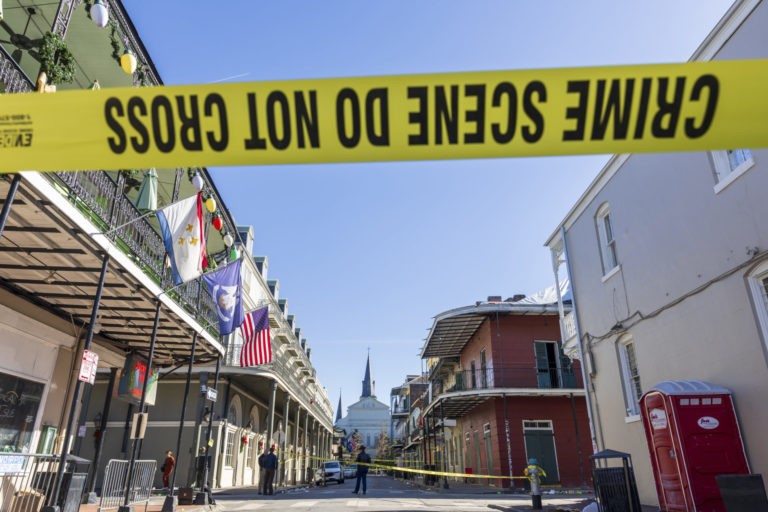
(Headline USA) Officials increased the reward for the capture of seven inmates who escaped from a New Orleans jail by fleeing through a hole behind a toilet as at least a dozen law enforcement agencies pressed their expansive search for the men for a third day on Sunday.
FBI Special Agent Jonathan Trapp said at a news conference that seven of the 10 men who originally escaped on Friday are still at large and that the FBI is offering $10,000 per inmate instead of the $5,000 previously announced. He said he believes members of the public may be aiding the men, and authorities will arrest those found aiding or abetting them.
The men range in age from 19 to 42 and face a variety of charges including aggravated assault, domestic abuse battery and murder.
The FBI reward is in addition to $5,000 rewards offered by the Bureau of Alcohol, Tobacco, Firearms and Explosives and $2,000 from CrimeStoppers.
A spokesperson for the Louisiana State Police said that the agency was unable to provide details about the scope and target of the investigation for security reasons. The spokesperson added that a multiagency task force was scouring the region for the remaining fugitives.
In a separate statement, Louisiana Attorney General Liz Murrill said on Sunday her office’s “main priority remains recovering the prisoners, protecting the public, securing and stabilizing the facility staff, and building.”
At least one of the escaped inmates was captured based on a tip from the public, according to a statement from the FBI on the social media platform X.
New Orleans Police Department Superintendent Anne Kirkpatrick warned that the fugitives are dangerous in a news conference on Friday night but also urged the public “not to panic.”
Orleans Parish Sheriff Susan Hutson said the men were able to get out of the Orleans Justice Center because of “defective locks.”
Hutson said she has continuously raised concerns about the locks to officials and, as recently as this week, advocated for money to fix the aged infrastructure.
“This massive jail break could be the largest jail break in the history of the state, and it never should have happened. The public deserves to know who, what and how this happened,” Gov. Jeff Landry said at the Sunday news conference.
Landry said an audit of the jail by the Department of Corrections will be done by the end of the week. He said everyone in the criminal justice system needs to be held accountable “except for the police, who seem to be doing their job.”
Landry cited delays in bringing charges against people accused of crimes, prosecutions and in sentencing as factors he said contribute to jail populations.
He blamed Friday’s escape on what he called a “progressive justice system,” saying that “there is also no excuse for the way these cases are currently being mismanaged in our criminal justice system.”
Landry declined to comment on whether the escape was an inside job or how it happened.
On Friday, Orleans Parish Sheriff Susan Hutson said the men were able to get out of the Orleans Justice Center because of “defective locks,” and possibly with help from people inside her department.
“It’s almost impossible, not completely, but almost impossible for anybody to get out of this facility without help,” she said of the jail where 1,400 people are being held.
The escape is drawing intense scrutiny and opprobrium. It took hours for sheriff’s officials to learn of the escape and then more time still to alert New Orleans police, even though some of the missing inmates are accused of violent offenses and they escaped into a neighborhood less than 2 miles (3.2 km) from the city’s famous French Quarter.
Louisiana State Police Superintendent Colonel Robert Hodges said authorities in neighboring states have been notified but that officials do not believe the men have left the state yet. Leads for the men have not panned out, he said.
(Dave DeCamp, Antiwar.com) US envoy Steve Witkoffsaid in an interview that aired Sunday that the US “cannot allow” Iran to maintain a civilian nuclear enrichment program, calling the issue a “red line” for the Trump administration.
“We have one very, very clear red line, and that is enrichment. We cannot allow even one percent of an enrichment capability,” Witkoff said.
Iranian officials have made clear that they’re ready to reduce uranium enrichment levels, but the idea of eliminating its enrichment program altogether is a non-starter, and the US’s insistence on that demand makes a deal unlikely.
Witkoff said the US has “delivered a proposal to the Iranians that we think addresses some of this without disrespecting them” and insisted the US is seeking “a deal that does not include enrichment.”
In response to Witkoff’s comments, Iranian Foreign Minister Abbas Aragchi vowed that Iran’s nuclear enrichment program would continue.
“If the US is interested in ensuring that Iran will not have nuclear weapons, a deal is within reach, and we are ready for a serious conversation to achieve a solution that will forever ensure that outcome,” Aragchi wrote on X. “Enrichment in Iran, however, will continue with or without a deal.”
The Trump administration is under significant pressure from Republicans in Congress to settle for nothing less than a deal that eliminates Iran’s nuclear enrichment program. More than 200 GOP lawmakers made the demand in a recent letter to President Trump, which was likely an effort to sabotage diplomacy to bring the US and Iran closer to war.
Trump has been threatening that the US will attack Iran if a deal isn’t reached on its nuclear program, even though his intelligence agencies recently reaffirmed that there’s no evidence Tehran is building a bomb or that Ayatollah Ali Khamenei has reversed his ban on the development of nuclear weapons.
(Ken Silva, Headline USA) The video below breaks down our best stories from last week that were either unreported or underreported by other outlets. Find the time-stamps and links to the stories below the video!
WEEKLY BRIEFING: Headline USA's @NumberSixTNP breaks down our best stories from last week that were either unreported or underreported by other outlets.
0:45 — Police Encountered Ryan Routh 9 Days before Alleged Trump Assassination Attempt
A May survey by research firm “co/efficient” revealed that 26 percent of voters now view Rep. Ocasio-Cortez, D-N.Y., as the Democratic National Committee’s face, the highest share of any other politician.
The poll, which surveyed 1,400 voters, also found that an identical 26 percent said they viewed “no one” as their party’s representative. Another 22 percent picked “other.”
Sen. Bernie Sanders, I-Vt., trailed far behind with just 12 percent support, while former Transportation Secretary Pete Buttigieg drew five percent, and Sen. Cory Booker, D-N.J., received four percent.
California Gov. Gavin Newsom, long rumored as a potential 2028 presidential contender, finished last with just 2 percent.
The survey’s findings come roughly five months after former President Joe Biden left the White House in disgrace, having temporarily run for re-election in 2024 before endorsing his beleaguered vice president, Kamala Harris.
Harris briefly served as the de facto party leader from July 2024 through the November election, but she was swiftly defeated by President Donald Trump.
Tellingly, only six percent of poll respondents named Harris as their party’s figurehead, placing her behind Rep. Jasmine Crockett, D-Texas, at eight percent.
Biden failed to register any support, according to the co/efficient poll, which was first reported by The Independent.
As noted by the paper, Democratic voters’ views of AOC as the party’s face are consistent with other polling. An AP/NORC poll found that 55 percent of respondents favored Ocasio-Cortez.
Data for Progress polling placed her as the favorite in a potential primary challenge against Senate Minority Leader Chuck Schumer.
While Schumer has already filed paperwork for re-election in 2028, Ocasio-Cortez has not ruled out a bid.
(Luis Cornelio, Headline USA) “Crooked” Hillary Clinton has once again outdone herself, unleashing a smear even harsher than her infamous “basket of deplorables” rant.
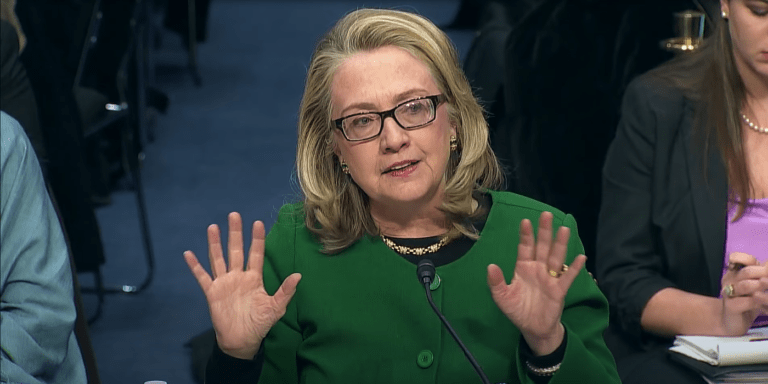
The twice-failed presidential candidate, who’s married to an alleged rapist, slammed Republican women as “handmaidens to the patriarchy” in a May 1 interview with Margaret Hoover.
Hoover asked what advice Clinton would give to a future woman president, to which Clinton replied, “First of all, don’t be a handmaiden to the patriarchy, which kind of eliminates every woman on the other side of the aisle, except for very few.”
Hoover noted Sen. Lisa Murkowski, R-Alaska and disgraced former Rep. Liz Cheney as exceptions.
Although the interview took place a few weeks ago, clips resurfaced online on Sunday, drawing fresh criticism.
Hillary Clinton complains about Elon Musk and JD Vance encouraging Americans to have children, suggests that’s what “legal and undocumented” immigrants are for.
“Black people aren’t black if they don’t vote Democrat. Latinos are stupid. Whites are racist. Women are handmaidens. It never ends,” journalist Robby Starbuck wrote on X. “This is what Democrats think of us.”
Legal scholar Robert P. George chimed in, saying that he believes “Democrats really do have an electoral death wish.”
“Here’s the latest from the person who fired up Donald Trump’s base with her ‘basket of deplorables’ line. Now she’s dissing women who don’t share her beliefs as “handmaidens to the patriarchy,” George added.
Others argued Clinton herself may fit the label—she stood by Bill Clinton through his scandals.
“Didn’t she cling to Bill even after all his sexual assault & harassment allegations? @HillaryClinton looks like the handmaiden to me,” wrote Gloria Romero, the former California Senate majority leader.
Another user scolded Clinton: “The evil hag who ruined the lives of Bill Clinton’s rape victims to keep them quiet would like you to know that Republicans are ‘handmaidens.’”
(Jesse Colombo, Money Metals News Service) Though silver has been quiet lately, it’s important to be aware of the many bullish factors that are setting the stage for a strong move higher.
As an analyst and investor who strongly believes in silver’s long-term potential, I often revisit and share key charts to stay grounded in the bullish thesis—and to help others do the same.
In periods of frustrating stagnation like we’ve seen recently, it’s easy to lose sight of silver’s powerful setup. But these doldrums won’t last forever, and it’s important to keep our eyes on the bigger picture.
In this piece, I’ll walk you through the bullish case for silver, using the latest charts and data to reinforce why this thesis remains as compelling as ever.
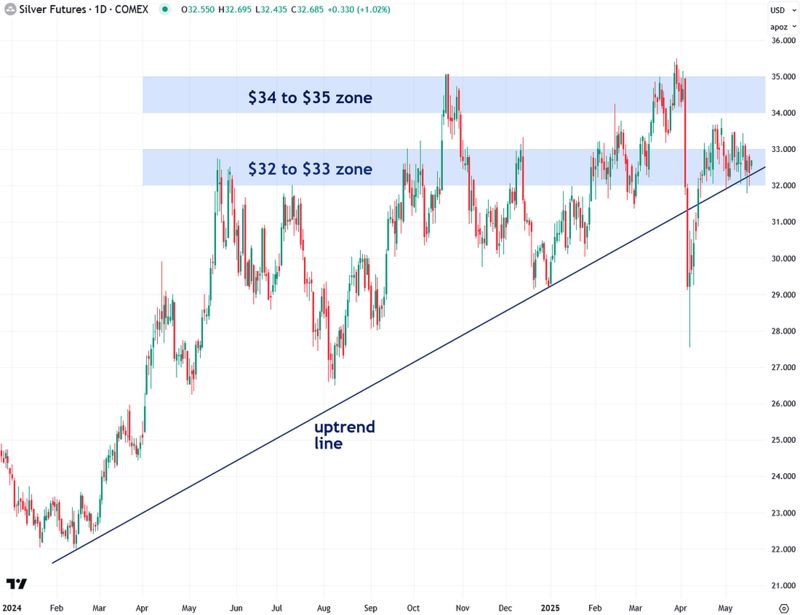
To begin, let’s examine the chart of COMEX silver futures and highlight the key technical levels currently in play.
First, take note of the $32 to $33 resistance zone, which has acted as a stubborn ceiling for much of the past year. A decisive breakout above that zone would issue an important bullish signal.
The next major hurdle is the $34 to $35 zone, which notably capped silver’s rally in late October. A decisive, high-volume close above that level would serve as strong confirmation that a major breakout is underway. Once silver clears both barriers, the path should be wide open for a powerful bull market.
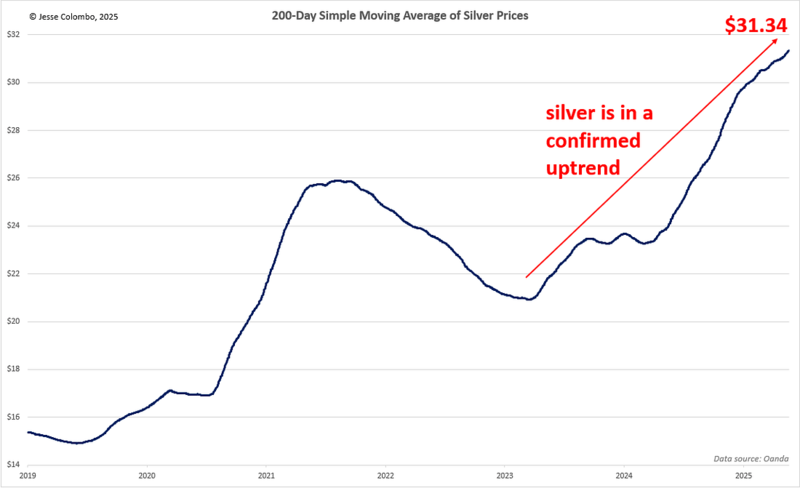
Although silver has traded in a choppy, erratic manner for much of the past year, it is in a confirmed uptrend, despite grinding higher in a frustrating “two steps forward, one step back” manner.
This is evident in the 200-day simple moving average, a helpful tool for identifying an asset’s primary trend by filtering out short-term price fluctuations.
More importantly, the 200-day moving average suggests that the odds favor further gains, as a trend in motion tends to stay in motion—much like Newton’s first law of motion, also known as the law of inertia.
The even better news is that once silver fully breaks out, as discussed earlier, I expect it to rise in a much more orderly fashion rather than continuing its erratic price swings.
One of the key reasons I believe silver is on the verge of a powerful new phase in its bull market is gold’s impressive rally over the past year.
Historically, gold is a major driver of silver’s price, though silver often lags before catching up. With economic uncertainty rising and the risk of a recession increasing, I believe gold still has plenty of upside potential.
As I’ll explain shortly, the higher gold climbs, the more undervalued silver will become relative to gold, making it increasingly difficult for silver to remain at these relatively low levels while gold continues to soar.
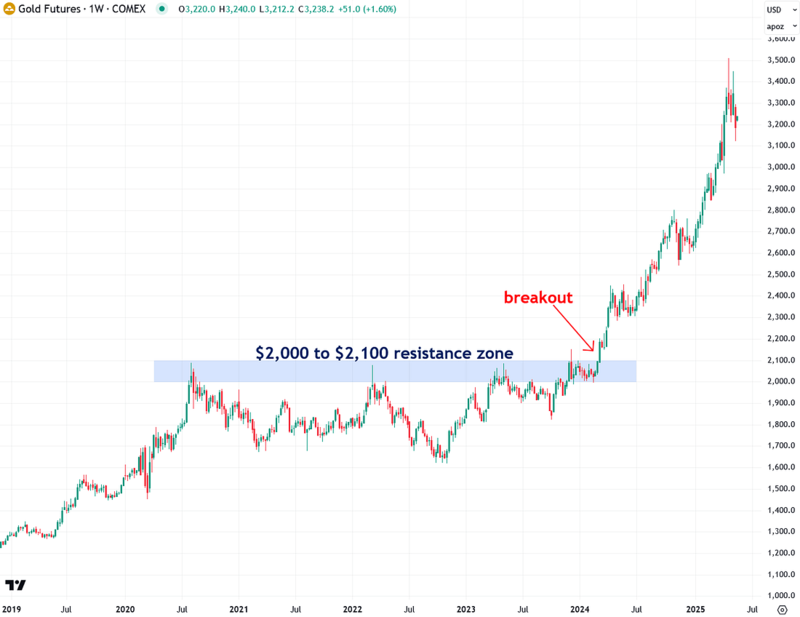
Also, take a look at the chart below and notice how gold struggled from 2020 to early 2024 to break above the $2,000–$2,100 resistance zone, which acted as a price ceiling for much of that period. Despite multiple attempts, gold was repeatedly pushed back down.
However, in March 2024, it finally broke out, igniting the powerful bull market we see today. I see striking parallels with silver’s $32–$33 resistance zone over the past year and believe that once silver manages to truly clear this level, it will soar just as gold did.
In addition to gold, copper is another key metal that strongly influences silver’s price, as I explained here. This understanding led me to develop the Synthetic Silver Price Index (SSPI)—an indicator designed to validate silver’s price movements and filter out potential fakeouts.
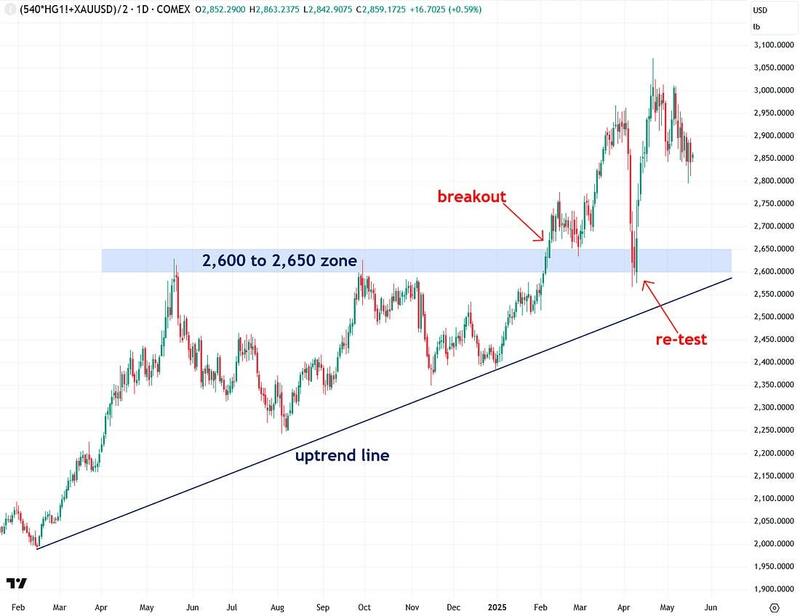
The SSPI is calculated as the average price of gold and copper, with copper adjusted by a factor of 540 to ensure gold doesn’t disproportionately impact the index. Remarkably, despite silver not being an input, the SSPI closely mirrors silver’s price movements.
For much of the past year, I’ve been closely monitoring the SSPI as it repeatedly struggled to break above the critical 2,600 to 2,640 resistance zone. I’ve consistently emphasized that a breakout above this level would serve as a major bullish confirmation for silver.
That long-awaited breakout finally occurred in February—driven in part by strong rallies in both copper and gold—signaling a notable tailwind for silver. As long as the SSPI holds above this zone and continues to climb, the odds of a silver rally grow increasingly likely.
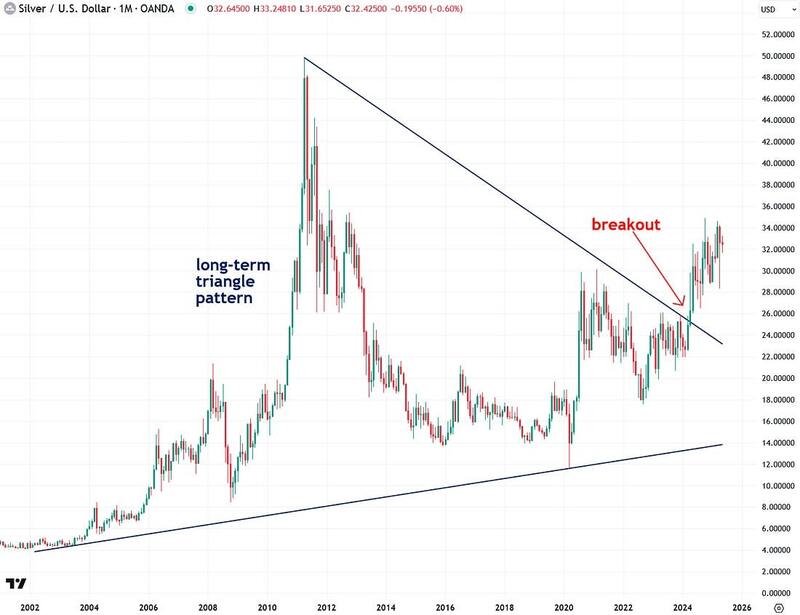
Another strong indication that silver is on the verge of a powerful bull market is its breakout in April 2024 from a two-decade-long triangle pattern:
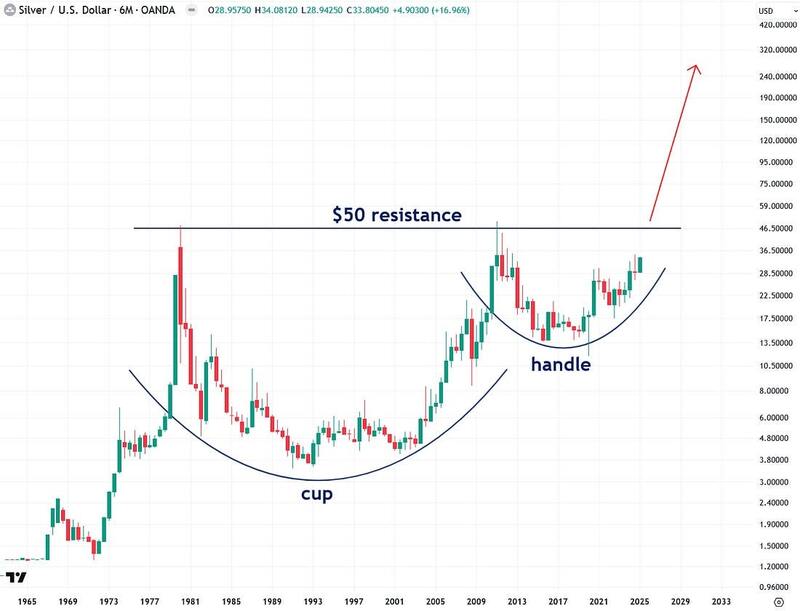
Even more exciting is the fact that silver’s logarithmic chart, dating back to the 1960s, reveals a cup-and-handle pattern, indicating the potential for silver to reach several hundred dollars per ounce during this bull market.
In order to confirm this particular scenario, silver needs to close decisively above the $50 resistance level.
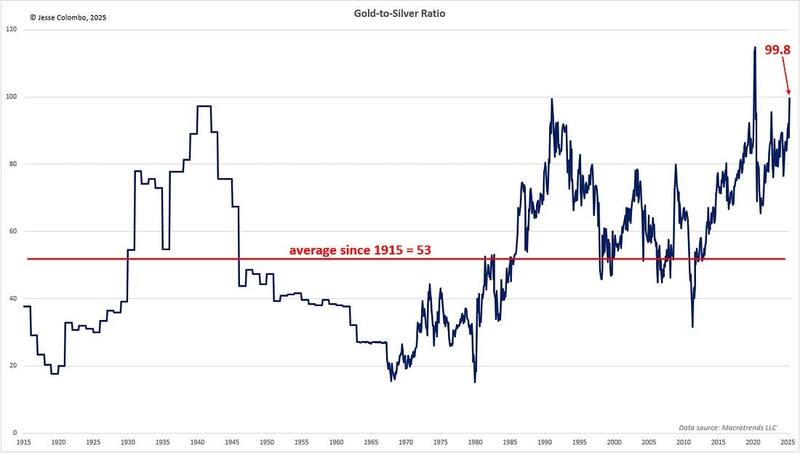
The long-term gold-to-silver ratio chart clearly shows that silver is significantly undervalued relative to gold, indicating that silver has substantial upside potential. As silver rises to close this gap, the ratio would decline.
The current gold-to-silver ratio stands at 99.8, but if it were to revert to its historical average of 53 since 1915—without any increase in gold’s price—silver would be valued at a solid $61.2 per ounce (which is nearly double the current price of $32.50).
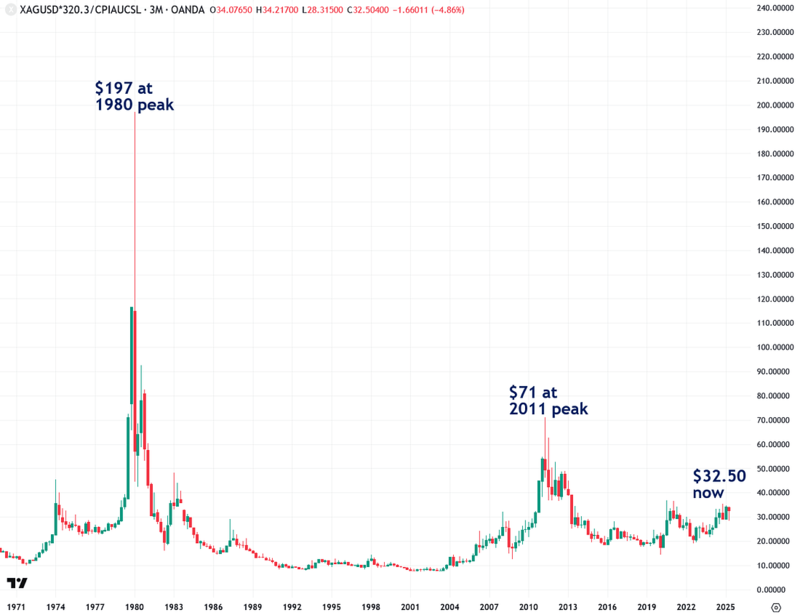
Adjusting silver’s price for inflation further highlights how undervalued it is by historical standards. During the Hunt brothers-induced spike in 1980, silver reached an inflation-adjusted price of $197. In the 2011 bull market, driven by quantitative easing, it hit $71.
Currently trading at just $32.50, silver has significant room to rise if it’s to catch up with these previous inflation-adjusted peaks.
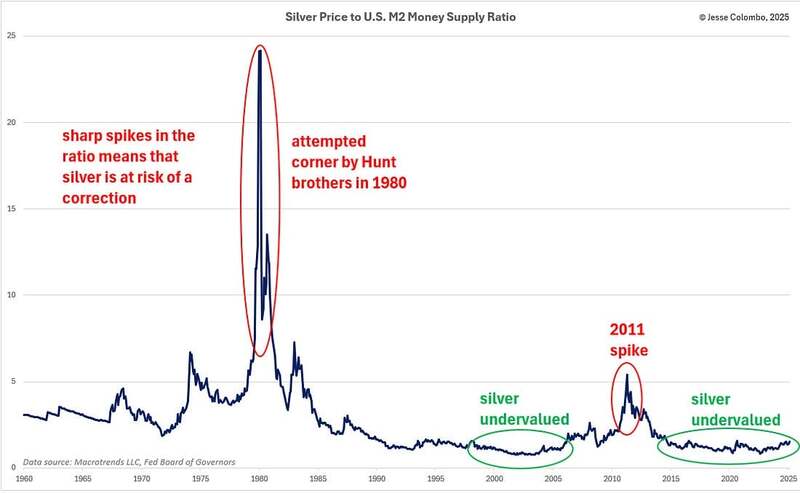
Another way to assess whether silver is undervalued or overvalued is by comparing it to various money supply measures. The chart below shows the ratio of silver’s price to the U.S. M2 money supply, providing insight into whether silver is keeping pace with, outpacing, or lagging behind money supply growth.
If silver’s price significantly outpaces money supply growth, the likelihood of a strong correction increases. Conversely, if silver lags behind money supply growth, it suggests a potential period of strength ahead.
Since the mid-2010s, silver has slightly lagged behind M2 growth, which, combined with other factors discussed in this piece, positions it for a strong rally.
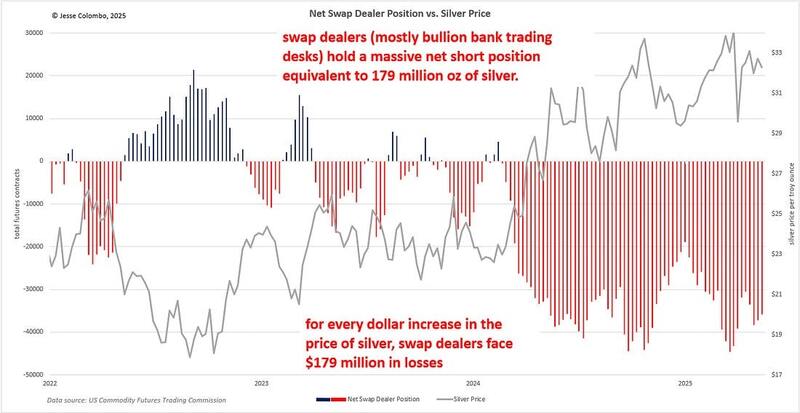
One of the key factors keeping silver’s price suppressed over the past year, even as gold surged, has been the heavy short-selling of COMEX silver futures by swap dealers—primarily the trading desks of bullion banks such as JPMorgan and UBS.
In the process, they amassed a massive net short position of 35,733 futures contracts, equivalent to 179 million ounces of silver—over one-fifth of the annual global silver production. This staggering figure highlights the immense downward pressure exerted on the silver market.
What’s even more astonishing is how much of this short position in silver futures is naked, meaning it isn’t backed by physical silver. It’s merely “paper” silver being dumped onto the market to suppress prices.
However, once silver finally breaks out, it could trigger a wave of short-covering—when traders who bet against an asset through short-selling are forced to buy it back as prices rise to limit their losses. As the price climbs, these traders become increasingly desperate to close their positions, further fueling the rally.
If the buying pressure is intense enough, it could even lead to a short squeeze, dramatically amplifying silver’s upward momentum. Given the size of their short position, bullion banks stand to lose approximately $179 million for every $1 increase in the price of silver—a setup for a major price surge. Now, just imagine what will happen as silver climbs by $5, $10, $20, and beyond from this point.
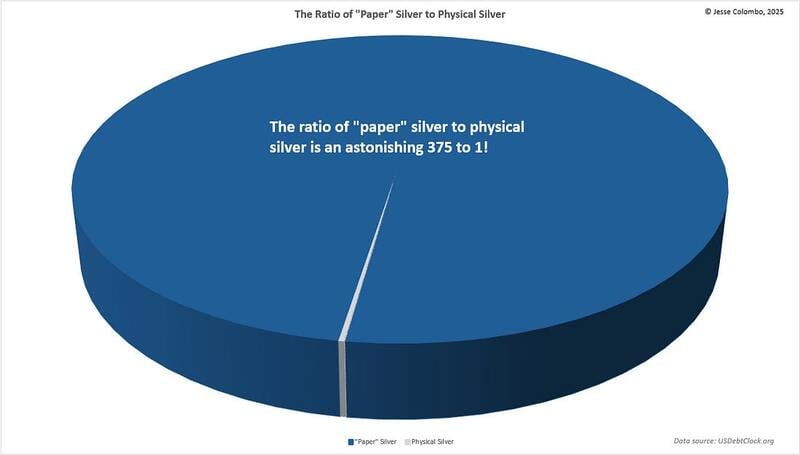
The risk of an explosive silver short squeeze is further amplified by the astonishing ratio of 375 ounces of “paper” silver—ETFs, futures, and other derivatives—for every single ounce of physical silver.
In a violent short squeeze, holders of “paper” silver could be forced to scramble for the extremely scarce physical silver to fulfill their contractual obligations.
This would cause the price of “paper” silver products to collapse, while physical silver prices would skyrocket to jaw-dropping levels, potentially reaching several hundred dollars per ounce (this event is what may fulfill the price target implied by the cup and handle pattern I showed earlier).
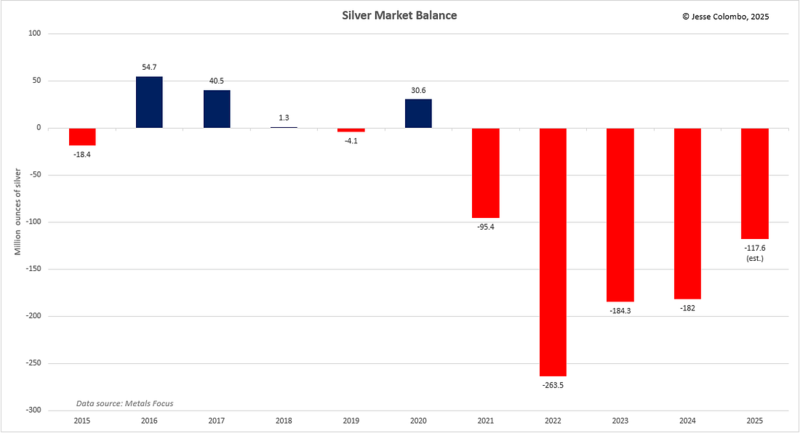
One key reason I believe silver will soon break free comes down to basic Economics 101: supply and demand. Over the past five years, silver demand has consistently exceeded supply, resulting in a persistent deficit.
In 2024 alone, the shortfall reached 182 million ounces, with an estimated additional 117.6 million ounces this year—and deficits are expected to continue for the foreseeable future.
As a result, above-ground silver stocks are dwindling rapidly. While bullion banks can create unlimited amounts of paper silver to suppress prices, they can’t manufacture the real physical silver that is crucial for a wide range of industries, alongside growing investment demand.
The persistent silver deficit stems from both dwindling supply and surging demand—a combination that, in an unmanipulated market, would naturally drive prices higher. That’s why I see silver as a beach ball being held underwater—pressure is building, and it won’t stay suppressed for much longer.
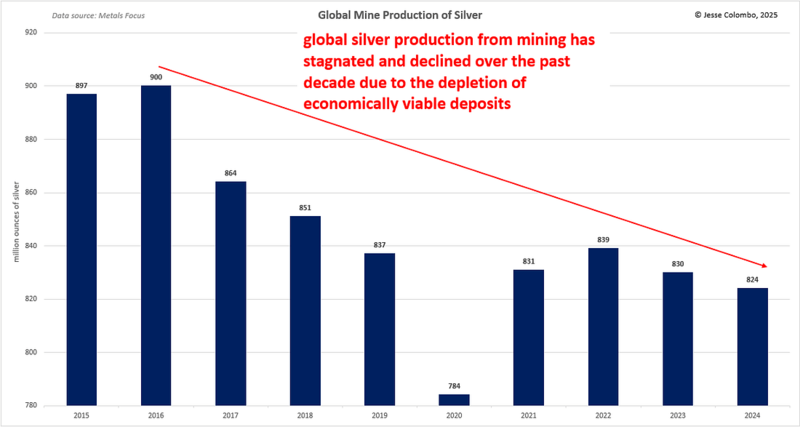
On the supply side, global silver mine production has peaked and declined over the past decade as economically viable deposits become depleted—something the bullion banks have absolutely no control over. And as time goes on, this supply crunch is only likely to worsen.
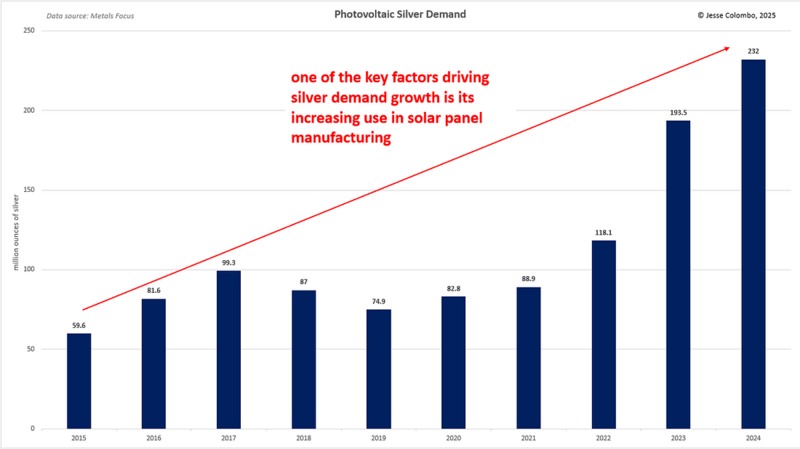
At the same time, demand for physical silver has skyrocketed across multiple sectors, with the biggest driver being the surge in solar panel manufacturing. As the world shifts away from fossil fuels toward renewable energy, this trend is only in its early stages.
Silver demand for photovoltaic (solar panel) applications alone has nearly tripled over the past four years, increasing by an astonishing 143.1 million ounces. With global efforts to expand clean energy accelerating, this demand is set to grow even further.
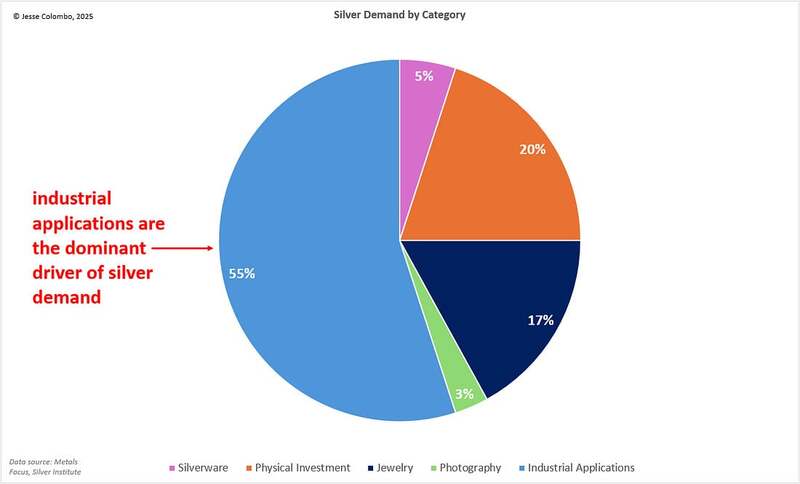
It’s important for silver investors to understand just how much industrial demand influences the price of the metal—unlike gold, which is considered a “pure” precious metal with relatively limited industrial use. Silver is a hybrid metal, serving both industrial and monetary roles, but its industrial demand far exceeds its investment demand.
This dual nature makes silver uniquely sensitive to both economic trends and investor sentiment. That said, I expect physical silver investment demand to ultimately surge as the precious metals bull market advances and a major financial reset unfolds.
As the pie chart below shows, the majority of silver demand—about 55%—comes from industrial use, while only around 20% comes from investment. In contrast, gold demand is driven largely by investment (44.57%) and jewelry (48.74%), with much of that jewelry serving as a form of investment as well, particularly in developing countries like India and China.
As we begin to wrap up, I’d like to touch on some key ways to position for the coming silver bull market. First and foremost, I’m a big fan of “stacking” or dollar-cost averaging physical silver bullion—an approach that’s well-suited for most investors.
However, as someone with a higher-than-average risk tolerance, I also look to silver mining stocks for their amplified upside potential. These stocks are leveraged to the price of silver and tend to move more dramatically—both up and down—so they’re not for the faint of heart. While riskier than holding bullion, they can offer explosive returns when silver truly takes off.
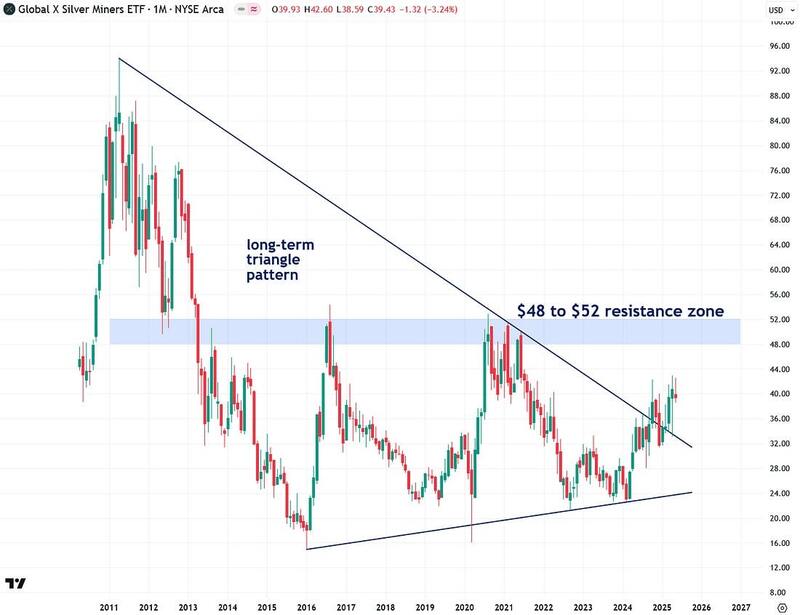
I use the Global X Silver Miners ETF (SIL) as a useful proxy to track the performance of silver mining stocks. SIL broke out of a long-term triangle pattern a few months ago, which is a bullish development.
However, a decisive close above the key $48–$52 resistance zone is still needed to fully confirm that the bull market in silver mining stocks is underway.
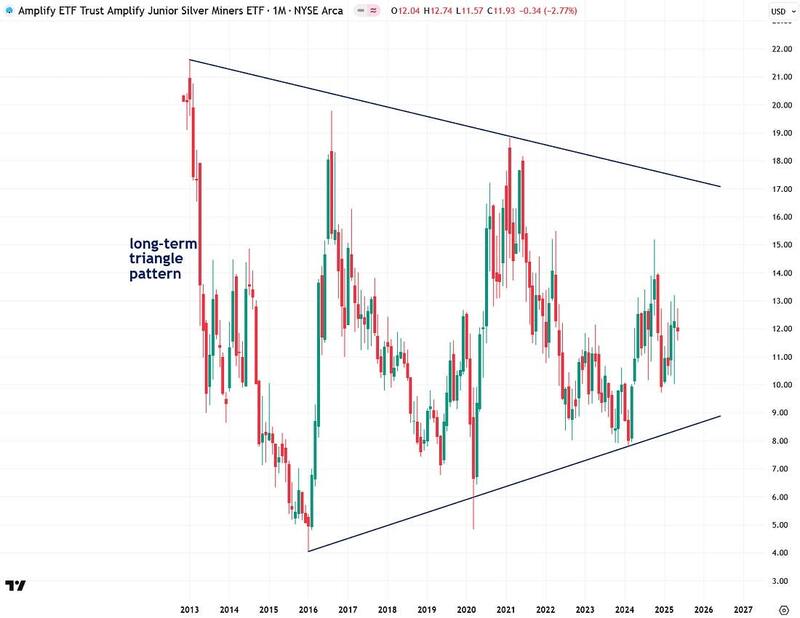
Junior silver mining stocks, as measured by the SILJ ETF, are beginning to show signs of life but remain confined within a long-term triangle pattern that dates back to 2013.
Once this pattern decisively breaks to the upside, I believe silver mining stocks—especially the juniors—are poised to surge in a truly spectacular fashion.
To summarize, while many investors continue to overlook silver due to its recent subdued performance, they’re missing the many positive factors quietly building behind the scenes.
From its historically low valuation across multiple metrics to the persistent supply-demand imbalance that’s rapidly depleting global inventories, silver is setting the stage for a major bull market.
I believe the years ahead will be highly rewarding for silver investors—but only for those with the faith and tenacity to stay the course. That’s exactly why I produce these reports: to remind both myself and my subscribers of the once-in-a-lifetime opportunity silver represents right now.
If you found this report valuable, click here to subscribe to The Bubble Bubble Report for more content like it.
Jesse Colombo is a financial analyst and investor writing on macro-economics and precious metals markets. Recognized by The Times of London, he has built a reputation for warning about economic bubbles and future financial crises. An advocate for free markets and sound money, Colombo was also named one of LinkedIn’s Top Voices in Economy & Finance. His Substack can be accessed here.
(Mike Maharrey, Money Metals News Service) Every once in a while, you’ll hear some talking head on a financial network claim that gold is “a useless metal.”
This is an absurd statement.
Fundamentally, gold is money, accounting for a lot of its demand, but it also has practical uses.
In the first quarter, tech and industrial applications used about 80.5 tonnes of gold, primarily in electronics and computing.
Overall, gold demand in industry was flat year-on-year. However, gold used in electronics rose by 2 percent to 67 tonnes despite concerns about the impact of tariffs on the industry and record gold prices.
Gold is an important input in the electronics sector. The metal is an excellent conductor, efficiently dissipates heat, and, unlike copper or silver, doesn’t oxidize or corrode over time. Gold is also extremely malleable and can easily be formed into very thin wires and sheets.
AI-related applications drove growth in memory chips and semiconductors during the quarter, helping boost tech demand for gold. The expansion of AI server memory in both China and the U.S. was key to growth. According to the World Gold Council, this trend should continue into Q2 with the launch of AI-enabled smartphones and PCs.
Demand for gold in the manufacture of Light Emitting Diodes (LEDs) grew slightly during Q1, driven partly by panel manufacturers and consumer device makers stockpiling to mitigate tariff disruption.
Demand for gold in sensor applications, such as biosensors, advanced automation systems, and big data applications, remained healthy in Q1.
The Printed Circuit Board (PCB) sector registered growth during the quarter. Although Q1 is traditionally a low season for PCBs, the robust demand was thanks to rush orders from consumer electronics manufacturers and ongoing strength from AI applications.
The wireless sector reported a modest decline in Q1, partly driven by supply chain adjustments. According to the WGC, the adoption of WiFi-7 should support wireless demand in the coming quarters as the shift from WiFi-6 requires a significant uplift in power amplifiers per unit. Continued growth in wireless infrastructure, including low Earth orbit satellites (LEOs), won’t likely be impacted by tariffs and could help support demand in the sector.
However, electronics manufacturers are reportedly cautious about the near-term outlook due to the tariffs and the potential for an economic recession.
Gold used in other industrial and decorative applications, primarily gold-plated items and jewelry, along with gold thread used in traditional Indian clothing, was down 5 percent year-on-year in Q1.
The ongoing decline in gold used in dentistry continued with a 6 percent year-on-year drop in volumes to 2 tonnes.
Demand for gold in industry and tech was up 7 percent in 2024, driven by growth in the electronics and computing sectors.
Industry and technology used 326 tons of gold last year, propelled by the strongest fourth quarter since 2021.
Gold Is Far From “Useless”
Warren Buffett once said, “Gold gets dug out of the ground in Africa or someplace. Then we melt it down, dig another hole, bury it again, and pay people to stand around guarding it. It has no utility. Anyone watching from Mars would be scratching their head.”
As you can see by the substantial demand for gold in technology and electronics, this is just silly.
In fact, gold is one of the most useful metals in the world. Due to its utility, coupled with its scarcity, gold is also one of the most valuable metals in the world.
In the first place, gold is strikingly beautiful. It has captured people’s eyes for thousands of years. That’s why people all over the world love to wear gold. About 44 percent of gold demand is for jewelry production. About 1,877 tons of gold were used in jewelry fabrication last year.
But gold isn’t just pretty. As already mentioned, the metal’s inherent physical and chemical properties make it useful in many industrial and technological applications.
This is why we see gold increasingly used in the tech sector. In fact, gold would probably be used even more if it weren’t so rare and expensive.
Gold is also important in the medical field. Its inherent stability and unique optical properties make it perfect for use in diagnostic testing. The World Gold Council said that gold is “at the heart of the hundreds of millions of Rapid Diagnostic Tests (RDTs) that are used globally every year.”
“This well-established and critically important technology has changed the face of disease diagnosis in the developing world over the last decade.”
Gold nanoparticles are used in testing for malaria, HIV, hepatitis, and other illnesses.
Gold has even been used in some exotic applications. In 2018, a team of Chinese researchers partially restored the sight of blind mice by replacing their deteriorated photoreceptors – sensory structures inside the eye that respond to light – with nanowires made of gold and titanium.
The point is that gold is far from useless.
But fundamentally, gold is money. And everybody wants to have money — especially real money.
Mike Maharrey is a journalist and market analyst for Money Metals with over a decade of experience in precious metals. He holds a BS in accounting from the University of Kentucky and a BA in journalism from the University of South Florida.
(Money Metals News Service) Gold demand soared in the first quarter of 2025, hitting its highest Q1 level since 2016.
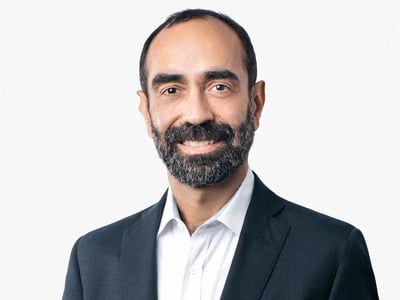
To explain what’s driving the trend, Mike Maharrey spoke with Juan Carlos Artigas, global head of research at the World Gold Council. Artigas offered key insights from their latest Gold Demand Trends report and shared what investors should know about this increasingly global market.
Artigas emphasized that gold must be understood in its full international context. While U.S. investors often focus narrowly on domestic factors like the dollar or interest rates, gold demand is shaped by activity around the world. Jewelry buying in India, bar and coin sales in China, and central bank purchases across emerging economies all influence gold’s price and stability.
As Artigas put it, “Gold is a global good.” Failing to account for that global nature leads to a narrow and often misleading view of the market.
(Interview Starts Around 6:31 Mark)
Who Is Juan Carlos Artigas?
Juan Carlos Artigas
Juan Carlos Artigas is the Global Head of Research at the World Gold Council, where he has led the organization’s market intelligence efforts since 2009. Based in New York, Artigas oversees a global team that delivers in-depth analysis on the dynamics of gold demand, supply, and pricing. His research helps institutional and retail investors understand gold’s evolving role as a strategic asset in global portfolios.
Under his leadership, the World Gold Council developed the Gold Valuation Framework—an academically validated model that explains gold’s performance through macroeconomic, financial, and market-specific lenses. This framework is now a cornerstone of the Council’s research output, widely referenced by analysts, institutions, and policymakers.
Before joining the World Gold Council, Juan Carlos Artigas served as a fixed income strategist at JPMorgan Securities, focusing on U.S. and emerging markets. There, he contributed to sovereign and corporate debt valuation models and published research for leading financial outlets.
Artigas holds a Bachelor of Science in Actuarial Sciences from ITAM (Instituto Tecnológico Autónomo de México), and earned both an MBA and a Master of Science in Statistics from the University of Chicago. He was also a Ph.D. candidate in Econometrics and Statistics at the same institution, bringing academic rigor and analytical precision to his role in the gold market.
Q1 2025 Highlights: Broad Participation and Steady Supply
Demand was strong across nearly every sector. Gold ETFs rebounded sharply after a weak 2024, jewelry buying held up despite higher prices, and consumer interest remained firm worldwide. Total global demand reached the highest Q1 level in nearly a decade.
Interestingly, jewelry demand measured in tonnage dipped slightly, but total spending actually rose. That’s because consumers, especially in Asia, continued to buy—just in smaller quantities. “People are still spending money on gold jewelry,” said Artigas, “they’re just buying smaller pieces.”
Another surprise was that recycling declined by 1%, even though gold prices rose. Historically, people sell more gold when prices rise. But this time, many held on to their gold, signaling continued faith in its long-term value. “People were not ready to part ways with their gold,” Artigas noted. That’s a bullish indicator for long-term investors.
Central Banks: Strong Buying… and Hidden Demand?
Central banks continued their buying streak for the 17th straight year. And while official IMF data reported modest purchases, the World Gold Council estimates far higher demand based on alternative methods.
Artigas explained that much of the buying is not captured in IMF reports, which are voluntary and often delayed. The Council works with Metals Focus, which analyzes customs data, conducts interviews, and reviews market intelligence to build a fuller picture.
The Q1 report showed that only about 22% of central bank gold buying was publicly disclosed. The rest happened under the radar. Despite this, Artigas said the Council’s estimates offer a fair representation of what’s actually occurring.
Geographic Divergence: East vs. West
Investment behavior varied widely by region. Chinese bar and coin demand came in at its second-highest level ever, just shy of the all-time record set in 2013. In fact, bar and coin demand rose 20 to 30% in many Asian countries.
By contrast, U.S. demand for physical gold hit its lowest point in five years. Artigas attributed this to a mix of investor habits and political sentiment. American investors often prefer ETFs or other paper instruments. There’s also a long-standing pattern: bar and coin demand in the U.S. tends to decline during Republican administrations and increase during Democratic ones.
That said, there are signs of a rebound. April 2025 data from the U.S. Mint shows physical gold demand picking up again, potentially reversing the early-year slump.
Meanwhile, in places like India, jewelry purchases blend culture and investment. Unlike in the U.S., Indian jewelry trades much closer to the spot price, which makes it a viable form of savings. These buyers view jewelry not as decoration but as a long-term store of value.
Rise of Gold ETFs in the East
Another trend catching analysts’ attention is the rise of gold ETF investment in India and China. Historically, these markets were dominated by physical gold ownership. Now, more investors in Asia are buying gold through financial instruments.
In China, that includes ETFs, bars, coins, and physical contracts traded on the Shanghai Gold Exchange. In India, recent tax reforms have made ETFs more appealing, creating new demand channels that didn’t exist a few years ago.
As their financial markets mature, Artigas said, “We are seeing new products being developed that allow more people to access gold in different ways.”
Looking Ahead: A Robust Outlook for Gold?
The World Gold Council doesn’t make price predictions, but Artigas provided some key insights. About 10 to 15% of gold’s 2025 price gains are due to geopolitical uncertainty. Ongoing trade conflicts, inflation risks, and monetary instability continue to drive demand.
Interest rates are another key factor. Even if they remain elevated, gold can benefit—especially if higher rates are driven by inflation rather than economic strength. Artigas noted that in many past cycles, gold has done well even with rising rates.
As for jewelry demand, high prices might temporarily cool enthusiasm. But if prices stabilize, consumer demand in India, China, and other key markets could bounce back quickly. “Pullbacks and volatility are normal,” said Artigas. “But the underlying factors for investment demand remain strong.”
Tools and Insights for Investors
The World Gold Council provides interactive charts, demand breakdowns, and economic models to help investors make informed decisions.
Artigas pointed to two important upcoming reports. The Central Bank Survey, coming in June 2025, will shed light on sovereign gold accumulation. And a mid-year market outlook later this summer will analyze macroeconomic trends shaping gold prices.
Final Thoughts
As gold hovers near or above $3,000 per ounce, investors should look beyond U.S. interest rates and the dollar. Bar and coin demand in Asia, central bank stockpiling, and a growing array of gold-backed financial products are reshaping the market.
“Gold is intuitive,” said Artigas. “Once you understand both the consumer and investment dynamics, it all starts to make sense.”
(Ken Silva, Headline USA) While the Sunday announcement from Joe Biden’s office that he has prostate cancer shocked much of the public, internet sleuths were quick to reference a nearly three-year-old video where the former President seemingly disclosed his diagnosis in a Freudian slip.
Biden’s apparent disclosure came during a July 2022 climate change speech in Massachusetts, where he was talking about how environmental pollution in Delaware has cancer rates there skyrocketing.
“You had to put on your windshield wipers to get the oil slick off your window. That’s why and so many other damn people I grew up with have cancer,” he said.
At the time, Biden’s disclosure was dismissed as just another slip of tongue by the then-aging President—like the time he said he had asthma. But in the wake of his newly announced diagnosis, skeptics are wondering whether he had cancer while acting as the President of the most powerful country in the world.
The public diagnosis of Biden’s cancer came just two days after the long-sought audio of his October 2023 interview with Special Counsel Robert Hur was finally released—confirming what critics expected all along about his cognitive abilities, or lack thereof.
For instance, when pressed about his work after serving as vice president in the Obama-Biden administration, he asked: “This is what, 2017, 18, in that area.”
“Yes, sir,” Hur confirmed.
BREAKING: Disturbing audio of former President Joe Biden’s interview with Special Counsel Robert Hur just dropped.
Biden’s mental decline was worse than everybody thought.
Despite the reminder, Biden confused 2009, when he left the Senate to become vice president, with 2015, when Beau died, and 2017.
In his final report, Hur declined to recommend prosecution, claiming he expected Biden to present himself to a jury as a “sympathetic, well-meaning, elderly man with a poor memory.”
But the audio directly contradicts Biden’s own protestations that he did not need reminders about his son’s death.
Ken Silva is the editor of Headline USA. Follow him at x.com/jd_cashless.
(Luis Cornelio, Headline USA) The lead attack-dog in the Mar-a-Lago case against President Donald Trump abruptly refused to answer basic questions during a closed-door deposition before the House Judiciary Committee on Wednesday.
Former federal prosecutor Jay Bratt invoked his Fifth Amendment right against self-incrimination. He argued—without evidence—that Trump allies in Congress are weaponizing the government to crack down on political opponents.
“This administration and its proxies have made no effort to hide their willingness to weaponize the machinery of government against those they perceive as political enemies,” Bratt’s spokesperson, Peter Carr, told CNN.
“That should alarm every American who believes in the rule of law. In light of these undeniable and deeply troubling circumstances, Mr. Bratt had no choice but to invoke his Fifth Amendment rights,” Carr added.
Bratt abruptly retired from the DOJ in January, a move widely seen as preempting his imminent firing by the incoming Trump administration. He had been one of the lead prosecutors in Special Counsel Jack Smith’s so-called classified documents case against Trump.
Despite accusing Trump and his allies of weaponizing government, Bratt has repeatedly been accused of doing exactly that.
Even the Biden-led FBI raised concerns about his aggressive tactics and partisan donations, according to NBC News. Since 1993, Bratt had donated several hundred dollars to Democratic-aligned campaigns.
Retired FBI Agent Steven D’Antuono recalled internal resistance to Bratt’s desire to raid Trump’s Mar-a-Lago estate in 2022. “Jay was being a little overly aggressive. The aggressiveness that was there, from day one,” he said.
D’Antuono implied that Bratt’s aggressiveness may have been fueled by ambition: “This is a huge case. It’s the former president. Was some of it due to ambition? Jay has been an attorney for a long time. This is the case of the century.”
Bratt also faced an ethics complaint after Stanley Woodward, a lawyer for one of Trump’s co-defendants, accused Bratt of unethically mentioning Woodward’s judgeship application in a bid to coerce the defendant into cooperating with prosecutors.
Now, Bratt is one of several former DOJ officials currently under investigation by the House Judiciary Committee as part of Republicans’ efforts to unwind the weaponization of the federal government sustained under former President Joe Biden.