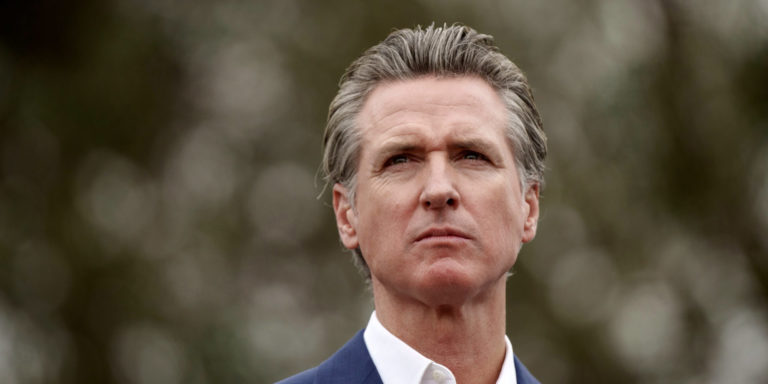
(Headline USA) California Gov. Gavin Newsom and the White House have been feuding over how to handle protests in Los Angeles—and now there are talks of Newsom’s potential arrest.
The public spat started Sunday when Tom Homan, the border czar, warned that anyone, including public officials, would be arrested if they obstructed federal immigration enforcement.
“No one’s above the law,” he said on Fox & Friends, although he added that “there was no discussion” about arresting Newsom.
The California governor responded in an interview with MSNBC.
"Tom, arrest me" Newsom's message to Tom Homan
Gavin Newsom should have been arrested for the lockdowns. Please Tom, for the love of God, throw him in jail forever. pic.twitter.com/1FyvRIfFRq
“Come after me, arrest me. Let’s just get it over with, tough guy,” Newsom said.
Trump grinned when asked about the exchange after landing at the White House.
“I would do it if I were Tom. I think it’s great,” Trump said. “Gavin likes the publicity, but I think it would be a great thing. He’s done a terrible job.”
President Trump on arresting Gavin Newsom:
"I would do it. Gavin likes the publicity, but I think it would be a great thing."pic.twitter.com/xbJ0Nye2fz
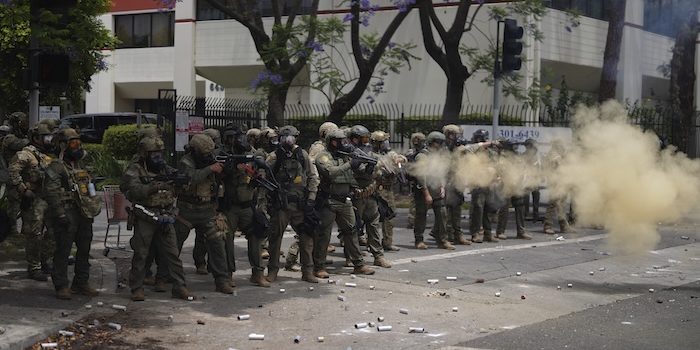
Newsom told MSNBC that he plans to file suit Monday against the Trump administration to roll back the National Guard deployment, which he called “an illegal act, an immoral act, an unconstitutional act.” This appears to be the first time in decades that a state’s National Guard was activated without a request from its governor.
Trump has cited a legal provision that allows him to mobilize federal service members when there is “a rebellion or danger of a rebellion against the authority of the Government of the United States.” Roughly 1,000 National Guard members arrived in the city by Monday, and Trump said he had authorized 2,000 members to deploy if needed.
(Clint Siegner, Money Metals News Service) Americans are accustomed to assets being priced in terms of Federal Reserve note dollars. It makes sense, of course.
The dollar is the currency of the realm. There is, however, a real problem with using it as a benchmark.
Government inflation statistics cannot be trusted. It isn’t easy to determine whether price gains represent appreciation of the asset or depreciation of the dollar.
Gold is an infinitely better store of value. That makes it a more useful standard against which other assets can be measured.
It’s an eye-opener to measure how key assets have performed with gold, rather than the dollar, as the benchmark.
Gold vs 10-Year Treasuries
The 10-year U.S. Treasury note has long been promoted as a “risk free” asset. This maxim is among the most dangerous and misleading ever uttered by Wall Street bankers and brokers. The secret to claiming 10-year Treasuries as “risk free” is that they are priced in dollars.
No matter how badly Treasuries perform, they hold up just slightly better than the dollar due to the pitiful yield.
Priced against gold, Treasuries have been a disaster. Buying 1 oz of gold in June 2015 cost around $1,180. That ounce of gold is now worth just over $3,300. The same $1,180 investment in the 10-year bond would be worth $1,500 today – less than half the value of the gold. That’s including reinvestment of interest.
Gold vs Oil
Oil remains the most vital commodity for powering the global economy. It has not performed well as an investment over the past decade. There have been modest gains relative to the dollar, but huge losses relative to gold.
West Texas Intermediate (WTI) crude was priced at $59.82 per barrel in June 2015. With gold at $1,180, the gold/oil ratio was 19.72. Today, the oil price is around $64.50, and the ratio is roughly 51. It now takes 51 barrels of oil to buy an ounce of gold.
The collapse of oil relative to gold is a complicated subject which involves increasing global production and other factors.
However, global GDP has reportedly grown at an average annual rate of 2.67% while oil production has risen just over 1% per year.
Based on the official data, demand should be outstripping supply, and oil prices ought to be rising. The gold/oil ratio suggests something is wrong with that data.
It’s a good bet that real economic growth is nowhere near as healthy as governments have been reporting.
Gold vs the S&P 500 Index
Stock prices fared much better than oil or Treasuries over the past 10 years. The S&P 500 Index was priced at roughly $2,100 in June 2015. The gold/S&P ratio was 0.56. Today, the Index is at $6,000, and the ratio is nearly unchanged at 0.55.
Not bad, except that in a healthy economy, stocks should significantly outperform gold. Instead, measured against gold, there is essentially no appreciation.
And if the window is extended to the past 25 years, the gold/S&P ratio climbed from 0.2 to 0.55. Gold dramatically outperformed stocks, even when reinvesting dividends.
Gold Tells the Real Story
There are lots of investors out there operating under the delusion that their investments are performing well. That delusion is only possible if assets are priced in dollars. If they measure performance against gold, the story could not be more different.
Clint Siegner is a Director at Money Metals Exchange, a precious metals dealer recently named “Best in the USA” by an independent global ratings group. A graduate of Linfield College in Oregon, Siegner puts his experience in business management along with his passion for personal liberty, limited government, and honest money into the development of Money Metals’ brand and reach. This includes writing extensively on the bullion markets and their intersection with policy and world affairs.
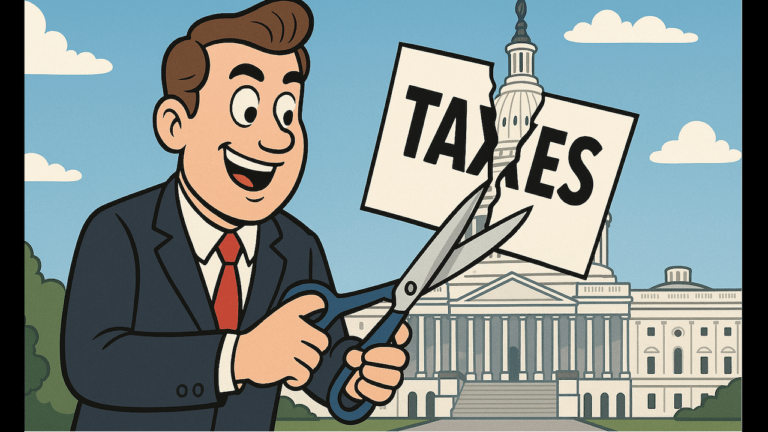
(Mike Maharrey, Money Metals News Service) Supporters of tax cuts argue that they eventually “pay for themselves” and lower deficits through economic growth and increased revenue, even without significant spending cuts.
Recent history casts doubt on this claim.
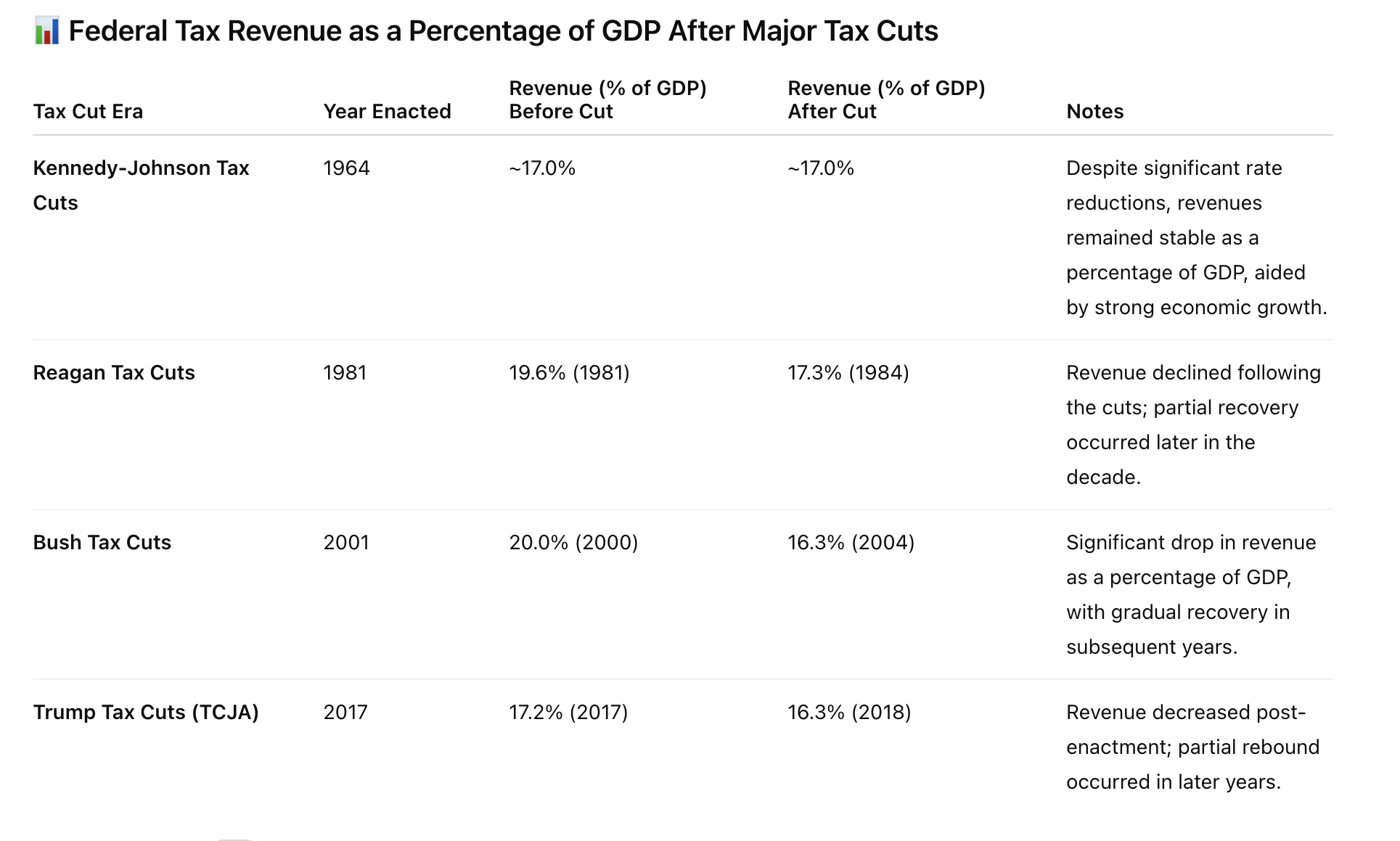
Examining the three major tax cuts over the last 50 years, after initially dropping, revenue ultimately rose in subsequent years and eventually exceeded pre-tax cut levels in nominal terms; however, revenue as a percentage of GDP fell in the aftermath of the cuts.
In the meantime, spending ballooned faster than revenue rose, erasing the modest impact of growth-related revenue generation.
This underscores a crucial point: Uncle Sam doesn’t have a revenue problem. It has a spending problem.
And there is little will to address that problem.
The Big Beautiful Bill
It’s easy to talk about cutting government spending and reining in deficits.
It’s tough (if not impossible) to cut government spending and rein in deficits.
This is why every presidential administration since Herbert Hoover’s has left the country deeper in debt at the end of its term than when it started.
The bill features 1,042 pages of spending cuts, spending increases, and tax cuts. While the legislation trims some outlays, it increases others, and it ultimately falls far short of addressing the surging budget deficits and ballooning national debt.
Proponents of the bill claim the CBO is understating the tax cuts’ stimulus effect and argue that economic growth will “pay for” the tax cuts and ultimately narrow the deficit.
Can We Grow Our Way Out of Debt?
The conservative theory is that tax cuts “pay for themselves” and will ultimately lower deficits due to the fact that they incentivize work and investment, thus boosting productivity. While tax rates are lower, they are applied to higher levels of income, keeping total tax revenues steady and even increasing them over time. This theory was popularized in the 1980s by the Laffer Curve.
How does this theory play out in practice?
Over the last 50 years, it hasn’t.
There have been three major tax cuts since the 1980s.
Reagan tax cuts in 1981 and 1986
Bush Tax cuts in 2001 and 2002
Trump tax cuts in 2016
In all three cases, federal revenue as a percentage of GDP declined, and the tax cuts ultimately contributed to higher deficits in the absence of spending cuts.
In 1981, Congress slashed the top marginal income rate from 70 to 50 percent and then cut it again to 28 percent in 1986. The U.S. did experience strong economic growth in the mid-to-late 80s, but budget deficits still exploded. Following the cuts, revenue as a percentage of GDP declined, reaching a low in 1984. It improved after that, but did not return to pre-cut levels during the Reagan presidency.
In the meantime, spending exploded.
In 1981, the budget deficit was $79 billion. In Reagan’s last year in office in 1989, it had ballooned to $153 billion. As a percentage of GDP, the deficit grew from 2.5 percent of GDP to 2.8 percent during Reagan’s time in office.
In 2001 and 2003, George W. Bush signed tax bills cutting income taxes, capital gains taxes, dividend taxes, and estate taxes. It resulted in modest economic growth, but still below historical averages. Federal revenue plunged initially and recovered only with the Fed-induced housing market bubble.
Between 2000 and 2008, the debt-to-GDP ratio grew from 34 to 39 percent. According to CBO and Treasury Department studies, the predicted revenue boost due to economic growth never materialized.
In Bush’s first year, the federal government ran a $128 billion budget surplus, thanks in large part to the “peace dividend” that allowed the government to significantly slash military spending. But in his last year in office, the deficit was $458.6 billion, 3.1 percent of GDP.
In 2016, Trump signed his tax bill into law, dropping the corporate rate from 35 to 21 percent and lowering individual income tax rates for most brackets. Even with a short-term boost to GDP, federal revenues still fell $430 billion short of expectations in 2018-2019. Meanwhile, budget deficits were widening even before the pandemic. The Trump administration was on pace for a $1 trillion deficit even before COVID-19 reared its ugly head. We hadn’t seen deficits that big since the Great Recession.
Tax cuts implemented in 1964 during the Kennedy presidency offer a ray of hope. Federal revenue as a percentage of GDP remained stable. However, the economic landscape was significantly different then, and in the last 50 years, tax cuts initially tanked federal revenue, and partial recoveries in later years did not boost government receipts to pre-tax levels.
One could argue that the failure of the Trump tax cuts to boost growth was due to the pandemic. But this reveals a weakness in government forecasting. The CBO and other organizations that make projections typically start with unreasonable assumptions. For instance, the CBO report card on the Big Beautiful Bill assumes no major recession in the next decade. These Goldilocks scenarios seldom play out in reality.
It’s the Spending
The bottom line is we can’t depend on tax cuts and economic growth to solve the national debt problem. Even when revenues increase, spending has historically increased faster. Uncle Sam doesn’t have a revenue problem. It has a spending problem. Tax cuts alone can’t fix it.
In other words, it is going to take substantial cuts to spending. There doesn’t seem to be much political will for that.
Instead of aggressively tackling the borrowing and spending problem, Republicans seem content to trim around the edges and offer implausible assurances that mystical economic growth will take care of the rest.
If history is any indication – it won’t.
Mike Maharrey is a journalist and market analyst for Money Metals with over a decade of experience in precious metals. He holds a BS in accounting from the University of Kentucky and a BA in journalism from the University of South Florida.
(Mike Maharrey, Money Metals News Service) Consumer borrowing unexpectedly surged in April as Americans tried to get ahead of potential price increases due to tariffs. This reversed a trend of declining consumer borrowing since the beginning of the year.
Total consumer debt swelled by $17.9 billion in April, a 4.3 percent annual increase, according to the latest Federal Reserve data.
Americans now owe $5.01 trillion in consumer debt.
The Federal Reserve consumer debt figures include credit card debt, student loans, and auto loans, but do not factor in mortgage debt. When you include mortgages, U.S. households are buried under a record level of debt. As of the end of Q1 2025, total household debt stood at $18.2 trillion.
Revolving credit, primarily reflecting credit card debt, jumped by $7.7 billion, a 7 percent annual increase. This followed a rather tepid 2.7 percent increase in revolving debt in Q1. It was the largest jump in revolving credit balances since the holiday season.
Americans are buried under $1.32 trillion in revolving debt.
According to analysts at pymnts.com, the surge in borrowing likely reflected “an April rush that indicates [consumers] sped up purchases as tariffs took effect that same month.”
Consumers paid down some of their credit card debt in the first quarter. This isn’t uncommon, as people pay off temporary balances added during the holiday season.
The problem is that consumer borrowing over the last several months seems to indicate Americans are getting close to their credit limits. The April spending surge could have been a last gasp as consumers move ever closer to the end of a dead-end road. After all, you can’t sustain an economy on Visa and Mastercard forever.
The spending may have also reflected some “consumer resilience” as they received income tax refunds in April.
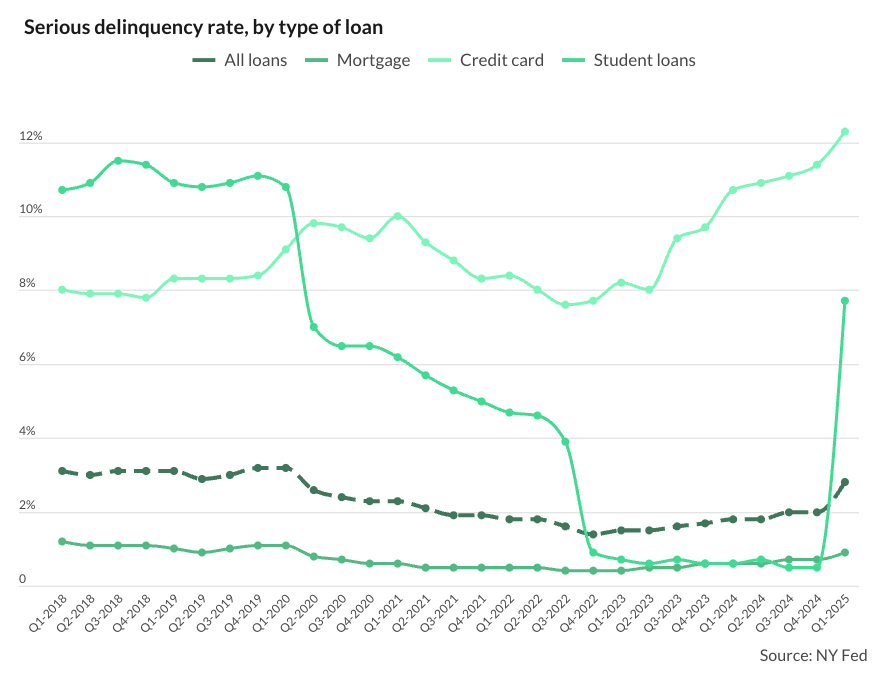
Despite the apparent consumer resilience, there are signs of strain. Late-stage delinquencies on credit card debt surged year over year in Q1. Meanwhile, 4.3 percent of total outstanding household debt is in some stage of delinquency. Serious delinquencies, defined as debts that are 90 or more days past due, rose to 2.8 percent of total debt, a 52 percent increase year on year.
According to CreditGauge, consumer credit delinquencies hit the highest level in five years in 2024.
“The combination of rising mid-to-late-stage credit delinquencies and rising credit balances suggests a growing debt burden that some consumers are increasingly struggling to manage.”
The double whammy of rising debt and interest rates exacerbates the debt problem. The average annual percentage rate (APR) currently stands at 20.12 percent, with some companies still charging rates as high as 28 percent. The average is only slightly down from the record high of 20.79 percent set last August.
Rates aren’t coming down much, even with Federal Reserve rate cuts. According to an ABC News report, despite a full percentage point in rate cuts, credit card companies are charging a higher margin “to weather default risk, cover overhead costs and recoup profits, experts added.”
“Credit card rates are high, and they’re staying high,” Bankrate analyst Ted Rossman told ABC News.
The Fed’s pause in rate cuts is more bad news for consumers buried in debt.
Non-revolving credit, primarily reflecting outstanding auto loans, student loans, and loans for other big-ticket durable goods, rose by $10.2 billion, a 3.3 percent increase. It was the biggest surge in non-revolving credit since July 2024.
Non-revolving debt currently stands at $3.69 trillion.
While the increase in non-revolving credit was larger than the 2 percent in non-revolving credit growth over the last year, it was still much lower than the 5 percent average typical before the pandemic. The growth in non-revolving credit reveals consumers have cut back on big-ticket spending to cover the increasing costs of day-to-day necessities.
After contracting in Q1, there was a big jump in auto loans as consumers tried to get ahead of potential tariffs.
Student loan debt is included in non-revolving credit. Borrowers recently started making payments again. Some student loan recipients have had payments on pause since the pandemic. Delinquencies surged as past-due reporting returned.
Only time will tell if April’s surge in consumer borrowing was a one-off event in response to the tariff threat, or if Americans still have a little wiggle room before they run up against their credit limits. But make no mistake – those limits are looming. An economy can’t run indefinitely on credit cards. The bills always come due. Since the pandemic, Americans have coped with dramatically rising prices by blowing through their savings and relying on credit. It’s not a matter of if the chickens will come home to roost, but when.
Mike Maharrey is a journalist and market analyst for Money Metals with over a decade of experience in precious metals. He holds a BS in accounting from the University of Kentucky and a BA in journalism from the University of South Florida.
(Money Metals News Service) On the latest Money Metals podcast, host Mike Maharrey welcomed Michael Pento, founder of Pento Portfolio Strategies, for an in-depth look at the gold market and broader financial trends.
Michael Pento believes gold is in a clear consolidation phase after hitting a record $3,500 per ounce in mid-April.
“The rally was driven by two main factors,” he explained — tariffs weakening global trade and a decline in the U.S. dollar.
“When you cut off global trade, you’re going to really hurt growth,” Pento noted, adding that this dynamic pushed investors away from stocks and bonds into gold.
Now, with the trade war on pause, Pento expects marginal trade deals rather than significant structural change.
“We were very long gold heading into the meat of the tariffs, and then we sold it off,” he said, noting his firm still maintains a 5% allocation to physical gold.
Current U.S. debt stands at $37 trillion. But based on his models, Pento forecasts it will soar to $67 trillion within a decade.
“It took 250 years to amass $37 trillion — we’re going to do $30 trillion more in just 10 years,” he warned.
Such debt will force the Federal Reserve to massively expand its balance sheet.
“The Fed’s going to have to be a big monetizer of the debt,” Pento said. Foreign buyers, once reliable sources of demand for Treasuries, are now retreating amid sanctions and tariff risks.
“They’re going to park a lot of that money in gold. That’s exactly what’s happening,” he added.
Early Stages of a Bond Market Collapse
Pento believes we are already witnessing the early stages of a U.S. bond market collapse — a scenario he predicted in his 2013 book The Coming Bond Market Collapse.
“Interest rates could easily spike well towards 20% in the future,” he said.
In 1980, rates hit 15% despite a much lower debt-to-GDP ratio of about 35-40%. Today, debt-to-GDP stands at 130%, making the risks far greater.
“If the Fed doesn’t buy the debt, there’s not enough natural buyers,” Pento warned. “And if they do buy it all, we’ll have hyperinflation.”
Foreign demand is already shifting, with Japanese bondholders increasingly preferring their domestic market.
Passive Investing and the Risk of a Major Equity Crash
Pento also highlighted dangerous complacency among retail investors.
“For decades, the Fed and Treasury have taught investors that the government has your back,” he said.
Many younger investors have known only a zero-interest-rate world, with expectations of perpetual bailouts.
U.S. households now hold a record 70% of assets in equities — “the highest it’s been ever,” according to Pento.
He predicts that when the next recession triggers a 30% market drop, many retirees will panic-sell, potentially driving the market down 50%.
“If you’re down 50%, that just puts the total market cap of equities back to a normal balance — about 100% of GDP,” he explained.
The Fed’s Balance Sheet and Future Crises
The Federal Reserve’s balance sheet, once $800 billion pre-2008, surged to $9 trillion during COVID. It remains elevated at $6.6 trillion.
Pento expects the next crisis to push it past $15-20 trillion.
“That’s going to wreak havoc on the dollar and wreak havoc in the bond market,” he said.
Despite official denials, Pento emphasized that this is real debt monetization.
“The Fed does print money,” he stressed. “That is the monetary base — high powered money.”
Persistent Inflation and Structural Challenges
Inflation is far from conquered, Pento argued.
“Prices went up 40-50% post-COVID,” he said. Housing is now the most unaffordable in history, pricing out first-time buyers.
Even current inflation rates of 2.5-3% remain above the Fed’s 2% target — and tariffs will add further upward pressure.
“To say that it’s a tax only on the exporters is a lie. It is untruth. It’s mendacious,” he said of the inflationary effects of tariffs.
Cautious on Silver and the Gold-Silver Ratio
Turning to silver, Pento was measured.
“I would love to say I’m in love with silver… but gold is the purest form of money we have,” he said.
Silver performs best when global growth and inflation coincide, due to its industrial component.
While Pento sees value in owning some silver, he does not expect it to “catch up” with gold in the near term.
“It’s gold that is fulfilling the role of an alternative currency — not silver, and not platinum either,” he added.
Pento explained: “China used to recycle trade surpluses into Treasuries. Now they say, ‘If the U.S. president doesn’t like me, they can confiscate my wealth.’”
Holding gold domestically ensures sovereign control of reserves, a compelling alternative in today’s environment.
Pento also noted that negative real interest rates, seen since the 2007-2008 financial crisis, further support gold’s appeal.
Preparing for the Grand Reconciliation
Looking ahead, Pento sees an inevitable “grand reconciliation” of global asset prices.
“We have bubbles in stocks, bubbles in bonds, bubbles in real estate,” he warned.
Crashes will come with greater intensity and frequency.
His Inflation/Deflation Economic Cycle Model (IDEC) aims to both profit in bull markets and protect against the coming downturns.
Finally, he cautioned about the current market:
“The stock market is trading at 22 times forward earnings with projected 14% earnings growth — but margins are already shrinking.”
With the economy slowing, Pento left listeners with a clear warning:
“If you don’t have an active manager who can get you out of harm’s way when this thing really collapses, you’re going to be very, very sorry.”
(Luis Cornelio, Headline USA) Laura Loomer descended on the U.S. Capitol Friday and Democrats ran away for the hills.
On Friday, the firebrand journalist pressed four House Democrats on naming the Muslim Brotherhood a terrorist organization and on desperate efforts to impeach President Donald Trump for a third time.
Unsurprisingly, the Democrats—Reps. Maximine Waters, D-Calif., Ted Lieu, D-Calif., Jamie Raskin, D-Md., Al Green, D-Texas— either went mum, played ignorant or rushed away.
First, Loomer approached Waters, who refused to acknowledge the questions and walked off without a word.
“Congresswoman, do you want to condemn the calls for political violence in the Democratic Party?” Loomer asked. Waters did not flinch, turning to a colleague and pretending not to hear a word.
Unlike Waters, Lieu addressed Loomer but feigned ignorance.
“I appreciate you letting me know. Let me do a little bit of due diligence and I — we’ll get you an answer,” Lieu said of the Muslim Brotherhood proposal.
Asked if he was familiar with the Sunni Islamist group, Lieu replied he wasn’t an “expert.”
Democrat Congressman @tedlieu pretended like he didn’t know the Muslim Brotherhood is a terrorist organization when I asked him if he would support his Democrat colleague Rep. Jared Moskowitz’s @JaredEMoskowitz call this week to designate the Muslim Brotherhood as a foreign… https://t.co/OosEengdDTpic.twitter.com/6qCCE4evbQ
Raskin, who never misses a chance to grandstand on cable news or congressional hearings, suddenly played deaf.
“Can you repeat that, I couldn’t understand a single word you said,” he asked.
When Loomer repeated the question, Raskin ran up a staircase and mumbled something about his office.
Democrat Congressman @RepRaskin
Jamie Raskin pretended like he didn’t know the Muslim Brotherhood is a terrorist organization and he LITERALLY ran away from me when I asked him if he would support his Democrat colleague Rep. Jared Moskowitz’s @JaredEMoskowitz call this week to… https://t.co/OosEengLtrpic.twitter.com/fFmRC8P7BA
Finally, Loomer confronted Green about his long-shot effort to impeach Trump.
When asked why he filed for articles of impeachment, Green muttered, “Because he’s unfit to be president.” But when pressed to elaborate, he ducked through a set of doors and disappeared.
Loomer blasted the pattern, calling out Democrats for dodging accountability: “Democrats can never explain themselves. They always run and hide.”
Today, Democrat Congressman @RepAlGreen Al Green announced his plans to take a vote on impeaching President Trump this month.
Earlier this year, Green was escorted out of President Trump’s address to Congress after screaming during the speech and refusing to stop.
(Alan Wooten, The Center Square) Extraordinary and pivotal decisions are playing out on opposite coasts of America as protesters of immigration policy wreak havoc on Los Angeles and President Donald Trump and his administration in Washington take action California leadership does not want.
The situation evolves against a backdrop of a November election in which the nation’s 47th commander in chief campaigned on closing borders and deportations; judges labeled “activist” have delivered courtroom homes to stymie Trump’s efforts; and Southern California hosts the hotbed of activity just five months after a natural disaster from wildfires.
National Guard troops were deployed by the president and not Gov. Gavin Newsom over the weekend.
On social media Sunday, Trump wrote, “A once great American city, Los Angeles, has been invaded and occupied by illegal aliens and criminals. Now violent, insurrectionist mobs are swarming and attacking our federal agents to try and stop our deportation operations – but these lawless riots only strengthen our resolve.
“I am directing Secretary of Homeland Security Kristi Noem, Secretary of Defense Pete Hegseth and Attorney General Pam Bondi, in coordination with all other relevant departments and agencies, to take all such action necessary to liberate Los Angeles from the migrant invasion and put an end to these migrant riots. Order will be restored, the illegals will be expelled, and Los Angeles will be set free. Thank you for your attention to this matter!”
On social media, Newsom early Monday morning Eastern time wrote, “Let’s get this straight: 1) Local law enforcement didn’t need help. 2) Trump sent troops anyway – to manufacture chaos and violence. 3) Trump succeeded. 4) Now things are destabilized, and we need to send in more law enforcement just to clean up Trump’s mess.”
Los Angeles Police Chief Jim McDonnell agreed with Newsom and said his officers could handle it. He also said deployment by Trump has escalated the situation.
(This is a developing story. Check back for updates from The Center Square.)
The report was published Friday and said that a high-level US military delegation was expected to meet with Syrian officials in the coming days with the goal of shifting the US military presence from an illegal occupation to a formalized, legal partnership.
The report comes as the US has been drawing down its forces in northeastern Syria and handing over some bases to the Kurdish-led SDF. The US is expected to maintain only one base in Syria, the al-Tanf Garrison in the south, which is situated where the borders of Syria, Iraq, and Jordan converge.
From al-Tanf, the US helped its proxy militia, known as the Syrian Free Army (previously known as the Revolutionary Commando Army), join in on the offensive led by Hayat Tahrir al-Sham (HTS) that ousted former Syrian President Bashar al-Assad on December 8, 2024.
A formal deal on al-Tanf would signal that the US is planning a long-term or even potentially a permanent military presence in Syria. The Pentagon has said that it’s currently working to reduce its forces in Syria to fewer than 1,000 troops in the country. According to the latest reports, approximately 1,500 US troops are currently stationed in the country.
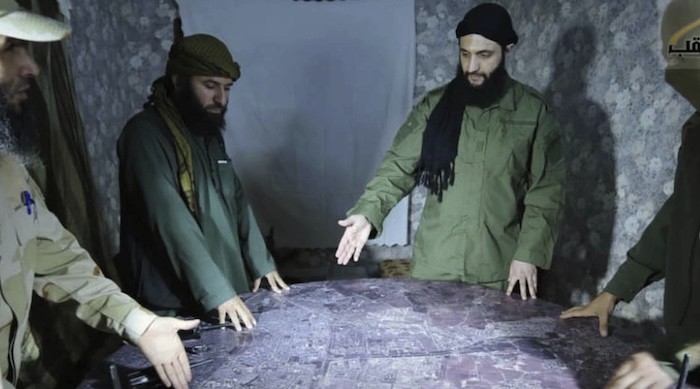
The US has embraced the new Syrian government that’s led by HTS despite the group still being listed by the State Department as a foreign terrorist organization due to its al-Qaeda roots. President Trump recently met with HTS’s leader and Syria’s de facto president, Ahmed al-Sharaa, formerly known as Abu Mohammed al-Jolani, and praised him as a “young, attractive guy” with a “very strong past.”
Sharaa got his start with al-Qaeda in Iraq, where he fought an insurgency against US troops before being imprisoned from 2006 to 2011. In 2012, he traveled to Syria and formed al-Qaeda’s affiliate in the country, the al-Nusra Front.
In 2016, Sharaa claimed the al-Nusra Front was cutting ties with al-Qaeda. At the time, he thanked the “commanders of al-Qaeda for having understood the need to break ties.” In 2017, he merged his group with several other Islamist factions to form HTS.
(Dave DeCamp, Antiwar.com) Iranian Intelligence Minister Esmail Khatib said on Sunday that Tehran had obtained a “treasure trove” of sensitive Israeli documents related to Israel’s secret nuclear weapons program and its relations with the US and Europe.
“The transfer of this treasure trove was time-consuming and required security measures. Naturally, the transfer methods will remain confidential, but the documents should be unveiled soon,” Khatib said.
The intelligence minister was responding to a question about a Saturday report from Iranian media that first alleged Iran had obtained a significant number of Israeli documents. So far, there’s been no official response from Israel about the Iranian claims.
Khatib said that members of Iranian intelligence had “achieved an important treasury of strategic, operational and scientific intelligence of the Zionist regime and it was transferred into the country with God’s help.”
The claim from Iran comes as Tehran’s nuclear program is under intense scrutiny from Israel and the West despite a recent US intelligence report that said there’s no evidence Iran is working toward a bomb. In contrast, Israel’s nuclear program gets virtually no attention, even though it’s an open secret that Israel has a stockpile of nuclear weapons, and the program operates with no oversight.
Israel is estimated to have somewhere between 90 and 300 warheads. Neither Israel nor the US acknowledges the existence of the arsenal, and Israel is under no pressure to join the Non-Proliferation Treaty and bring its nuclear program under the oversight of the International Atomic Energy Agency (IAEA).
(Headline USA) A runaway pet zebra that was on the loose for more than a week in Tennessee and became an internet sensation in the process was captured Sunday, authorities said.
Ed the Zebra was captured safely after being located in a pasture near a subdivision in the Christiana community in central Tennessee, the Rutherford County Sheriff’s Office confirmed. The sheriff’s office said aviation crews captured the zebra.
“Ed was airlifted and flown by helicopter back to a waiting animal trailer,” the sheriff’s office said in a statement.
Video posted by the sheriff’s office shows Ed wrapped in a net with his head sticking out as he is carried by the helicopter to the trailer.
NEW: Runaway Zebra captured after a week on the run in Rutherford County, Tennessee.
His friends aren’t going to believe this.
Ed the Zebra was seen hanging from a helicopter before being delivered to his owner.
Ed arrived in Christiana on May 30, the sheriff’s office said. His owner reported him missing the next day.
The zebra was spotted and filmed running along Interstate 24, forcing deputies to shut the roadway. But Ed escaped into a wooded area.
There were several sightings posted to social media. Ed was filmed trotting through a neighborhood.
The zebra quickly became the subject of internet memes. One fake posting showed Ed dining at a Waffle House, a southern staple. Others had him visiting other Tennessee cities or panhandling on the side of the road.
The pursuit of Ed came a month after a runway kangaroo shut down a section of Alabama interstate.