“Unless there are some significant things that happen that change the culture, there’s no room for it,” the former Arkansas governor told the outlet, adding that he didn’t think those “changes” would happen “in our lifetime.”
When asked if the US was still pursuing the goal of a Palestinian state, he said, “I don’t think so.”
While the US has been working against a Palestinian state for decades by continuing to back Israel as it expands illegal settlements in the Israeli-occupied West Bank, Huckabee’s comments mark one of the most explicit denials of the goal of a Palestinian state from a top US official.
Huckabee also suggested that a Palestinian state could be carved out of a Muslim country. “Does it have to be in Judea and Samaria?” he said, using the Biblical name for the West Bank.
In 2008, Huckabee was recorded saying there was “really no such thing as a Palestinian,” and suggested back then that the Arabs native to historic Palestine should be moved to Arab countries. “If you look at a map and say, here’s how much Israel has and here’s how much the Arab states hold, there’s plenty of land. Let them take it out of Egypt, let them take it out of Jordan, let them take it out of Syria,” he said.
(Kenneth Schrupp, The Center Square) Alberto M. Carvalho, superintendent of the Los Angeles Unified School District, ordered the district to deploy its police officers to defend schools and school events, including graduations, from federal immigration operations.
“I have directed our own police force to redouble their efforts and establish perimeters of safety around graduation sites to intervene and interfere with any federal agency who may want to take action during these joyous times that we call graduation,” said Carvalho at a press conference.
LAUSD serves a diverse student body, where 73.14% of its students are Hispanic, and many parents and students are in the country illegally. According to estimates shared by city officials, 10% of Los Angeles residents are illegal immigrants.
Carvalho came to the United States as a minor by overstaying a tourist visa, becoming an illegal immigrant until he secured a student visa, and was once homeless as a teenager in Miami.
Before LAUSD, Carvalho rose through the ranks as a competent leader, becoming superintendent of Miami-Dade County Public School District, where he cut the budget by $2 billion without firing a single classroom teacher by laying off administrators.
Carvalho assumed leadership of LAUSD in 2022 after the district experienced significant budget growth and declining academic performance during the COVID-19 era.
LAUSD currently spends approximately $45,703 per student, with per-student spending up 229%, staffing up 21%, and student enrollment down 29% since the 2012-2013 school year.
2023-2024 LAUSD data show 57% of students did not meet state reading standards, 67% did not meet math standards, and 76% did not meet science standards.
The school district anticipates a $1.3 billion deficit by fiscal year 2028 amid rising costs and declining enrollment.
(Jesse Colombo, Money Metals News Service) After fifteen years of stagnation, platinum has woken up in a big way with an impressive 36% surge over the past two months. Even more exciting, this bull market may just be beginning.
Although I typically focus on gold and silver in this newsletter, today I’m shifting gears to present the bullish case for platinum, which has been on an impressive run lately. I’ve been planning to write this report for some time, but platinum’s breakout and rapid surge over the past week caught even me off guard—as I’ve been fully occupied covering developments in gold and silver.
The good news? I believe we’re still in the early stages of platinum’s bull market. In this report, I’ll explain why I’m bullish on platinum and explore the various ways you can invest in it.
For some background, platinum is a dense, malleable, ductile, and highly unreactive precious metal with a silver-white sheen. It’s also one of the rarest elements in Earth’s crust—roughly 30 times rarer than gold. About 90% of global production comes from a handful of regions, including Russia’s Ural Mountains, Colombia, Canada’s Sudbury Basin, and especially South Africa, which holds the largest reserves.
Due to its scarcity, only a few hundred metric tonnes are produced annually. This limited supply, combined with its critical industrial and investment applications, makes platinum both highly valuable and a key precious metal commodity.
Thanks to its unique physical and chemical properties, platinum is heavily used in industrial and automotive applications. It plays a vital role in catalytic converters, laboratory equipment, electrical contacts and electrodes, platinum resistance thermometers, dental instruments, and the glass industry.
Platinum is also popular in jewelry, especially when gold prices are high—as they are now. With gold trading at $3,323 an ounce and platinum at just $1,227, many consumers—particularly in China—are turning to platinum as a more affordable yet elegant alternative.
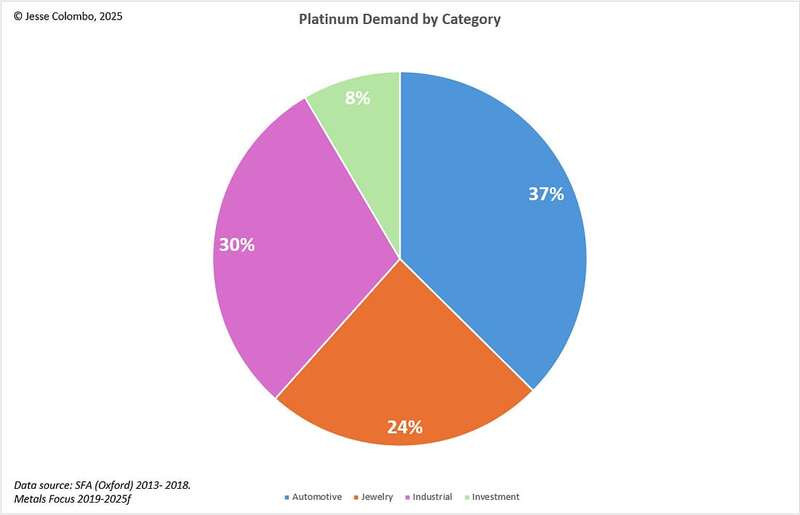
Unlike gold and silver—which have long histories as monetary metals used in coinage, currency backing, and investment—platinum was only discovered and understood relatively recently, in the 18th century. It has seen virtually no use as money, and only about 8% of its demand comes from investment. The remaining 92% is driven by other applications: automotive catalytic converters (37%), industrial uses (30%), and jewelry (24%), as illustrated in the pie chart below.
Owing to its substantial demand from industrial sectors, automotive applications, and jewelry, platinum exhibits high sensitivity to economic cycles, significantly more so than gold or silver.
This sensitivity is one reason I’ve been less enthusiastic about platinum, especially as I actively anticipate and prepare for a major economic crisis. Consequently, I’ve favored gold and silver more heavily.
That said, I remain optimistic about platinum’s future and consider it an excellent portfolio diversifier for larger portfolios with a strong foundation of gold bullion for stability, complemented by some silver. Check out my recent reports for detailed insights into why I’m highly bullish on gold and silver.
I want to highlight the remarkably small size of the global platinum market compared to gold and silver, a factor that contributes to its greater volatility and choppiness, while also presenting significant upside potential when conditions align favorably.
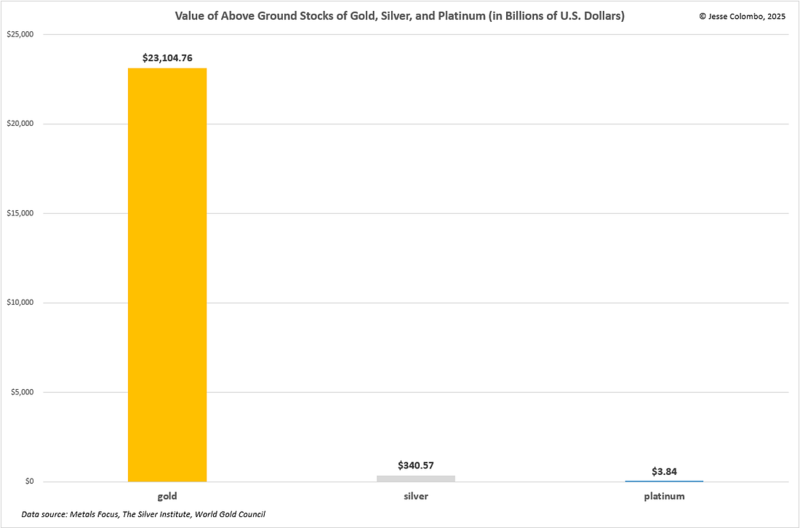
The total value of above-ground gold stock stands at an impressive $23.1 trillion, silver at $340.57 billion, and platinum at a mere $3.84 billion, as shown in the chart below. This small scale is one of the reasons why central banks and major institutional investors largely overlook platinum, favoring gold as their preferred asset.
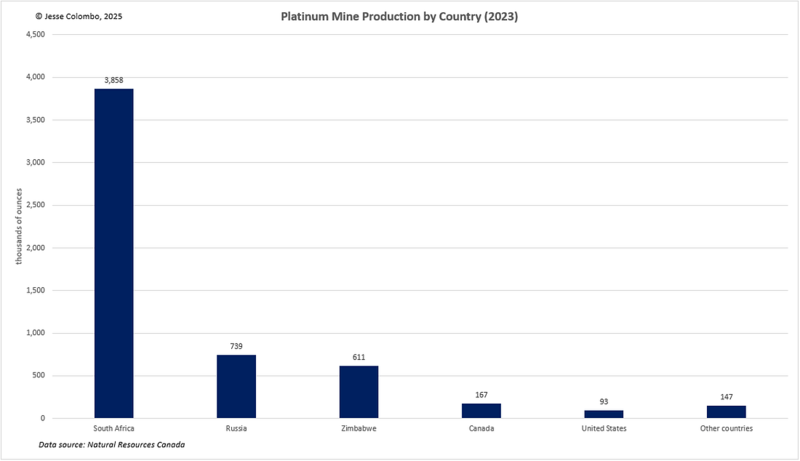
The platinum market’s volatility is further amplified by its heavy reliance on mine production concentrated in a few countries. South Africa leads with 3.86 million troy ounces mined in 2023, followed distantly by Russia with 739,000 troy ounces and Zimbabwe with 611,000 troy ounces, while the U.S. contributed a modest 93,000 troy ounces.
This dependence on nations susceptible to labor strikes and geopolitical instability introduces significant uncertainty and price volatility to the platinum market.
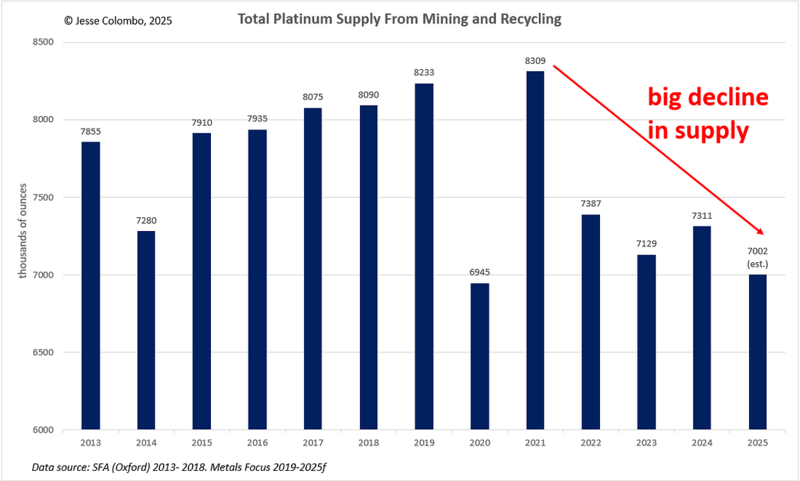
One key driver behind the recent surge in platinum prices (which I’ll explore in greater detail shortly) and a cornerstone of the bullish case for platinum is the significant decline in supply from both mining and recycling. This supply has dropped by approximately 1.3 million troy ounces, or roughly 16%, since its 2021 peak, influenced by multiple factors.
In South Africa, the leading producer, persistent electricity shortages, labor strikes, escalating operational costs, and insufficient investment in new capacity have caused major supply disruptions. Similarly, Russia, the second-largest producer, has faced challenges due to international sanctions stemming from the Ukraine conflict.
Another contributing factor is the global decline in average ore quality, as high-grade deposits are exhausted, requiring increased effort and higher costs to extract the same quantity of platinum, which gradually erodes supply over time.
Additionally, the low platinum prices in recent years (as I’ll show shortly) have rendered mining less profitable, further suppressing mine supply.
While the global supply of platinum has declined over the past five years, demand has remained robust, even amidst concerns about reduced need for platinum in automotive catalytic converters due to the rising popularity of electric vehicles.
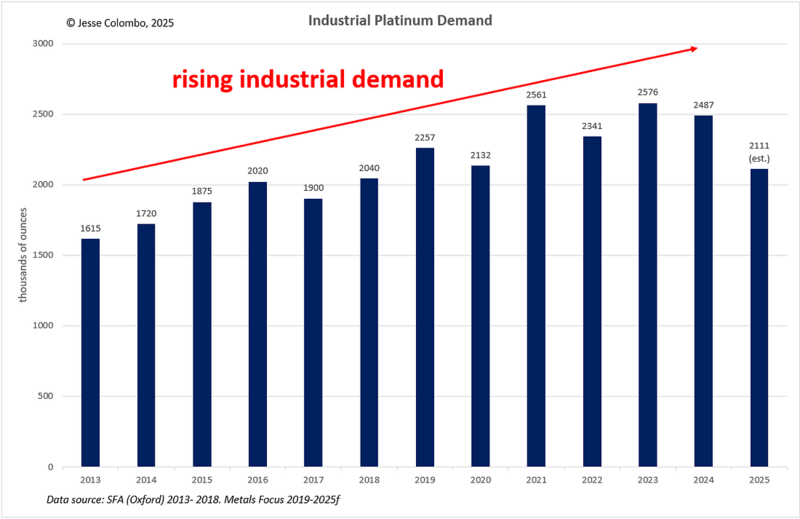
A key growth area for platinum demand over the past decade has been the industrial sector, which constitutes approximately 30% of total demand, as highlighted earlier. This increase is driven by global economic growth, surging demand in glass manufacturing, the medical sector, and platinum’s expanding role in hydrogen fuel cell electric vehicles (FCEVs), a component of the green energy transition.
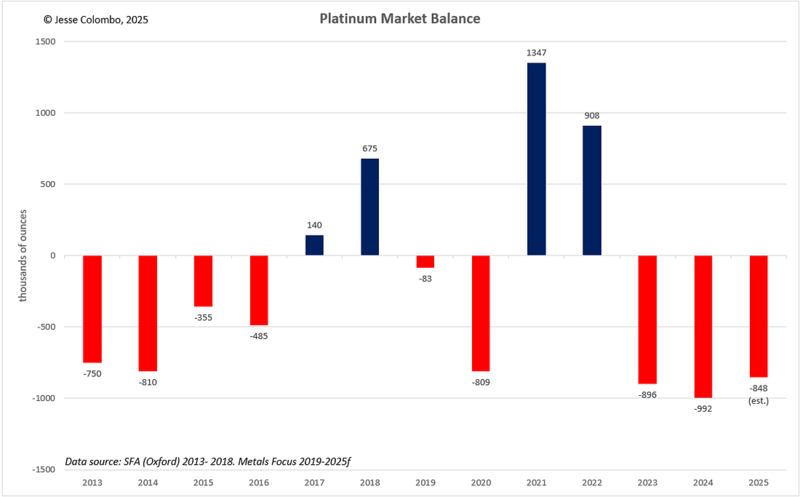
The shrinking supply of platinum, coupled with sustained demand, has driven the platinum market into a deficit of nearly 1 million ounces over the past two years, with a similar shortfall anticipated for the current year.
This deficit—and the growing recognition that it is unlikely to improve soon—has been an important catalyst for platinum’s remarkable surge over the past two months, with prices rising approximately 36% to $1,227 per ounce. I will explore this trend in greater detail in the upcoming technical analysis section of this report.
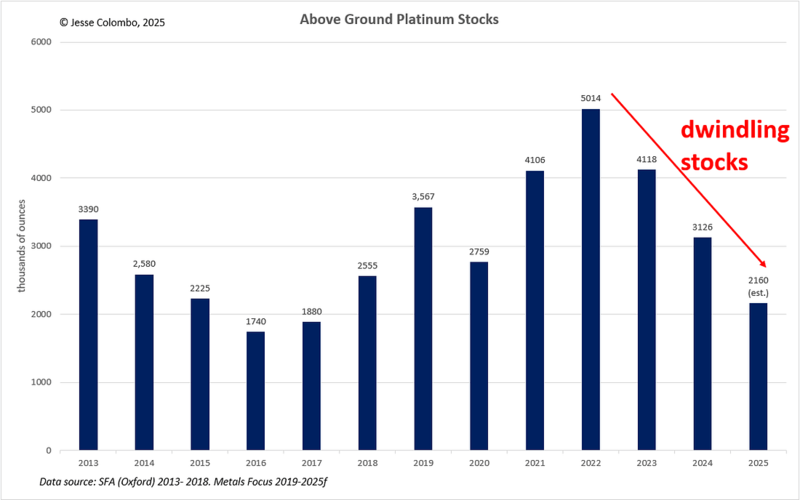
Not surprisingly, the platinum deficits of recent years have led to a substantial decline in above-ground stocks, dropping from a peak of approximately 5 million ounces in 2022 to an estimated 2.16 million ounces this year—a striking 57% reduction in just a few years. This development exacerbates the already tight platinum market, which is inherently small, with above-ground stocks valued at just $3.84 billion, as noted earlier.
This limited supply means that even relatively modest investment capital could acquire a significant portion of the available stock, driving prices sharply higher. For large institutions and investors, this would be akin to an elephant leaping into a kiddie pool, causing water to splash dramatically in all directions.
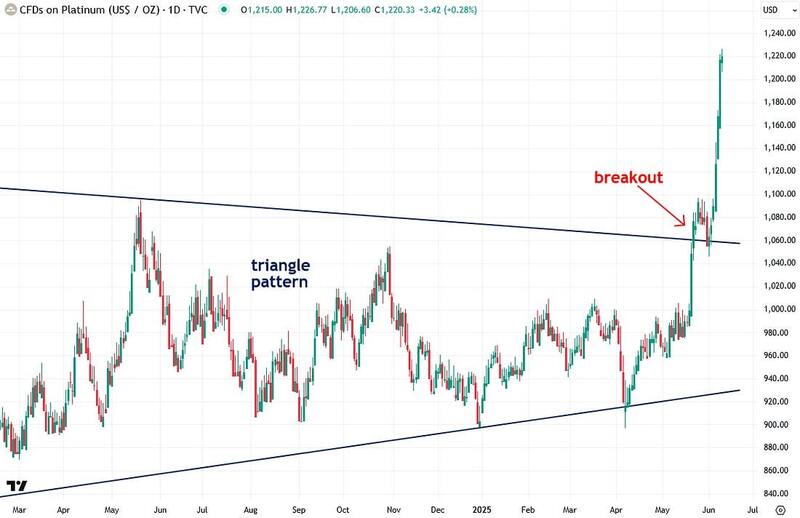
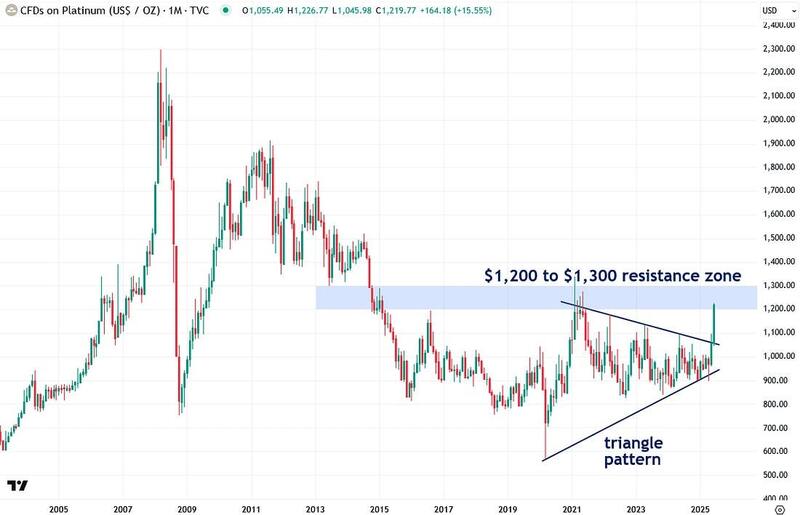
Let’s now transition to the technical analysis section of this report. As shown in the chart below, platinum has experienced a remarkable 36% surge over the past two months, breaking out of a triangle pattern that had developed over the previous three years. This breakout signals a highly bullish trend; however, platinum is currently overbought in the short term and susceptible to a healthy pullback.
The optimal strategy would have been to enter during the breakout in mid-May, but for those who missed it, I would wait for a pullback or consolidation phase before entering. I believe that this platinum bull market is still in its early stages, a perspective I will substantiate throughout the remainder of this report.
Several catalysts have propelled platinum’s recent breakout after 15 years of stagnation, including the robust bull market in gold and the recent silver breakout I had anticipated, both of which have ignited growing enthusiasm for the precious metals sector. Additionally, as discussed earlier, the increasing recognition that platinum market deficits are likely to persist in the foreseeable future has played a pivotal role.
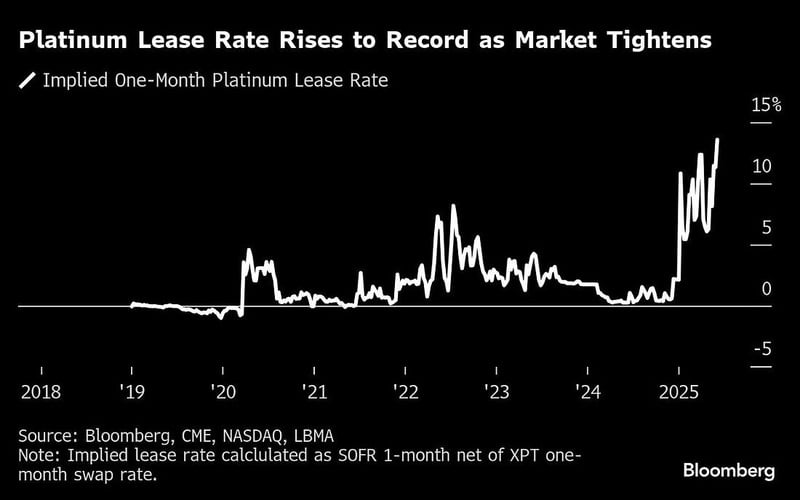
This supply tightness, coupled with the price surge, has driven lease rates in London and Zurich vaults to multi-year highs, signaling a scramble for platinum. Furthermore, a significant portion of this recent rally is technically driven, a common occurrence when an asset breaches a key resistance level or price pattern, such as platinum’s three-year triangle formation.
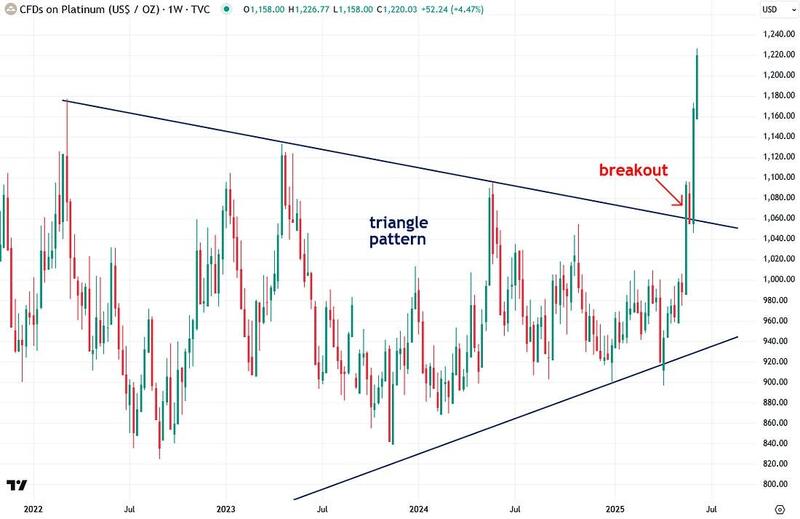
An examination of the weekly chart of platinum highlights the significance of the triangle pattern, which has been forming since 2022. Triangle patterns indicate a volatility squeeze, where the asset is compressed like a coiled spring, poised to release with substantial energy upon breaking out.
Stepping back to analyze the longer-term monthly chart provides valuable context for the triangle pattern and the recent platinum breakout. As noted earlier, platinum appears somewhat overextended in the short term, suggesting a healthy pullback is likely.
This view is reinforced by the $1,200 to $1,300 resistance zone, which lies just above and is likely to pose a challenge to further price increases in the near future. However, should platinum successfully break through this zone, it would serve as a strong signal that additional gains are likely ahead.
So far, I have outlined the bullish fundamental case for platinum, focusing on the persistent deficits, as well as the technical case, and now I aim to demonstrate how undervalued platinum remains across various metrics. The potential for its price to realign with historical norms further bolsters the bullish outlook, even without any changes in the supply and demand dynamics.
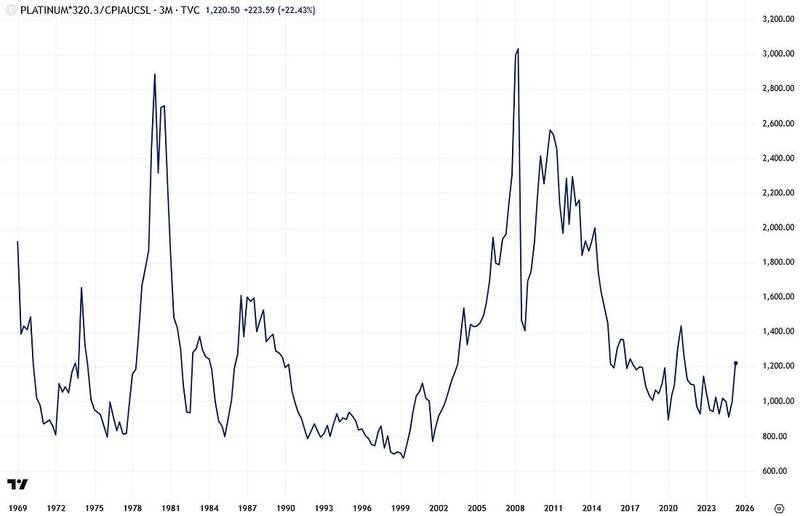
The first metric I will highlight is the real or inflation-adjusted price of platinum, tracing back to the 1960s. As depicted in the chart below, despite the recent surge, platinum remains near the lower end of its historical real price range. With its current price at $1,227 per ounce, it is less than half the approximately $3,000 it reached during the late 1970s and late 2000s.
This indicates that platinum is significantly undervalued, with considerable potential for further price appreciation. Moreover, this historically low price is a key driver behind the decline in global mine output, as it renders mining much less profitable at current levels, especially given the substantial rise in mining costs due to inflation.
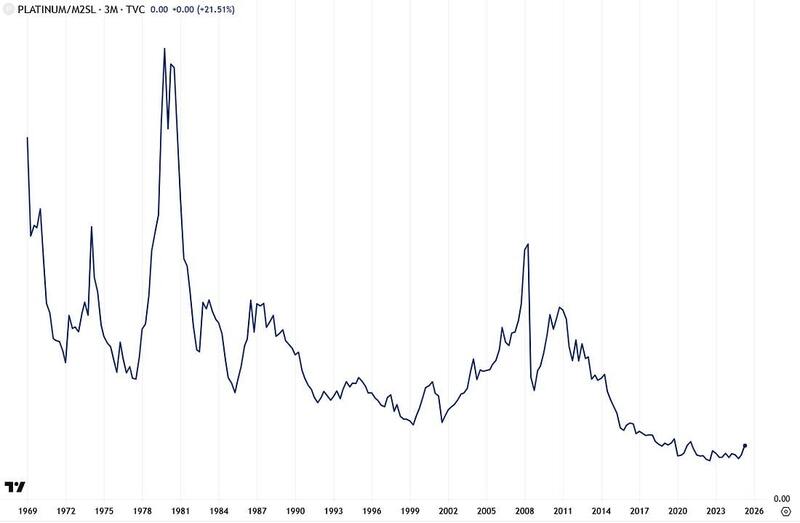
Additional evidence of platinum’s current undervaluation is evident in the platinum-to-U.S. M2 money supply ratio, which is near its lowest levels over the past five decades. I frequently compare asset prices to the M2 money supply to assess whether they are keeping pace with monetary inflation, and in this instance, platinum has clearly lagged.
As I detailed in a recent report, the resurgence of M2 money supply growth in the U.S. and globally over the past year has been a significant catalyst for the broader precious metals bull market during this period.
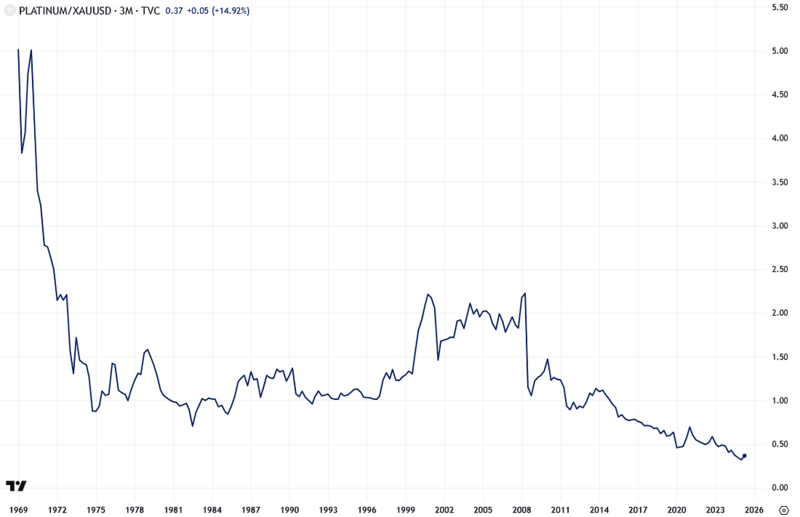
Comparing precious metals such as platinum and silver to the leading precious metal, gold, provides valuable insight into their relative valuation—whether they are historically undervalued, overvalued, or fairly priced.
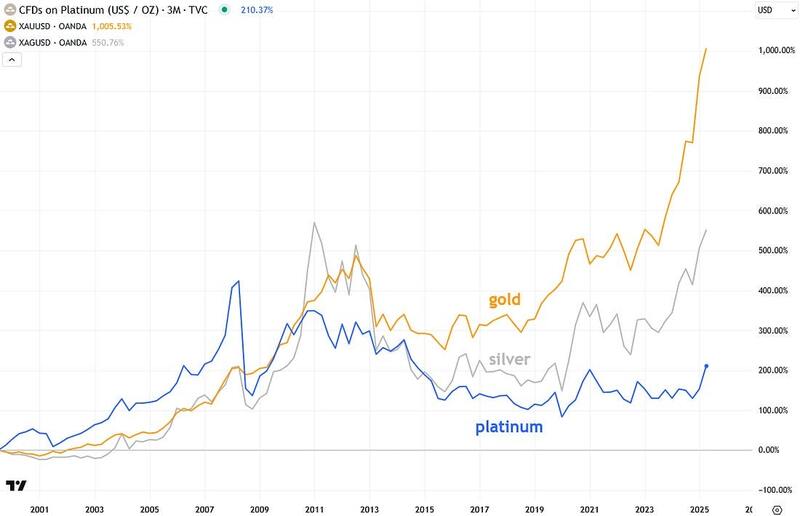
In this instance, platinum is currently at its lowest levels relative to gold since the 1960s, strengthening my conviction that it is substantially undervalued and holds significant potential for future price appreciation.
During this period, gold has risen by approximately 1,000%, silver by 550%, while platinum has increased by only about 200%. Nevertheless, this condition is likely to reverse as platinum’s bull market gains traction and its valuations return to historical norms.
Another significant catalyst poised to drive all precious metals, including platinum, higher is a potential bear market in the U.S. dollar, as detailed in my recent analysis. The dollar and commodities, including precious metals, typically move inversely, meaning a bearish trend in the dollar is bullish for commodities, and vice versa.
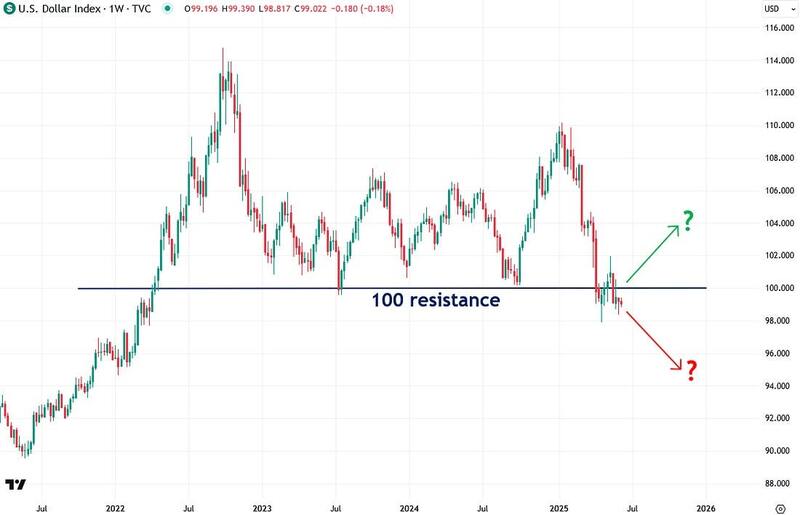
The U.S. Dollar Index is currently at a critical inflection point, hovering near the pivotal 100 resistance level, which has proven influential over the past few years. With the index now below this 100 threshold, the likelihood of further declines increases, with 90 emerging as the next potential target, provided this recent breakdown persists.
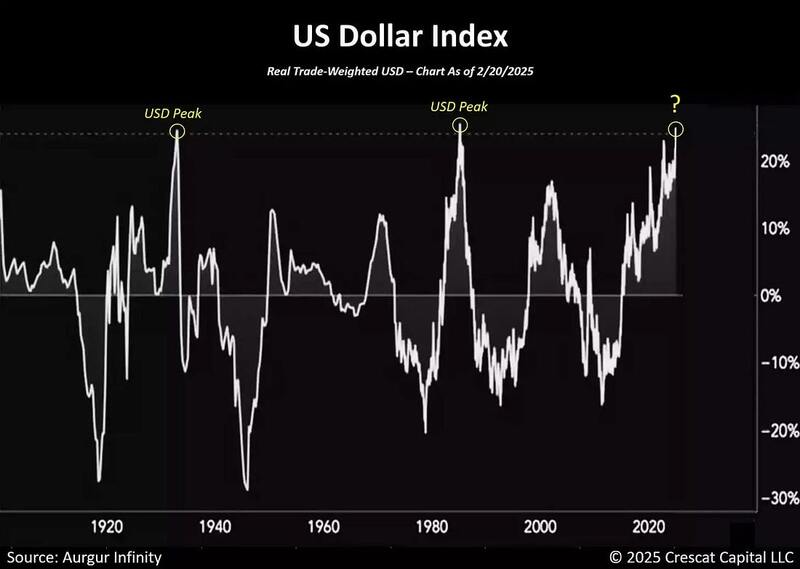
I foresee a substantial bear market for the dollar in the near future, driven by its extreme overvaluation relative to more than a century of historical data. Such pronounced overvaluation has only occurred twice before—in 1933 and 1985—each time followed by substantial dollar declines.
The dollar’s unusual strength in recent years has been a major factor keeping commodity prices—including platinum—much lower than they would ordinarily be. However, an impending correction in the dollar’s value should trigger a powerful bullish surge across the commodities sector, including assets like copper, gold, silver, platinum, and mining stocks.
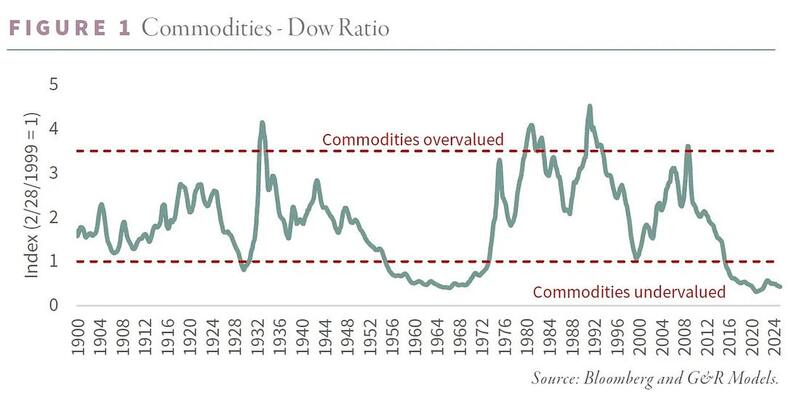
Multiple metrics indicate that commodity prices are currently exceptionally undervalued, aligning platinum’s low prices with this broader trend (as well as silver’s). One key metric is the commodities-to-Dow ratio, which highlights that commodities remain significantly undervalued compared to stocks.
However, I anticipate this unusual condition will soon normalize through a robust commodities boom or supercycle—reminiscent of the early 2000s—and a notable correction in equity markets. This aligns with my broader view that we’re in the early stages of a major capital rotation out of overvalued stocks and into still-undervalued precious metals.
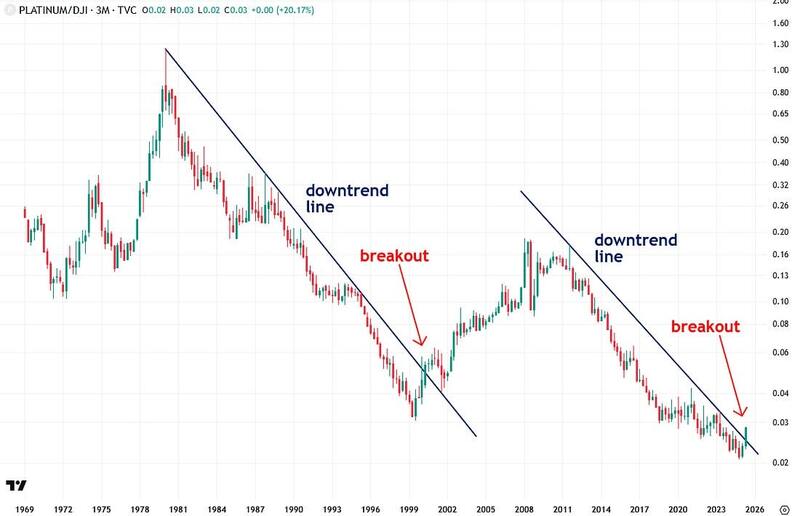
In addition to the commodities-to-Dow ratio shown above, I created a long-term logarithmic chart of the platinum-to-Dow ratio, which reveals that the metal is currently at near-record lows relative to stocks.
Notably, it has recently broken above the downtrend line that has been in effect since 2011, marking a bullish development. It’s worth highlighting that the last time the platinum-to-Dow ratio broke above a downtrend line, at the start of the millennium, it led to an impressive nearly 500% price increase over the subsequent seven years.
To summarize, there are compelling reasons to adopt a bullish stance on platinum, including the persistent deficits of recent years and those projected for the foreseeable future, the favorable technicals such as the recent breakout, its demonstrated undervaluation relative to inflation, gold, the M2 money supply, and stocks, as well as the strong possibility of an impending U.S. dollar bear market, which could soon trigger another commodities supercycle akin to the early 2000s—a development that would be highly bullish for precious metals, including platinum.
Although platinum exhibits significant volatility and sensitivity to economic cycle fluctuations, I believe it deserves a place in portfolios, provided they are built on a solid foundation of gold bullion and supplemented with some silver, alongside high-quality mining stocks for enhanced upside potential.
If you found this report valuable, click here to subscribe to The Bubble Bubble Report for more content like it.
Jesse Colombo is a financial analyst and investor writing on macro-economics and precious metals markets. Recognized by The Times of London, he has built a reputation for warning about economic bubbles and future financial crises. An advocate for free markets and sound money, Colombo was also named one of LinkedIn’s Top Voices in Economy & Finance. His Substack can be accessed here.
Trump, who is gearing up for Saturday’s historic celebration in Washington marking the Army’s 250th birthday, coinciding with Flag Day and the president’s 79th birthday, hit up the North Carolina base Monday afternoon.
Much like one of the themes of Saturday’s celebration, a celebration of the Army’s history and traditions, Trump, who was joined by Defense Secretary Pete Hegseth, underscored their commitment to affirming the Army’s history.
The president used the event to announce that several Army bases would be restored to their original names.
“For a little breaking news, we are also going to be restoring the names to Fort Pickett, Fort Hood, Fort Gordon, Fort Rucker, Fort Polk, Fort A.P. Hill, and Fort Robert E. Lee,” Trump announced to the crowd. “We won a lot of battles out of those forts. It’s no time to change. And I’m superstitious. I like to keep it going.”
Fort Bragg is one of several Army bases renamed under the Biden administration due to the bases’ Confederate namesakes.
Fort Bragg, briefly named Fort Liberty, was returned to Fort Bragg in honor of Pfc. Roland Bragg, a World War II hero. It was initially named after General Braxton Bragg, a Confederate general.
In addition to Bragg, the administration previously returned the Georgia Army base, Fort Benning, to its original name after it was renamed Fort Moore.
Virginia bases, Fort Pickett (previously Fort Barfoot), Fort AP Hill (previously Fort Walker) and Fort Lee (previously Fort Gregg Adams) are among those to be renamed.
In addition, the name changes include Fort Hood (previously Fort Cavazos), Fort Gordon (previously Fort Eisenhower), Fort Rucker (previously Fort Novosel), and Fort Polk (previously Fort Johnson).
Hegseth decried what he described as a culture of political correctness in the military, telling soldiers that the Army is returning to its warfighting ethos.
“Standards, accountability, readiness, training, war fighting, lethality. We’re not a college or a university. We’re not interested in your woke garbage and your political correctness. We’re warfighters,” Hegseth told the cheering crowd.
Trump also addressed the violent protests ongoing in Los Angeles, where he deployed the state’s National Guard and some Marines to help restore law and order to the situation.
“Generations of Army heroes did not shed their blood on distant shores only to watch our country be destroyed by invasion and third world lawlessness here at home, like is happening in California,” Trump said. “As commander in chief, I will not let that happen. It’s never going to happen. What you’re witnessing in California is a full-blown assault on peace, on public order and on national sovereignty carried out by rioters bearing foreign flags with the aim of continuing a foreign invasion of our country.”
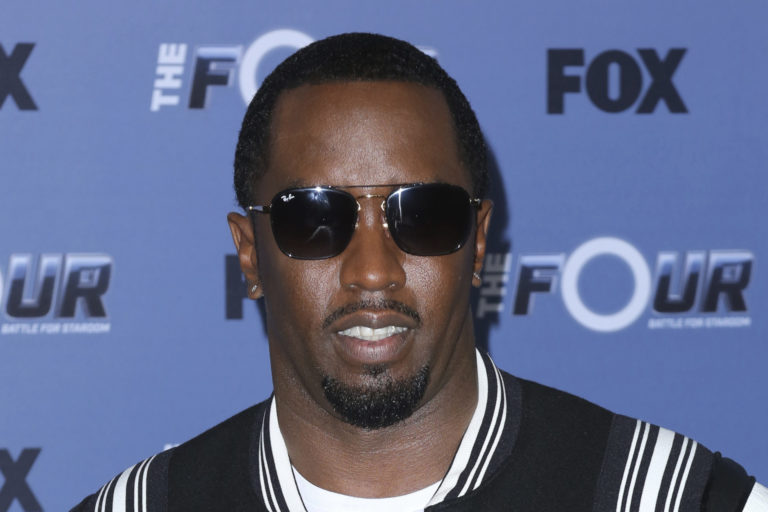
(Headline USA) Under cross-examination, Sean “Diddy” Combs’ ex-girlfriend testified Tuesday she took part in sex acts with male sex workers at the music mogul’s request because it made her feel loved by him, but now regrets what she came to recognize as the “cuckold” lifestyle.
The woman was testifying at Combs’ sex-trafficking trial under the pseudonym “Jane” to protect her identity. A day earlier, she revealed their three-year relationship stretched up until the Bad Boy Records founder was arrested in September at New York hotel, where she’d been planning to meet him.
Combs, 55, has pleaded not guilty to sex trafficking and racketeering conspiracy charges that carry a potential penalty of 15 years to life in prison. He has been jailed without bail.
Prosecutors allege Combs used violence, threats and a network of employees and associates to control and abuse women for two decades. His lawyers have told the jury in federal court in Manhattan that although there was domestic violence in his relationships, everything he did sexually was consensual.
Earlier in the trial, R&B signer Casandra “ Cassie ” Ventura testified over four days that Combs physically abused her and that she participated in hundreds of “freak-off” sexual performances during a nearly 11-year relationship that ended in 2018.
The Associated Press doesn’t name alleged victims of sexual abuse without their consent unless they have shared their identities publicly, as Cassie has.
Teny Geragos, a lawyer for Combs, cross-examined Jane on Tuesday by leading her into discussing the drug-fueled sexual marathons choreographed by Combs — which Jane said sometimes happened weekly — by reminding her that she mentioned regrets in earlier testimony.
“I resent him for leading me into the lifestyle he led me to,” Jane said. “I resented the way he went about introducing me to this lifestyle.”
She said she agreed to these “hotel nights” while “under a lot of emotional pressure” — and already hooked on love and a desire to stay in a relationship with Combs.
Jane testified Monday she began therapy about three months ago. She previously met with lawyers on Combs’ defense team but cut off those meetings in April, days before the trial began.
She said she struggles to understand why she kept participating in “hotel nights” even though she only wanted to have sex with Combs, however the reasons are “becoming more and more clear” as she proceeds with therapy.
Jane initially felt it was “something very special” to have these secret sexual experiences with Combs. She said she didn’t want to judge him and “really wanted to just go along with these things because if I can be my partner’s escapes than I would be.”
Jane said she researched sexual variations in 2022 and came across the words “cuck” and “cuckold,” which seemed to fit the lifestyle she found herself in because she said a man known as a “cuck” derives pleasure seeing “his woman receive pleasure” from another man.
In earlier testimony, Jane provided recent examples of Combs acting violently toward a woman while seeking to fulfill his sexual desires. Cassie sued Combs in November 2023 alleging sexual abuse. The lawsuit was settled within hours for $20 million, but it touched off the criminal investigation into Combs.
(Headline USA) Rep. LaMonica McIver, D-NJ, was indicted Tuesday on federal charges alleging she assaulted and interfered with immigration officers outside a New Jersey detention center while Newark’s mayor was being arrested after he tried to join a congressional oversight visit at the facility.
Acting U.S. Attorney for New Jersey Alina Habba announced the grand jury indictment in a post on X.
Today a federal grand jury seated in Newark, New Jersey returned a three-count indictment charging U.S. Representative LaMonica McIver with forcibly impeding and interfering with federal law enforcement officers. This indictment has a maximum penalty of 8 years for Count One, an…
“While people are free to express their views for or against particular policies, they must not do so in a manner that endangers law enforcement and the communities those officers serve,” Habba said.
In a statement, McIver said the charges amounted to the Trump administration trying to scare her.
“The facts of this case will prove I was simply doing my job and will expose these proceedings for what they are: a brazen attempt at political intimidation,” she said.
McIver, a Democrat, was charged in a complaint by Habba last month with two assault charges stemming from the May 9 visit to Newark’s Delaney Hall — a 1,000-bed, privately owned facility that Immigration and Customs Enforcement uses as a detention center.
The indictment includes three counts of assaulting, resisting, impeding and interfering with federal officials. Habba said two of the counts carry a maximum sentence of up to eight years in prison. A third has a maximum sentence of one year.
A nearly two-minute clip released by the Homeland Security Department shows McIver on the facility side of a chain-link fence just before the arrest of the mayor on the street side of the fence. She and uniformed officials go through the gate and she joins others shouting “surround the mayor.” The video shows McIver in a tightly packed group of people and officers. At one point her left elbow and then her right elbow struck a police officer.
United States Representative LaMonica McIver has still not been arrested after assaulting multiple federal officers on video.
Within 48 hours of smiling and waving in the Capitol on J6, I was in county jail isolation under 24-hour supervision, charged with 3 crimes, 2 were lies,… pic.twitter.com/ef3iLktGHb
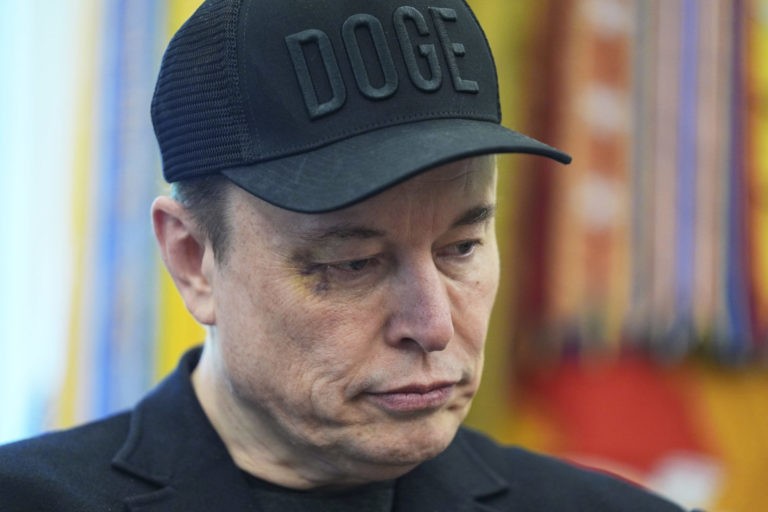
(Ken Silva, Headline USA) Billionaire Elon Musk is apparently trying to mend fences with President Donald Trump, writing on X that he regrets some of his posts about his onetime ally and that they went “too far.”
Early Wednesday morning, he posted “I regret some of my posts about President @realDonaldTrump last week. They went too far.”
I regret some of my posts about President @realDonaldTrump last week. They went too far.
Musk’s break with a president whom he spent hundreds of millions of dollars to elect appeared to put an end to his influence in the White House and prompted concerns about effects on his companies.
It’s still not totally clear what caused the rift. Musk expressed concern about Trump’s “big beautiful” spending bill, while the President said Musk was just made he wasn’t getting his electric car subsidies. Since then, reports have come out about Musk’s purported drug use. The New York Times said the breaking point was when Musk physically accosted Treasury Secretary Scott Bessent in the White House.
“President Trump heard about it and said, ‘This is too much,’” Trump supporter Steve Bannon reportedly said of the incident.
Musk earlier deleted a post in which he claimed without evidence that the government was concealing information about the president’s association with infamous sex criminal Jeffrey Epstein. Meanwhile, other posts that irritated Trump, including ones in which Musk called the spending bill an “abomination” and claimed credit for Trump’s election victory, remained live.
On Sunday, Trump told NBC’s Kristen Welker that he has no desire to repair their relationship and warned that Musk could face “serious consequences” if he tries to help Democrats in upcoming elections. Trump has already threatened to cut Musk’s contracts.
The Associated Press contributed to this report.
Ken Silva is the editor of Headline USA. Follow him at x.com/jd_cashless.
(Sarah Roderick-Fitch, The Center Square) Protests are being planned across the country to deflect from the celebratory events to be held in Washington on Saturday marking the Army’s 250th birthday and Flag Day, which coincide with President Donald Trump’s 79th birthday.
The No Kings Nationwide Day of Defiance will take place “during Donald Trump’s military parade,” as the event is being billed by Invisible, a grassroots progressive movement.
The Day of Defiance comprises dozens of progressive grassroots organizations and unions, including the American Federation of Teachers and Planned Parenthood. The movement says it is comprised of “pro-democracy and pro-worker movements” and activists.
“Instead of allowing this military parade to be the center of gravity, activists will make action everywhere else the story of America that day,” according to a release from Invisible.
The group says activists nationwide “will come together for marches, rallies, and demonstrations to reject corrupt, authoritarian politics in the United States,” adding that the protests are modeled after “Hands Off!” and May Day demonstrations.
The organizers accuse the president of holding the military parade to celebrate himself, comparing his actions to that of a king.
“Donald Trump wants tanks in the streets and a made-for-TV display of dominance for his birthday,” according to No Kings. “A spectacle meant to look like strength. But real power isn’t staged in Washington – it rises up everywhere else. June 14th is also the U.S. Army’s birthday – a day that marks when Americans first organized to stand up to a king. Trump isn’t honoring that legacy. He’s hijacking it to celebrate himself.”
While the group says the event is meant to boost the president’s “ego,” he emphasizes that it is meant to honor the Army and highlight its history.
“This parade salutes our soldiers’ remarkable strength and unbeatable spirit,” Trump said in a promotional video on Thursday of last week. “You won’t want to miss it. I think it’s going to be better and bigger than any parade we’ve ever had in this country.”
According to White House communications, “Attendees will experience 250 years of Army heritage through historical U.S. Army personnel reenactors, period-accurate equipment, vehicles, impressive flyovers, and military bands participating in the landmark event.
Despite the parade being held in D.C., the group opted not to hold a competing event in there. Instead, it is hosting one of its major protests in Philadelphia. However, an interactive map on the No Kings website shows several events to be held around the Beltway.
While the demonstrations come on the heels of violent protests in Los Angeles, the events have been planned as early as the first of May. The group says it is committed to “nonviolent action,” urging its participants “deescalate any potential confrontation.”
The Ukrainian Air Force claimed that 460 of the drones were intercepted and that it recorded a total of 10 successful strikes. According to the Kyiv Post, one of the targets appeared to be an airfield in northwestern Ukraine’s Rivne Oblast, which is believed to be housing US-made F-16 fighter jets.
The Russian Defense Ministry acknowledged a strike on an airfield in Rivne, saying its strikes were part of its response to Ukraine’s recent drone attack that targeted airfields deep inside Russia.
“Last night, the Russian forces carried out a massive strike with high-accuracy long-range air-based weapons on one of the airfields where Ukrainian tactical aircraft are based in the area of Dubno, the Rovno Region,” the Defense Ministry said.
In Russia’s Kursk Oblast, the governor said a Ukrainian strike hit a cultural center, killing a 64-year-old man and injuring five other people.
On top of the drone attacks, fighting raged along the frontlines, with Russia claiming that its forces inflicted huge casualties on Ukrainian forces. “The Ukrainian army lost up to 1,350 troops in battles with Russian forces in all the frontline areas over the past 24 hours,” Russia’s TASS news agency reported, citing Defense Ministry numbers.
The Russian Defense Ministry also said that it expanded the territory it controls in the Dnipropetrovsk Oblast, an area Russia first said it pushed into on Sunday.
The massive military operations follow the pattern of escalating strikes in recent weeks as ceasefire negotiations have appeared to make no progress. One result of the direct talks between Russia and Ukraine has been prisoner swaps, and another one was conducted on Monday amid the heavy fighting.
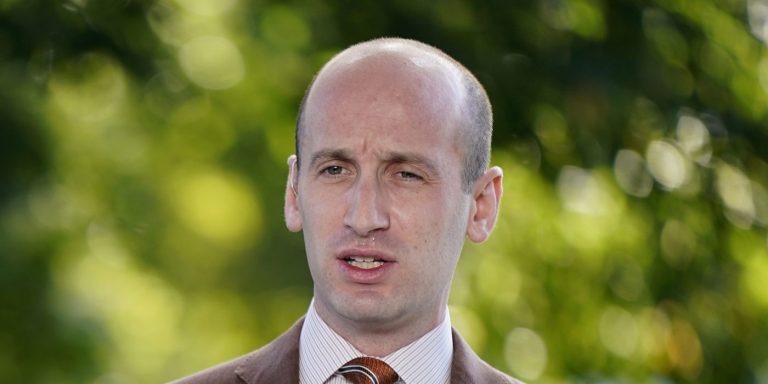
(Luis Cornelio, Headline USA) ABC News has fired one of its star correspondents after he publicly berated President Donald Trump and White House official Stephen Miller in a brazen anti-Trump rant.
The network said Tuesday it would not renew its contract with Terry Moran, a senior national correspondent, after he accused both Trump and Miller of being “world-class” haters.
In a statement, ABC News said the smear breached its purported “objectivity” policy. Moran had worked for the network for 28 years.
“We are at the end of our agreement with Terry Moran, and based on his recent post — which was a clear violation of ABC News policies — we have made the decision to not renew,” an ABC News spokesman said.
“At ABC News, we hold all of our reporters to the highest standards of objectivity, fairness and professionalism, and we remain committed to delivering straightforward, trusted journalism,” the spokesman added.
The liberal New York Times reported Moran’s contract was set to expire Friday. The next day, he attacked Trump and Miller on X.
BREAKING: Terry Moran is out at ABC News, according to CNN's Brian Stelter.
ABC News, the same outlet that rigged the debate against Trump before the 2024 election, accused Moran of not being "fair."
"We are at the end of our agreement with Terry Moran and based on his recent… pic.twitter.com/keO36usa7N
In a now-deleted post, Moran specifically wrote: “Miller is a man who is richly endowed with the capacity for hatred. He’s a world-class hater. You can see this just by looking at him because you can see that his hatreds are his spiritual nourishment. He eats his hate.”
Moran also called Trump a “world-class hater,” saying his so-called hatred was “only a means to an end, and that end of his own glorification.”
Moran’s firing was shocking, considering that his comments were in line with the anti-Trump bias ABC News has peddled for years, NewsBusters reported Tuesday.
For instance, in 2021, Moran claimed that Trump controlled the Republican Party like a “caudillo,” “Ceaser” and “Fuhrer.” He also declared that “women will die” after the Supreme Court overturned Roe v. Wade.
Those were just a few examples of Moran’s long-standing partisan outbursts.
ABC's Terry Moran is interviewing President Donald Trump to talk about the first 100 days of the administration.
Expect an unfair interview.
Here's a look back at Terry's infatuation with Obama and his anti-Trump "reporting" over the past 19 years. pic.twitter.com/g3dqDkqKah