Back in the U.S., ‘Maryland Man’ Pleads Not Guilty to Human Smuggling Charges

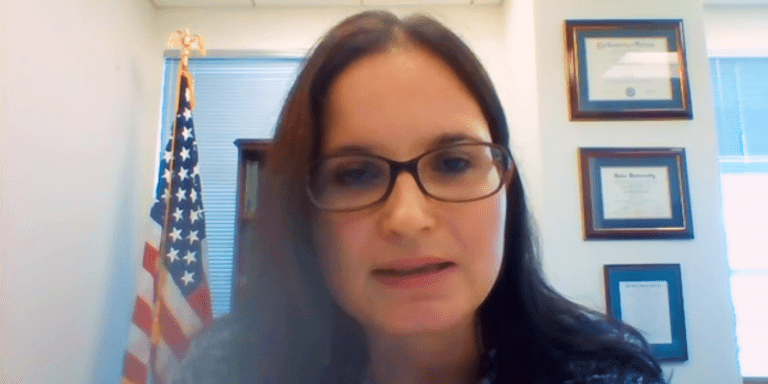
(Headline USAKilmar Abrego Garcia, the alleged MS-13 member whom mainstream media dubbed “Maryland man” after he was deported to El Salvador, pleaded not guilty Friday to human smuggling charges in a federal court in Tennessee.

The hearing was the first chance Abrego Garcia has had in a U.S. courtroom to answer the Trump administration’s allegations since he was sent to an El Salvadorian supermax prison in March, in contravention of an immigration judge’s hold on his deportation.

Most of Friday’s hearing focused on whether Abrego Garcia should be released as he awaits trial. U.S. Magistrate Judge Barbara Holmes said she will write her decision “sooner rather than later.”

The smuggling charges stem from a 2022 traffic stop for speeding in Tennessee during which Abrego Garcia was driving a vehicle with nine passengers. While officers suspected possible smuggling, Abrego Garcia was allowed to go on his way with only a warning.

Body camera footage shows a calm exchange between officers and Abrego Garcia. The officers then discussed among themselves their suspicions of smuggling before letting him go. One of the officers says, “He’s hauling these people for money.” Another says Abrego Garcia had $1,400 in an envelope.

The federal indictment accuses Abrego Garcia of smuggling throughout the U.S. hundreds of people living in the country illegally, including children and members of the violent MS-13 gang.

In briefings before Friday’s hearing, U.S. attorneys described Abrego Garcia as a danger to the community and a flight risk. They also accused him of trafficking drugs and firearms and of abusing the women he transported, among other claims, although he is not charged with such crimes.

Rob McGuire, Acting U.S. Attorney for the Middle District of Tennessee, told the judge Friday that “migrant transportation is inherently dangerous.”

The prosecutor also presented two orders of protection that Abrego Garcia’s wife sought in 2020 and 2021 against him for domestic violence. Jennifer Vasquez Sura said this spring that the couple had worked things out “privately as a family, including by going to counseling.”

Abrego Garcia’s attorneys rejected the prosecution’s assertions that he was a danger, while arguing the charges aren’t serious enough for detention.

“If Mr. Abrego Garcia is so dangerous, this violent MS-13 guy, why did they wait almost three years to indict him on this?” Shabazz asked the judge. “Why wait until literally after the Supreme Court told them they denied him due process and they had to bring him back before they investigate him?”

Special agent testifies

Friday’s proceeding included testimony from a Department of Homeland Security agent who quoted three unnamed witnesses who spoke to a grand jury about Abrego Garcia’s alleged actions.

Special agent Peter Joseph said that the witnesses saw Abrego Garcia trafficking people, guns or drugs and that Abrego Garcia earned upwards of $100,000 a year. One man said Abrego Garcia was sexually inappropriate towards underage girls, Joseph testified, while a woman said Abrego Garcia had solicited nude photos of her when she was 15 and she believed he was in the MS-13 gang.

During cross-examination, Abrego Garcia’s attorneys raised questions about possible conflicts of interest. One man had been convicted of a felony and was previously deported. He also was serving a 30-month sentence when investigators contacted him, Joseph acknowledged. That witness is now living in a halfway house and on his way to getting work authorization.

“He sounds like the exact type of person this government should be trying to deport,” Federal Public Defender Dumaka Shabazz said. “They’re going to give all these other people deals to stay in the country just to get this one other person.”

The second man is a very close relative of the first witness and “said he would help in return for his release from jail,” said Richard Tennent, an assistant federal public defender. A third witness had previously been compensated for her work with law enforcement.

Tennent said one of the witnesses told investigators that Abrego Garcia would drive roundtrip between Maryland and Houston — nearly 24 hours each way — two or three times per week. The witness said Abrego Garcia usually had two of his children and his wife with him.

Tennent pointed out that Abrego Garcia has three children, two of whom are autistic.

Adapted from reporting by the Associated Press

Woke Snow White Is Disney’s Biggest Flop in Years

(Luis CornelioHeadline USA) Disney’s controversial live-action remake of Snow White has become its worst-performing wide-release reboot in nearly a decade, marking yet another case of “go woke, go broke.” 

The 2025 film reportedly cost $410 million to make and promote, but it barely grossed $200 million worldwide, resulting in an official loss of more than $ 210 million, according to IMDb.com data reported by Fox News.

The last time Disney suffered a flop of this scale was in 2016 with Pete’s Dragon, a reboot of the 1977 film. The 2016 movie made just $143.7 million, though it only cost $65 million to produce. 

Snow White‘s downfall came after more than a year of backlash. over its overt fixation on diversity, equity and inclusion, or DEI, and its rejection of the original 1937 film’s characters and iconic storyline. 

Rachel Zegler, who starred in the 2025 film, attacked the original cartoon as “creepy” during a 2022 interview at Disney’s D23 Expo. 

“I mean, you know, the original cartoon came out in 1937 and very evidently so,” Zegler bemoaned. “There’s a big focus on her love story with a guy who literally stalks her. Weird! Weird. So we didn’t do that this time.” 

Zegler’s comments, combined with industry-wide strikes, reportedly led Disney to push the film’s release by a full year. However, such a delay only made the reboot’s debacle worse. 

Zegler shocked critics when she took to social media to issue disturbing threats against President Donald Trump and his supporters. 

“May Trump supporters and Trump voters and Trump himself never know peace,” Zegler wrote on Instagram. “F**k Donald Trump.” 

In August 2024, she added to the controversy by voicing support for the Hamas-controlled Gaza Strip, writing: “And always remember, free Palestine.” 

She ultimately walked back her rhetoric, claiming that “hatred and anger have caused us to move further and further away from peace and understanding.” 

Her apology came too little, too late for movie-goers. 

Lone Survivor of Indian Plane Crash Breaks Silence

(Luis CornelioHeadline USA) The lone survivor of the Air India Flight 171 crash shared harrowing details of how he escaped as the plane burst into flames and killed at least 290 people on Thursday. 

Vishwash Kumar Ramesh, a 40-year-old Briton of Indian descent, told Indian state-owned DD News from his hospital bed that he made it out of the plane through a broken emergency exit.  

“I can’t believe how I came out of it alive,” Ramesh said, according to the outlet. “For a moment, I felt like I was going to die too but when I opened my eyes and looked around, I realized I was alive. I still can’t believe how I survived.” 

Ramesh recounted that shortly after taking off, the plane felt “stuck in the air” before “the lights started flickering—green and white.” 

“The aircraft wasn’t gaining altitude and was just gliding before it suddenly slammed into a building and exploded,” he added. “At first, I thought I was dead. Later, I realised I was still alive and saw an opening in the fuselage.” 

He said he unbuckled his seatbelt, used his leg to push through an opening and crawled out.  

“I don’t know how I survived,” he said. “I saw people dying in front of my eyes – the air hostesses, and two people I saw near me … I walked out of the rubble.” 

The man said one of his arms caught fire, though Indian doctor Dhaval Gameti said he is out of danger. 

Flight AI171 was bound for London Gatwick Airport from Sardar Vallabhbhai Patel International Airport on Thursday. Minutes after takeoff, the plane crashed into a medical school facility, killing several students. 

According to authorities, 241 out of 242 people on board died. It is unclear what caused the plane to crash. 

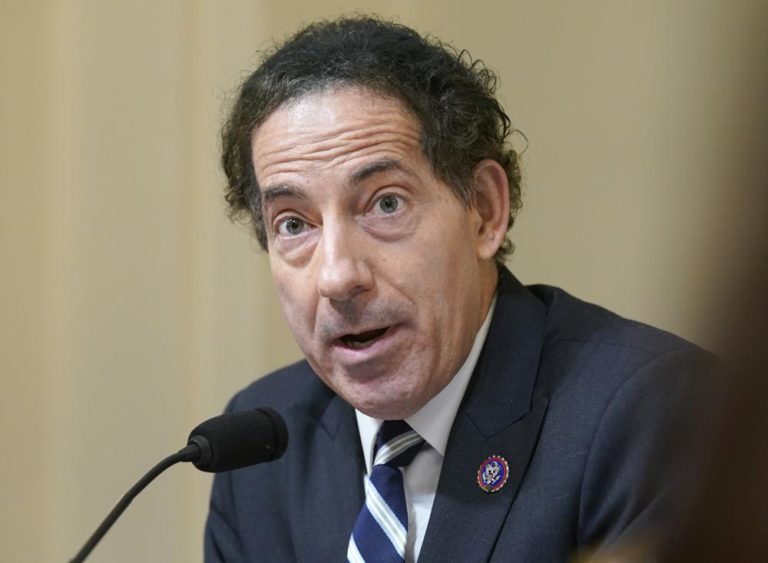
Jamie Raskin Explodes on Conservative Journalist: ‘Get Out of My Face!’

(Luis CornelioHeadline USA) Rep. Jamie Raskin, D-Md., barked at conservative journalist Nick Sortor, who pressed him on Friday about his past support for illegal aliens, including Kilmar Armando Abrego Garcia, the Salvadoran National and dubbed “Maryland man.”  

Raskin grew visibly angry as Sortor asked whether he still backed Garcia after the Trump administration returned him to the U.S. to face a federal human‑trafficking indictment. The Democratic Party had claimed there was no evidence Garcia was a criminal or was tied to gangs. 

Raskin was one of Garcia’s most vocal defenders, arguing the Salvadoran national had been deported by mistake. However, he threw that defense out the window when Sortor pressed him. 

“Go back to your QAnon meeting!” Raskin shouted. “QAnon is calling you! Go back to QAnon.” 

Sortor, unfazed by Raskin’s smears, asked if he believed Maryland residents wanted illegal aliens in their state. Raskin continued hurling insults. 

“Get out of my face, you little fascist!” he yelled, repeating the phrase. “Get the hell out of my face, you little fascist.”  

“There’s something wrong with you, man, QAnon is calling you! Get back to QAnon.”  

 Raskin’s refusal to defend Garcia was striking, given his staunch advocacy in the past.   

The Democratic lawmaker had appeared in multiple media interviews, delivered statements to press outlets, and even issued formal remarks through his congressional office, all in defense of Garcia.  

“The Administration has produced no viable evidence that he was a member of any gang and admitted his detention and removal were an ‘error,’” Raskin said in a joint statement with House colleagues. “He was given no chance to see what he was accused of or to plead his case—just snatched, shackled, and shipped off to a Salvadoran prison with the very gang members whose persecution he had fled and had been given protection from.” 

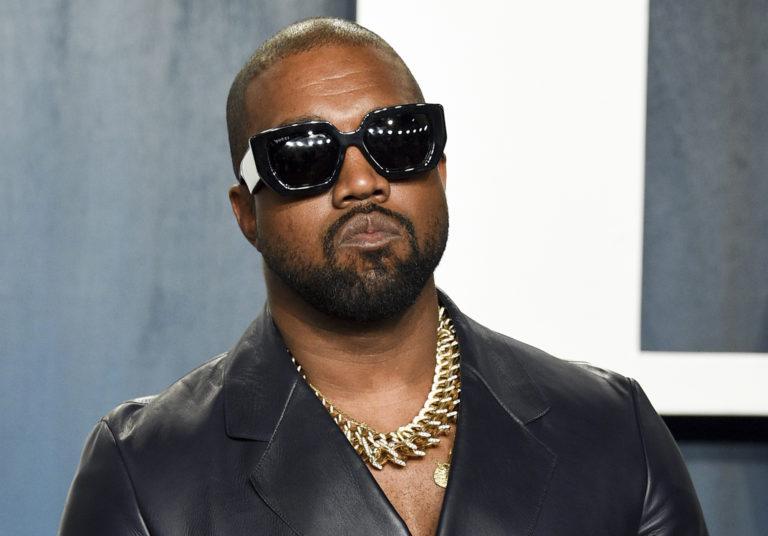
Kanye Makes Surprise Appearance at ‘Diddy’ Trial

(Headline USAYe, the rapper formerly known as Kanye West, briefly showed up to the New York sex trafficking trial of Sean “Diddy” Combs on Friday to support the hip-hop mogul, a longtime friend. But he wasn’t allowed into the courtroom and left after briefly watching the trial on a video monitor in another room.

Ye, dressed in white, arrived at Manhattan federal court before noon while the trial was on a break and spent about 40 minutes in the building.

After emerging from an airport-style security screening, Ye was asked if he was at the courthouse to support Combs.

“Yes,” he responded with a nod. He then hustled to an elevator and did not respond when asked if he might testify on Combs’ behalf when the defense begins its presentation as early as next week.

Courthouse security did not take him to the 26th floor where the trial occurs in one of the building’s largest courtrooms. Admittance there is strictly controlled, with seats reserved for Combs’ family and legal team, the media and spectators who wait in line for hours to get a coveted seat.

The rapper was taken instead to a courtroom three floors below the trial floor. There, he briefly observed testimony on a large closed-circuit monitor in an overflow room that was one floor below the usual overflow room, which was packed with media representatives and courthouse employees who heard erroneously that he might be there.

As word of his actual location spread and spectators trickled into the room where Ye sat in the front row with Combs’ son, Christian, a bodyguard and another Combs’ supporter on a side of the room that was otherwise kept vacant by a court officer, Ye looked around the room before abruptly getting up and leaving, along with the others with him.

Ye didn’t answer further questions as he left the courthouse, walking past reporters and TV cameras and ducking into a waiting black Mercedes sedan.

In the courtroom where the trial occurred, Combs, 55, seemed elated and aware his friend had visited as family members including his mother watched the proceedings. He has pleaded not guilty to sex trafficking and racketeering conspiracy charges alleging that he used his fame, fortune and violence to commit crimes over a 20-year period.

Ye’s appearance at the courthouse came a day after a woman identified in court only by the pseudonym “Jane” finished six days of testimony.

She testified that during a relationship with Combs that stretched from 2021 until his arrest last September at a Manhattan hotel, she felt coerced into frequent dayslong sexual marathons with male sex workers while Combs watched and sometimes filmed the drug-fueled encounters.

Defense attorneys have argued that Combs committed no crimes and that federal prosecutors were trying to police consensual sex that occurred between adults.

On Thursday, Jane testified that during a three-month break in her relationship with Combs, she flew to Las Vegas in January 2023 with a famous rapper who was close friends with Combs.

Prior to Jane’s testimony on the subject, lawyers and the judge conducted a lengthy hearing out of public view to discuss what could be divulged about the January trip.

Jane was asked if the rapper she accompanied along with the rapper’s girlfriend was “an individual at the top of the music industry as well … an icon in the music industry.”

“Yes,” Jane replied.

Once in Las Vegas, Jane testified, she went with a group including the rapper to dinner, a strip club and a hotel room party, where a sex worker had sex with a woman while a half-dozen others watched.

She said there was dancing and the rapper said, “hey beautiful,” and told her, in crude language, that he had always wanted to have sex with her. Jane said she didn’t recall exactly when, but she flashed her breasts while dancing.

Also Friday, the judge said he was leaning toward removing a juror and replacing him with an alternate after prosecutors found inconsistencies in his answers about where he lives.

During jury selection, the juror said he lived in the Bronx. But, prosecutors said, he told a court employee that he recently moved to New Jersey.

Under questioning by Judge Arun Subramanian, the juror acknowledged moving, but said he retains a New York driver’s license and stays there during the week. Only New York residents can serve as Manhattan federal court jurors.

Combs’ lawyers called it a “thinly veiled effort to dismiss a Black juror” and suggested Subramanian was “conflating inconsistencies with lying.”

The judge noted that even if the juror is ousted, the jury would be diverse.

Adapted from reporting by the Associated Press


DHS Confirms 4 Illegal Immigrants Escaped from ICE Facility

(Headline USAFour detainees broke through a wall and escaped from a federal immigration detention center in Newark, New Jersey, amid reports of disorder breaking out there, according to Sen. Andy Kim and the Department of Homeland Security.

Kim, a Democrat from New Jersey, spoke Friday outside the Delaney Hall detention center. He said he was told detainees managed to break through an interior wall that led to an exterior one and from there were able to escape to a parking lot.

More “law enforcement partners” have been brought in to find the detainees missing from Delaney Hall, according to an emailed statement attributed to a senior DHS official whom the department did not identify. The statement also didn’t specify which law enforcement agencies are involved, and authorities haven’t released the names of the escapees.

DHS identified the four escapees as two Colombian men who were arrested on burglary and other counts and two Hondurans, Franklin Norberto Bautista-Reyes and Joel Enrique Sandoval-Lopez, who were arrested on aggravated assault and other charges.

Newark’s mayor cited reports of a possible uprising and escape after disorder broke out at the facility Thursday night and protesters outside the center locked arms and pushed against barricades as vehicles passed through gates. Much is still unclear about what unfolded there.

GEO Group, the company that owns and operates the facility for the federal government, said in a statement that there’s “no widespread unrest” at the facility.

Immigration and Customs Enforcement opened a 1,000-bed facility there this year under a 15-year, $1 billion contract as part of President Donald Trump’s crackdown on illegal immigration.

Protest at the detention center

Photos and video from outside the facility Thursday showed protesters pushing against the gates amid word that detainees inside were upset about delayed meals.

Amy Torres, executive director of New Jersey Alliance for Immigrant Justice, said some officers pepper sprayed, tackled and dragged protesters away from the facility. She said some protesters had minor injuries, but no one was hit by the vehicles.

Mustafa Cetin, an attorney for a client who’s been detained in Delaney Hall for about two weeks, told The Associated Press that things turned violent late Thursday afternoon after detainees’ meals arrived hours late.

“Apparently the guards lost control of them,” Cetin said. “And they started to, you know, create a disturbance. They came back up to the third floor, where my client is. Basically, they blocked off cameras, security cameras, and some of them made their way into a housing unit with a very thin, shallow wall, and they knocked it out.”

Kim said he had heard about problems related to food and an odor in the water. Kim also said it seems as if there will be “major movements” of detainees out of the facility over the next 24 hours. He said he was seeking “full confirmation” about that.

A message seeking comment was left with the Homeland Security Department, which oversees Immigration and Customs Enforcement.

Attorneys with clients inside Delaney Hall have had calls canceled and weren’t able to get inside the facility Friday, according to Araceti Argueta, a spokesperson for the American Friends Service Committee, a nonprofit that represents immigrants.

Adapted from reporting by the Associated Press


Iran Strikes Israel, Ends Nuclear Talks With U.S.

(Kyle Anzalone, Antiwar.comOn Friday, Iran began its response to an Israeli war launched on the Islamic Republic last night. Additionally, Tehran said it would withdraw from talks with Washington on establishing a new nuclear safeguards agreement.

Iranian Supreme Leader Ali Khamenei announced that Tehran would retaliate to Israel’s aggressive war in a statement on Friday afternoon. “The Zionist regime has made a big mistake, a grave error, and committed a reckless act. By God’s grace, the consequences of this will bring that regime to ruin.” He added, “The Iranian nation won’t permit the blood of its valued martyrs to go unavenged, nor will it ignore the violation of its airspace.”

Iranian missiles were reported to have hit targets in Israel, with some videos showing impacts in Tel Aviv. At the time of this writing, the extent of the Iranian attack and the damage in Israel is unclear.

Tehran says some of the missiles were fired at Israel from a submarine.

According to Reuters Pentagon correspondent Idrees Ali, two US officials confirmed that American forces helped to shoot down Iranian missiles targeting Israel. The US has also deployed additional military assets to the region to help intercept Iranian missiles and drones.

Moreover, Tehran canceled talks with Washington that were scheduled to take place Sunday in Oman. Earlier in the day, Trump urged Iran to agree to a deal with the US, and American officials said the White House was still open to meeting with Iranians.

“There has already been great death and destruction, but there is still time to make this slaughter, with the next already planned attacks being even more brutal, come to an end,” Trump posted on Truth Social. “Iran must make a deal, before there is nothing left, and save what was once known as the Iranian Empire. No more death, no more destruction, JUST DO IT, BEFORE IT IS TOO LATE.”

Starting in April, US and Iranian officials engaged in five rounds of Omani-mediated negotiations. While Tehran reported some progress was made in the later rounds of talks, the White House adopted the hardline position that the Islamic Republic would have to completely dismantle its uranium enrichment program.

The Israeli attack on Iran has hit several nuclear and military facilities as well as residential buildings in Tehran, while some top Iranian military officials and nuclear scientists were assassinated in the strikes. At least 78 people have been killed, with scores injured.

This article originally appeared at Antiwar.com.

Kyle Anzalone is the opinion editor of Antiwar.com and news editor of the Libertarian Institute. He hosts The Kyle Anzalone Show and is co-host of Conflicts of Interest with Connor Freeman.

Alleged Would-be Trump Assassin Says Judge Cannon is Violating His Constitutional Rights

(Ken Silva, Headline USA) Ryan Routh has accused Judge Aileen Cannon of violating his Sixth Amendment and First Amendment rights by sealing two of his recent motions filed in the alleged would-be Trump assassin’s federal criminal proceedings.

According to Routh’s Friday court filing, he recently filed a “motion for public proceedings” and a “motion for appearance by video.” However, Judge Cannon sealed both of those motions, preventing the public from seeing them.

“Mr. Routh submits that the sealing of these records violates his Sixth Amendment right to a public trial and his First Amendment rights for the reasons set forth in the proposed sealed filing,” his lawyers said in their Friday filing.

The Justice Department opposes Routh’s motion to unseal. Their reasons for opposing Routh’s motion are also sealed.

Routh is set to stand trial in September for allegedly trying to kill Donald Trump at his Florida golf course on Sept. 15, 2024.

Meanwhile, Judge Cannon is also considering a motion from the DOJ to prevent Routh’s proposed defense expert from giving evidence. The proposed defense expert, Michael McClay—a former National Guard pilot and Palm Beach County Sheriff’s deputy who now works for American Airlines—test-fired Routh’s rifle on May 13. When he did so, the rifle was able to fire the first round—but would not feed the subsequent rounds into its chamber, according to McClay’s report.

However, while the rifle may have misfired after its first shot, the DOJ says that’s irrelevant to the charges Routh is facing: attempted assassination, possession of a firearm by a felon, possession of a firearm with an obliterated serial number, and assault on a Secret Service agent. The DOJ is seeking to exclude McClay’s analysis from being presented to a jury.

“What possible relevance could McClay’s testimony about his test-fire have other than to suggest improperly that Routh might not have been able to succeed in killing President Trump if he had required a second shot to do so?” the DOJ said in a filing earlier this week.

Routh has yet to publicly respond to this motion. It’s unclear whether his sealed motions have anything to do with this issue.

Ken Silva is the editor of Headline USA. Follow him at x.com/jd_cashless.

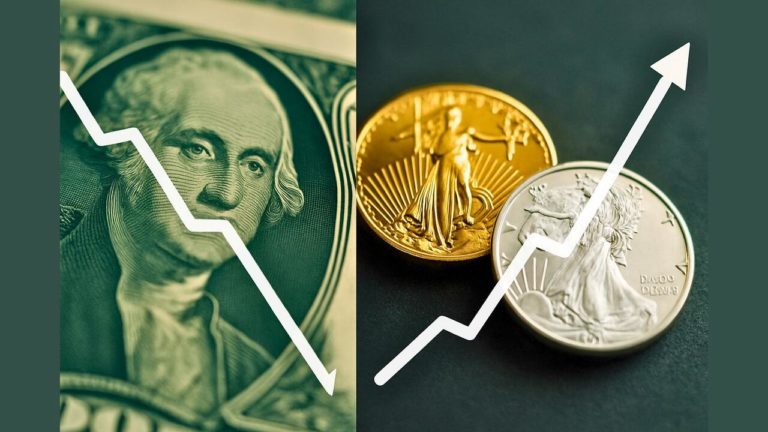
Dollar Hits 3-Year Low—Here’s What It Means for Precious Metals

(Jesse Colombo, Money Metals News Service) The U.S. dollar is undergoing a major technical breakdown—a highly bullish development for commodities, especially precious metals and their mining stocks.

For the past couple of months, I’ve been warning of a likely breakdown in the U.S. dollar—an event that historically signals a bullish turn for precious metals due to their well-established inverse relationship (read my recent report to learn more).

That breakdown is now unfolding, as I had anticipated, and gold, silver, and mining stocks are responding favorably. In this update, I’ll break down where these assets currently stand from a technical perspective and what’s likely to come next.

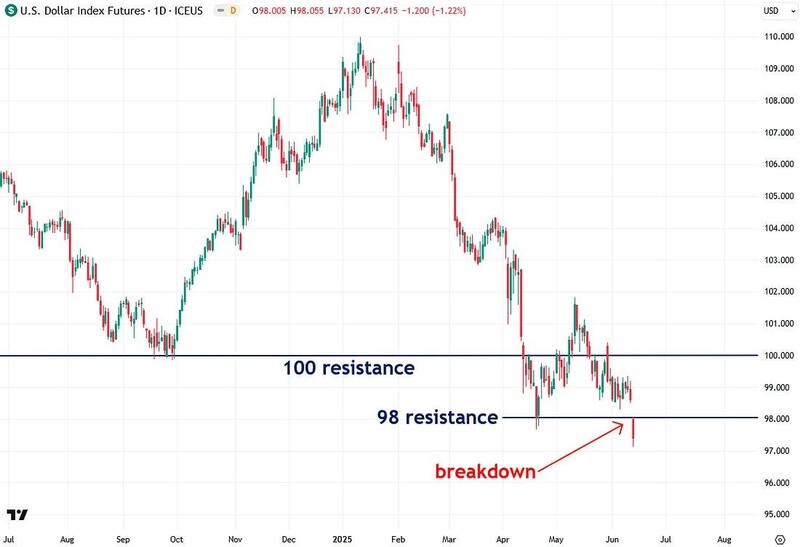
In my recent dollar updates, I emphasized the importance of the 100 level on the U.S. Dollar Index—a key support that had triggered several major rallies in recent years. But that support was recently broken, shifting my bias firmly bearish. In my latest analysis, I also pointed out the 98 level as the next important support and warned that a break below it would confirm a deeper selloff. Sure enough, the index sliced through that level today, hitting a three-year low and further reinforcing the downtrend.

The U.S. dollar has weakened over the past two days, driven by several key developments. Yesterday’s benign Consumer Price Index (CPI) report was followed by a soft Producer Price Index (PPI) reading today, reinforcing the disinflationary trend.

Adding to the pressure, a new report yesterday showed that U.S. continuing jobless claims have risen to their highest level in over three years. Together, these data points increase the likelihood of upcoming interest rate cuts—further weighing on the dollar’s outlook.

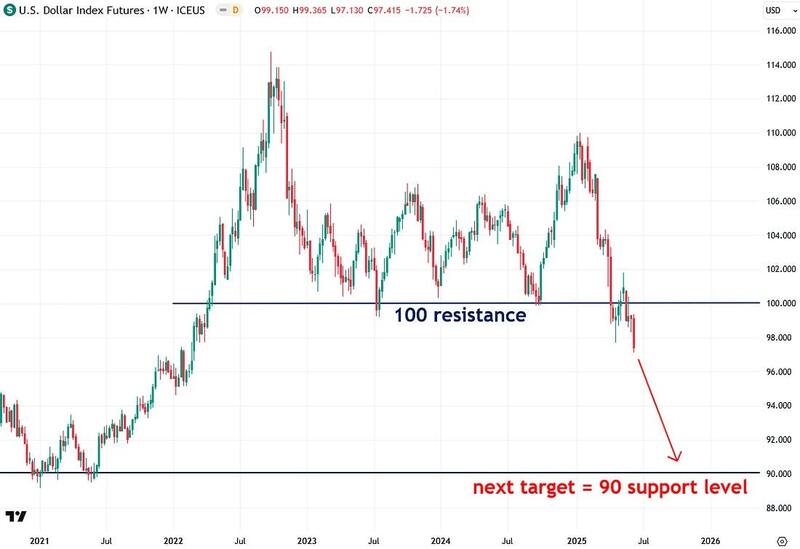
The weekly chart of the U.S. Dollar Index highlights how the 100 level has served as critical support for several years, with multiple rebounds occurring off of it. However, the recent decisive break below that level has given an important bearish signal. With that breakdown now validated, the next major support lies near the 90 level—which is now my next downside target.

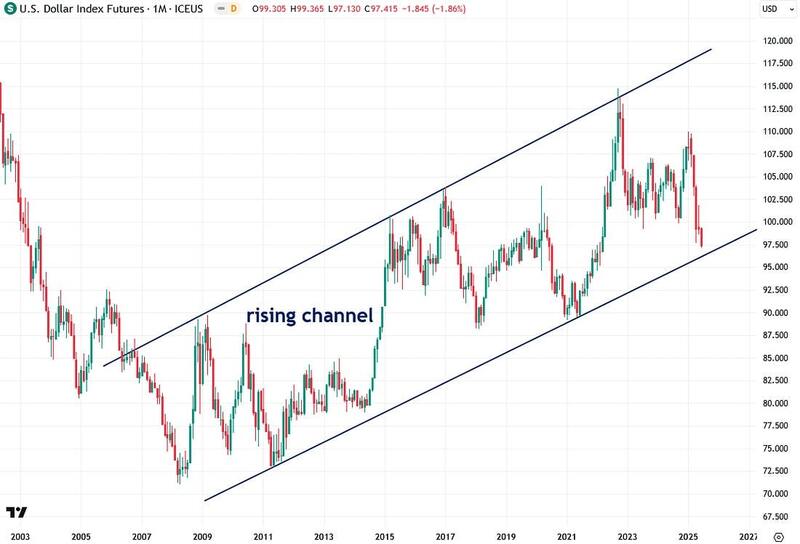
Zooming out to the long-term monthly chart of the U.S. Dollar Index reveals that it has been trading within a rising channel for nearly two decades. A continued move toward the key 90 level would mark a decisive breakdown from that pattern—one that is likely to open the door to even deeper declines.

There are numerous fundamental reasons to remain bearish, including the dollar’s extreme overvaluation relative to historical norms. A sustained dollar bear market would be like rocket fuel for commodities, especially precious metals and mining stocks. As a reminder, the early 2000s commodities bull market was fueled, in large part, by a prolonged dollar bear market—and I see strong parallels between that period and the current environment.

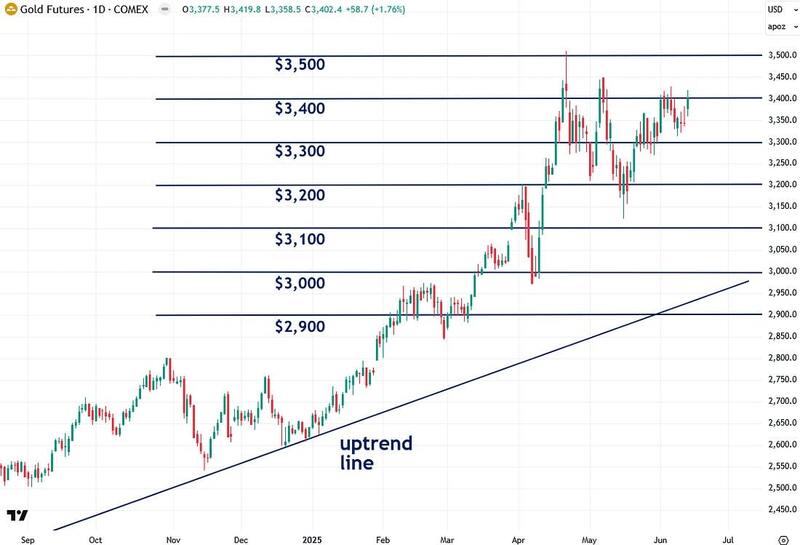
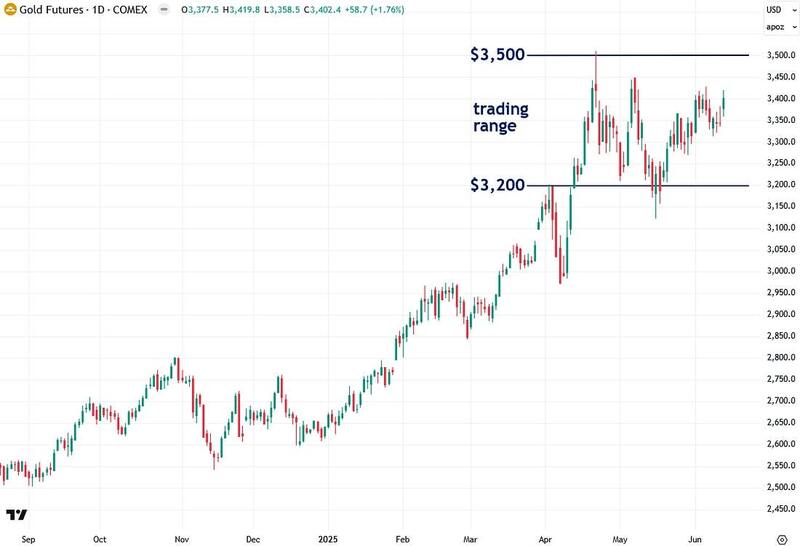
Next, let’s take a look at gold via COMEX futures, which I follow closely due to its tendency to trade in clean $100 increments—creating strong support and resistance around round numbers like $3,000, $3,100, $3,200, and so on.

Gold delivered a strong performance today, rising 1.76% on the back of soft inflation and jobs data, which pressured the U.S. dollar. Geopolitical tensions also contributed to the rally, with reports indicating that Israel may be weighing a strike on Iran’s nuclear facilities. This surge pushed gold futures up to the $3,400 level—but for a stronger bullish confirmation, I’d like to see a decisive breakout above that threshold in the days ahead.

As I’ve been showing in recent updates, gold remains in a healthy consolidation range between $3,200 and $3,500, pausing to catch its breath after strong gains earlier this spring.

This sideways action may continue a bit longer, but a decisive breakout above $3,500 is the key signal I’m watching. That would likely mark the start of gold’s next major leg higher—likely targeting $4,000 next, given its significance as a major psychological milestone that tends to act like a magnet for price.

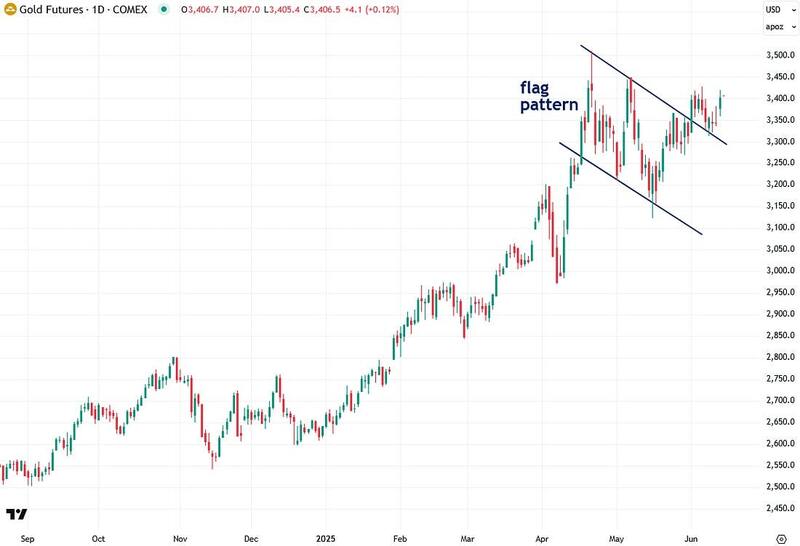
It’s also worth noting that gold had been forming a bull flag pattern over the past couple of months—and it recently broke out to the upside. This is a technically bullish development that reinforces the strength of the current move and warrants close attention.

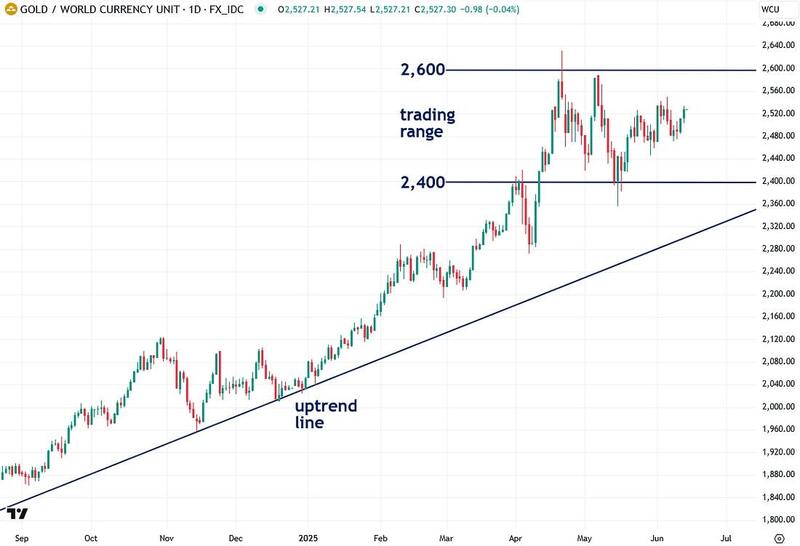
I’ve recently begun tracking gold priced in the World Currency Unit (WCU)—a composite currency based on the GDP-weighted average of the world’s 20 largest economies. In many ways, it offers one of the most balanced and accurate reflections of gold’s true global performance, which is why I’ve been paying close attention to it.

Gold priced in World Currency Units (WCUs) clearly demonstrates that its uptrend remains strong, with a well-defined trading range between 2,400 and 2,600 that’s important to watch closely:

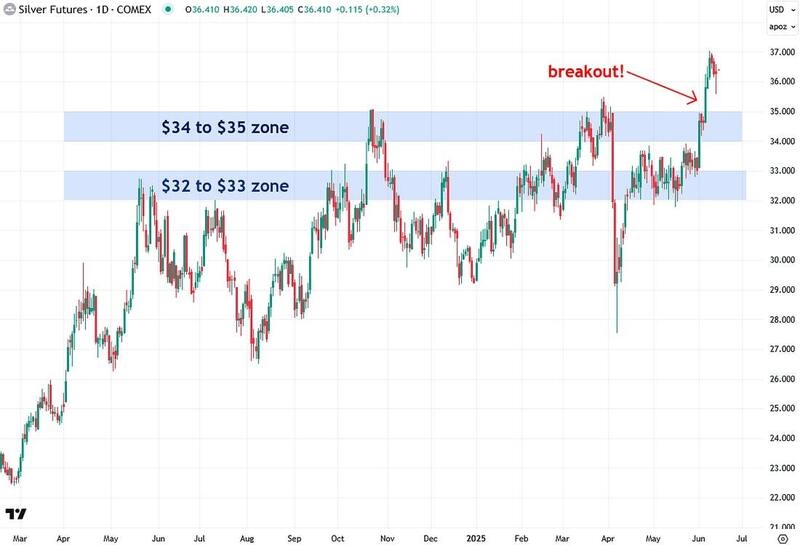
Silver has finally broken through its long-standing $34–$35 resistance zone—a strong signal that its bull market is gaining momentum after a year of frustrating false starts. Despite a few quiet days, the breakout remains intact. In my view, silver is simply consolidating before its next leg higher—first to $40, and eventually much higher.

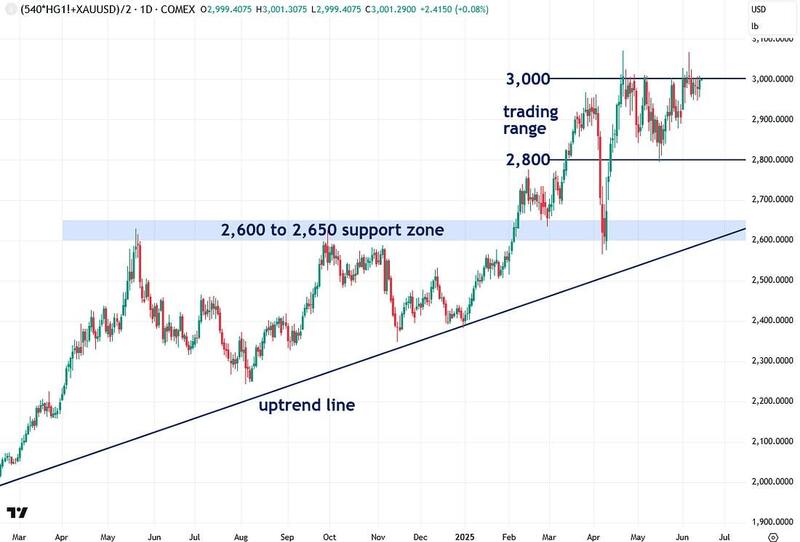
Next, let’s take a look at the Synthetic Silver Price Index (SSPI)—a proprietary indicator I developed to help validate silver’s price action and filter out potential false moves. The SSPI is calculated as the average of gold and copper prices, with copper scaled by a factor of 540 to prevent gold from dominating the index. Interestingly, even though silver isn’t part of the calculation, the SSPI closely tracks its movements. To learn more, check out the recent article I published.

The SSPI remains in a consolidation range between 2,800 and 3,000. A breakout above the 3,000 level would be a strong bullish confirmation for silver. Recent bullish action in both gold and copper pushed the SSPI right up to that 3,000 mark—an encouraging sign—but I’m waiting for a decisive close above it to confirm the breakout. I’ll be watching this development closely and will keep you all updated as it unfolds.

I also like to examine the underlying components of the SSPI to get a clearer sense of what’s happening beneath the surface. Since we’ve already covered gold, let’s now take a quick look at copper.

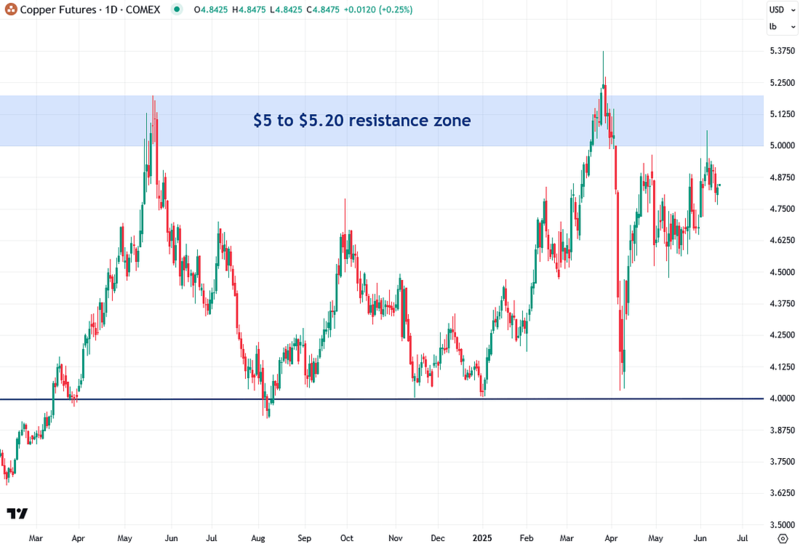
Copper is just under a major resistance zone between $5.00 and $5.20. A breakout above that zone would likely mark the start of a new copper bull market—one that would lift the SSPI and, by extension, silver as well. That’s because algorithmic trading systems arbitrage price relationships across metals, often causing their movements to align.

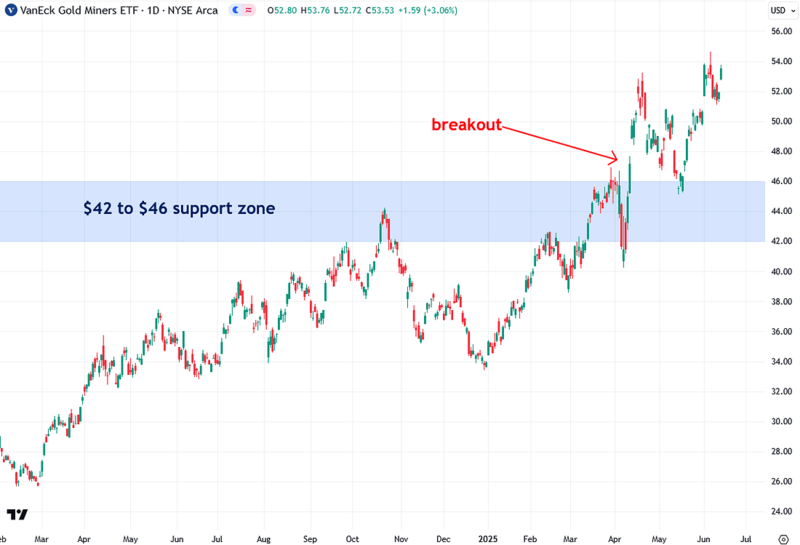
Next, let’s look at gold mining stocks, as tracked by the popular large-cap VanEck Gold Miners ETF (GDX). Notably, GDX recently broke above the $42–$46 resistance zone I’ve been highlighting—a strong signal that gold miners are finally coming to life.

After years of being deeply undervalued, mining stocks are finally starting to attract attention and get bought up. I’m increasingly optimistic about the sector and will be writing more soon now that I have a much clearer read on their trajectory.

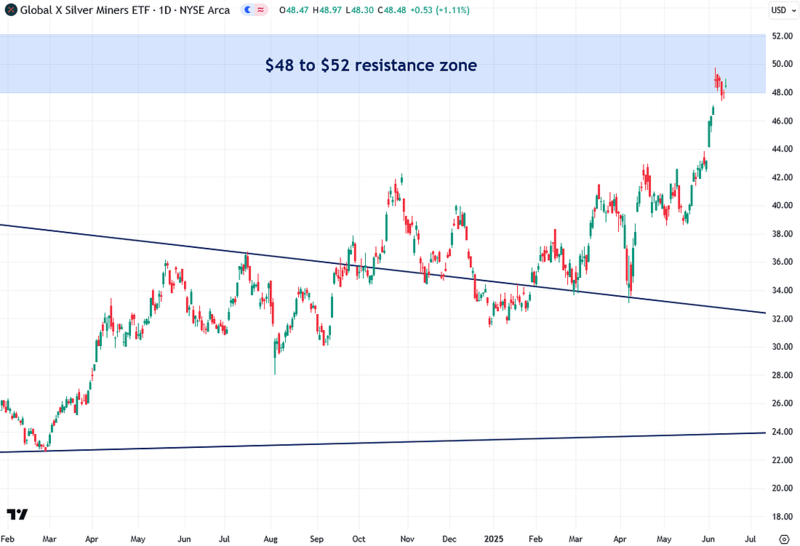
Silver miners, tracked by the SIL ETF, are also performing strongly and have entered the key $48–$52 resistance zone. A decisive breakout above this zone would provide further bullish confirmation—especially as silver’s momentum continues to build following its recent breakout.

To summarize, the U.S. dollar is undergoing a major technical breakdown, driven by signs of easing inflation and a weakening job market. Given the long-established inverse relationship between the dollar and commodities—especially precious metals—this breakdown is likely to serve as a powerful tailwind for gold, silver, and their mining stocks.

It’s an exciting and pivotal moment for the precious metals space, and I’m glad to have you on this journey with me. Stay tuned for more updates ahead!

If you found this report valuable, click here to subscribe to The Bubble Bubble Report for more content like it.


Jesse Colombo is a financial analyst and investor writing on macro-economics and precious metals markets. Recognized by The Times of London, he has built a reputation for warning about economic bubbles and future financial crises. An advocate for free markets and sound money, Colombo was also named one of LinkedIn’s Top Voices in Economy & Finance. His Substack can be accessed here.

Broken Precious Metal Promises

(Stuart Englert, Money Metals News Service) Whenever the indebted United States nears its legal borrowing limit, the fiscal can kickers in Washington, D.C., and their misinformation-spewing mouthpieces spout an oft-repeated falsehood and make audacious predictions about the nation’s ability to finance its burgeoning debt forever.

“The U.S. has never defaulted on its debts,” claimed Voice of America in 2023.

“The nation has never defaulted on its debt, and it never will,” President Joe Biden said during a 2023 press conference.

“The United States has never defaulted on its debts,” contended an article published at usatoday.com in 2024.

Earlier this month, Treasury Secretary Scott Bessent reiterated Biden’s definitive prognostication, suggesting “the United States of America is never going to default” on its debt obligations. “That is never going to happen.”

Never is a long time.

Told in various forms and iterations, the bold statements about repaying the nation’s debts are intended to ensure confidence in the U.S. dollar and government-issued debt instruments. They are echoed by federal officials, politically driven pundits, ill-informed commentators, script-reading news anchors, and historically illiterate reporters in the mockingbird mass media.

Don’t believe them when they parrot the big lie or regurgitate presumptive prophecies.

Despite bogus assertions and grand pronouncements made during previous debt-ceiling dramas in the nation’s capital, the United States has defaulted on its debts and financial commitments. And if history is a teacher, it will again, either through outright nonpayment or, more likely, its equivalent: currency depreciation via monetary inflation. It’s happened in the past when metal was foundational and preferred money.

Both before and after the debt limit was established with the passage of the Second Liberty Bond Act in 1917, the federal government failed or refused to honor its obligations to redeem silver and gold for paper currency. Those broken precious metal promises resulted in defaults and engendered others.

Continental Currency Became Unkept Paper Promises

The nation’s first default occurred in 1779 when the fledgling U.S. government devalued its paper Continental currency. Authorized by the Continental Congress, the bills of credit were used to finance the Revolutionary War and specified redemption in silver or gold at a prescribed rate.

When the excess supply of promissory notes couldn’t be exchanged for hard currency at their prescribed rate, they lost value and became worthless, giving rise to the phrase “Not worth a Continental.” The rebellious American colonists preferred gold and silver coinage to unkept paper promises.

The revenue-strapped government also defaulted on other domestic and foreign debts in the 1780s after some of the 13 former colonies failed to uphold their financial obligations. Once the U.S. Constitution was ratified in 1788, Congress gained taxing authority and the ability to pay the nation’s debts.

The financial fiasco caused by the hyperinflated Continental currency and default led to the inclusion of the contract clause in the U.S. Constitution, which says, “No state shall… make any Thing but gold and silver Coin a Tender in Payment of Debts.”

The second default transpired during the American Civil War. Following the passage of the Legal Tender Act in 1862, the U.S. government halted the redemption of its paper Demand Notes for gold and silver. Failure to keep its promise to exchange constitutionally-prescribed coinage “on demand” for the paper IOUs constituted a default.

The law, however, allowed the federal government to bankroll the Union cause with a deluge of unbacked Greenbacks, so named for the emerald-colored ink used on their reserve side. Since the paper notes weren’t redeemable for precious metals, their value was volatile, fluctuating with the North’s battlefield losses and victories, and steadily declined as their quantity increased to finance the bloody and costly four-year conflict.

Volatility, depreciation of the fiat currency, and price inflation prompted the hoarding of gold and silver coins, which, along with increased exports of the monetary metals, created a shortage of hard currency.

After the South surrendered in 1865 and the Confederate government defaulted on its own debts, the U.S. government reduced the number of Greenbacks in circulation to strengthen and stabilize their value. Redemption of gold and silver for paper notes resumed in the 1870s, but savvy savers, wary and weary of debased and inferior paper currencies, continued to favor and squirreled away specie for hard times and wealth preservation.

Gold Criminalization and Demonetization Led to Default

The next major default ensued during the Great Depression of the 1930s when the value of circulating U.S. dollars and outstanding debt instruments dwarfed the value of the nation’s gold and silver holdings.

“Behind government currency we have, in addition to the promise to pay, a reserve of gold and a small reserve of silver, neither of them anything like the total amount of the currency,” President Franklin D. Roosevelt said during a fireside chat broadcast on May 7, 1933.

To obscure the financial fraud and ensuing default—which obliterated an estimated $100 billion in public and private debt—the U.S. government, through a series of calculated, coercive, and compulsory steps, asserted control over and ownership of the nation’s monetary gold.

Often referred to as gold nationalization, the process to this day is considered confiscation and theft by many constitutionalists, sound money advocates, and precious metal investors.

Regardless of what it’s called, the default was set in motion on April 5, 1933, when Roosevelt issued an executive order that outlawed most private gold ownership. The decree required Americans to surrender their monetary gold for paper currency at the rate of $20.67 an ounce.

Congress, several months later, approved a joint resolution voiding all gold contract clauses and passed the Gold Reserve Act of 1934, which prohibited the redemption of U.S. currency for gold. After signing the measure, Roosevelt raised the official gold price to $35 an ounce, devaluing the dollar by 40 percent and effectively stealing 69 percent in purchasing power from the law-abiding citizens who, 10 months earlier, were coerced to exchange their gold for paper currency.

The sweeping actions spawned a slew of lawsuits. In 1935, the U.S. Supreme Court in Nortz v. United States and Perry v. United States sided with the government by a slim 5-4 margin, upholding its spurious gold guarantees and deliberate debt default.

While Congress’ invalidation of all gold contract clauses was deemed unconstitutional, the court rulings supported redemption of Treasury-issued gold certificates and bonds, which stipulated payment in gold for paper dollars, since gold ownership was illegal. The court also concluded the gold certificates and bonds were redeemable in paper currency at their face value rather than at the government’s revalued—and higher—gold price, which would have provided the plaintiffs with additional Federal Reserve Notes.

Combined, the dictatorial presidential decree, controversial legislative measures, and convoluted high court rulings abolished gold as legal tender, nullified the gold standard in the United States, and allowed the federal government to default on its gold obligations. By rescinding the requirement under the Gold Standard Act of 1900 to redeem the nation’s paper currency for gold coins, the U.S. government broke its gold-for-paper currency pledge to the American people.

Another default took place in the 1960s as the U.S. government was demonetizing silver, removing the metal from the nation’s coinage and eliminating its convertibility contrary to the original, legal definition of a dollar.

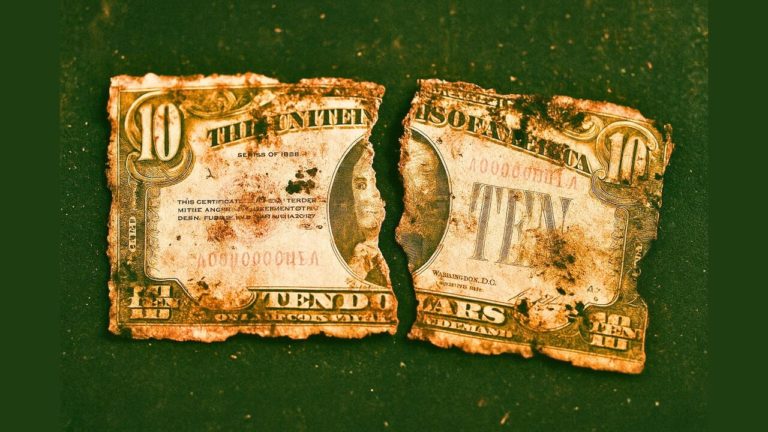
While government-issued paper silver certificates include a clear assurance of payment in the actual gray metal—“Silver Payable to the Bearer on Demand”—the U.S. Treasury in 1964 halted their redemption for silver dollar coins and ended their exchange for silver granules in 1968. This failure to convert paper certificates into physical metal represented a default and repudiation, particularly since the nation’s founders defined a dollar as 371.25 grains of pure silver.

President Nixon Reneged on the Bretton Woods Accord

The most far-reaching default took place a few years later when the U.S. dollar was delinked from gold at the international level.

When President Richard Nixon took office in 1969, the amount of dollars in circulation exceeded by four times the value of U.S. gold reserves.

The shocker came in 1971. To halt the drain on the nation’s remaining gold stocks, Nixon reneged on the 1944 Bretton Woods agreement, and the United States failed to honor its commitment to foreign nations to redeem dollars for gold at a rate of $35 an ounce.

“I have directed [Treasury] Secretary [John] Connally to suspend temporarily the convertibility of the dollar into gold or other reserve assets except in amounts and conditions determined to be in the interest of monetary stability and in the best interests of the United States,” Nixon said in a televised address on Aug. 15, 1971.

Unable—and unwilling—to abide by the Bretton Woods accord and exchange gold for dollars, the president’s temporary suspension became permanent. The U.S. dollar no longer was “as good as gold.” Nixon demonstrated that fact by boosting the official $35 gold price to $38 an ounce in 1972 and $42.22 in 1973, thereby devaluing the dollar—the world’s leading reserve and trade currency—by another 20 percent against gold.

The Nixon shock, as the president’s startling announcement came to be known, and the subsequent “closing of the gold window,” opened the door to unprecedented credit expansion and borrowing, massive currency creation and price inflation, and today’s nearly $37 trillion national debt.

Those who support raising the nation’s roofless debt ceiling may claim the U.S. government has never defaulted, but they can’t erase or rewrite history.

Truth be told, the United States has reneged on its financial obligations, and its defaults always reveal that its paper currency and broken promises aren’t as sound and trustworthy as silver and gold.


A veteran journalist, Stuart Englert is the author of Rigged: Exposing the Largest Financial Fraud in History, which documents precious metals market manipulation and price suppression. You can visit his Substack HERE.