This underscores the fact that governments hold gold for a reason.
According to the latest data compiled by the World Gold Council, Russia has sold around 44 tonnes of gold since the beginning of the year. The Russians are tapping into their gold reserves to fill budget holes as the ongoing war with Ukraine and economic sanctions strain the country’s economy.
The Bank of Russia has sold gold every month this year, decreasing its reserves by nearly 10 tonnes in June alone.
Economists estimate Russia has raised about $5.6 billion through its gold sales.
Russia’s government budget has grown to around ₽7 trillion ($89 billion).
The Moscow Times noted that the drawdown of Russian gold reserves is the largest in decades, including during the pandemic era.
“Even during the pandemic, when authorities sold assets from foreign exchange reserves to support the ruble and the budget, the Central Bank sold six times less gold—7.6 tonnes—between July 2020 and April 2021. As of July 1, 2026, the Central Bank’s gold reserves had fallen to 2,283 tonnes (73.4 million ounces), the lowest level since February 2020.”
The Times said the central bank has been selling gold into the domestic market. The Russian Finance Ministry has been conducting similar gold sales through the National Wealth Fund (NWF).
Freedom Global analyst Vladimir Chernov explained the mechanism behind the Bank of Russia gold sales.
“When oil and gas revenues fall below the level stipulated by the fiscal rule, or when fund assets are allocated for domestic investment, the Bank of Russia carries out offsetting transactions involving liquid reserve assets. In doing so, the Central Bank is executing the technical aspect of the mechanism rather than making a specific decision to cover the budget deficit by selling gold.”
Chernov pointed out that the very nature of gold makes these transactions possible despite aggressive sanctions that have effectively cut Russia off from the global economy.
“Gold is suitable for such operations because it is stored in Russia, remains accessible to the regulator under sanctions, and has appreciated significantly in recent years.”
Russia was prepared for this.
The Bank of Russia launched a gold buying spree beginning in 2014. Over the next six years, the Russian central bank increased its reserves by around 40 million ounces (1,244 tonnes).
During this period, the price of gold ranged from $1,100 to $1,500 an ounce.
When the war began, Russia held about half of its reserves in dollar, euro, and pound sterling assets. The other half was in yuan and gold, which remain accessible.
The Russians also made a shrewd move before the invasion of Ukraine, transferring their National Welfare Fund holdings into yuan (60 percent) and gold (40 percent). A RAND Corporation study notes, “This was an indication that Russia was preparing for increased Western economic pressure. During the war, Russia has been using these funds to support the budget.”
Russia’s recent selling reveals just why central banks hold gold. It serves as a long-term reserve free from counterparty risk. And since its value is recognized around the world, it can serve as an emergency fund – even if you’ve been locked out of the global dollar-dominated financial system.
Mike Maharrey is a journalist and market analyst for Money Metals with over a decade of experience in precious metals. He holds a BS in accounting from the University of Kentucky and a BA in journalism from the University of South Florida.
(Mike Maharrey, Money Metals News Service) Several large Chinese banks have announced plans to halt retail paper gold trading. Could this be a coordinated push by China to exert more influence and break the Western grip on gold pricing?
Last month, the Industrial and Commercial Bank of China (ICBC) announced it would stop offering individual trading in precious metals linked to the Shanghai Gold Exchange effective July 24. ICBC ranks as the world’s largest bank by assets.
Postal Savings Bank of China, Ping An Bank, and China Guangfa Bank have also announced plans to end paper gold trading.
Paper trading involves “futures.” These are exchange-traded contracts between two parties who agree to buy/sell a set amount of gold at a predetermined price on a specific future date. At the end of the contract, the buyer can either roll the contract over into a new one or take delivery of the physical metal.
Futures are used for hedging against price fluctuations and for speculating on market movements.
Since most futures traders never take delivery of physical gold, there is far more paper than metal. If every investor holding a buy contract demanded delivery, there wouldn’t be enough gold to go around. This opens the door to price manipulation through the movement of paper contracts.
This would represent a seismic shift in the gold market, moving the balance of pricing power away from the paper-dominated West to the physical metal-oriented East.
London, New York, and Switzerland have served as the center of the gold trade for nearly two centuries. The spot price is driven by the London Bullion Market Association (LBMA) morning and evening gold fixes.
Meanwhile, the Shanghai Gold Exchange (SGE) is the world’s largest physical spot gold exchange. Its activity centers on the physical delivery of bullion, unlike the COMEX, which is primarily a hub for moving paper. However, despite its size, the SGE has far less influence on global pricing.
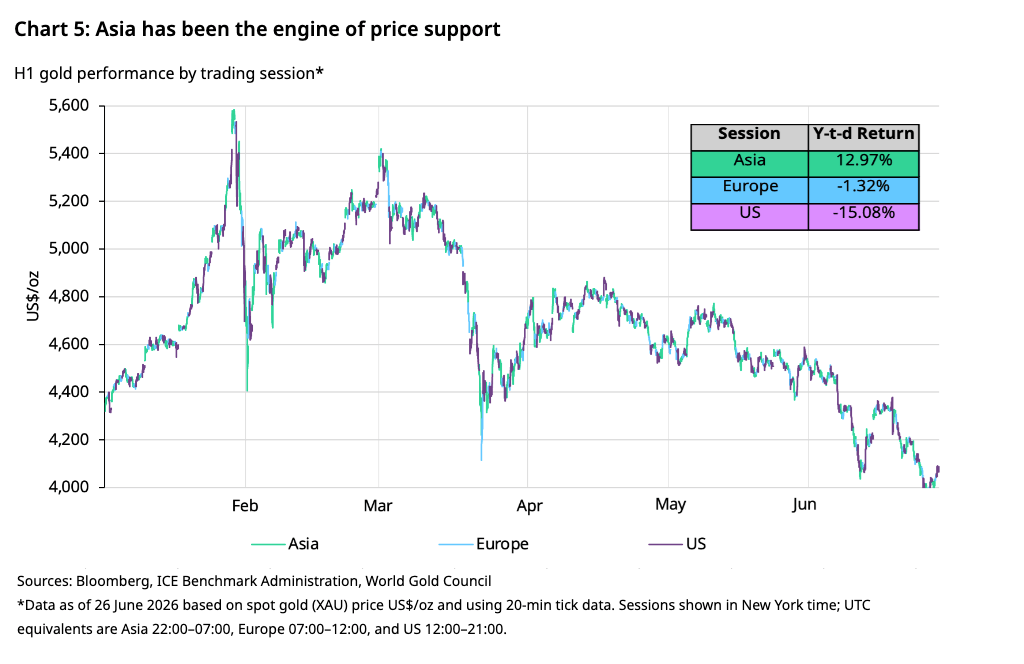
The World Gold Council picked up on an interesting trend in its H1 gold market analysis.
“Interestingly, intraday analysis suggests that the bulk of gold’s movements have been linked to activity during Asian and U.S. trading hours. Many of the pullbacks occurred during U.S. hours and, conversely, gold’s rebounds generally occurred during Asian hours.”
During Asian trading hours, gold was up 12.9 percent through the first six months of the year. During North American trading hours, the yellow metal was down 15 percent. European sessions split the difference, with gold falling modestly by 1.3 percent.
Analyst Ed Steer argues that this reflects Western price manipulation through the paper markets.
“This simple difference in investment strategy is all the proof needed that the world’s banks and large commercial traders are actively managing the price between the a.m. and p.m. gold fixes in London — and have been doing so since the paper market in gold first opened on 02 January 1975.”
It’s not a leap to think that the Chinese would prefer to set the gold price and strip power away from the paper traders in the West.
Risk Management
Officials say Chinese banks are exiting paper futures trading to manage risk and prevent “speculative excesses.”
“Chinese banks are tightening retail precious metals trading as a risk-control response to heightened price volatility,” State Street Investment Management gold strategist Robin Tsui told the South China Morning Post.
Joshua Rotbart operates a precious metals firm with offices in Hong Kong and Singapore. He agreed, telling the Investing News Network that we shouldn’t take the move as a sign that China is “cooling on gold.”
“What is being switched off is the speculative paper layer. This move reflects a distinction between leveraged paper trading and physical ownership.”
Paper trading increases volatility because it can be moved so easily. Rotbart said Chinese banks have become increasingly concerned about leveraged retail products given the recent price swings.
“When gold prices move sharply, leveraged paper products expose both the investor and the institution to greater risk. Discontinuing these products reduces operational and reputational risk while supporting broader financial stability.”
It also shifts the pricing emphasis away from speculative paper toward the physical market. This would arguably mean a price better reflecting the market fundamentals as opposed to speculative soothsaying.
Rotbart hinted that a more Asian-centric gold pricing regime could orient the market more toward physical gold.
“Over time, this development may encourage greater emphasis on physical ownership rather than short-term leveraged speculation. It channels demand toward the metal itself rather than reducing it.”
VRIC Media CEO Jay Martin said he doesn’t buy the official explanation.
“I think that July 24th is the day that China starts finding out what gold is actually worth.”
He pointed out that the paper market creates the illusion that there is far more gold than there really is, making it easy for paper traders to depress prices.
“If there are 10 paper claims for every real ounce of gold, the market sees 10 times more gold than actually exists.”
By removing this dynamic from the market, Martin argues we will find out “the real price of gold.”
And he thinks it’s much higher than the LBMA fix indicates.
Von Greyerz’s partner Matthew Piepenburg agrees.
“I’ve written ad nauseam for years about the COMEX and the LBMA markets, and how they legalize price manipulation and fraud legally, and China isn’t stupid. They’ve been watching this since 1973 … They know that we use massive amounts of leverage to force the boot to the neck of gold and silver, so we don’t have natural price discovery. Fast forward to 2026, China is saying for us to have more credibility, more trust, and more natural price discovery, we are now going to try and make the paper trade, which is an open secret that it’s a lie; we’re going to call the bluff on that. We’re going to go focus more on physical supply and demand.”
Piepenburg called it “another move in the direction toward true price discovery.”
“What Shanghai and Hong Kong and China in the East are doing is anchoring the trade in something more valuable, actual supply and demand, less nonsense, less dishonesty, and that gives them more credibility.”
It’s impossible to know the true motives of Chinese players in the gold market. However, it doesn’t really matter.
Whether the Chinese government is intentionally trying to wrest control of pricing from the West or simply protecting its investors from volatility and market excess, the practical implications are the same. China is positioning itself to become a more influential player in gold pricing. The Chinese market is much more oriented toward physical bullion.
Ergo, Asian pricing will likely more strongly reflect the value of physical metal as opposed to speculation about gold on paper.
Mike Maharrey is a journalist and market analyst for Money Metals with over a decade of experience in precious metals. He holds a BS in accounting from the University of Kentucky and a BA in journalism from the University of South Florida.
(Ken Silva, Headline USA) CNN reported Thursday that a Secret Service agent on Vice President JD Vance’s security detail has been put on administrative leave and is suspected of leaking information about his travel to a news site.
According to CNN, the agent is suspected of leaking to MS NOW about how agents on Vance’s security detail are overworked by his busy schedule. MS NOW’s source complained about Vance planning to fly with his son on a Marine Corps helicopter to a golf lesson — even though that plan was canceled.
“The story caught the attention of Secret Service, FBI and White House officials, who fumed over operational details being described in the press,” CNN reported Thursday.
Secret Service Chief of Communications Anthony Guglielmi confirmed to CNN that an agent is indeed under investigation.
“A member of the Vice Presidential Protective Division is the subject of an administrative investigation, and potential criminal inquiry, involving allegations of compromising operational and information security,” Guglielmi reportedly said in the statement. “While we will not comment on the specifics of this matter, one principle is unequivocal: any conduct that undermines the trust and confidence between a protectee and their protective detail is fundamentally incompatible with our mission and will not be tolerated.”
🇺🇸 A Secret Service agent on Vance's detail is suspected of leaking to the press that agents were fed up with his travel demands.
Which, according to reports, included flying his son to a golf lesson on a Marine Corps helicopter…
Thursday’s report isn’t the first instance of an agent leaking information about Vance’s travel schedule. In January, journalist James O’Keefe published a report about how another Secret Service agent assigned to Vance’s security detail leaked details about his travels to one of O’Keefe’s undercover reporters. O’Keefe is famous for having attractive females—and sometimes males—seduce government officials to get them to leak info.
Along with leaking agents, another Secret Service guard on Vance’s detail was recently arrested for a drug deal with an undercover cop. RealClearPolitics reporter Susan Crabtree reported the arrest last month, saying that she’s withholding the agent’s name “until more details emerge about the alleged drug-related arrest.”
The incidents on Vance’s detail represent just a few of the many scandals plaguing the Secret Service.
In May, a Secret Service officer was reportedly arrested for public masturbation at a DoubleTree hotel near the Miami airport.
In April, a married Secret Service agent was revealed to have been having an affair with an OnlyFans star and making pornographic videos with her.
Around the same time, ABC News revealed that a Secret Service trainee was arrested for spying on his roommate, also an agent-in-training, with a hidden camera.
Before that, a Secret Service agent protecting former First Lady Jill Biden shot himself in the buttocks last month at the Philadelphia International Airport.
And earlier in the month, Crabtree reported that agent Myosoty Perez, who is a lesbian, has been suspended and is under investigation for marrying a foreign national—possibly an illegal immigrant—without declaring it. Perez was one of the agents responsible for nearly getting President Donald Trump killed at his July 13, 2024, campaign rally in Butler, Pennsylvania.
Additionally, in January a Secret Service recruit shot and killed a 16-year-old in Tamarac, Florida. The 16-year-old victim was identified as Orlando Wedderburn. A woman was also grazed. The Secret Service recruit, for his part, is claiming self-defense.
According to Crabtree, Secret Service Director Sean Curran is receiving internal criticism for not doing enough to eliminate the agency’s diversity, equity and inclusion policies, which were implemented starting in the Obama era.
Meanwhile, the agency is looking to hire 4,000 new employees by 2028.
Ken Silva is the editor of Headline USA. Follow him at x.com/jd_cashless.
(Luis Cornelio, Headline USA) A former Democratic lawmaker in Pennsylvania is facing federal charges after authorities served a search warrant at his residence in connection with an investigation into alleged child sexual abuse material.
Jesse White, who served in the Pennsylvania House of Representatives from 2006 to 2014, was charged by criminal complaint with “receipt and possession of child pornography,” the DOJ announced Wednesday.
U.S. Attorney for the Middle District of Pennsylvania Brian D. Miller said federal investigators executed the search warrant at White’s residence on Tuesday, where they reportedly seized multiple computers and hard drives.
The investigation began after the National Center for Missing & Exploited Children received a tip reporting suspected child pornography. According to the DOJ, federal agents ultimately identified White as the alleged producer of the files.
BREAKING: Former Pennsylvania State Rep Jesse White (D) indicted on child p**n charges pic.twitter.com/NrDr9kqUCj
The criminal complaint alleged that one hard drive contained “numerous files containing images of child pornography,” including content depicting minors between the ages of seven and 15. A separate drive allegedly contained “approximately 100 files depicting child pornography.”
White is a well-known figure in Pennsylvania Democratic politics, having represented the state’s 46th Legislative District in the Pennsylvania House for nearly a decade.
He lost his 2014 reelection bid to a Republican following a social media scandal in which he allegedly created fake social media accounts to attack constituents and political opponents, according to the Pittsburgh Post-Gazette.
White’s district included parts of Allegheny, Beaver and Washington counties.
The DOJ’s statement indicates that White has not yet been indicted. If he is convicted, he faces a maximum sentence of up to 30 years in prison.
(Luis Cornelio, Headline USA) MyPillow CEO and Minnesota gubernatorial candidate Mike Lindell left some conservatives scratching their heads after embracing a series of pragmatic immigration policies that critics characterized as “amnesty.”
Lindell is seeking the Republican nomination for governor of Minnesota, with the primary election scheduled for Aug. 11. He entered the race as a leading GOP contender after receiving an endorsement from President Donald Trump in July.
Lindell explained in several interviews that he would support a conditional non-resident visa for foreign nationals who have maintained clean records during their unlawful stay in the United States.
The proposals would come alongside continued deportations of criminal illegal aliens. The plan would require foreign nationals to submit fingerprints and avoid criminal activity. It would also empower authorities to prosecute employers who pay workers below minimum wage or in cash to exploit illegal labor.
“I’d like the whole United States to do this, but let’s say I did it here in Minnesota,” Lindell said Tuesday in an interview with the Washington Examiner. “Six months, all the illegal immigrants would have to go get what’s going to be called a conditional work visa.”
He added, “I’m a person of second chances, if the only thing they ever did was cross the border and didn’t report back in because they were afraid of being re-deported.”
Lindell first discussed the immigration plan earlier this month during an interview with CBS News Minnesota.
Mike Lindell just surrendered to the radical left by supporting amnesty for illegal aliens.
– Conditional visas where you never have to leave the country regardless of citizenship. – Drivers licenses for illegals. – Government subsidies to illegals to gain legal status.
Lindell said the proposal came after he learned that some foreign nationals had themselves become victims of crimes committed by other immigrants. He also said he discovered that some employers may exploit foreign labor by paying below-minimum wage rates, effectively preventing American workers from competing for those jobs.
He emphasized that the proposal would not create a pathway to citizenship.
“Now, you’re not a citizen,” Lindell warned. “You can’t vote, but you have this card that now you can work and you can go be paying taxes, be functioning in society.”
It remains unclear how Lindell could implement the plan, as immigration policy largely falls under federal authority. Lindell’s position also appears similar to a previous idea embraced by Trump.
During a Cabinet meeting in April, Trump said he would allow some farm workers who are in the U.S. unlawfully to return legally if they voluntarily leave the country and if their employers vouch for them.
“So a farmer will come in with a letter concerning certain people, saying they’re great, they’re working hard. We’re going to slow it down a little bit for them, and then we’re going to ultimately bring them back. They’ll go out. They’re going to come back as legal workers,” Trump said.
He added, “We’re going to work with them right from the beginning on, trying to get them back in legally. So it gives you real incentive. Otherwise they never come back. They’ll never be allowed once a certain period of time goes by, which is probably going to be 60 days.”
Trump on deportations: We are going to work with farmers. If they have strong recommendations for their farms for certain people we’re going to let them stay in for a while… we have to take care of our farmers and our hotels and various places where they need the people pic.twitter.com/OQEScOnGkq
Democratic Gov. Mikie Sherrill disclosed Tuesday that roughly 6,600 people who lack citizenship entered the rolls between June 2023 and June 2024 while seeking driver’s licenses and identification cards. Every one of them marked the application to show they were not citizens. The motor vehicle system enrolled them anyway.
A preliminary state review counted fewer than 400 who went on to cast ballots, the Journal reported. Their registrations split among Democrats, Republicans, and unaffiliated voters, and they turned upscattered across the state.
Sherrill, sworn in this January, separated her handling from Washington’s. “When we find a problem, we don’t hide it, deny it, or invent conspiracies. We investigate it, we fix it, and we tell the public,” she said. She learned of the malfunction last week, ordered her chief counsel to investigate, and told officials to delete every registration created in error. The breakdown dates to the tenure of Phil Murphy, a fellow Democrat, whose spokesman offered no comment.
“I am appalled by the reckless failures that allowed this to happen and the lack of transparency shown by those in charge at the time,” Sherrill said. “We have no evidence at this time that any elections were swayed.”
Her vendor disagrees. Idemia supplied the software built to screen non-citizens out, and the firm told the Journal that it merely relays records. Registration data “is transmitted to the New Jersey Department of State, Division of Elections, which is ultimately responsible for verifying eligibility to vote. Information submitted by Idemia must still be validated and adjudicated by the Division of Elections,” the company said. Idemia went further with the New York Post,insisting the records tracked New Jersey’s own specifications. According to an Axios report, the state has startedshopping for a successor to Idemia.
Timing sharpens the story. President Donald Trump wants Congress to impose tighter identification and proof of citizenship standards before November. Homeland Security Secretary Markwayne Mullinnotified state officials last Thursday that an early screen surfaced as many as 35,152 possible noncitizen registrations in New Jersey, part of some 250,000 the department alleges across four states. Those counts describe unconfirmed database matches rather than proven voters. The Justice Department opened aseparate inquiry, per NBC News.
New Jersey ranks among30 states fighting federal demands for unredacted rolls. About a dozen district judges, several of them Trump appointees, have sided with the states, and a split appellatepanel did the same in June as CNN reported.
José Niño is the deputy editor of Headline USA. Follow him at x.com/JoseAlNino
(Money Metals News Service) In this episode of the Money Metals Midweek Memo, host Mike Maharrey argues that investors should look beyond daily headlines and recognize the long-term patterns reshaping financial markets. Drawing parallels between hockey goalies who rely on pattern recognition rather than reflexes, Maharrey contends that history provides valuable clues about where markets are headed—even if the exact events never repeat themselves.
His central thesis is that the U.S. Treasury market is undergoing a fundamental structural shift. If this trend continues, it could permanently alter interest rates, constrain Federal Reserve policy, weaken the traditional 60/40 investment portfolio, and strengthen the long-term case for owning gold and silver.
Why Pattern Recognition Matters More Than Headlines
Maharrey opens with an unusual analogy from professional hockey. NHL goalies routinely stop slap shots they physically cannot react to in time because they recognize patterns before the puck even leaves the stick. Investors, he argues, should approach markets the same way.
Instead of reacting to every social media post, Federal Reserve comment, or daily price movement, investors should study historical trends that unfold over years or decades. Technical analysis and long-term historical perspective can reveal recurring cycles that help anticipate future market behavior.
According to Maharrey, today’s financial markets suffer from “compressed timeframes,” where many participants remember little before the 2008 financial crisis. This has distorted expectations, leading many investors to mistakenly believe that the ultra-low interest rates of the last decade represent normal conditions.
Inflation Is Making Retirement More Difficult
Before diving into the bond market, Maharrey highlights a recent Morningstar survey showing that 46% of Americans say they cannot currently afford to save for retirement.
As one potential solution, Maharrey discusses Money Metals’ monthly installment program, which allows investors to accumulate precious metals beginning with contributions as low as $100 per month, gradually building a portfolio designed to preserve purchasing power over time.
A Fundamental Shift Is Happening in the Bond Market
The heart of the episode focuses on evidence suggesting the U.S. Treasury market has entered a long-term structural transition.
Drawing heavily from research published by Massif Capital and work by analyst Will Thompson, Maharrey explains that for roughly the last two decades, long-term interest rates largely followed expectations surrounding Federal Reserve policy.
Today, however, that relationship appears to be changing.
Instead of central banks dominating Treasury demand, private investors seeking competitive returns increasingly determine bond prices. As these investors become more sensitive to risk and required yields, long-term interest rates are being driven more by fiscal concerns and geopolitical risks than by Federal Reserve policy alone.
This shift, Maharrey argues, fundamentally changes how Treasury markets function.
Jim Grant’s Long-Term Bond Bear Market Thesis
Maharrey then revisits the work of legendary bond analyst Jim Grant, publisher of Grant’s Interest Rate Observer.
Grant has long argued that interest rates move through multi-decade cycles. According to Maharrey, Grant believes the world is entering a generational bear market in bonds, meaning persistently higher interest rates and lower bond prices over many years.
Grant bases this conclusion on recurring historical cycles dating back more than a century. Interest rates fell during portions of the late nineteenth century, rose through the early twentieth century, declined again between 1920 and 1946, climbed from 1946 through 1981, then entered another extended decline that culminated in nearly a decade of zero-percent interest rates following the 2008 financial crisis.
At the peak of that era, nearly $18 trillion of global debt carried zero or even negative yields—something Grant considers one of history’s greatest bond market excesses.
Massif Capital Explains Why This Cycle Is Different
While Grant identifies the historical pattern, Massif Capital attempts to explain the mechanics behind today’s shift.
Maharrey explains that Treasury prices and yields remain governed by supply and demand. As demand falls, bond prices decline, and yields rise.
Recent behavior, however, has defied traditional expectations.
The 10-year Treasury yield climbed from roughly 1.5% in late 2021 to nearly 5% by the fall of 2023. Even after the Federal Reserve began lowering short-term interest rates, long-term yields remained elevated instead of declining.
According to Massif Capital, this represents a genuine “regime change” in Treasury markets.
The firm points to one particularly striking example.
After the Federal Open Market Committee cut rates by 50 basis points at its September 2024 meeting, the 10-year Treasury yield actually increased, rising from approximately 3.65% on September 17, 2024, to roughly 4.79% by January 2025.
By March 2026, despite projections for roughly 225 basis points of additional rate cuts, the 10-year Treasury still traded near 4.45%, suggesting Federal Reserve policy no longer fully controls long-term rates.
Bonds Are Losing Their Safe-Haven Status
Perhaps the most significant change Maharrey identifies is the evolving role of Treasury securities during periods of geopolitical stress.
Historically, investors rushed into U.S. government debt during wars or financial turmoil, pushing bond prices higher and yields lower.
Instead, recent conflicts—including heightened tensions involving Iran—have coincided with Treasury selling rather than buying.
According to Maharrey, this indicates investors increasingly view long-term government debt as a risk asset rather than a safe haven.
He notes that the New York Fed’s Adrian, Crump, and Moench model placed the 10-year term premium near 0.6% in late May 2026, after spending much of the previous decade near zero or negative territory. On January 13, 2025, the term premium exceeded 0.8%, its highest level since 2011.
These higher premiums indicate investors now demand greater compensation for holding long-term U.S. debt.
Why Global Demand for Treasuries Is Falling
Maharrey argues that two primary forces are reducing international demand for U.S. government debt.
The first is America’s deteriorating fiscal position.
With the national debt approaching $40 trillion, continued deficit spending has raised concerns among global investors about the long-term sustainability of U.S. finances.
The second is the weaponization of the U.S. dollar.
Following Western sanctions and the freezing of Russian dollar-denominated assets after Russia’s invasion of Ukraine, many governments began reassessing the risks associated with holding large quantities of U.S. financial assets.
According to Maharrey, these developments accelerated global de-dollarization efforts.
One notable example is China, whose Treasury holdings have fallen to approximately $652.3 billion, the lowest level since September 2008.
He also notes that earlier this year, gold surpassed U.S. Treasuries as the world’s leading reserve asset, underscoring how many central banks are increasingly substituting gold for government bonds.
Rising Borrowing Costs Leave the Fed in a Difficult Position
Maharrey argues that higher bond yields create serious problems for Washington.
As interest rates increase, the federal government’s borrowing costs rise accordingly.
He notes that during fiscal year 2026, the U.S. Treasury has already spent approximately $1.5 trillion on interest expenses, representing a 14.2% increase over the comparable period in fiscal 2025.
Interest costs totaled approximately $1.22 trillion during fiscal 2025, up 7.3% from the previous year.
Interest on the national debt has now become the federal government’s second-largest spending category, exceeding defense and Medicare expenditures, with only Social Security costing more.
Maharrey contends that if foreign governments continue reducing Treasury purchases while private investors demand higher yields, the Federal Reserve may have little choice but to resume large-scale bond buying through quantitative easing.
The Federal Reserve’s Catch-22
According to Maharrey, this creates a dilemma the Federal Reserve cannot escape.
If policymakers continue fighting inflation through tighter monetary policy, they risk bursting the debt bubble and severely damaging the economy.
If they instead resume aggressive monetary easing and quantitative easing, they risk reigniting inflation through additional money creation.
Maharrey believes history suggests the Federal Reserve will ultimately choose inflation over recession, arguing that preserving economic stability has consistently taken priority over maintaining purchasing power.
He suggests that the changing bond market may increasingly limit the Fed’s ability to control long-term interest rates, forcing policymakers into decisions they would rather avoid.
Why Gold Could Replace Bonds in Traditional Portfolios
Maharrey concludes by examining what these structural changes could mean for investors.
That strategy depended on bonds rising when stocks declined.
Today, however, bonds and equities increasingly move together.
Massif Capital’s research found that the rolling correlation between stocks and bonds, which remained moderately negative from 2003 through 2021, surged to approximately +0.5 during 2022 and has since averaged near +0.6.
As a result, bonds no longer provide the diversification many investors expect.
Maharrey points to Morgan Stanley Chief Investment Officer Michael Wilson, who recently suggested a 60/20 strategy, replacing half of the traditional bond allocation with gold as a more resilient inflation hedge.
Central Banks Continue Choosing Gold
Supporting this view, Maharrey notes that central banks themselves increasingly favor gold over government bonds.
According to the figures cited in the episode, central banks have purchased more than 1,000 metric tons of gold annually for four consecutive years.
By comparison, average annual central bank gold purchases between 2010 and 2021 totaled only 473 metric tons.
For Maharrey, this trend reinforces the idea that gold has increasingly become the world’s preferred safe-haven asset as confidence in long-term government debt continues to erode.
Looking Beyond Today’s Headlines
Maharrey closes by returning to the episode’s central message: investors should focus less on daily market noise and more on long-term historical patterns.
Whether examining Treasury markets, Federal Reserve policy, inflation, or precious metals, he believes today’s developments point toward a prolonged period of structurally higher interest rates, persistent currency debasement, and increased demand for tangible assets.
(Headline USA) ESPN is undergoing a significant round of layoffs for the first time in three years after taking over NFL Network in April.
Chairman Jimmy Pitaro said in a memo to employees Tuesday morning, obtained by The Associated Press, that most moves are the result of ESPN’s acquisition of NFL Network and other league digital assets last year.
The deal was announced last August and also included NFL Fantasy and the rights to distribute the RedZone channel to cable and satellite operators. In return, the NFL got a 10% equity stake in ESPN.
It was approved by government regulators in January. NFL Network employees became part of ESPN on April 1.
“Over the past several months, we’ve made significant progress integrating the NFL assets that we acquired into ESPN,” Pitaro wrote in the memo. “Throughout this process, we have taken the time to carefully evaluate our collective teams, resources and organizational structure to best position us for the future. As a result, we had to make some difficult decisions about job impacts that we will be communicating today.
“While most of the job impacts are tied to the acquisition, we will also notify colleagues in other parts of the company today that their positions have been impacted. We are committed to treating employees with compassion and respect and to providing support as they navigate this transition.”
While most of the layoffs affect production and behind-the-scenes personnel, some on-air talent were affected. Ryan Clark, who joined ESPN in 2015 as an NFL analyst, learned of his layoff while on “NFL Live” on Monday. A person familiar with the situation said Clark was originally going to be told Tuesday morning before reports leaked about the decision.
Clark was told by company executives rather than hear about it elsewhere. He did not finish his appearance on the show.
The person spoke to the AP on condition of anonymity because they were not at liberty to discuss personnel decisions.
Clark took to social media on Tuesday to address the layoffs. He also shared a video of himself working out.
“Sending prayers and love to all those laid off today by ESPN. So many of you have poured your life into that company, & I know how you’re feeling right now,” Clark wrote on X. “My hope is as this door closes another opens for you all. God bless!”
Other notable names include Karl Ravech, who had been with ESPN since 1993 and had been an integral part of its baseball coverage. Ravech was the voice of “Sunday Night Baseball” from 2022-25 before the package moved to NBC this season. He did call Monday night’s game between the Los Angeles Dodgers and Philadelphia Phillies.
Tom Pelissero, who had been with NFL Network since 2017, is also part of the cuts.
ESPN had recently signed NFL insiders Ian Rapoport and Adam Schefter to extensions.
The ESPN cutbacks are also part of other reductions that are taking place throughout the Walt Disney Company this week.
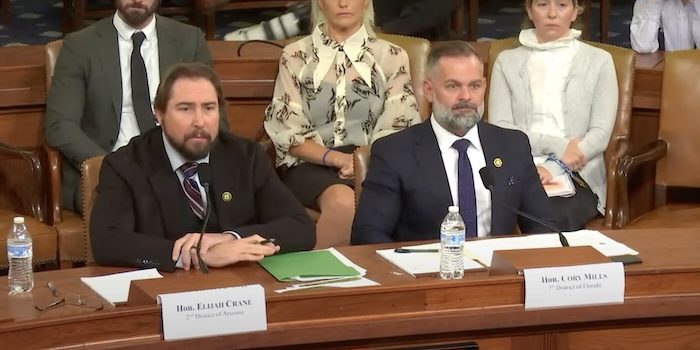
(José Niño, Headline USA) Federal prosecutors are opening up a criminal investigation of Rep. Cory Mills, R-Fla.,Fox News reported on Wednesday. A source familiar with the matter said the Justice Department inquiry stays active, though nobody has described its focus.
MS NOWbroke the story a day earlier, citing two sources, and reported that the FBI questioned someone last year about the congressman’s finances and associates.
Mills denies wrongdoing. Prosecutors have charged him with nothing.
Fox News noted the House Ethics Committee separately weighs campaign finance violations, sexual misconduct, and dating violence claims. The Office of Congressional Conduct opened that trail in August 2024, telling the panel it had substantial reason to believe Mills misstated financial disclosures, took improper contributions, and held federal contracts while serving, per theCongressional Record.
The committee seated an investigative subcommittee on November 19, 2025. Itscharter covers whether Mills “engaged in misconduct with respect to allegations of sexual misconduct and/or dating violence.”
Fox News reported the panel confirmed in April that its work continued and set no deadline. AMay statement went further, calling the allegations “serious and complex” while disclosing more than twenty subpoenas, thousands of documents, and dozens of witnesses. The Hill observed that such updates break the panel’s usual silence.
Washington police answered a call at the congressman’s residence in February 2025 after a woman alleged assault. She later recanted, though the Washington Post obtained body camera footage showing bruises on her arms. That July, another former partner told Florida authorities Mills threatened to release intimate images of her. A Columbia County judge granted her a protective injunction in October. MS NOW reports the order has since expired.
Rep. Nancy Mace, R-S.C., forced a censure vote in November 2025. The Houseburied it 310 to 103 by sending the measure to Ethics. The Hill reported that she filed anexpulsion resolution on April 20, 2026, declaring that Mills “needs to be expelled immediately.” She never designated it privileged, so no vote followed.
Mills fired back, saying “Nancy thinks allegations and accusations is due process.” Speaker Mike Johnson kept his distance, telling reporters “The key word there is allegation.” Mills toldCNN that “There’s absolutely no reason to resign.”
José Niño is the deputy editor of Headline USA. Follow him at x.com/JoseAlNino
(Ken Silva, Headline USA) The man who supplied the gun used in the Old Dominion University school shooting in March has pled guilty to dealing in firearms without a license and three counts of making false statements during purchases of firearms.
Kenya Mcchell Chapman, 32, of Smithfield, will be sentenced on Dec. 18 for selling a gun to Mohamed Bailor Jalloh, who on March 12 committed a terrorist shooting at ODU during an Army Reserve Officers’ Training Corp (ROTC) class—killing one victim and wounding two more. Jalloh was fatally stabbed by a heroic cadet who intervened.
Chapman reportedly admitted that he stole a .22-caliber firearm from a car about a year before selling it to Jalloh the night before his attack.
According to court records, Chapman said he met Jalloh at work and that Jalloh told him he needed the gun for protection as a delivery driver. Chapman told agents he knew Jalloh had spent some time behind bars, but denied knowing he had a previous felony conviction.
Chapman told agents he had no idea the man would commit the attack.
Jalloh wasn’t the first person Chapman illegally sold arms to. According to court records, he was caught by the ATF making illegal straw purchases of weapons in 2021—but he went unpunished at the time.
“Two [of] the firearms were recovered from a homicide shooting in the fall of 2021—one from a victim and one from the shooter. Another firearm was recovered from a drunk in a public incident,” court records state. “Chapman was interviewed and admitted to straw purchasing all three firearms. ATF issued Chapman a straw purchaser warning letter and Chapman wrote a letter of apology.”
The guy who provided the Old Dominion shooter his firearm was under ATF investigation for straw purchases. He once bought weapons for both the victim and the shooter in a homicide case. https://t.co/UFNNKnM8kMpic.twitter.com/3TkRN0MphI
Some five years later, Chapman now faces 35 years in prison for selling a firearm to a terrorist—a convicted felon who wasn’t allowed to own guns.
Jalloh was a former Army National Guard member who pleaded guilty in 2016 to attempting to aid the Islamic State extremist group.
Jalloh, who yelled “Allahu akbar” before opening fire, was subdued and killed by ROTC students, according to FBI officials who praised the students’ bravery for preventing further harm. The shooting killed an ROTC leader who was a professor of military science at ODU, and left two others hurt.
Jalloh, who was sentenced to 11 years in prison in the Islamic State group case, was released from federal custody in December 2024. He was on supervised release, which is comparable to probation.
He was released about 2 1/2 years early after completing a drug treatment program. The person was not authorized to speak publicly and did so on condition of anonymity.
It wasn’t clear how Jalloh qualified for the program, which allows inmates to shave up to a year off their sentences. Inmates serving sentences for terrorism-related offenses typically aren’t eligible for such programs or other sentence-reducing credits.
The Associated Press contributed to this report.
Ken Silva is the editor of Headline USA. Follow him at x.com/jd_cashless.