Central Banks Stockpiled More Gold in May

(Mike Maharrey, Money Metals News Service) The pace of central bank gold buying picked up slightly in May.

Globally, central banks officially added a net 20 tonnes of gold to their reserves in May, according to the latest data compiled by the World Gold Council. This compares to 14 tonnes in April.

While the pace of gold buying picked up, it remained slightly below the 12-month average of 27 tonnes.

Gold touched a record high of $3,500 an ounce in April. The World Gold Council said the slowdown in central bank purchases could be in part “a response to the rapid appreciation in the gold price since the start of the year.

“While the rally to multiple new record highs is unlikely to deter central banks from buying gold – as they tend to be more strategic in nature – it could explain some of the deceleration in the pace of monthly net buying.”

However, based on the World Gold Council’s 2025 Central Bank Gold Survey, the buying trend will continue.

Of the 73 central banks that responded to the survey, 95 percent said they believe central bank gold reserves will increase over the next 12 months. A record 43 percent of the respondents indicated they expect their own gold reserves to expand. That was up from 29 percent in 2024.

Which Countries Bought and Sold Gold in May?

The National Bank of Kazakhstan was the biggest buyer in May, adding 7 tonnes of gold to its reserves. Since the beginning of the year, Kazakh gold holdings are up by about 15 tonnes.

The Central Bank of Turkey expanded its gold reserves by 6 tonnes. Turkey was one of the biggest buyers in 2024. While the pace of buying has slowed, the Turkish government will likely continue adding gold to its holdings. Meanwhile, the Turkish people are also buying a lot of gold as they deal with significant price inflation.

Poland continued increasing its gold holdings, adding another 6 tonnes to its reserves in May.

At 515 tonnes, the National Bank of Poland now holds more gold than the European Central Bank.

The NBP has increased its gold reserves by 67 tonnes since the beginning of the year. Poland was the biggest buyer in 2024 as well, adding 90 tonnes to its holdings.

Last year, National Bank of Poland Governor Adam Glapiński indicated the central bank plans to increase its gold holdings to 20 percent of its reserves.

“This makes Poland a more credible country, we have a better standing in all ratings, we are a very serious partner, and we will continue to buy gold.

The Polish central bank has exceeded that level and continues to add to its reserves.

The People’s Bank of China reported an increase in its official reserves for the seventh straight month, adding another 2 tonnes to its reported holdings. That pushed its official gold holdings to 2,296 tonnes, about 6.5 percent of its total reserves.

Notice the emphasis on “official.”

China is one of the central banks that likely holds significantly more gold than it publicly discloses. As Jan Nieuwenhuijs has reported, the People’s Bank of China is secretly buying large amounts of gold off the books. According to data parsed by the renowned Money Metals researcher, the Chinese central bank is currently sitting on more than 5,000 tonnes of monetary gold located in Beijing – more than TWICE what has been publicly admitted.

Several other banks reported increases in their gold reserves.

  • Czech Republic – 2 tonnes
  • Kyrgyz Republic – 1 tonne
  • Cambodia – 1 tonne
  • Philippines – 1 tonne
  • Ghana – 1 tonne 

Updated April data revealed that Qatar increased its reserves by 2 tonnes that month.

Singapore was the biggest seller, decreasing its reserves by 5 tonnes.

Uzbekistan sold 1 tonne of gold in May. The Uzbek central bank has been the biggest seller of the year, decreasing its reserves by 27 tonnes. It is not uncommon for banks that buy from domestic production – such as Uzbekistan and Kazakhstan – to switch between buying and selling.

The German central bank also decreased its reserves by 1 tonne in May.

Big Picture

On net, central banks officially increased their gold holdings by 1,044.6 tonnes in 2024. It was the 15th consecutive year of expanding gold reserves.

Last year was the third-largest expansion of central bank gold reserves on record, coming in just 6.2 tonnes lower than in 2023 and 91 tonnes lower than the all-time high set in 2022. (1,136 tonnes). 2022 was the highest level of net purchases on record, dating back to 1950, including since the suspension of dollar convertibility into gold in 1971.

Looking at the broader perspective, the central bank gold buying trend is now entering its 16th year.

World Gold Council analysts expect the trend to continue, with buying “close to the range seen over the past three years on continued elevated trade-related risks and uncertainty premia in U.S. assets.

The WGC also noted that “diversification” with “a reduction of U.S. assets” is one of the factors driving central bank gold buying. In other words, de-dollarization.

“We don’t see an end to this narrative unless there is a material shift in geopolitical tensions. The IMF has downgraded growth prospects in the U.S. more than in other major economies, citing policy uncertainty. This suggests that other countries may have leverage in negotiations, although these typically last months and years, not weeks. Hence, we don’t expect any near-term resolutions.”


Mike Maharrey is a journalist and market analyst for Money Metals with over a decade of experience in precious metals. He holds a BS in accounting from the University of Kentucky and a BA in journalism from the University of South Florida.
Are Interest Rates Too High?

(Mike Maharrey, Money Metals News Service) Are interest rates too high? A lot of people think they are, and a growing chorus of voices is calling on Federal Reserve Chairman Jerome Powell to cut rates.

Are they right? Does the central bank need to step in, slash interest rates, and loosen monetary policy?

The honest answer to the question is that nobody really knows. However, from a historical perspective, interest rates are low, and monetary policy remains loose.

What Are Interest Rates?

Before we delve into whether the current interest rate environment is too high or too low, we need to understand exactly what an interest rate is.

Fundamentally, it is a price – the price of borrowing money.

Since interest rates are prices, they behave in the same way as any other price in a free market. As the demand for money increases, interest rates (the cost of money) tend to rise. When the demand for money wanes, rates fall. In other words, if left alone, interest rates will set themselves based on market activity.

When central planners intervene and “set” interest rates, it inevitably creates problems.

Think about it. Would you trust government central planners to set the price of tennis shoes? Or iPhones? Or automobiles? Imagine what would happen.

In fact, we don’t have to imagine. We have countless examples of government price controls going haywire. Inevitably, we end up with shortages and/or overproduction.

For example, in 1971, President Richard Nixon implemented wage and price controls. It was a disaster. Price ceilings intended to hold costs down led to widespread shortages, particularly in meat, gasoline, and other essentials. Businesses weren’t willing to sell at unprofitable prices.

Or consider the impact of minimum wage laws. These price floors also distort the market. They raise the pay of some workers, but it also lowers demand for workers more generally, leading to higher rates of unemployment.

The problems with price fixing are entirely predictable given that prices serve as signals in the economy. Distort the signals, distort the economy.

Economist Thomas Sowell explained the fundamental role of prices in his foundational book Basic Economics.

“Each consumer, producer, retailer, landlord, or worker makes individual transactions with other individuals on whatever terms are mutually agreeable. Prices convey those terms, not just to the particular individuals immediately involved but throughout the whole economic system – and indeed, throughout the world. If someone else somewhere else has a better product or a lower price for the same product, that fact gets conveyed and acted upon through prices, without any elected official or planning commission having to issue orders to consumers or producers – indeed faster than any planners could assemble the information on which to base their orders.”

Generally, central planners have noble intentions. They want to eliminate some “unfairness” or right some perceived wrong. But in effect, they obliterate these important signals. This causes chaos and confusion. Inevitably, we end up with misallocations of resources. The economy becomes less efficient. Markets cease to function. As a whole, society becomes poorer.

In effect, government action distorts, and in some cases, obliterates the price system. As economist Ludwig von Mises explained, “prices are by definition determined by people’s buying and selling or abstention from buying and selling. They must not be confused with fiats issued by governments or other agencies enforcing their orders by an apparatus of coercion and compulsion.

“Prices are a market phenomenon. They are generated by the market process and are the pith of the market economy. There is no such thing as prices outside the market. Prices cannot be constructed synthetically, as it were.”

Given this history, why would you want these central planners trying to set one of the most important prices in the economy – the price of money?

The results are exactly what you would expect. Central bank interest rate manipulation has distorted the economy, incentivized unsustainable levels of debt, driven boom-bust cycles, and generally wrecked the operation of the economy.

Are Interest Rates Too High?

This brings us back to the original question. Now that we understand the nature of interest rates, it should be clear why we can’t answer the question. Not even the brain-trust at the Fed can possess and process all the information necessary to accurately “set” any price, much less the price of money.

However, we can look back in time and see how the current interest rate environment compares with the past.

Historically, rates aren’t high.

As you can see from the chart, the Federal Reserve funds rate peaked just above the level of the 2006 peak. (You’ll also want to note the steep decline in rates beginning in 2006, long before the 2008 financial crisis and Great Recession.)

You’ll note a general downward ratchet effect in rates over time. Each interest rate peak preceding a bust gets lower as the economy has become more addicted to easy money.

In effect, the economy needs bigger doses of the easy money drug to reinflate the bubble each time through the cycle.

The most notable aspect of the chart is the nearly 10 years of zero percent interest rates following the 2008 financial crisis. This is the real outlier. However, we have millions of people working in the financial sphere who have never experienced a “normal” interest rate environment during their careers. They imagine that zero is closer to the norm than five-and-a-half percent.

The current low-interest-rate environment (from a historical perspective) becomes even more apparent if you look at the real yield (inflation-adjusted) on the 10-year U.S. Treasury.

Keep in mind, the central bank has far less control over rates on the long end of the curve. Supply and demand have a bigger impact on these rates. But even as the demand for U.S. debt has sagged, Treasury yields are still low from a historical standpoint.

The bottom line is that monetary policy remains historically loose. The Chicago Fed National Financial Conditions Index reflects this reality. As of the week ending June 27, the NFCI stood at -0.50. A negative number reflects historically loose financial conditions.

When Too Loose Is Too Tight

While interest rates remain historically low, they may be too high for the current economic environment.

Year after year of zero percent rates since 2008 has incentivized staggering levels of debt. Debt-burdened economies don’t perform well in high-interest rate environments.

Furthermore, an economy addicted to the easy money drug needs bigger and bigger fixes to maintain the high. This is why we’ve seen more extreme monetary policy during each subsequent economic downturn.

Given the economic environment, it makes sense that President Trump and many others want rate cuts. While rates are historically on the loose side, they may well be too tight for current conditions.

However, we find inflation lurking on the other side of the coin.

Low interest rates are inherently inflationary. They incentivize borrowing. Given the fractional reserve nature of the banking system, new loans mean new money injected into the economy. This is, by definition, inflation.

In fact, the money supply has been increasing for over a year. Again, this is inflation.

So, Powell & Company isn’t wrong to be concerned about cutting rates too fast. It could lead to another bout of price inflation.

The Fed’s inaction is exactly what you would expect given the Catch-22 it finds itself in. It simultaneously needs to cut rates to prop up the easy money-addicted economy and hold rates steady (or even raise them) to keep inflation at bay.

The bottom line is that Federal Reserve monetary malfeasance has completely distorted the economy. The central bank has squeezed itself between a rock and a hard place. The reality is that there isn’t a good choice between economic malaise and inflation.

The question is what path with they take?


Mike Maharrey is a journalist and market analyst for Money Metals with over a decade of experience in precious metals. He holds a BS in accounting from the University of Kentucky and a BA in journalism from the University of South Florida.

Mass Shooting Hits At Least 18 in Chicago

(Headline USAFour people have died from gunshot wounds and 14 others have been hospitalized following a drive-by shooting in Chicago, police said Thursday. At least three were in critical condition.

The shooting happened late Wednesday in Chicago’s River North neighborhood. Several media outlets said it happened outside a restaurant and lounge that had hosted an album release party for a rapper.

Someone opened fire into a crowd standing outside, police said, and the vehicle immediately drove away.

No one was in custody, police said.

Preliminary information from police said 13 women and five men ranging in age from 21 to 32 were shot, and that the dead included two men and two women. Those shot were taken to multiple hospitals, police said.

Video showed people waiting and crying outside of hospitals. Other images showed multiple police and ambulances at the scene of the shooting.

Police said that nine people, including the two women who died, were taken to Northwestern Hospital. Five people, including the two men who died, were taken to John H. Stroger Hospital.

Adapted from reporting by the Associated Press

Report: U.S. Used $1.25 Billion Worth of THAAD Interceptors To Defend Israel From Iranian Missiles

(Dave DeCamp, Antiwar.comA report from the Israeli newspaper Haaretz estimates that the US used 93 interceptors from its THAAD missile defense system to defend Israel from Iranian missiles during the 12-day US-Israeli war against Iran.

At $13 million per interceptor, that means the US launched an estimated $1.25 billion worth of THAAD munitions during the war. The Israeli military also used its Arrow 2 and Arrow 3 interceptors, which are jointly produced with the US. The Haaretz report said that the total cost of the Arrow and THAAD interceptors used was about $1.5 billion.

Haaretz reached its figures using open-source videos that showed 84 interceptors being launched from Israel during eight Iranian missile salvos. Extrapolating from there, the paper estimated that the US and Israel launched an estimated 195 interceptors, including the 93 THAADs, 80 Arrow 3s, and 22 Arrow 2s.

A report from Military Watch Magazine came up with similar numbers, estimating the US used 60 to 80 THAAD interceptors during the war, accounting for 15% to 20% of its global THAAD arsenal. The Biden administration first sent a THAAD system to Israel and about 100 troops to operate it in October 2024, ahead of an Israeli attack on Iran.

In April of this year, reports said the US sent a second THAAD battery to Israel, which would mean that the US has two of its seven THAAD missile defense systems stationed in Israel.

The US also intercepted Iranian missiles using US warships that were firing SM-3 interceptors, which cost between $10 million and $30 million per missile. It’s unclear how many SM-3 interceptors were fired, but the top officer in the US Navy said they were used at an “alarming rate” during the 12-day war.

The Haaretz report said that Iran fired over 500 missiles at Israel during the war, including 272 that were likely allowed to fall in open areas, and 258 that Israeli and US air defenses attempted to intercept. The Israeli military has said 36 missiles struck built environments, but the number is likely higher since it issued censorship orders during the war and hasn’t shared information about strikes on military targets.

This article originally appeared at Antiwar.com.

Why the Dollar Is Dying—and Gold Is Thriving

(Money Metals News Service) In the latest episode of the Money Metals Midweek Memo, host Mike Maharrey dives into the troubling trajectory of the U.S. dollar, recent warnings from international banks, and the growing shift toward gold among global central banks.

Drawing on fresh data, historical parallels, and economic indicators, Maharrey lays out a compelling case: the dollar is in trouble, and gold is emerging as the true safe haven.

UBS: The Dollar Is “Unattractive”

Leading the charge in dollar skepticism is Swiss banking giant UBS. In a recent analyst note, the firm bluntly advised investors to “reduce and hedge exposure to USD before further dollar declines.” UBS stopped short of calling the dollar “garbage,” but Maharrey was happy to supply the term.

The note cited the 10.8% drop in the U.S. Dollar Index from January 1 to June 30, 2025, marking the steepest dollar decline in the first half of any year since 1973—just two years after President Nixon severed the last link between the dollar and gold.

UBS anticipates more weakness ahead, citing a slowing U.S. economy and an increasingly fragile fiscal outlook in Washington.

“This was supposed to be the dollar’s moment,” Maharrey said, referencing global geopolitical tensions, Fed interest rate policy, and aggressive tariffs. “Instead, the dollar has stumbled.”

Exporters Rejecting the Dollar

Bloomberg reports further affirm the trend. Many global exporters are now asking U.S. importers to settle invoices in euros, pesos, or yuan, aiming to shield themselves from dollar volatility.

The trend reflects a deeper unease about U.S. monetary policy and the growing politicization—or “weaponization”—of the dollar in global affairs, ultimately leading to naturally rational de-dollarization.

Gold: The Overlooked Currency

While UBS failed to mention gold, others in the financial world have not. Frank Holmes, Chief Investment Officer at U.S. Global Investors, called gold “the preferred reserve asset,” and one of the “surest beneficiaries” of dollar weakness.

He noted that gold recently surpassed the euro as the second-largest global reserve asset—a milestone driven by surging central bank demand.

Central Bank Gold Buying by the Numbers:

  • 2022: 1,136 metric tons (highest net purchases on record since 1950)
  • 2023: Only 6.2 tons lower than 2022
  • Average (2010–2021): 473 tons/year
  • 2025 Outlook:
    • 95% of central banks expect global gold reserves to increase
    • 43% expect their own reserves to grow (up from 29% in 2024)
    • 73% anticipate a decline in their U.S. dollar holdings over the next 5 years

Meanwhile, the dollar’s share of global reserves has dropped to 57.8%, its lowest since 1994, down from 72% in 2002.

Holmes’ Warning to Investors

Frank Holmes urges retail investors to think like central banks. With the dollar’s supremacy “gradually slipping,” Holmes advises individuals to diversify their portfolios with gold and other real assets—particularly as inflation risks resurface.

The Real Threat of De-Dollarization

Maharrey emphasized that even modest de-dollarization could pose serious problems for the U.S. economy. The dollar’s reserve status helps support the country’s massive deficits and borrowing by sustaining global demand for dollar-denominated assets. If that demand wanes, inflationary pressures could intensify at home.

The Money Supply and Inflation Disconnect

Contrary to the “tight monetary policy” narrative, Maharrey reveals that the U.S. money supply has grown by over $600 billion since mid-2023. While M2 briefly contracted during the Fed’s rate-hike phase—bottoming at $20.6 trillion—a $3 trillion reduction would still be needed to return to pre-pandemic trendlines.

“If the world stops soaking up those dollars,” Maharrey warns, “that inflation stays home. You’re going to feel it in the checkout line.”

Retail Sales: The Inflation Illusion

Retail sales have increased by 15.9% since July 2021, reaching $715.4 trillion in May. But when adjusted for inflation, real retail sales have been flat since April 2021, hovering between $550 trillion and $575 trillion.

“The consumer is spending more and getting less,” Maharrey explains, debunking media narratives that portray strong retail sales as proof of economic health.

He illustrated this with a simple example: If widget prices rise from $1 to $2 but purchases fall from 100 to 60, retail sales still increase from $100 to $120—even though consumers got fewer widgets.

Official CPI vs. Real-World Inflation

Government inflation statistics understate the true impact, Maharrey argues. The CPI was redesigned in the 1990s to mask inflation. Using older metrics from the 1970s, true inflation may be double the reported rate, closer to 6% rather than the official 3%.

Conclusion: Your Dollar Is Garbage

Bringing the episode full circle, Maharrey restated his blunt thesis: “Your dollar is garbage.”

Inflation isn’t an accident, he said. It’s a policy choice designed to fund government excess without raising taxes—so long as consumers don’t notice.

But they are noticing. And that’s why investors—like central banks—are turning to gold and silver. Maharrey closed by urging listeners to consider adding precious metals to their portfolios as a hedge against currency debasement.

CIA Memo: Obama Team ‘Excessively Involved’ in Fueling Trump-Russia Narrative

(Luis CornelioHeadline USA) A newly declassified CIA memo revealed that top officials within the Obama administration deliberately manipulated intelligence to exaggerate Russia’s purported 2016 election interference. This set the stage for the years‑long Trump‑Russia collusion probe. 

The review, commissioned by CIA Director John Ratcliffe in May 2025, reassessed the 2016 Intelligence Community Assessment on Russian interference. It found then‑CIA Director John Brennan, FBI Director James Comey and DNI James Clapper were “excessively involved” in framing the initial Russia narrative. 

On Dec. 6, 2016—just weeks after President Donald Trump’s election—then-outgoing President Barack Obama ordered the probe, concluding Vladimir Putin “aspired” to sway the vote. 

However, according to the declassified 2025 review, Brennan, Comey and Clapper rushed the 2016 assessment in a “chaotic,” “atypical” and “markedly unconventional” fashion, raising questions about a “potential political motive.” 

The review found intelligence officials felt “jammed” by the rushed timeline, with many seeing the draft report for the first time at the sole in-person review on December 19. One CIA author called it “unusual” that so few changes were made to such a lengthy and high-profile assessment. 

This rushed assessment ultimately cast doubt on Trump’s legitimacy and opened the door to the Mueller investigation, partisan congressional hearings, and countless media leaks. 

“All the world can now see the truth: Brennan, Clapper and Comey manipulated intelligence and silenced career professionals — all to get Trump,” Ratcliffe said, thanking CIA officers who conducted the review.

New York Post columnist Miranda Devine broke the story on Wednesday, revealing the review’s damning conclusions. 

The review confirms what was already widely known in conservative and Republican circles: Brennan, Comey and Clapper were the political architects of the Trump-Russia hoax. 

Antifa Rioters Charged with Arson and Assault in Portland

(Luis CornelioHeadline USA) The Trump-led DOJ has charged four individuals in connection with the violent anti-ICE riots that broke out in June in Oregon. 

The defendants, some allegedly caught on video, spent several weeks targeting an Immigration and Customs Enforcement facility and assaulting federal officers, prosecutors said in a press statement on Tuesday. 

One of the individuals, 31‑year‑old August Dean Gordon, pulled a proximity card reader from its stanchion on the facility’s driveway. He kicked, grabbed and injured five officers during his arrest, the DOJ said.  

That same evening, 33‑year‑old Nadya Malinowska refused orders to leave the site. Meanwhile, 35‑year‑old David Pearl attempted to interfere with officers’ arrest of another rioter. 

On June 11, prosecutors said 34-year-old Trenten Edward Barker retrieved a lit flare from his backpack and tossed it into a barricade of debris near the ICE facility. 

Malinowska and Pearl each face misdemeanor charges for failing to obey a lawful order; Pearl also face a count of creating a disturbance. 

Gordon and Barker are charged with willful depredation of government property and assaulting a federal officer. Barker additionally faces an arson charge. 

According to journalist Andy Ngo, the rioters are affiliated with Antifa.

They all made their first appearance on Monday and face hefty penalties if found guilty.  

“Felony arson of federal property is punishable by up to 20 years in federal prison with a mandatory minimum sentence of five years,” the DOJ said. “Misdemeanor assault of a federal officer and misdemeanor willful depredation of government property are punishable by up to one year in federal prison.” 

Additionally, the DOJ said failure to obey a lawful order and creating a disturbance are misdemeanors punishable by up to 30 days in prison. 


Report: Pentagon Halts Some Munitions Shipments To Ukraine Over Concerns That US Stockpiles Are Too Low

(Dave DeCamp, Antiwar.com) The Pentagon has halted shipments of some air defense missiles and other munitions to Ukraine over concerns that US stockpiles have gotten too low, POLITICO reported on Tuesday.

The report said the decision was driven by Elbridge Colby, the undersecretary of defense for policy, a China hawk who wants the US to focus on building up its forces in the Asia Pacific to prepare for a conflict over Taiwan.

The halt of the shipments was ordered after a review of Pentagon munition stockpiles, which found that the number of artillery shells, air defense missiles, and precision munitions was dwindling. The US has sent Ukraine an enormous number of such weapons, and it has also been depleting air defenses supporting Israel’s wars in the Middle East.

The shipments that have been paused were previously pledged to Ukraine under the Biden administration using two types of aid mechanisms: the Presidential Drawdown Authority, which allows the US to ship weapons directly from Pentagon stockpiles, and the Ukraine Security Assistance Initiative, which authorizes the US to purchase arms for Ukraine.

During his final months in office, President Biden approved billions of dollars worth of weapons shipments under the two mechanisms, which will take years to deliver. The Trump administration briefly paused the shipments following the Oval Office blow-up between President Trump and Ukrainian Volodymyr Zelensky, but the assistance was quickly resumed after US and Ukrainian officials held another meeting.

This article originally appeared at Antiwar.com.

‘Big Beautiful Bill’ Includes $150 Billion in Extra Military Spending

(Dave DeCamp, Antiwar.com) The Senate on Tuesday advanced a massive spending package, dubbed the “Big Beautiful Bill” by President Trump, that includes $150 billion in extra military spending.

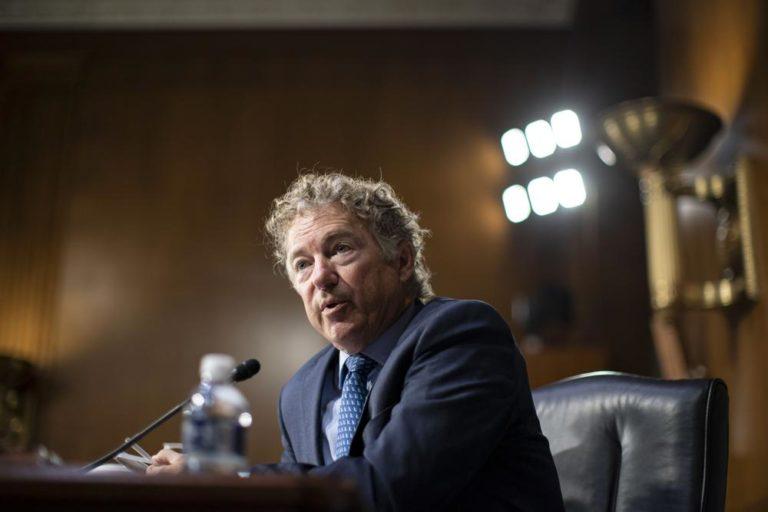
The bill passed in a vote of 51-50, with Vice President JD Vance casting the tie-breaking vote, as three Republicans — Senators Rand Paul (KY), Susan Collins (ME), and Thom Tillis (NC) — joined Democrats in voting against the sprawling piece of legislation.

House GOP leaders have scheduled a vote for the bill on Wednesday and are hoping to get it to President Trump’s desk by this Friday, though uncertainty remains about how fast it will get through the chamber.

The $150 billion will fund several of the Trump administration’s priorities, including Trump’s plan for a massive air defense system, known as the “Golden Dome,” which is bound to kick off a new arms race and will be a major boondoggle for the weapons makers that will be involved.

The majority of the $150 billion is meant to supplement the military budget for the 2026 fiscal year to bring it over the $1 trillion mark that Trump is aiming for. The White House has requested a military budget of $892.6 billion, which includes $848.3 billion for the Pentagon, and it is planning to use $113 billion from the supplemental spending package to bring the total 2026 national security budget to approximately $1.006 trillion.

While the US has never officially had a $1 trillion military budget, the actual cost of US military spending has exceeded $1 trillion for years. According to veteran defense analyst Winslow Wheeler, based on the $895 billion National Defense Authorization Act, US national security spending for 2025 was expected to reach about $1.77 trillion.

Wheeler’s estimate accounts for military-related spending from other government agencies not funded by the NDAA, such as the Department of Veterans Affairs and Homeland Security. It also includes the national security share of the interest accrued on the US debt, as well as other factors.

This article originally appeared at Antiwar.com.

CBP Data: Trump Admin Has Released Thousands of Inadmissibles Into U.S.

(Bethany Blankley, The Center Square) The Trump administration has released more than 13,000 inadmissible noncitizens into the U.S. in the first four full months of his administration who arrived at ports of entries (POEs) nationwide, according to U.S. Customs and Border Protection data evaluated by the Transactional Records Access Clearinghouse (TRAC), a nonpartisan organization founded at Syracuse University.

The data includes case-by-case CBP Office of Field Operations data reported at POEs nationwide in records TRAC obtained through Freedom of Information Act requests.

It excludes illegal border crossers reported by Border Patrol who were apprehended or encountered between ports of entry. It also excludes gotaways, those who evaded capture and illegally entered the country, also deemed inadmissible.

The Immigration and Nationality Act defines “inadmissible aliens” as “An alien present in the United States without being admitted or paroled, or who arrives in the United States at any time or place other than as designated by the Attorney General …” The law includes multiple categories and definitions related to public health and a range of crimes and circumstances, including national security and terrorism designations and associations.

“Noncitizens arriving at the United States by land, air and sea continue to seek entry to this country without adequate papers,” the TRAC report states. Since President Donald Trump was sworn into office in January and through the end of May, 50,071 foreign nationals “arrived at ports of entry and were initially found ‘inadmissible,’” according to the data published by TRAC.

“The Trump administration has not stopped all noncitizens without papers from entry,” the TRAC report states. As of the end of May 2025, 10,673 inadmissibles were paroled into the U.S.; an additional 2,351 were issued Notices to Appear before an immigration judge and allowed entry by CBP Office of Field Operations officers, TRAC says, according to the data it obtained.

The greatest number of inadmissables were released into the country by CBP OFO officers in San Diego and San Francisco; CBP OFO officers who issued the greatest number of NTAs were at Laredo and New York POEs, TRAC found.

When evaluating data from February through May, the greatest number of foreign nationals reported by CBP OFO officers at POEs were citizens of Mexico, Cuba, Philippines, Haiti, Canada, Venezuela, Ukraine, India, China, Honduras, Russia, Nicaragua, Guatemala, Colombia and El Salvador, according to the TRAC analysis.

The data includes everyone OFO determined was inadmissible and categorizes the reasons OFO gave for each designation and how they were processed. CBP provided data for most periods, TRAC said, however “CBP recently refused to release” some data it requested, and is “contesting this unlawful withholding.”

The data is categorized by country of origin, month and year, OFO location/POE, inadmissible entry details, gender, age, and other categories and subcategories.

Parole data refers to humanitarian, public interest or parole programs specific to countries.

Each category is searchable using different drop-down menus.

For example, in March 2025, 20,860 inadmissables were reported by CBP OFO officers nationwide. Among them, the greatest number were Mexicans (4,137), followed by Philippinos (2,693), Canadians (2,662), Indians (1,933) and Chinese (1,875).

Among them, the greatest number of inadmissibles released into the country in March were Mexican nationals: 1,548 were paroled into the country; 88 were released given NTAs to appear before a federal immigration judge, according to the data.

The large numbers of inadmissible Philippine, Indian and Chinese nationals are attributed to crew members of ships who didn’t have proper papers. Only 44 Philippino, 71 Indian and 76 Chinese nationals were paroled into the U.S. that month.

Of the 2,662 inadmissible Canadians, 93 were paroled into the U.S.; five were given NTAs. The majority, 2,481, were withdrawals, according to the data.

CBP OFO officers work at more than 300 POEs nationwide at international airports, land and seaports.

TRAC data includes more than 6 million foreign nationals designated as inadmissible by CBP OFO officers at POEs nationwide, from October 2011 to May 2025.

FNF TRAC border data