


‘Leave MS-13 Alone!’ Says Democratic Rep.

(José Niño, Headline USA) A Rhode Island state representative is under fire for condemning federal authorities who arrested a known MS-13 gang member on fentanyl trafficking charges.

State Rep. Enrique Sanchez has doubled down on his criticism of federal immigration enforcement, even after learning that a recent arrest involved a self-admitted MS-13 gang member with fentanyl trafficking charges.

The incident began on Sunday, when U.S. Immigration and Customs Enforcement (ICE) arrested Ivan Rene Mendoza Meza, a 27-year-old Honduran national on Alverson Avenue in Providence. According to ICE, Mendoza is a self-admitted member of the violent MS-13 gang and has three prior charges for fentanyl trafficking in Rhode Island dating back to 2023.

The arrest occurred after Mendoza attempted to flee from ICE agents, causing a crash by striking ICE vehicles before running into his apartment, where he was eventually surrounded and surrendered.

Rep. Sanchez immediately took to social media to condemn the arrest, posting inflammatory language that called ICE agents “Nazi Gestapo ICE thugs” and described the operation as an “act of terror.”

In a subsequent post on Tuesday, Sanchez wrote: “The Nazi Gestapo ICE thugs kidnapped another of our neighbors in Providence this morning. This time on Alverson St. The ICE thugs damaged a couple of residents’ cars as well. They think they are above the law. I strongly condemn this act of terror.”

Fox News correspondent Bill Melugin noted that Sanchez was “doubling down” by attacking the ICE agents.

Sanchez has maintained his stance even after being informed of Mendoza’s criminal background and gang affiliation.

When questioned by local media about his remarks, Sanchez stated he was waiting for documentation to prove the MS-13 claim, but admitted he was unaware of any official records tied to the drug charges and said he was “willing to accept my mistake or my error of maybe not mentioning that, or defending someone who was dealing with drug trafficking.”

ICE had previously lodged an immigration detainer against Mendoza following his fentanyl trafficking charges in August 2023, but Rhode Island’s 6th District Court declined to honor the detainer and released him after he posted $50,000 bail. This forced ICE agents to track him down in the community rather than taking custody directly from the jail.

The incident has drawn national attention partly because of Sanchez’s own controversial background. The state representative was arrested in February on DUI charges in Cranston, where police found him stopped at a green light at 3 a.m., smelling of alcohol. He has faced calls for resignation but has refused to step down, pleading not guilty to the charges.

José Niño is the deputy editor of Headline USA. Follow him at x.com/JoseAlNino 
Why Did Rep. Mills Drive through the Middle East Alone to Visit a Terrorist?

(José Niño, Headline USA) National security experts are questioning why Rep. Cory Mills, R-Fla., drove through hostile Middle Eastern territory without security and had a one-on-one meeting with a former terror-linked Syrian leader.

Blaze News recently revealed further details about Mills’ joint trip with Rep. Marlin Stutzman, R-Ind., where he traveled by private car from Damascus, Syria to Beirut, Lebanon. This is a journey that “could take anywhere from 2.5 to four hours through territory that is dangerous and hostile to Americans,” depending on checkpoints and travel conditions.

An intelligence source from the region stated that Hezbollah controls “much of the borderlands in both Syria and Lebanon,” and that for Mills to cross that territory, he would have needed a “pass” from the militant group. Despite the risks, Mills, as a sitting U.S. congressman, made the drive without any security detail beside him.

Roger Sollenberger, an independent journalist, reported that Mills sought a private meeting with Syrian President Ahmed Hussein al-Sharaa, spending 90 minutes alone with al-Sharaa and Foreign Minister Asaad Hassan al-Shaibani. A travel filing screenshot notes their discussion covered several “sensitive” topics, including “U.S.-Syria relations, humanitarian concerns, and regional stability,” according to The Blaze report.

In 2013, al-Sharaa was labeled a global terrorist by the U.S. government for his ties to the rebel group al-Nusra, although the State Department lifted the terrorist designation for al-Nusra earlier this month.

Kyle Shideler, director and senior analyst for homeland security and counterterrorism at the Center for Security Policy, called Mills’ solo meeting with al-Sharaa “worrisome,” emphasizing the risk that the “appearance of impropriety … could be exploited by foreign adversaries.”

He told Blaze News, “Generally speaking, U.S. officials should just not be meeting alone with foreign dignitaries or leaders. Even phone calls with foreign leaders include staffers and translators to help brief and keep the meeting on topic and in line with official U.S. policy. Even professional U.S. diplomats who actually have the responsibility to have such meetings don’t hold them alone but bring witnesses.”

Although Stutzman and Mills followed a joint itinerary to Damascus, Stutzman did not join Mills’ private meeting with al-Sharaa and al-Shaibani. Stutzman also opted out of the dangerous drive, with travel filings showing that he flew from Damascus to Istanbul, Turkey a day prior to Mills’ journey.

The Blaze reported that neither Mills nor Stutzman received “dignitary protection details from the State Department or Capitol Police” for their official trip. In this case, any security provided came from Syria.

Nonetheless, Mills still elected to travel through an area and crossed a border largely held by Hezbollah, without any security. presence. The reason behind Mills’ additional trip to Lebanon remains unclear.

Mill’s private life has faced increased scrutiny, with Headline USA reporting allegations of a covert conversion to Islam and missed payments on his luxury apartment lease.

Dems Plowed Donor Dollars on Lavish Trip to Visit Deported Illegal Alien

(Luis CornelioHeadline USA) House Democrats tapped into the coffers of their campaign funds to bankroll their overseas trip to El Salvador, where they visited illegal alien Kilmar Abrego Garcia, an accused MS-13 member now federally indicted for human smuggling.  

Most of the Democrats falsely claimed they paid for the trip “out of their own pocket.” 

In total, Reps. Robert Garcia, D-Calif., Maxwell Frost, D-Fla., Yassamin Ansari, D-Ariz., and Maxine Dexter, D-Ore. plowed through $7,000 for their April 17 trip, according to Federal Election Commission filings reviewed by the New York Post. 

Garcia’s campaign used $1,981.99 for travel on Taca International Airlines, a local Salvadoran carrier. On April 29, he spent another $501.53 for “event space rental” at the five-star Hilton San Salvador, a luxury hotel featuring upscale dining and poolside amenities. 

Frost’s campaign donors paid $1,362.49 for a flight on Avianca Airlines and $967.43 on additional travel on Volaris. 

Not to be outdone by her colleagues, Ansari had her campaign shell out $2,616.45 in four Avianca Airlines transactions between April 17 and 21, the Post reported.  

Meanwhile, Dexter’s FEC filings show $1,315.44 on Taca Airlines on April 18, just one day after the group arrived in El Salvador. 

Despite these filings, three Democrats publicly claimed they paid for the trips themselves. This was not the case for Garcia. 

An Ansari spokesperson said that she “paid for her own flights and hotel with her own money, and the campaign paid for a campaign volunteer with campaign funds.” 

Tellingly, her office previously told a different outlet that she “paid for the trip out of her own pocket.” 

A spokesperson for Dexter also said months ago that the trip was self-funded. 

Frost’s office told Politico no tax dollars were used, specifically referencing the Members’ Representational Allowance. The MRA is used to cover the expenses of running congressional offices. 

Only Garcia had admitted early on that campaign funds were used for the trip. 

Separately, Rep. Glenn Ivey, D-Md., spent $291.25 in campaign funds for a separate visit to El Salvador. 

The Democratic politicians were in El Salvador to protest the Trump administration’s deportation of Garcia, an illegal alien described by DHS as an MS-13 gang member.  

He had been removed from the U.S. amid a legal dispute over a court order staying an earlier deportation order. 

He has since been returned to the U.S., only to face a federal indictment on human smuggling.  

Following the indictment, Democrats largely distanced themselves from Garcia at the direction of House Minority Leader Hakeem Jeffries, D-N.Y. 

Morgan Stanley Expects Further Euro Gains – A Tailwind for Gold?

(Jesse Colombo, Money Metals News Service) Morgan Stanley is predicting further euro appreciation, which should also give gold a meaningful boost, given their strong correlation.

Anyone who has followed my work over the past eight months knows I’ve been consistently bearish on the U.S. dollar — a call that has played out as the dollar has fallen about 10% against a basket of major foreign currencies this year.

turned bearish immediately after President Trump’s inauguration, when the Dollar Index was at 108.375, and reaffirmed that stance when it dropped below 100 in the spring.

I also argued that a weaker dollar would boost the euro and commodities like gold and silver, given their inverse relationship — a view confirmed by the strong rallies in both the euro and precious metals.

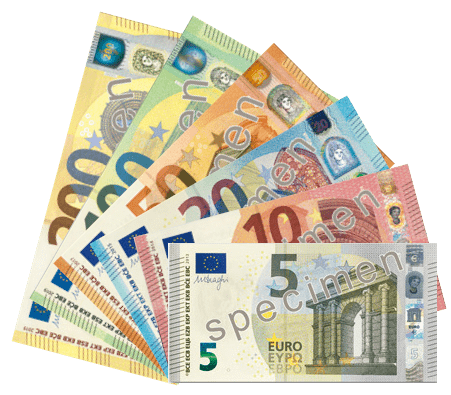
An assortment of euro banknotes. Source: Wikipedia.
An assortment of euro banknotes. Source: Wikipedia.

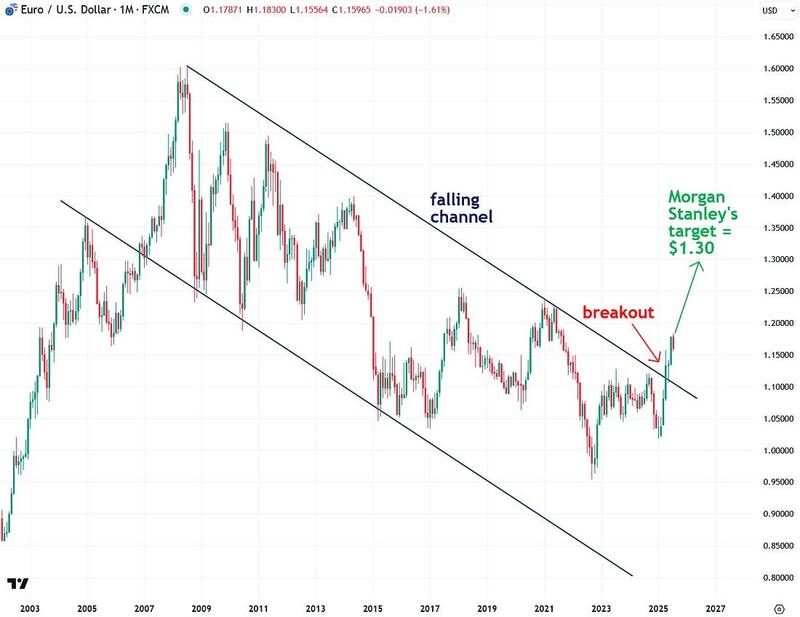
Yesterday, Morgan Stanley predicted that the euro will continue climbing toward $1.30 and beyond — a roughly 12.1% rise from its current level of $1.15965.

The investment bank attributes this expected strength to European investors increasing foreign exchange hedges on their U.S. asset holdings, particularly equities, in response to ongoing dollar weakness.

According to their estimates, about $3.6 trillion — nearly half — of European-held U.S. assets remain unhedged, well below historical norms.

They added that “risks are skewed toward investors raising their hedge ratios well beyond historical averages,” which is likely to propel the euro even higher.

Morgan Stanley’s forecast aligns with my view that the euro is heading even higher — not only due to continued dollar weakness (as I’ll explain shortly), but also because of the euro’s decisive breakout in April from a long-term falling channel that had been in place since 2008, as the chart below illustrates.

Given the scale of that 15-year pattern, Morgan Stanley’s $1.30 target may ultimately prove conservative. It would be unusual for such a significant technical breakout to lose momentum so quickly.

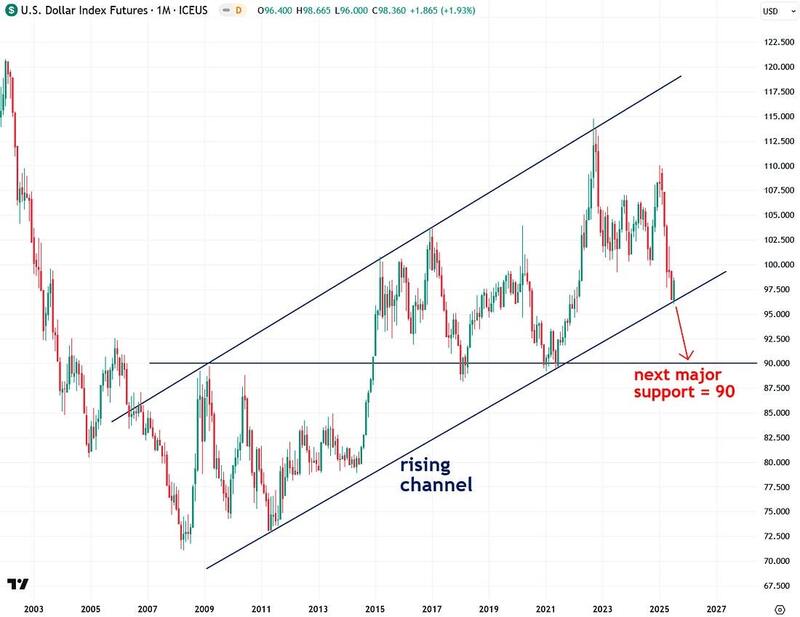
Interestingly, the euro’s long-term falling channel since 2008 is almost perfectly mirrored by the U.S. Dollar Index’s rising channel over the same period — a reflection of their inverse relationship.

When the euro rises, the dollar falls, and vice versa. While the euro has already broken out of its channel, the Dollar Index has yet to break down from its own.

The U.S. Dollar Index recently bounced off its lower trendline, but if it breaks down from its long-standing rising channel — as it would if Morgan Stanley’s euro forecast plays out — the next key target is the 90 level. That’s a major support level marked by the index’s peaks in late 2008, early 2009, and 2010, as well as key lows in 2018 and 2021.

Notably, a drop to 90 in the Dollar Index roughly corresponds to a $1.30 euro, which reinforces the case technically.

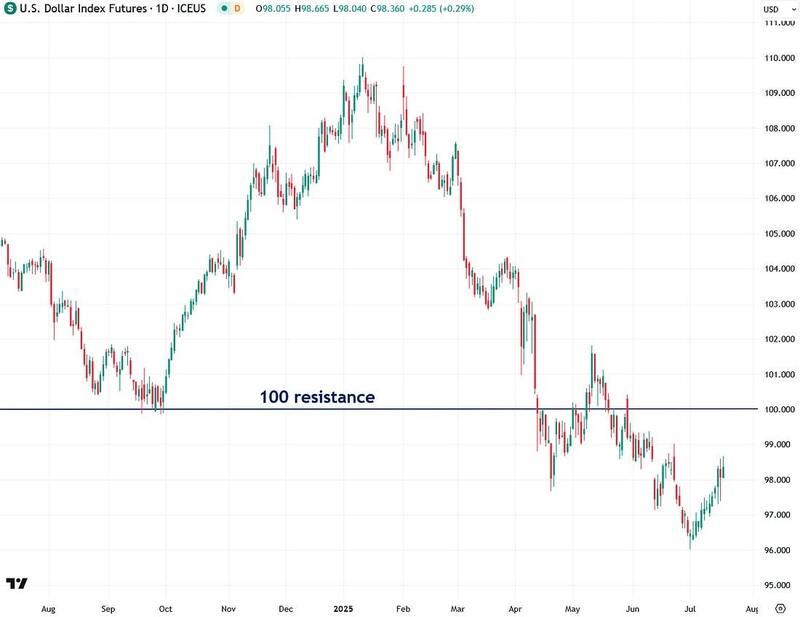
Turning to the short-term chart of the U.S. Dollar Index, it recently broke decisively below the key 100 level — a major technical breakdown that tilts the bias toward further weakness as long as it stays below that threshold.

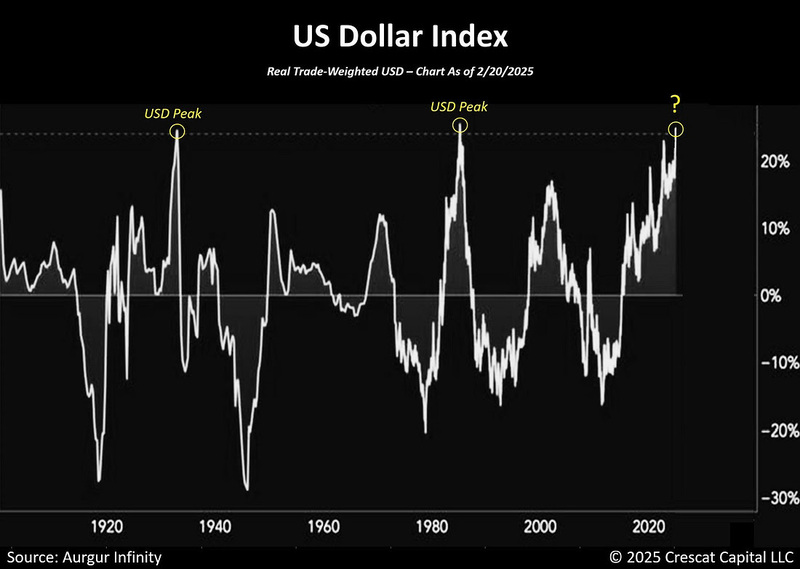
I am still quite bearish on the dollar because of its extreme overvaluation relative to other currencies, a phenomenon unseen in over 120 years of data except in 1933 and 1985—both periods followed by significant dollar declines. The dollar’s unusual strength in recent years has been a major factor keeping commodity prices much lower than they would ordinarily be.

However, further correction in the dollar’s value should continue to boost the commodities sector, including assets like copper, gold, silver, and mining stocks.

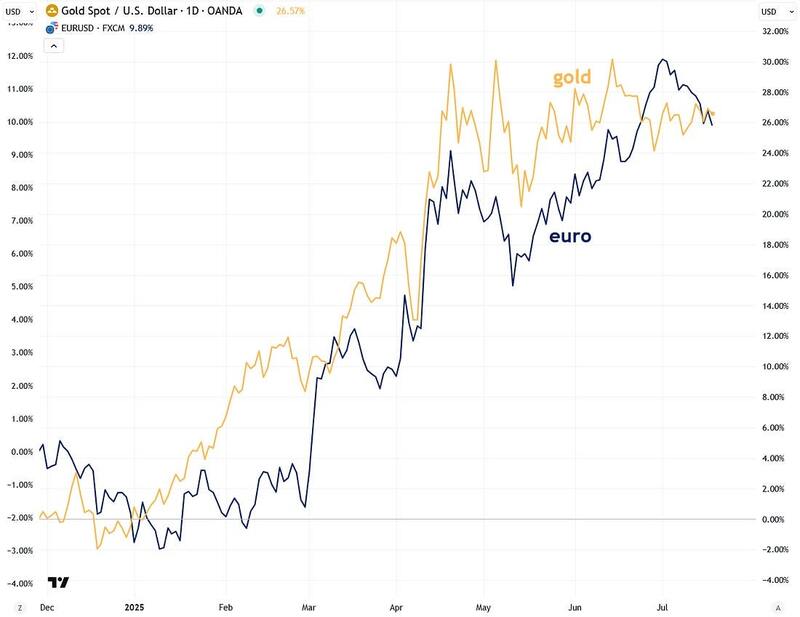
As I’ve emphasized throughout this report, Morgan Stanley’s bullish euro outlook has bullish implications for gold as well — even though the firm didn’t mention gold specifically. The two are closely correlated, trading in near lockstep since the start of the year:

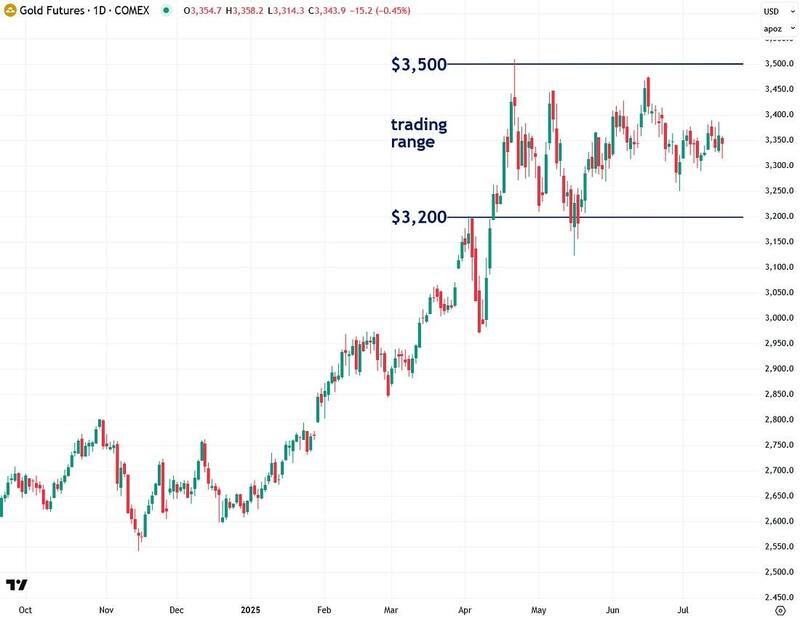
Gold has been treading water in recent months, consolidating in a range between $3,200 and $3,500 — a typical summer pattern as news flow and trading volume slow with traders on vacation.

However, further euro strength, as Morgan Stanley expects, could be a key catalyst that propels gold out of this range and toward $4,000 — a target shared by both Goldman Sachs and JPMorgan.

To summarize, I firmly believe precious metals investors should closely monitor major currencies like the U.S. dollar and the euro, as their movements often offer valuable clues about the direction of metals due to long-standing correlations.

This approach, known as intermarket analysis, is a core part of my toolkit and has consistently proven valuable. I expect continued dollar weakness accompanied by strength in both the euro and precious metals, so it’s encouraging to see Morgan Stanley echoing that outlook and providing further support for why this scenario is likely to play out.

If you found this report valuable, click here to subscribe to The Bubble Bubble Report for more content like it.


Jesse Colombo is a financial analyst and investor writing on macro-economics and precious metals markets. Recognized by The Times of London, he has built a reputation for warning about economic bubbles and future financial crises. An advocate for free markets and sound money, Colombo was also named one of LinkedIn’s Top Voices in Economy & Finance. His Substack can be accessed here.

Fed Chair Candidate Warsh Wants More Inflation

(Mike Maharrey, Money Metals News Service) One of the top candidates to succeed Jerome Powell at the Federal Reserve said the central bank needs to coordinate more closely with the U.S. Treasury and advocated for a much more inflationary monetary policy.

Kevin Warsh served as a Federal Reserve governor from 2006-2011. He is widely regarded as one of the top three or four candidates to take the reins at the Fed when Powell’s term ends in May 2026 (or sooner if Trump forces him out).

During a recent interview with CNBC, Warsh called for a regime change at the central bank, citing its reluctance to cut interest rates.

“Their hesitancy to cut rates, I think, is actually quite a mark against them. It’s as if they’ve lost some of the credibility. Truth is, in economics and inflation, bygones are not bygones. The specter of the miss they made on inflation, it has stuck with them. So, one of the reasons why the president, I think, is right to be pushing the Fed publicly is we need regime change in the conduct of policy.”

The interviewer directly asked Warsh if he thought Trump should fire Powell.

“I think regime change at the Fed will happen in due course.”

Warsh Wants More Inflation

Like President Trump, Warsh is an outspoken advocate of interest rate cuts, arguing that price inflation is under control. His statements indicate he believes the central bank has moved too slowly in the past. During the interview, he said the central bank should look beyond the “one-off” change in prices due to tariffs.

But make no mistake – this is a call for more inflation.

While the CPI has cooled significantly (the June uptick notwithstanding), the money supply has been increasing for over a year. This is, by definition, inflation. Rising prices are just one result of this monetary inflation.

The bottom line is the Fed never did enough to slay the inflation dragon.

Rate cuts would likely accelerate the expansion of the money supply by incentivizing more borrowing. In a fractional reserve banking system, each new loan injects new money into the financial system. It isn’t as quick and clean as money creation via quantitative easing (QE), but it is inflationary nonetheless.

But to be fair, there is a valid case to be made for rate cuts. While people like Warsh would never say it out loud, the U.S. economy is addicted to easy money. It is loaded up with debt and simply can’t function in a normal interest rate environment over the long term. Higher interest rates don’t play well with massive levels of debt.

For instance, interest on the national debt cost $144.6 billion in June. That brought the total interest expense for the fiscal year to $921 billionup 6 percent over the same period in 2024. It’s apparent, given the federal debt load, that Uncle Sam needs some interest rate relief.

U.S. corporations and consumers are also loaded up with debt.

A higher interest rate environment will eventually crack the debt-riddled economy and pop the bubbles. The economy needs its easy money drug. However, a few good CPI reports notwithstanding, inflation is far from dead.

Simply put, the Federal Reserve is in a Catch-22. It simultaneously needs to cut rates to prop up the easy money-addicted economy and hold rates steady (or even raise them) to keep inflation at bay.

A Fed Partnership With the Treasury?

Warsh also signaled a need for better coordination between the Federal Reserve and the U.S. Treasury.

In other words, he’d be perfectly fine with shedding the illusion of Federal Reserve independence.

Powell has repeatedly stated that he doesn’t take fiscal issues, such as the national debt, into account when setting monetary policy. Warsh would take a different approach.

“We need a new Treasury fed accord, like we did in 1951, after another period where we built up our nation’s debt, and we were stuck with a central bank that was working at cross purposes with the Treasury. That’s the state of things now.”

What does this mean?

Warsh is referring to a Federal Reserve–Treasury Accord, agreed to on March 4, 1951.

During World War II, the central bank pegged interest rates on government debt with short-term rates at 0.375 percent and long-term rates around 2.5 percent. This allowed the federal government to borrow cheaply to fund the war effort.

Under the 1951 agreement, the Fed was no longer obligated to peg interest rates to help the Treasury. The central bank regained autonomy to conduct monetary policy aimed at controlling inflation, reestablishing at least the illusion of Federal Reserve independence.

It’s not completely clear what Warsh is proposing, but it seems he wants to go back to a scenario where the Fed is more actively involved in coordinating with the federal government to facilitate borrowing.

“If we have a new accord, then the … Fed chair and the Treasury secretary can describe to markets plainly and with deliberation, ‘This is our objective for the size of the Fed’s balance sheet.’”

Reading between the lines, this seems to imply Warsh would be open to using quantitative easing to create demand in the bond market, lowering borrowing costs.

In QE operation, the Fed buys Treasuries on the open market and holds them on its balance sheet. This creates artificial demand for U.S. debt, raising bond prices and lowering yields. QE during the Great Recession and the pandemic allowed the U.S. government to borrow more than it could have under normal market conditions.

However, QE is extremely inflationary because the central bank buys bonds with money created out of thin air and injects it into the financial system. Between the 2008 financial crisis and the pandemic, the Fed injected nearly $9 trillion into the economy. This resulted in the spate of price inflation we suffered through after the pandemic.

Currently, Warsh seems more interested in trying to rein in borrowing costs with rate cuts, saying, “I think the Fed has the balance wrong. A rate cut is the beginning of the process to get the balance right.

In fact, the central bank has much less control over rates than it would have you believe. The Fed can cut its federal funds rate, and that has a significant impact on the short end of the curve. But longer-term rates are much less impacted by Fed interest rate manipulation. In fact, longer-term Treasury yields have gone up since the Fed’s 1 percent cut in 2023/2024.

In practice, if the Federal Reserve really wants to coordinate with the Treasury, QE may be the only avenue. The fact that Warsh seems open to this approach should concern anybody worried about inflation.


Mike Maharrey is a journalist and market analyst for Money Metals with over a decade of experience in precious metals. He holds a BS in accounting from the University of Kentucky and a BA in journalism from the University of South Florida.

‘I Know It’s Corny’: Obama Opens Up about Gay Companionship

(Luis CornelioHeadline USA) Former President Barack Obama apparently wants young boys to befriend gay men.

Obama made the odd call to action during a sit-down interview with former First Lady Michelle Obama, as the two reminisced about young men and what they need beyond father figures.

“One of the most valuable things I learned as a guy was: I had a gay professor in college—at a time when openly gay folks still weren’t out a lot—who became one of my favorite professors and was a great guy and would call me out when I started saying stuff that was ignorant,” Obama told his wife in her IMO podcast.

“You need that to show empathy and kindness,” he added.

Clarifying that the friend doesn’t have to be gay, but could be another member of the LGBTQ community, he continued:

“And by the way, you need that person in your friend group so that if you then have a boy who is gay or non-binary or what have you, they have somebody that they can go, ‘Okay, I’m not alone in this,’ right?’ So that, I think … is creating that community. I know it’s corny, but that’s what they need.”

Obama’s comments come as he faces mounting rumors about an imminent divorce and his sexuality.

However, in the same interview, he claimed ignorance of the swirling divorce rumors, while Michelle said she had never considered “giving up on” her man.

His remarks also follow longstanding online speculation from some internet trolls about his personal affinity for homosexuality.

When he was 21, Obama wrote to former girlfriend Alex McNear that he made love to men every day though only in his mind.

“In regard to homosexuality, I must say that I believe this is an attempt to remove oneself from the present, a refusal perhaps to perpetuate the endless farce of earthly life. You see, I make love to men daily, but in the imagination,” Obama wrote in November 1982, according to the New York Post.

Obama also drew renewed scrutiny when media personality Tucker Carlson interviewed Larry Sinclair, a man who claimed he once had drug-fueled sex with Obama while he was a local politician in Chicago.

The legacy media has long dismissed Sinclair’s allegations due to his criminal record. Headline USA couldn’t verify Sinclair’s claims.

2,200 Year Old Money Discovered in Czech Republic

(Mike Maharrey, Money Metals News Service) You’ll often hear me say that gold and silver have served as money for thousands of years. They’ve stood the test of time!

Now, this might sound like hyperbole coming from a “gold bug,” but there is ample evidence supporting this assertion. After all, we have coins dating back to antiquity.

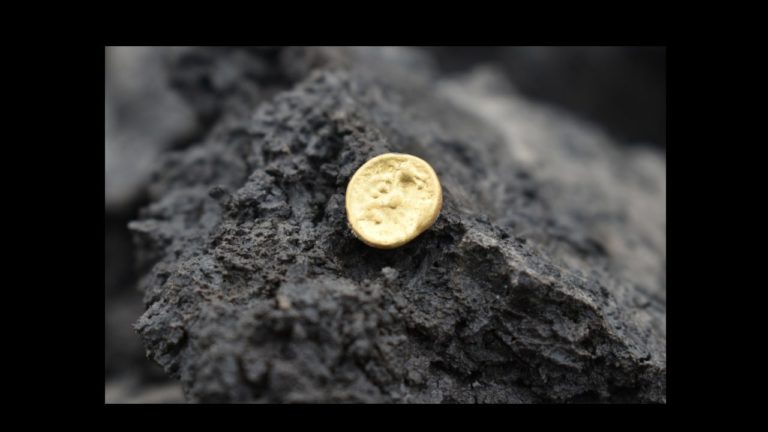
Just recently, archaeologists discovered an ancient Celtic settlement in the Bohemia region of the Czech Republic. They estimate the settlement is around 2,200 years old. Among the remains of dwellings, production facilities, and at least one religious shrine, the archaeologists found several hundred gold and silver coins. They also found dies used to mint coins.

In other words, archaeologists found money that is well over 2,000 years old. Good luck to archaeologists trying to find U.S. dollars 2,000 years from now. I don’t think paper and digits in a computer will stand the test of time.

The archaeologists also found over 1,000 pieces of jewelry, pottery, and other everyday items at the site.

Researchers say the settlement was unfortified, and they believe the residents were major players in regional trade. According to a spokesperson from the Museum of Eastern Bohemia, there are indications that the people traded amber and other products “on routes across Europe.” The settlement is similar to other settlements along the “amber route corridor” that ran from the Baltic and North Seas to central Europe. Amber was highly valued for its beauty and was often incorporated into jewelry and religious objects.

That being the case, it makes sense to find gold and silver coins. Their value would have been recognized by all the various diverse cultures that traded in the region. That was one of the characteristics that led gold and silver to be adopted as money around the world. Their scarcity and value were universally recognized.

Gold and silver ultimately became money simply because people wanted to use them as such. No government mandate was necessary. The metals spontaneously evolved as money through a free market system.

Economist Carl Menger first to explain how money originates spontaneously through market processes, not through government action, in his seminal work, Principles of Economics. Gold and silver arose as money because individuals sought efficiency in trade, gradually converging on the metals as a commonly accepted medium of exchange. Gold and silver both possess the characteristics of good money because they are durable, divisible, portable, and widely desired.

Think about it. More than 2,000 years after these coins were minted, we know their value. The culture that produced the coins is long gone, but the coins are still valued by people today — not just because of their historical significance, but because we know exactly how much the gold and silver are worth. A person could easily use these coins as money today.

In contrast, fiat money such as the dollar is forced on people by government edict. Unlike gold and silver, fiat is easily produced by governments. All they need is a printing press (or a computer). The reality is that government people always give in to the temptation to create more and more of it for their own purposes. This steals the purchasing power and ultimately the wealth of those forced to use it. And when the government falls, so does the money. Confederate script is worth nothing more than its historical value.

The bottom line is that gold and silver remain a superior store of value compared to fiat.

So, people like me who laud gold and silver as “sound money,” arguing that it has been chosen by people to fill that role for thousands of years, are not just blowing smoke. We have the coins to prove it!

Photo courtesy of the Museum of Eastern Bohemia 


Mike Maharrey is a journalist and market analyst for Money Metals with over a decade of experience in precious metals. He holds a BS in accounting from the University of Kentucky and a BA in journalism from the University of South Florida.

MIT Lab Funded by Epstein Floated Giving Child Sex Robots to Offenders

(Luis Cornelio, Headline USA) A lab at the Massachusetts Institute of Technology once hosted a panel that seemingly endorsed the idea of giving “child-size sex robots” to sex offenders, claiming it may keep them from abusing real children. 

Disturbingly, the same MIT Media Lab once accepted funding from convicted pedophile Jeffrey Epstein over 17 years, the Daily Caller reported on Wednesday.

That lab also held a July 2016 conference without “social and moral constraints” to discuss pedophilia. According to the Caller, panelists argued pedophilia should not be viewed as a “moral failing,” but rather a medical condition. 

MIT even considered inviting Epstein to one of its events that same month, according to a 2020 report commissioned by the university, per the Caller. 

“Once child-size sex robots hit the market, which they will, is the use of these robots going to be a healthy outlet for people to express these sexual urges and thus protect children and reduce child abuse? Or is the use of these robots going to encourage, normalize, propagate that behavior?” one panelist asked.  

“We can’t research it [because of reporting restrictions],” the panelist added. “But I do wonder whether they’re doing more harm than good in these cases. Because as much as people want these sexual urges — the urges, not the act — to be a moral failing, they are a psychological issue.” 

Another panelist argued that such robots could help researchers better understand pedophilia. 

“The notion of studying sexual deviance and actual normal humans interacting with these things can provide the basis for a deeper understanding of how that operates,” the panelist added. 

Headline USA tried to embed video footage of the disturbing panel, but MIT restricted it from being shared. Watch it here: https://www.youtube.com/watch?v=bxiT5Q6WZaU

MIT spokesperson Kimberly Allen dodged questions about whether Epstein had been invited to a July 2016 conference and downplayed the lab’s involvement in a statement. 

“The panel referenced occurred nearly a decade ago, and we can’t comment on individual programming decisions a department made. Thousands of events take place on our campus each year,” Allen said. “As a general practice, we also don’t comment on the individually held and freely expressed views of any particular community member. The views of any individual community member are their own.” 

DHS Agents at Butler Rally Were Led by an FBI Domestic Terrorism Squad Member

(Ken Silva, Headline USA) In the wake of the July 13, 2024, assassination attempt on President Donald Trump, whistleblower disclosures revealed that at least 16 Homeland Security Investigations agents were working security that day. Critics say the HSI agents didn’t have the same training as their Secret Service counterparts, which may have been part of the reason why there were so many security failures.

What hasn’t been reported until now is the fact that the HSI agents were led by a member of the FBI’s Joint Terrorism Task Force. Moreover, according to interview transcripts, this FBI JTTF member made crucial mistakes leading up to the Trump shooting—including diverting another agent away from his search for the suspicious person with a rangefinder, who later turned out to be Trump’s would-be assassin.

The revelations about an FBI JTTF member working at Butler were included in the Senate Homeland Security Committee’s interview with the Secret Service “protective intelligence agent,” a transcript of which was released Sunday. In the interview, the agent, who isn’t named, talked about her background with congressional investigators—revealing her JTTF domestic terrorism credentials.

“In 2022, I was assigned to the Joint Terrorism Task Force at the FBI in the Domestic Terrorism Squad. I left the Phoenix Field Office in August of 2024, and transferred [REDACTED],” said the protective intelligence agent, a veteran of some 21 years with the Secret Service.

The agent said she wasn’t working at Butler in her capacity as a JTTF member. Rather, she was leading the “jump team” of HSI agents, along with performing the duties of a protective intelligence agent—someone who investigates possible threats.

“HSI special agents were used to supplement Secret Service for post-standing assignments. So my role for the campaign would be for a three-week rotation. Myself and a team of other agents would travel from site to site and stand post for whatever event we were assigned to,” she said.

According to interview transcripts, the JTTF member made at least two crucial mistakes on July 13, 2024.

The first mistake came when her partner—a plainclothes Pennsylvania State Police trooper—told her around 5:45 p.m. that a suspicious person with a rangefinder was spotted outside of the rally perimeter. She hopped in a golf cart and went to look for the suspicious person, only to stop and give up when she encountered the chain-link fence between the rally site and the AGR building, which was later used as a sniper perch by gunman Thomas Crooks.

“We were stopped at the chain-link fence and there was a locked gate. Had I been able to go further at that time I would have. There was about a 20-yard grassy area and then a second chain-link fence, and the individual was reported to be on the other side of that second fence, in an industrial area,” she said.

“I went as far as I could go physically, and I visually inspected the area, and I didn’t see the person. The reporting parties didn’t have a visual on them at that time. I didn’t feel comfortable, given that the program had begun and that President Trump was en route, I didn’t feel comfortable leaving the venue to go look for somebody.”

The JTTF member said she headed back towards the stage area, while her PSP partner hopped in his truck to go look for the suspicious person outside of the perimeter.

While at the stage area, the JTTF member made her second crucial mistake. There, she encountered another agent who was searching for the suspicious person. The JTTF member told the agent—the counter-sniper response agent, which is a man on the ground that provides intelligence for counter-snipers—that she already had officers searching for the suspicious person near the AGR building. According to the counter-sniper response agent, she then allegedly directed him to go look south of the stage, which was the opposite side from where Crooks was.

“She said that her state trooper counterpart was already over on the opposite side [near AGR] … and that we should spread out from there, she would go back up towards the Command Post and look up that way, and I would go back toward the south end,” the counter-sniper response agent told Congress.

When asked about whether she directed the agent to go look south of the stage, the JTTF member said she couldn’t recall.

“I don’t recall giving him any instruction, no,” she told Congress.

The JTTF member was never disciplined. She no longer works with the FBI because she transferred to another office. She said she asked to be transferred because her husband was hired as a coach. Redactions block additional details about this coaching job.

Ken Silva is the editor of Headline USA. Follow him at x.com/jd_cashless.

Trump Orders Unsealing of Epstein Files, Threatens Lawsuit after WSJ Hit Piece

(Headline USA) President Donald Trump promised a lawsuit after The Wall Street Journal described a sexually suggestive letter that the newspaper says bore Trump’s name and was included in a 2003 album for Epstein’s 50th birthday. Trump denied writing the letter, calling it “false, malicious, and defamatory.”

Trump also directed Attorney General Pam Bondi to try to make some of the documents in the case public.

Bondi said she would seek court permission Friday to release grand jury information, but it would require a judge’s approval, and she and Trump were silent on the additional evidence collected by federal law enforcement in the sprawling investigation that Bondi last week announced she would not release.

“This SCAM, perpetrated by the Democrats, should end, right now!” Trump said online.

However, unsealing the grand jury docs won’t end the “scam.” Only a small fraction of Epstein’s victims testified before a grand jury, so the full extent of his criminal enterprise won’t be known, even if a judge agrees to unseal additional records.

The letter revealed by The Wall Street Journal was reportedly collected by disgraced British socialite Ghislaine Maxwell as part of a birthday album for Epstein years before the wealthy financier was first arrested in 2006 and subsequently had a falling-out with Trump. The letter bearing Trump’s name includes text framed by the outline of what appears to be a hand-drawn naked woman and ends with, “Happy Birthday — and may every day be another wonderful secret,” according to the newspaper. The outlet described the contents of the letter but did not publish a photo showing it entirely.

Maxwell was arrested in 2020 and convicted a year later on charges that she helped Epstein lure girls to be sexually abused.

Trump slammed the story in a lengthy social media post Thursday night, saying he spoke to both to the paper’s owner, Rupert Murdoch, and its top editor, Emma Tucker, and told them the letter was “fake.” Trump promised to sue the paper over the story, saying: “These are not my words, not the way I talk. Also, I don’t draw pictures.”

Vice President JD Vance said The Wall Street Journal “should be ashamed” for publishing it.

“Where is this letter? Would you be shocked to learn they never showed it to us before publishing it? Does anyone honestly believe this sounds like Donald Trump?” he wrote on X.

Adapted from reporting by the Associated Press