(Sarah Roderick-Fitch, The Center Square) A powerful House committee issued subpoenas for key government officials, including former President Bill Clinton and former Secretary of State Hillary Clinton, as part of a congressional investigation into well-connected financier and sex offender Jeffrey Epstein.
Chairman of the House Committee on Oversight and Government Reform, Rep. James Comer, R-Ky., issued subpoenas Tuesday to the Clintons, former FBI Director James Comey, former U.S. Attorney General Loretta Lynch, former U.S. Attorney General Eric Holder, former U.S. Attorney General Merrick Garland, former FBI Director Robert Mueller, former U.S. Attorney General William Barr, former U.S. Attorney General Jeff Sessions and former U.S. Attorney General Alberto Gonzales as part of the House investigation on the “oversight of the federal government’s enforcement of sex trafficking laws” and the “handling of the investigation and prosecution” of Epstein and close confidant Ghislane Maxwell.
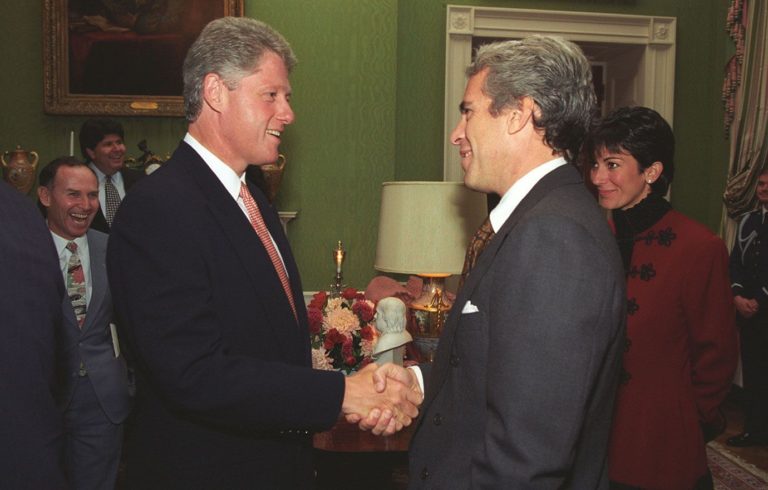
Comer noted examples of a potentially close relationship between the former president and Epstein in the letter to Bill Clinton.
“By your own admission, you flew on Jeffrey Epstein’s private plane four separate times in 2002 and 2003. During one of these trips, you were even pictured receiving a ‘massage’ from one of Mr. Epstein’s victims,” the congressman wrote.
“It has also been claimed that you pressured Vanity Fair not to publish sextrafficking allegations against your ‘good friend’ Mr. Epstein, and there are conflicting reports about whether you ever visited Mr. Epstein’s island. You were also allegedly close to Ms. Ghislane Maxwell, an Epstein co-conspirator, and attended an intimate dinner with her in 2014, three years after public reports about her involvement in Mr. Epstein’s abuse of minors.”
Comer’s letter to Hillary Clinton indicated that the former president’s trips on Epstein’s plane were part of the Clinton Family Foundation trips. He also included a connection between the former first couple and Maxwell, noting that Maxwell’s nephew was employed by Hillary’s 2008 failed presidential campaign and then hired by the State Department after becoming Secretary of State.
Comer says the purpose of the investigation is to “inform legislative solutions to improve federal efforts to combat sex trafficking and reform the use of non-prosecution agreements and/or plea agreements in sex-crime investigations.”
The subpoenas come ahead of Comer’s scheduled testimony with Maxwell, which was initially scheduled for Aug. 11, but has been postponed until after an appeal from Maxwell to the Supreme Court has been decided.
The House’s investigation comes as the Trump administration and Department of Justice face mounting pressure to fulfill promises to declassify the Epstein files, including his rumored client list and the circumstances surrounding his 2019 death.
House deposition and record return dates:
Department of Justice Records: Aug. 19
Former U.S. Attorney General William Barr: Aug. 18
Former U.S. Attorney General Alberto Gonzales: Aug. 26
Former U.S. Attorney General Jeff Sessions: Aug. 28
Former FBI Director Robert Mueller: Sept. 2
Former U.S. Attorney General Loretta Lynch: Sept. 9
Former U.S. Attorney General Eric Holder: Sept. 30
Former U.S. Attorney General Merrick Garland: Oct. 2
(Mike Maharrey, Money Metals News Service) While the bulls are running down Wall Street and stocks keep surging to new record highs, Joe Main Street is feeling stressed.
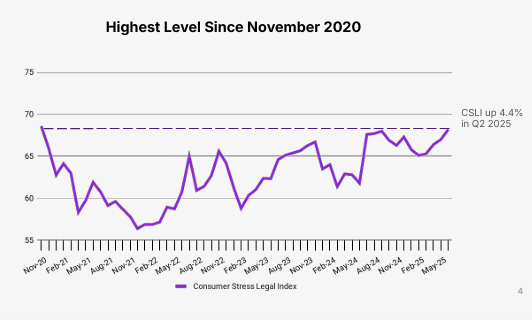
LegalShield’s Consumer Stress Index (CSLI) increased by 4.4 percent in the second quarter and is at the highest level since November 2020, when the economy was shut down during the pandemic.
What is causing all this stress?
Debt.
“As consumers take on more credit to keep up with inflation and everyday expenses, many are hitting a breaking point. The increase in legal inquiries tied to foreclosures and personal finance issues suggests that debt-fueled spending is no longer sustainable for a growing number of Americans.”
As inflation surged in the wake of the monetary malfeasance of the pandemic era, Americans blew through their savings. Then they turned to credit cards. It wasn’t that people were buying more. They were just paying more, trying to keep up with surging price inflation. Once they blew through their savings, consumers were forced to finance life using Visa and Mastercard. Consumer debt surged from $4.15 trillion in 2020 to over $5 trillion today.
Now they are struggling to pay the bills.
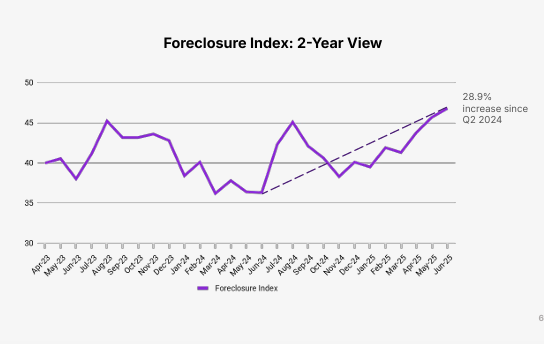
LegalShield’s Foreclosure Index surged 13.3 percent in Q2 and now stands nearly 29 percent higher than a year ago.
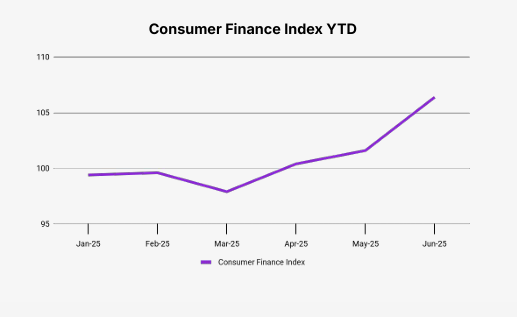
The consumer finance index also spiked in Q2, climbing 8.5 points to 106.4. According to LegalShield, this reflects “growing legal demand tied to billing disputes, loan defaults, and credit problems.”
LegalShield senior vice president of consumer analytics told Kitco News the jump in consumer stress could signal trouble on the horizon.
“Government data reports are lagging indicators. But we believe we’re a leading indicator because on a day-by-day basis, we’re hearing from people today who have an issue that they need help with.”
LegalShield bases its Consumer Stress Index on “a dataset of over 35 million consumer requests for legal assistance dating to 2002. The index examines findings from approximately 150,000 calls received monthly from U.S. consumers seeking legal help.”
Americans currently owe $1.3 trillion in revolving credit, primarily made up of credit card debt. A recent slowdown in credit card spending also signals that American consumers may be close to reaching their credit limits.
The double whammy of rising debt and interest rates exacerbates the debt problem. The average annual percentage rate (APR) currently stands at 20.13 percent, with some companies still charging rates as high as 28 percent. The average is only slightly down from the record high of 20.79 percent set last August.
Rates aren’t coming down much, even with the Federal Reserve rate cuts last year. According to an ABC News report, despite a full percentage point in rate cuts, credit card companies are charging a higher margin “to weather default risk, cover overhead costs and recoup profits, experts added.”
LegalShield said even if the Federal Reserve delivers interest rate cuts later this year, it doesn’t see much relief coming down the pike.
“Our data doesn’t suggest that there’s any improvement on the horizon, and we see continued steps toward increased financial stress. Lower interest rates should help consumers with their debt financing, but there is an argument to be made, right? That an interest rate cut is not going to be the silver bullet that fixes things today.”
The fact of the matter is that the Federal Reserve had a hand in creating this problem to begin with. Nearly two decades of artificially low interest rates to “stimulate” the economy not only drove price inflation through the roof, but they also incentivized borrowing. The problem with Fed-induced bubbles is that they always pop. And there are a lot of pins floating around out there in the economy.
Mike Maharrey is a journalist and market analyst for Money Metals with over a decade of experience in precious metals. He holds a BS in accounting from the University of Kentucky and a BA in journalism from the University of South Florida.
(Mike Maharrey, Money Metals News Service) Citibank just did a 180 on gold and now forecasts new record highs before the end of the year.
Just six weeks after lowering its forecast and warning that gold could drop below $3,000 before the end of the year, Citibank now projects gold will hit $3,500 an ounce over the next three months. This would put it in range to eclipse the record high hit in April.
Citi also raised its expected gold trading range to $3,300 to $3,600, up from $3,100 to $3,500 previously.
In June, Citi lowered its 6 to 12-month gold price forecast to $2,800 per ounce from $3,000.
Citi analysts remain worried about the impact of tariffs on the global economy and also cited dollar weakness as a reason to be bullish on gold.
“U.S. growth and tariff-related inflation concerns are set to remain elevated during 2H’25, which alongside a weaker dollar, are set to drive gold moderately higher, to new all-time highs.”
The dollar charted its worst start to a year since 1973. In fact, one could argue that it’s not so much that the gold is going up but that the greenback is sagging. Gold is reflecting the devaluation of the U.S. currency.
There also appears to be a developing bear market in bonds. U.S. Treasuries have historically been a go-to safe-haven asset. However, Treasury yields increased as bonds sold off in April at the height of geopolitical uncertainty.
The note pointed out that U.S. import tariffs set in many of the trade deals reached in recent weeks were higher than expected, including taxes levied on major trading partners, including Canada, India, Brazil, and Taiwan.
“The market has been concerned about a U.S. recession due to high interest rates for the past three years, buying gold to hedge the downside risks. This fear has likely only increased over the past six months, given President Trump’s largest-in-a-century trade tariff agenda.”
Citi analysts also cited increasing weakness in the labor market and continued geopolitical risk, particularly relating to the war between Russia and Ukraine. Additionally, they noted declining “institutional credibility” in the U.S. due to President Trump’s incessant pressure on Federal Reserve Chairman Jerome Powell and the recent firing of Bureau of Labor Statistics Commissioner Erika McEntarfer.
Citi notes that gold demand has exploded, rising about 33 percent since 2022. In that time, the price has nearly doubled. Analysts cite strong investment demand, continued central bank gold buying, and a relatively resilient jewelry market despite headwinds created by higher prices.
Mike Maharrey is a journalist and market analyst for Money Metals with over a decade of experience in precious metals. He holds a BS in accounting from the University of Kentucky and a BA in journalism from the University of South Florida.
(Jesse Colombo, Money Metals News Service) Although gold has been relatively quiet in recent months following a strong start to the year, many investors have lost interest or assumed the rally has run its course.
However, I believe gold may be setting up for another powerful advance, with the potential to surge to around $4,400 in short order.
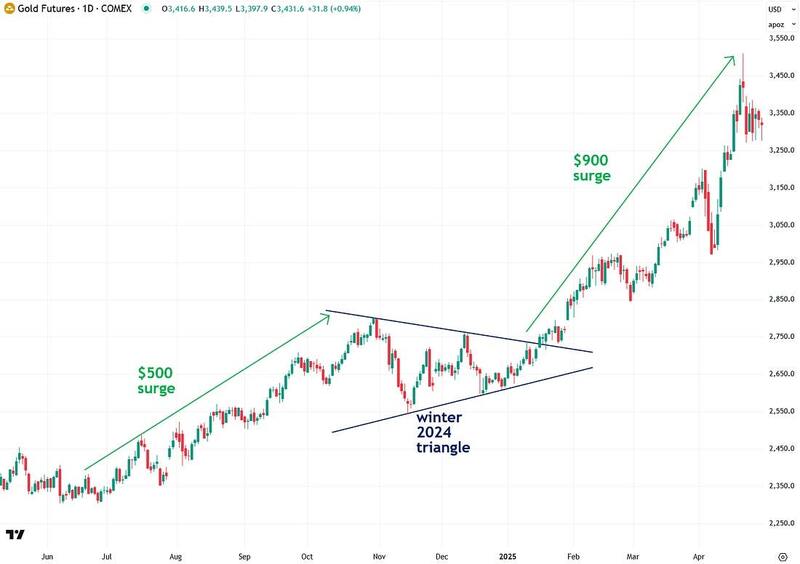
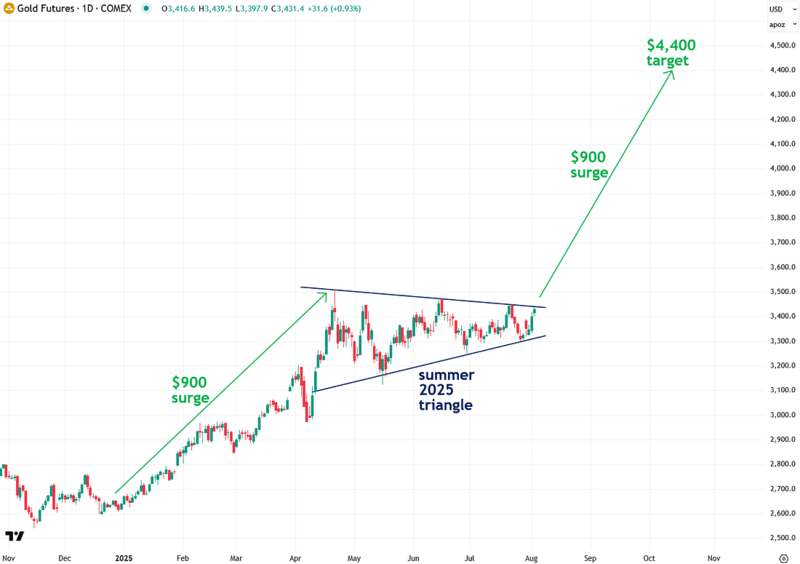
I’m now seeing clear similarities to the price action we saw in November and December, when gold also moved sideways for a time before launching a dramatic $900 rally in early 2025.
Let’s begin by revisiting gold’s behavior in the winter of 2024, when it formed a triangle pattern that ultimately led to an impressive $900-per-ounce rally:
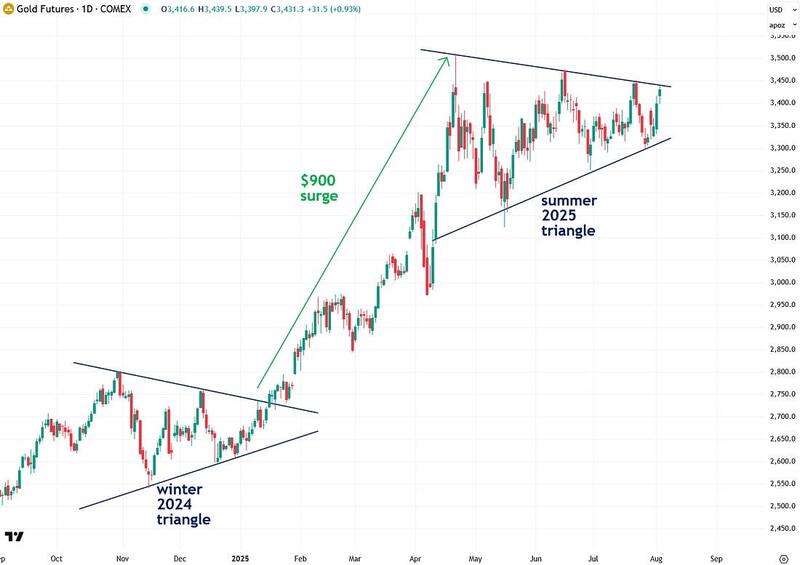
Now take a look at gold’s current chart below and observe the triangle pattern that has taken shape over the past few months. It looks remarkably similar to the one that formed in November and December.
It’s also worth noting that this pattern has developed during the summer—a time typically marked by lighter news flow and reduced trading volume, as much of the financial world is in vacation mode. Since volume is the lifeblood of financial markets, this seasonal lull makes the current setup all the more significant.
To confirm my theory that gold is on the verge of another powerful rally, we need to see a decisive breakout from the current triangle pattern accompanied by strong volume.
The return of Wall Street in September is likely to coincide with the move and provide the necessary fuel to propel it higher. Again, this bullish scenario will remain unconfirmed until a clear breakout occurs.
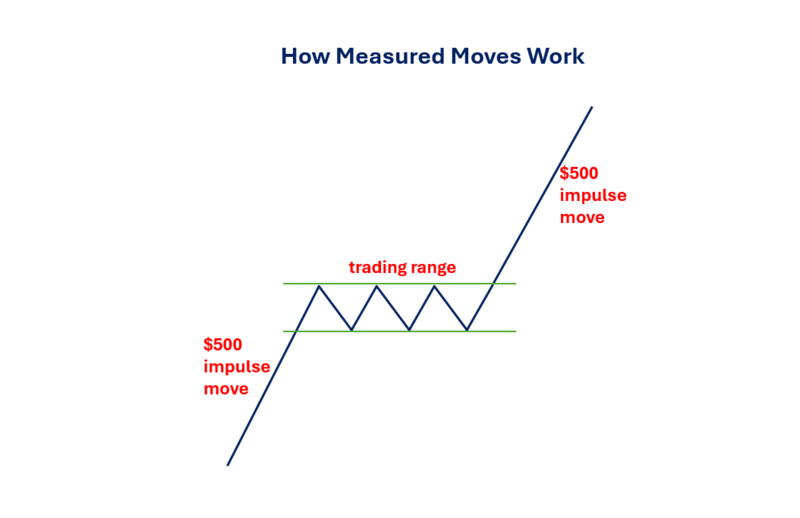
Interestingly, there’s an effective way to estimate how far gold is likely to rally once it breaks out of its current triangle pattern. It involves a principle in technical analysis known as the measured move. This technique projects a potential price target based on the size of the prior move and often proves to be remarkably accurate.
I created the diagram below to illustrate how measured moves work. It begins with an initial impulse move—such as the $500 advance shown in the example. After that surge, the market or asset pauses to consolidate its gains. This consolidation phase can take various forms, such as a sideways trading range or a triangle pattern.
Once the consolidation is complete, the asset breaks out and resumes its rally, typically rising by an amount equal to the initial move—in this case, another $500. It’s a straightforward concept, but a powerful one.
So let’s return to the current triangle pattern in gold and examine how high it could rally using the measured move principle. The rally from January to April, which led into the current consolidation, was $900 per ounce.
According to this method, a breakout from the triangle would likely produce a similar $900 move—bringing gold to an impressive target of approximately $4,400, representing a very respectable 28% gain. It’s also worth noting that both JPMorgan and Goldman Sachs expect gold to reach $4,000 by 2026, so the $4,400 target is hardly far-fetched.
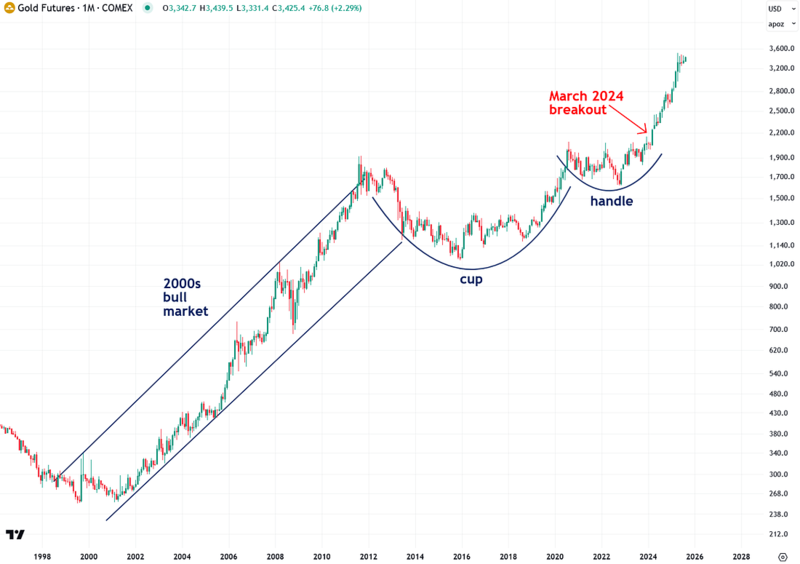
Another reason the $4,400 price target for gold isn’t far-fetched is that, in March 2024, gold broke out of a massive cup and handle pattern that dates all the way back to 2011.
Given the scale of that pattern, it indicates that gold’s bull market still has significant room to run. Historically, gold bull markets typically last a decade or more, as shown by the 2000s bull market highlighted in the chart below.
Now that I’ve outlined the technical case for a potential gold rally, I’d like to turn to several key fundamental factors that also support this outlook. The most immediate is the sharp increase in the odds of a U.S. Fed Funds rate cut in September—rising from around 45% to approximately 75% following Friday’s surprisingly weak jobs report.
The report showed that only 73,000 jobs were created in July, well below the 104,000 estimate. To make matters worse, employment figures for May and June were revised down by a combined 258,000, revealing that the labor market is much weaker than previously believed. The surging rate cut odds are bullish for gold and bearish for the U.S. dollar.
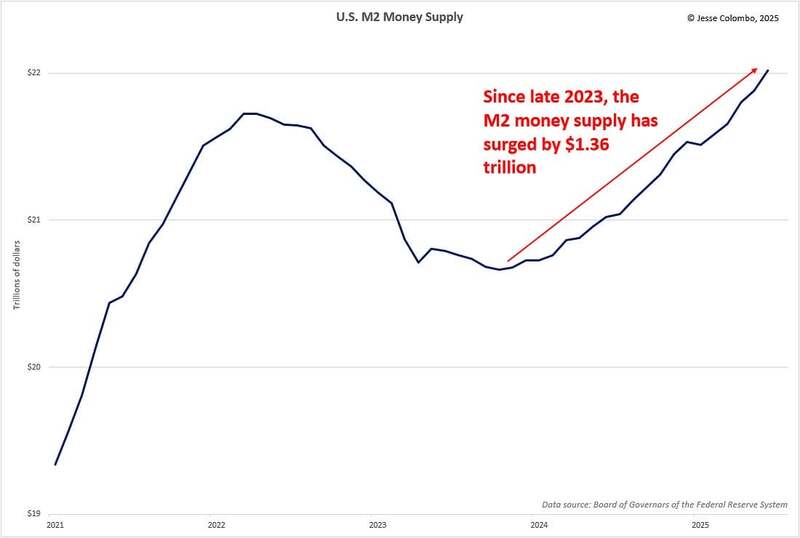
In addition, a major but often overlooked factor driving gold’s bull market since early 2024 has been the renewed expansion of the U.S. money supply, following a rare contraction in 2022 and 2023. Since bottoming in late 2023, the U.S. M2 money supply has surged by an alarming $1.36 trillion, reaching a record $22 trillion.
There is little reason to believe this trend will slow anytime soon. A rising money supply is the primary driver of inflation, and gold tends to respond strongly, often rising in tandem. Importantly, this is not just a U.S. issue but a global one.
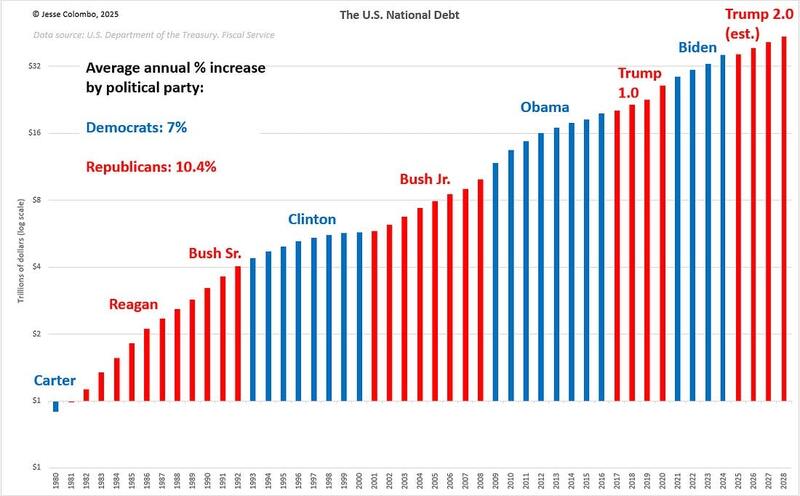
Another major source of fuel for gold’s ongoing bull market is the expected continued rise of the U.S. national debt. The debt has already reached a record high of $37.19 trillion and will easily exceed $40 trillion within the next few years, continuing a long-term upward trend.
This trajectory is expected to accelerate under the Trump administration’s One Big Beautiful Bill Act, which will add $3.4 trillion to the debt over the next decade and more than $4 trillion when accounting for additional interest costs.
As the chart below shows, both major U.S. political parties have consistently contributed to the rising national debt. They may differ in how they choose to spend, but the end result is the same: growing deficits. In that sense, it hardly matters who is in office, as both are bullish for gold.
Further fueling gold’s continued rise is the insatiable demand from global central banks, which are increasingly diversifying their reserves into hard assets, which is a wise move. This strategy is intended to hedge against the surging global money supply, persistent inflation, and the mounting economic risks associated with historically high debt levels worldwide.
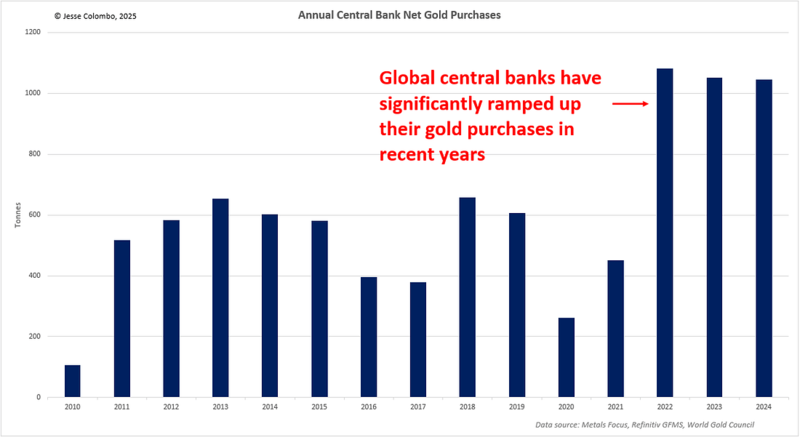
Since the 2020 COVID-19 pandemic, central banks around the world have significantly ramped up their gold purchases, averaging just over 1,000 tonnes per year in 2022, 2023, and 2024. This marks a dramatic increase of roughly double the annual average of about 500 tonnes in the preceding decade.
Moving along, a nascent capital rotation out of the overvalued U.S. stock market and into gold is emerging as a major driver of gold’s bull market, and it’s only just getting started.
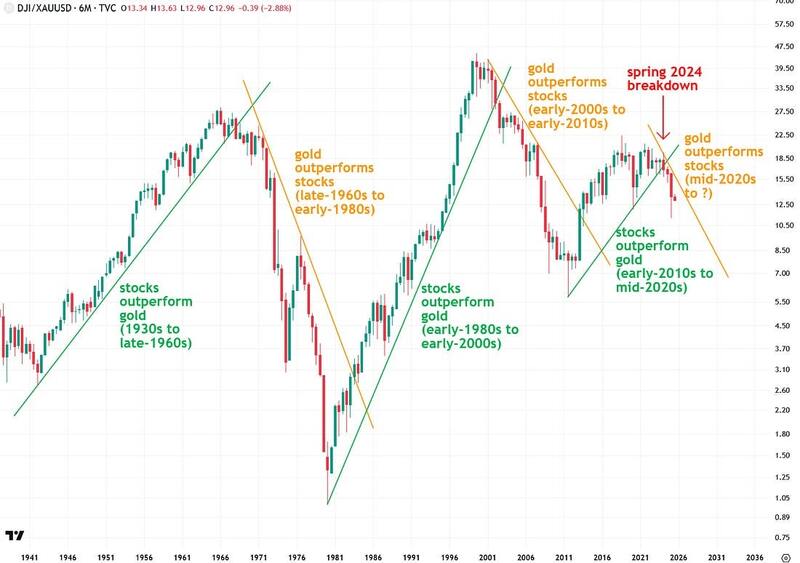
To understand capital rotation and the dynamic between stocks and gold—two essentially competing asset classes—it’s helpful to examine the long-term chart of the Dow-to-gold ratio, which is calculated by dividing the Dow Jones Industrial Average (DJIA) by the price of gold.
I focus on the Dow because it offers the longest historical data, but the same analysis can be applied to other stock indices, including international ones like Japan’s Nikkei and the UK’s FTSE 100.
The Dow-to-gold ratio chart I’ve created below spans all the way back to the early 1940s, using 3-month bars and a logarithmic price scale. When the ratio is rising, it indicates that stocks are outperforming gold; when it’s falling, gold is outperforming stocks. This chart is a powerful tool because it respects trendlines remarkably well—so much so that when the ratio breaks a key trendline, it signals the beginning of a new capital rotation era.
Stocks outperformed gold during several major periods: from the 1930s to the late 1960s amid the post–World War II economic boom, during the powerful bull market from 1982 to 2000, and again from 2012 to 2024 following the Great Recession.
Conversely, gold outperformed stocks during the stagflationary years of the late 1960s through the early 1980s, and again in the dot-com bust era from the early 2000s to the early 2010s.
Notably, a new era began in the spring of 2024 when the Dow-to-gold ratio broke below the uptrend line that had been in place since 2012. This breakdown signals a major shift: a powerful wave of capital flowing out of stocks and into gold—sending gold much higher from here, with silver riding that wave as well.
It’s also important to note that these capital rotation cycles typically last 10 to 15 years. That means we’re still in the early innings of a precious metals bull market—and the early stages of a prolonged period of underperformance for stocks.
What will further supercharge this capital rotation from stocks into gold is the extreme overvaluation of the U.S. stock market, which is clear evidence of a bubble of unprecedented magnitude. This indicates that a significant amount of capital will transfer into gold over the coming decade.
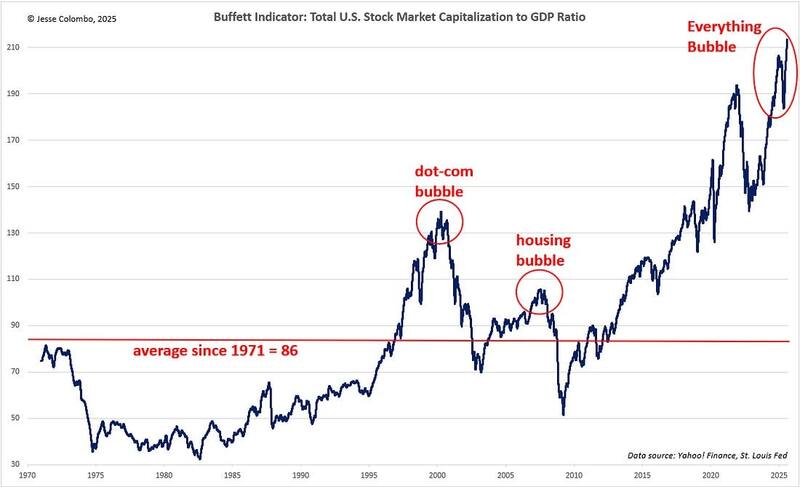
Virtually every major valuation metric confirms that stocks are in the midst of a massive bubble, but the one I want to highlight today is the “Buffett Indicator.”
This metric, which compares the total U.S. stock market capitalization to GDP, is a simple but highly reliable gauge of market valuation. It is named after billionaire investor Warren Buffett, who has called it “the best single measure of where valuations stand at any given moment.”
Currently, the Buffett Indicator stands at a staggering 214, which is 149% above its long-term average of 86, dating back to 1971. This level is even higher than the peak of the late-1990s dot-com bubble, which ended in a devastating crash.
Buffett himself warned that when the ratio approaches 200%, investors are “playing with fire.” The reason for this extreme valuation is that the stock market has surged far beyond the growth of the actual economy, a classic hallmark of speculative excess.
History has shown that valuations eventually revert to the mean, making the market highly vulnerable to a sharp and violent downturn. Given the current extremes, the risk of a major bear market is not a question of if, but when—and when it arrives, it will propel gold into the stratosphere.
Based on this and the other factors discussed in this piece, I believe gold will reach at least $15,000 per ounce in the next decade.
Finally, another major reason I believe gold’s bull market still has plenty of life left in it, and why the $4,400 price target could be easily reached, is that despite gold’s impressive 71% gain so far, the rally has been driven primarily by central banks and overseas investors, particularly in Asia. American and other Western investors have only entered the market in a tepid way so far. As their participation strengthens, the resulting influx of capital will supercharge gold’s bull market.
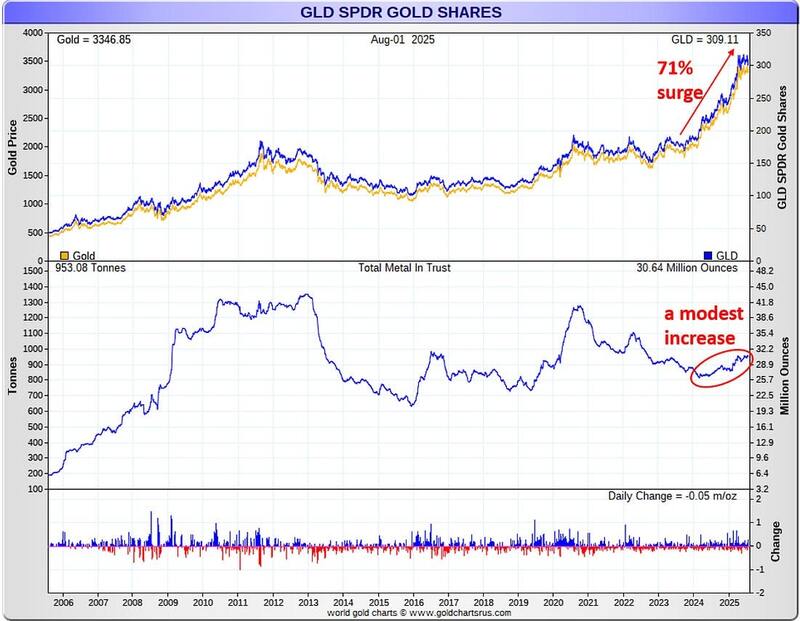
A prime example of this dynamic is the SPDR Gold Shares (GLD), the most popular American gold ETF and a widely used proxy for U.S. investor interest in gold.
Although the current bull market has been underway for a year and a half, GLD’s holdings have increased only modestly, rising just 16% to 953 tonnes. This remains well below the 2012 peak of approximately 1,350 tonnes, when gold was trading about 42% lower near the $2,000 level.
The implication is clear: when American investors eventually pour into gold ETFs and other gold vehicles, it will give the bull market a tremendous shot in the arm.
To wrap things up, I firmly believe that gold’s bull market is still in its early stages, with a wide range of powerful forces poised to drive it even higher.
These include the weakening U.S. job market and rising odds of interest rate cuts, renewed growth in both the U.S. and global money supply, the relentless increase in the U.S. national debt, continued strong gold buying by central banks, the beginning of a major capital rotation out of the highly inflated U.S. stock market, and a large amount of untapped buying power from U.S. investors who are only now beginning to re-engage with gold.
In the near term, I’m closely watching the triangle pattern that has developed in recent months, and I’m now waiting for confirmation of this thesis through a decisive breakout that is likely to propel gold well above $4,000.
All in all, these are incredibly exciting times to be a precious metals investor, and I believe gold and silver are positioned to be among the best-performing assets over the next decade.
If you found this report valuable, click here to subscribe to The Bubble Bubble Report for more content like it.
Jesse Colombo is a financial analyst and investor writing on macro-economics and precious metals markets. Recognized by The Times of London, he has built a reputation for warning about economic bubbles and future financial crises. An advocate for free markets and sound money, Colombo was also named one of LinkedIn’s Top Voices in Economy & Finance. His Substack can be accessed here.
(Thérèse Boudreaux, The Center Square) After weeks of stalling, Democratic leaders are finally expressing willingness to engage with Republicans in the government funding process – but they’re wielding Medicaid as a bargaining chip.
Congress has until Sept. 30 – the end of fiscal year 2025 – to pass all 12 annual appropriations bills that provide funding for federal agencies to spend on programs. If lawmakers do not pass all 12 in some form through both chambers of Congress, they risk a government shutdown.
Both chambers of Congress are in recess and will not return until September. But Senate Minority Leader Chuck Schumer, D-N.Y., and House Minority Leader Hakeem Jeffries, D-N.Y., sent a letter Monday to congressional Republican leaders, urging a so-called “Big Four” meeting to “discuss the government funding deadline and the health care crisis.”
“The Senate recently demonstrated that Congress is still able to achieve bipartisan appropriations legislation for the American people when the legislative process is permitted to work,” the lawmakers wrote, referring to the bipartisan passage of a “minibus” Friday night that combined three of the appropriations bills into one package.
“Today, we wish to reiterate that we should pursue a bipartisan path – you can work with us to protect health care for the American people and chart a better course for this country,” Schumer and Jeffries continued.
While Democrats are accusing Republicans of “rebuffing bipartisanship,” Republicans have accused them of acting based on “reflexive anti-Trump sentiment.”
Republicans originally planned to tackle the government funding process soon after the One Big Beautiful Bill Act became law in early July. Among hundreds of other policy changes, the massive budget reconciliation bill targets Medicaid fraud and abuse. It enforces work requirements on able-bodied adults without dependents, rescinds Medicaid eligibility for noncitizens residing illegally in the country, and cracks down on dual enrollment.
Despite Democratic concerns to the contrary, the changes do not make a dent in overall federal spending on Medicaid – which is still set to increase by more than $200 billion by 2034 – but merely slow spending growth. They also won’t kick any vulnerable populations off healthcare coverage, according to an analysis by the nonpartisan Congressional Budget Office.
Now, Schumer and Jeffries are continuing to press Senate Majority Leader John Thune, R-S.D., and House Speaker Mike Johnson, R-La., as the government shutdown deadline looms.
“As Leaders of the House and Senate, you have the responsibility to govern for all Americans and work on a bipartisan basis to avert a painful, unnecessary shutdown at the end of September,” they wrote. “Yet it is clear that the Trump Administration and many within your party are preparing to ‘go it alone’ and continue to legislate on a solely Republican basis.”
While the lawmakers have not yet laid out specific demands, their emphasis on the upcoming healthcare changes suggests Democrats will haggle for repealing as many Medicaid reforms in the OBBBA as possible.
The minibus still needs to receive House approval. If Congress is unable to pass all 12 appropriations bills by Sept. 30, they will likely pass a short-term Continuing Resolution, or CR, to keep government funding on cruise control until all appropriations bills are finalized. If the minibus (or other appropriations bills) pass both chambers by the deadline, the CR would apply to the remaining federal agencies.
If a CR happens, lawmakers will have punted on funding the government properly for the fourth time in a row. Congress never passed a fiscal year 2025 budget, instead passing three consecutive CRs to keep government funding on cruise control until Sept. 30.
(Dave DeCamp, Antiwar.com) House Speaker Mike Johnson (R-LA) traveled to the West Bank on Monday to visit a Jewish settlement considered illegal under international law, a strong show of support for the Israeli occupation of the Palestinian territory.
According to Ynet, the trip was organized by the Yesha Council settler lobby in coordination with the US-Israel Education Association, a pro-Israeli advocacy group. The trip makes Johnson the first sitting House speaker to visit the West Bank.
During his visit to the Ariel settlement in the central West Bank, Johnson declared that the Jewish people have the “right” to the Palestinian territory, which he referred to as Judea and Samaria, using the biblical name.
Mike Johnson delivers a humiliation speech at the Wailing Wall in Israel.
He says the Bible commands Christians to always stand with Israel, a nation founded in 1948 by the Rothschilds. pic.twitter.com/M4a0Q8YBul
“Every corner of this land is important to us. It is an integral part of our faith, and therefore the significance for us is great… We stand entirely by your side,” Johnson said, according to a statement from the settlement’s municipal authority.
“Scripture teaches us that the mountains of Judea and Samaria were promised to the Jewish people, and they belong to them by right. But many people around the world do not see it like this, they label it the ‘occupied territories’ or the ‘West Bank’ or any other name,” Johnson added.
Johnson was joined in his delegation by Reps. Michael McCaul (R-TX), Nathaniel Moran (R-TX), Michael Cloud (R-TX), and Claudia Tenney (R-NY), as well as Arkansas Governor Sarah Huckabee Sanders and her father, US Ambassador to Israel Mike Huckabee. Both Johnson and Huckabee are known for their Christian Zionist views and their belief that God gave historic Palestine to the modern state of Israel, a theology that’s rejected by the majority of Christian denominations.
During the visit, Yisrael Gantz, chair of the Yesha Council, asked the US politicians for their support in advancing the goal of the Israeli annexation of the West Bank. “Today, we present to you a diplomatic initiative calling to apply the sovereignty of the State of Israel over Judea and Samaria and declare to the whole world that the territories of Judea and Samaria are once again an eternal part of the Jewish state,” he said.
There’s no sign that during the visit, Johnson raised the issue of two US citizens who were murdered by Jewish settlers last month or the recent settler violence against Taybeh, a West Bank village that’s populated entirely by Christians.
Israeli officials told Axios that Johnson and his delegation are also expected to travel to Gaza and visit distribution sites run by the US-backed Gaza Humanitarian Foundation (GHF), which are death traps for desperate Palestinians seeking aid. The US representatives are also set to meet with Israeli Prime Minister Benjamin Netanyahu. An Israeli official said Johnson is going to spend an “unusually long” amount of time in Israel and won’t leave until August 10.
(Bethany Blankley, The Center Square) After no quorum was reached in the Texas House on Monday, House Speaker Dustin Burrows voted for and signed motions the House passed requiring the return of 56 missing Democrats. This included Burrows signing civil warrants for their arrest and directing the sergeant of arms to find those in Texas and bring them back to the capitol.
Those who absconded out of the state can only be arrested by Texas law enforcement within state lines, which is why dozens of Democrats left the state Sunday to halt a vote on a congressional redistricting effort that could flip up to five seats from blue to red.
However, when asked if Burrows would accept assistance from the Trump administration to arrest Democrats who went to Illinois and New York, he replied, “we will do whatever we need to do to continue this important work. There is nothing off the table.”
Gov. Greg Abbott also directed Texas Department of Public Safety troopers to assist with their arrest and return to the capitol, The Center Square reported.
On Sunday, dozens of House Democrats announced “the special session was over” in opposition to Texas redistricting efforts and left the state. The legislature had convened on July 21 for 30 days to address 18 legislative items, including funding and policy changes related to the historic July 4 deadly flood event. On Saturday, a House committee passed a redistricting bill that was scheduled for a vote on Monday. By absconding, House Democrats delayed the vote.
Sunday night, Abbott ordered that they return to Austin or they would be arrested and potentially removed from office. He also said those who were fundraising were potentially committing bribery.
Democrats who fled “abandoned their posts, and turned their backs on the constituents they swore to represent,” Burrows said. “They’ve shirked their responsibilities under the direction of pressure of out-of-state politicians and activists who don’t know the first thing about what’s right for Texas.”
After signing the civil arrest warrants, Burrows held a news conference saying the House had important work that needed to be done.
“We encountered unprecedented flooding in the Hill Country. We have members of committees who have met not only in Austin to meet with the relevant state officials, but also the families,” he said. They’ve been working on legislation that has been filed, referred, and will be heard,” he said. The bills relate to funding for flood victims but also policy changes to implement to help with future floods.
Other issues include eliminating the STAAR test, property tax reform, human trafficking penalties and protections, among others the governor put on the call for the special session.
He also explained that lawmakers not working is not optional.
Pursuant to the Texas Constitution, “the governor gets to set the agenda, and the constitution says the members of the legislature shall show up to do their jobs,” Burrows said. “I am proud of the members who are here. It was bipartisan. I am hopeful there’ll be more members here tomorrow.
“But I am disappointed that while these members are here reporting for their duty under the Constitution, others are out of the state in New York and Chicago, in places they do not represent.”
He also said that while the work of the House may be delayed, “whether it’s tomorrow or next week, the House will complete its required duties.”
Authorities will be arresting members who are in the state, including one who announced a fundraiser in Austin on Tuesday, Burrows said. He sent the information “to DPS and said they should be invited to attend as well,” he said.
Abbott on Monday afternoon also directed the Texas Rangers to “immediately investigate fleeing Texas House Democrats for potential bribery and any other potential legal violations connected to their refusal to appear for a quorum, conduct business, and cast votes. That investigation should extend to anyone who aided or abetted such potential crimes.”
Based on statements Democrats made in news conferences and posts on social media, many solicited or claimed to receive funds to evade conducting legislative business and casting votes. “Under the Texas Penal Code, any of those Democrats who solicit, accept, or agree to accept such funds to assist in the violation of legislative duties or for purposes of skipping a vote may have violated bribery laws,” Abbott said. “Also, it could be a bribery violation for any other person who offers, provides, or agrees to provide such funds to fleeing Democrat House members.”
The House is scheduled to convene on Tuesday at 1 pm.
(Ken Silva, Headline USA) The New York Times published new photos on Tuesday of Jeffrey Epstein’s Manhattan mansion, including one indicating that the deceased sex trafficker once had a bet with billionaire Bill Gates.
Among the photos released by the Times is a framed dollar signed by Gates, with the caption, “I was wrong!” The Times said it was “possibly” a payment of a bet, but didn’t provide any more details.
Epstein also had a framed dollar signed by Bill Gates with the caption "I was wrong!" What do you think he was wrong about? Also, is that who I think it is on the top right? https://t.co/GgaVAyS1Kypic.twitter.com/c1jEQ7hTOU
Epstein and Gates infamously maintained their friendship even after the former was convicted of sex crimes against minors in 2008.
“In retrospect, I was foolish to spend any time with him, and he sort of got time with various people by spending time with other people,” Gates, who has denied criminal wrongdoing, told Wall Street Journal editor-in-chief Emma Tucker earlier this year. “I think I was quite stupid. I thought it would help me with global health, philanthropy. In fact, it failed to do that, and it was just a huge mistake.”
The framed dollar wasn’t the only new photo published by the Times. Also pictured in Epstein’s mansion was a framed photo of billionaire Elon Musk, who’s accused President Donald Trump of being on the “Epstein client list.”
According to the Times, Epstein also had a map of Israel drawn on a chalkboard with the signature of former Israeli Prime Minister Ehud Barak—who reportedly wrote a letter to Epstein in 2016, telling him that “you are like a closed book to many of them but you know everything about everyone.” The Times didn’t publish photos of the map or the letter.
Additionally, Epstein had two framed photos of MAGA commentator Steven K. Bannon, including a selfie of the two. The Times didn’t publish the selfie, but a photo of someone resembling Bannon appears in the same picture that shows the Gates dollar bill.
Additionally, the Times published a letter from director Woody Allen, describing how dinners at Epstein’s reminded him of Dracula’s castle, “where Lugosi has three young female vampires who service the place.”
The new information about Epstein is coming amidst calls for the Trump administration to release all records the government has about him. Many researchers suspect that Epstein was running a sexual blackmail operation on the behalf of one or more intelligence agencies, which was why he was allowed to operate with impunity for decades.
Ken Silva is the editor of Headline USA. Follow him at x.com/jd_cashless.
(Kyle Anzalone, Libertarian Institute) Washington is boosting its military presence on the Korean Peninsula by creating another super squadron near the demilitarized zone. The move follows North Korea saying it will only engage in talks with the US if Washington drops its demand that Pyongyang give up its nuclear weapons.
The US has relocated 31 F-16s from Kunsan Air Base to Osan Air Base. A statement from the Department of Defense saysthe goal is to “consolidate air power and increase combat capability on the Korean Peninsula.”
The Pentagon says this is the second “super squadron” in South Korea.
Last week, Pyongyang ruled out talks with Washington unless the US dropped its demand that North Korea give up its nuclear weapons. Kim Yo-jong, sister to North Korean Supreme Leader Kim Jong-un, said, “Any attempt to deny the position of the DPRK as a nuclear weapons state which was established along with the existence of a powerful nuclear deterrent and fixed by the supreme law reflecting the unanimous will of all the DPRK people will be thoroughly rejected.”
“I do not want to deny the fact that the personal relationship between the head of our state and the present US president is not bad,” she explained. “However, if the personal relations between the top leaders of the DPRK and the United States are to serve the purpose of denuclearization, it can be interpreted as nothing but a mockery of the other party.”
Kim also said that North Korea was unwilling to engage in direct talks with South Korea. “We clarify once again the official stand that no matter what policy is adopted and whatever proposal is made in Seoul, we have no interest in it and there is neither the reason to meet nor the issue to be discussed with the ROK,” Kim said, according to North Korean state media.
This article originally appeared at The Libertarian Institute.
According to Ynet, President Trump has given Netanyahu a “green light to launch a more aggressive military operation against Hamas in Gaza.”
A source in Netanyahu’s office told The Jerusalem Post that Netanyahu had reached a decision on the full occupation and plans to order military operations in areas where Israel believes its captives are being held by Hamas. “The die is cast — we are going for a full occupation of the Gaza Strip,” an Israeli official told Ynet.
The Israeli military has previously pushed back against plans for a full occupation, but Netanyahu’s message to IDF Chief of Staff Eyal Zamir is that if he doesn’t like it, he should quit. “There will be operations even in areas where hostages are being held. If the IDF chief of staff doesn’t agree, he should resign,” the Israeli official said.
Netanyahu is set to convene his cabinet on Tuesday, where he will seek approval for the planned escalation. The Israeli military currently controls about 75% of Gaza, and under the new plan, it will work to capture the remaining territory to bring the entire Strip under Israeli control. Israeli reports from last week said that Netanyahu was planning to propose a plan to start annexing territory in Gaza.
The Israeli media reports on Monday did not say what would become of the Palestinian civilians living in the areas currently not occupied by Israel. Israeli officials previously announced a plan to build a concentration camp in a tiny area of southern Gaza with the goal of forcing the entire civilian population into it.
Netanyahu and his government have made clear that their ultimate goal is the removal of the Palestinian population of Gaza, which they now call the “Trump plan.” But so far, there’s been no indication that any regional countries are willing to take in a sizeable amount of Palestinians to facilitate the ethnic cleansing.
The Trump administration has shown no interest in pressuring Israel to end its genocidal war and reach a deal with Hamas, which the US could do by leveraging military aid. While Israeli officials are now claiming Hamas doesn’t want a deal, the group has long said it is willing to release all remaining Israeli captives in exchange for a permanent ceasefire.