US-Funded Hunger Monitor Concurs With UN-Backed IPC That Famine Is Occurring in Gaza

(Dave DeCamp, Antiwar.comA US government-funded hunger monitor has concurred with the UN-backed Integrated Food Security Phase Classification (IPC) that famine is taking place in the Gaza Strip.

The Famine Early Warning Systems Network (FEWS Net), which has historically been funded by the US Agency for International Development (USAID), issued a report on August 22, the same day as the IPC report, stating that famine is ongoing in the Gaza Governorate, which includes Gaza City.

The FEWS Net and IPC reports said that famine is also likely occurring in the North Gaza Governorate and that the situation may even be worse there, but that it couldn’t be officially confirmed due to the lack of data. The report said that famine is projected to begin in the Khan Younis and Deir el-Balah Governorates by the end of September unless immediate action is taken.

“FEWS NET’s classification of current or projected Famine (IPC Phase 5) in three governorates was reached jointly with the Integrated Phase Classification (IPC) partnership and independently reviewed by the Famine Review Committee (FRC),” FEWS Net said in its report.

The FEWS Net report also made clear that Israel was responsible for the famine in northern Gaza and cited the Israeli government’s own data to say that no food was allowed into the area from March to May. “After 22 months of war, repeated mass displacements, the destruction of nearly all essential infrastructure, and extreme restrictions on the entry of food, northern Gazans have long exhausted their coping capacity,” Fews Net said.

The US-funded hunger monitor also said that Israel’s plans to take over Gaza City will only make the situation worse. “The confinement of the population, density of overcrowding amid scarce shelter, and increasing strain on extremely limited humanitarian and healthcare services are all expected to worsen in the lead-up to Israel’s plan to forcibly displace the entire population of Gaza City by October,” FEWS Net said.

The report noted the killing of Palestinians near aid distribution sites run by the US-backed Gaza Humanitarian Foundation, an effort strongly supported by the Trump administration. “Over 700 deaths linked to the distribution of aid were reported across the Gaza Strip in July alone, including 390 in or near GHF distribution sites in the south,” FEWS Net said.

Antiwar.com asked the State Department if it agreed with or rejected the findings of FEWS Net. A State Department spokesperson pointed to President Trump’s earlier comments that “starvation” was taking place in Gaza and said that the administration will “neither use nor legitimize data from the Hamas-controlled Gaza Health Ministry (GHM) and we are seeking clarification on if and how any of that was used in IPC reporting.”

The Famine Review Committee report on the famine determination listed Gaza Health Ministry mortality data as one of its many sources used to determine that famine was taking place, noting that surveys and indirect evidence suggest the ministry’s numbers are likely a significant undercount, which aligns with studies of the death toll in Gaza.

“Multiple surveys of the population in Gaza indicate that the Ministry of Health facilities-based mortality fails to fully capture non-trauma mortality,” the report reads. “The high numbers of malnourished children and mothers of young children unable to access appropriate diets or nutrition treatment, in combination with environmental conditions detailed in this report, are known to exacerbate fatality rates among the malnourished. These indirect sources of evidence indicate a much higher mortality rate than malnutrition deaths reported by the Ministry of Health, providing reasonable evidence that mortality thresholds for famine have been passed.”

While the State Department didn’t outright reject the report, US Ambassador to Israel Mike Huckabee has boosted Israel’s claims that the IPC report was an “outright lie.”

FEWS Net was suspended by the Trump administration during its review of foreign aid, but was relaunched back in June. The hunger monitor was first established by USAID in the 1980s and is now likely funded directly by the State Department since the Trump administration has merged USAID’s remaining operations with the State Department.

Last year, FEWS Net issued a report warning that famine was imminent in northern Gaza due to an Israeli blockade, but it was retracted due to pressure from the Biden administration. Then-US Ambassador to Israel Jack Lew blasted the report as “irresponsible.”

This article originally appeared at Antiwar.com.

 

Report: ‘Dark Money’ Group Funding Pro-Democrat Influencers

(Luis Cornelio, Headline USA) Those social media influencers pushing Democratic talking points? They may have been paid off by a shady group funded by dark money.

A secretive group called Chorus has paid influencers as much as $8,000 each in exchange for pro-Democrat videos, according to bombshell WIRED reporting.

WIRED reported Wednesday that the operation, dubbed “Chorus Creator Incubator Program,” is funded by none other than the Sixteen Thirty Fund—a non-profit that has funneled hundreds of millions in pro-leftist causes.

Founded in 2009, the group is a “liberal response to conservative dark money groups and organizations like the Koch network,” according to WIRED. As a 501(c)(3), the group is not required to disclose its donors, who conveniently get tax breaks for their partisan donations.

Some of the influencers tied to the operation boast a combined 13 million followers across Big Tech platforms. This number is much higher as over 90 creators are making Democrat-friendly content for cash.

The money-for-videos scheme is shocking. After years of railing against so-called dark money, the left is now eagerly cashing in without even knowing who’s footing the bill.

Worse, Chorus allegedly forbade the influencers from publicly speaking of the operation or even disclosing to their followers that they are being paid by shady money.

These influencers also must seek prior approval before posting political videos or interviewing lawmakers. This is likely to ensure that the content is in line with approved talking points.

WIRED reported the group even boasted about bypassing Federal Election Commission rules by concealing payments through a non-profit entity, all while working to elect Democrats.

“There are some real great advantages to … housing this program in a nonprofit,” Chorus lawyer Graham Wilson reportedly said in a Zoom meeting. “It gives us the ability to raise money from donors. It also, with this structure, it avoids a lot of the public disclosure or public disclaimers—you know, ‘Paid for by blah blah blah blah’—that you see on political ads. We don’t need to deal with any of that. Your names aren’t showing up on, like, reports filed with the FEC.”

The operation has been active for several weeks, following Democrats’ humiliating defeat in the 2024 election, as President Donald Trump dominated independent podcasts and online shows. The difference is he didn’t have to pay for it.

As summarized by WIRED, among the influencers are “Olivia Julianna, the centrist Gen Z influencer who spoke at the 2024 Democratic National Convention; Loren Piretra, a former Playboy executive turned political influencer who hosts a podcast for Occupy Democrats; Barrett Adair, a content creator who runs an American Girl Doll–themed pro-DNC meme account; Suzanne Lambert, who has called herself a ‘Regina George liberal;’ Arielle Fodor, an education creator with 1.4 million followers on TikTok; Sander Jennings, a former TLC reality star and older brother of trans influencer Jazz Jennings; David Pakman, who hosts an independent progressive show on YouTube covering news and politics; Leigh McGowan, who goes by the online moniker ‘Politics Girl’; and dozens of others.”

Chorus co-founder and social media personality Brian Tyler Cohen issued the following video in response to the backlash, describing the operation as nothing but a “scholarship” program:

FBI Director’s Girlfriend Sues Ex-Agent over Unsubstantiated Claim That She’s a Former ‘Mossad Agent’

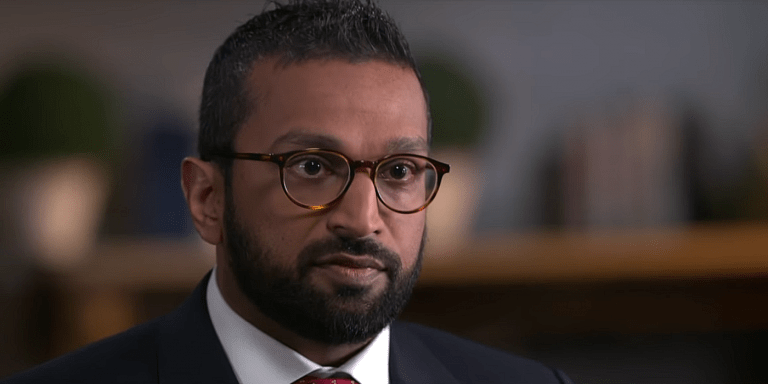
(Ken Silva, Headline USA) FBI Director Kashyap Patel’s girlfriend, country music singer and conservative commentator Alexis Wilkins, has filed a lawsuit against former bureau agent Kyle Seraphin over his unsubstantiated claim that she’s a former agent for the Mossad—Israel’s national intelligence agency.

Seraphin made the claim on last Friday’s episode of his online show. The clip went viral on Tuesday.

“[FBI Director Kash Patel] has had his own little ‘honeypot’ issue that’s been going on of late, so we’re just going to acknowledge it real publicly. He’s got a girlfriend that is half his age, who is apparently is both a country music singer, a political commentator on Rumble, a friend of John Rich through [Dan] Bongino, who also now owns a big chunk of Rumble, and she’s also a former Mossad agent in what is like the equivalent of their NSA,” Seraphin said.

“But I’m sure that’s totally because, like, she’s really looking for like a cross-eyed, you know, kind of thickish built, super cool bro who’s almost 50 years old who’s Indian in America.”

In her lawsuit, Wilkins, 26, blasted Seraphin over his allegations. She noted that she’s a Christian and a U.S. citizen who’s never been to Israel. She also said she’s been in a “long-term” relationship with Patel since January 2023. Seraphin didn’t mention Wilkins by name, but she said his reference to her was obvious.

“He is accusing Ms. Wilkins of being a spy for a foreign government, conducting espionage to undermine our national security and/or to manipulate federal law enforcement at the highest level, and even committing treason. These accusations are all categorically false, and Defendant knows it,” her lawsuit says.

“Defendant cannot even claim ignorance or negligence, because he has personally met Ms. Wilkins with Mr. Patel at a conservative political event roughly two years ago, and was specifically aware from that encounter that Ms. Wilkins was in a relationship with Mr. Patel, who was not the FBI director at that time.”

Wilkins is seeking $5 million. She says Seraphin’s comments damaged “her fitness to perform her occupation as a patriotic, country music artist, and as a patriotic, conservative commentator for a company like PragerU.”

The rumors about Wilkins stems from her work for PragerU, which constantly pumps out pro-Israel propaganda. PragerU’s CEO, Marissa Streit served in Unit 8200—Israel’s equivalent of the NSA—and its founder, Dennis Prager, has gone on secret missions on behalf of Israel. Prager has talked about Israel sending him on a secret mission to smuggle Jewish artifacts into the Soviet Union when he was 20 years old.

However, there is no evidence that Wilkins is an intelligence agent, Mossad or otherwise.

Seraphin responded to the lawsuit Thursday night on Alex Jones’s show.

Seraphin’s comments about her are his latest in a string of attacks on Patel—some of them more legitimate than others.

Seraphin said last month that Patel is a closed homosexual who parties all night and shows up for work late.

Patel was recently revealed to be living with GOP donor Michael Muldoon in the billionaire’s Las Vegas home—an arrangement that’s raising some eyebrows within the bureau, according to Seraphin.

“The other question I’ve had people bring up … including people who are pro-Trump … They don’t know a lot of 50- or 40-something-year-old Indian men that are unmarried and living with other men that don’t have something going on,” Seraphin recently said on the show Redacted, hosted by Clay Morris.

“There’s rumors passing around the FBI that have kind of intimidated that this may be more than just two men living together, which by the way, for two men in their 40s and 50s is a pretty strange circumstance.”

Patel’s lawyer hasn’t responded to Headline USA’s media inquiry about Seraphin’s comments.

Since taking the helm at the bureau, Patel flip-flopped on domestic surveillance and now supports warrantless spying, he’s backtracked on releasing the Jeffrey Epstein files, and he hasn’t exposed the U.S. government’s involvement in the Jan. 6, 2021, protests-turned-riots.

Patel’s also pushed for a bigger budget for the FBI, insisted that Epstein killed himself, and said that there’s nothing more for the public to know about the July 13 Trump assassination attempt. Despite saying that the investigation into July 13 is closed, Patel’s FBI has refused to release records on that incident.

Ken Silva is the editor of Headline USA. Follow him at x.com/jd_cashless.

Senior Israeli Official Accused of Child Sex Offense Skips U.S. Hearing

(José Niño, Headline USA) A senior Israeli official facing allegations of child sex crimes in the United States did not attend a scheduled court hearing, after returning to Israel several weeks earlier, raising fears that he may be attempting to evade prosecution.

According to a report by Al-Jazeera, Tom Artiom Alexandrovich’s attorney, David Chesnoff, told a Nevada court on Wednesday, “He was instructed by me that he didn’t have to be here.”

However, Judge Barbara Schifalacqua immediately rejected this, emphasizing that suspects out on bond such as Alexandrovich “have to make every court appearance.” 

She told Chesnoff, “I’m looking at his bond documents that indicate the court appearance that he was ordered to appear at was today. And so your oral – I guess – request without anything before the court to waive his appearance here today is hereby denied.”

Alexandrovich’s case has drawn controversy and global attention since news of his arrest emerged earlier this month. He was apprehended on August 6, a fact that remained undisclosed for over a week until the Las Vegas Metropolitan Police Department announced an undercover operation “targeting child sex predators.”

After being charged with luring or attempting to lure a child online for sexual conduct, Alexandrovich was released and allowed to return to Israel, sparking speculation about whether he had received special treatment due to the United States’ intimate ties to Israel. 

Nonetheless, Trump administration officials have denied any involvement in the case, and the local district attorney argued Alexandrovich’s release was “standard.” Meanwhile, Israel’s government initially denied Alexandrovich’s arrest and attempted to minimize the situation.

During Wednesday’s proceedings, Chesnoff claimed there was an arrangement with prosecutors regarding Alexandrovich’s future court appearances: “My client is not here. We have an agreement with the state, and I informed your staff earlier that he was not going to be here.” 

Yet Judge Schifalacqua insisted, “Nobody got a waiver from my court,” adding that the district attorney’s office lacks “authority to waive appearances” at a felony arraignment.

It was ultimately decided that Alexandrovich would appear remotely before the court next week, on September 3, for his arraignment, which will formally present the charges and allow him to enter a plea. 

Schifalacqua also warned she may institute restrictions on his release, such as prohibiting contact with minors, use of social media, or dating platforms.

Public anger has mounted over Alexandrovich’s freedom to leave the U.S. As acting U.S. Attorney for the District of Nevada Sigal Chattah wrote, “A liberal district attorney and state court judge in Nevada FAILED TO REQUIRE AN ALLEGED CHILD MOLESTER TO SURRENDER HIS PASSPORT, which allowed him to flee our country.”

José Niño is the deputy editor of Headline USA. Follow him at x.com/JoseAlNino 


Trump Administration Asks Military Base Near Chicago for Support on Immigration

(Headline USA) The Trump administration asked a military base outside of Chicago for support on immigration operations this week, offering a clue of what an expanded law enforcement crackdown might look like in the nation’s third-largest city.

The Department of Homeland Security asked Naval Station Great Lakes for “limited support in the form of facilities, infrastructure, and other logistical needs to support DHS operations,” Matt Mogle, spokesperson for the base 35 miles (56 kilometers) north of Chicago, said Wednesday.

The request came weeks after the Republican administration deployed National Guard troops to Washington, D.C., to target crime, immigration and homelessness, and two months after it sent troops to Los Angeles.

Although details of the administration’s plans for Chicago are scarce, city leaders said Thursday that they are preparing for multiple possible scenarios, from troops assisting in immigration arrests to patrolling in the streets.

“We don’t want to raise any fears,” Police Superintendent Larry Snelling told reporters. “We don’t want to create any speculation around what’s going on.”

City leaders said Thursday that the White House hadn’t contacted them about its plans, and a spokesman for the Illinois National Guard said the base hadn’t received requests regarding a Chicago mobilization.

Mogle, the base spokesman, said no decisions had been made on the request, and that the base hadn’t received an official request to support a National Guard deployment. The Chicago Sun-Times first reported on the request to the Navy base.

DHS did not confirm whether it had asked to use the base. But it said in a statement Thursday that it was working to make “our streets and cities safe again.”

Mayor Brandon Johnson and Illinois Gov. JB Pritzker have pushed back against a possible mobilization, saying crime has fallen in Chicago and that the city doesn’t want or need the military’s help. They are planning to sue.

City leaders said workers were circulating know-your-rights cards in neighborhoods with heavy immigrant populations, which offer tips on what to do in case of an encounter with an immigration agent. Other workers were checking in on Chicago’s homeless encampments and providing information about shelters since Trump has pushed to move homeless people far from Washington.

Snelling asked for more communication on plans involving law enforcement.

“To make sure that we’re not stoking fears through neighborhoods and we don’t have people running scared and it doesn’t create chaos on our streets, we’re willing to have those conversations,” Snelling said.

Trump has often singled out Chicago, likening it to a war zone and “hellhole.” Chicago’s long-held status as a so-called sanctuary city has irked the Trump administration, which used Chicago to kick off a nationwide crackdown on immigration weeks after Trump’s second inauguration.

Pritzker and Trump, who has zeroed-in on Democrat-led cities, have traded barbs over the issue for days.

“The people are desperate for me to STOP THE CRIME, something the Democrats aren’t capable of doing,” Trump posted Thursday on his Truth Social network.

In recent days, the administration has been pointing out recent shootings in the city, including at Thursday’s White House press briefing when press secretary Karoline Leavitt listed crime statistics.

“This is JB Pritzker’s legacy, by the way,” she said.

Violent crime has dropped significantly in Chicago in recent years, but it remains a persistent problem in parts of the city.

Chicago had a homicide rate of 21.7 per 100,000 residents in 2024, according to analysis of federal data by the Rochester Institute of Technology. 

Still, Chicago reported 573 homicides in 2024, the most of any U.S. city that year. At the same time, violent crime dropped significantly in the first half of this year, representing the steepest decline in over a decade, according to city data. In the first six months of 2025, total violent crime dropped by more than 22% compared with the first half of 2024.

In Illinois there are roughly 10,000 members of the Illinois Army National Guard and 3,000 Air National Guard. They routinely mobilize at armories around the state, including nearly a dozen in Chicago and its suburbs. But they are state-owed property and if the federal government mobilizes the Guard without the governor’s blessing, the armories aren’t available for use.

Adapted from reporting by the Associated Press.


Trump HHS Tells States to Remove Gender Ideology From Sex Ed or Lose PREP Funding

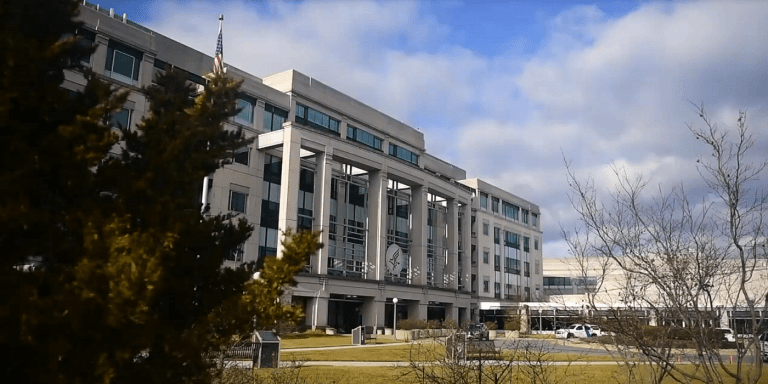
(Tate Miller, The Center Square) The Trump administration directed 46 states and territories to remove gender ideology from their sex ed materials or else face possible termination of federal Personal Responsibility Education Program (PREP) funding, with a family advocate praising the move.

Policy director for family advocacy group American Principles Project Paul Dupont told The Center Square: “The introduction of gender ideology into schools has been an enormous scandal, and the Trump administration is doing the right thing in moving to defund it.”

Dupont told The Center Square that this directive from the Department of Health and Human Services (HHS) “is what real leadership looks like.”

“The American people gave President Trump a mandate to restore sanity to our government, and that’s exactly what he’s doing,” Dupont said.

Dupont told The Center Square that “for years now, American tax dollars have been used to teach our children the false and harmful ideas that they can be born in the wrong body and that any discomfort with their identity could be a sign that they are actually a different gender.

“It should come as no surprise that the number of children identifying as transgender has skyrocketed recently, with many tragically being put on the pipeline to irreversible hormonal and surgical interventions,” Dupont said.

“During the last election, President Trump campaigned strongly on protecting our children from harmful gender ideology,” Dupont said. “Since taking office, the president and his administration have delivered on those promises, with this HHS directive being the most recent example.”

The Department of Health and Human Services (HHS) told The Center Square that “earlier this year, the Administration for Children and Families (ACF) requested that all states submit their PREP curricula for review.”

PREP’s efforts work towards “preventing pregnancy and sexually transmitted infections” in young people, as stated on an HHS webpage.

HHS told The Center Square it “identified concerning gender ideology content in 46 states and territories that exceeded the program’s statutory purposes,” following this review.

“ACF is giving these states and territories 60 days to remove all content outside the scope of the PREP statute, and failure to comply will result in enforcement actions including the withholding, suspension, or termination of federal PREP funding,” the HHS told The Center Square.

The HHS said that “ACF remains steadfast in its mission to protect American families and children and will continue to uphold the integrity of federally funded programs.”

The 40 states the HHS told to remove gender ideology from their sex ed materials are Alabama, Alaska, Arizona, Colorado, Connecticut, Delaware, Georgia, Hawaii, Illinois, Iowa, Kentucky, Louisiana, Maine, Maryland, Massachusetts, Michigan, Minnesota, Mississippi, Missouri, Montana, Nebraska, Nevada, New Jersey, New Mexico, New York, North Carolina, Ohio, Oklahoma, Oregon, Pennsylvania, Rhode Island, South Carolina, South Dakota, Tennessee, Utah, Vermont, Washington, West Virginia, Wisconsin, and Wyoming, according to a news release.

The five territories include Guam, Northern Mariana Islands, Palau, Puerto Rico, and the Virgin Islands, with Washington D.C. making 46.

The total amount of funding that could be withheld or terminated from all 46 states and territories comes to more than $81 million.

The HHS said in its press release that its demand for the removal of transgenderism from sex ed “reflects the Trump Administration’s ongoing commitment to protecting children from attempts to indoctrinate them with delusional ideology.”

Last week, California’s PREP grant was terminated after the state refused to remove “radical gender ideology” from its federally-funded “education program to prevent teenage pregnancy and sexually transmitted infections in schoolchildren.”

Embattled Fed Governor Sues Trump Over “Illegal” Firing

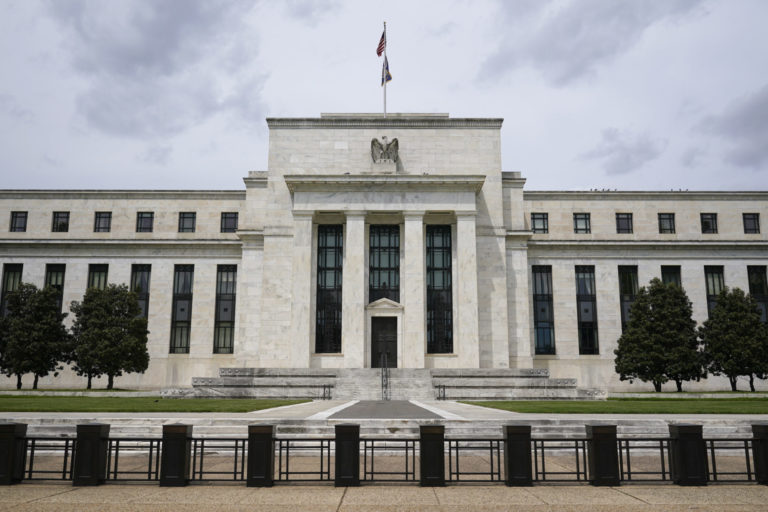
(Brett Rowland, The Center Square) A Federal Reserve governor accused of mortgage fraud filed a lawsuit Thursday alleging her firing was “unprecedented and illegal.”

Trump fired Federal Reserve Governor Lisa Cook, appointed by President Joe Biden, on Monday after Federal Housing Finance Agency Director William Pulte alleged she committed mortgage fraud.

Pulte said Cook owns properties in Georgia and Michigan but had separately listed both as her “primary residence” on different mortgage agreements. A primary residence can mean lower mortgage rates. 

Cook hit back on Thursday with a lawsuit. She said the independence of the central bank was at risk.

“The operational independence of the Federal Reserve is vital to its ability to make sound economic decisions, free from the political pressures of an election cycle,” Cook’s attorney, Abbe David Lowell, wrote in the suit.

 Download PDF

He said allegations of wrongdoing don’t meet the requirement for “cause” to terminate. 

“This case challenges President Trump’s unprecedented and illegal attempt to remove Governor Cook from her position which, if allowed to occur, would the first of its kind in the Board’s history,” Lowell wrote in the lawsuit. “It would subvert the Federal Reserve Act, which explicitly requires a showing of ’cause’ for a Governor’s removal, which an unsubstantiated allegation about private mortgage applications submitted by Governor Cook prior to her Senate confirmation is not.”

U.S. courts have never weighed in on what constitutes “for cause” when removing a Federal Reserve board of governors member because it hasn’t ever happened. 

Cook’s suit names Federal Reserve Chair Jerome Powell and the board of governors as defendants.

The lawsuit comes amid Trump’s high-profile campaign to get the Federal Reserve to lower key interest rates. Trump has said the U.S. should have the lowest rates in the world, but the Federal Open Market Committee has taken a wait-and-see approach on rates over concerns about how Trump’s tariffs would affect the economy. 

Trump said he has the authority to fire Cook “for cause” and did so appropriately. 

On Monday evening, Trump posted a termination letter to Cook on his Truth Social account.

“The American people must be able to have full confidence in the honesty of the members entrusted with setting policy and overseeing the Federal Reserve,” the president wrote. “In light of your deceitful and potentially criminal conduct in a financial matter, they cannot and I do not have such confidence in your integrity.”

The Federal Reserve said it would abide by a court decision.

Last week, Powell hinted that the Fed may lower interest rates at its next meeting.

Earlier this year, the U.S. Supreme Court indicated it might treat the Federal Reserve differently than other independent agencies.

The nation’s highest court said the president and the Federal Reserve’s relationship differed from other independent agencies.

“The Federal Reserve is a uniquely structured, quasi-private entity that follows in the distinct historical tradition of the First and Second Banks of the United States,” the high court wrote in an emergency ruling in May.

One of Wall Street’s top bankers also warned against a move on the Fed. 

“Playing around with the Fed could have adverse consequences, the absolute opposite of what you might be hoping for,” JPMorgan Chase CEO Jamie Dimon said during an earnings call. “It is important that they be independent.”


CDC Director Susan Monarez is Fired and Other Agency Leaders Resign

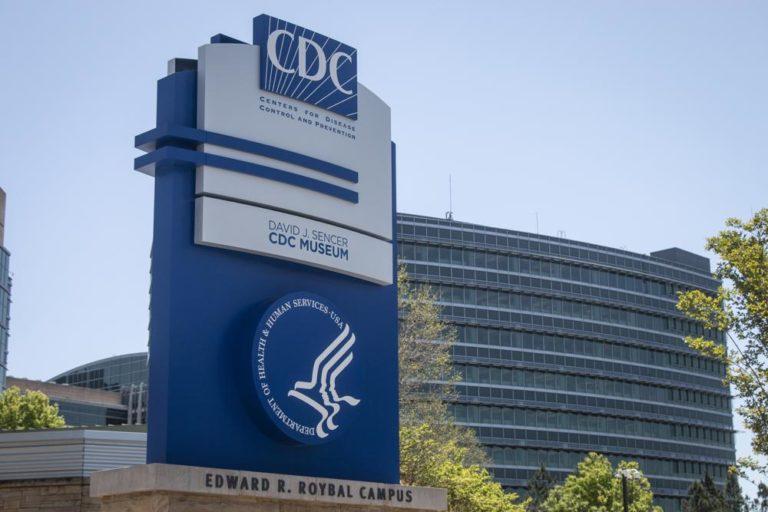
(Headline USA) The director of the nation’s top public health agency has been fired after less than one month in the job, and several top agency leaders have resigned.

Susan Monarez isn’t “aligned with” President Donald Trump’s agenda and refused to resign, so the White House terminated her, spokesman Kush Desai said Wednesday night.

The U.S. Department of Health and Human Services had announced her departure in a brief social media post late Wednesday afternoon. Her lawyers responded with a statement saying Monarez had neither resigned nor been told she was fired.

“When CDC Director Susan Monarez refused to rubber-stamp unscientific, reckless directives and fire dedicated health experts, she chose protecting the public over serving a political agenda. For that, she has been targeted,” attorneys Mark Zaid and Abbe David Lowell wrote in a statement.

“This is not about one official. It is about the systematic dismantling of public health institutions, the silencing of experts, and the dangerous politicization of science. The attack on Dr. Monarez is a warning to every American: our evidence-based systems are being undermined from within,” they said.

Her departure coincided with the resignations this week of at least four top CDC officials. The list includes Dr. Debra Houry, the agency’s deputy director; Dr. Daniel Jernigan, head of the agency’s National Center for Emerging and Zoonotic Infectious Diseases; Dr. Demetre Daskalakis, head of its National Center for Immunization and Respiratory Diseases; and Dr. Jennifer Layden, director of the Office of Public Health Data, Surveillance, and Technology.

Daskalakis worked closely with the Advisory Committee on Immunization Practices. Kennedy remade the committee by firing everyone and replacing them with a group that included several vaccine skeptics — one of whom was put in charge of a COVID-19 vaccines workgroup.

In his resignation letter, Daskalakis lamented that the changes put “people of dubious intent and more dubious scientific rigor in charge of recommending vaccine policy.” He described Monarez as “hamstrung and sidelined by an authoritarian leader.” He added: “Their desire to please a political base will result in death and disability of vulnerable children and adults.”

He also wrote: “I am unable to serve in an environment that treats CDC as a tool to generate policies and materials that do not reflect scientific reality.”

HHS officials did not immediately respond to questions about the resignations.

Some public health experts decried the loss of so many of CDC’s scientific leaders.

Monarez, 50, was the agency’s 21st director and the first to pass through Senate confirmation following a 2023 law. She was named acting director in January and then tapped as the nominee in March after Trump abruptly withdrew his first choice, David Weldon.

She was sworn in on July 31 — less than a month ago, making her the shortest-serving CDC director in the history of the 79-year-old agency.

Her short time at CDC was tumultuous. On Aug. 8, at the end of her first full week on the job, a Georgia man opened fire from a spot at a pharmacy across the street from CDC’s main entrance. The 30-year-old man blamed the COVID-19 vaccine for making him depressed and suicidal. He killed a police officer and fired more than 180 shots into CDC buildings before killing himself.

No one at CDC was injured, but it shell-shocked a staff that already had low morale from other recent changes.

Monarez had scheduled an “all hands meeting” meeting for the CDC staff — seen as an important step in addressing concerns among staff since the shooting — for Monday this week. But HHS officials meddled with that, too, canceling it and calling Monarez to Washington, D.C., said a CDC official who was not authorized to talk about it and spoke to the AP on condition of anonymity.

The Atlanta-based federal agency was initially founded to prevent the spread of malaria in the U.S. Its mission was later expanded, and it gradually became a global leader on infectious and chronic diseases and a go-to source of health information.

This year it’s been hit by widespread staff cuts, resignations of key officials and heated controversy over long-standing CDC vaccine policies upended by Health Secretary Robert F. Kennedy Jr.

During her Senate confirmation process, Monarez told senators that she values vaccines, public health interventions and rigorous scientific evidence. But she largely dodged questions about whether those positions put her at odds with Kennedy, a longtime vaccine skeptic who has criticized and sought to dismantle some of the agency’s previous protocols and decisions.

The Washington Post first reported Monarez was ousted.

Adapted from reporting by the Associated Press.


Copper & Silver Are Setting Up for Powerful Moves

(Jesse Colombo, Money Metals News Service) I’ve been spotting and writing a lot about volatility squeezes lately, which occur when volatility drops to extremely low levels and signal big upcoming moves. This dynamic is currently developing in assets such as gold and U.S. Treasuries.

These volatility squeezes are not coincidences, as they are actually all related. Much of the financial markets are in a gigantic volatility squeeze as they wait for a major catalyst.

These potential catalysts include further clarity on the U.S. stagflation situation (inflation + economic stagnation), the likelihood of further rate cuts, and the next Fed chair that President Trump will appoint.

In today’s update, I want to focus on the volatility squeeze developing in copper and how it is setting up both copper and its closely correlated counterpart, silver, for a significant move.

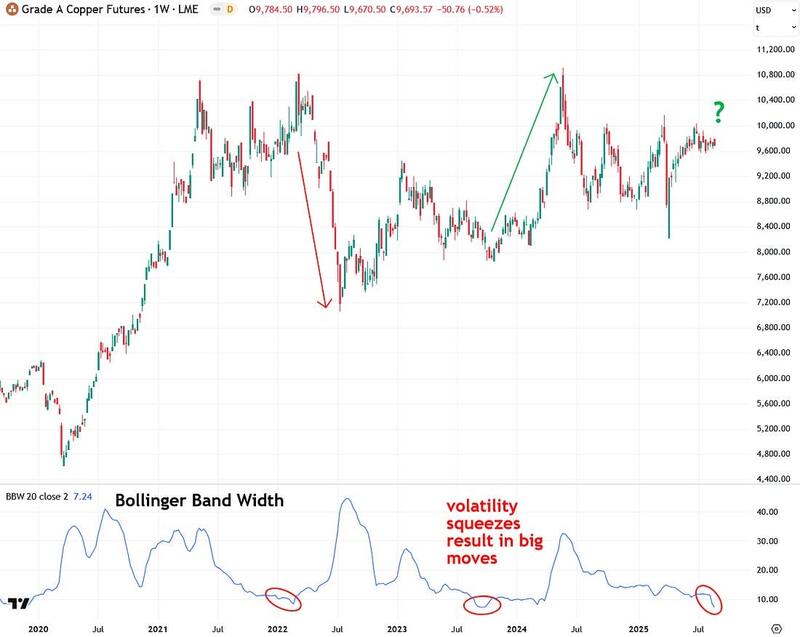
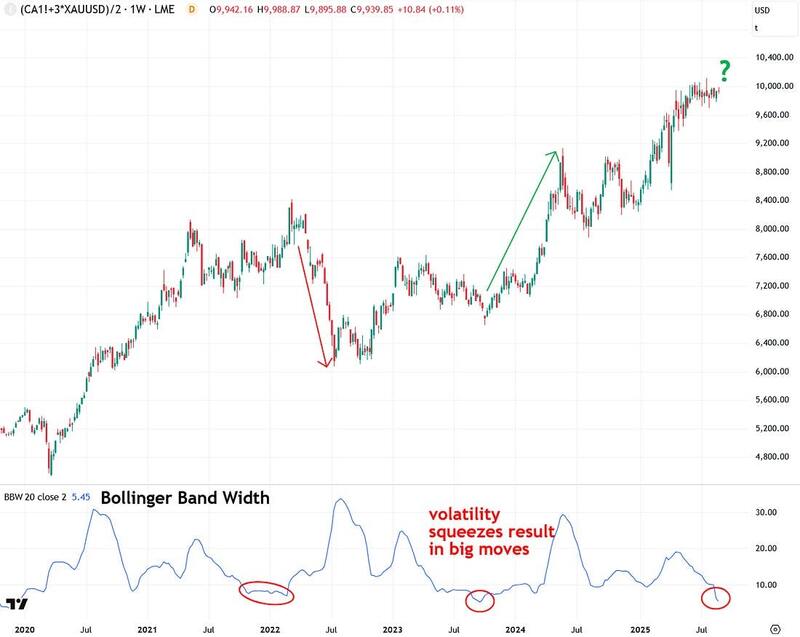
Let’s first take a look at the weekly chart of London Metal Exchange (LME) copper futures, which I am now using as my preferred proxy for copper prices instead of U.S. COMEX copper futures because the latter have been heavily distorted by the Trump administration’s recent tariffs.

This chart shows a clear volatility squeeze as indicated by the Bollinger Band Width indicator beneath the chart, which is a valuable tool for tracking volatility in financial markets and assets.

The last time volatility in copper dropped to such extremely low levels was in 2022 and 2023, and in both instances, it led to significant moves in copper prices.

Based on the current setup, I believe another major move in copper is ahead as this volatility squeeze resolves.

While volatility squeeze setups indicate that a big move is likely ahead, they do not reveal the direction of that move. To determine the likely outcome, we need to incorporate other methods, including chart analysis.

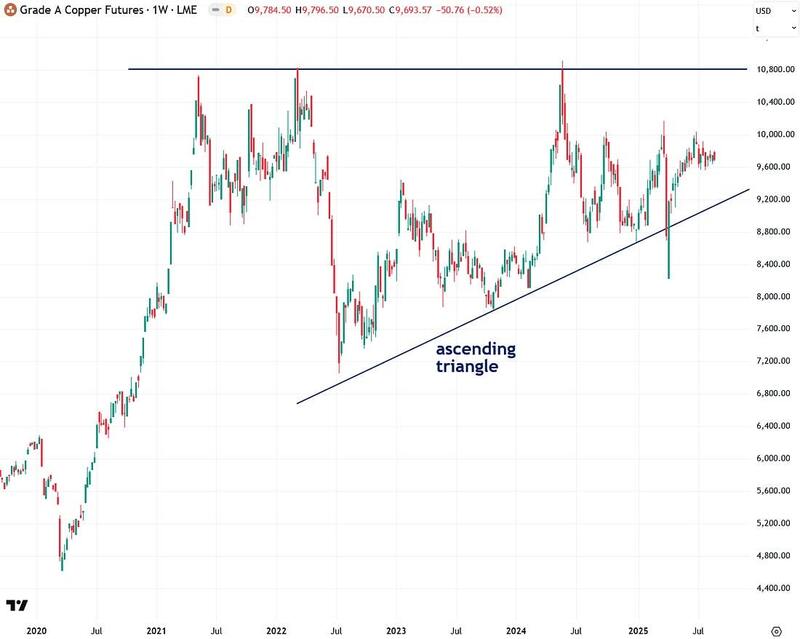
The weekly chart of LME copper futures currently shows an ascending triangle pattern forming, which is typically a bullish chart pattern. However, it must be confirmed by a decisive breakout on strong volume above the $10,800 per tonne resistance level.

This combination of an ascending triangle and a volatility squeeze indicates that a significant bullish move in copper is likely ahead.

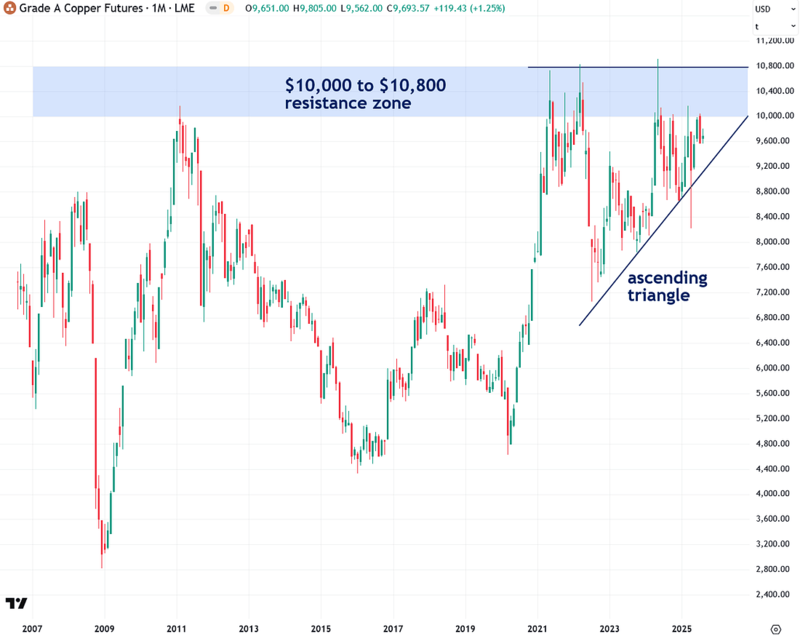
The longer-term monthly chart of LME copper futures highlights both the ascending triangle pattern that has been developing over the past several years and the critical $10,000 to $10,800 per tonne resistance zone, which dates all the way back to 2011.

Once copper achieves a decisive breakout from both its ascending triangle and above this major resistance zone, I believe a powerful new bull market in copper will begin.

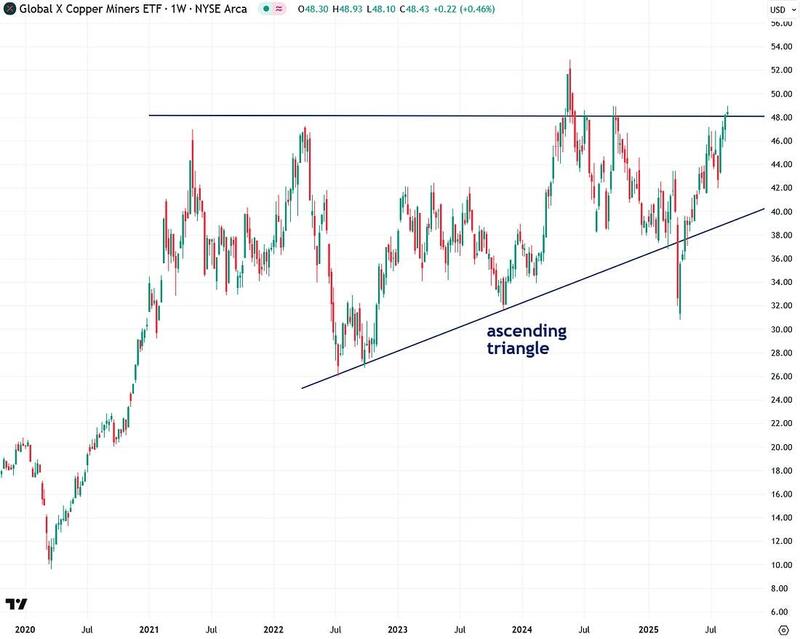
For those interested in this bullish copper thesis, one convenient way to gain exposure is through the Global X Copper Miners ETF (COPX).

Interestingly, COPX has also been forming an ascending triangle pattern since 2021 and is now on the verge of breaking out. However, I would prefer to see a decisive close above the $48 resistance level for stronger confirmation of the breakout.

In addition to the bullish technical setup in copper, the fundamental picture is also highly supportive. For example, Goldman Sachs has dubbed copper “the new oil” due to its essential role in clean energy technologies, and Visual Capitalist published a fascinating infographic on this theme.

Copper earns this title because its demand is expected to surge in the coming decades, while oil consumption is projected to decline as the world transitions away from fossil fuels. Reflecting this shift, the IMF forecasts a 66% increase in copper demand between 2020 and 2040.

Copper’s likely upcoming bull market would align with the outlook of French billionaire and commodities trader Pierre Andurand, who predicted that copper prices could soar to $40,000 per tonne in the coming years—a more than fourfold increase from the current price of $9,682 per tonne.

Explaining his bullish stance, Andurand stated, We are moving towards a doubling of demand growth for copper due to the electrification of the world, including electric vehicles, solar panels, wind farms, as well as military usage and data centers.

If copper enters a major bull market, it would also be highly bullish for silver because silver, along with gold, is heavily influenced by the prices of both metals. This relationship exists largely due to arbitrage trading algorithms that tend to pull silver in the same direction as gold and copper.

Because of this little-known dynamic, I developed a proprietary indicator called the Synthetic Silver Price Index (SSPI).

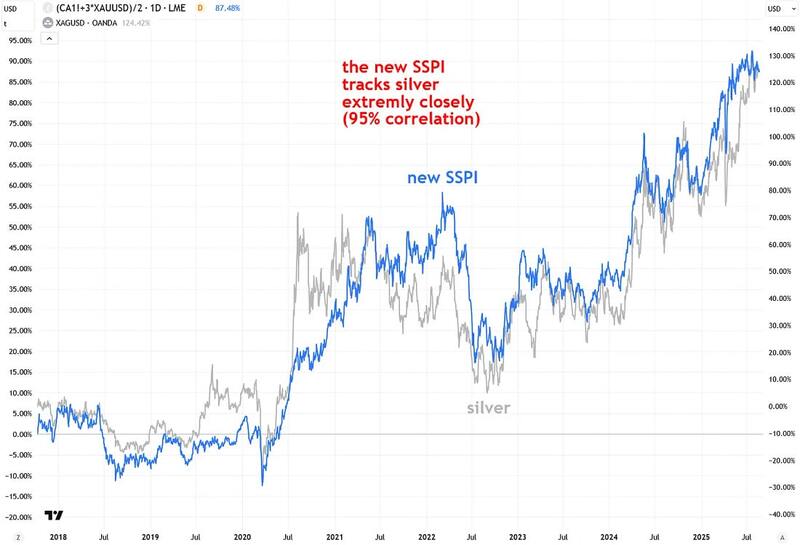
The SSPI is essentially the average of gold and copper prices, and it has proven to track silver extremely closely, making it a powerful tool for both confirming and predicting moves in silver, as I’ll demonstrate shortly.

Interestingly, a volatility squeeze is also forming in the SSPI, which reflects the volatility squeezes occurring in its underlying components, gold and copper.

As shown in the chart below, previous volatility squeezes in the SSPI have consistently led to significant moves in the indicator—and, by extension, in silver as well. I view the current volatility squeeze in the SSPI as a strong signal that a major move in silver is approaching.

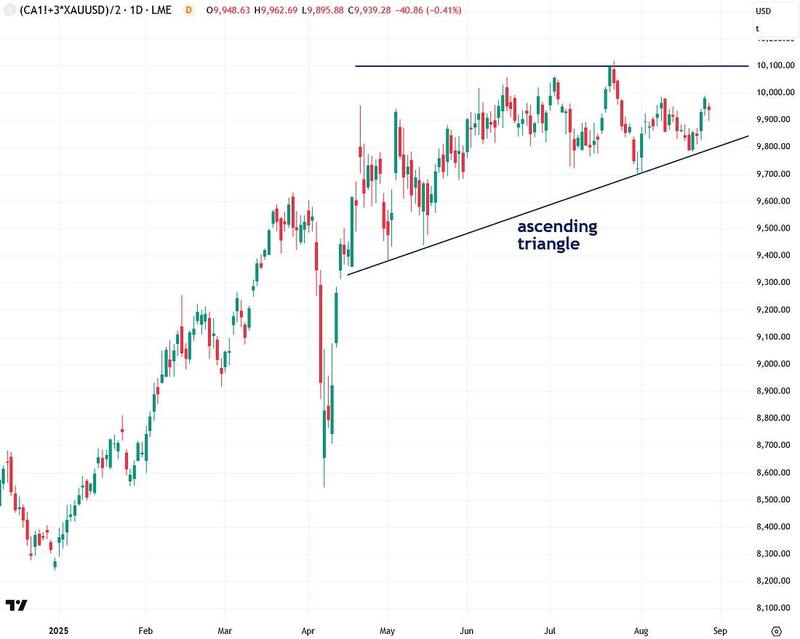
Zooming in on the daily chart of the Synthetic Silver Price Index (SSPI) shows that an ascending triangle pattern is forming (there are a lot of these lately!).

Once this pattern breaks out, it is likely to result in a significant bullish move, which would also place substantial upward pressure on silver.

The chart below illustrates just how closely correlated my proprietary Synthetic Silver Price Index (SSPI) and silver are. Since 2018, the correlation has been an impressive 95%, which is remarkable given that silver is not even a component of the SSPI.

One of my favorite ways to use the SSPI is to perform technical analysis on it and treat its breakouts and breakdowns as signals for what silver is likely to do next. This approach has proven to be highly effective and, in many cases, the SSPI even leads the price of silver.

For this reason, the current volatility squeeze and ascending triangle pattern forming in the SSPI are particularly noteworthy and well worth watching for silver bulls.

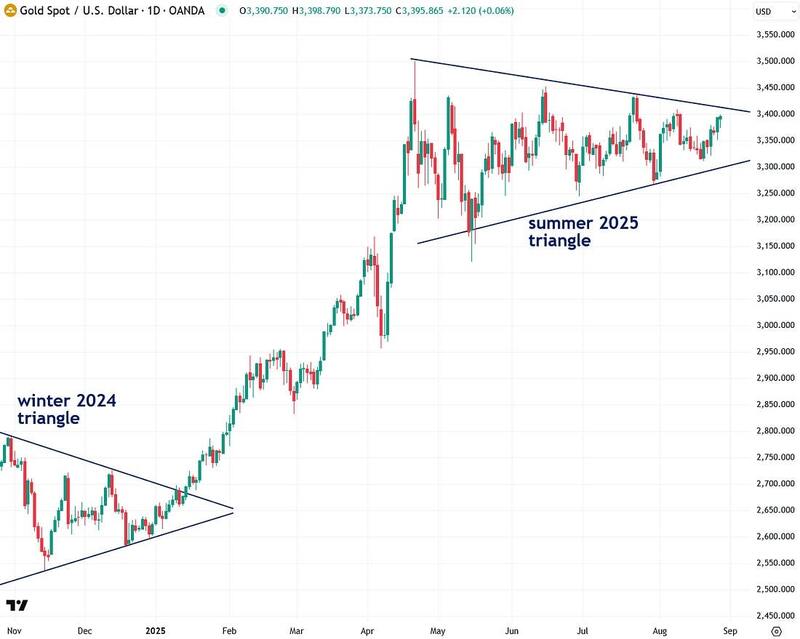
I mentioned earlier that the volatility squeeze in the Synthetic Silver Price Index (SSPI) is the byproduct of the volatility squeezes in its two components, copper and gold. I’ve already shown the setup in copper, so now let’s look at the triangle pattern that has been forming in gold over the past five months.

I am now waiting for a decisive breakout in gold. Assuming that occurs, I expect it to run to $4,000 and beyond, which would, in turn, boost both the SSPI and silver itself.

With all this discussion about how bullish moves in copper and gold would be highly supportive for silver, let’s finally take a closer look at silver itself.

I believe silver began a major new bull market in early June when it broke above the $32 to $35 resistance zone that had capped its progress for much of the previous year.

Since that breakout, silver has been consolidating and forming a triangle pattern of its own. Despite this sideways action, I believe the bull market thesis remains intact. Silver has simply been taking a healthy breather, which is normal during the summer months when much of Wall Street is on vacation.

Looking ahead, the combination of summer ending and the potential for major breakouts in both copper and gold is what I believe will propel silver’s bull market much higher—to $50, $60, and far beyond. However, confirmation is still needed, which would come in the form of silver closing above the key $40 resistance level.

To summarize, the extremely quiet trading that has characterized Summer 2025 has actually created multiple volatility squeezes across key assets, including U.S. Treasuries, gold, and copper.

Ironically, periods of extremely low volatility almost always resolve with extremely high volatility, and I believe we are likely to see that happen in these assets soon.

While many investors are bored with these assets, and most don’t even understand what volatility squeezes are, they should be doing the exact opposite.

This is shaping up to be a very exciting setup and opportunity for precious metals investors, as big rallies are likely to erupt this fall.

If you found this report valuable, click here to subscribe to The Bubble Bubble Report for more content like it.


Jesse Colombo is a financial analyst and investor writing on macro-economics and precious metals markets. Recognized by The Times of London, he has built a reputation for warning about economic bubbles and future financial crises. An advocate for free markets and sound money, Colombo was also named one of LinkedIn’s Top Voices in Economy & Finance. His Substack can be accessed here.

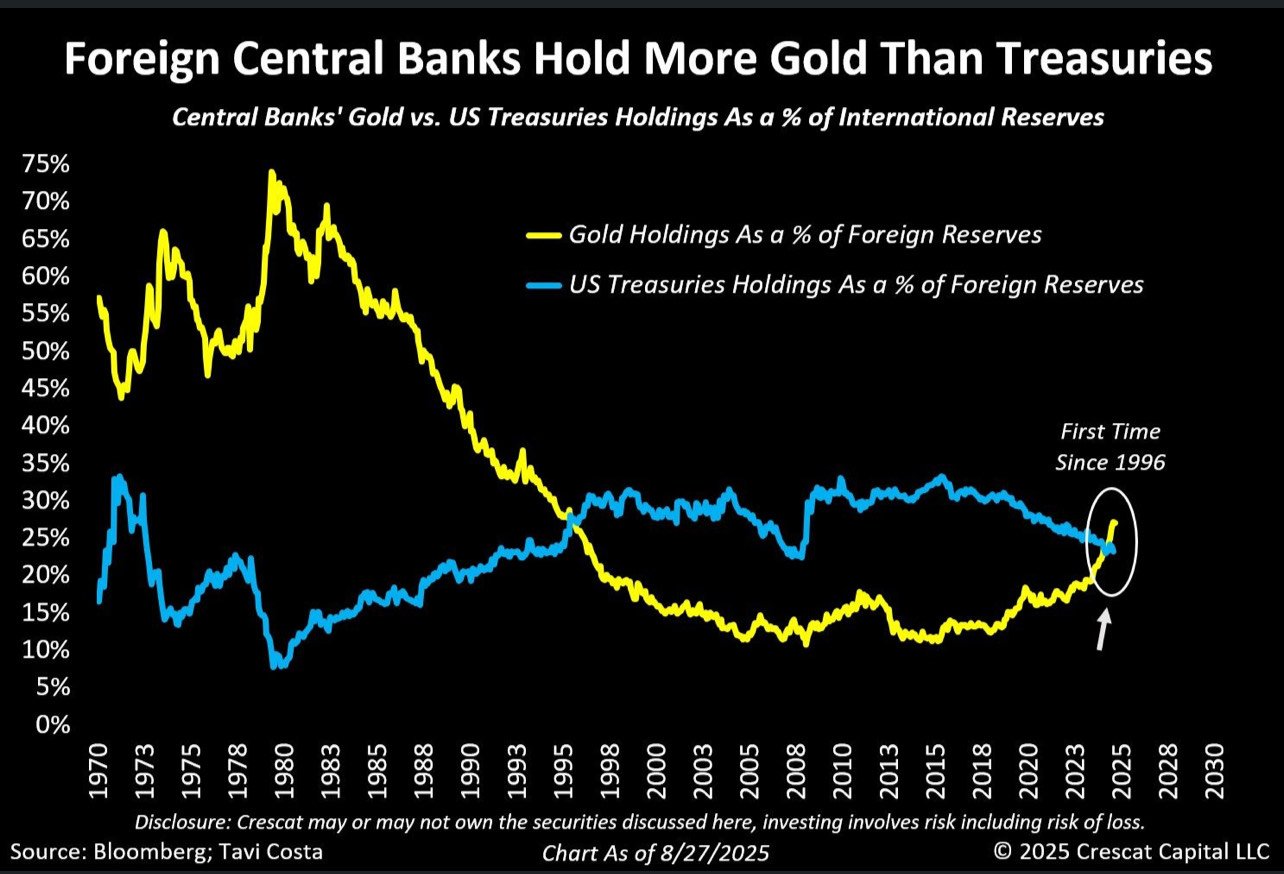
For First Time in Nearly 30 Years, Foreign Central Banks Hold More Gold Than U.S. Treasuries

(Mike Maharrey, Money Metals News Service) For the first time since 1996, foreign central banks hold more gold than U.S. Treasuries as the world continues to de-dollarize.

Crescat Capital macro strategist Tavi Costa highlighted the crossover moment in a post on X, saying it is “likely the beginning of the most significant global rebalancings we’ve experienced in recent history.

Central banks have been aggressively adding gold to their reserves over the last three years.

Last year was the third-largest expansion of central bank gold reserves on record, coming in just 6.2 tonnes lower than in 2023 and 91 tonnes lower than the all-time high set in 2022. (1,136 tonnes). 2022 was the highest level of net purchases on record, dating back to 1950, including since the suspension of dollar convertibility into gold in 1971.

To put that into context, central bank gold reserves increased by an average of just 473 tonnes annually between 2010 and 2021.

At the same time, dollar reserves have been falling. As of the end of last year, dollars made up 57.8 percent of global reserves. That is the lowest level since 1994, representing a 7.3 percent decline over the last decade. In 2002, dollars accounted for about 72 percent of total reserves.

A recent JPMorgan note said this reveals the waning dependence on the U.S. dollar in trade that is being reflected in the gold market.

“The main de-dollarization trend in FX reserves, however, pertains to the growing demand for gold. … This increased demand has in turn partly driven the current bull market in gold, with prices forecast to climb toward $4,000/oz by mid-2026.”

On the other side of the coin, there is sagging demand for U.S. Treasuries.

Why De-Dollarization?

Why are so many countries spurning the dollar?

Many are concerned about the weaponization of the U.S. currency. In an article published by the Atlantic Council, Kimberly Donovan and Maia Nikoladze point out that “central banks that are worried about getting sanctioned, want to protect themselves from a potential global financial crisis, or both have been stacking up gold at record levels.

There are also growing worries about the U.S. government’s fiscal irresponsibility. Earlier this month, the national debt pushed above $37 trillion, and there is no sign that the borrowing and spending will slow down any time soon.

Earlier this year, analyst Artis Shepherd called the sagging demand for U.S. Treasuries “red lights blinking.”

“The bond market is sending a message to the U.S. government that its spending is out of control and the reserve currency ‘privilege’ it has abused for the last 80 years is running out.”

Ramifications

The dollar isn’t in danger of collapsing or even losing its reserve status – at least not yet. However, even a modest de-dollarization spells trouble for the federal government and the U.S. economy.

In a nutshell, the United States needs the world to need dollars.

The U.S. depends on this global demand for dollars supported by its reserve status to underpin its massive government. The only reason Uncle Sam can borrow, spend, and run massive budget deficits to the extent that it does is the dollar’s role as the world’s reserve currency. It creates a built-in global demand for dollars and dollar-denominated assets. This absorbs the Federal Reserve’s money creation and helps maintain dollar strength despite the Federal Reserve’s inflationary policies.

WolfStreet summed up the risk the U.S. faces as the dollar’s status continues to erode.

“The status of the U.S. dollar as the dominant global reserve currency has helped the U.S. fund its twin deficits and thereby has enabled them: the huge fiscal deficit every year and the massive trade deficit every year. The reserve currency status comes from other central banks (not the Fed) having purchased trillions of USD-denominated assets such as Treasury securities, other government securities, corporate bonds, and even stocks. The dollar’s status as the dominant reserve currency has been crucial for the U.S., and as that dominance declines ever so slowly, risks pile up ever so slowly.”

While the threat isn’t immediate, a slowly growing pile eventually turns into a giant pile.

But again, even a modest de-dollarization will have significant impacts. If the world needs fewer dollars, they will begin to return to the U.S., causing a dollar glut. This will increase inflationary pressure domestically as the value of the U.S. currency further depreciates. In the worst-case scenario, the dollar could collapse completely, leading to hyperinflation.


Mike Maharrey is a journalist and market analyst for Money Metals with over a decade of experience in precious metals. He holds a BS in accounting from the University of Kentucky and a BA in journalism from the University of South Florida.