(Headline USA) The body camera hung from the top of the IV drip, recording the slightest twitch made by Yang Guoliang as he lay bloody and paralyzed in a hospital bed after a police beating with bricks.
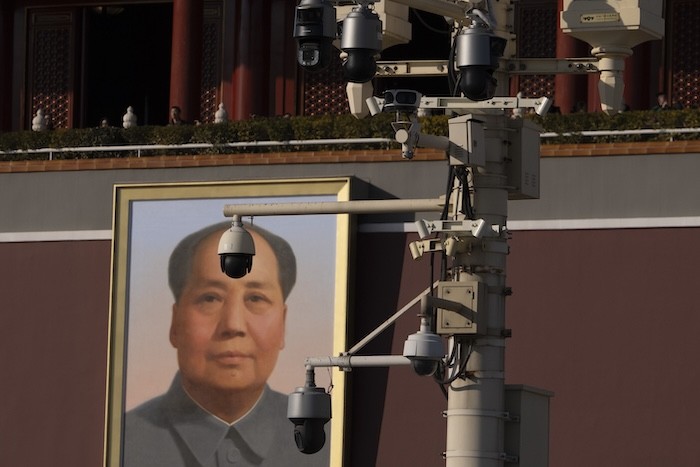
By then, surveillance was nothing new for the Yang family in rural China, snared in an intricate network based on U.S. technology that spies on them and predicts what they’ll do.
Their train tickets, hotel bookings, purchases, text messages and phone calls are forwarded to the government. Their house is ringed with more than a dozen cameras. They’ve tried to go to Beijing 20 times in the past few years, but masked men show up and grab them, often before they depart. And last year, Yang’s wife and younger daughter were detained and now face trial for disrupting the work of the Chinese state — a crime carrying a sentence of up to a decade in prison.
Yet the Yangs say they are not criminals. They are simply farmers trying to beg Beijing to stop local officials from seizing their 1 1/2 acres of land in China’s eastern Jiangsu province.
“Every move in my own home is monitored,” Yang said, sitting behind black curtains that block him from the glare of police lights trained straight at his house. “Their surveillance makes me feel unsafe all the time, everywhere.”
Across China, tens of thousands of people tagged as troublemakers like the Yangs are trapped in a digital cage, barred from leaving their province and sometimes even their homes by the world’s largest digital surveillance apparatus. Most of this technology came from companies in a country that has long claimed to support freedoms worldwide: the United States.
Over the past quarter century, American tech companies to a large degree designed and built China’s surveillance state, playing a far greater role in enabling human rights abuses than previously known, an Associated Press investigation found. They sold billions of dollars of technology to the Chinese police, government and surveillance companies, despite repeated warningsfrom the U.S. Congress and in the media that such tools were being used to quash dissent, persecute religious sects and target minorities.
Critically, American surveillance technologies allowed a brutal mass detention campaign in the far west region of Xinjiang — targeting, tracking and grading virtually the entire native Uyghur population to forcibly assimilate and subdue them.
U.S. companies did this by bringing “predictive policing” to China — technology that sucks in and analyzes data to prevent crime, protests, or terror attacks before they happen. Such systems mine a vast array of information — texts, calls, payments, flights, video, DNA swabs, mail deliveries, the internet, even water and power use — to unearth individuals deemed suspicious and predict their behavior. But they also allow Chinese police to threaten friends and family and preemptively detain people for crimes they have not even committed.
For example, the AP found a Chinese defense contractor, Huadi, worked with IBM to design the main policing system known as the “Golden Shield” for Beijing to censor the internet and crack down on alleged terrorists, the Falun Gong religious sect, and even villagers deemed troublesome, according to thousands of pages of classified government blueprints taken out of China by a whistleblower, verified by AP and revealed here for the first time. IBM and other companies that responded said they fully complied with all laws, sanctions and U.S. export controls governing business in China, past and present.
Across China, surveillance systems track blacklisted “key persons,” whose movements are restricted and monitored. In Xinjiang, administrators logged people as high, medium, or low risk, often according to 100-point scores with deductions for factors like growing a beard, being 15 to 55 years old, or just being Uyghur.
Some tech companies even specifically addressed race in their marketing. Dell and a Chinese surveillance firm promoted a “military-grade” AI-powered laptop with “all-race recognition” on Dell’s official WeChat account in 2019. And until contacted by AP in August, biotech giant Thermo Fisher Scientific’s website marketed DNA kits to the Chinese police as “designed” for the Chinese population, including “ethnic minorities like Uyghurs and Tibetans.”
While the flood of American technology slowed considerably starting in 2019 after outrage and sanctions over atrocities in Xinjiang, it laid the foundation for China’s surveillance apparatus that Chinese companies have since built on and in some cases replaced. To this day, concerns remain over where technology sold to China will end up.
For example, 20 former U.S. officials and national security experts wrote a letter in late July criticizing a deal for NVIDIA to sell H20 chips used in artificial intelligence to China, with 15% of revenues going to the U.S. government. They said no matter who the chip is sold to, it will fall into the hands of Chinese military and intelligence services.
NVIDIA said it does not make surveillance systems or software, does not work with police in China and has not designed the H20 for police surveillance. NVIDIA posted on its WeChat social media account in 2022 that Chinese surveillance firms Watrix and GEOAI used its chips to train AI patrol drones and systems to identify people by their walk, but told the AP those relationships no longer continue. The White House and Department of Commerce did not respond to requests for comment.
Thermo Fisher and hard drive maker Seagate promoted their products to Chinese police at conferences and trade shows this year, according to online posts. Officers stroll the streets of Beijing with Motorola walkie talkies. NVIDIA and Intel chips remain critical for Chinese policing systems, procurements show. And contracts to maintain existing IBM, Dell, HP, Cisco, Oracle, and Microsoft software and gear remain ubiquitous, often with third parties.
What started in China more than a decade ago could be seen as a cautionary tale for other countries at a time when the use of surveillance technology worldwide is rising sharply, including in the United States. Emboldened by the Trump administration, U.S. tech companies are more powerful than ever, and President Donald Trump has rolled back a Biden-era executive order meant to safeguard civil rights from new surveillance technologies.
As the capacity and sophistication of such technologies has grown, so has their reach. Surveillance technologies now include AI systems that help track and detain migrants in the U.S. and identify people to kill in the Israel-Hamas war. China, in the meantime, has used what it learned from the U.S. to turn itself into a surveillance superpower, selling technologies to countries like Iran and Russia.
The AP investigation was based on tens of thousands of leaked emails and databases from a Chinese surveillance company; tens of thousands of pages of confidential corporate and government documents; public Chinese language marketing material; and thousands of procurements, many provided by ChinaFile, a digital magazine published by the non-profit Asia Society. The AP also drew from dozens of open record requests and interviews with more than 100 current and former Chinese and American engineers, executives, experts, officials, administrators, and police officers.
Though the companies often claim they aren’t responsible for how their products are used, some directly pitched their tech as tools for Chinese police to control citizens, marketing material from IBM, Dell, Cisco, and Seagate show. Their sales pitches — made both publicly and privately — cited Communist Party catchphrases on crushing protest, including “stability maintenance,” “key persons,” and “abnormal gatherings,” and named programs that stifle dissent, such as “Internet Police,” “Sharp Eyes” and the “Golden Shield.”
Other companies, like Intel, NVIDIA, Oracle, Thermo Fisher, Motorola, Amazon Web Services, Microsoft, Western Digital, creator of mapping software ArcGIS Esri, and what was then Hewlett Packard, or HP, also sold technology or services knowingly to Chinese police or surveillance companies. Four practicing lawyers said sales like those uncovered by AP could potentially go against at least the spirit, if not the letter, of U.S. export laws at the time, which the companies denied.
American technology made up nearly every part of China’s surveillance apparatus, AP found:
MILITARY AND POLICE: In 2009, Chinese defense contractor Huadi worked with IBM to build national intelligence systems, including a counterterrorism system, used by the Chinese military and China’s secret police, the Ministry of State Security. Chinese agents sold IBM’s i2 police surveillance analysis software to the same ministry and to Chinese police, including in Xinjiang, through the 2010s, leaked emails and marketing posts show. IBM said it has no record of its i2 software ever having been sold to the Public Security Bureau in Xinjiang.
SURVEILLANCE: NVIDIA and Intel partnered with China’s three biggest surveillance companies to add AI capabilities to camera systems used for video surveillance across China, including Xinjiang and Tibet, until sanctions were imposed. NVIDIA said in a post dating to 2013 or later that a Chinese police institute used its chips for surveillance technology research.
ETHNIC REPRESSION: IBM, Oracle, HP, and ArcGIS developer Esri sold hundreds of thousands of dollars’ worth of geographic and mapping software to Chinese police that allows officers to detect when blacklisted Uyghurs, Tibetans or dissidents stray out of provinces or villages. As late as 2019, with detentions in Xinjiang well underway, Dell hosted an industry summit in its capital. Dell and then-subsidiary VMWare sold cloud software and storage devices to police and entities providing data to police in Tibet and Xinjiang, even in 2022 after abuses there became widely known.
IDENTIFICATION: Huadi worked with IBM to construct China’s national fingerprint database; IBM told AP it never sold “fingerprinting-specific product or technology” to the Chinese government “in violation of US law.” HP and VMWare sold technology used for fingerprint comparison by Chinese police, while Intel partnered with a Chinese fingerprinting company to make their devices more effective. IBM, Dell, and VMWare also promoted facial recognition to Chinese police. China’s police and police DNA labs bought Dell and Microsoft software and equipment to save genetic data on police databases.
CENSORSHIP AND CONTROL: In 2016, Dell boasted on its WeChat account that its services assisted the Chinese internet police in “cracking down on rumormongers.” Seagate said on WeChat in 2022 that it sells hard drives “tailor made” for AI video systems in China for use by police to help them ”control key persons,” despite facing backlash for selling drives in Xinjiang.
For extended findings, click here.
“Everything was built on American tech,” said Valentin Weber, a researcher at the German Council on Foreign Relations who studied the use of U.S. tech by Chinese police. “China’s capability was close to zero.”
IBM, Dell, Cisco, Intel, Thermo Fisher and Amazon Web Services all said they adhere to export control policies. Seagate and Western Digital said they adhere to all relevant laws and regulations where they operate.
Oracle, Hewlett Packard Enterprise, and tech conglomerate Broadcom, which acquired VMWare and cloud company Pivotal in 2023, did not comment on the record; HP, Motorola and Huadi did not respond, and Esri denied involvement but did not reply to examples. Microsoft told AP it found no evidence that it “knowingly sold technology to the military or police” as part of the “Golden Shield” update.
Some U.S. companies ended contracts in China over rights concerns and after sanctions. For example, IBM said it has prohibited sales to Tibet and Xinjiang police since 2015, and suspended business relations with defense contractor Huadi in 2019.
However, sanctions experts noted that the laws have significant loopholes and often lag behind new developments. For example, a ban on military and policing gear to China after the 1989 Tiananmen massacre does not take into account newer technologies or general-use products that can be applied in policing.
They also noted that the law around export controls is complicated. Raj Bhala, an expert in international trade law at the University of Kansas, said the issues the AP described fell into “the kind of gray area that we put in exams.”
“It would raise concerns about possible inconsistencies, possible violations,” said Bhala, who emphasized he was speaking generally and not about any specific company. “But I really stress ‘possible.’ We need to know more facts.”
While German, Japanese and Korean firms also played a role, American tech firms were by far the biggest suppliers.
The Xinjiang government said in a statement that it uses surveillance technologies to “prevent and combat terrorist and criminal activity,” that it respects citizens’ privacy and legal rights and that it does not target any particular ethnicity. The statement said Western countries also use such technology, calling the U.S. “a true surveillance state.” Other government agencies did not respond to a request for comment, including China’s police and authorities in the Yangs’ province.
This technology still powers the police database that controls the Yangs and other ordinary people. An estimate based on Chinese government statistics found at least 55,000 to 110,000 were put under residential surveillance in the past decade, and vast numbers are restricted from travel in Xinjiang and Tibet. China’s cities, roads and villages are now studded with more cameras than the rest of the world combined, analysts say — one for every two people.
“Because of this technology … we have no freedom at all,” said Yang Guoliang’s elder daughter, Yang Caiying, now in exile in Japan. “At the moment, it’s us Chinese that are suffering the consequences, but sooner or later, Americans and others, too, will lose their freedoms.”
Selling surveillance superpowers
Back when China was emerging from the chaotic violence of the Cultural Revolution in 1976, three in four Chinese were farmers, including the Yangs. They lived in a three-room home of tiles and pounded earth nestled among the lush, humid fields of the Yangtze River delta.
After Chairman Mao Zedong’s death that year, Beijing’s new leaders opened China to the world, and American tech firms like HP and IBM rushed in. But there were hard limits on how much change the government would accept. In 1989, the Tiananmen pro-democracy protests rattled Beijing, which sent tanks and troops to shoot students.
Soon after, Beijing began planning the “Golden Shield,” aimed at digitizing China’s police force.
In 2001, the 9/11 al-Qaida attacks turbocharged interest in surveillance technology. One researcher claimed authorities could have foiled the attack by unearthing connections between hijackers through public information in databases.
American companies cashed in, selling the U.S. billions of dollars in surveillance technologies they said could prevent crime and terror attacks.
They spotted the same sales opportunity in China. Researchers warned surveillance technologies would be “instruments of repression” in the hands of authoritarian states. Yet IBM, Cisco, Oracle, and other American companies clinched orders to supply Beijing’s “Golden Shield.”
“China didn’t have this kind of thing before,” said Wang, a former Chinese police official in Xinjiang who asked to be identified only by last name for fear of retaliation. “These concepts all came from the West.”
Soon, disturbing stories emerged. Chinese police blocked sensitive news, pinpointing dissidents with unnerving precision. They stalked adherents of the Falun Gong sect banned by authorities. Congress demanded explanations from tech companies.
In 2008, documents leaked to the press showed Cisco saw the “Golden Shield” as a sales opportunity, quoting a Chinese official calling the Falun Gong an “evil cult.” A Cisco presentation reviewed by AP from the same year said its products could identify over 90% of Falun Gong material on the web. Followers sued Cisco, which is now petitioning the U.S. Supreme Court to throw out the lower court ruling that allowed the lawsuit.
At a human rights conference in February, then-Cisco lawyer Katie Shay said companies had a responsibility to understand how customers might misuse their technology for “surveillance and censorship.”
“A lot of people have suffered at the hands of their government, and I want to acknowledge that pain,” said Shay, who left Cisco in June. “I also will say that Cisco disputes the allegations of Cisco’s involvement.”
Cisco told the AP it is committed to human rights, but the court allegations may “open the floodgates for suits against U.S. corporations merely for legal exports of off-the-shelf goods and services.”
As Cisco was summoned before Congress, IBM partnered with a Chinese defense contractor on Phase Two of China’s “Golden Shield.”
Classified government blueprints obtained by AP show that in 2009, IBM worked with Huadi, the state-owned subsidiary of China’s biggest missile military contractor spun off from China’s Ministry of Defense, to build out predictive policing.
“Consolidate Communist Party rule,” read the Huadi blueprint, which showed the databases would track hundreds of thousands of people online.
In response to AP’s questions, IBM referred to any possible relationship it may have had with Chinese government agencies as “old, stale interactions”:
“ … If older systems are being abused today — and IBM has no knowledge that they are — the misuse is entirely outside of IBM’s control, was not contemplated by IBM decades ago, and in no way reflects on IBM today.”
Back in 2009, Beijing needed the technology urgently to quash critics bonding online. Among them were the Yangs.
In April that year, local authorities ordered the Yangs and more than 300 other families in their village off their land. Developers coveted their prime lakefront property for “Western-style” apartments and villas, with fountains, football fields and shopping centers.
The Yangs had no idea police were installing systems that could target families like theirs. They just knew their land was being seized — in return for just a unit in a five-floor walk-up, too many stairs for their elderly mother to climb.
The Yangs and other farmers across China filed complaints.
“I discovered the way the government took our land was illegal,” Yang Caiying said. “They cheated us.”
Predict and prevent
In July 2009, three months after the Yang land was seized, riots erupted on the other side of the country in Xinjiang. Gory images of a Uyghur lynched at a toy factory spread online, angry Uyghurs took to the streets, and hundreds were killed.
Once again, American firms pitched their technology as the solution.
The government sent troops and cut Xinjiang’s phone and internet connections. In secret meetings, officials concluded that police had failed to spot the danger signs because they couldn’t identify Uyghurs deemed separatists, terrorists, and religious extremists, three engineers then working for the Xinjiang government told AP.
At the time, Xinjiang police and data systems were already running on American technology including IBM, Cisco, Oracle, and Microsoft, the engineers said, which AP verified by reviewing government contracts. But the databases were unconnected.
So Xinjiang launched an ambitious initiative to fuse data from all available sources, including banks, railways, and phone companies, into a central database. Officials demanded complete information on all suspicious individuals and their relatives going back three generations, according to the engineers, who described specific meetings in which they participated. Two asked to remain anonymous, fearing for their family in China; the third, Nureli Abliz, is now in Germany.
Soon, lucrative contracts went up for bidding. Among those seeking to profit was IBM.
“Prevent problems before they happen,” IBM promised Chinese officials. In an August 2009 pamphlet, IBM cited the Xinjiang riots and said its technology could help the government “ensure urban safety and stability.”
IBM executives fanned out across the country to court Chinese officials. In December 2009, they set up a new “IBM Institute for Electronic Governance Innovation” in Beijing. In 2011, IBM acquired i2, a software program designed to prevent “terrorist threats.” IBM touted i2’s ability to analyze Chinese social media and licensed a Shanghai-based firm called Landasoft to sell it to China’s police, corporate records show.
Chinese police purchased tens of millions of dollars’ worth of products from companies like IBM, Cisco, Oracle, and Microsoft to upgrade the “Golden Shield” policing systems, a leaked accounting ledger acquired by AP from a whistleblower shows.
In the confrontation between the Chinese state and its critics, American technology tipped the scales of power.
In 2011, thieves ransacked the Yangs’ house, hunting for their property deed. They didn’t find it.
Two years later, bald men with tattoos and gold chains smashed down their door, shattered windows and flipped furniture to bully them out of their home anyway. Yang’s mother dropped to the floor in terror. Doctors diagnosed a heart attack, but the Yangs didn’t have money for a pacemaker.
Furious, the Yangs sued local police. In June 2015, a judge ruled their land had been seized illegally. The Yangs celebrated.
But just weeks after the ruling, officers identified human rights lawyers through the “Golden Shield” technology, cuffed hundreds of them and pressed them into police vans across China. One lawyer later recalled how police monitored his messages on human rights in WeChat before they grabbed him, shackled him to a chair, and tortured him.
Overnight, China’s budding rights-defense movement was dealt a fatal blow — and with it, the Yangs’ case. The Yangs were called in and curtly told the judgment was being overturned, their lawsuit dismissed without trial.
“We really had too much faith in the law, you know?” Yang Guoliang said, his hands clenched in fists. “It turned out to be worthless.”
Technologies of terror
In the meantime, Beijing was transforming Xinjiang into the most heavily surveilled place on earth, sweeping around a million people into camps and prisons.
When bombs tore through a train station in Xinjiang’s capital hours after a visit by leader Xi Jinping in 2014, Xi demanded a crackdown.
“He was super angry,” said Abliz, one of the engineers with the Xinjiang government. “They concluded they weren’t surveilling Uyghurs closely enough.”
The next year, in April 2015, Abliz attended a closed-door exposition in Xinjiang. A booth ran by Landasoft, the former IBM partner, caught his eye.
After years as a vendor of IBM’s i2 police surveillance analysis software to Xinjiang police, Landasoft had struck out on its own, touting i2-like software it said could detain extremists before they caused trouble. The similarity was no coincidence: Landasoft’s software was copied from i2, according to leaked emails and records.
“The platform is developed based on i2,” a Landasoft project manager wrote in an email.
It used a proprietary data visualization system developed by i2. The software powered what was called the Integrated Joint Operations Platform, or IJOP, with the authority to trigger arrests.
Abliz went numb.
“I thought then that this was the end of humanity,” he said.
Landasoft did not respond to repeated requests for comment. IBM said it cut ties with Landasoft in 2014 and was not aware of any interaction between Landasoft and the Public Security Bureau in Xinjiang.
In the autumn of 2015, months after the Xinjiang expo, Landasoft signed contracts with Xinjiang police, emails show. Workers installed millions of cameras and wired over 7,000 police outposts, often built just hundreds of meters apart. Nearly 100,000 officers were recruited to pound on doors and collect names, addresses, fingerprints and face-scans.
Though Chinese hardware was favored, foreign software was irreplaceable for its performance and compatibility with China’s American-built systems, engineers told AP. That included server and database software from Oracle and Microsoft and cloud software from VMWare, which Dell acquired in 2016.
In late 2016, the crackdown began. Internal documents, a leaked copy of the Landasoft software and interviews with 16 former Xinjiang police officers, officials and engineers reveal how the system worked.
Landasoft’s software combined data fed into a central police database to compile a dossier on vast swaths of Xinjiang’s population, tagging them with categories like “went on pilgrimage” or “studied abroad.” Administrators then questioned them, computed risk scores and decided who to detain.
Hundreds of thousands of people were tagged “untrustworthy”, leaked messages show. Leaked documents show the IJOP flagged 24,412 people as “suspicious” in just one week in 2017, leading to most being detained.
“They thought it better to grab thousands of innocents than let a single criminal slip free,” Abliz said.
The technology was crude and flawed. Landasoft emails show engineers frantically fixing a software bug to release hundreds of people categorized as high-risk. And surveillance cameras often misidentified people, a former Xinjiang police officer found when he checked their ID cards.
Yet officers were told “computers cannot lie” and that the IJOP’s listed targets were “absolutely correct,” Abliz said. The software’s orders were often obeyed fearfully, unquestioningly.
“The tech companies told the government their software is perfect,” Abliz said. “It’s all a myth.”
Minority report
The all-encompassing surveillance forced total compliance: Officers arrested colleagues, neighbors informed on each other.
In May 2017, Kalbinur Sidik, a teacher now in the Netherlands, was summoned to her district government office in a yellow brick apartment building in Xinjiang’s capital. A young Uyghur woman, fresh from college, rose and introduced herself as a local official. Sidik, the woman explained, was being appointed as the head of her building, responsible for collecting information on neighbors.
“What’s this data going to be used for?” Sidik asked.
The woman looked at a computer, with a Landasoft program running and lists of names and tags: “Goes out at night,” “Overseas phone,” “unemployed.” One button stood out: “Push Alert.”
The woman clicked it, and the screen filled with names. These people, the woman explained, would be detained and interrogated for suspected ties to terrorism. Sidik’s eyes widened.
“I hated her for what she was doing,” Sidik said. “I knew those people would disappear.”
Xinjiang officials issued arrest quotas, Sidik and five other former officers and administrators said. Sidik watched with horror as the number of people who attended her compound’s weekly mandatory flag-raising ceremony shrank, from 400 to just over 100, as residents were arrested.
At the district office, she observed the logos popping up on screens: Oracle, Microsoft, Intel. The AP found evidence of products from all three companies used in Xinjiang’s policing and data systems during the crackdown, along with Esri, Seagate, Western Digital, NVIDIA, Thermo Fisher, and VMWare, then owned by Dell, which advertised cooperation with Xinjiang authorities on its website.
Sidik asked her neighborhood official where it all came from.
“We’ve spent a lot of money to import foreign technology,” she recalls the official telling her.
Among those caught in the digital dragnet was Parida Qabylqai, an ethnic Kazakh pharmacist at a military hospital in Xinjiang.
In February 2018, Qabylqai was flagged by the IJOP for visiting her parents in Kazakhstan. At first, her boss thought it was a mistake.
“You’re a good person, you shouldn’t be listed,” she recalled him saying. Then he checked the IJOP and spotted her name.
“It’s really serious! You’re going to end up in the camps,” he blurted out in shock.
An officer pressed a confession into her hands.
“What did I do wrong?” Qabylqai asked.
“Just sign!” the officer shouted.
Qabylqai was cuffed, hooded, and whisked to a camp, where cameras watched her day and night, even peering at her naked body in the toilet. Guards barking over speakers ordered her not to speak or even to move.
“They did things to us that no human being should ever have to experience,” she said. “But they said my name was listed by the IJOP, so they didn’t need to explain anything.”
Even enforcers of the system weren’t spared.
In 2018, Liu Yuliang, a civil servant in Xinjiang, was ordered to the home of a young police officer in his village. He and dozens of others stood, silent, as the officer embraced his sobbing, pregnant wife.
The officer had forced many people into the camps. Then he himself was flagged for detention.
Too fearful to resist, Liu went along with the arrest, just as the young officer had done before him.
Landasoft software alerted police when flagged people did anything labeled suspicious, like going out at night or logging on the internet repeatedly. Liu was sent to knock on doors, questioning residents whose “eyes filled with fear.”
As police swept Xinjiang, Landasoft purchased software from Pivotal, a cloud company later acquired by Broadcom, emails show. And Landasoft registered accounts on both Amazon Web Services and Microsoft Azure in 2018, seeking to expand cloud offerings to police clients, emails show.
AWS said Landasoft “consumed very limited cloud services for a brief period” and not for software in the Xinjiang crackdown. Microsoft said Landasoft used Azure services through a self-service portal retired in 2021, and that any Landasoft data was deleted.
The Xinjiang government told the AP: “There is absolutely no such thing as ‘large-scale human rights violations.’”
Liu eventually resigned and returned to his hometown in eastern China, trying to forget what he had seen and done. But he noted with unease the new cameras and checkpoints being installed around his home.
Four days later, state security called and summoned him for questioning. The all-seeing surveillance apparatus had followed him home.
“The Xinjiang model is being copied everywhere, in every city in China,” Liu said.
In 2024, Liu left China, ignoring an airport officer who warned that wherever he went, he would be watched.
“This technology has no emotions,” Liu said. “But in the hands of a government that doesn’t respect the law, it becomes a tool for evil.”
Automated autocracy
The Yangs are still trapped by U.S. technology. IBM, Dell, HP, Cisco, and Seagate servers, switches and drives power police systems targeting them, maintenance contracts dating to this year show. Intel and NVIDIA chips process data. Oracle and VMWare software run the database.
But the harder the Yangs push, the harder the system pushes back.
In February 2023, they went to the National Public Complaints Administration in Beijing with a letter. Two days later, police grabbed them from their hotel and drove them home.
The Yangs persisted, trying to plead their case to Beijing. In the following months, they were seized at bus and train stations, beaten at a hospital and abducted by ambulance.
Last July, Yang’s mother tried again. She carried a letter for Chinese leader Xi Jinping:
“They’re using violence and kidnapping to bar me from petitioning and seeking medical treatment … We beg you, General Secretary, to save us.”
Outside Beijing’s leadership compound, burly men in black tackled Yang’s mother to the ground. She was jailed for over a month, questioned, strip-searched, force-fed medication and deprived of food and water. In October, she and Yang’s sister disappeared.
The Yangs’ house is now the last left standing. The father lives alone.
His relatives have cut contact, unnerved by the flock of police that tail him. Thousands of pages of documents stashed in drawers, stuffed in bags, and piled in boxes in a bathtub chronicle every step of their 16-year quest for justice.
In April, Yang was sent criminal charges showing how much police had spent to stop the family’s “abnormal petitioning.”
The cost: About $37,000.
Adapted from reporting by the Associated Press