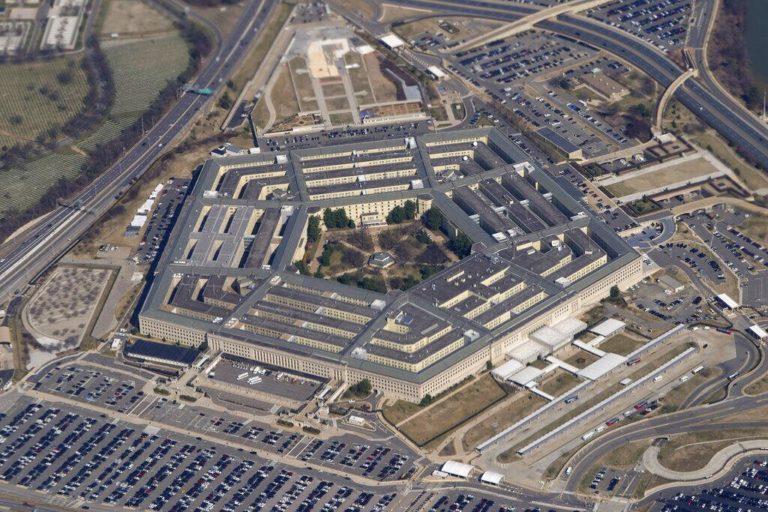
(Kyle Anzalone, Antiwar.com) The House of Representatives passed its version of the annual Pentagon spending bill. The legislation includes the repeal of the Authorization for Use of Military Force (AUMF) for the Gulf and Iraq Wars.
The 2026 National Defense Authorization Act (NDAA) passed the House on Wednesday, 231 to 196. The vote mainly fell along party lines, with 17 Democrats voting for the legislation and 4 Republicans voting against.
The NDAA is the annual Department of War funding bill. The House and Senate typically pass separate versions of the legislation. Then, the leadership of the Upper and Lower Chambers meet in a conference committee and roll out a compromise bill.
Repealing the AUMFs may have support in the Senate. In 2024, the Senate passed legislation by a wide margin that repealed the 2002 and 1991 AUMFs.
The House version of the NDAA includes a provision that will repeal the 1991 and the 2002 AUMFs. The laws were responsible for allowing the President to start the Gulf and Iraq Wars.
While the AUMFs are rarely invoked today to justify military action, during his first term, President Donald Trump asserted the 2002 AUMF gave him the authority to assassinate Iranian General Qussam Soleimani in Iraq in 2020.
The 2001 AUMF, passed in the days after the 9/11 terror attack, is the authorization that Presidents have relied on to wage war across Africa and Asia.
The provision repealing the AUMFs was inserted into the text of a bill during the amendment process in the House Rules Committee. The repeal was introduced by Democrat Jim McGovern, and only passed with the support of three members of the Republican House Freedom Caucus.
The full House also voted on the AUMF amendment 261 to 167. 49 Republicans joined most Democrats voting in support of the change.
A top Democrat said his party largely voted against the NDAA because they did not get any of the amendments they offered into the bill. “We didn’t get any of the amendments or debates that we wanted. Not a single solitary one,” Rep. Adam Smith stated on the House floor.
The legislation also includes $893 billion in funding for the Department of War, the US nuclear weapons program, and foreign aid. Representative Marjorie Taylor Greene previously tried to amend the NDAA to remove $500 million in military aid for Israel. That amendment was rejected by the House 6-422.
Taylor said in a post on social media that he and U.S. Sen. Marsha Blackburn, R-Tenn., have discussed Memphis’ crime problem for months.
“The senator and I have talked about how National Guard troops can best be used as a force multiplier to support local, state, and federal law enforcement officials,” Taylor said. “This may include administrative and logistical support for law enforcement professionals permitting an increased presence of local and state officials in the community seeking out law breakers and protecting the public.”
Lt. Gov. Randy McNally said he also supported the decision.
“Law and order is the first and most important function of government,” McNally said. “Memphis has not been in control of its crime problem for many years.”
Memphis City Councilwoman Jerri Green, running for governor as a Democrat, said National Guard troops make headlines but they don’t solve problems.
“Tennessee doesn’t need more boots – we need smarter investments: common-sense gun laws, safer neighborhoods, mental health support, anti-blight funding, business training, streamlined jail processes, and survivor services,” Green said.
Trump made the announcement from a guest appearance on the network television show Fox and Friends. It comes after days of speculation and comments from the governor and mayor about crime.
Lee said Wednesday he was sending 50 members of the Tennessee Highway Patrol to Memphis.
Young said in a statement Thursday that he was aware of discussions about the National Guard coming to the city.
“We agree with Governor Lee that effective support for Memphis comes through focused initiatives that deliver results like we have seen with the FBI, state troopers, and other law enforcement partnerships,” Young said in the statement posted on WREG. “What we need most are financial resources for intervention and prevention, additional patrol officers, and case support to strengthen MPD’s investigations. Memphis is already making measurable progress in bringing down crime, and we support initiatives that help accelerate the pace of the work our officers, community partners, and residents are doing every day.”
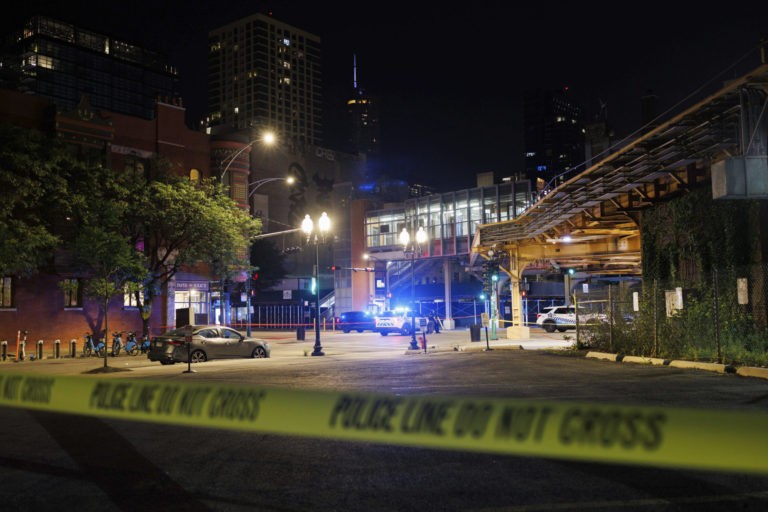
Chicago Flips Red founder Zoe Leigh spoke at a downtown news conference Thursday and said the city needs federal intervention.
“President Trump, I am pleading. Come to Chicago. Come to Illinois. Help us save our city before it’s too late,” Leigh said.
Lupe Castillo, a Republican candidate for Congress in Illinois’ Fourth District, said Gov. J.B. Pritzker and Mayor Brandon Johnson are cowards for saying Chicago is one of the safest cities.
“I dare one of them to walk down by my neighborhood, La Villita, at 10 o’clock at night without any bodyguards, because that’s all they have. They don’t go anywhere without their bodyguards,” Castillo told The Center Square.
Castillo said public safety in Chicago is nonexistent.
Chicago Flips Red vice president Danielle Carter-Walters said the Democratic Party machine tolerates and encourages violence, from campus rallies to city streets. She said silence has gotten residents nowhere.
“Silence is what has allowed crime to explode, corruption to spread and our communities to suffer. We will not be silenced any more,” Carter-Walters said.
Carter-Walters said people are tired of Pritzker and Johnson claiming they speak for the citizens of Chicago and Illinois.
“Let’s be clear. They do not represent us. The people deserve their own voice, and that is exactly what we are here to give them today,” Carter-Walters said.
Pritzker and Johnson have said they don’t want the National Guard or Immigration and Customs Enforcement to help fight crime in Chicago.
Carter-Walters called on Trump to help.
“We are asking for your leadership and your actions, because the people of Chicago cannot wait any longer,” Carter-Walters said.
A day after the fatal shooting of Illinois native and conservative leader Charlie Kirk in Utah, Carter-Walters said she and her colleagues refuse to let evil win.
(Brett Rowland,The Center Square) States are gearing up to deliver more votes for their favored political parties in a rare, mid-decade overhaul of voting maps that threatens to frustrate voters ahead of the 2026 midterms.
President Donald Trump led calls for Texas to redraw its congressional map in July. Texas Republicans bluntly said the process was aimed at increasing their party’s power in Washington. Blue states, including California, are pushing back with their own redistricting.
Politicians used to save battles over political boundaries for a once-a-decade update from the U.S. Census Bureau. However, that’s not the case this year.
Trump kicked off a recent wave of state-level redistricting, which hasn’t been seen since the post-Civil War era.
The Republican-controlled Texas legislature passed the party’s new congressional maps in August and sparked a nationwide scramble over redistricting. In states across the country, Democratic and Republican governors are working to get their party more votes at the federal level.
Walter Olson, a senior fellow at the Cato Institute’s Robert A. Levy Center for Constitutional Studies, said after the Civil War, politicians would often redistrict when they thought it could give them an advantage. But over time, that practice ended and gave way to the once-a-decade update.
“The norms were there partly because it was thought that politics was not as bare-knuckle, and partly because it was thought that people would be embarrassed having the public see them do this,” Olson told The Center Square. “Because, as a number of people have observed lately, if you’re in the middle of the decade, you don’t have new census numbers, and you haven’t been given some sort of court order that you have to change. That sort of rules out pretty much all of the likely motives, except for the sheer naked politics of doing so.”
State political leaders no longer seem embarrassed or concerned about how voters might react, Olson said.
“Trump, like a bulldozer, just can apparently override the local political judgment in different states that would never have done this,” he said.
While some states, like Ohio, had to redraw political boundaries due to a 2018 constitutional amendment, most states, including Texas, California, Florida, Missouri, Illinois, Indiana, New York, New Jersey, and Maryland, are doing so voluntarily.
New polling commissioned by Common Cause and done by Noble Predictive Insights found voters don’t like it. The poll found 51% of Republicans, 70% of Democrats, and 60% of Independents oppose allowing political parties to engage in mid-decade redistricting. Those numbers moved even higher when the redistricting is done by one party.
“This data makes it clear: Republicans and Independents are just as tired of partisan gerrymandering as Democrats,” said Virginia Kase Solomón, president and CEO of Common Cause. “The White House and Congress need to follow the data and listen to their own voters: No more mid-decade redistricting.”
The poll found more than three-in-four voters support a boundary-drawing process that puts community interests ahead of political advantage (78%), and having independent commissions draw electoral districts (77%).
Olson said some of the new maps could face legal challenges. However, he said the states that are redrawing their maps likely have lawyers well-versed in election law, including the 1965 Voting Rights Act, which prohibits racial discrimination in voting.
With all the focus on power in Washington, some voters could be left frustrated by all the mid-decade redistricting.
“Voters aren’t being listened to at all,” Olson said. “They are just completely being moved around. I won’t even call them pawns on a chess board, because you don’t want to lose a pawn.”
Voters, he said, should be frustrated.
“Voters should be dissatisfied when this sort of thing happens because it’s a very clear message that voters’ interests have been demoted to the bottom,” he said.
However, politicians won’t get exactly what they want, Olson said.
“They can’t squeeze the orange too hard without restoring some competitiveness in some seats,” he said.
Furthermore, states can’t gerrymander the governor’s office, which is statewide, Olson noted
Cox said investigators determined the alleged shooter, 22-year-old Tyler Robinson, used a bolt action rifle, which was discovered on the edge of Utah Valley University’s campus wrapped in a dark colored towel. Cox said the rifle had a scope on it.
Cox listed four bullet casings with written inscriptions. The casing that had been fired read “notices bulges OWO what’s this?”
Three other casings that had not been fired also had inscriptions on them. One casing read “hey fascist! catch!” with an up arrow symbol, right arrow symbols and three down arrow symbols, Cox said.
Another casing with an inscription read “oh bella ciao bella ciao bella ciao ciao ciao,” Cox said.
The fourth casing recovered by investigators read “if you are reading this, you’re gay lmao.”
Cox said a family member of Tyler Robinson, the alleged shooter, told investigators he had becomes “more political” in recent years.
Cox called on the public to display unity following Kirk’s shooting.
“History will dictate if this is a turning point for our country,” Gov. Cox said. “Every single one of us gets to choose right now if this is a turning point for us.”
Syrian diplomatic sources told The Media Line that the US has granted an entry visa to Sharaa for the General Assembly, which he will be attending from September 21 to September 25, a step the US is taking while denying visas to Palestinian Authority officials as an effort to impede Western countries from recognizing a Palestinian state.
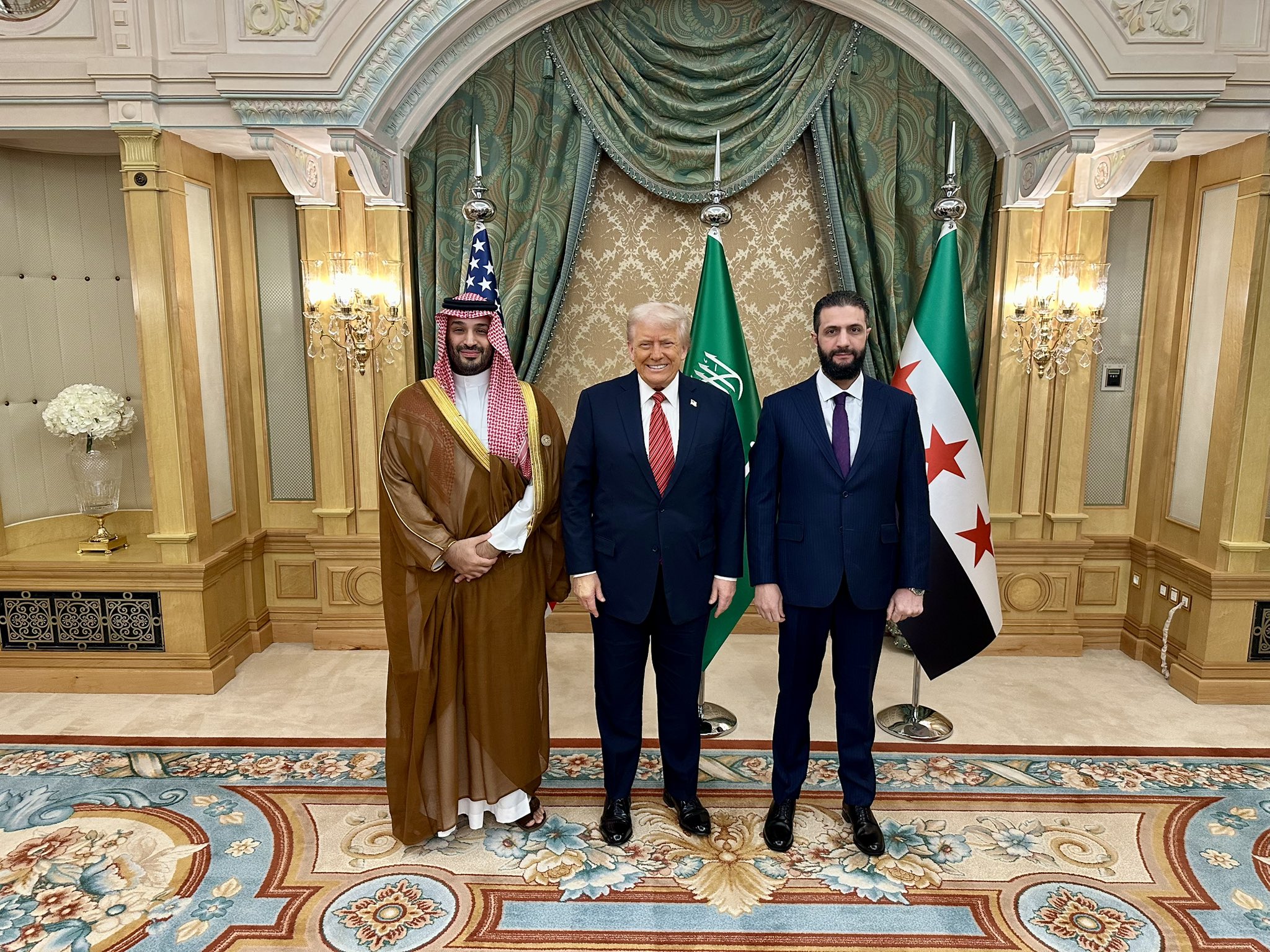
The Media Line report also said that preparations are underway for a bilateral meeting between Trump and Sharaa on the sidelines of the General Assembly. The two leaders met in Saudi Arabia back in May, and Trump praised Sharaa as a “young, attractive guy” with a “strong past.”
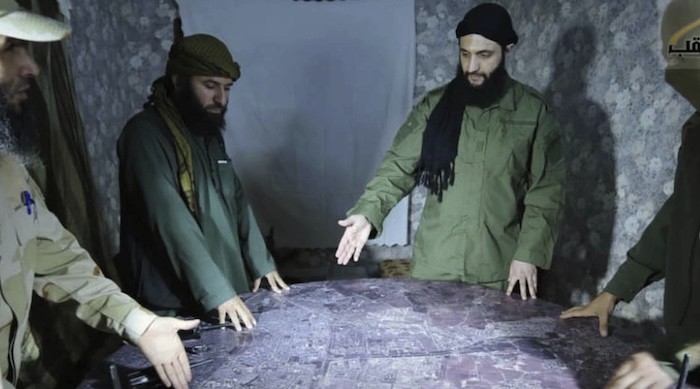
Sharaa, formerly known as Abu Mohammed al-Jolani, got his start with al-Qaeda in Iraq, where he fought an insurgency against US troops before being imprisoned from 2006 to 2011. In 2012, he travelled to Syria and formed al-Qaeda’s affiliate in the country, the al-Nusra Front.
President Trump, Ahmed al-Sharaa, and Saudi Crown Prince MbS in Riyadh on May 14, 2025 (White House photo)
In 2016, Sharaa claimed the al-Nusra Front was cutting ties with al-Qaeda. At the time, he thanked the “commanders of al-Qaeda for having understood the need to break ties.” In 2017, Julani merged his group with several other Islamist factions to form Hayat Tahrir al-Sham (HTS), the group that led the offensive that ousted former Syrian President Bashar al-Assad in December 2024.
According to The New Arab, Syria’s new foreign minister, Asaad al-Shaibani, who will also be traveling to New York, was also a founding member of the al-Nusra Front and oversaw its transition into HTS. The US will be welcoming the two former al-Qaeda leaders to New York less than two weeks after the 24th anniversary of the September 11 attacks, which killed 2,606 people at the Twin Towers in New York City.
Reports say the US may be placing travel restrictions on Iranian officials who are attending the General Assembly, but there’s no sign that travel will be limited for Sharaa and his delegation. The Media Linereport said Sharaa may also visit New York’s Turkish House, the headquarters of several Turkish diplomatic missions, together with Turkish President Recep Tayyip Erdogan, one of HTS’s major backers.
Despite the violence, the US has embraced the new Syrian government by lifting sanctions and removing HTS from its list of terror organizations. Israel, which supported and celebrated the overthrow of Assad, has used the HTS takeover as a pretext to invade and occupy more territory in southwest Syria.
(Luis Cornelio, Headline USA) A popular conservative journalist has shared a disturbing video of a man chasing her into her apartment in an effort to call out law enforcement’s failure to investigate the interaction immediately.
The journalist, Breanna Morello, directly blasted the Plano Police Department in a series of X posts on Sunday, saying it took weeks to identify the suspect and seemed more interested in investigating her over alleged gun possession.
Headline USA attempted to reach a PPD detective but was instead directed to the agency’s “professional standards unit,” which handles public complaints and did not answer the phone.
The surveillance video—viewed nearly six million times—shows Morello walking her dog outside her apartment complex in July.Seconds later, a man who Morello identified as Middle Eastern ran toward her.
He followed her into the complex. Stairwell footage shows him chasing her up the stairs, pointing his finger and insisting on speaking with her.
Morello said the man only stopped chasing her when he believed he saw a pistol.
Back in July, a Middle Eastern man followed me while I was walking my dog.
He snuck up behind me and entered my apartment complex.
After I repeatedly told him to leave, he became coming up the stairs and towards me.
He only left after he allegedly saw a “black pistol.”
The PPD reportedly launched an investigation only after Morello publicly released the footage. She said the man admitted he chased her because he thought she was attractive.
“Monsters think it’s open season on women out here,” Morello said in a press statement. “We need to begin correcting this issue before more women lose their lives.”
She added, “How many more white women need to be targeted in this country before we realize we have a MAJOR issue of minority men coming after us?”
The man has not been charged with any crime. Meanwhile, Morello said the PPD initially focused on her alleged weapon instead.
She declined to comment further without legal representation.
It remains unclear why the PPD prioritized the alleged weapon over the suspect’s actions.
Probably because I embarrassed the department online. I was told that a firearm would only escalate an incident like this. It’s a way to get me to fear potential prosecution. Problem is, I fear no police department.
(Mike Maharrey, Money Metals News Service) Bolivia has been using its gold reserves to maintain its solvency as it struggles under a massive debt burden.
The Bolivian central bank has been buying gold from local miners, having it refined abroad (in Turkey), and then liquidating the bullion for dollars to service its debt.
Now, a new report indicates the country has leveraged its gold in another way.
According to a Bloomberg report, the Bolivian central bank raised $589 million by entering two gold futures contracts. The bank collected the money up front with the promise of delivering 5.4 tonnes of gold in one year.
The first contract, executed in May, was for 4.32 tonnes of gold. A second contract in August pledged 1.08 tonnes.
The bank reportedly sold three tonnes of gold through a similar hedge forward deal earlier this year, but the central bank did not disclose the amount raised. Bolivian analyst Luis Fernando Romero estimates the three operations combined brought in around $916 million.
The Bolivian central bank used the futures contract as a workaround. By law, the central bank must maintain a 22-tonne gold reserve. By pledging to deliver the gold later, the bank was able to access much-needed cash to pay its debt obligations, while buying time to accumulate the necessary gold.
In August, a statement from the central bank board indicated that it approved a “gold reserve accumulation plan” to meet “future obligations,” but included no details.
The Bolivian central bank has purchased a large amount of gold from domestic mines over the last few years.
According to the most recent data reported by Bloomberg, the bank has bought almost 24 metric tons of locally produced metal and monetized 44 tons since May 2023. The operations have generated around $3 billion.
Bolivia has significant gold reserves. Last year, the country produced 26.5 tonnes of gold, according to World Gold Council data.
By the same token, in the less likely event that the gold price falls significantly in the next year, the Bolivian central bank could come out ahead on the deal.
This futures scheme isn’t without risk. If the price of gold continues to appreciate, the 5.4 tonnes of gold could be worth significantly more than $589 million. This risk is inherent in any futures contract.
There are also political risks. The responsibility of delivering the gold will fall to a new government. Bolivia will hold a runoff election for a new president featuring a right-wing candidate and a centrist. This will end nearly two decades of socialist governance.
The central bank asserted that these operations have helped the country avoid default.
Large amounts of dollar-denominated debt burden Bolivia, and the country owns the lowest credit rating of any Latin American country, according to S&P Global. The country’s debt is rated Ca, defined as “likely in, or very near, default.” It is the second-lowest rating on the scale.
According to the agency, the country’s abysmal credit rating is based on its “reduced reserve levels” and its “weak capacity to fully meet its debt commitments over the next six to 12 months.”
Mike Maharrey is a journalist and market analyst for Money Metals with over a decade of experience in precious metals. He holds a BS in accounting from the University of Kentucky and a BA in journalism from the University of South Florida.
(Mike Maharrey, Money Metals News Service) Despite the significant increase in tariff revenue, the U.S. continues to run massive budget deficits. The budget shortfall for fiscal 2025 has already exceeded last year’s deficit.
So much for import duties paying for the government.
That’s because Uncle Sam doesn’t have a revenue problem. He has a spending problem.
The Trump administration ran a $344.79 billion budget deficit in August. That was about $35 billion lower than last August. However, it was still the second-highest budget deficit charted this year.
The August deficit pushed the fiscal 2025 shortfall to $1.97 trillion with one month left. In fiscal 2024, the federal deficit was $1.82 trillion.
The U.S. pulled in $29.5 billion in customs duties in August, a staggering 321.4 percent increase. That pushed August receipts to $344.32 billion, a 12.3 percent increase year-over-year.
Through the first 11 months of fiscal 2025, the U.S. government brought in $165.2 billion in customs duties. That’s up $95.5 billion from the same period in fiscal ’24.
In total, the federal government has collected $4.69 trillion so far in fiscal 2025. That’s 6.8 percent higher than through the same period last year.
That’s a healthy revenue increase for any organization.
Unless that organization spends without restraint.
That’s exactly what the federal government does, and spending is going up even faster than revenue.
A lot faster!
The Trump administration blew through $689.1 billion last month alone. That was 2.5 percent higher than August 2024.
With one month left, the federal government has spent $6.73 trillion, a 5.9 percent increase over the same period in fiscal ’24. The Trump administration has already spent more this fiscal year than it did last.
There is no indication that spending will slow down any time soon. The Big Beautiful Bill “cut” some spending but increased it in other areas. Furthermore, those “cuts” were from projected spending increases. Actual spending will still go up, just not as fast as originally planned. The bottom line is that even with the Big Beautiful Bill, spending will increase on an absolute basis.
This is par for the course.
You might recall that President Biden promised that the [pretend] spending cuts would save “hundreds of billions” with the debt ceiling deal (aka the [misnamed] Fiscal Responsibility Act).
The ugly truth is the government isn’t committed to cutting spending in any meaningful way, and it always finds new reasons to spend even more, whether for “crises” at home or wars overseas.
Interest on the national debt cost $111.47 billion in July. That brought the total interest expense for the fiscal year to $1.12 trillion, up 6.7 percent over the same period in 2024.
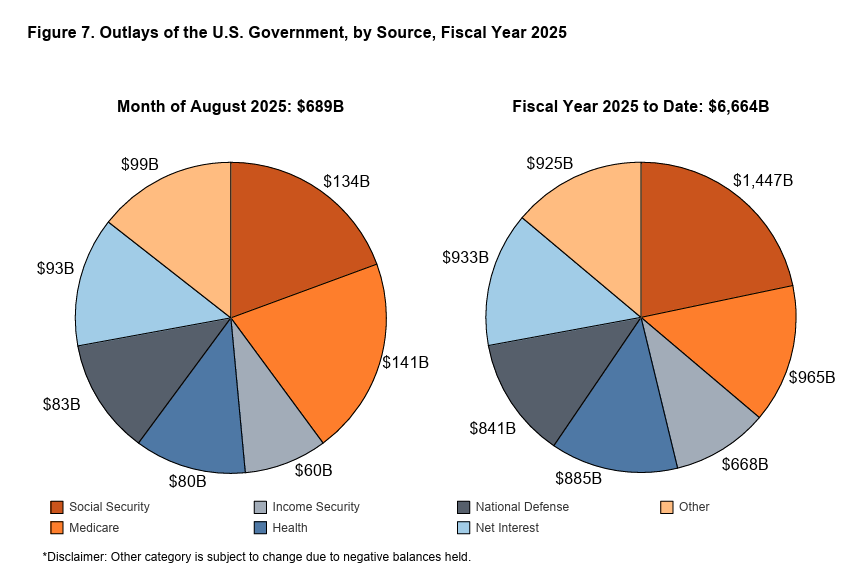
Net interest (interest expense – interest receipts) stands at $933 billion through the first 11 months of this fiscal year.
So far, in fiscal 2025, the federal government has spent more on interest on the debt than it has on national defense ($841 billion) or Medicare ($965 billion). The only higher spending category is Social Security ($1.45 trillion).
Uncle Sam paid $1.13 trillion in interest expenses in fiscal 2024. It was the first time interest expense had ever eclipsed $1 trillion.
Much of the debt currently on the books was financed at very low rates before the Federal Reserve started its hiking cycle. Every month, some of that super-low-yielding paper matures and must be replaced by bonds yielding much higher rates. And even after the Federal Reserve cut rates, Treasury yields have pushed upward as demand for U.S. debt sags.
The Bottom Line
The U.S. government has a spending problem it won’t address. No matter what the politicians in D.C. claim, there is no way to fix the budget problem by shoveling more money into the hole with tariffs, much less replacing the IRS.
The rest of the world is paying attention.
We’ve been watching Treasury yields inch upward for months. Even during times of geopolitical uncertainty, we’ve seen Treasuries sell off. In the past, U.S. notes and bonds were a safe haven go-to. No more.
This indicates sagging demand for U.S. debt.
That’s a big problem for a country that depends on the world to prop up its borrowing and spending habits.
We were warned.
The Bipartisan Policy Center warned that the growing national debt and the mounting fiscal irresponsibility are eroding the foundation of the dollar.
“Confidence in U.S. creditworthiness may be undermined by a rapidly deteriorating fiscal situation, an increasing concern with federal debt set to grow substantially in the coming years.”
Biden ran the debt higher at a dizzying pace, but to be fair, this isn’t just a Biden problem. Every president since Calvin Coolidge has left the U.S. with a bigger national debt than when he took office.
It’s going to take more than DOGE rooting out waste to get the borrowing and spending under control. Even if the Trump administration manages to slash discretionary outlays as promised, that only accounts for 27 percent of total spending. The vast majority is for entitlements, and there is little political will to take the scissors to Social Security or Medicare.
And the sad fact is that, given the political incentives, people in power will always kick the debt can down the road. It is a long-term problem that will require painful measures to fix. Politicians don’t want to create pain. That’s a quick path out of office. So, they will punt the debt problem and spend more to make constituents happy.
This is all well and good, but the problem with playing kick the can down the road is that you eventually run out of road.
Mike Maharrey is a journalist and market analyst for Money Metals with over a decade of experience in precious metals. He holds a BS in accounting from the University of Kentucky and a BA in journalism from the University of South Florida.
Patel and FBI Deputy Director Dan Bongino reportedly ripped the agents in an online Thursday morning meeting over the matter, saying he wouldn’t tolerate any more “Mickey Mouse operations.” About 200 agents were on the call.
“They expressed themselves with such fierce urgency that, in the view of some participants, it hinted at another motive: to prove they were up to the task,” the Times reported.
The FBI released photos of the suspect on Thursday afternoon. Presumably, the public could’ve seen those photos up to 15 or more hours earlier if they had been shared with Patel in a timely fashion.
🚨BREAKING NEWS🚨
The FBI is looking for this person of interest related to Charlie Kirk’s assassination.
The agents’ suppression of the photo was one of many apparent blunders made by the FBI during its roughly 36-hour manhunt. President Donald Trump said Friday morning that they finally have a suspect in custody.
Law enforcement previously had two persons of interest in custody before clearing them.
The first person, George Zinn, was booked in the county jail for obstruction of justice. Zinn apparently made a scene after the shooting that may have distracted law enforcement and allowed the killer to escape unnoticed.
The second person taken into custody, Zachariah Qureshi, was initially described by Director Patel as a suspect. However, Utah Gov. Spencer Cox clarified at the press conference that Qureshi was a person of interest rather than a suspect. Mason further said Thursday morning that neither men were considered suspects.
Ken Silva is the editor of Headline USA. Follow him at x.com/jd_cashless.