(Luis Cornelio, Headline USA) State prosecutors in Massachusetts arrested on Wednesday a top official in the Democratic Gov. Maura Healey’s administration on drug trafficking charges after he allegedly ordered cocaine delivered to his government office.
The official, LaMar Cook, served as deputy director in Healey’s Western Massachusetts office, directly overseeing constituent services of more than 800,000 residents.
Hampden District Attorney Anthony D. Gulluni, a Democrat, announced that Cook was charged with drug trafficking, unlawful possession of a firearm and unlawful possession of ammunition.
He was arraigned on Wednesday and held on a $25,000 bail ahead of a Friday hearing, NBC Boston reported.
Cook’s arrest followed two drug seizures earlier this month. One of the seizures resulted in the confiscation of 8 kilograms of suspected cocaine. This raid, conducted on Oct. 25, occurred at the Springfield State Office Building, where Cooked worked.
An earlier seizure occurred on Oct. 10 at a separate location.
Detectives raided the Springfield State Office Building on Oct. 27 and arrested Cook the following day. In total, police have seized 21 kilograms of suspected cocaine.
In response, Healey terminated Cook effective immediately, saying through a spokesperson: “The conduct that occurred here is unacceptable and represents a major breach of the public trust. Mr. Cook has been terminated from his position effective immediately.”
The governor’s office said it is actively collaborating with investigators. Meanwhile, Gulluni said the probe remains ongoing and could result in additional charges tied to prior shipments.
(José Niño, Headline USA) Eleanor Holmes Norton, Washington D.C.’s 88-year-old congressional delegate, claims to sit on multiple boards at prestigious institutions, but investigations reveal she hasn’t been active with them in years. Some of these positions no longer even exist according to a report by Luke Goldstein and Dan Boguslaw.
According to her latest financial disclosure, Norton lists positions on roughly half a dozen boards. However, when contacted, three organizations reported no recent contact with her, while two confirmed their boards had been dissolved years ago.
These revelations follow a troubling NBC4 report that obtained a police document detailing how scammers posing as HVAC repairmen defrauded Norton of $4,400 for services never performed. The report also noted that Norton has a caretaker with power of attorney who reported the fraud.
Norton, once a prominent civil rights leader who participated in the 1963 March on Washington, now appears to have outdated information on her ethics forms, suggesting her staff may be resubmitting portions automatically without updates.
Goldstein and Boguslaw observed that the boards Norton lists include the executive committee of the Yale Law School Association, the board of trustees for Antioch College, the lawyers committee for civil rights, and advisory boards at Georgetown’s Women’s Law & Public Policy Fellowship Program, American University’s Women and Politics Institute, and the Sewall Belmont House.
Repeated inquiries to these organizations yielded concerning responses. Norton was a founding member of Georgetown’s Women’s Law & Public Policy Fellowship Program and regularly hosted fellows for Capitol Hill lunches. However, according to a spokesperson, she hasn’t done so since 2019.
American University’s response was even more revealing: “The Women & Politics Institute no longer has an advisory board,” they wrote, per Goldstein and Boguslaw’s report.
Similarly, representatives for the Sewall-Belmont House explained that ownership transferred to the National Park Service in 2016, and the Park Service has no record of an advisory board or Norton’s current involvement with the site.
Two congressional sources confirmed Norton is largely absent from committee meetings and planning sessions. During the Trump administration’s deployment of troops to Washington D.C., Norton was nearly invisible except for a generic condemnation statement.
Republican-led hearings on D.C. crime and public safety should have been Norton’s opportunity to defend her constituents, but she struggled through a prepared statement. Sources close to city council reported her “halting” performance immediately sparked discussions about organizing efforts to push her toward retirement.
Two city council members have since announced primary challenges: Robert White, the current at-large council member, and Brooke Pinto, the Ward 2 council member.
Despite these challenges, Norton has told reporters she intends to run for re-election at age 90, though her staff maintains she hasn’t decided.
Democratic Party leadership has remained silent on the situation, declining to intervene while Washington D.C. faces ongoing challenges with minimal representation.
José Niño is the deputy editor of Headline USA. Follow him at x.com/JoseAlNino
(Mike Maharrey, Money Metals News Service) South Korea is considering jumping on the gold bandwagon and adding gold to its reserves.
During a speech at an event hosted by the London Bullion Market Association and London Platinum and Palladium Market in Kyoto, Japan, Bank of Korea official Heung-Soon Jung said, “The Bank of Korea plans to consider additional gold purchases…”
The last time the Bank of Korea expanded its gold reserves was in 2013. The country currently holds around 104 tonnes of gold.
Jung said the central bank will “monitor markets” to determine the timing and size of its gold purchases. He indicated that decisions will be based on “the evolution of its international reserves,” along with the price trajectories of gold and the Korean won.
De-dollarization has been a factor in the recent surge in global gold reserves. Jung specifically categorized gold as a reserve alternative to the greenback.
“Given gold’s role as an inflation hedge and its potential as an alternative investment to the U.S. dollar, it’s evident that gold should be considered as one of the viable assets from a medium- to long-term perspective.”
During the same meeting, Madagascar’s central bank governor, Aivo Andrianarivelo, indicated he is considering increasing the country’s gold reserves from 1 tonne to 4 tonnes.
South Korea and Madagascar could join the growing number of other central banks increasing their gold holdings. In the first half of 2025, central banks globally added 415 tonnes of gold to their reserves based on official numbers compiled by the World Gold Council. Some countries, including China, have added even more gold through back channels.
According to data parsed by Money Metals researcher Jan Nieuwenhuijs, the Chinese central bank is currently sitting on more than 5,000 tonnes of monetary gold located in Beijing – more than TWICE what has been publicly admitted.
On net, central banks officially increased their gold holdings by 1,044.6 tonnes in 2024. It was the 15th consecutive year of expanding gold reserves.
Last year was the third-largest expansion of central bank gold reserves on record, coming in just 6.2 tonnes lower than in 2023 and 91 tonnes lower than the all-time high set in 2022 (1,136 tonnes). 2022 was the highest level of net purchases on record, dating back to 1950, including since the suspension of dollar convertibility into gold in 1971.
To put that into context, central bank gold reserves increased by an average of just 473 tonnes annually between 2010 and 2021.
World Gold Council analysts expect the trend to continue, with buying “close to the range seen over the past three years on continued elevated trade-related risks and uncertainty premia in U.S. assets.”
The WGC also noted that “diversification” with “a reduction of U.S. assets” is one of the factors driving central bank gold buying. In other words, de-dollarization.
“We don’t see an end to this narrative unless there is a material shift in geopolitical tensions. The IMF has downgraded growth prospects in the U.S. more than in other major economies, citing policy uncertainty. This suggests that other countries may have leverage in negotiations, although these typically last months and years, not weeks. Hence, we don’t expect any near-term resolutions.”
Mike Maharrey is a journalist and market analyst for Money Metals with over a decade of experience in precious metals. He holds a BS in accounting from the University of Kentucky and a BA in journalism from the University of South Florida.
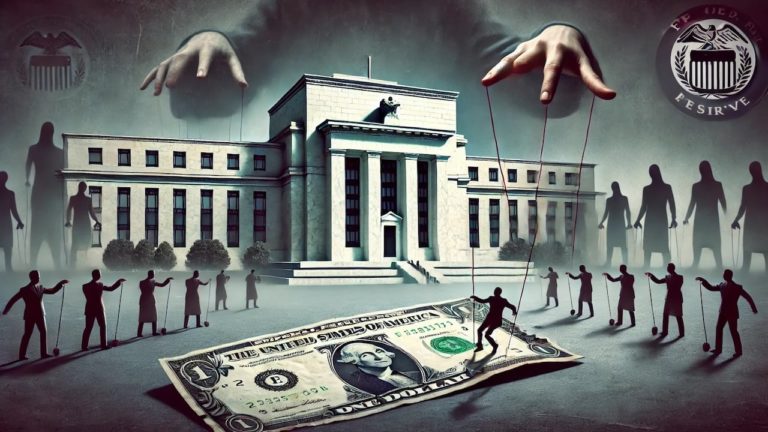
The Federal Reserve chairman tried to sound like a hawk, but the central bank’s actions were those of a dove.
For the second straight meeting, the Fed cut the federal funds rate by a quarter percent on Wednesday. In an even more aggressive move toward monetary easing, the FOMC also announced balance sheet reduction will end in December.
However, Federal Reserve Chairman Jerome Powell tried to keep the party from heating up too much by downplaying the possibility of another cut in December.
The FOMC voted 10-2 to cut rates. The federal funds rate now sits in a range between 3.75 and 4 percent.
As he did at the September meeting, Trump appointee Governor Stephen Miran cast a dissenting vote, indicating he wanted a half-percent cut. On the other side of the coin, Kansas City Fed President Jeffrey Schmid voted NO, signaling that he opposed any cut at this time.
The official FOMC statement acknowledged, “Inflation has moved up since earlier in the year and remains somewhat elevated,” yet eased monetary policy anyway. The committee stated that “downside risks to employment rose in recent months.”
Balance Sheet Reduction to End
Powell hinted that the central bank could end balance sheet reduction earlier in the month. The FOMC followed through, announcing an end to quantitative tightening as of December 1.
In practice, this means the central bank will stop reducing its holdings of Treasuries and mortgage-backed securities, maintaining the size of its balance sheet at the current level.
Balance sheet reduction, or quantitative tightening (QT), pulls liquidity out of the financial system by reducing bank reserves and shifting government debt financing to the private sector. This tightens funding conditions and market debt. It is effectively deflationary. Ending the balance sheet runoff will increase liquidity. It is also inflationary.
More significantly, an end to balance sheet reduction will take some pressure off the Treasury market, as the central bank would have to purchase new bonds as the old ones mature. In effect, this would create additional artificial demand in the Treasury market. This could help drive bond yields lower, allowing the federal government to borrow at lower rates, lowering its financing costs.
The Fed announced a balance sheet reduction plan in March 2022, when it could no longer convince everybody that price inflation was “transitory.” The plan wasn’t exactly ambitious, given the amount of inflation it created during the pandemic. If the Fed followed the blueprint (and it didn’t), it would take 7.8 years for the Fed to shrink its balance sheet back to pre-pandemic levels. This doesn’t even account for the trillions added in the wake of the 2008 financial crisis.
And of course, the central bank didn’t stick with the plan. The Fed slowed the pace of balance sheet reduction in May 2024, and now it’s over.
From its peak, the Fed ran around $2.4 trillion off the balance sheet. That sounds impressive, but it only represents about half of the increase during the pandemic alone.
Chairman Powell’s Open Mouth Operations
Powell and Company filled up the punchbowl and cranked up the easy money party, but the Fed chair then tried to talk the giddy partygoers down by tempering expectations for a December rate cut.
That’s because the Fed just aggressively eased monetary policy despite persistent inflation. In a sane world, the central bank would be holding rates higher to strangle inflation once and for all. It might even be hiking rates.
But we don’t live in a sane world.
We live in a world with a debt black hole and a bubble economy created by decades of easy money that can’t function in a modestly higher interest rate environment.
Powell knows this, so he has to at least talk like a central banker worried about inflation even as he’s cranking up the inflation machine.
Going into the October meeting, most analysts expected the Fed to cut both this month and then again in December. But Powell said we shouldn’t just assume there will be further easing in the final meeting of 2025.
“In the committee’s discussions at this meeting, there were strongly differing views about how to proceed in December. A further reduction in the policy rate at the December meeting is not a foregone conclusion. Far from it.”
Powell also indicated that there is “a growing chorus” among the committee members to “at least wait a cycle” before cutting again.
Powell’s jawboning worked. Traders lowered the odds for a December cut from 90 percent to 67 percent after Powell’s post-meeting presser, and the stock market sank in disappointment.
But this is nothing but talk. Fed officials can say all kinds of things. It’s important to pay attention to what it does. What it did was cut rates and ease monetary policy in an inflationary environment. And the FOMC has no clue what it will do in December because it is effectively flying blind with the government shutdown limiting the release of data. When asked about December, Powell conceded, “We just don’t know what we’re going to get. If there is a very high level of uncertainty, then that could be an argument in favor of caution about moving.”
Powell also claimed, “Inflation, away from tariffs, is actually not so far from our 2 percent goal.”
But no matter how Powell tries to parse and spin the CPI data, inflation is already increasing, and this additional cut, coupled with an end to quantitative tightening, will accelerate that trend.
As of the end of June, the money supply had expanded by more than $600 billion since its low point in mid-2023.
As of September, the M2 money supply stood at $22.2 trillion and is above the peak reached during the pandemic.
Rising consumer prices are just one symptom of monetary inflation. We also see it showing up in asset prices such as real estate and stocks. This is precisely why the stock market sold off when Powell started in on his hawkish messaging.
The reality is the Fed is in a Catch-22. It simultaneously needs to hold rates higher to deal with inflation and cut rates to try to keep the economy from being completely sucked into the debt black hole. Make no mistake, no matter what you hear coming out of the mouths of Fed officials, they’ve picked inflation.
Mike Maharrey is a journalist and market analyst for Money Metals with over a decade of experience in precious metals. He holds a BS in accounting from the University of Kentucky and a BA in journalism from the University of South Florida.
(Luis Cornelio, Headline USA) Former Special Counsel Jack Smith unsuccessfully subpoenaed the phone records of Sen. Ted Cruz, R-Texas, as part of his unprecedented effort to target allies of President Donald Trump after the 2020 election.
The subpoena targeted Cruz’s phone provider, AT&T, which refused to comply with the order over concerns that the records were protected under the Speech and Debate Clause in Article I of the Constitution.
AT&T tried to alert the senator to the demand, which was blocked by U.S. Judge James Boasberg, the controversial Obama-appointed judge behind orders blocking several Trump policies.
Cruz blasted the ruling at a press conference on Wednesday, saying Boasberg justified the gag order on purported “reasonable grounds” that Cruz would have destroyed evidence.
“That is utterly without basis in fact. There was no evidence to support that,” Cruz said, arguing that any prosecutor who said otherwise would have perjured himself. “There is precisely zero evidence to conclude that I am likely to destroy or tamper with evidence or to intimidate potential witnesses.”
Cruz is now demanding Boasberg’s impeachment over the controversial subpoena, first reported by Axios on Oct. 20.
I am, right now, calling on the House of Representatives to impeach Judge Boasberg.
Mark my words: there will be accountability for these partisan zealots who sought to corrupt the DOJ and judiciary to attack their enemies. pic.twitter.com/J8lkD1fvmL
The subpoena sought phone records from Cruz’s congressional office from Jan. to Jan. 7, 2021, including detailed “records for inbound and outbound calls, text messages, direct connect, and voicemail messages.”
Senate investigators are demanding that Smith appear for a transcribed interview over his anti-Trump probe. The embattled former prosecutor was appointed by Attorney General Merrick Garland to lead the federal probe into Trump’s protest of the 2020 presidential election.
His probe, preceded by the secret FBI “Arctic Frost” investigation, targeted 430 conservative entities and individuals through 197 subpoenas. Cruz is the latest lawmaker revealed to have been targeted under the Biden administration’s probe.
Others included GOP Sens. Marsha Blackburn, Tenn.; Ron Johnson, Wis., Bill Hagerty, Tenn.; Josh Hawley, Mo.; Cynthia Lummis, Wyo.; Lindsey Graham, S.C.; Dan Sullivan, Alaska, and Tommy Tuberville, Ala.; and Rep. Mike Kelly, Pa.
(Money Metals News Service) On a recent episode of Money Metals’ Midweek Memo podcast, host Mike Maharrey opens with a pointed analogy: calling a 3% CPI “good” because it beat a grim forecast is like celebrating “no cancer” while ignoring high cholesterol, hypertension, and pre-diabetes. The patient isn’t healthy; the diagnosis is merely less dire. That’s how markets keep greeting inflation prints.
The episode was recorded with volatility front and center. Despite a bruising two-week selloff, Maharrey remains bullish on gold and silver because the underlying drivers haven’t changed. The message is to stay focused on fundamentals rather than day-to-day price noise.
Market Action
Gold spent most of yesterday below $4,000 per ounce before bouncing roughly $75 this morning to reclaim that level. Some technicians are eyeing $4,000 as support, with others floating $3,750 as a potential line in the sand.
Silver followed suit, sliding firmly under $50 and then clawing back. During show prep, it traded around $48.60. The question “Are the bulls dead?” meets a simple answer: not if the same forces that drove record highs are still in place.
Perspective on the Trend
Even after the drop, gold is up more than 89% since January 1, 2024. The metal sprinted from $3,500 to $4,000 in just 36 days, a $500 step that historically took 18 to 24 months. Blow-off speed invites pullbacks, and corrections are normal in a bull market.
Maharrey notes that after gold first cleared $3,000 in April, it corrected and then moved sideways for four months. A period hovering near $4,000—perhaps even into early 2026—wouldn’t be shocking. The strategy is to decide whether you’re trading a headline or investing for five to ten years.
Why the Selloff Happened
Two forces stand out. First, profit-taking after a parabolic run drew in weak hands, and once the price turned, panic selling compounded the slide. Second, a bout of “risk-on” optimism tied to chatter about a U.S.–China trade deal sapped safe-haven demand.
Fawad Razaqzada at Forex.com observed that improving risk sentiment helped push the S&P 500 to fresh record highs, leaving gold on the back foot. He also cautioned that core tensions—national security and tech competition—won’t be solved in a single deal. The regime-uncertainty backdrop persists even if headlines look calm.
Five Pillars Still Supporting Gold
Maharrey lists five enduring drivers:
Falling real interest rates as the Fed shifts toward easing.
Persistent inflation that refuses to fade.
Ongoing trade and geopolitical uncertainty (regime uncertainty).
U.S. fiscal irresponsibility and dedollarization pressures.
Systemic financial risks from years of ultra-easy money and malinvestment.
Real interest rates are falling as the Fed heads into an easing cycle, shrinking the opportunity cost of holding metal. Inflation remains persistent, even when the monthly print looks “better than forecast.”
Geopolitics and trade remain unsettled, with policy unpredictability adding a steady risk premium. U.S. fiscal irresponsibility is worsening—debt eclipsed $38 trillion after jumping from $37 trillion in roughly two months—bolstering dedollarization currents. Systemic financial risks from years of ultra-easy money linger beneath the surface.
The Inflation Checkup
Headline CPI rose 3% year over year in September, up from 2.9% in August and 2.7% in July, and well above the 2.4% low notched in March. The “beat” was merely against a 3.1% forecast. On the month, prices rose 0.3%; annualized, that’s about 3.6%, and the last three months also annualize near 3.6%.
Core CPI increased 3% year over year, down a tick from 3.1% in August. Month over month, core rose 0.2% after 0.3% in July. Over the last four months, core advances of 0.2, 0.3, 0.3, and 0.2 annualize to 3%. Food at home rose 0.3% on the month, the overall food index rose 0.2%, and services climbed another 0.2% month over month and 3.5% year over year.
Targets, Formulas, and Reality
Maharrey argues that 3% is not 2%, and the range hasn’t truly cooled since mid-2022. He adds that 1990s CPI formula changes understate real-world price pressure compared to 1970s methodology; by that older yardstick, today’s 3% might look closer to 6%. The official figures still matter because policy is set by them, but households feel a cost-of-living reality that data revisions can’t soften.
The Bureau of Labor Statistics still released September CPI despite an ongoing government shutdown approaching a month, prioritizing the data because it affects Social Security adjustments. The headline characterization as “good” stems from beating the forecast, not from hitting the target.
The Fed’s Tightrope
The Fed’s October meeting began yesterday and wrapped up yesterday, October 29th. Markets largely expect a 0.25% rate cut and possibly a timetable to end quantitative tightening, after Chair Jerome Powell hinted at just such a shift weeks ago.
A CNBC Fed survey found 92% of respondents expected a cut at this meeting, but only 66% thought it should happen; 38% completely opposed the next cut. Richard Bernstein flagged that financial conditions are near historically easy, GDP is tracking 3.5% to 4%, asset prices are ripping, and inflation remains above target—hardly a rate-cut backdrop in saner times.
Liquidity and Labor
Chicago Fed financial conditions never became tight by historical standards, even at the peak of hikes. Liquidity shows up in the money supply: by August, M2 stood at $22.2 trillion, more than $600 billion above the mid-2023 trough and above the pandemic-era peak. The prior contraction that briefly “wrung out” inflation has reversed.
The labor side looks softer. The BLS showed just 22,000 jobs created in August and revised away nearly 1 million jobs. With September data delayed by the shutdown, private payrolls suggest sluggish hiring. Weak growth alongside sticky inflation has a name that keeps resurfacing: stagflation.
Data Gaps and Policy Risk
Some on Wall Street caution that cutting rates into an information fog is risky. One economist likened the Fed’s path to flying in a blizzard blindfolded, with mountains nearby. Maharrey’s broader point is that central planning can’t master an economy’s complexity; it inevitably runs aground on unintended consequences.
The Fed faces a binary: fight inflation or prop up a debt-burdened, bubble-prone economy. It can’t hike and cut at the same time. When forced to choose, recent history suggests policymakers choose inflation—the “poison they know”—to keep the bubbles from bursting.
What It Means for Stackers
If you believe the long-term case is intact, swift drawdowns become opportunities. Sub-$4,000 gold and mid-$40s silver are levels Maharrey views as add points within a still-supported bull market. Volatility is a feature, not a bug, when real rates fall and deficits swell.
One timely example: 90% silver coins—pre-1965 dimes and quarters—are available at Money Metals for five cents below spot, a rare negative premium. A 1964 quarter alone carries well over $8 in melt value at current prices, underscoring the appeal of highly liquid, low-cost silver.
Takeaway
No single headline will end this cycle’s push-and-pull. Inflation sits at 3% year over year, core hovers near 3%, services run at 3.5%, and three-month annualized CPI is about 3.6%. Debt has raced past $38 trillion. M2 has rebounded to $22.2 trillion. The Fed is poised to ease again as growth cools and price pressures linger.
Through it all, the thesis doesn’t change: policy preference for easy money erodes purchasing power over time. The antidote is to own real money and treat selloffs as chances to improve your position, rather than as reasons to abandon the field.
How to Act
Maharrey closes with the practicals. If you have questions about where metals fit in your portfolio or which products match your budget, talk to a Money Metals specialist at 1-800-800-1865.
Prefer not to call?
You can chat or order directly at moneymetals.com, and you can store holdings in the company’s state-of-the-art Idaho vault.
The broader counsel is steady: ignore the noisy diagnosis and treat the underlying condition. In a system that defaults to devaluation, the long game still favors gold and silver.
The move lowers the Fed’s benchmark short-term interest rate to a range between 3.75% and 4%, the lowest in three years. That’s down from a peak of around 5.4%.
“Available indicators suggest that economic activity has been expanding at a moderate pace,” the Federal Open Markets Committee said in a statement. “Job gains have slowed this year, and the unemployment rate has edged up but remained low through August.”
It also noted that inflation “has moved up since earlier in the year and remains somewhat elevated.”
The federal government shutdown, which started Oct. 1, has limited the economic data available to the rate-setting committee.
“Although some important federal government data have been delayed due to the shutdown, the public and private sector data that have remained available suggest that the outlook for employment and inflation has not changed much since our meeting in September,” Federal Reserve Chairman Jerome Powell said Wednesday at a news conference.
The Fed projected an additional quarter-point cut at its next meeting in December, but Powell said Wednesday that was uncertain. Powell said there were “strongly differing views” about what the Fed should do in December.
“A further reduction of the policy rate in December is not a foregone conclusion – in fact, far from it,” Powell said.
Trump’s newest appointee to the FOMC, Stephen Miran, voted against the move, preferring a 1/2 percentage point cut at this meeting. Jeffrey Schmid also opposed the cut, he preferred no change to the federal funds rate.
Trump wants even lower rates and has aggressively pushed the independent central bank to lower them.
Trump has said the U.S. should have the lowest rates in the world.
Ryan Young, senior economist with the Competitive Enterprise Institute, said the biggest news was that the Fed will stop reducing its balance sheet as of Dec. 1, which roughly doubled in size during the pandemic.
“That doubling was a leading cause of the pandemic inflation,” he said. “Since about 2022, the Fed has slowly been shrinking its balance sheet back to pre-COVID levels, and still has a ways to go. The Fed’s balance sheet is a much more potent source of inflation than interest rates, because it directly affects the money supply.”
The move lowers the Fed’s benchmark short-term interest rate to a range between 3.75% and 4%, the lowest in three years. That’s down from a peak of around 5.4%.
“Available indicators suggest that economic activity has been expanding at a moderate pace,” the Federal Open Markets Committee said in a statement. “Job gains have slowed this year, and the unemployment rate has edged up but remained low through August.”
It also noted that inflation “has moved up since earlier in the year and remains somewhat elevated.”
The federal government shutdown, which started Oct. 1, has limited the economic data available to the rate-setting committee.
“Although some important federal government data have been delayed due to the shutdown, the public and private sector data that have remained available suggest that the outlook for employment and inflation has not changed much since our meeting in September,” Federal Reserve Chairman Jerome Powell said Wednesday at a news conference.
The Fed projected an additional quarter-point cut at its next meeting in December, but Powell said Wednesday that was uncertain. Powell said there were “strongly differing views” about what the Fed should do in December.
“A further reduction of the policy rate in December is not a foregone conclusion – in fact, far from it,” Powell said.
Trump’s newest appointee to the FOMC, Stephen Miran, voted against the move, preferring a 1/2 percentage point cut at this meeting. Jeffrey Schmid also opposed the cut, he preferred no change to the federal funds rate.
Trump wants even lower rates and has aggressively pushed the independent central bank to lower them.
Trump has said the U.S. should have the lowest rates in the world.
Ryan Young, senior economist with the Competitive Enterprise Institute, said the biggest news was that the Fed will stop reducing its balance sheet as of Dec. 1, which roughly doubled in size during the pandemic.
“That doubling was a leading cause of the pandemic inflation,” he said. “Since about 2022, the Fed has slowly been shrinking its balance sheet back to pre-COVID levels, and still has a ways to go. The Fed’s balance sheet is a much more potent source of inflation than interest rates, because it directly affects the money supply.”
(Brett Rowland, The Center Square) Economists told the U.S. Supreme Court that President Donald Trump’s plan to reduce U.S. trade deficits will backfire, exacerbating the underlying issue the president used to justify the sweeping tariffs.
The economists filed a friend-of-the-court brief arguing that Trump’s trade policies won’t address the trade deficit emergency the president says gives him authority to impose broad tariffs that apply to nearly every imported product.
Trump said Tuesday that his use of tariffs generated $20 trillion in pledged U.S. investments from foreign countries. Those pledged investments would increase U.S. trade deficits, according to the economists.
“Thus, when the United States receives $1 trillion in foreign investments, it receives $1 trillion in imports,” attorneys for the economists wrote. “Increasing net foreign investment in the U.S. means increasing the U.S. trade deficit.”
The economists further argue that trade deficits aren’t unusual and don’t qualify as an emergency. The government has argued that the president has broad discretion to determine emergencies and that the courts can’t second-guess those decisions.
The economists used bananas to explain some U.S. trade deficits.
“The United States has the dominant technology sector in the world and, as a result, has been running a persistent surplus in trade in services for decades,” the attorneys wrote. “Conversely, the United States has long run banana trade deficits because the climate in the United States is not good for banana farming.”
Neither constitutes a national emergency, they argue.
Trump said the opposite when he declared a national emergency on April 2, the day he first announced his so-called reciprocal tariffs on every U.S. trading partner. Those rates have since been suspended and modified.
The economists further argued that Trump’s tariffs are so sweeping that they could not help but violate the major questions doctrine, which essentially says that an issue of major national significance must be supported by clear congressional authorization.
They say a 76-word provision of the 1977 International Emergency Economic Powers Act doesn’t explicitly authorize congressional authorization to “fundamentally transform the U.S. economy.” In fact, the 1977 law doesn’t mention tariffs at all.
“These sweeping tariffs, which apply to almost every good that enters the United States, will have massive budgetary, allocative, and distributive effects across the country,” attorneys for the group wrote. “Their impact on government revenue alone is one or two orders of magnitude greater than that of programs that this Court has already determined triggered the ‘major questions doctrine,’ whereby explicit Congressional authorization is required to impose programs of significant economic impact.”
An August report from the Congressional Budget Office estimated tariffs could generate $4 trillion over the next decade. However, the report came with caveats, noting that tariffs would raise consumer prices and reduce the purchasing power of U.S. families.
Trump has said that U.S. trade deficits are so large that the nation stands at a tipping point that could lead to economic disaster.
The economists said that’s not the case.
“They know of no ‘tipping point theory’ of trade deficits, or a clear causal pathway from persistent trade deficits to an undefined ‘national security catastrophe,’ and the government has not identified any,” attorneys wrote in the brief.
Dozens of economists signed on to the brief, including some notable names: former Federal Reserve Chairman Ben Bernanke, former Council of Economic Advisers Chairman N. Gregory Mankiw, Nobel Prize winner Roger Myerson, and former Treasury Secretary Janet Yellen.
The economists were represented by attorneys from Chicago-based Jenner & Block. That firm sued Trump in March after the president issued an executive order that threatened penalties against the firm. In May, a judge issued a permanent injunction in favor of Jenner & Block, holding the order unconstitutional. The Trump administration has appealed that ruling.
(Brett Rowland, The Center Square) Amnesty International, a human rights organization, condemned U.S. military strikes on suspected drug boats in the Caribbean and eastern Pacific that have killed 57 people since September.
The group called on Congress to stop the strikes.
“In the last two months, the U.S. military’s Southern Command has gone on a murder spree by following the Trump administration’s illegal orders,” said Daphne Eviatar, Amnesty International USA’s Director for Human Rights and Security. “The administration has not even named its victims, nor provided evidence of their alleged crimes. But even if they did, intentionally killing people accused of committing crimes who pose no imminent threat to life is murder.”
Eviatar said Congress must act.
“It is well past time for Congress to exercise its oversight role over the administration’s unlawful behavior, put an end to these illegal air strikes, and hold those responsible for these murders accountable,” she said.
President Donald Trump and Secretary of War Pete Hegseth have said the strikes will continue.
“These narco-terrorists have killed more Americans than Al-Qaeda, and they will be treated the same,” Hegseth said Tuesday. “We will track them, we will network them, and then, we will hunt and kill them.”
Last week, Trump said his administration plans to inform Congress about using the military to target drug traffickers, but stopped short of saying they would ask for authorization to use military force.
Amnesty International officials said that even if Trump got authorization from Congress, the strikes would still be illegal under international human rights law.
“The laws of war simply do not apply here. The Caribbean and eastern Pacific are not warzones where the U.S. military can bomb boats the White House claims carry enemies,” said Daniel Noroña, Amnesty International USA’s Advocacy Director for the Americas. “Deploying the army on alleged law enforcement grounds is an old and failed trick of the authoritarian playbook that has repeatedly led to serious human rights violations in Latin America. These air strikes also send a chilling message of tacit approval to other leaders seeking to extrajudicially execute people.”
The Senate recently shut down a proposal led by Democrats that would have required Trump to get congressional approval before using the military to destroy suspected drug boats in the region.
Trump has said every suspected drug boat destroyed at sea saves 25,000 American lives from overdose.
After one of the U.S. strikes against a speedboat, agents from the Dominican Republic’s National Drug Control Directorate and the Dominican Republic Navy seized 377 packages of suspected cocaine about 80 nautical miles south of Beata Island, Pedernales province.
Previously, U.S. military vessels, including the U.S. Coast Guard, would stop suspected drug smuggling boats, seize drugs and turn those on board over to local authorities.
Trump and Hegseth have shifted course in the areas around Venezuela amid a buildup of U.S. military forces in the region. So far, U.S. officials have reported military strikes on 13 boats, killing at least 57 people. Most of the strikes so far have been in the Caribbean, but last week the military started engaging in the eastern Pacific. The Pentagon has yet to provide more details about the strikes outside of Trump and Hegseth’s videos and social media posts.
Trump’s shift to military strikes instead of interdiction has drawn criticism from Democrats, a few Republicans and some foreign leaders. Experts have raised legal and ethical questions about the justification for the strikes.
The administration is putting pressure on Nicolás Maduro, the president of Venezuela. Maduro has been accused of consolidating power through fraudulent elections. In 2024, his reelection was widely condemned as illegitimate, with allegations of vote tampering and intimidation of opposition leaders. Maduro is also facing allegations of human rights abuses, corruption, and involvement in illegal narcotics trafficking. U.S. prosecutors have charged Maduro with running a drug cartel using cocaine trafficking as a tool to sustain the regime and put a $50 million bounty on information leading to his arrest.
Since the 9/11 terrorist attacks in 2001, U.S. presidents of both parties have used the military to kill terrorists abroad, including members of Al-Qaeda and ISIS.